Abstract
Background:
High-level volleyball requires athletes to have efficient kinematic patterns, dissipate impact forces with controlled landings, and perform rapid, multidirectional movements (1). While players may exhibit inherent biomechanical risk factors, shoe selection may contribute to elevated injury risk. Footwear design parameters, such as the weight and shape of the shoe, can directly impact an athlete’s mechanics (2). Therefore, investigating how different shoes affect female athletes’ movement is essential for developing a comprehensive understanding of all factors contributing to injury risk.
Hypothesis:
To identify differences in biomechanical risk factors associated with a female-specific volleyball shoe (designed specifically for the female foot) compared to two control volleyball shoes–best-rated and best-selling – during a countermovement jump (CMJ) task.
Methods:
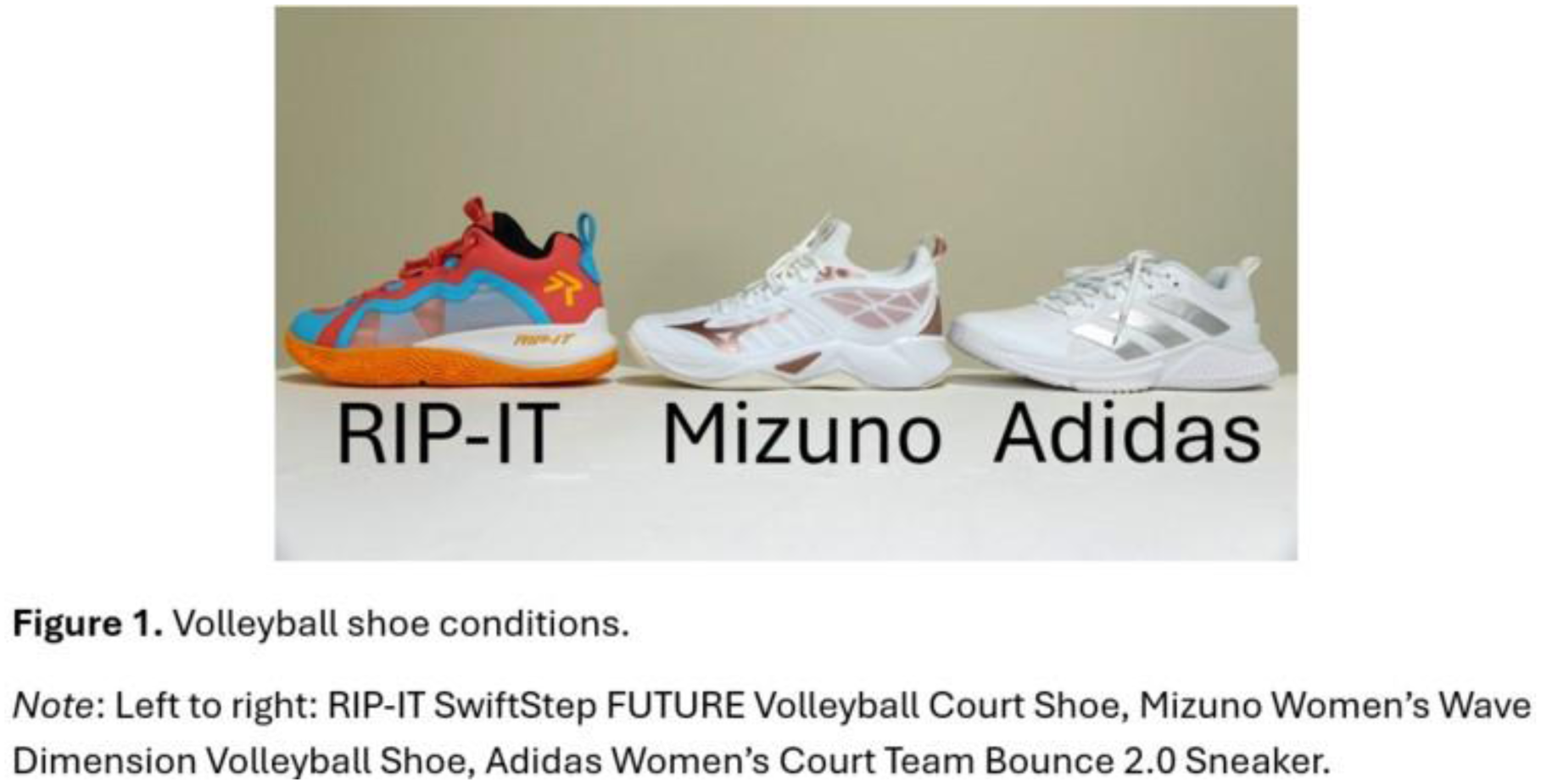
Thirteen competitive female volleyball players (15.97±1.66 years, 169.58±3.67 cm, 63.63±9.27 kg) were tested performing a CMJ in a motion capture laboratory. For each shoe condition (female-specific RIP-IT, Mizuno, Adidas; Figure 1), participants performed an identical dynamic warm-up, to ensure familiarity, and testing protocol. Kinematic and kinetic data were collected using an 8-camera markerless motion capture system and six embedded force plates, respectively. Three-dimensional joint angles for the hip, knee, and ankle were subsequently calculated and peak angles were extracted across the landing phase (initial contact to maximum knee flexion). Friedman tests with post hoc Wilcoxon paired comparisons were performed to identify differences in peak angles by shoe condition (Bonferroni-corrected alpha=0.05).
Results:
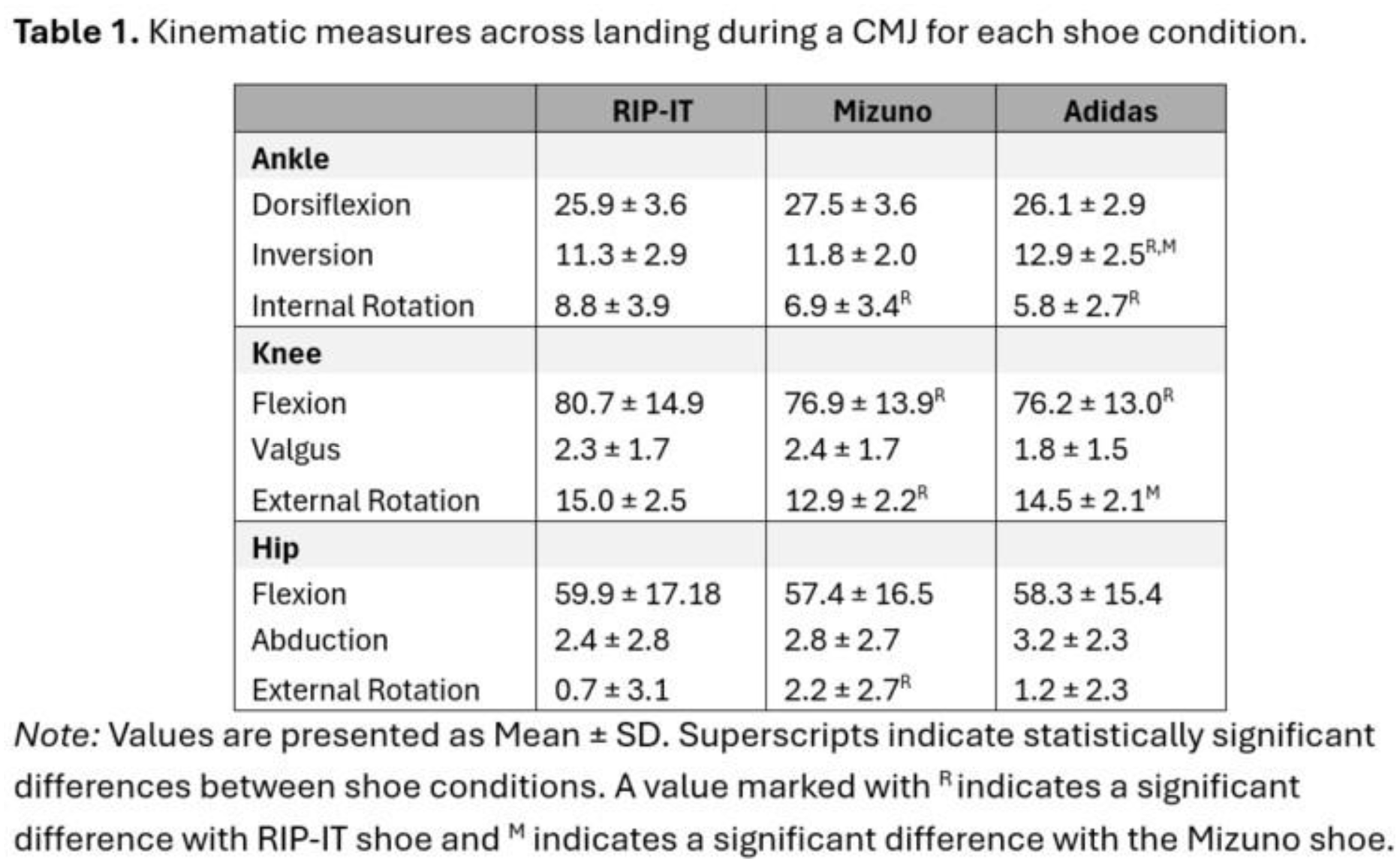
On average, RIP-IT and Mizuno elicited less ankle inversion than Adidas (p=0.009, 1.56º difference and p=0.016, 1.06º difference, respectively; Table 1). RIP-IT also elicited significantly greater ankle internal rotation compared to Mizuno (p=0.007, 2.39º difference) and Adidas (p=0.007, 3.02º difference). Greater knee flexion was observed for RIP-IT compared to Mizuno (p=0.002, 3.74º difference) and Adidas (p=0.011, 4.48º difference), as well as greater external knee rotation compared to Mizuno (p=0.013, 2.07º difference). Lastly, less external hip rotation was observed for RIP-IT compared to Mizuno (p=0.009, 1.45º difference).
Conclusion:
Biomechanical risk factors differed by shoe condition upon landing from a CMJ. The RIP-IT shoe, designed specifically for females, was associated with better shock absorption and ankle stability, eliciting the least coronal ankle motion upon landing. While stiffer landings were observed for both the Mizuno and Adidas shoes, the Adidas volleyball shoe elicited the greatest elevation of biomechanical risk factors. These findings suggest that sport-specific footwear design has a measurable impact on lower extremity biomechanics and informed shoe selection may reduce injury risk in adolescent female athletes.