Abstract
Background:
Figure skating is a demanding sport that requires athletic and artistic abilities. Injury patterns for pediatric female figure skaters (FFSs) are not well understood (References 1, 2, 3) The purpose of our study was to investigate pediatric FFS injury patterns and to compare common medical diagnoses by age.
Hypothesis:
Common medical diagnoses would differ between younger (<14 years) and older (>15 years) FFSs.
Methods:
In this descriptive epidemiological study, we conducted a retrospective chart review at a single center tertiary-level pediatric sports medicine clinic of data over 15 years. To be included, FFSs had to self-identify as figure skaters, sustain an injury (or injuries) as a result of figure skating participation, and be >9 - <19 years of age. Mechanism of injury (acute or overuse), injured body part(s), and medical diagnoses were extracted. Descriptive statistics and chi-square (x2) tests were employed to assess injury proportional differences between younger (<14 years) and older (>15 years) FFSs for specific medical diagnoses in the three most commonly injured body parts. Statistical significance was set at p<0.05, with odds ratio (OR) and 95% confidence interval (95%CI) reported.
Results:
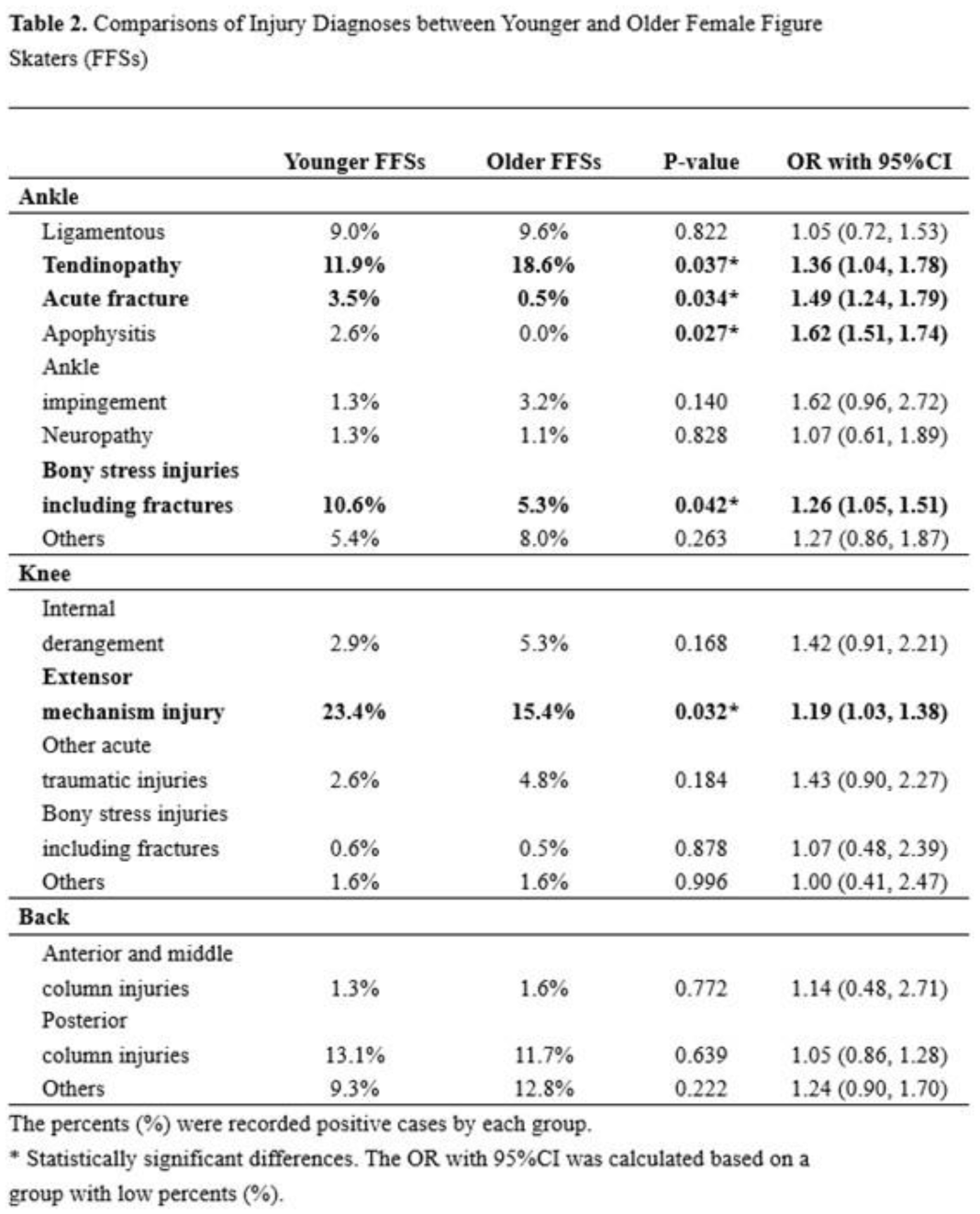
A total of 760 FFSs related injuries were found (physical characteristics, Table 1). Approximately 31.7% (N=241) of the injuries were acute, while 67.2% (N=511) were overuse. Foot/ankle (30.1%, N=229), knee (19.5%, N=148), and back (16.2%, N=123) were the top three commonly injured body parts. Comparison by medical diagnoses within the three most frequently injured body parts found that there were more acute fractures (p=0.034), apophyseal injuries (p=0.027), and bone stress injuries (p=0.042) of the foot/ankle in the younger sub-group compared to the older sub-group who sustained more soft tissue overuse injury including Achilles tendinopathy (p=0.037). For the knee, the younger cohort sustained injuries to the extensor knee mechanism and apophyses including Osgood-Schlatter (p=0.032) compared to the older FFSs (OR, 95% CI, Table 2).
Conclusion:
Injury patterns differed by age in this cohort of pediatric FFSs, with the younger sub-group more likely to sustain acute bony foot/ankle injuries than older figure skaters, whose injuries appeared to be more soft tissue overuse in nature. The underlying mechanism may be related to skeletal immaturity and physical maturation (skeletal growth still remaining in conjunction with transitioning to pre-pubescent to pubescent) of the FFSs. To reduce risk of ankle bony injuries in the younger FFSs, training volume/loads as well as figure skating boot fitting may need to be re-evaluated.