Abstract
Background:
Adolescent athletes have an elevated risk of post-concussion musculoskeletal injury, but the mechanistic underpinnings of this relationship remain unknown. The acoustic startle reflex (ASR) is a brainstem-mediated reflex that may be an indicator of concussion-related impairment. The ASR is suppressed in adolescents with a history of concussion, but it is currently unknown whether this suppression may be associated with future musculoskeletal injury risk. Our purpose was to examine differences in ASR between adolescent athletes with a concussion history who did and did not sustain a musculoskeletal injury across one year.
Hypothesis:
We hypothesized that adolescent athletes with a concussion history who sustained a lower extremity musculoskeletal injury across one year would have a suppressed ASR compared to those who did not sustain an injury.
Methods:
We conducted a pilot study on 12 adolescent athletes with a concussion history who did (age: 15.4 ± 2.8 years; 67% female, concussion history: 2.0 ± 1.3, range: 1-4) and did not (age: 15.4 ± 2.8 years; 17% female, concussion history: 1.2 ± 0.4, range: 1-2) sustain a lower extremity musculoskeletal injury across a 1-year study period. The eye blink of the ASR was recorded via electromyography of the orbicularis oculi muscle during twelve 103-decibel acoustic startle probes delivered 15-25 seconds apart. Participants completed an ASR assessment and injury history at the initial study visit and reported any new lower extremity musculoskeletal injuries at 6-month and 1-year follow ups. The variables of interest were mean ASR (µV) at the initial study visit and group (subsequent musculoskeletal injury vs. no subsequent musculoskeletal injury). We used an independent t-test to determine if there were differences in ASR between groups.
Results:
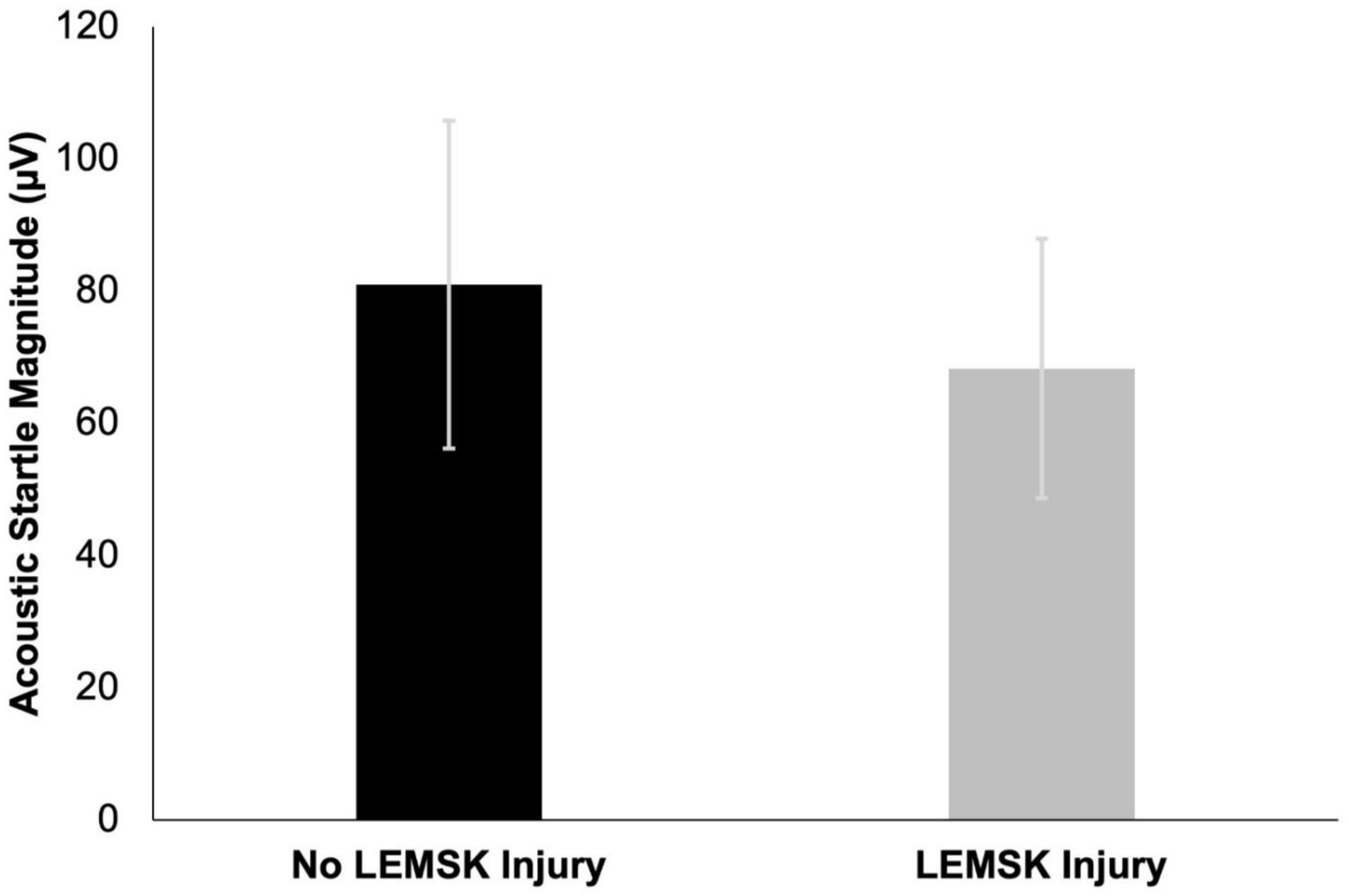
Adolescent athletes who sustained a lower extremity musculoskeletal injury (50%) within the study period had a suppressed ASR magnitude (68.3 ± 19.6 µV) compared to those who did not sustain a subsequent injury (81.0 ± 24.8 µV); however, the difference between groups was not statistically significant (t(10)=0.98, p=0.34); Figure).
Conclusion:
Adolescent athletes with a concussion history who sustained a lower extremity musculoskeletal injury across a 1-year study period had a relatively suppressed ASR compared to those who remained injury free. Though not statistically significant, this initially observed pattern of ASR suppression in a small sample of adolescent athletes with a concussion history provides further evidence that ASR may identify lingering post-concussion impairment and justification for examining ASR as a risk factor for subsequent musculoskeletal injury.