Abstract
Background:
Etiologies of knee osteochondritis dissecans (OCD) remain to be further elucidated. Past literature has suggested that specific knee morphologies may be associated with OCD of the medial femoral condyle (MFC), however parameters have not been thoroughly externally validated [1, 2, 3, 4].
Hypothesis:
We hypothesize that an increased medial femoral condyle width, narrower notch width, increased normalized tibial spine height, and increased medial tibial slope are associated with the presence of MFC OCD in pediatric/adolescent patients.
Methods:
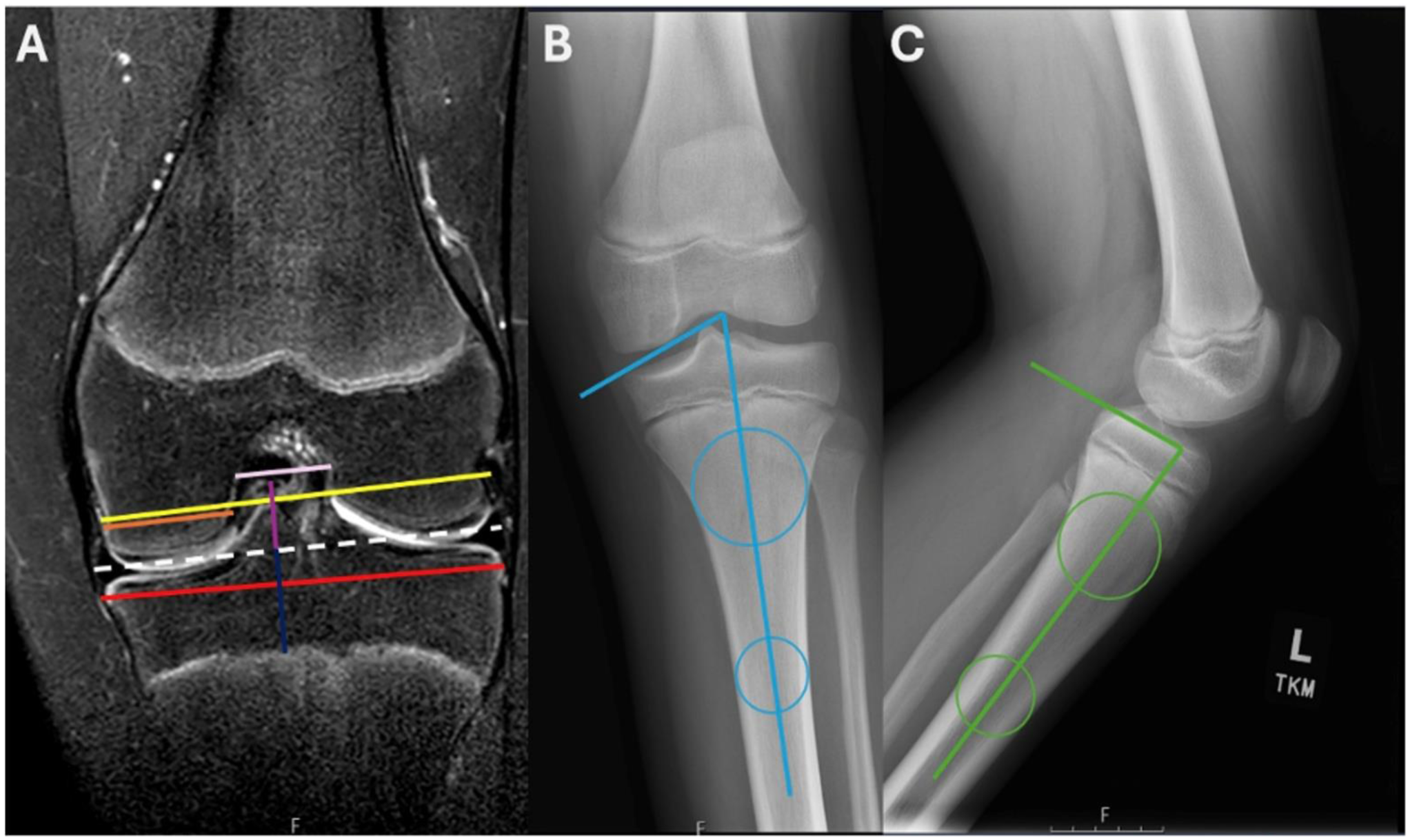
Patients under 21 years of age diagnosed with MFC OCD between 2016-2024 were age and sex-matched to control patients 1:1 who had advanced knee imaging for reasons unrelated to MFC OCD. Radiographic measurements were made by two independent observers and included MFC width (MFCW), tibial plateau width (TPW), femoral notch width (FNW), femoral bicondylar width (FCW), distance from top of tibial spine to bimeniscal axis (A), distance from top of tibial spine to proximal tibial physis (B), medial tibial slope (MTS) and posterior tibial slope (PTS). Medial condyle index (MCI = MFCW/TPW), Notch Width Index (NWI = FNW/FCW), and S ratio (S = A/B) were calculated. Measurements were compared between the two groups via regression modeling.
Results:
86 MFC OCD patients [32 females (37.2%)] were matched to 86 control patients (n=172 total). Mean age was 13.8 ± 2.8 years. MCI (0.371 ± 0.029 vs. 0.338 ± 0.023, p<0.001) was significantly larger in the OCD group, while NWI was significantly smaller (0.232 ± 0.032 vs 0.263 ± 0.031, p<0.001). No significant differences were found in A, B, S Ratio, MTS, or PTS. Multivariable logistic regression identified MCI (p<0.001), NWI (p=0.011), and MTS (p<0.001) as significant predictors of MFC OCD. Patients with an MCI > 0.354, NWI < 0.240, and an MTS > 18.9 degrees had a 18.6-, 4.7-, and 9.4-fold higher likelihood of having OCD, respectively.
Conclusion:
Wider medial femoral condyles, narrower femoral notches, and larger medial tibial slope angles were significantly associated with abnormal osseous morphology in pediatric and adolescent MFC OCD.