Abstract
Background:
Osteochondritis dissecans (OCD) lesions commonly present at the capitellum, particularly among athletes who participate in overhead sports or impact load through their upper extremity. However, bilateral elbow OCD lesions are rare and can significantly impact sport participation and elbow function. Previous studies have shown unique capitellar OCD characteristics are associated with specific sport participation – gymnasts tend to have posterior lesions with lesser lesion containment.
Hypothesis:
Tumbling athletes (gymnasts, cheerleaders, dancers) have an increased propensity for bilateral OCD lesions and would benefit from screening at the time of first presentation.
Methods:
A retrospective review was performed of a consecutive series of pediatric and adolescent patients with elbow OCD lesions who presented to a single tertiary care pediatric hospital, identified using CPT and ICD codes. Data regarding patient demographics, sports participation, lesion characteristics on radiographs and MRI, and timeline of presentation were collected for patients with bilateral lesions. Descriptive statistical analyses was performed to compare unilateral and bilateral lesions.
Results:
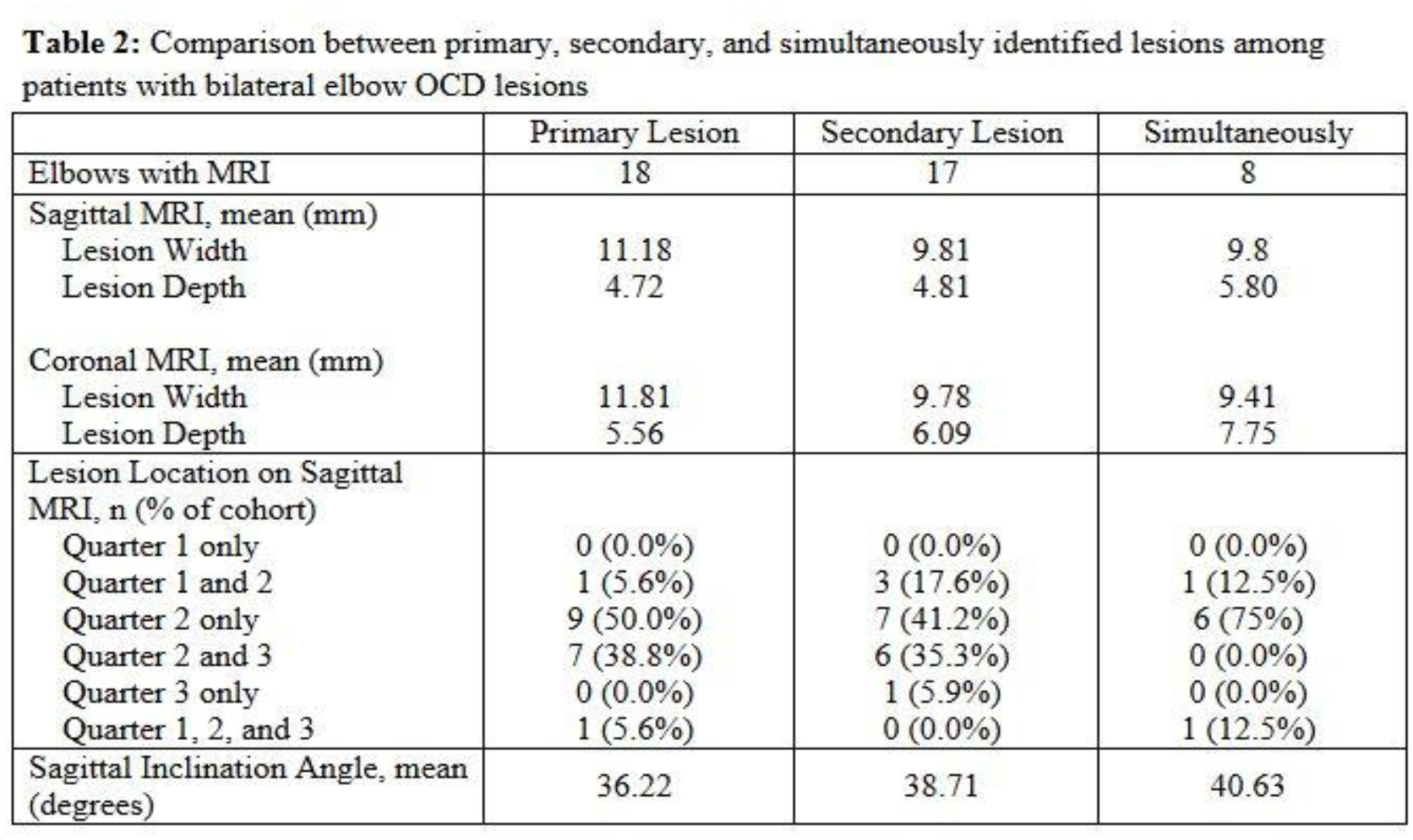
A total of 279 consecutive patients from 2009-2025 with a diagnosis of elbow OCD and a mean age of 13.4 (8.0-19.1) years were included, of which 10.3% (n=29) were determined to have bilateral lesions. Patients with bilateral lesions were younger compared to unilateral lesions (12.9 vs 13.4, p<0.001). Compared to unilateral lesions, bilateral lesions were observed at higher rates among females (79.43% vs 38.2%, p<0.001) and in tumbling athletes (72.4% vs 32.8%, p<0.001). Bilateral lesions were noted at a mean sagittal inclination angle of 38 (±14.1) degrees, indicating that these lesions tend to occur on the posterior aspect of the capitellum. Of the 29 bilateral patients, only 7 (24.1%) had bilateral lesions concomitantly identified at initial presentation while 22 (75.9%) had their bilateral lesions found sequentially. The majority (26/29, 90.0%) of the secondary lesions were identified after becoming symptomatic, whereas 3 (10.3%) secondary lesions were found incidentally.
Conclusion:
In our series, bilateral elbow OCD occurred at an incidence of 10.3%; however, the incidence was over double in tumbling athletes. Bilateral lesions were more common in young females. Due to the high level of prevalence in tumbling athletes, consideration should be given to contralateral elbow screening at initial presentation in tumbling athletes, and screening should be promptly performed at the initiation of contralateral symptoms.