Abstract
Background:
Psychological readiness after ACL reconstruction (ACLR) in young athletes has been shown to affect return to sports (RTS), knee function and patient-reported outcomes and has been shown to differ by age and sex in young patients. While the ACL Return to Sport after Injury (ACL-RSI) score is commonly used to assess psychological readiness, it is unknown whether specific ACL-RSI scores can predict functional readiness on return to sport testing after ACLR.
Hypothesis:
We hypothesized that ACL-RSI scores at 6 and/or 9 months post-ACLR may predict ≥90% limb symmetry (LS) on functional hop testing.
Methods:
Prospective data from young athletes (ages 10-30) at a single center was analyzed post-ACLR and stratified into 3 age groups (10-14, 15-18, and 19+ years). The primary functional outcome was defined as achieving ≥90%, 80-89% and <80% LS on 6/9 month hop testing. The ACL-RSI was collected at 6 and 9 months post-ACLR. Descriptive analyses were conducted by age, sex, follow-up timepoint, and limb symmetry (LS) group. Multivariable logistic regression models adjusted for age and sex evaluated associations between ACL-RSI and functional readiness, with predictive accuracy summarized using ROC curve/Area under Curve (AUC).
Results:
335 total patients were analyzed with 6 (N=189) and/or 9 (N=146) months post-ACLR hop testing and ACL-RSI data respectively.
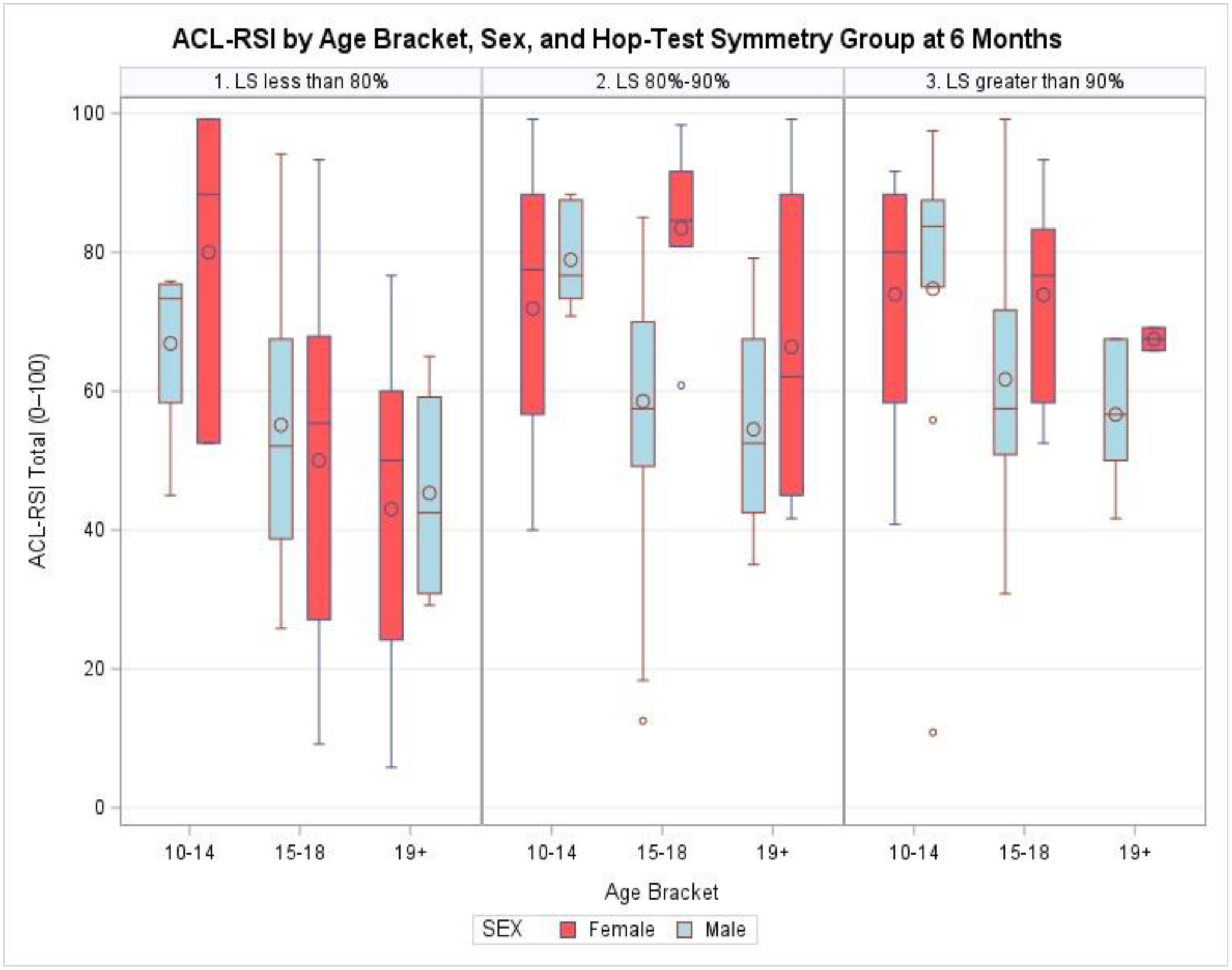
At 6 months, participants with ≥90% LS had the highest mean ACL-RSI scores, and thus greatest psychological readiness (mean 67.9). Those with <80% LS showed the lowest psychological readiness (mean 52.4). The youngest age group (10-14) had higher ACL-RSI scores compared to 15–18 and 19+, and across sexes and LS strata.
At 9 months, mean ACL-RSI scores improved but showed less discrimination across LS groups.
In the multivariable model, controlling for age/sex, higher ACL-RSI was an independent predictor of ≥90% LS at 6 months but had limited predictive ability (AUC 0.621) and was not predictive at 9 months.
The youngest age group (10-14) had nearly fourfold higher odds compared to the oldest age group (19+) to achieve ≥90% LS. Age was a stronger effect modifier than sex.
Conclusion:
ACL-RSI was mildly predictive of ≥90% LSI on functional testing at 6 months but not at 9 months post-ACLR. Age was more predictive of ≥90% on functional hop testing at 6 & 9 months compared with ACL-RSI or sex. A single ACL-RSI cut-off value and sex-based ACL-RSI cut-off values were not found to reliably predict functional readiness after ACLR.