Abstract
Background:
Fear of reinjury is commonly cited by patients with patellofemoral instability (PFI) as a barrier to returning to sports. While many metrics are used to subjectively assess a patient’s knee function after PFI surgery, psychological readiness is not well established in this population. The Anterior Cruciate Ligament Return to Sport after Injury (ACL-RSI) scale assesses confidence in knee performance, fear of reinjury, and emotional responses to returning to sport, with certain thresholds predictive of successful return to sport (RTS) after ACL reconstruction. The ACL-RSI may be similarly beneficial for understanding psychological readiness in those with PFI. The purpose of this study was to evaluate factors associated with successful RTS after PFI surgery and determine the predictive value of the ACL-RSI in this successful outcome.
Hypothesis:
Higher ACL-RSI scores in PFI patients are associated with an increased likelihood of RTS after patellar stabilizing surgery.
Methods:
A retrospective review of adolescent patients (10-19 years-old) treated surgically for PFI (medial patellofemoral ligament reconstruction surgery [MPFLR] with or without tibial tubercle osteotomy [TTO]) at a single institution from 1/2020-10/2024. Patients actively participating in sports at their first orthopedic visit who completed the ACL-RSI during postoperative rehabilitation were included. Patient demographics, injury characteristics, surgical procedure ACL-RSI scores, and RTS status were recorded. Descriptive statistics and bivariate analysis were performed. Using the Euclidean distance, the optimal ACL-RSI cutoff score for predicting successful RTS was determined, and diagnostic accuracy was evaluated with a receiver operating curve.
Results:
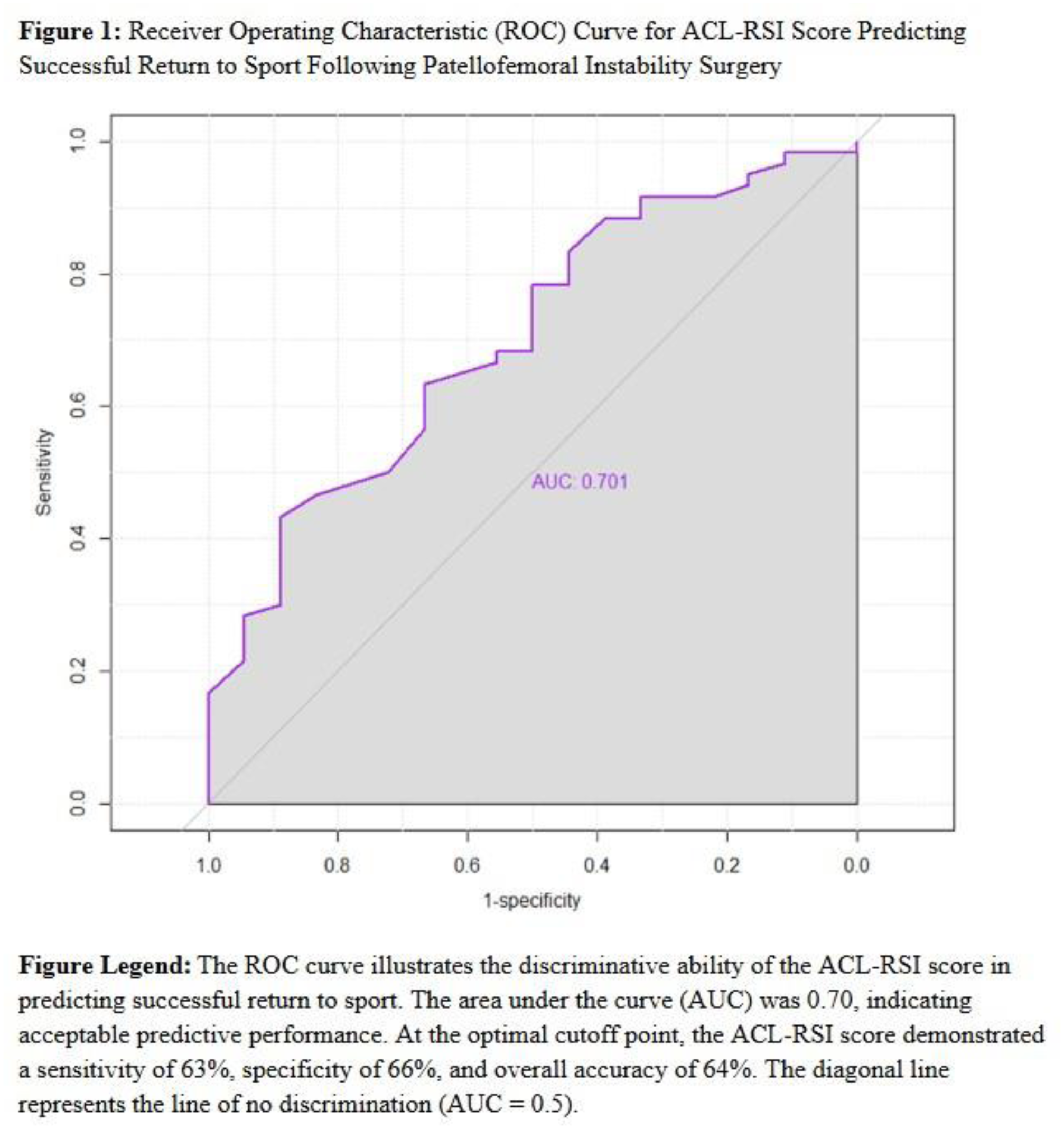
Study criteria identified 97 patients (55% female, median (IQR) age 15.6 (14.2-16.5) years with 70 undergoing isolated MPFLR and 27 undergoing MPFLR with TTO. Successful RTS was achieved in 77.3% (n=75) patients. RTS was associated with higher ACL-RSI scores (p=0.029) and undergoing isolated MPFLR (p < 0.01) (Table 1). An ACL-RSI score of ≥59.2 was identified as indicative of successful return to sport (AUC = 0.70, 95% CI = 0.56-0.83, Figure 1). Patients with ACL-RSI scores ≥59.2 had 3.1 times higher odds of returning to sports compared to patients with scores < 59.2 (p=0.035), while patients who underwent isolated MPFLR had 3.5 times higher odds of returning to sports compared to those who underwent MPFLR+TTO (p=0.016).
Conclusion:
Isolated MPFLR and ACL-RSI scores ≥59.2 are associated with an increased likelihood of successful RTS after surgical treatment for PFI in adolescents. Patient demographics features and the studied injury characteristics do not appear to influence the ability to successfully RTS.