Abstract
Background:
Anterior cruciate ligament reconstruction (ACLR) in skeletally immature patients presents a clinical dilemma concerning transphyseal versus physeal-sparing reconstruction. While evidence supports transphyseal ACLR, long-term (≥10 years) outcomes are underreported. This Level IV investigation aimed to systematically review the literature to better understand long-term outcomes and complications following transphyseal ACLR in skeletally immature patients.
Objectives:
The existing literature suggests transphyseal ACLR in skeletally immature patients yields high rates of successful return to sport, acceptable long-term knee stability, and moderate graft failure rates over follow-up of ≥10 years.
Methods:
A search of the PubMed, Embase, Cochrane, and Scopus databases was conducted from inception to April 2025 to identify studies reporting outcomes ≥10 years following transphyseal ACLR in skeletally immature patients. Studies written in English that reported on patients with a minimum follow-up of 10 years, reporting injury etiology, postoperative outcomes including return to sport (RTS), complications, and reoperations, were included.
Results:
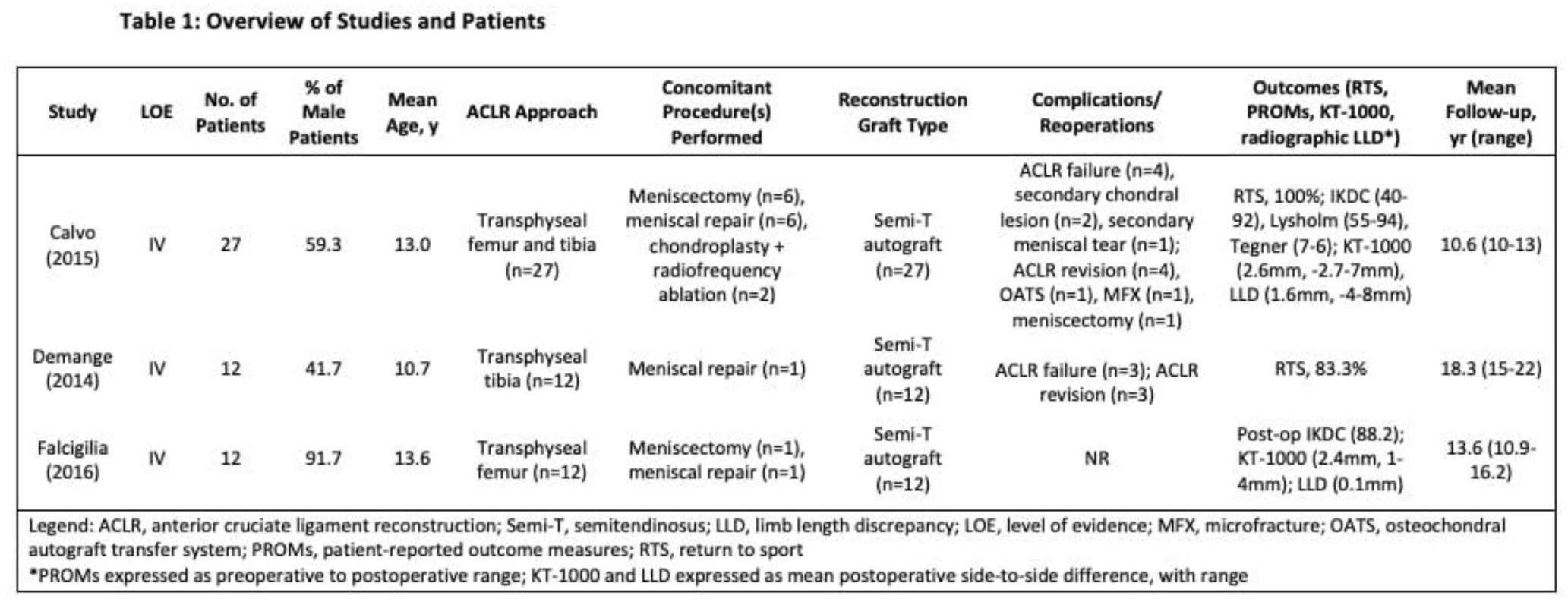
A total of three studies, consisting of 51 skeletally immature patients undergoing transphyseal ACLR with a weighted mean follow-up of 13.1 years (range, 10–22 years), were identified. The weighted mean patient age was 12.6 years (range, 8–16 years), with 63% being male. Transphyseal drilling of both the femur and tibia was performed in 52.9% (n=27/51) of cases, with isolated femur or tibia drilling in 23.5% (n=12/51) each. Hamstring tendon autograft was used in 100% (n=51/51) of procedures. Meniscal repair and meniscectomy were performed in 15.7% (n=8/51) and 13.7% (n=7/51) of patients, respectively. Graft failure occurred in 17.9% of patients (n=7/39), all of whom underwent revision ACLR. Successful return to sport (RTS) was reported in 94.9% (n=37/39) of patients, with 88.9% (n=24/27) returning to an equal or higher level of performance. The weighted mean International Knee Documentation Committee score improved from 40 (range, 17–61) to 90.8 (range, 44–100). At final follow-up, the weighted mean postoperative KT-1000 anteroposterior side-to-side difference was 2.51mm (range, -2.7 to 7mm). The weighted mean radiographic limb length difference (LLD) revealed a 1.1mm (range, -4 to 8mm) lengthened operative limb overall, and a 0.53mm (range, -3 to 4mm) lengthened operative limb in Tanner II/III patients at the time of ACLR. No angular deformities were observed.
Conclusion:
In skeletally immature patients undergoing transphyseal ACLR with a minimum 10-year follow-up, hamstring tendon autograft was reported in all cases, while graft failure was reported in 17.9% of patients. Successful RTS was reported in 94.9% of patients. Mean radiographic LLD revealed a 1.1mm lengthened operative limb.