




Abstract

In recent years, awareness has grown around the challenges faced by women in the workplace. While the focus has often been on breaking the glass ceiling and ensuring equal opportunities, there is a darker, often unspoken reality that many working women in India confront: Sexual violence. This article examines the impact of workplace sexual violence on women’s mental health, analyzes systemic issues that exacerbate these risks, and offers recommendations for creating safer work environments. By reviewing recent incidents, we also highlight the profound psychological toll that these experiences take on survivors.
The Psychological Impact of Workplace Sexual Violence
The mental health implications of sexual violence in the workplace are deep and long-lasting. Women who experience such violence frequently suffer from various psychological issues, including anxiety, depression, posttraumatic stress disorder (PTSD), and a diminished sense of self-worth. The trauma extends beyond the assault itself and is often exacerbated by the reactions of colleagues, management, and even the legal system. Many survivors report feeling isolated, guilty, and helpless, which can severely impact both their professional and personal lives (Duwaji, 2024; The Guardian, 2024).
Emerging research in the Indian context provides empirical support for these psychological consequences. Islam et al. (2025) found that over 92% of female health care workers experienced sexual harassment, yet most refrained from reporting it due to fear and institutional inaction. Singh et al. (2023) observed similar patterns in North India, where 75% of health care workers reported workplace violence, often accompanied by psychological distress. Kumar (2019) documented how psychological abuse affects the self-worth and retention of early-career women professionals. In clinical and emergency settings, Kumar et al. (2025) and Grundmann et al. (2017) described underreporting, emotional exhaustion, and disrupted sleep as common outcomes. Das et al. (2025) highlighted the failure of Indian public health institutions to enforce redressal laws and called for structural reform. Outside of health care, Subaveerapandiyan et al. (2024) noted a high prevalence of harassment among female library professionals, with limited support from their institutions. Kumari et al. (2022) emphasized that legal mechanisms are insufficient without broader institutional and cultural change. These findings align with international evidence and highlight a need for systemic action.
A particularly harrowing example is the case of a 31-year-old trainee doctor at R.G. Kar Medical College in Kolkata, who was brutally raped and murdered during a night shift. The incident not only sparked outrage and protests but also brought attention to the mental anguish experienced by women in the health care sector. Medical professionals, who often work long hours under stressful conditions, are particularly vulnerable to such attacks, leading to a pervasive sense of fear and insecurity among female doctors and nurses (Jha, 2024).
This fear is further heightened by inadequate security measures in many workplaces. For instance, the nurse who was raped and murdered in Uttarakhand earlier in 2024 faced similar vulnerabilities. Her family has since spoken out about the psychological trauma she endured before the attack, highlighting the immense mental burden women carry as they navigate unsafe work environments. Studies from Iceland and other countries confirm the psychological toll of workplace sexual violence, with victims often experiencing anxiety, depression, PTSD, and other mental health challenges (Jónsdóttir et al., 2024; McClain et al., 2021; Naveed et al., 2022). These findings underscore the universal nature of these impacts and the need for robust interventions.
Recent data from the National Crime Records Bureau (NCRB) provide a statistical foundation for understanding the scale of workplace sexual violence in India. In 2022, the NCRB recorded 458 cases under Section 354 A of the Indian Penal Code, which pertains specifically to sexual harassment at the workplace (National Crime Records Bureau, 2022). However, legal experts and gender rights advocates caution that this figure does not reflect the true prevalence. Many cases go unreported due to fear of stigma, workplace retaliation, and the lack of faith in complaint mechanisms. Furthermore, conviction rates remain low, pointing to systemic gaps in the legal and institutional frameworks meant to protect women at work. The gap between reported and actual cases highlights the urgent need to address both underreporting and delays in justice delivery. These national statistics reinforce the lived experiences documented in qualitative studies and support the need for structural reform.
Table 1 presents these NCRB data, while Table 2 provides recommendations for creating safe work environments across various professional sectors.
Reported and Resolved Cases of Sexual Harassment at the Workplace in India (Varghese, 2024)
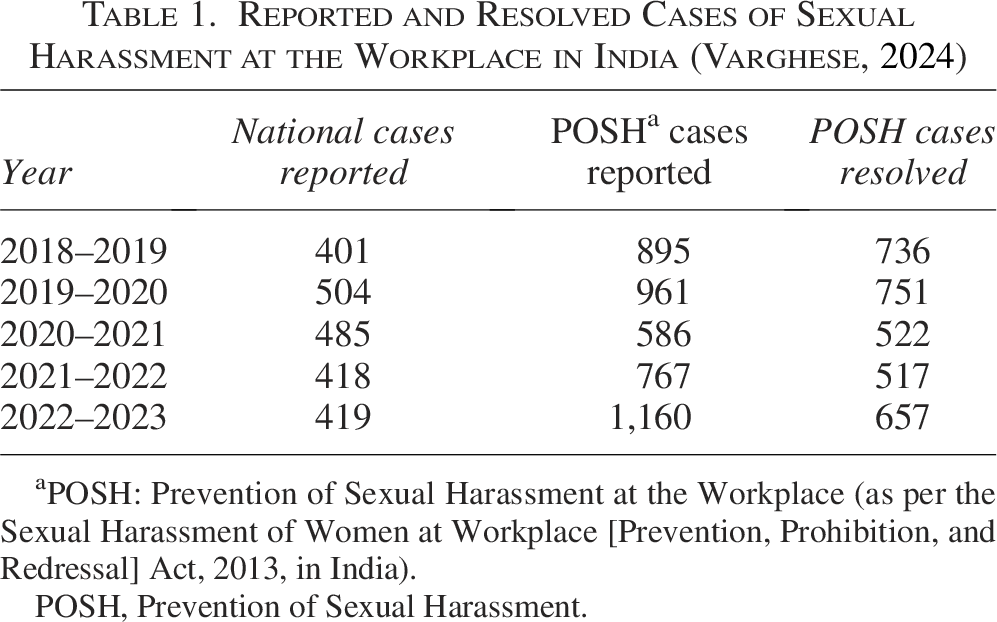
aPOSH: Prevention of Sexual Harassment at the Workplace (as per the Sexual Harassment of Women at Workplace [Prevention, Prohibition, and Redressal] Act, 2013, in India).
POSH, Prevention of Sexual Harassment.
Recommendations for Creating Safe Work Environments in Various Sectors
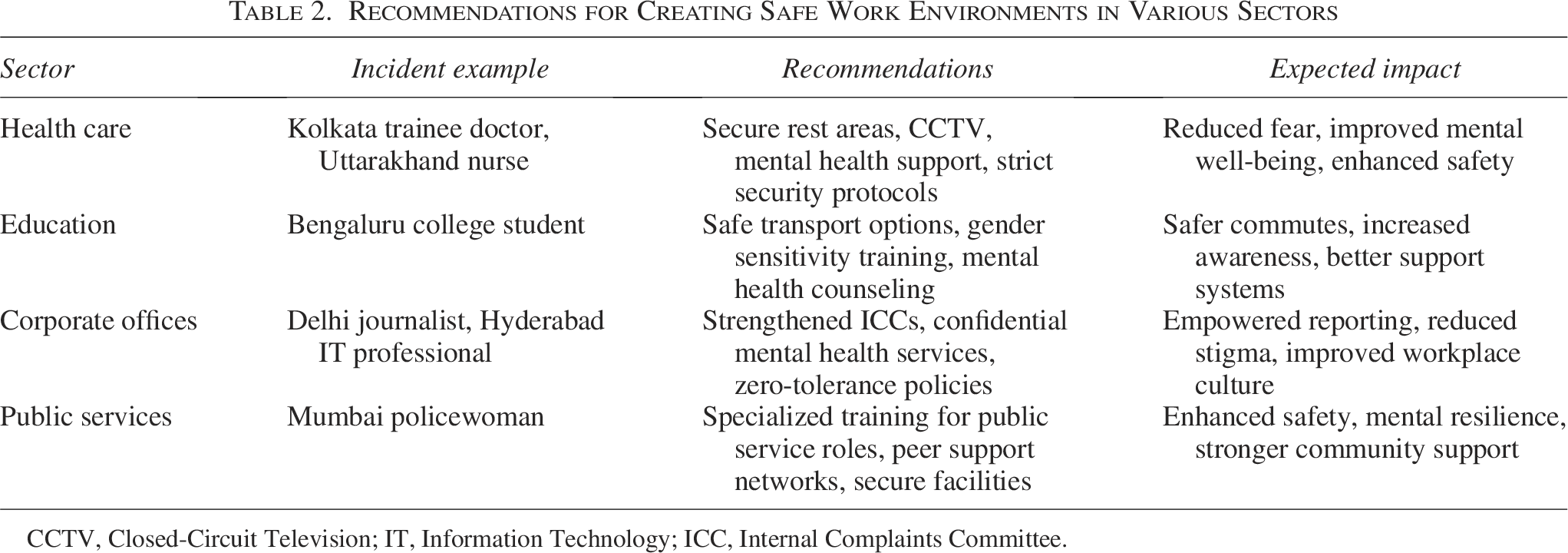
CCTV, Closed-Circuit Television; IT, Information Technology; ICC, Internal Complaints Committee.
Systemic Failures and Cultural Apathy
The mental health impacts of workplace sexual violence are often overlooked due to systemic failures and cultural apathy. Despite the presence of laws such as the Sexual Harassment of Women at Workplace (Prevention, Prohibition, and Redressal) Act, 2013, enforcement remains weak. Internal Complaints Committees (ICCs), established to handle cases of sexual harassment, are often ineffective due to bias, the lack of training, and a fear of retaliation (The Economic Times, 2023).
Moreover, cultural attitudes toward women who report sexual violence further exacerbate their psychological distress. Victims are frequently blamed or shamed, leading to toxic work environments where silence is preferred over speaking out. This culture of silence perpetuates the cycle of abuse and leaves many women feeling trapped and unsupported (Duwaji, 2024; The Guardian, 2024).
In many cases, fear of career repercussions compounds the trauma. Women who report harassment or assault often face backlash from colleagues and superiors, ranging from subtle ostracism to outright dismissal. This fear forces many women to suffer in silence, further entrenching the psychological damage caused by the initial violence (Jha, 2024). Studies emphasize the importance of creating a cultural shift and stronger institutional support to address systemic failures (Lee & Oh, 2021). Effective strategies include gender-sensitive training, impartial oversight of complaints mechanisms, and fostering a workplace culture that prioritizes safety and respect.
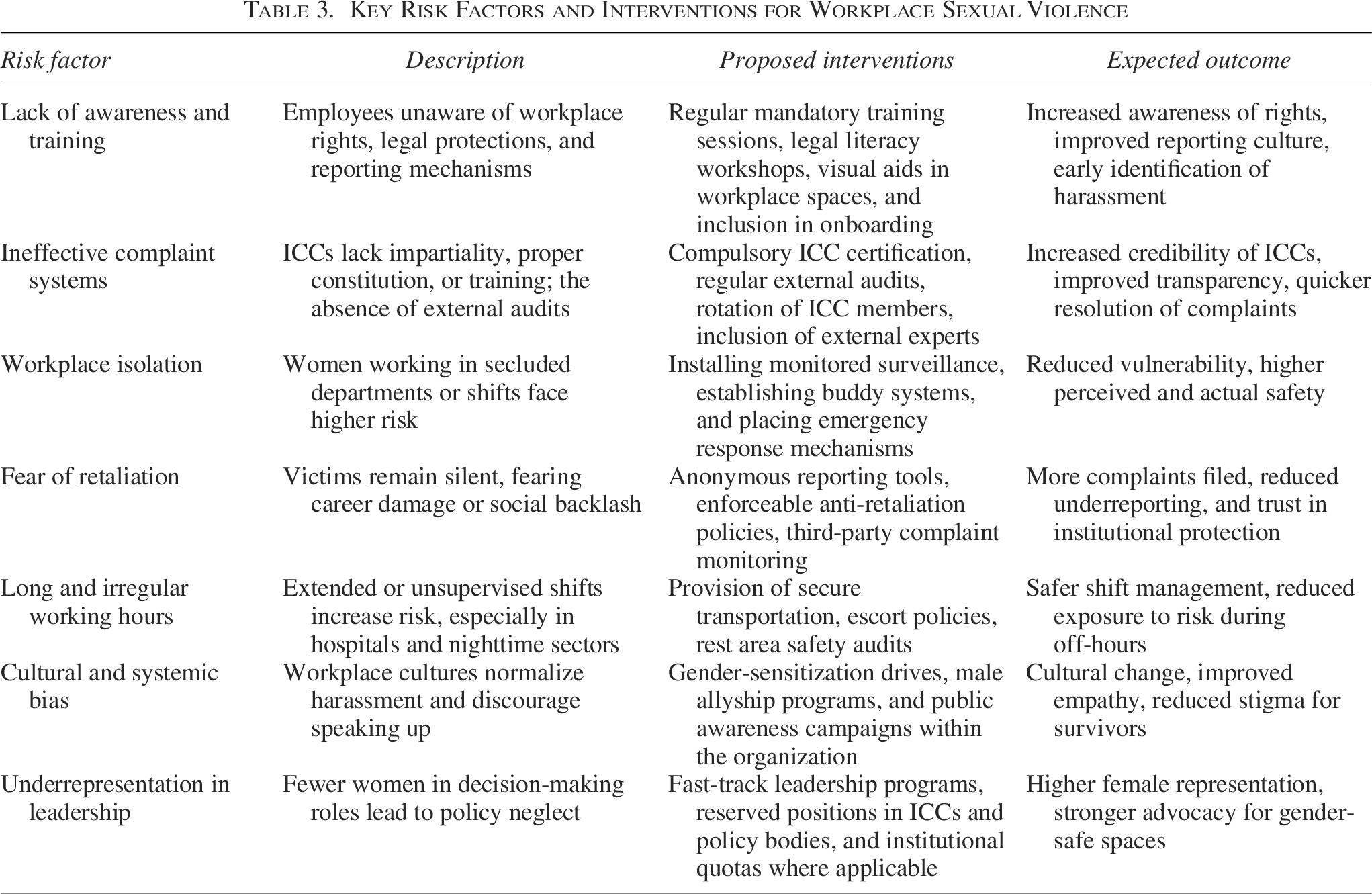
Table 3 outlines the key risk factors associated with workplace sexual violence and corresponding interventions that can mitigate these risks and improve workplace safety.
Key Risk Factors and Interventions for Workplace Sexual Violence
The Need for Comprehensive Support Systems
Addressing the mental health impacts of workplace sexual violence requires the development of comprehensive support systems that both prevent such incidents and provide robust assistance for survivors. A safer and more respectful work environment must be prioritized, and victims must be empowered to access support without fear of stigma or retaliation.
Mental health support services: Employers must ensure access to psychological counseling and mental health services for employees who experience sexual violence. These services should be confidential, easily accessible, and free of charge. Counseling can be vital in helping survivors cope with trauma, rebuild their confidence, and continue their careers without the burden of unresolved emotional pain (The Economic Times, 2018). Studies have demonstrated the value of integrating mental health services into workplace support systems, as seen in sectors with high prevalence of harassment (Dehghan and Mangolian Shahrbabaki, 2023; Worke et al., 2021). Training and awareness programs: Regular training on gender sensitivity, workplace safety, and mental health awareness is essential. These programs should educate employees about trauma signs, the importance of support, and available resources. By fostering a culture of understanding and empathy, workplaces can become safer and more supportive environments for all employees (The Economic Times, 2022). Insights from studies such as Nielsen et al. (2024) highlight the role of tailored training programs in addressing systemic underreporting and fostering supportive environments. Strengthening ICCs and legal frameworks: The effectiveness of ICCs must be bolstered through regular audits, mandatory training, and external oversight to ensure impartiality. Furthermore, legal frameworks protecting women should be regularly updated to reflect evolving workplace dynamics and close gaps that allow perpetrators to evade justice (Hersch, 2015; International Labour Organization, 2020). Evidence from global best practices suggests that transparent and well-regulated ICCs can significantly improve trust and reporting rates. Creating safe work environments: Workplaces must be designed with safety as a priority. This includes installing CCTV cameras, securing restrooms and break areas, and providing safe transportation for employees working late shifts. These measures are particularly critical in sectors such as health care, where long, irregular hours often make women more vulnerable (Jaffer, 2022; Shaw et al., 2018). Redesigning workplace infrastructure, as discussed in Shaw et al. (2018), is a crucial step in reducing vulnerability and fostering employee confidence.
Conclusion
This study has highlighted the serious psychological consequences of workplace sexual violence, particularly among Indian women in professional settings such as health care, education, public service, and corporate sectors. The empirical patterns observed in studies by Islam et al. (2025), Singh et al. (2023), and others align with national data from the NCRB, confirming widespread underreporting and systemic inefficiencies. By integrating these findings with lived experiences and institutional responses, the article underscores that psychological trauma is compounded by weak redressal mechanisms, workplace isolation, and cultural apathy.
The recommendations presented in this article, including improved mental health services, robust legal mechanisms, and gender-sensitive training, are grounded in both academic literature and real-world evidence. These interventions are designed to address key institutional gaps that leave women vulnerable in the workplace.
However, this article has some limitations. It relies primarily on secondary sources and lacks primary field-based data, which may limit the scope of generalization. Moreover, the analysis treats women as a homogenous category and does not explore the impact of intersecting identities such as caste, class, and disability on experiences of workplace violence.
Future research should apply intersectional frameworks to understand how multiple forms of disadvantage influence vulnerability to workplace harassment. In addition, longitudinal studies and sector-specific evaluations are required to assess the effectiveness of current policies and institutional reforms. Expanding the empirical base in these areas will deepen our understanding of workplace violence and guide the development of inclusive and responsive strategies for ensuring safety and dignity for all women in professional spaces.
Footnotes
Data Availability
No datasets were generated or analyzed during the current study.
Ethical Approval
Ethical approval is not applicable for this article.
Author Disclosure Statement
The author declares that there are no financial or personal interests to disclose.
Funding Information
No funding was received for this article.