




Abstract
Innovative therapeutics are transforming care of children with previously untreatable neurological disorders. However, there are challenges in the use of new therapies: the medicine may not be effective in all patients, administration may not be tolerated, and matching therapy choice to patient is complex. Finally, costs are high, which imposes financial burdens on insurance companies, families, and the health-care system. Our objective was to address challenges for clinical implementation of the new therapeutics. We sought to develop a process that would be personalized for patient and disease, encourage appropriate use of a therapeutic agent while mitigating pressure on a clinician to prescribe the therapy in all instances, and assist third-party payers in approving therapeutic use based on safety and efficacy. We report our creation of a Neurology Therapeutics Committee for pediatric patients. We review the committee’s mechanisms, describe its use and report outcomes, and suggest the Neurology Therapeutics Committee’s broader applicability.
There has been a rapid development and approval of new medicines for neurological disease indications in children. This includes multiple Food and Drug Administration approvals just in the past 2 years, including new therapeutics for spinal muscular atrophy type 1 (nusinersen), 1 for ceroid lipofuscinosis type 2 (cerliponase alfa), 2 and for Duchenne muscular dystrophy (deflazacort, eteplirsen). 3,4 Other therapies including gene therapy for spinal muscular atrophy and hematopoietic stem cell gene therapy for X-linked adrenoleukodystrophy (ALD) are in clinical trials and will likely be approved soon. 5,6 In addition, rapid advances in stem cell therapies and gene therapies may herald a new age for many previously untreatable neurological conditions of childhood. 7
The conditions targeted by these novel therapeutics have significant morbidities and high mortality. Spinal muscular atrophy is a devastating disease, leading to profound disability and often death within a few years: More than 95% of patients with spinal muscular atrophy type 1 die before their second birthday. 8 Children with Duchenne muscular dystrophy face a chronic regression in motor abilities with loss of cardiac ability and early death. 9 ALD causes demyelination of the brain, developmental regression, and death. 10
However, there are challenges to use of these and other transformative new therapeutics. The drug may not halt progression or reverse symptoms in a patient in whom disease progression is too extreme, administration may not be tolerated, and matching choice of therapy to the patient is complex. Costs of the medicines are often high, third-party payers may not be familiar with the medicine, and patients who might benefit from therapy may be denied coverage.
Our objective was to develop a strategy to address the challenges in deploying these new therapeutics. We sought to develop a process to appropriately match a specific therapeutic intervention to a particular patient, encourage appropriate use of a therapeutic for the clinician while moderating the pressures placed on that clinician to reflexively prescribe therapy, and assist third-party payers in the process of approving coverage for individual patients based on safety, efficacy, and appropriate use. We describe below our design of a strategy, based on the use of a committee for evaluation and recommendations of novel neurological therapeutics in pediatric patients.
Methods
Study Site and Population
Children reported in this study were cared for by physicians of the University of Utah, at either a University of Utah clinic or Primary Children’s Hospital, in calendar years 2017 to 2018. Study approvals for reporting our results were obtained from the institutional review board of University of Utah and the Intermountain Healthcare Privacy Board.
Results
In 2017, the Division of Pediatric Neurology in the Department of Pediatrics formed the Neurology Therapeutics Committee. The purpose of the Neurology Therapeutics Committee was to provide objective clinical recommendations to patients and families, care providers, and third-party payers, as to the potential risks and benefits of newly approved medications for a specific pediatric patient.
The Neurology Therapeutics Committee is composed of 6 members: 2 pediatric neurologists, one of whom acts as the chair of the Neurology Therapeutics Committee, the chair of the Hospital Ethics Committee, the chief of Pediatric Pulmonology, an adult neuromuscular specialist, and a physical medicine and rehabilitation physician. A nonphysician clinical staff member attends all meetings to provide continuity of follow-up and to assist with information collection. Recommendations of the committee are based on an evaluation of the patient’s clinical status, the diagnosis, the patient’s individual disease course, consideration of the expected natural history of the disease, risks to patient of the medicine, and likelihood of benefit.
A Neurology Therapeutics Committee consultation includes a presentation of the patient by the treating physician and of the proposed medicine. Following discussion of the risks and benefits for each case, the committee makes a recommendation whether or not to proceed with treatment. The chair of the Neurology Therapeutics Committee prepares a letter summarizing the Neurology Therapeutics Committee recommendation (Figure 1). The letter is sent to the treating physician and the patient’s family and is included in the request for preauthorization to insurance.
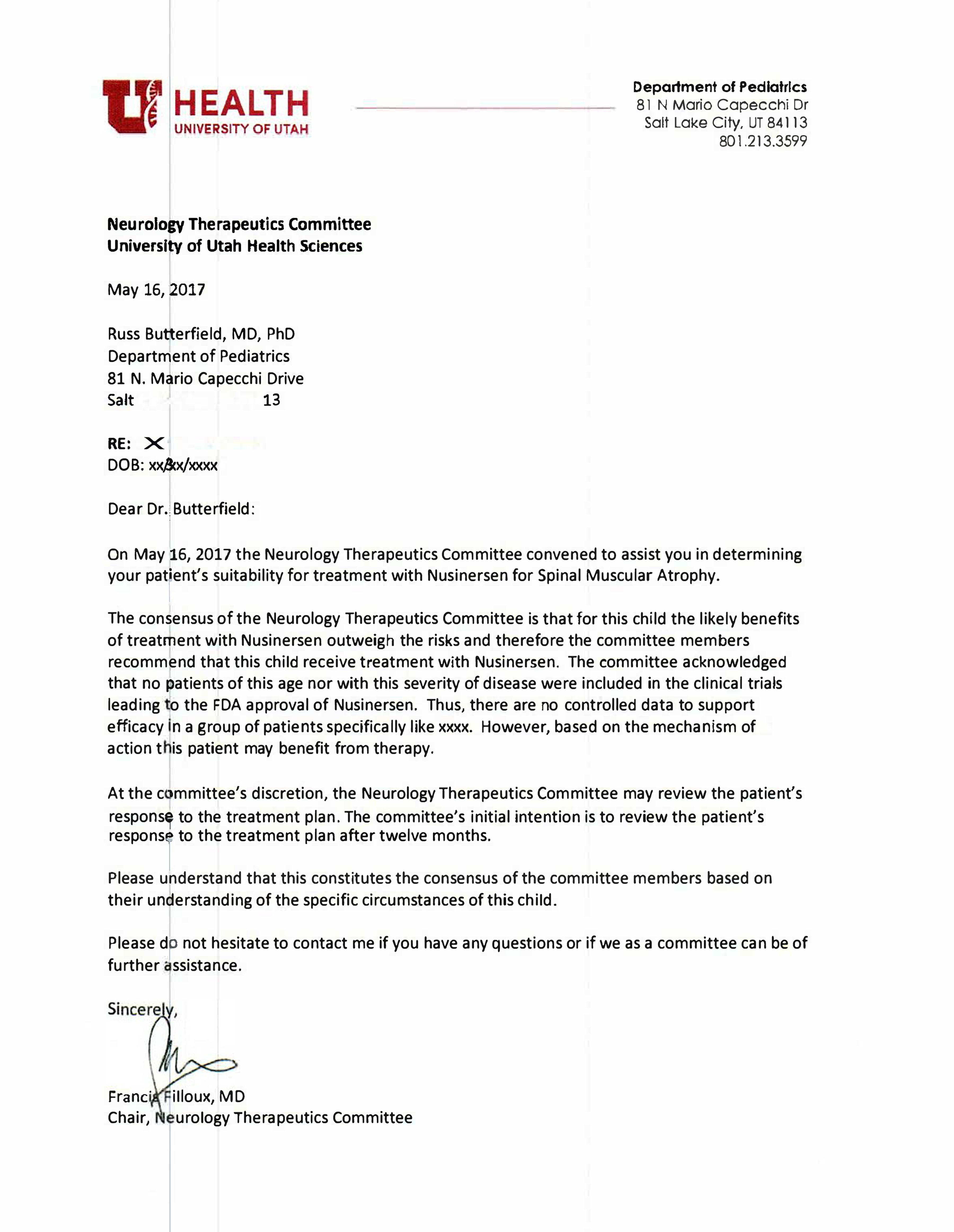
Letter of findings from the Utah Neurology Therapeutics Committee.
Since the first meeting in February 2017, the Neurology Therapeutics Committee has met 23 times. Fifty-seven patients’ cases have been discussed (some more than once), including patients with spinal muscular atrophy, Duchenne muscular dystrophy, pediatric autoimmune neurological syndrome, and G protein subunit α O1 encephalopathy (Table 1). The Neurology Therapeutics Committee recommended the therapy in 56 patients; for 54 of those patients, the corresponding insurance company subsequently approved treatment as recommended.
Patient Evaluations and Results of the Neurology Therapeutics Committee.a

Abbreviations: NTC, Neurology Therapeutics Committee; PANS, Pediatric Autoimmune Neurological Syndrome.
aCharacteristics of the patients evaluated by the NTC. Total of 67 case presentations.
Discussion
To our knowledge, this is the first development of a guidance committee for pediatric neurology therapeutics, designed to address the concerns of families, facilitate peer review by treating physicians, and assist payers unfamiliar with the complex nuanced decisions about drug approval. Our strategy has since been adopted by one other group at our institution (Pediatric Pulmonology), for evaluation of treatments for cystic fibrosis, in which new costly medicines also require specialized considerations. 11
With the maturation of the Neurology Therapeutics Committee, we have developed and implemented several additional innovations. First, in addition to the overall summary recommendation of the Neurology Therapeutics Committee, we will also provide 4 subcategories of scoring to provide more granular insight. These 4 subcategories are: Is the therapy safe? Is the therapy likely to provide meaningful clinical improvement? Is use of the therapy for the indication supported by professional society guidelines or medical literature? and Are there recommendations for follow-up to reevaluate the recommendation of the Neurology Therapeutics Committee? Second, we are in communication with the different regional insurance companies, to explain the Neurology Therapeutics Committee process and the advantages of its review and recommendation. Third, we are developing strategies to track patient responses and arrange Neurology Therapeutics Committee follow-up. To facilitate follow-up assessment of safety and efficacy, clinical assessments will be collected on a scheduled basis to assess for disease progression or improvement and for any significant side effects. Improvement or lack of progression is compared to the natural history of the disease for that specific patient. This is designed to ensure that patients are responding to treatment, to provide follow-up to insurance companies, and to track patients if different therapies become indicated. For example, a patient might be switched from an antisense oligonucleotide therapy to a gene therapy.
Insurance companies and other third-party payers have concerns related to the novel therapeutics. First, the new medicines often employ molecular strategies that are not familiar, and the complexities of administration and follow-up can be difficult to understand. Second, the high cost of many medicines raises important ethical and practical questions. The resources to treat a child with one of these novel medicines need to be balanced with resources allocated to more basic health-care needs such as immunizations and preventative health visits that have impact across large numbers of children.
Issues surrounding the high cost of novel therapeutics for pediatric patients make up a rapidly evolving landscape. Even prior to the approval of the newest high-cost medicines, a small group of medicines accounted for the majority of pediatric medicine expenditures. 12 Recognition of the ethical challenges has prompted institutional and professional society discussions about use and prescribing practices. 13 –15
Our efforts highlight an innovative approach for decision-making with the advent of novel, complex, and highly expensive therapeutics in pediatric neurology. This Neurology Therapeutics Committee approach helps formalize and objectify a process for stewardship governing novel therapeutic use. Although at this time the Neurology Therapeutics Committee has been in particular useful for convincing third-party payers of necessity for a therapeutic, we do anticipate that the Neurology Therapeutics Committee will have an increasing role for helping providers in situations where a family is convinced of a need for a therapeutic, but data and/or clinical judgment argues against its use. We think it is likely that as more different novel therapeutic choices become available and that as decisions become more nuanced about whether a therapeutic will provide benefit, the Neurology Therapeutics Committee approval rates will decrease. This will lead to situations where the Neurology Therapeutics Committee does not give approval. The family may appeal the decision (a situation we observed in a few cases), either to the Neurology Therapeutics Committee and/or directly to the insurance company. Potentially a Neurology Therapeutics Committee denial could worsen the likelihood that an insurance company then subsequently approves coverage for a patient, but essentially this is not significantly different than the current process with insurance companies.
The Neurology Therapeutics Committee does require an investment of time and effort by the clinicians and their supporting institution, which is not currently reimbursed. Further, it does not solve other ethical and financial issues associated with these therapeutics. Third-party payers and government regulators will need to develop infrastructure and guidelines to address these problems.
Footnotes
Authors’ Note
E.B.C. and R.J.B. are co-first authors.
Acknowledgments
The authors thank the members of the Neurology Therapeutics Committee for assistance with the program, and are grateful to advice from Angelo Giardino, Department of Pediatrics, and Katy Welkie and Dustin Lipson of Primary Children’s Hospital.
Author Contributions
JLB, RJB, EBC, and FMF conceptualized and designed the study. RJB and FMF contributed to acquisition, analysis, and interpretation. RJB agrees to be accountable for all aspects of work ensuring integrity and accuracy. All authors critically revised manuscript and gave final approval. All authors drafted the initial manuscript, coordinated and collected data, and reviewed and revised the manuscript.
Declaration of Conflicting Interests
The authors declared no potential conflicts of interest with respect to the research, authorship, and/or publication of this article.
Funding
The authors disclosed receipt of the following financial support for the research, authorship, and/or publication of this article: Dr Bonkowsky is supported by NIH grant 3UL1TR002538-01S1, has served on scientific advisory boards to Bluebird Bio and Calico, is on the Board of Directors of wfluidx, owns stock in Orchard Therapeutics, and has royalties from BioFire. Dr Butterfield is supported by NIH grant 5K08NS097631-03, receives funding via contracts for clinical trials from PTC Therapeutics, Sarepta Therapeutics, Pfizer, and Biogen, and serves on scientific advisory boards for Sarepta Therapeutics and Biogen.
Ethical Approval
Study approvals for reporting our results were obtained from the institutional review board of University of Utah and the Intermountain Healthcare Privacy Board.