



Abstract
The present interpretive research contributes to the increasing niche of studies that acknowledge spirituality and religion in organizations. The current study examines communication in the workplace as it is mediated by the organizational context. In particular, we explore how a faith-based organization navigated the seemingly incompatible ideologies of faith and business. First, we identify the ideological commitments and values that coexist for organizational members. Second, we argue that bridge discourse facilitated the coexistence of disparate ideological commitments and values. Specifically, we describe how three dominant discourses, (a) a spiritual-business discourse, (b) a theological-science discourse, and (c) a discourse of excellence, navigated ideological differences in a nonprofit, faith-based organization. The findings in this article have implications for future studies ranging from the pragmatic to the critical.
The contemporary western workplace is experiencing a growing fascination with spirituality. Practitioners recognize it as a “spiritual renaissance” (Gockel, 2004, p. 156), and business scholars refer to it as a “spiritual awakening” (Garcia-Zamar, 2003, p. 355). In a review of the past decade’s trend toward acknowledging spirituality as an element of organizational life, Marques, Dhiman, and King (2005) suggested that there are multiple reasons for this new business orientation including “the escalating downsizing and layoffs, reengineering, and corporate greed of the 1980’s, to the enhanced curiosity about eastern philosophies, the aging of baby boomers, greater influx of women in the workplace, and the shrinking global work village” (p. 81). Recent studies reveal connections between an increased attention to spirituality in the workplace and enhanced job performance, financial success, decreased absenteeism, stress reduction, overall wellness, and organizational morale (Davidson & Caddell, 1994; Grant, O’Neil, & Stephens, 2004; Miller, 2003; Sheep, 2006; Steger, Pickering, Shin, & Dik, 2010).
Communication scholars are beginning to establish our own voice in the current dialogue. Indeed, the Journal of Applied Communication Research recently dedicated a special issue to religion and spirituality (Stafford & David, 2011). However, according to Scott (2007), faith in the workplace has been “under-theorized by communication scholars” (p. 262). Solely focusing on work from secular perspectives limits our understanding of the complexities and possibilities within organizational communication. Recently, organizational communication scholarship has started to consider spiritual communication in direct connection to work identity, motivation, health and well-being, feelings of burnout, employee turnover, and overall life satisfaction (Cheney, Zorn, Planalp, & Lair, 2008; Goodier & Eisenberg, 2006; Harter & Buzzanell, 2007; Kirby et al., 2006; McGuire, 2010; Scott, 2007). While there is some evidence of research about work and spirituality in the field of communication, there remains a need for greater understanding of how organizational members negotiate these values in the workplace. The present interpretive research fills an important gap by contributing to the development of literature that seeks to understand organizational spirituality from a communicative perspective. Specifically we explore how one nonprofit organization navigated the seemingly incompatible ideologies associated with faith-based organizations that must also be profitable businesses (Sanders, 2012).
Based firmly in a social construction perspective, in which case communication is the process by which thoughts, values, and beliefs are produced (generative) and reproduced (reinforced and reified; Berger & Luckmann, 1967; Mumby, 1989), this article first identifies the organizational ideologies present in a case study of a faith-based, nonprofit organization. In addition, we argue that bridge discourse facilitated the coexistence of disparate organizational ideologies. Thus, this study demonstrates how pluralistic ideological commitments were managed by one organization. The findings in this article have implications for business communication theorists and professionals as they facilitate an understanding of the contradictions and consistencies that are unearthed for organizational leaders and employees in a faith-based workplace.
Literature Review
The literature review proceeds with a brief conceptualization of faith-based organizations. Next, we define ideology in the context of organizing, specifically the role discourse plays in constituting ideology. Following this we develop the argument that multiple ideological commitments, values, and worldviews coexist in organizations.
Faith-Based Nonprofit Organizations
Faith-based values in an organization involve the pursuit of spiritual meaning and purpose within the workplace (Feldner, 2006). A faith-based or spiritual organization has an intrinsic, transcendent focus on the spiritual, which is embedded in everyday work, mission, and practice. McGuire (2010) contended that, “spirituality serves as a pervasive and significant organizing framework in the workplace” (p. 75). Groβ (2010) argued that one strand of scholarship “emphasizes that organizational spirituality is a possible method of creating employee commitment and motivation as well as enhancing productivity” (p. 62). As a critical scholar she asked, “Can organizational profit-making and individual spirituality fit together in modern corporations? And if yes, how are they related to each other?” (p. 62). This study seeks to answer the latter.
Previous literature has attended to the distinctions between for-profit and nonprofit organizational models; however, little research has examined nonprofit, faith-based organizations from the vantage of holding both profit and mission driven values. Nonprofit companies have been found to emphasize core values, such as prioritizing relationships over profit, serving others, and fulfilling a personal calling (Goodier & Eisenberg, 2006; Lewis, Hamel, & Richardson, 2001; Smith, Arendt, Lahman, Settle, & Duff, 2006). While for-profit companies may view their success through monetary value and high levels of efficiency, nonprofit companies’ success is often more ambiguous (Lewis et al., 2001). Within a structure of self-governance, nonprofits are typically motivated by their mission or cause, choosing to risk overworked employees for the sake of the services they offer (Lewis et al., 2001). Yet nonprofits must still maintain fiscal solvency to be able to provide the services they offer. Thus a faith-based, nonprofit organization is an ideal location to study competing organizational ideologies.
Discourse and the Social Construction of Organizational Ideologies
According to Mumby (1989), ideologies contain implicit commitments, values, and worldviews that are imbued with meaning, essentially crafted by language. These taken-for-granted values, such as being faith-based, act as codes of meaning that structure a group’s collective knowledge (Mumby, 1989). Such codes of meaning qualify what organizational members “recognize as what is, what is good and what is possible” (p. 302, italics original), navigating how organizational members view the world (Groβ, 2010). Cloud and Gunn (2011), summarizing Jon Elsters’s work, link ideology to “the interest-based dissemination of distorted ideas . . . widespread support for the capitalistic system and U.S. imperialism, and the psychological comfort of palliative discourses such as religion and patriotism” (p. 408). In organizational settings, ideologies inherently set guidelines that can constrain or enable organizational members, which emerge through particular organizational designs, procedures, or social dynamics (Stohl & Cheney, 2001). Not only do ideologies take root in an organization, they also necessitate further normative guidelines and behaviors in the organization (Hoffman & Cowan, 2008; Mumby, 1989). Inherent in definitions of ideology is it’s taken-for-granted quality; however, scholars argue exposing ideologies facilitates the agency of social actors (Cloud & Gunn, 2011; Taylor, 1990).
Discourse plays an integral role in producing and reproducing ideologies (Fairhurst & Putnam, 2004; Foucault, 1984; Russell, 1997; Shotter & Gergen, 1997). Indeed, Berger and Luckmann (1967) argued that ideology could not be understood apart from discourse. Studying discourse within an organization reveals how organizational realities are constructed and reconstructed (Bennington, Shelter, & Shaw, 2003; Buzzanell & Meina, 2005). Extant literature conceptualizes discourse as the micropractices of everyday talk, in which case its influence is garnered through day-to-day interaction, as well as the organizing ideologies that order our world (Alvesson, Karreman, & Swan, 2002), such as the discourses of capitalism, patriarchy, and rational science (Ashcraft, 1999; Kuhn et al., 2008). The current study provides an example of how discourses associated with a faith-based business reveal larger ideological messages of work.
Alvesson and Karreman (2000) conceptualized ideological discourse taking place at the individual (everyday talk and conversation), organizational (espoused organizational values and commitments often in brochures, mottos, rituals, etc.), and societal levels. For example, Deetz’s (1998) research of an engineering consulting firm demonstrated the relationship between social languages and particular ideologies that were socially constructed in the workplace with titles such as “consultant.” By calling themselves consultants employees were willing to work excessive hours—more hours than they were willing to work when they were called “employees” of the organization. Thus language reconstituted their understandings of work and the values associated with it (for other examples, see Herrmann, 2011; Krone, 2001). The renaming of employees to consultants aligned worker values with the societal-level ideological discourses associated with capitalism and the Protestant work ethic, including long hours and loyalty to work (Weber, 1904/2008).
Similarly, this study examines discourse that takes place at the individual level as well as the organizational level. We contextualize these discourses by linking them to contemporary societal-level discourses. This study adopts Ashcraft and Mumby’s (2004b) position that “discourse—in all its forms—does ideological work that shapes our relationships to the world in ways that are not always apparent to us” (p. xviii). Accordingly, we asked,
Research Question 1 (RQ1): What ideological commitments, values, and worldviews are present in the individual-level discourses among employees and organizational-level discourses of a faith-based, nonprofit organization?
Coexisting Ideological Commitments, Values, and Worldviews
While previous studies have linked discourse to commitments, values, and worldviews regarding work, scholars are careful to acknowledge that meaning is not singular and that tension is always present as people make sense of work through communication (Kirby et al., 2006; Mumby, 1989; see also Corman & Poole, 2000; Putnam & Pacanowsky, 1983). Therefore, ideologies are multiple, complex, competing, and complementary. Communication scholarship is well positioned to illuminate the various ways that competing ideological commitments are negotiated in the workplace. For example, Castor (2005) found that university faculty participants discussing “diversity requirements” described diversity as both “a set of categories” and as power relationships that are historically situated (p. 490). In the case of diversity requirements as a set of categories, the faculty shifted from assessing why diversity should be studied to what or who it is that should be studied. At play is the ideological worldview that diversity is good, American, valuable, and indeed part of the social and historical fabric of U.S. democracy. However, also being navigated in the understanding of diversity as a “category” are values of compliance and legality deeply embedded in a rational-legalist society. Both conceptualizations have their own legacy of social and power relationships. Castor defined this “multivocalic process” as the presence of multiple, tension-filled discourses that compete to affirm what is true and what is valued for the institution (p. 485). Belova, King, and Sliwa (2008), drawing on Bakhtin, also examine the competition and power among what they refer to as a polyphony of voices within organizations. Goodier and Eisenberg’s (2006) case study develops examples of multiple and competing languages representing spiritual and corporate values in the workplace. In light of this literature, we take for granted the existence of multiple ideological commitments and values and their need to be navigated and negotiated. We seek to add knowledge about communication in businesses that “live with” the ongoing negotiation of multiple ideologies. The present study attends to the multivocality of the workplace by asking,
Research Question 2 (RQ2): How do organizational members communicatively navigate and negotiate multiple ideologies in a faith-based, nonprofit organization?
What follows is the case study of Heritage, a faith-based, nonprofit organization, and the methods used to study it. 1
Method
To address the above research questions, we examined the discursive practices and organizational behavior of participants at a faith-based, nonprofit organization. The method section follows with a description of the site, data collection, and analysis methods.
Research Site
Heritage is a small, emergent, nonprofit Christian organization located in the northwestern United States officially cofounded by two women in 2001. While some might call it an abstinence program, Heritage members distance themselves from this concept by intentionally avoiding the term, focusing instead on what it means to live a “whole life” through “sexual integrity” (website). The organization integrates social science data and biblically based theology in curriculum development pertaining to sexuality education, making it an ideal site for studying multiple workplace ideologies. Heritage creates and produces academic curricula that utilize various media, including CDs, DVDs, and booklets. Their film and audio drama production and distribution consist of script writing, content and media editing, as well as casting and recording actors. Their market demographic includes Christian schools, churches, and other businesses, in which they employ interactive media and texts, as well as workshops and seminars in the educational process. The president is the primary speaker and teacher, traveling approximately twice a month throughout the United States.
Heritage currently has a team of more than 30 organizational members consisting of a board of directors, part-time staff, resource specialists, consultants, and volunteers. Among the nine board directors are individuals in pastoral roles, an owner of an architecture business, top real estate investors, nonprofit founders and presidents, trained facilitators, education specialists, and campaign specialists. The 16 advisory board members also contribute a variety of experience stemming from their occupational positions as financial consultants, medical practitioners, chiropractic specialists, best-selling authors, songwriters, social scientists, computer specialists, expert public speakers, and founders of nonprofits. Heritage has also hired more than eight part-time consultants, and benefited from the work of several volunteers. The organization partners with schools, churches, and faith-based business as test sites during implementation, and utilizes event planning for fund-raising.
Data Collection
In the present study we used observations and interviews, fieldnotes, taped recordings, background research pertaining to the mission of the organization, and website review, turning “what is public but unseen” into empirical data (Deetz, 1982, p. 138). Heritage observations took place over ten weeks. The organization operates from home offices and community meeting places rather than a common office building, making observations entirely dependent on the personal schedules of Heritage members.
We conducted a total of ten interviews, each one lasting between 60 to 90 minutes depending on the organizational member’s time and availability. All interviews were recorded and transcribed resulting in approximately 137 pages of typed data. The president of Heritage introduced the primary researcher to the organizational members in several meetings, events, and emails. All Heritage members were invited to participate in the research study and interview process. Interviews were sought until we discovered coherence and repetition within the main themes of the text. We reached a point of information saturation at ten interviews (Deetz, 1982; Lindlof & Taylor, 2011). Participants included the president of Heritage, the chair of the board, board members, consultants, volunteers, and the cofounder of the organization. Interview dialogue included prompting and navigating questions such as, “Tell me about your history with the organization? How did you come to work here? In your opinion, what would you say are some of the values of the organization?” and “How would you compare other organizations you have worked in with this organization?” These questions allowed participants to respond and elaborate depending on their own personal perspectives.
We conducted eight separate observations of meetings, totaling 17 hours. Meeting times ranged from 1 hour to 3 hours, with an average time of 2 hours 30 minutes. They included audio drama auditions, rehearsals, and recordings for media curriculum, two monthly creative/educational project development meetings, one conference with the DVD producer during a final editing, one quarterly board meeting, and one curriculum development meeting between the president and lead writing consultants. We took vigorous fieldnotes throughout the observation experience.
Data Analysis
Two distinct stages composed the analysis and coding process. In the initial coding, we organized responses from each participant using Shotter and Gergen’s (1997) seven “instructional accounts” that focus on the principal role that communicative interactions play in the social construction of reality (Shotter & Gergen, 1997). 2 For example, the fourth instructional account, “social languages and speech genres reveal behavioral or lived ideologies,” provides a lens for answering these questions: What language is predominant? And how does it preserve particular ideologies? For example, in the present case study “prayer” was coded as a dominant language. It was demonstrated in each meeting, as well as talked about as an expected practice, revealing specific ideological commitments to faith and business constructs.
We administered specified coding by examining congruence and collapsing the patterned groups into categories assigned to specific ideological patterns found in the participants’ interaction. Originally, we clustered 7 categories and 18 subcategories. Further collapsing and organizing of the data revealed six dominant ideological categories with subgroups based on the dominant clusters of the participants’ particular shared knowledge. For example, pertaining to possible ideologies that exist within the organization’s communication (RQ1), organizational members’ discourse revealed an ideology of education with two subgroups: lifestyle learning and member empowerment. Categories that were not substantial were omitted from this essay but do represent other discourses, such as a discourse of uniqueness. Several Heritage members included discourses about unique leadership and the uniqueness of the organization itself. For example, one board member stated, “This organization is unique in the sense that it’s really philosophical. It’s also unique that, while Christian in orientation it is not linked to any specific religious denominations. I think that Esther has done a good job of adopting a language that works with different audiences.” While this discourse communicated a value of uniqueness, it also demonstrated how commitments to theology and science coexist. Therefore, we included this example in the bridge discourse of theological science.
Finally, applying the conventional concept of validity in interpretive research is challenging based on the “culturally situated” and individual nature of the case (Lindlof & Taylor, 2011). In order to address this challenge and rigorously report the present study’s findings, we used thick description and multiple sources, and identified rich exemplars of the organizational members’ discourse (Lindlof & Taylor, 2011). By doing so, we were able to demonstrate the link between our interpretations of the data and our results, ensuring we addressed empirically meaningful claims about the current phenomenon (Lindlof & Taylor, 2011).
Findings
The first research question asked what ideological commitments, values, and worldviews were found in the everyday and organizational discourse of a faith-based, nonprofit organization. Within the discourse of Heritage, four ideologies consistently emerged revealing what the organization valued as good, possible, and true (Mumby, 1989). We develop these ideologies next. Subsequently, we identify how these taken-for-granted values reveal complementary and competing worldviews existing in plurality. Specifically, we address the question of how these ideologies coexist (RQ2).
Multivocality
Everyday discourse among workers and organizational discourse (constituted by leaders and organizational materials) clustered in four ideological areas. Commitments to business, education, basic human interests, and faith surfaced as the most prominent in the organization. These are discourses that constitute the multivocality of this particular workplace.
Commitment to Business
Everyday talk among members of Heritage revealed an ideological commitment to typical business values, such as professionalism 3 and efficiency. Historically, for-profit businesses prioritize these values over relational needs, focusing on the use of time and energy for the success of the organization (Lewis et al., 2001; Smith et al., 2006). Cheney and Ashcraft (2007) suggest that professionalism is “a taken-for-granted term widely invoked and recognized but rarely interrogated or deeply understood” (p. 146). Professionalism has been defined as being composed of “education, expertise, and association” (Cheney & Ashcraft, 2007, p. 149). Professionalism is most obviously linked to the societal-level ideological discourse of capitalism where the identity of professional works to further the organization’s primary capital goals (Cheney & Ashcraft, 2007; Kuhn et al., 2008). Thus, assumptions about professionalism reflect, shape, and organize workplace interactions. In this case, Heritage interactions indicated that professionalism constitutes a powerful ordering framework.
Heritage organizational members frequently reproduced the value of professionalism in their language. We categorized references to high levels of competence, skill, work ethic, and standards expected of an organizational member in a well-trained vocation, as professionalism (Lewis et al., 2001; Smith et al., 2006). For example, in an interview with Stacey (part-time employee), she described a typical expectation of a professional: “You want to have people with good work ethic . . . when you say you’re going to do something, you’re going to do it. And, you’re going to do your very best.” Similarly, Meredith (staff member) said, “How they [Heritage] handle their time, money, and the quality of work . . . it’s more professional than my experience with working in a church or in a school.” In two other interviews, both John (chair of the board) and Sheri (volunteer and prayer team member) mentioned professionalism as one of the main values Heritage espouses, listing specific examples of member interactions to support their claims.
Efficiency, the ability to do something well without wasting time or energy (Lewis et al., 2001), is critiqued as being a paramount value in organizations. Cheney, Christensen, Zorn, and Ganesh (2010) argued that efficiency is one of the most taken for granted values in business even though its logic does not always transfer to nontraditional organizational contexts. In many ways it has become an unquestioned value in corporate companies; however, nonprofit organizations do not always prioritize it as such (Lewis et al., 2001). For example, an efficient professor may not provide the greatest quality of education (Cheney, Lair, Ritz, & Kendall, 2010). Yet members at Heritage frequently evoked an efficiency discourse. The president’s answer to an interview question demonstrated an emphasis on time when she was asked, “What structures are in place that help you do your job?” She replied, “Personal discipline . . . including how you manage your own time.” Other Heritage organizational members demonstrated an underlying focus on time and efficiency as a foundational value. For instance, when describing Heritage interactions, Susan (cofounder) stated they operate with “immediacy and an urgency. . . . I think that’s really good, it’s healthy for an organization.” These examples reveal everyday discourses and actions that literally referred to, or evoked notions of professionalism and efficiency. These everyday discourses promote a worldview that prioritizes the needs of the business and is indicative of an ideological commitment to business.
Commitment to Education
A concurrent pattern of discourse revealed a commitment to education. This value was reproduced in the everyday talk that prioritized learning and equated learning to empowerment. Talk of, about, or in support of education within Heritage was normative defining how the members view the world (Littlejohn & Foss, 2007; Mumby, 1989). The value of education has been associated with a societal-level ideology that privileges science, critical thinking, rationality, and logic (Russell, 1997). One can argue education within this framework holds opposing qualities to an ideology of faith (described later), which by definition requires no evidence.
The value of and commitment to education was so strong it may be the reason we gained access to Heritage as research site. When the president introduced the first author as the researcher in a staff meeting, she described her as having a “fresh brain,” with “a worldview of higher education,” providing the verbal passport that admitted us into their world. Organizational discursive practices also reproduced the value of education. For example, Esther (president) made education a normative part of her leadership style. In every meeting observed, Esther brought books, pamphlets, and other information material to discuss and hand out to the members. In an interview, Esther said, “I value education so much, I feel like it’s just something that I think is normal. I think it’s normative to always be thinking, hey let’s learn about that, and help each other.” Meredith (staff member) echoed this local ontology in her interview stating, “As we are teaching, we are also learning.”
This particular value was produced in individual forms of discourse—a frequent occurrence in interviews. For instance, Stacey (part-time employee) stated, “I think the way that you empower people is through education, through knowledge.” When talking about the Heritage workplace, Meredith (staff member) said she values being “equipped with knowledge.” This emphasis on education as empowerment spills over into their interaction with those outside of the organization as well. For instance, John (chair of the board) recommended several books to the first author stating that being educated allows “us to operate in power and passion.” This discourse illustrates education as a core value of the organization and promotes a worldview that prioritizes learning to the extent that it is an ideological commitment.
Commitment to Serve Basic Human Interests
Another ideological commitment transparent in Heritage discourse demonstrated the value of serving basic human interests. We organized discourse in this category around the theme of human interests because (a) it differs from both a commitment to business values and educational values and (b) Heritage member discourse mirrored the “basic human interests” outlined by organizational scholars Fisher, Ury, and Patton (1991). Fisher et al. contend five basic human interests represent core values that motivate all people: security, control over one’s life, recognition, feelings of belonging, and economic well-being (p. 48). Serving human interests is embedded in both religious and spiritual societal-level worldviews, in which case charity and human rights are at the forefront (Dempsey & Sanders, 2010). However, a commitment to basic human interests could originate in a secular, socialistic worldview that promotes caring for one another. The following are exemplars that demonstrate this discourse of basic human interest in the everyday interaction among other organizational members.
Fisher et al. (1991) define security as feeling psychologically protected or safe (p. 49). Lydia (employee) said, “I worked for another woman and she treated me very poorly. It was not a pleasant or safe-feeling place to work. . . . I really feel like she [Esther] makes me feel motivated.” Other interviewees revealed a similar pattern. For example, Sheri (volunteer and prayer team member) said of the Heritage leadership, “If there is such a thing as a safe ego, for a leader, they are very safe. They have an agenda, but it’s not a give-to-get agenda. They value and respect people.”
Recognition, defined by Fisher et al. (1991) ensures feelings of fair treatment and acknowledgment. Heritage discourse involving recognition revealed social languages that emphasized giving feedback and honoring one another. Lydia (employee) articulated this perspective saying, “I think that each individual is really valued for who they are. There’s a lot of verbal encouragement.” John (chair of the board) emphasized this when he stated, “One of the core values of Heritage is to honor people, to treat them well, and to give people honor for the work that they do.” Honoring could be considered as a way of recognizing what you see as good or noteworthy in another person. Words and phrases like “honor or values ideas” demonstrate an ideological commitment to the basic human interest of recognition applied to the organization’s foundational priorities.
Belonging, the final human interest visible in everyday discourse of Heritage employees, equates to feelings of acceptance and was demonstrated with words such as bonding and inclusion (Fisher et al., 1991). For example, in her interview Lydia (employee) said, “I look forward to the bonding that takes place in the midst of the business . . . its fun. We laugh a lot. I think it’s because we know who we are.” Sheri (volunteer and prayer team member) also communicated feelings of belonging in her description of a particular Heritage event, continually using the words “respect, gracious, and hospitable” when describing other members of the organization.
Throughout this study, the value of serving these three basic human interests (security, recognition, and belonging) were evoked as common ways of talking about work. Everyday references were made about feelings of interpersonal and work-related safety (security), affirmation and feedback (recognition), as well as organizational unity (belonging). For example, Esther (president) stated in an interview, “I think if they feel valued and worth something, they’ll produce what they said they can do. And they’ll feel safe and encouraged and empowered and educated.” This particular excerpt typifies foundational values of the organization that focus on an ideological commitment to basic human interests. It highlights the leader’s emphasis on security, recognition, and belonging. Esther underscores this again when she later stated, “One of my personal values is to be safe to my team, at any level, whether it’s the graphic artist, lawyer, or the board members, the staff, or the volunteers.” Hence, attending to basic human interests is a distinct ideological commitment for this organization. Discourse about and within work at Heritage produced and reproduced the importance of meeting the core values of security, recognition, and belonging.
Commitment to Faith
Not surprisingly given the organizational context, organizational talk implicated a worldview reliant on faith. An ideological commitment of faith differs from a an ideology that centralizes human interests in our analysis because the faith discourse was clearly religious and specifically Christian, while human-interests talk was secular, not tied to an emphasis on the spiritual. This organizational commitment has obvious origins in a societal-level, religious worldview in which belief does not depend on evidence. For Heritage, two striking discourses supported and reproduced commitments to faith—living one’s faith and being chosen. The rhetoric of being chosen is historically linked to religious ideology. Religious sociology scholar Roberta Coles (2002) argued “that Manifest Destiny has remained embedded in America’s civil religion as a resilient and robust narrative useful for justifying war, intervening on behalf of ubiquitous national interests, and restoring America’s self-image of exceptionalism” (p. 405). Regardless of its historical meaning, we found the language endured at Heritage.
Members of the organization talked about living one’s faith, meaning not just talking about faith but enacting it. They revered and repeated anecdotes and examples of people whose words and actions demonstrated their faith, discursively reproducing this value. For example, in her interview Sheri (volunteer and prayer team member) described Heritage work members as, “People who are the same in the dark as they are in the light.” Sheri’s metaphor indicates that having faith means that actions should be congruent with one’s words. Esther (president) equated faith with “doing a lot of good,” reinforcing the view that faith is active. Other members of the organization valued a visible faith commitment in their leaders.
Another common way of discussing faith at Heritage was the reference to being chosen by God for this work. For example, when some of the organizational members voiced feelings of doubt in their ability, Esther (president) responded, invoking a biblical discourse, “I want you to know that you are more than worthy, you were chosen.” In an interview, Lydia (employee) said, “I believe that God has a purpose for me in this organization and in life.” During prayer time at the beginning of the board meeting, John (chair of the board) stated, “God, we honor you . . . thank you for the people [Heritage workers] you’ve brought to us.” These particular discourses constituted primary values and commitments to faith in the workplace that are distinct from other ways of talking about work.
Bridge Discourse
In the first section of our findings, we identified the ideological commitments, which constituted four dominant, socially constructed ways of ordering the way the world worked and created meaning for Heritage employees. In the current section, we address our second research question, which examined how individual and organizational discourses helped members navigate and negotiate multiple ideologies. We found three themed discourses that enabled multiple ideologies to coexist: (a) a spiritual-business discourse, (b) a theological-science discourse, and (c) a discourse of excellence. This language constituted new meanings that “bridged” seemingly disparate values; accordingly we have named them bridge discourses.
As Lakoff and Johnson (1980) argued, metaphors play a central role in shaping the way we define our realities. Metaphors allow us to understand and experience one thing in terms of another. In using the metaphor of a bridge, we posit the significant characteristics of a bridge for understanding how the three discourses function to negotiate the competing ideologies employed within Heritage. First, there is a context in which a bridge is necessary; inhabitants recognize the need to connect distinct locations that are divided by some barrier. This barrier creates difficulty for navigation between the locations. Second, when linked by a bridge the locations remain distinct even though exchange between the two points is possible. Third, this exchange invariably influences the locations through the interaction allowed by the bridge, but it also creates its own space, arising from a place of intersection between two points, the bridge itself unites distinctions. The keys found in these three points are that navigation between locations is impeded by some barrier, a bridge links the divided locations, exchange between the locations is facilitated by the bridge, and once linked the locations can influence each other through the interaction allowed by the bridge.
Thus, these bridge discourses constitute organizational discourse because they are ways of talking about and within the organization that are uniquely attributed to and constructed by organizational leaders and members. For example, Heritage defines scientific truth as “hard and soft sciences in fields as diverse as biology, neurology, psychology, health, sociology and anthropology” (company website). Heritage asserts, “What we place
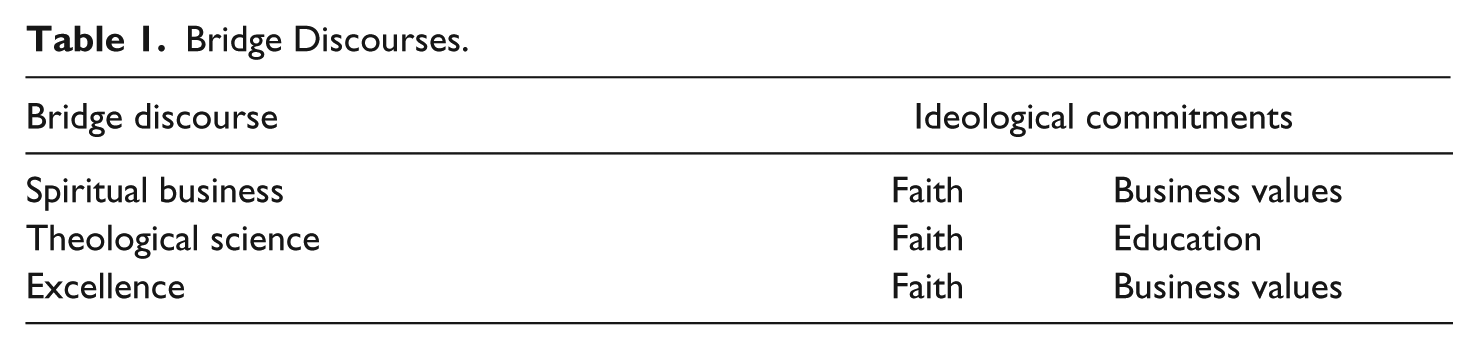
Bridge discourse allows for tensions between ideologies to be navigated, to be lived with, rather than battled through or given hierarchical value. Table 1 depicts the three bridge discourses we identified and the ideologies they connect. The spiritual business discourse allows for ideologies of faith and business to coexist. A theological science discourse bridges faith and education. Finally, a discourse of excellence also bridges ideologies of faith and business values. These bridge discourses define and constitute meanings, allowing for the navigation of the ideologies.
Bridge Discourses.
Spiritual-Business Discourse
The spiritual-business discourse bridged the ideological commitments to faith and business values normalizing references to God, faith, and spirituality while enacting traditional business processes. God was constructed as an active participant in the organization and prayer was an organizational structure. For example, Heritage members talked about God as the “boss” of their organization. In Lydia’s (employee) interview she said, “He [God] is the conductor of our lives. This organization is God-based. You want Him to really be the president . . . where you seek His wisdom.” Susan (cofounder) demonstrated this perspective as well: “Organizationally, it’s the cosmic awareness that I’m not the boss here, you [God] are.” Similarly, Sheri (volunteer and prayer team member) said that Heritage members “seek His [God’s] guidance and direction and blessing. He will let you know what His will is, He’ll give you peace about something, or maybe a word of wisdom or advice.” Constructing God as the boss or president of the organization firmly places faith at the head of the conference table.
Prayer was also woven into normal business practice. Indeed, observing Heritage, one might think that prayer was a business strategy. Heritage members collectively prayed at the beginning, and often at the end of each meeting. Moreover, the efficient use of time and authority in decision-making was credited to God’s handiwork. For example, Debra (board member) stated, “It’s always so amazing how much more quickly the meeting goes when we first pray over the agenda.” In her interview, Meredith’s (staff member) comments also connect prayer and business concepts, “It [prayer] is the foundation of everything. It covers, protects, and enables you.” The approach to prayer sounds much like an insurance policy for their business. It is spoken as a way of receiving protection and serves as a precautionary defense against possible organizational harm. Sheri (volunteer and prayer team member) attributed the success of the organization to bridging concepts: “They don’t just have a team of advisors. They’ve got a whole prayer team as well. Prayer is the key to their success.” The language of teamwork ordinarily attributed to work project groups (LaFasto & Larson, 2001) is used as a way of establishing prayer as an integral work group focus. Member discourse demonstrates that teamwork includes a focus on prayer as a business strategy.
Not only was prayer’s role in the business visible in the daily talk of organizational members, its role in business was supported by organizational structures and rituals, firmly establishing it as an organizational discourse. The Heritage Prayer Memo, formatted as an official document with the organization’s emblem and letterhead, was sent to all members and volunteers once a month listing organizational events, “praise reports,” and requests for prayer on upcoming events. The memo also addressed prayer requests of the members regarding such topics as persistent headaches, writing creativity, protection, and good health. By naming this document a prayer memo the organization constructed prayer as part of their business practices. Discussion about God as an active organizational member and prayer as a necessary inclusion in everyday work practices revealed a discursively created space where the organization’s communication honored both the business worldview and a worldview that centralizes faith. Neither discourse makes sense without the connection to the other. God as an active member of the organization might be considered odd outside of the ideology of faith. In addition, religious members would not refer to God as CEO without the strong ideological framework of business.
Theological-Science Discourse
Education was defined at Heritage as not only theological (the organization’s mission) but also grounded in science. Thus education could not be considered quality by Heritage members without meeting both of these criteria. This resulted in a bridging theological-science discourse promoted by organizational leaders and adopted by organizational members. This discourse connected both educational commitments and faith commitments. For example, John (chair of the board) explained, “We want God’s truth. And, it’s backed up in social science data, anthropological data, [and] scriptural data. We feel an obligation to teach biblical truth and to have it be backed by scientific data.” Accordingly, the education valued by Heritage members does not mean focusing solely on Christian theological concepts; rather faith and science are entwined to reconstitute what education means for organizational members. For example, on the Heritage website words are paired together, such as “scriptural picture, scientific truth, [and] practical purpose,” as goals that support the organization’s mission. The organizational discourse of theology and science was reproduced in the conversations of organizational members. During a committee meeting in which the group was discussing new books to read, Esther (president) commented, “It’s good to have an understanding about the whole picture. This [holding up a book] is not all Christian stuff by the way.” According to Martin (board member), “This organization is unique in the sense that it’s really philosophical. It’s also unique that while Christian in orientation it is not linked to any specific religious denominations.” Members valued and defined education as locally including principles from the Bible and scientific data bridging theology and science, constructing a multivocalic space from two distinct discourses.
Excellence Discourse
The final prominent discourse that worked to bridge parallel ideologies was an organizational discourse of excellence. This discourse also facilitated the balancing of commitments to faith and business values. Excellence, in this organization, could not be achieved with commitment to just one worldview. Excellent work was described as passionate, invoking a commitment to spiritual or theological work and professional, meaning excellence could not be achieved with the absence of the other. For example, Sheri (volunteer and prayer team member) stated, “[Esther] is just very gracious in her hospitality, but also expects excellence as well. She had it [a particular project] set up for excellence. She is going to set it up for excellence and she expects that as well.” Sheri framed excellence as an organizational assumption.
In another example of how this discourse constituted certain definitions that combined ideologies, Esther was asked what she looked for in a potential employee. She responded, “Passion alone doesn’t make you a good employee, it makes you a great fan. Most of the time, rather than hire somebody initially, I had people volunteer, and as they spent time volunteering, I was looking for skill sets.” Indeed, leaders and members of the organization made a point to defend their professionalism with this bridging language. Stacey (part-time employee) commented in her interview, “I think when God gives us work we need to do it well.” In Esther’s view, faith-based organizations do not always demonstrate a commitment to professionalism. She said, “Faith-based groups should be more excellent. Unfortunately, I think people get lazy because they have so much going on relationally, people don’t push themselves as much as they could, and I don’t like that.” Another example of bridging these ideologies took place in a production meeting when Esther shared, “We produced three video series. One with Jake [male Christian speaker], he’s been on Oprah, Larry King. He’s written fourteen books. The man is great. Most of all, he’s godly. And we shot [filmed] him in a day, because he’s a professional.” Reproduced in this brief description about Jake is the importance of being godly (faith) and being professional (business). This excerpt shapes meaning about what is expected and valued by the organization; it constitutes a larger discursive space that defines excellence for Heritage employees and board members (Mumby, 1989).
Organizational statements reflect the discourse of excellence as being both spiritually passionate and professionally grounded. For example, “We’ve done our homework. We embrace the free marketplace of ideas, believing that open, educated discussion ultimately leads to truth. Our contribution to this discussion is a positive, biblical approach, delightfully supported by mountains of data across a wide range of disciplines” (company website).
In Sum
The three prominent bridge discourses identified above illustrate the ways organizational members managed potentially competing ideological commitments granting new, local meanings for how meetings are accomplished, what it means to educate and be educated, and what it means to be excellent. These powerful discourses are both produced in the everyday talk of organizational members and at the organizational level in the leadership messages, organizational structures (e.g., the prayer memo), rituals, and other artifacts. These findings have implications at the theoretical and practical levels.
Discussion
This interpretive study provides a needed empirical example of how talk constitutes and reinforces particular values and worldviews in organizations. In particular, this study contributes to business communication research in three ways. First, the study disrupts the prolific conceptualization that organizational ideologies necessarily compete and/or are contradictory concepts. Second, the study challenges a hegemonic scholarly discourse that has historically privileged research on secular organizations. Finally, and most importantly, the study advances communication research by identifying bridge discourses that allow organizational members to navigate and manage dominant organizational ideologies. These claims are developed next.
Contributions and Future Research
Although organizational communication research as of late has especially taken the lead in problematizing simplistic understandings of organizational ideologies (Ashcraft & Mumby, 2004a), this study specifically challenges the conceptions widely constituted in popular media that an ideology of faith is contradictory to secular ideological commitments, such as business, education, and science (Begley, Rosenberg, & Yarett, 2010). This study demonstrates that in one faith-based organization, multiple and varied values of business, such as professionalism and efficiency, were highly prized as were the commitments organizational members had to faith and basic human interests. And as described above, these potentially competing values and ideological commitments were not only present, they were connected to bridge the strong values present in multiple ideologies. Such was the case when the leader of the organization emphasized that “passion” (faith) was not enough to be hired in the organization, but that professional (business) habits were an important aspect of the job. Neither passion nor professionalism could stand alone in an understanding of excellence. Hence, by focusing on the discourses that were repeated and widely used by organizational members and leaders, this study provides empirical strength to Castor’s (2005) claim that organizational values and commitments are multivocalic. Extending this work, we found that although sometimes the ideologies represented by the discourses do compete, in this case, in place of tension and competition, sometimes they work together to create new meanings for organizational members. We suggest that future studies seek to further problematize the concept of multivocality in both profit and nonprofit discourse.
Next, this case study challenges the historical tendency for scholarship to privilege traditional for-profit business in studies of work. Rodriguez (2001) argued that secular hegemony is the suppression of the spiritual through the privileging of secular scholarship, elevating one worldview, rather than providing space for multiple perspectives (see also Buzzanell & Harter, 2006). Ashcraft and Mumby (2004) further define Gramsci’s (1971) foundational concept of hegemony as the “process of domination through the active consent of subordinated groups” (p. 23). This study disrupts what Rodriguez refers to as “secular hegemony” by drawing scholarly attention to businesses that operate with spiritual missions that extend beyond profit (p. x). In recent years, nonprofit organizations have garnered the attention of scholars (Lewis et al., 2001; Sanders & McClellan, 2011). And a proliferation of scholarship has emerged in pursuit of understanding interorganizational collaborative relationships in nontraditional and alternative organizations (Heath & Frey, 2004; Keyton, Ford, & Smith, 2008; McGuire, 2010). This study adds to the rich communication scholarship that continues to challenge the boundaries that define traditional organizations and businesses. Thus, it disrupts the hegemonic conception of business as secular. Indeed faith-based businesses exist, and studying them is worthwhile as they teach us more about how businesses work.
Finally, the study goes beyond identifying the presence of multivocalic ideologies that were made visible in organizational discourse. The case study provides a rich exemplar of what we have called bridge discourse. Bridge discourse places communication at the heart of negotiating seemingly competing values. When ideologies that posit significantly different codes of meaning coexist within an organization, a word or discourse is a bridge that manages the tension between the ideologies. Different ideologies then can put forward uniquely generative understandings of what is, what is good, and what is possible within an organization (Mumby, 1989). This can produce a harmony between them that on the surface seems to be unlikely.
Bridge discourse provides a new heuristic from which to understand organizational negotiation. Scholarship may continue to add to the bridge discourses found in this study. Cheney et al. (2008) suggest that spiritual communication scholars should collaborate within the field of organizational communication to assess how “belief systems encourage particular views of work and how individuals enact them” (p. 174). By highlighting the values that were bridged in Heritage, the present article offers insight in this area. Bridge discourse provides an analytical tool in which to illuminate the multivocality of worldviews and values present in the workplace. Its contribution is an analytical move away from dichotomous and overly simplistic understandings of workplace ideologies.
In addition, the hegemonic qualities of bridge discourses should continue to be developed. While a discourse of faith connects Heritage workers to a spiritual community, we acknowledge the spiritual community researched here is embedded in a larger capitalistic, rational-scientific, and patriarchal societal context. Not surprisingly, organizational members drew upon bridging discourses that allowed faith and capitalistic values of efficiency and professionalism to not only coexist, but also work together. This created a unique identity for organizational members who claimed that “we [Heritage members] are not just passionate; we are professional.” And in a particular discourse of education—theological science, that is the study of religion and the pursuit of evidence-based “truth,” social orders were organized by reproducing the value of education and redefining it as something that is informed by faith and science. This discourse of education is linked to larger societal structures in which case western cultures will often value education over social, and historical experiences (Meehan, 1975), not to mention mystic or religious experiences.
Though the bridge discourses surfaced as a way of navigating the broader ideologies associated with religion, science, and capitalistic businesses, they are embedded in their own ideological privilege. Thus the terrain of bridge discourse is also a space for political contestation. Here the question becomes, who is constructing these communicative spaces within bridge discourse and what voices of power govern these spaces? As Lair, Shenoy, McClellan, and McGuire (2008) argued, “Meanings of work are embedded in socially or historically created notions of self and spirituality, taken-for-granted organizational practices, and hierarchical cultural norms, all of which affect workplace members and societal articulations of the possible meanings of work” (p. 178). Arguably, Michel Foucault (1984) provides some of the most comprehensive examples of how discourse disciplines and regulates individual, organizational, and societal behaviors and structures (e.g., his analyses of the penal system and sexual identity). Foucault’s work elucidates the path we have begun here, in which we connect micro and organizational discourses to larger ideological systems of thinking. Although we identified some of the larger societal discourses at play in organizational language at Heritage, our study was primarily interpretive and descriptive. Therefore, we did not attend to those voices that were marginalized in these bridge discourses. Future scholars may ask how bridge discourses are used to shade power. Accordingly, the area of bridge discourses has the potential to spawn many fruitful future studies ranging from the pragmatic to the critical.
While provocative, this case has several limitations. The organization provided admittedly little structure from which continuous observation could be conducted. Its employee structure was also loose with a large number of consultants. In addition, case studies are always limited in the conclusions they can extrapolate to organizations in general. However, the findings generated in this study provide a new framework from which to further examine faith-based, nonprofit organizations. We argue that this framework can guide future studies of communication in businesses that have strong ideological roots and that it offers a successful case of business communication for practitioners who seek knowledge on how to navigate seemingly competing values at work.
Footnotes
Declaration of Conflicting Interests
The author(s) declared no potential conflicts of interest with respect to the research, authorship, and/or publication of this article.
Funding
The author(s) received no financial support for the research, authorship, and/or publication of this article.