




Abstract
Strategy workshops are frequently used by executive management to formulate strategy but are underresearched and underreported in the academic literature. This study uses a form of discourse analysis to identify a dialogic pattern of talk in an executive management strategy workshop. The group’s dialogue in the workshop discourse displayed an emphasis on achieving shared understanding rather than winning a debate. Affirmation, Topic Expansion, Productive Difference, and Reflexive Observation were derived from the dialogue literature as particular features of dialogical interaction and were used in this analysis to identify spontaneously occurring dialogue in the strategy workshop. The study thus proposes a basis for identifying dialogue in naturally occurring strategy discourse and for understanding its potential contribution in that setting.
Introduction
Strategy workshops are normally carefully planned events lasting from half a day up to 2 days (Hodgkinson, Whittington, Johnson, & Schwarz, 2006). In a relatively short, 80-minute strategy workshop, an executive team identified a fundamental weakness in its conception of a strategically important activity. Their workshop concluded with a decision to prepare a new vision for the topic under discussion, which went well beyond the outcome originally intended from the workshop agenda. This article attempts to answer the question that naturally arises:
How did a significant change in perspective about an important strategic topic arise from an executive team’s short, 80-minute strategy workshop?
The article explores how features in the discourse that are indicative of dialogue might help explain what was happening. A review of the literature focusing on the important but underresearched area of strategy workshops is provided. The literature review also provides an insight into the nature of dialogical interaction and its potential contribution in strategy workshops. Following the literature review, details are given of the empirical data from a strategy workshop and the discourse analysis (DA) methods used to analyze that material. An analysis is then given of how four dialogical features—Productive Difference, Affirmation, Topic Expansion, and Reflexive Observation—operated within the discourse of the strategy workshop.
The article concludes with a commentary on the findings and identifies potential implications for the practice of strategy workshops.
Strategic Practice, Discourse, and Dialogue
Since the 1990s a variety of sources have increasingly stressed the “organizing property of communication” (Boden, 1994; Cooren, Kuhn, Cornelissen, & Clark, 2011; Keenoy, Oswick, & Grant, 1997 ). This “linguistic turn” has been applied to the field of corporate strategy by scholars such as Knights and Morgan (1991) and Samra-Fredericks (2003). Within the broader literature on corporate strategy, strategy-as-practice and DA literature have provided new insights on how communication may be viewed as action in the context of strategy formulation and implementation (Jarzabkowski & Spee, 2009). In this context, the communication processes involved in the creation of strategic plans has been studied (for example, Spee & Jarzabkowski, 2011), interactions in board meetings (for example, Samra-Fredericks, 2003), and the role of accounting calculations in the legitimization of strategy (Ezzamel & Willmott, 2008).
Strategy Workshops
Despite their apparent ubiquity and importance, strategy workshops are an underresearched and poorly reported phenomenon (Johnson, Prashantham, & Floyd, 2005). Their importance is widely acknowledged, but they have not been subjected to a significant amount of systematic analysis, and there are limited empirical accounts of what actually occurs during them (Hendry & Seidl, 2003; Schwarz, 2004b). Hodgkinson et al. (2006, p. 480) summarized it well in saying “we know very little about a phenomenon that, on the face of it, appears to be important in understanding the practice of making strategy.” The interactions in strategy workshops are one of a variety of practices that need to be studied in detail if we are to respond to the challenge posed by the calls for a return to practice (Miettinen, Samra-Fredericks, & Yanow, 2009).
Strategy workshops are used to review, formulate, or plan strategy (Schwarz, 2004a) but are rarely triggered by external pressures or crises (Hodgkinson et al., 2006, p. 482). In most cases, strategy workshops tend to be exclusive to the most senior managers (Hodgkinson et al., 2006; Johnson et al., 2005) and are often organized with predetermined agenda, exclusive attendees, and a pro forma structure facilitated by an external consultant (Hodgkinson et al., 2006; Johnson et al., 2005). Hendry and Seidl (2003) suggest that strategy workshops are used as a mechanism to switch from an operational focus to a strategic focus. By “suspending” the normal structures and routines present in regular meetings, strategy workshops enable participants to reflect on those practices and strategic discourses with a view to revising and developing future strategy.
Despite their potential to enhance strategy, much of the work on the “high-stakes activities” (Whittington, Molloy, Mayer, & Smith, 2006, p. 619) of strategy workshops and other strategy interactions have stressed the conflict inherent in such communications. More recently, Thomas, Hardy, and Sargent (2011) have shown how strategy workshops can serve as forums for meaningful cooperative interactions between managers and can include interactions where shared understandings and interpretations emerge. As Thomas et al. (2011, p. 36) point out, arguments for such evanescent cooperative discourses, have prior to their own work been “in the main theoretical.” The present work aims to add to this developing empirical exploration of such interactions. In doing so, theories of dialogic interaction developed by writers such as Bohm (1996), Isaacs (1993), and Senge (2006) have been used to identify four dialogic indicators for use in this analysis.
Dialogue
In common language usage, dialogue and discussion are often used interchangeably and are normally understood as a verbal exchange between two or more people. However, in the context of the research reported in this article, dialogue is understood as a particular type of interactive talk, aimed at establishing common understanding of underlying assumptions and perceptions (Bohm, 1996; Isaacs, 1993, 1999; Senge, 2006). This contrasts with the intent of discussion, which is to analyze a topic and then to assert a particular way to act or react (Bohm, 1996; Senge, 2006). Dialogue is concerned with conversation between people. In Bohm’s formative thinking on dialogue he proposes:
The object of dialogue is not to analyze things, or to win an argument, or to exchange opinions. Rather it is to suspend your opinions and to look at the opinions—to listen to everybody’s opinions, to suspend them, and to see what all that means. (Bohm, 1996, p. 30)
Bohm describes dialogue as “a stream of meaning flowing among and through us and between us” (Bohm, 1996, p. 7). He suggests the aim of dialogue is to uncover the flaws in people’s thinking, so that a group can collectively develop a better understanding of their underlying thinking and assumptions. Significantly, Bohm also believes that there should never be a winner or loser in a dialogue. It is important to note how this contrasts with a discussion, the aim of which is generally to reach an agreed conclusion through analysis, or to win an argument through point-scoring exchanges (Bohm, 1996, p. 7; Isaacs, 1999, p. 41; Senge, 2006, p. 230). Isaacs offers a more refined description of dialogue as “a discipline of collective thinking and inquiry, a process for transforming the quality of conversation and, in particular, the thinking that lies beneath it” (Isaacs, 1993, p. 25).
Central to both Bohm’s and Isaacs’ definitions is the scrutiny of individual and collective thinking. Collectively, Bohm says that “while we don’t have “rules” for the dialogue, we may learn certain principles as we go along which help us” (Bohm, 1996, p. 35). Some of these principles include examining the whole thought process of individuals and the group (p. 10), addressing the conflict of absolute necessities (p. 26), suspending assumptions for open examination by the group (p. 23), and developing the capacity for proprioception of our thoughts (a self-awareness of the effect our thoughts have on our dialogue) (p. 28).
Individuals may often bring conflicting views into a group discussion, which they may defend as “truth” (Bohm, 1996, p. 3). However, groups are seldom equipped to recognize or deal with potential flaws in the thinking processes through which such “truths” might have been originally formed by individuals. This problem is dealt with in dialogue by the fundamental concept of “suspending assumptions” (Bohm, 1996, p. 22; Isaacs, 1999, p. 134; Senge, 2006, p. 226). “To suspend assumptions means to display attributions and the data that leads to them, but also to hold in abeyance and reflect on the underlying automatic process of thought that gave rise to a particular conclusion” (Isaacs, 2001, p. 733). In participating, facilitating, or analyzing a group’s interactions, suspending assumptions represents the junction at which conversation moves from a discussion form to a dialogic form (Isaacs, 1993, p. 34).
Suspending assumptions is therefore a fundamental and essential feature of dialogue. In a preplanned dialogue session (Innes & Booher, 2003), it is normally presented and explained in detail to participants at the beginning of the session. The concept requires participants to reflect on the assumptions they bring to a conversation and to have those assumptions scrutinized in detail by themselves and the other participants. It is normally an explicit activity in a dialogic conversation which is strongly guided by a facilitator (Innes & Booher, 2003). Bohm (1996) and Isaacs (1999) go further and identify thoughts and the process of thinking as the fundamental “assumption” which should be “suspended” for reflection and scrutiny. By highlighting potential incoherence in individuals’ thought, suspending assumptions seeks to improve the coherence of the group’s collective thought (Senge, 2006, pp. 225-226). Through suspending assumptions for open scrutiny, all participants should come to a better understanding of why people hold the views they do. This provides the foundation to build shared understanding through dialogue.
The literature on dialogue does not explicitly define indicators by which dialogue might be readily identified. The concepts behind dialogue are described and explained, along with details of how dialogue sessions might be conducted or why they might be used. For the purpose of analyzing a recorded discourse it was necessary to develop indicators that reflected the key concepts explained in the literature and then to select a more limited number for use in a closer analysis of the data and reporting in this article.
Reflecting Bohm’s and Isaacs’ theoretical base for dialogue, Senge (2006) sees dialogue as a core enabler of team learning. From this applied perspective, six indicators or features can be inferred from Senge which may be used to characterize conversation as dialogic: Reflexive Observation, Inquiry, Reflection, Consensus (focusing down), Consensus (opening up), and Topic Expansion (Senge 2006, pp. 223-231).
From an organizational discourse perspective, Gergen, Gergen, and Barrett (2004, p. 42) define dialogue more generically as “discursive coordination in the service of social ends”. They identify “moves” that should be present in what they term “ …generative dialogue, dialogue that brings into being a mutually satisfying and effective organization” (p. 45). Six such ‘moves’ may be inferred from their work: Affirmation, Productive Difference, Coherence (Metonymic reflection), Coherence (repeating), Coherence (answering) and Repetitive Sequences (Gergen et al., 2004, p. 45-49).
Twelve dialogic indicators derived from the literature are illustrated in Table 1. Three of the indicators—affirmation, topic expansion and reflexive observation—are shown to be indicators of the concept of suspension of assumptions, which is fundamental to the concept of dialogue (Bohm, 1996, p. 22; Isaacs, 1999, p. 134; Senge, 2006, p. 226). A fourth indicator, productive difference, relates to how conflict or disagreement may manifest itself in the context of dialogue and is consequently included as an indicator for more detailed analysis. The relevance of these four indicators and the reasons for using them are discussed in more detail below.
Dialogic Indicators developed from literature.
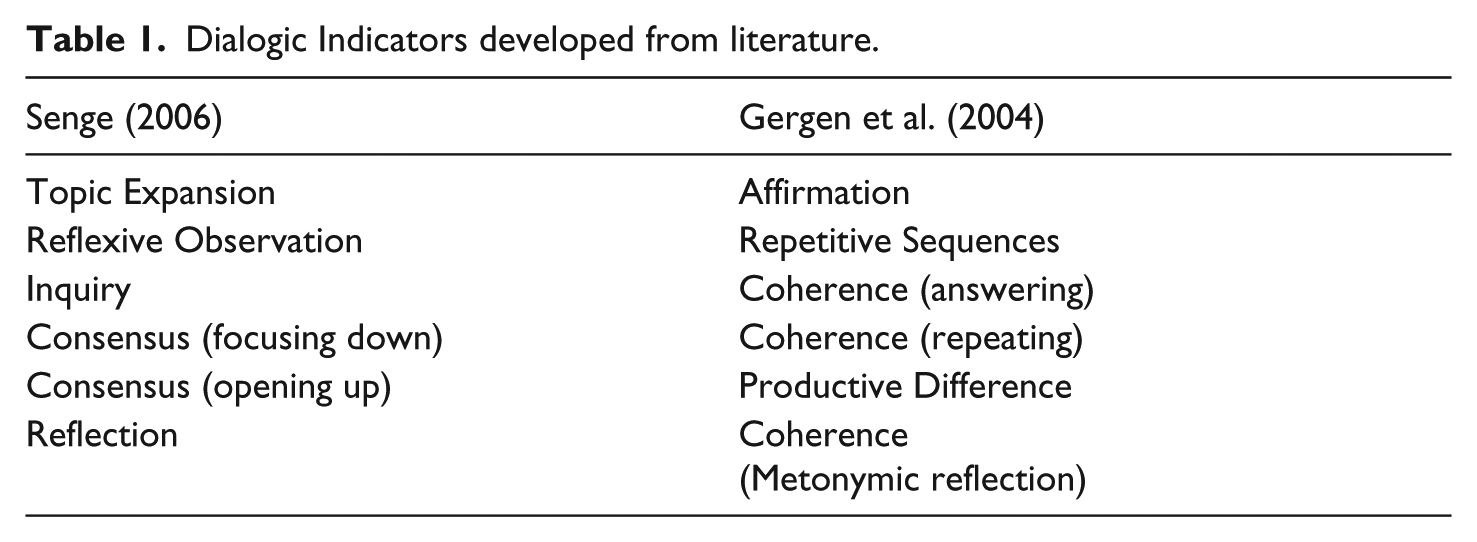
Senge (2006) and Gergen et al. (2004) approach dialogue from different perspectives. Senge focuses on dialogue in the context of organizational teams with particular reference to team learning. He is particularly attentive to distinguishing between dialogue and discussion in that context, but his focus is on identifying those characteristics that allow interactions to be described as dialogue. He also identifies the relevance and role of a facilitator in the context of fostering dialogue within teams as a means of enhancing team learning and performance. In contrast to Senge (2006), Gergen et al. (2004) reflect a much broader view on dialogue. Set in the context of organizational discourse, they initially explore a diverse range of interpretations of dialogue before focusing on the generative and relational coordination role of dialogue in organizing processes within organizations. They reflect on a range of processes that can be discursively constructed through dialogic forms of interaction. Unlike Senge, they do not focus on any one aspect of an organization but rather elaborate how different forms of dialogue may contribute to different aspects of organizational life. The indicators developed for this study were derived from the aspects of their respective work considered most relevant to the particular setting of the strategy workshop being studied for this article.
Affirmation as proposed by Gergen et al. (2004) involves different ways of acknowledging other people’s ideas and perspectives. It may be positive or negative but essentially involves acknowledging the validity of other views, whether agreeing with them or not. As such, it requires a measure of joint examination of those views to at least understand their foundation. Thus affirmation may be considered an indicator of suspending assumptions.
Reflexive Observation is grounded in Senge’s (2006) concepts of reflection and inquiry. It requires a measure of objectivity and willingness to self-examine both the negatives and positives in what we do and think. In this regard, it closely relates to the underlying concept of suspending assumptions and therefore provides a perspective on the extent to which suspending assumptions was happening spontaneously in the workshop without being prescribed in advance or sought by the facilitator.
Topic Expansion as derived from Senge (2006) requires participants to view their conversation subject from many different perspectives, which are founded on individuals’ thoughts and thought processes. It is similar to suspending assumptions in that it requires exploration of underlying thought surrounding a given topic.
As a feature of “generative dialogue” (Gergen et al., 2004, p. 45), productive difference emphasizes how discourse contributes to relationships within organizations. In this context, it is a discursive concept that provides for how differences between participants’ utterances in organizational discourse contribute to on-going meaning-making. Where utterances curtail or negate previous contributions, they are considered destructive and impede the construction of a “mutually viable reality” (Gergen et al., 2004, p. 47).
Data and Method
Data—Context and Source
The data was gathered at what Johnson, Prashantham, Floyd, and Bourque (2010) describe as one of “the rare opportunities to observe strategy workshops” (p. 1593). The workshop was set in the Higher Education (HE) sector in Ireland. Over recent years HE has become increasingly internationalized and commodified (Shuk-ching Poon, 2006). The focus on competition for student recruitment, funding allocation, financial viability, and long-term sustainability of HE organizations has led to the adoption of strategic and operational planning practices and processes often seen in commercial organizations (Cowburn, 2005; Dooris, Kelley, & Trainer, 2004; Lamal, 2001). As a result, the discourse adopted within management teams in HEs has become more business-oriented, providing an opportunity for their business practices to be researched with a view to contributing to the wider business literature. Furthermore, the high-value service sector is increasingly important in the economy of developed countries, and HE in this sense serves as an exemplar for the kind of issues faced by an increasing number of organizations (Jorgenson & Timmer, 2011). The Irish context is also useful in that it provides an example of a highly globalized developed economy, which at the time of the study was at the cutting edge of the global economic crisis (Hogan, Donnelly, & O’Rourke, 2010). The topic of this workshop was specifically driven by that economic crisis.
In an Organization for Economic Cooperation and Development (OECD) review of the Irish HE sector, a particularly relevant finding was the need for additional support for improving adult education provision (OECD, 2004, pp. 32-33). Between 2004 and the onset of a deep recession in 2008, little was done at national level to implement the OECD recommendations. In particular, the problems associated with adult education were still present and exacerbated by the onset of the recession.
In this context, the executive team in one HE organization selected adult education as the topic for their strategy workshop. The workshop took place immediately after a routine executive team meeting. The room layout was conventional boardroom style, with participants seated as they had been for the preceding executive meeting. The workshop proceedings were recorded on a digital recorder.
A preworkshop briefing note and the workshop agenda positioned this workshop as a routine strategy workshop. Dialogue was not a planned feature of the workshop and the facilitative methods used were not specifically intended to accommodate dialogue taking place. The workshop purpose was to prioritise issues of concern related to adult education and to define actions to resolve the issues.
The executive management team in this organization comprised six people who had worked together for in excess of 5 years. The chief executive and one of the heads of function were unable to attend the workshop. As part of their ongoing management development, Myers Briggs personality profiling had been used to identify their synergies and potential weaknesses as a management team. Subsequent to completion of the analysis in this research, it was established that the participants had never received training in dialogue techniques and were not familiar with that form of discursive interaction.
The workshop facilitator (one of this work’s authors) was known to all members of the executive management team. He previously worked with the executive team, both as a consultancy adviser and as a coparticipant on other activities within the HE sector. This enabled the warm up activities normally associated with the “transition phase” of such workshops (Johnson et al., 2005) to be minimized, which in part contributed to the relatively short but focused nature of the workshop. At the time of the workshop the facilitator had no previous experience of facilitating or taking part in the form of dialogue identified in this research. It is therefore worth noting that neither the participants nor the facilitator set out to engage in a dialogic way or to run a dialogue session. (Note: The facilitator is identified in transcript extracts as Facilitator.)
Method of Analysis
Since direct analysis of strategy workshops is rare (Hodgkinson et al., 2006; Johnson et al., 2010), it is appropriate that the method of analysis would focus on the detail of the strategy workshop itself. In their similarly case-based inductive approach, Johnson et al. (2010) analyzed their data using ritualization theory, but what was interesting about the strategy workshop reported in this paper was its creative rather than its ritualistic character. To understand the productivity of the workshop relative to its duration, and to try to explain how a significant change in strategic perspective arose from such a short strategy workshop, a discourse analytical approach was adopted. Discourse Analysis (DA) has been shown to be a fruitful approach when analyzing strategy and strategy formation (Ezzamel & Willmott, 2008; Hardy & Palmer, 1999; Hendry, 2000; Knights & Morgan, 1991). The talk generated in this workshop provided real-time examples of actual language in use and represents a firsthand account of discourse that informs the development of an organization (Phillips & Hardy, 2002). Hodgkinson et al.’s (2006, p. 479) survey also points to the discursive nature of strategy workshops further supporting the adoption of DA.
There is a great variety of particular ways to apply DA and such variety is explored in detail elsewhere (for example, Alvesson & Kärreman, 2011). The particular approach adopted here follows in a tradition of Potter and Wetherell (1987); Duberly, Cohen, and Mallon (2006); and Whittle and Mueller (2011). Our discourse analytical approach is unashamedly interpretative and since the discourse analyzed involves a researcher we adopt the approach of transparently including the words of the researcher so that they can be used as an interpretative resource rather treated as a contaminate (Mishler, 2005; O’Rourke & Pitt, 2007; Speer & Hutchby, 2003).
Potter and Wetherell’s (1987) 10-stage process for analyzing discourse informed the analytic methodology in this study but specific methods for detailed analysis of the workshop transcript are not strongly prescribed in this literature (Phillips & Hardy, 2002, p. 74). This is because the inductive approach analyses interaction with great sensitivity to the context in which it is generated and relies therefore on the resources of the researchers, both to guide the research and transparently communicate the construction and its context.
The resulting text, of which the transcribed extracts below are representative, was initially coded under general themes to identify the main features characterizing the group’s discourse, such as establishing personal and organizational identity, use of metaphors, how individuals represented particular aspects of the workshop topic, and how relationships between participants were established through their discourse. Through a number of iterations, the text was then recoded under more specific headings related to adult education (the workshop topic), factors affecting it, staff attitudes towards it, the group’s views on societal disposition towards it, and economic factors and governmental policy affecting adult education. The text was then analyzed to understand how the group handled any conflict arising during the workshop. The apparent lack of conflict in the group’s discourse highlighted the potential for examining the dialogic features of the workshop discourse. Dialogic indicators were derived from the literature and the text was coded in detail using those indicators. Coding for the dialogic indicators was done by reviewing every turn in the workshop discourse and assigning an indicator where the turn reflected the characteristic of that indicator.
Analysis
Multiple iterations through the workshop transcript identified a number of features that were constructed through the group’s discourse (Duffy, 2010). The dialogic discourse pattern was the principle finding and is the subject of this article.
One of the later iterations through the transcript sought to code for points of disagreement during the workshop and how disagreements were discursively handled. The apparent lack of significant disagreement was unexpected and prompted a more detailed analysis of the data to identify discursive features that might account for this observation. Preliminary analysis of the workshop proceedings suggested that a type of conversation was taking place that had not been planned by the facilitator or the group and that was not noticed by the facilitator during the workshop. Working on an initial assumption that the group engaged in some form of dialogic exchange, the dialogic indicators developed from the literature (see Table 1 above) were used to examine if the interaction could be characterised as dialogue. As discussed above, four indicators were selected. Three were considered the most reflective of the concept of “suspending assumptions,” which is the distinguishing feature of dialogue (Bohm, 1996, p. 22; Isaacs, 1999, p. 134; Senge, 2006, p. 226). The fourth indicator offered a dialogic basis for analyzing how disagreements or conflict were being discursively dealt with (Gergen et al., 2004) by the group.
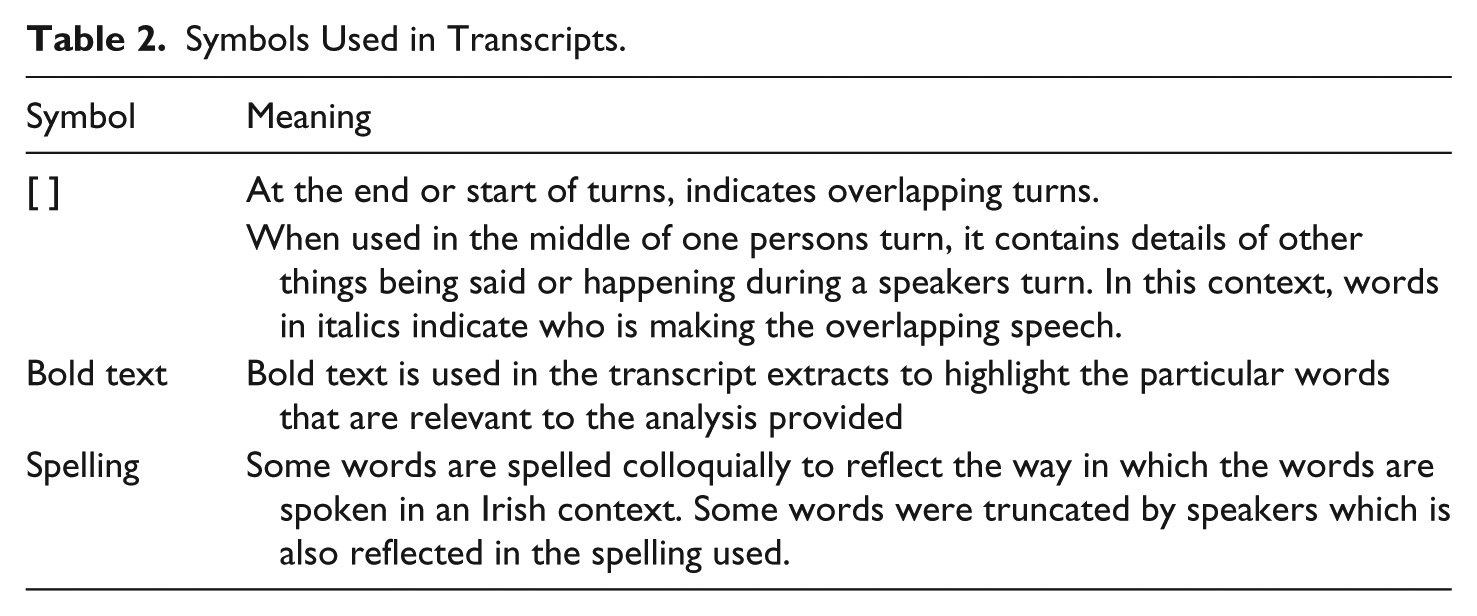
Table 2 below provides details of the symbols and conventions used in the transcript extracts.
Symbols Used in Transcripts.
Affirmation
Affirmation is a conversational act that confers significance, worth, or value on someone else’s utterance. It can be shown in a number of ways by a speaker: through being attentive, curious, seeking clarification, or being moved by a contribution. It does not mean assent but does signify engagement in the conversation (Gergen et al., 2004). The first example of affirmation is taken from early in the workshop (Transcript Extract 1 below). The data source for the transcript extracts is an audio recording of an executive management team’s strategy workshop (duration 1 hour 20 minutes) recorded on March 12, 2010.
13 Speaker A It’s funding, it comes down to funding at the end of the day [general agreements..]
15 Speaker B The fringe stuff is there to a large extent because it takes a huge amount more energy to recruit an adult learner in continuing ed 3 per FTE per year than it does through the CAO. If I get a hundred students in on a course through the CAO they’re by and large there for four years job done, there’s four hundred FTEs with a bit of loss three hundred somethin FTEs, bam, there you are. To get three hundred and somethin FTEs through the continuing ed adult learner, smaller lumps of learning and market all that course is mind numbing in terms of the energy and ….. The work based ones we have to keep [
16
17 Speaker B going back over and over again, so the energy investment is consistent, repeated and substantial, to get an educational impact through the adult learner cohort of staff. When we started off with a strategic plan back about eight years ago we said we were going to get about half our students through continuing ed and half through the CAO, and when you crunch the numbers you actually can’t do that.
Source: Transcript starting at time mark 00:13:37
(Note: FTE stands for Full Time Equivalent and CAO stands for Central Applications Office)
(Note on emboldening: Text in bold in the transcript extracts is considered particularly relevant to the point being made in the analysis.)
Speaker C’s simple interjection in Turn 16 provides affirmation of both Speaker A’s earlier contribution in Turn 13 and Speaker B’s longer turn on the extra work required for part-time adult education compared with their full time equivalent (FTE) younger alternatives. Noting that Speaker B is not referring to funding as articulated by Speaker A, Speaker C’s affirmation may be seen as “careful or sympathetic attention” (Gergen et al., 2004, p. 46) and bridges the meaning between the two contributions.
The use of affirmation illustrated how the participants used active listening and provided affirmative feedback, giving a sense of dialogic engagement in the conversation.
Topic Expansion
Dialogue is characterized by a group exploring difficult and complex issues from diverse perspectives. This requires individuals to actively go beyond the initial bounds of the topic under consideration and see how it relates to and is influenced by other topics. Such divergent thinking can lead to a sense of incoherence in a group’s discourse. To bring coherence to the group’s conversation therefore requires participants to “become sensitive to all the possible forms of incoherence” (Senge, 2006, p. 226). This requires a willing and proactive examination of all factors that contribute to individuals’ and the group’s perceptions of the topic being talked about, recognition of the potential for the conversation to become incoherent and conscious effort from all participants to ‘suspend assumptions’ leading to the apparent incoherence, with a view to building greater understanding throughout the group. We have termed this process topic expansion.
The workshop interactions demonstrated many examples of topic expansion. This was manifested through their diverse conceptualization of adult education and how they actively problematized it, taking as many factors into account as possible. To build a coherent and consensus-based view of a problem, individuals in a group need to satisfy themselves that they fully understand all the perspectives that each individual is using to inform their views on the topic. By openly exchanging and challenging these perspectives, the underlying thinking processes can be examined and more clearly understood as part of the search for coherent thought on the origins and nature of the problem. This then provides a common basis of understanding which can be arguably considered a natural precursor to devising consensus-based solutions. Transcript Extract 2 below illustrates how the group expanded their conceptualization of adult education and the factors affecting it in the first half of the workshop.
11 Speaker D but I think, you know, particularly with the sort of restructuring in higher education and a review of
13 Speaker A It’s
21 Speaker B But that’s a serial change … but the more recent labour activation stuff has been
22 Speaker A There’s something that sits uncomfortably in the Irish psyche about an auld fella goin back to education, it just doesn’t seem right, whereas if you go to other jurisdictions ….[laughter]
38 Speaker D I think the adult education, the way I’ve always seen it was …. ya know
70 Speaker C The other thing that happens with this, is they look at the whole bureaucracy, there’s a, there’s a kind a, the part-time education is
82 Speaker B So are we swimming against a tide or are we accommo, or
Source: Transcript starting at time mark 00:12:25
Transcript extract 2 illustrates how they considered adult education from many different perspectives:
economics and politics (Turns 11 and 38)
a funding dimension (Turns 13 and 21)
the national psyche (Turn 22)
a public-sector bureaucratic versus a private-sector entrepreneurial business view (Turn 70)
meeting basic student needs (Turn 82)
Transcript Extract 3 also illustrates how the topic of adult education was expanded during the workshop interactions. The exhibit starts with Turn 166—the facilitator summarizes how the topic of adult education had already been characterized during the meeting, summarizing that the group’s view of adult education was founded on two different concepts (use of language and mindsets) raised in the preceding turns. Speaker D then expanded this foundation to include “values, norms, mindsets, attitudes” (Turn 167).
166 Facilitator … but to wrestle with and succeed better than you’ve succeeded to date maybe
167 Speaker D Well, yea, yea I think we’re probably in a better place
171 Speaker B Ok, well I would just qualify what you just there Facilitator, is provided
172 Speaker C But is it not like, because things are being spoken of the way they are
173 Speaker A That’s what the
174 Speaker B Sean Fitzpatrick went off and he did all the things he did because he’s such a creator .. The ultimate entrepreneur,
175 Speaker C But, yea, the fact that we’re in a period of incredible change if we’re alert
Source: Transcript starting at time mark 01:08:52
Note: The workshop facilitator is identified as Facilitator
Speaker B calls for realistic constraints to be factored into the thinking process and Speaker C sees opportunity arising from “the way” things are being spoken of (Turns 172 and 174). Speaker A’s use of a simile from banking (Turn 173) brings in a resistance to change perspective that Speaker B counters, invoking the need for rules or else face the negative fate implied by his rhetorical question “where is he now.” In this short passage of turns lasting just 2½ minutes, a wide spectrum of factors are raised relating to their adult education topic, illustrating the concept of topic expansion.
The diversity of the dimensions to the adult education problem discussed by the group illustrates their unconstrained thinking and an open exploration of factors that influence or contribute to the perceived problem. This illustrates the group’s use of topic expansion as a dialogic feature to enable their full consideration of the issue under consideration.
Productive Difference
In dialogue, meaning is created by the differences between contributions from participants. If there is no difference, the result is at best affirmation and at worst duplication. Productive difference exists when a contribution sustains or extends a previous contribution. Contributions are destructive where they negate or curtail other utterances, in that “they impede the process of constructing a mutually viable reality” (Gergen et al., 2004, p. 47).
Transcript Extract 4 provides an example of a significant change to integrating students from part-time and full-time programs (Turn 159). The scale of the change is implied by the phrases “we did turn it on its head” and “suddenly there’s a mind shift there.”
159 Speaker A But you also don’t want to raise false expectations either because they still have to go through their channels [Facilitator sure, yea], ya know, but that, the one example here where
160 Speaker B No,
161 Speaker A No, but
Source: Transcript starting at time mark 01:05:28
However, Speaker B immediately tempers this (Turn 160) by pointing out that it constituted “breaking rules” and would require additional work to make “manual adjustments” to HEA returns. Productive difference arises in that Speaker B does not fully sanction Speaker A’s initiative but also identifies the work around necessary to make it possible—difference is a source of focused and productive action rather than perpetuating unproductive disagreement. Speaker A affirms Speaker B’s concern with “I know (Speaker B),” particularly with the use of his first name, making the exchange productive towards their relationship and continues his broader point that they have to continue pushing to discuss and try new approaches to bring about new mind sets regarding adult education.
Transcript Extract 5 below illustrates how a line of conversation is initially closed down but productive difference allows a more positive outcome. Speaker A’s initial point is picked up by Speaker D (Turn 114) and becomes a jocular exchange between them over the next two turns, until Speaker D declares their exchange a “total digression” (Turn 116).
113 Speaker A The other thing which I’m aware of is the academic community, eh, also bring with them
114 Speaker D Well the] cla,
115 Speaker A in half the time….[
116 Speaker D Anyway,
117 Facilitator
Source: Transcript starting at time mark 00:55:57
Note: The workshop facilitator is identified as Facilitator.
However, the facilitator holds a different view, hearing “key issues” in the exchange that could be discussed further. The difference in views between participants and facilitator went on to prompt a wider engagement about the frames of reference used by staff about adult education, which became a partial action point at the end of the workshop.
Reflexive Observation
Reflexive Observation as a dialogic indicator is based on two concepts—self-review of how we construct the world in talk and a willingness to challenge that construction when necessary. The capacity to test and develop these models that we construct requires a culture supportive of critical inquiry, infrastructure to support engagement with those models and personal awareness and reflective skills (Senge, 2006, p. 171). There is a close relationship between suspending assumptions as described earlier and a willingness to review and challenge the constructions used by decision makers to interpret and make sense of the world. So reflexive observation also shows how the group suspends their assumptions during the workshop.
Transcript Extract 6 provides an explicit example of the group’s “frames of reference” being held up for scrutiny by Speaker A.
124 Speaker A Once, and the,
128 Speaker A There’s a great book by Jack Messereau, on education, and he says,
Source: Transcript starting at time mark 01:58:28
Speaker A initially raises the need for a deeper self-reflection in Turn 124 using the phrase “when you actually can stand aside.” His implicit challenge is backed up by a more academic treatment in Turn 128, by invoking a writer on the specific topic of education and identifying the particular feature that needs to be reflected on—frames of reference. Speaker A’s proposal strongly correlates with suspending assumptions required in a dialogic discourse.
Dialogue in the Workshop Discourse
The participants’ dialogic approach enabled a wide range of perspectives on adult education to be explored, without a sense of possession or protection of the ideas being talked about. A willingness to suspend assumptions and hold them up for examination and critique within the group’s discourse, promoted a balanced review of their topic and resulted in the consensus based outcome to critically review the organization’s vision for adult education.
The need to reformulate a vision for adult education was first raised explicitly at Turn 214, 1½ minutes before the end of the workshop.
The group reached the “new vision” conclusion without explicitly identifying it as a problem during the workshop. We can see it emerge quite quickly in the initial turns of Transcript Extract 7. In Turn 210, Speaker C responds to Speaker D by injecting the phrase “changing mindsets,” with this agreed with by Speaker B who adds that this includes “terminology.” In Turn 213, Speaker B begins with a “but,” though the concern seems to be about “following through on that,” and the “that” seems to be what his colleagues have been discussing. This interpretation of Speaker B’s turn is supported by the fact that Speaker B seems happy to move on immediately after Speaker Dmakes the explicit statement of the “one thing that will emerge” In Turn 214. This interaction provides evidence that realities may be shaped and formed by the subtlety of the language used, as much as by any overt or explicit statements. Shared meaning and understanding was implicitly conveyed during the workshop. That this shared meaning was taking place was evident by the agreed outcome to the workshop and made explicit after the event, through analysis of the discourse. The dialogic pattern of the group’s discourse provides one explanation for how the implicit sharing of meaning was taking place and enabled underlying and often unspoken assumptions to surface and to be constructively challenged by workshop participants. This facilitated development of a common understanding of the strategic problem and potential solutions. Through adopting a dialogic approach, participants avoided undermining or defending personal views or positions. Instead, dialogue afforded an opportunity for all contributions to be critically but constructively examined and a shared understanding to be reached.
209 Speaker D Ok, lets put it on that agenda for that group that I’m championing on adult education that one of the things, apart from the sort of operational things is that
210 Speaker C Is about changing mindsets? [ and that’s a change
211 Speaker B Yes] and that includes terminology [
212 Speaker C Yea, it is, it’s all
213 Speaker B but if we don’t follow through on that, we’re all just going to go to lunch and we will stay ….
214 Speaker D ..ok
215 Speaker B For the record, Speaker A is back, (laughter) without his lawyer …
216 Speaker D …because what happens is, when we come up against the practical issues that are going to come out of that, for example why are ..(unintelligible).. We seen today or this is the action list, that’s, none of those there on the CAO that here we are, we’re talking about an open day on Apr 20th and some of these programmes aren’t even accredited, or even still, that would never happen with CAO, it happens because of all the things that are going on…
217 Facilitator What’s that group Speaker D, what’s the name of,
218 Speaker D Eh, it’s the adult education group, …..
219 Speaker C There’s an adult ed, we have a ..unintelligible… eh plan, eh set of priorities for the year,
Source: Transcript starting at time mark 01:18:08
Note: The workshop facilitator is identified as Facilitator
The dialogic nature of their discourse and the multiple perspectives of individual participants in the discourse, resulted in shared understanding by participants of the next steps to be taken. The pattern of dialogue identified in the group’s discourse may also help to explain why the quantity of contribution by individual participants was not an indicator of influence on the final outcome. The least prolific speaker, Speaker C, arguably had the greatest influence in challenging the current thinking on adult education and identifying the need to review mindsets and set a new vision for adult education in the organization.
The workshop’s most surprising feature was identification of and agreement on the requirement for a new vision for adult education, without explicitly articulating that need until the last turns of the workshop. The discourse carried an implicit meaning that went beyond the specific words used, in which a shared meaning was created and fully understood by the participants. The analysis identifies dialogue as the principal contributor to this outcome.
Summary of Interpretation
The research is based on a detailed analysis of a short, 80-minute, strategy workshop. The research sought to answer the question:
How did a significant change in perspective about an important strategic topic arise from an executive team’s short, 80-minute strategy workshop?
The question was prompted by an apparent mismatch between the short duration of the workshop versus the profound conclusion the participants reached about their understanding of and vision for a significant strategic topic in their organization.
By identifying four dialogic indicators from the literature and showing how these indicators are reflected in the group’s routine discourse, we explain, at least in part, how a change in perspective can be explained by spontaneously occurring dialogue.
The literature suggests that dialogue sessions need to be carefully set up as such in advance (Innes & Booher, 2003). They need to follow predefined “rules” and normally need to be carefully facilitated towards that particular purpose, to engender the shared learning that is intended from dialogue. Yet in this case, the participants did not make such careful preparations for a dialogue session. The conclusion is that the group’s discourse in the workshop can be characterized as dialogue which occurred spontaneously and appears to have made a significant contribution to the efficient use of the group’s time in the workshop.
The inductive implications of this conclusion are discussed in the next section. This study provides an opportunity for participants to consider an alternative approach to engaging in such strategy workshops.
Discussion and Implications
Payne and Williams (2005) point out how difficult it is for any researcher, including an interpretative one, to avoid generalizing and argue that appropriately modest generalizations are both viable and valuable. The research presented here has been carried out with the goal of deriving learning from the empirical materials that can be of use more generally. We are not putting forward abstract laws that can be procedurally applied to determine outcomes in any given situation. Rather, we are suggesting how the discourses of strategy workshops may operate, given similar contexts or with appropriate preparation which we discuss in the following section. To know what contexts might be similar we have provided what Seale (1999, p. 148) calls a “rich, detailed account of the ‘sending’ context” that will facilitate any potential user of this work to judge what lessons from it may apply elsewhere. Duffy (2010) provides a more detailed account of the specific context from which this paper is derived. Such knowledge of the particular interactional form and specific contexts from which the empirical material was drawn helps in being appropriately rigorous and cautious about the abstractions we offer.
In the workshop analyzed here, dialogue seems to reflect Hendry and Seidl’s (2003, p. 191) assertion that “If an episode is to have any value, it must develop some kind of structure of its own, and in particular a discursive structure within which the participants can communicate effectively.” The dialogic pattern identified in this case supported the examination and challenge of ideas rather than people, and avoided interpersonal friction. Particular value arose from a relatively short strategy workshop that produced a significant, consensus-based output—that is, the need for the organization to develop a new vision for adult education. The requirement for a new vision was implicitly represented from the beginning through the group’s use of dialogic discourse and only became explicit in the final 2 minutes of the workshop.
For the important but underresearched and underreported phenomenon of strategy workshops (Hendry & Seidl, 2003; Hodgkinson et al., 2006; Jarzabkowski & Spee, 2009; Johnson et al., 2005; Schwarz, 2004a), this study contributes to a better understanding of both their dynamics and potential ways to improve them. The workshop agenda, structure and facilitation were not intended to produce a dialogue session. However, detailed analysis of the group’s discourse identified an intuitive tendency to interact in what we have characterized as a dialogic way. By producing an interpretation of what emerged in this unplanned way, we have added to the understanding of how dialogue happens. This suggests that focusing preworkshop planning on the potential benefits of a dialogic approach could improve the efficiency and efficacy of strategy workshops. Participants would need to be made aware of the key features and intention of dialogue and how it differs from their more conventional mode of interaction. Up-skilling in a dialogic approach may be required for such benefits to be realized, since they may not always occur spontaneously as found in this case.
A preworkshop briefing note to participants indicated that the consultant’s role was to facilitate the discussion and contribute from an external perspective where appropriate. The research validates Wright’s (2010) contention that “consultants are strategists” in the context of workshop facilitation. The facilitator’s influence was catalytic in focusing the unfolding dialogic exchange into an actionable outcome, but the facilitator was not aware of nor had he planned for the dialogic nature of the group’s discourse. Consequently, workshop facilitators could benefit from becoming more aware of the subtle features of dialogue. Learning to harness the deep exploratory potential of dialogue in the context of strategy workshops would enable greater input and productivity from workshop participants and potentially minimize the need for consultants’ input to the workshop’s strategy content.
Hendry and Seidl’s proposed “need for linguistic innovation within episodes if strategies are to be reflexively monitored and changed” (Hendry & Seidl, 2003, p. 191) was reflected in this naturally occurring discourse. Yet this is in the form of dialogue in contrast to the manipulation, gamesmanship, or personal aggrandizing often evident in the discourse of strategy workshops (Samra-Fredericks, 2003; Schwarz, 2004b; Thomas, Hardy, & Sargent, 2007). Perhaps workshop patrons and facilitators should therefore avoid imposing too much structure from the outset, although this may run counter to a natural inclination to want certainty of output before the event. Paradoxically, seeking too much workshop structure in advance of a strategy workshop may preclude the emergence of dialogue as a potentially more productive discourse structure within the workshop.
The shared meaning achieved by the dialogic pattern of the workshop discourse counters Thomas et al. (2007, p. 20) finding that there was “little evidence of the workshop being an arena for the negotiation of shared meanings.” This workshop seemed to have little of the personal agenda plays as reported by Samra-Fredericks (2003) or Schwarz (2004b). In this case, personal egos and agendas were apparently transcended by dialogic discourse, enabling multiperspective exploration of their strategic topic. The literature suggests that dialogue sessions are carefully organized, structured, and facilitated, with an explicit aim of achieving shared understanding between participants (Bohm, 1996; Innes & Booher, 2000; Isaacs, 1993, 1999, 2001). However, this workshop demonstrated that dialogue may be present in a strategy workshop without it being explicitly set up to do so. The analysis established dialogue as an emergent characteristic of this group’s workshop discourse that significantly contributed to how they constructed their strategy. Given that the group, including the facilitator, had no previous experience or training in dialogue techniques, the spontaneous occurrence of dialogue is consistent with Bohm’s (1996) assertions that dialogue is a natural part of human discourse that has been partially lost in more recent times.
The analytic effect of dialogue in this particular workshop discourse contrasts with Hodgkinson et al.’s (2006) survey finding that limited analysis takes place in strategy workshops. Simple talk replaced structured analytic technique, but to arguably equal or perhaps more incisive effect. Adult education was represented from many perspectives internal and external to the organization. The dialogic exchange accommodated deep analysis through challenging underlying assumptions and thinking related to the topic. Analysis does not only depend on tools or techniques such as SWOT or PEST or other common analytical practices. The analysis shows how self-structured, dialogic interactions in a workshop context can have the same and perhaps more profound impact. However, adopting a dialogic approach would require management teams to shift from the more familiar rationalist approaches, tools and techniques normally used in strategy workshops. Care would also be required to avoid workshops missing the need for clear analysis in the face of too much talk. Competent facilitation to ensure the correct balance between dialogue to develop shared understanding and the need to produce actionable outcomes (Senge, 2006) should address this concern.
Adopting a dialogic approach helped to create what Jarzabkowski and Seidl (2008, p. 1407) term “free discussion.” While the facilitator’s periodic summaries provided some structure, there was no formal chair, no rules for turn taking and the conversation was self-organizing with participants responding directly to each other (p. 1404). In terms of impact on strategy, the outcome was consistent with Jarzabkowski and Seidl’s findings that “free discussion” in meetings tends to have a “destabilizing” effect on existing strategy. In this case, the call for a new strategic vision for adult education “destabilized” the existing strategy. However, this is only the first step in the process of changing this organization’s strategy. The executive workshop generated a request to a broader management group in the organization to develop a new vision for adult education. This larger group could still seek to preserve the status quo. Jarzabkowski and Seidl’s taxonomy of meeting structures (p. 1414) suggests that such follow-on meetings would also need to be “free discussion” if a new strategy is to evolve and ultimately displace the existing strategy.
The findings from this research could provide a blue print for this organization to ensure that such follow-on meetings are as productive as the executive team’s workshop, although by its very definition, adopting a dialogic approach could not assure any prescribed outcome. Where the rationale for a change in vision was implicit in the executive’s discourse, making it explicit and therefore communicable to those outside the executive’s workshop is no small task and will pose a significant follow-on challenge for the executive team.
Footnotes
Authors’ Note
This manuscript is the original work of the declared authors and is not under consideration or published elsewhere.
Declaration of Conflicting Interests
The author(s) declared no potential conflicts of interest with respect to the research, authorship, and/or publication of this article.
Funding
The author(s) received no financial support for the research, authorship, and/or publication of this article.