



Abstract
This study aims to evaluate the mediating roles of empowerment, procedural justice, and organizational support in the influence of top-down and bottom-up information sharing on citizenship behaviors. In line with our hypotheses, we found that top-down practices primarily reinforce a sense of empowerment, whereas bottom-up practices primarily reinforce the perception of procedural justice. Finally, we found that information-sharing practices significantly influence citizenship performance in all three exchange mechanisms studied.
Keywords
Many scholars and practitioners see information-sharing practices as a strategic element yielding mutual benefits for employees and organizations (Lawler, Mohrman, & Ledford, 1995; Peccei, Bewley, Gospel, & William, 2005). The literature on high-performance organizations and comparable concepts (e.g., Boxall & Macky, 2009; Mohr & Zoghi, 2008) has consistently highlighted the determinant role of information sharing in ideal human resources (HR) practice configurations. Paradoxically, to date, scant attention has been paid to information sharing by HR and organizational behavior (OB) researchers, and its contribution has only rarely been established theoretically. Even though the positive impact of information sharing on some work attitude and behavior indicators has been highlighted on a regular basis (e.g., Chen, Aryee, & Lee, 2005; Clampitt & Down, 1993; Dillon & Flood, 1992; Ng, Butts, Vandenberg, Dejoy, & Wilson, 2006; Paré & Tremblay, 2007; Rodwell, Kienzle, & Shadur, 1998; Varona, 1996; Young & Worchell, 1998), such works have several limitations. First, the effect of information sharing or communication practices on citizenship performance has rarely been studied (Kandlousi, Ali, & Abdollhi, 2010). Second, to the best of our knowledge, no research has been undertaken to examine the differentiated effects of top-down information sharing (TDIS) and bottom-up information sharing (BUIS) on citizenship behaviors. Third, with few exceptions (e.g., Paré & Tremblay, 2007; Peccei et al., 2005; Zhang & Agarwal, 2009), researchers have paid very little attention to the role of social exchange mechanisms in the influence of information-sharing practices. They often treat information-sharing practices as a residual human resources activity, and rarely have they evaluated the impact of information-sharing practices and provided specific hypotheses to justify their relationship with several social exchange mechanisms. In more concrete terms, no study has tested the mediating effects of procedural justice (PJ), psychological empowerment (PE), and perceived organizational support (POS) between the two information-sharing dimensions and organizational citizenship behaviors (OCBs).
The primary objective of this study, which is part of ongoing work aimed at assessing the influence of HR practices on citizenship performance, is to examine whether information-sharing practices may have an effect on extra-role behaviors, and to look at the exchange mechanisms through which this influence is exerted. The theoretical model illustrated in Figure 1 suggests that top-down information affects OCBs indirectly through empowerment and POS, whereas the bottom-up effect is realized through procedural justice and POS.
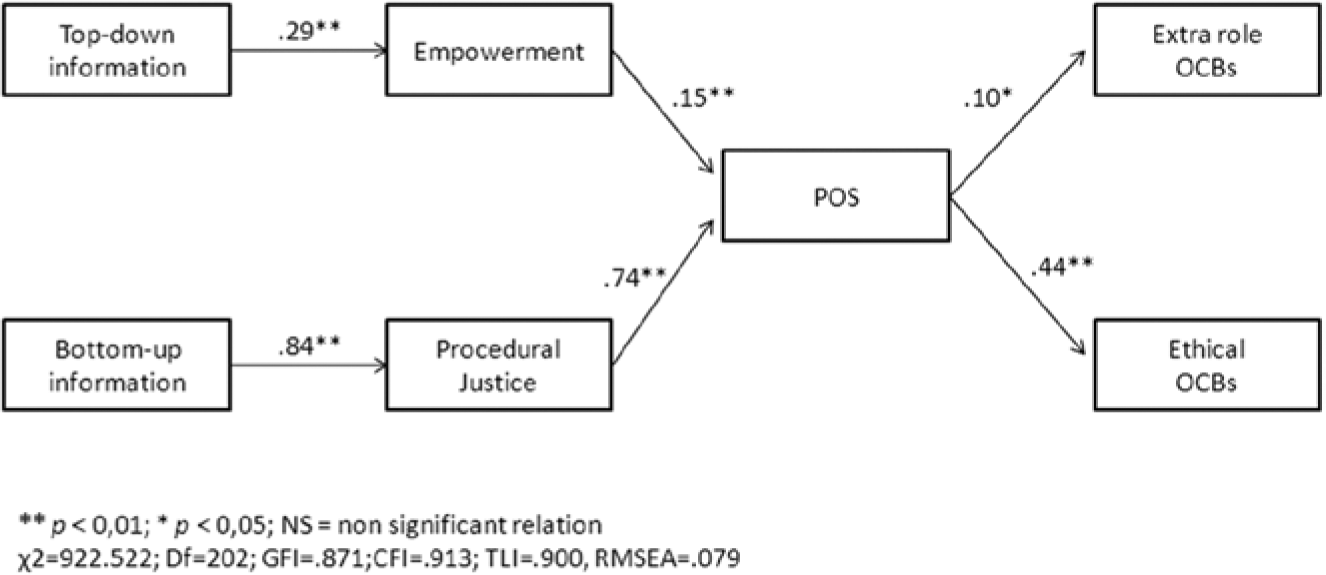
Test of the theoretical model.
Influence of Top-Down Information-Sharing Practices on Psychological Empowerment
TDIS refers to information dissemination practices, particularly with respect to the operation of the company, its objectives, its strategic orientation, and its financial results (Gibson, Porath, Benson, & Lawler, 2007). Spreitzer (1995) defined the concept of psychological empowerment as an intrinsic motivation expressed through four constructs: a sense of meaning, a sense of competence, a sense of self-determination, and a sense of impact. She believed that these four dimensions need to be present for an employee to feel significantly empowered. However, if one of these dimensions is either absent or weakly present, an employee’s sense of empowerment is not eliminated; rather, it is simply weakened. There is evidence to suggest that there is a strong relationship between TDIS and PE. To feel a sense of authority to act at work, employees need to be well informed of the general operation of the organization (Matthews, Diaz, & Cole, 2003).
If individuals have a poor grasp of the organization’s objectives and strategies, they may not understand the direction adopted by the company and may only be slightly aware of their personal contributions to the organization’s overall performance (line of sight) (Gibson et al., 2007; Lawler, Mohrman, & Ledford, 1992). Randolph (1995) considered TDIS as not only the most important but also the most commonly neglected and least understood component of empowerment. He believed that workers cannot act independently and responsibly if they have not been given all the information they need. To our knowledge, only Spreitzer (1996) and Bordin, Bartram, and Casimir (2007) have evaluated and found a relationship between TDIS and empowerment. Even though they do not make a distinction regarding the type of information disseminated, Zhang and Agarwal (2009) found a strong positive correlation between their communication construct and PE. Despite the dearth of available empirical evidence, arguments presented in the literature lead us to propose the following hypothesis:
Link Between Bottom-Up Information Sharing and Procedural Justice
PJ refers to employees’ perception of the fairness of decision-making procedures (Konovsky, 2000). In an organizational context, employees will consider a procedure to be fair if it allows them control over the decision-making process (voice effect) or over decisions leading to results (choice effect) (Thibault & Walker, 1975). In the literature, information sharing—BUIS in particular—is associated with a perception of procedural justice (e.g., Konovsky, 2000; Paré & Tremblay, 2007; Tremblay, Cloutier, Simard, Chênevert, & Vandenberghe, 2010). Unlike TDIS, BUIS deals with information reception practices such as voice mechanisms or upward problem-solving schemes (Dundon, Wilkinson, Marchington, & Ackers, 2004; Marchington, 2005). Such practices may assume various forms (suggestion boxes, opinion surveys, advisory committees, etc.), and they are concretized when employees are encouraged to state their ideas, opinions, concerns, and suggestions (Bovee & Thill, 2005; Lawler, 1986). According to Thibault and Walker (1975) and Folger (1977), procedures are perceived as fairer if they allow employees to express themselves. By encouraging individuals to voice their ideas, opinions, and suggestions, practices associated with BUIS are designed to offer employees the opportunity to express themselves and thus create a perception of PJ among them (Bhal & Ansari, 2007). According to the group-value model, employees view the use of just and equitable procedures as a sign of respect, consideration, and influence (Lind & Tyler, 1988). This theory suggests that employees value being members of the group and holding an enviable standing within the group. Offering opportunities to voice may be interpreted as a clear indication that the employee is considered as a valued member and his or her inputs are important. Shapiro and Brett (2005) maintained that giving the opportunity to voice enhances procedural justice through two important processes: the feeling of being listened to carefully and being sincerely respected, and the perception of having an influence on decision making. Findings regarding the effect of information sharing on PJ are relatively consistent. Paré and Tremblay (2007) discovered a positive correlation coefficient between these variables for a sample of Canadian employees, whereas Zhang and Agarwal (2009) observed a similar relation with a Chinese sample. However, neither of these studies specified the direction in which information is disseminated. Nevertheless, previous research suggests a positive link between BUIS and PJ.
Mediating Role of PE Between TDIS and Perceived Organizational Support
POS is another exchange mechanism that is likely to come into play in the relationship between information sharing and citizenship performance. POS is defined as an individual’s belief that his organization values his contributions and is concerned about his well-being (Eisenberger, Huntington, Hutchison, & Sowa, 1986). To some extent, POS can serve as an indication of the company’s commitment to its employees (Eisenberger et al., 1986). POS is also interpreted as assurance that the company will do everything to help and support employees experiencing difficulties (Rhoades & Eisenberger, 2002). Employees with a strong sense of POS believe that their employer is committed to them, values their contributions, is concerned about their well-being, and will support them whenever they face problems in their personal and professional life (Eisenberger et al., 1986; Rhoades & Eisenberger, 2002; Tremblay et al., 2010). According to Tremblay and Simard (2005), POS is increased through normal everyday actions, particularly when the company shows an interest in employees’ opinions, values, and problems. Therefore, HR practices that value employees’ contributions are likely to be perceived as constituting a sign of support from the organization (Allen, Shore, & Griffeth, 2003). Such HR practices show employees that the organization is committed to them and it wishes to build a long-term relationship with them. By engaging in sustained information-sharing practices (ISPs) and disseminating strategic and useful information (e.g., vision and values), the employer sends out a signal that it wishes to treat its employees as true associates, and that it is ready to provide them with the resources required to optimize their contributions (Allen, 1995; Zhang & Agarwal, 2009). Because top-down information-sharing practices are more likely to be viewed as discretionary, according to POS theory, this favorable treatment tends to be interpreted as a sincere intent to fulfill several important needs (e.g., resources and self-esteem; Allen, 1995; Eisenberger & Stinglhamber, 2011). Seen from that perspective, a clear link between ISPs and POS emerges.
Regarding PE, most authors have prioritized the analysis of the relationship combining structural empowerment and POS, thus abandoning the psychological aspect, which is central to the concerns covered in this study. An employee who believes she has a relatively high degree of freedom of action and control in her work is more likely to believe that her organization values her contributions and, consequently, will support her (Niehoff, Moorman, Blakely, & Fuller, 2001). Furthermore, to feel that they have the power to act, employees must have autonomy in their work and thus perceive that they have control over their actions. Such support enhances their feeling of self-determination (Seibert, Wang, & Courtright, 2011). According to Rhoades and Eisenberger (2002), autonomy is an antecedent for POS, and, theoretically, a high degree of autonomy should likewise be associated with high POS (Eisenberger, Rhoades, & Cameron, 1999). This relation was tested by Rhoades and Eisenberger (2002), who, as part of their meta-analysis, found a strong positive correlation coefficient between these variables. Because the perception of autonomy is one of the four components of the concept of PE, it is therefore fully plausible that PE will be positively associated with POS.
Mediating Role of PJ Between BUIS and POS
Like empowerment, PJ can also be associated with POS. This relationship is based on an argument advanced by Eisenberger et al. (1986), which stipulates that an organization that treats its employees favorably increases POS among the staff. Consistent use of fair procedures (considered as favorable treatment) has a positive effect on POS because it indicates the company’s willingness to consider the well-being of its members (Rhoades & Eisenberger, 2002). If the employee perceives the system to be just, then he will feel that the organization values him and considers him important, which will in turn lead him to feel supported by the latter. The relationship between PPJ and POS has undergone frequent empirical investigation (e.g., Ambrose & Schminke, 2003; Baran, Schanock, & Miller, 2011; Loi, Hang-Yue, & Foley, 2006; Rhoades & Eisenberger, 2002; Stinglhamber, De Cremer, & Mercken, 2006; Tremblay et al., 2010). The positive relationship between these variables thus represents a second link in the relationship between information sharing and OCBs. Tremblay et al. (2010) examined the extent to which PJ plays a mediating role between BUIS and POS. They found that adding a direct link between BUIS and POS did not significantly improve the proposed model. The authors conclude that PJ seems to have a fully mediating effect between information sharing and POS. We can therefore propose the following hypothesis:
Mediating Role of POS Between PE, PJ, and Citizenship Behaviors
We have shown that both PJ and PE are associated with POS (Rhoades & Eisenberger, 2002). Our model suggests that these two psychological states influence OCBs only indirectly, and that their effect is concretized through POS.
Direct Link Between Perception of PJ and OCB
There is compelling evidence to suggest that OCBs are influenced by PJ (Cohen-Charash & Spector, 2001; Colquitt, Conlon, Wesson, Porter, & Ng, 2001; Masterson, Lewis, Goldman, & Taylor, 2000). The perception of PJ is more strongly associated with the presence of OCBs than is the perception of distributive justice (Ball, Trevino, & Sims, 1994; Konovsky & Pugh, 1994; Niehoff & Moorman, 1993). Tepper, Lockhart, and Hobber (2001) have demonstrated that strong PJ is associated with a higher frequency of OCBs and a greater tendency to define these behaviors as in-role activities. According to social exchange theory (Blau, 1964), organizations are considered to be loci of mutual social and long-term transactions between employees and employers (Wayne, Shore, & Liden, 1997). These social exchange relationships typically trigger unspecified future obligations (Konovsky, 2000). Moreover, social exchange relationships are strongly influenced by the level of mutual confidence that the parties involved will comply with their fairly long-term obligations. PJ is thus considered one of the main factors of trust (Folger & Konovsky, 1989; Konovsky & Pugh, 1994) and an important input in exchange relations with employees (Masterson et al., 2000). A social exchange relationship founded on fair procedures is therefore more likely to promote a contractual relationship that gives employees the freedom to adopt discretionary behaviors. These behaviors are adjustment variables that employees can use to counter organizational injustice (Organ, 1990). Consistent with our earlier argument that fair procedures enhance the feeling of being treated as a full member of the organization, this sentiment should predispose individuals to perform activities and assume roles that exceed their normal tasks (de Cremer & Knippenberg, 2002; Tepper & Taylor, 2003). Moreover, when employees perceive they are treated fairly, they are more likely to trust authority that extra-role performance will be noticed and rewarded (Folger & Konovsky, 1989).
Direct Link Between PE and Organizational Citizenship Behaviors
The relation between PE and OCBs ranks among the least studied exchange mechanisms. Niehoff et al. (2001) found a positive link between PE and loyalty behaviors. Peccei and Rosenthal (2001), much like Chebat and Kollias (2000), observed a direct relationship between consumer prosocial behaviors and empowerment dimensions. Several theoretical justifications have been advanced to account for these links. First, as previously discussed, PE may be perceived as a signal that the organization trusts its employees and that it is adopting measures to support them. According to social exchange theory (Blau, 1964), employees should be more likely to adopt behaviors that are beneficial to the organization. Nonetheless, Bailey’s model (in Appelbaum, Bailey, Berg, & Kalleberg, 2000) states that PE may also be considered as a signal that the individual has the opportunity and/or power to perform discretionary actions. A third explanation concerns the reinforcement of the perception of personal efficiency. Research has shown that perceived personal efficiency (e.g., Bandura, 1977) is linked to a high degree of diversity in behaviors that some have associated with extra-role performance (Walumbwa, Cropanzano, & Goldman, 2011).
Direct Link Between POS and OCBs
POS has been associated with extra-role behaviors such as helping others and coming up with creative suggestions (Eisenberger, Fasolo, & Davis-Lamastro, 1990; Kaufman, Stamper, & Tesluk, 2001; Lynch, Eisenberger, & Armeli, 1999; Masterson et al., 2000; Moorman, Blakely, & Niehoff, 1998; Shore & Wayne, 1993; Van Yperen, van den Berg, & Willering, 1999; Wayne et al., 1997; Wayne, Shore, Bommer, & Tetrick, 2002). The meta-analysis by Rhoades and Eisenberger (2002) has demonstrated a moderate association between POS and OCB toward the organization (r = .28). Social exchange theory is the predominant theoretical explanation for these links (Blau, 1964). Accordingly, POS can be perceived as some favors or discretionary actions from employers that awaken feelings of indebtedness in their recipients. When and how this debt is to be repaid are generally unspecified (Wayne et al., 1997). Nonetheless, employees are motivated to repay the employer’s favorable treatment and to exhibit behaviors commensurate with the support obtained (Wayne et al., 1997). When an individual or entity treats another party well, that person is obliged to reciprocate by treating the other party better. The relation between the sense of obligation to repay a debt and citizenship performance was studied by Eisenberger, Armeli, Rexwinkel, Lynch, and Rhoades (2001). Adopting extra-role behaviors is thus a form of reciprocity shown to the employer. Rhoades and Eisenberger (2002) suggested two other explanations for the link between POS and OCBs. First, the respect, approval, and caring that underlie POS are likely to satisfy several socioeconomic needs (e.g., needs for esteem, consideration, and inclusion in the group). Second, POS should reinforce the belief that the organization recognizes and rewards employees’ efforts and performance. These processes should in turn motivate employees to exhibit extra-role behaviors (Wayne et al., 1997). Coupled with the predicted relationships between PJ, PE, and POS, and between POS and OCB, the present study suggests that POS could serve as a mediator of justice and empowerment-OCB relationships. However, such mediation should only be partial given that POS alone is incapable of fully explaining such complex paths. We therefore propose the following hypotheses:
Methodology
Participants
To test our research hypotheses, we used a sample of respondents from two major Canadian organizations. The sample is made up of 568 respondents: 274 from an organization operating in the financial sector and 294 from an organization in the health care sector. Out of a total of 1696 questionnaires sent out, 908 were returned to the researchers, representing a 53.3% response rate (financial organization: 69%; health care organization: 47%). Out of 908 participants, we retained only those whose immediate superiors had agreed to assess their citizenship performance. We thus formed 568 respondent dyads. The sample retained for the study primarily consisted of women (86%), and the average age of respondents was 42. The employees had been in their organizations for an average of 11.6 years.
Procedure
To verify our research hypotheses, we used data collected as part of two surveys conducted. In the case of the financial sector organization, the sample was selected from a list of branch managers who had previously shown interest in questions about staff’s extra-role performance. Of all the managers contacted, eight responded, thus allowing researchers the possibility of reaching a pool of about 500 employees. 477 questionnaires were sent out by post to staff working in the eight branches retained. This was a voluntary, confidential, and anonymous exercise. In the case of the health care sector organization, the questionnaires were distributed at the work sites of the institution’s employees by internal mail. The respondents had 2 months to answer and had to return the completed questionnaires in a locked box. Employees who completed and returned the questionnaires were entitled to two tickets for free meals in the cafeteria. A pretest of the questionnaire was also given to about 30 people selected at random. It allowed an assessment of the employees’ understanding of the questions and indicated how much time would be needed to complete the questionnaire.
Both data collection exercises were conducted through a questionnaire administered to selected employees and their immediate superiors. All perceptions respecting practices and attitude variables were measured by the employees. Organizational citizenship behaviors were assessed by the immediate superiors. Furthermore, the fact that we had this variable measured through the immediate superior, unlike other variables measured by the employee, allowed us to avoid common variance problems and to limit social desirability bias.
Measurement Instruments
For all indicators, respondents had to state their degree of agreement on a scale ranging from (1) completely disagree to (7) completely agree.
Statistical Analyses
The analytical approach used is the two-step modeling recommended by Anderson and Gerbing (1998). Basically, by using a series of niche models and chi-square difference tests, this method prioritizes the factor pattern assessment before embarking on a structural analysis of a model specified a priori from theoretical bases. Thus, to determine how to adjust the measurement model to suit the data collected, we carried out a confirmatory factor analysis by specifying a measurement model and comparing it with alternative measurement models. Next, we used structural equations to test the research hypotheses, using the AMOS 7.0 software application. We also tested for the significance of the mediated effects using Sobel’s (1982) test. The chi-square difference tests allowed a comparison of our theoretical model with several alternative models found in the literature. In our analyses, we used the maximum likelihood estimation method. Several indices were used in assessing the degree of fit of the proposed measurement and structure models, that is, the chi-square (χ2), the Comparative Fit Index (CFI), the Goodness-of-Fit Index (GFI), the Tucker-Lewis Index (TLI), and the root mean square of approximation (RMSEA). We thus cover the primary absolute and parsimony indices required to assess our models (Byrne, 2001). The absolute indices selected—namely, χ2, GFI, and RMSEA—allow us to measure the match between the proposed theoretical models and the data collected. Ideally, the χ2 value should be significant at the p < .05 threshold, the RMSEA should be less than .08, and the GFI greater than .90 (Roussel & Wacheux, 2005). The incremental indices selected—namely, the CFI and TLI—allow assessment of the difference in fit between the theoretical models and an independent model wherein the variables are not correlated. Both of these indices should be as close as possible to 1 and ideally be greater than .90.
Confirmatory Factor Analyses
To demonstrate the construct of our measurement scales, we carried out a confirmatory factor analysis of our 7-factor model in addition to testing several alternative measurement models. We also tested a 6-factor model in which we included both top-down and bottom-up information sharing. Next, we tested a 5-factor model composed of three attitude-mediating variables, namely, PE, PJ, and POS. We also tested a 6-factor model with two OCB variables combined to form a single factor. Finally, to test the discriminating validity of our measurement scales, we examined a model in which all models are combined to form a single factor, which allowed us to identify common variance problems. As can be seen in Table 1, our 7-factor theoretical measurement model comprises highly acceptable indices (χ2 = 761.47, df = 188, GFI = .891, CFI = .931, TLI = .915, and RMSEA = .073) in addition to being significantly superior to the other models evaluated. After evaluating the acceptability of the measurement model, we examined plausible alternative models to answer two specific questions related to the proposed model depicted in Figure 1: (a) Do empowerment and procedural justice have full or partial mediating effects on information-sharing practices and POS? (b) Does POS have a full or partial mediating influence on POS-OCBs? Table 2 presents averages, standard deviations, internal consistency coefficients (alphas), and correlations among the latent variables studied.
Confirmatory Factor Analysis Results.

Note. χ2 = chi-square; ∆ χ 2 = delta chi-square; df = degrees of freedom; GFI = Goodness-of-Fit Index; CFI = Comparative Fit Index; TLI = Tucker-Lewis Index; RMSEA = root mean square of approximation; OCB = organizational citizenship behavior.
p < .05; **p < .01.
Averages, Standard Deviations, Alphas, and Correlations Between Latent Variables.
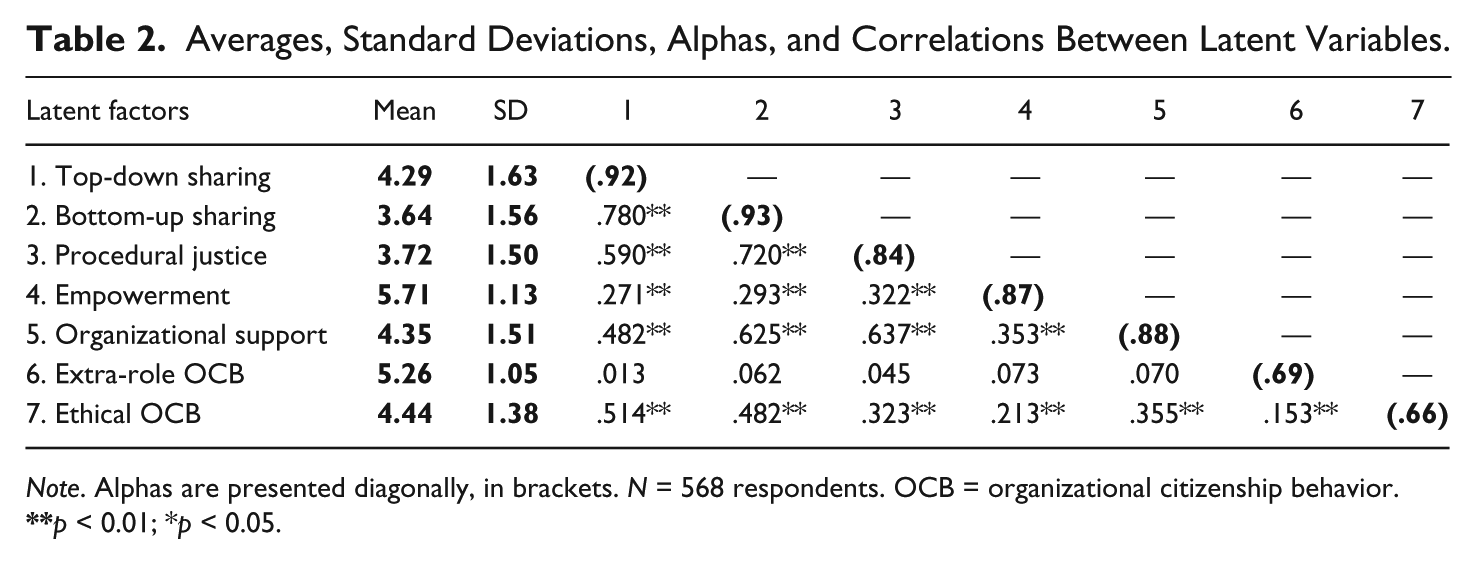
Note. Alphas are presented diagonally, in brackets. N = 568 respondents. OCB = organizational citizenship behavior.
Test of Hypotheses
The fit indices obtained for the theoretical model are satisfactory (GFI = .871; CFI = .913; TLI = .900; RMSEA = .079). Figure 1 presents standard coefficients (β) obtained for the theoretical structure model. Furthermore, as Table 3 shows, all the links tested within the theoretical model proved to be significant. In accordance with hypotheses 1 and 2, we found a significant positive relationship between TDIS and PE (β = .29, p < .01) and between BUIS and PJ (β = .84, p < .01). In addition, the results indicate that empowerment (β = .15, p < .01) and PJ (β = .73, p < .01) are positively related to organizational support. Hypothesis 3 proposed that PE mediates the relationship between top-down information and organizational support. Sobel’s (1982) test of indirect effect indicates that mediation is significant (Z = 4.71, p < .01). Hypothesis 4 proposed that procedural justice mediates the relationship between bottom-up information and organizational support. Sobel’s test of indirect effects indicates that the mediation effect is significant (Z = 8.1, p < .01). Hypothesis 5 posited that POS mediates the relationship between PJ and extra-role and ethical OCBs. The results indicate that POS is positively related to extra-role (β = .10, p < .01) and ethical OCBs (β = .21, p < .01). Sobel’s test of indirect effect indicates that mediation is significant only for the extra-role performance path (Z = 1.98, p < .05). Hypothesis 6 stated that POS mediates the relationship between empowerment and OCBs. Sobel’s test of indirect effect indicates that mediation is significant for extra-role (Z = 2.16, p < .05) and ethical OCBs (Z = 4.74, p < .01).
Structure Models.
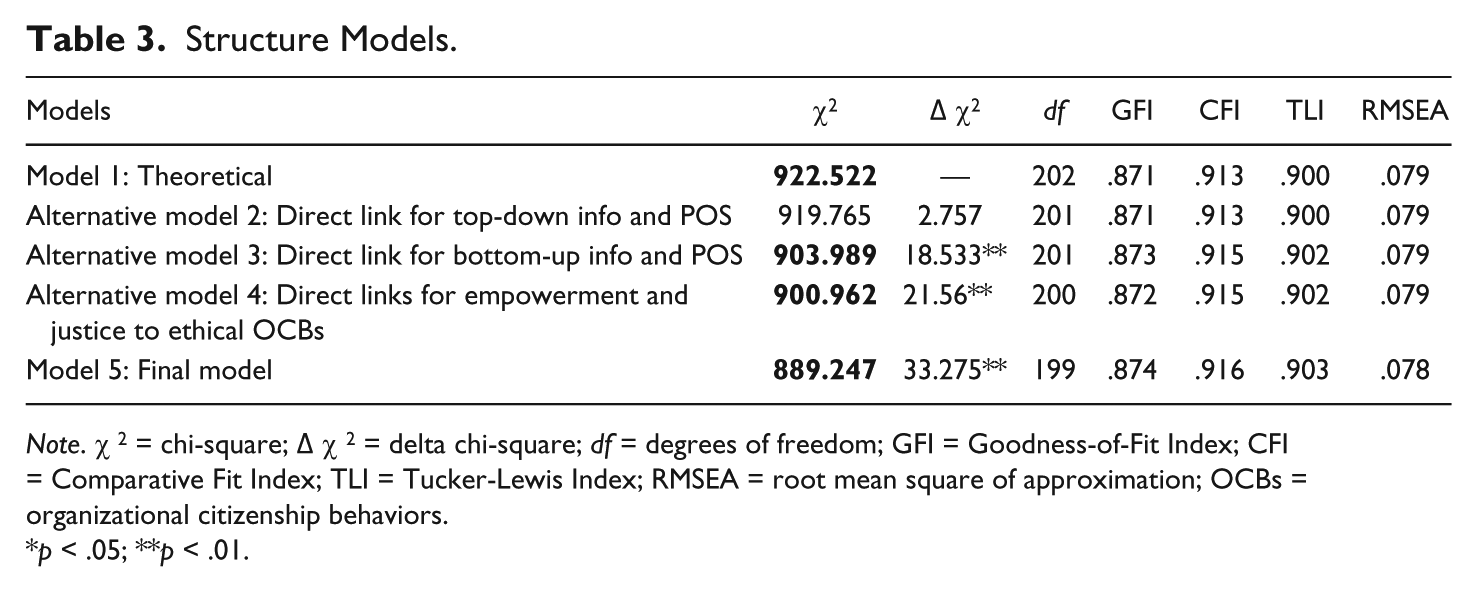
Note. χ 2 = chi-square; ∆ χ 2 = delta chi-square; df = degrees of freedom; GFI = Goodness-of-Fit Index; CFI = Comparative Fit Index; TLI = Tucker-Lewis Index; RMSEA = root mean square of approximation; OCBs = organizational citizenship behaviors.
p < .05; **p < .01.
Alternative Models
We tested alternative models to improve the model proposed. Alternative model 2 is based on the argument that communication from influential managers may be interpreted as discretionary favorable treatment (Eisenberger & Stinglhamber, 2011). We thus posit a direct relation between TDIS and POS. This alternative path was not significantly superior to the theoretical model. Mediation hypothesis H3 is therefore validated. Consistent with previous studies that found that discretionary HR investments that enhance employees’ initiatives and involvement are more likely to increase POS (e.g., Gavino, Wayne, & Erdogan, 2012), our results show that alternative partial mediation model 3, which specifies a direct relation between BUIS and POS, is significantly superior to the theoretical model (∆ χ2 = 18.533, ∆ df = 1, p < .01). Mediation hypothesis H4 is therefore partially validated. Alternative model 4, which proposes a direct relation between empowerment, procedural justice, and ethical OCBs, also proved to be significantly superior to the theoretical model (∆ χ2 = 21.56, ∆ df = 3, p < .01). Consequently, mediation hypotheses H5 and H6 are partially validated. Compared with the theoretical model, these models produce better results for all the indices evaluated. We tested an additional model (5), in which we included the direct relations proposed in models 3 and 4. As Table 3 illustrates, model 5 is significantly superior to the theoretical model (∆ χ2 = 33.275, ∆ df = 3, p < .01). It also produces better results for all indices evaluated compared with the other models tested. Consequently, model 5 was retained as the final model. Figure 2 presents the standard coefficients of the final model retained.
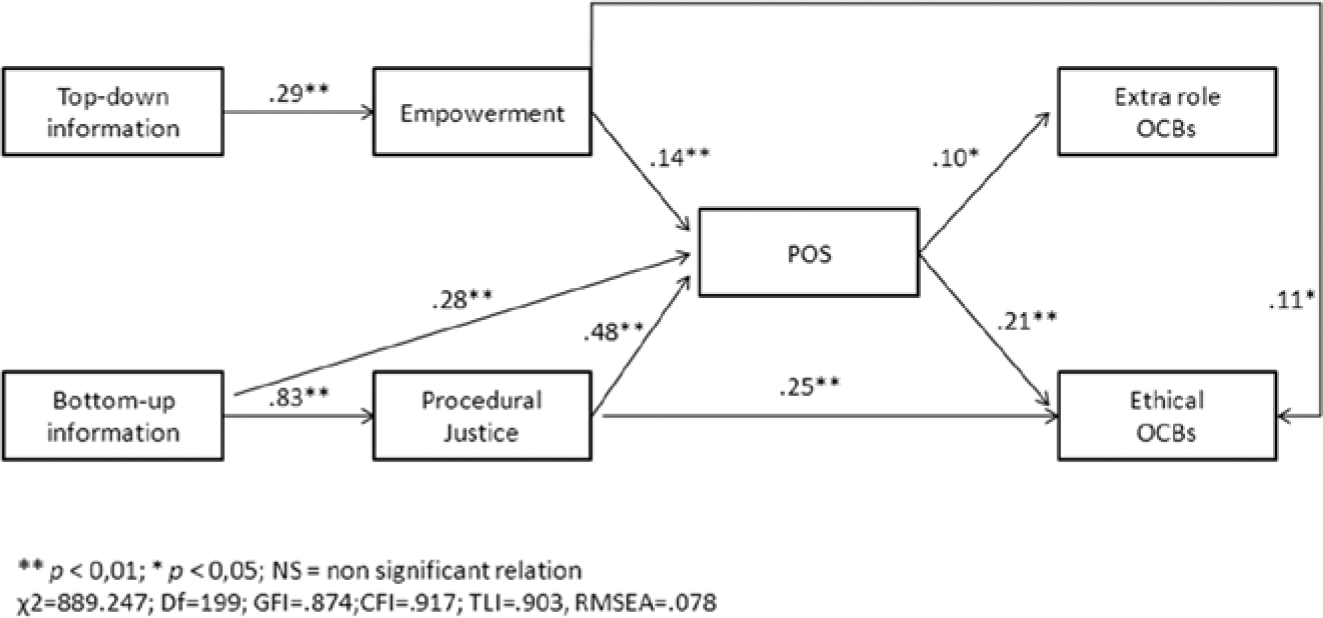
Final model.
Discussion
The primary aim of this study was to propose and test a theoretical model containing four psychological conditions forming an explanatory chain between information-sharing practices and organizational citizenship behaviors. The results support the superiority of the model by taking into consideration two distinct latent factors for the organizational information-sharing construct. The structure model test confirmed our first hypothesis concerning the positive influence of TDIS practices on PE. Concretely, the more respondents perceive management as sharing important information with them (e.g., major projects; new products, programs, and/or services; and financial performance), the greater their desire to act at work. This result is consistent with past studies (Bordin et al., 2007; Spreitzer, 1996) and is particularly interesting to the extent that it supports the theoretical arguments stating the importance of sharing strategic information with employees to increase their sense of empowerment. If individuals do not have a good idea about the challenges facing the organization, they will be more likely to either not know or not understand the direction adopted by the company, and have a limited or unclear vision of their personal contribution to the organization (Gibson et al., 2007; Lawler et al., 1992). Fully in line with this argument, our respondents consider themselves to have greater authority to act when they believe they have the information required to contribute actively and personally to realizing the organization’s objectives. Even though past studies established a relation between information sharing and PJ (Paré & Tremblay, 2007; Zhang & Agarwal, 2009), our research demonstrates that this perception of PJ is very sensitive to the BUIS dimension. The more respondents believe that management is offering them concrete means to express themselves, the greater the sense of PJ they perceive in their work environment. Thus, although information-sharing practices (opinion surveys, focus groups, etc.) aim to encourage individuals to express their ideas, opinions, and suggestions, they also allow them to strengthen the perception of procedural justice. This backs the arguments by Thibault and Walker (1975) and Folger (1977) that organizational procedures are more likely to be perceived as fair if they allow employees to express their thoughts and opinions. In line with the group-value model perspective (Bies & Shapiro, 1988), giving employees the means and power to express their opinions and ideas reinforces messages of inclusion and that the employer is treating them as worthy people.
In line with our first mediation hypothesis (H3), the model that links TDIS to POS did not prove to be superior to the theoretical model. PE thus appears to have a fully mediating effect between TDIH and POS. Few previous studies had analyzed the influence of PE on POS. However, the perception of autonomy has received more attention (see Rhoades & Eisenberger, 2002). Our results suggest that the perception of having greater authority to act at work fosters a greater level of support. The fact that PE has a fully mediating effect leads us to believe that information sharing is perceived as a resource that fosters support, provided such actions result in a greater ability to act.
Hypothesis H4, which evaluated the mediating effect of PJ between BUIS and POS, could only be partially validated. We found a direct significant relation between BUIS and POS in this study, and this model proved to be superior to the theoretical model. This result suggests that the expression of ideas and opinions is perceived as a clear signal that the organization is striving to meet its employees’ needs (e.g., self-esteem). Alternatively, intermediate mechanisms other than PJ and PE, which are likely to influence POS, may not have been taken into consideration in this study. For example, trust in the organization or in authorities may represent an important variable explaining how information sharing influences POS. It would be interesting to have future studies verify this possibility.
Hypothesis H5, which proposed that POS should have a mediating effect between PJ and OCBs, is partially confirmed by our results. This result implies that PJ strengthens OCB performance (ethical dimension) both directly and indirectly. First, PJ appears to foster OCBs by reinforcing POS. This result is consistent with research by Stinglhamber et al. (2006) and Tremblay et al. (2010) on the partial mediating effect of POS between justice and extra-role performance. The use of fair procedures may be seen as a sign that the organization is taking steps to support its employees. To return the favor, employees who feel they have been treated fairly would have a greater tendency to reciprocate through higher extra-role performance. Whenever the organization uses procedures that are considered equitable, the moral need to repay is more strongly felt and is translated into more OCBs. However, the most parsimonious model is the one that directly links PJ to ethical extra-role behaviors, represented primarily through conscientiousness and sportsmanship. These elements capture the individual’s desire to observe the rules and accept constraints. The literature puts forth three prominent motivations to account for the effect of PJ on extra-role performance: (a) instrumental motivation (self-interest), (b) relational motivation (status, or standing in the group), and (c) moral motivation (moral principles) (Cropanzano, Rupp, Mohler, & Schminke, 2001). If individuals believe that the organization or its representatives are committing violations (e.g., non-observance of psychological contract rules), then the individuals may consider that they too are not required to observe certain moral principles, and may deem it acceptable to overlook certain explicit or implicit rules (e.g., being absent at a higher than normal rate, stealing the employer’s time, and constantly criticizing work methods). It may be interesting in the future to focus research efforts on examining the impact of various motivations associated with justice, particularly on in- and extra-role performance.
Lastly, hypothesis H6, which covers the mediating role of POS between PE and OCBs, has been partially confirmed. This result would suggest that PE affects ethical OCBs directly as well as through POS. First, PE reinforces POS, which in turn reinforces OCBs. Our results back the social exchange and opportunities arguments. Supporting social exchange, actions aimed at fostering PE are likely to improve citizenship behaviors if such actions can signal that they were implemented to provide employees with support and help (Eisenberger & Stinglhamber, 2011). However, if employees perceive increased control and a greater workload, empowerment will have little effect on POS (Chênevert & Tremblay, 2009). Incidentally, POS is not the only path through which PE influences OCBs. The direct link between PE and OCBs, recently confirmed by the meta-analysis performed by Seibert et al. (2011), can be explained by the facts that (a) empowerment may indeed lead the employee to believe that the organizational structures in place offer her opportunities and the authority to take discretionary actions (Robbins, Crino, & Fredendall, 2002); (b) it may foster a higher sense of employee identification and involvement in the overall workplace (Seibert et al., 2011); and (c) the influence of PE is indirect and is realized through other social exchange mechanisms, such as trust (Laschinger, Finegan, & Shamian, 2001; Robbins et al., 2002).
Theoretical and Practical Implications
To our knowledge, our study is one of only a few to have investigated the effect of information-sharing practices on extra-role performance, while deliberately distinguishing TDIS and BUIS, and showing the importance of examining the two modes as separate entities. Our results show TDIS to be very useful for reinforcing PE and BUIS to be very useful for increasing the perception of PJ. From a theoretical standpoint, our research sheds an interesting light by reaffirming the existence of intermediate mechanisms between information sharing and OCBs. Furthermore, our results lead us to conclude that, singly, information-sharing methods have no effect on extra-role performance. Rather, their influence is conditional on such actions being perceived as signs of relational commitment by the employer or its representatives. Third, POS cannot be considered enough of an exchange condition to prompt strong citizenship behaviors. JP and PE are thus exchange mechanisms that are just as beneficial as POS. Furthermore, our research does not allow us to confirm the existence of a social exchange hierarchy, or that there is only one principal path to extra-role performance. Rather, it seems that individuals need to accumulate significant amounts of “social debts” to be motivated to adopt reciprocity behaviors, at least regarding their citizenship performance.
From a practical standpoint, although information sharing may never have been combined with another innovative HR practice, communication efforts may indirectly contribute to improved extra-role performance. Furthermore, the close link between bottom-up information sharing and PJ shows decision makers how important it is to allow employees the chance to express themselves. Organizations wishing to foster a strong sense of fairness in procedures must make serious investments in information-sharing efforts and resources. Incidentally, in light of our results, the dissemination of strategic information (vision and values) and operational information (e.g., objectives and competitors’ performance) represents effective means of action for developing a strong sense of empowerment in the workplace. However, managers must be aware that these two information-sharing practices, although both beneficial, do not have the same effect on citizenship behaviors. The present study suggests that practitioners can encourage this type of performance using various formal and informal means of soliciting employees’ opinions and ideas. Finally, our results suggest that organizations should provide managers with resources and support (budget, time, and training) to allow them to optimize the impact of their communication initiatives on their followers.
Limitations and Future Research
Our study, nonetheless, has certain limitations. Because our sample is composed of employees working in two organizations, we cannot consider extrapolating our results to a larger scale. Second, although our structural equation analyses point to the influence that certain psychological variables have on POS and OCBs, it would indeed be a stretch to talk of a causality relationship. Indeed, since the methodology prioritized was not longitudinal, we cannot firmly conclude that a given variable predicts another, and not the other way around. It would be reckless to claim with absolute certainty that the sense of empowerment strengthens POS, that information practices and POS are the causes of extra-role performance, or that the opposite is false. Third, risks associated with a common variance error may have influenced the relations in our model. Considering that attitude variables were measured simultaneously and only in a single source (employee), there is a significantly high probability for a common variance error to occur. However, given that we wanted to study employees’ perceptions, we could not avoid this error by questioning their colleagues or their superiors. We thus minimized the common variance error by collecting performance data from immediate superiors. Our results pave the way for future research. First, we believe that it would be interesting to have our theoretical model undergo an empirical evaluation, but in a different context. We could then reexamine our research hypotheses to determine their robustness to new circumstances. This exercise should allow us to validate or cancel this study’s results while evaluating their true generalization potential. Second, we believe that it would be interesting to study the causality of the relationships in the final model using a longitudinal design. As mentioned, the methodology used in this research does not allow us to conclude that a particular variable causes another. Thus, using a longitudinal design could considerably improve our level of knowledge and provide formal backing for the direction of such relationships. To minimize the risks associated with common variance errors, we also believe that it would be important to involve the immediate superior in the process, for example by asking him or her to evaluate the level of dissemination of information-sharing practices. Fourth, it would be interesting to consider other psychological mechanisms likely to come into play. In addition to trust, which we identified earlier, the roles of organizational commitment, recognition, and interpersonal justice could be investigated. It would also be worth studying other relationships, combining information sharing in the workplace with various behaviors such as absenteeism and the turnover rate. Finally, this study suggests that the more individuals receive information or are solicited to provide it, the more positive their reactions will be. Several scholars have challenged this assumption and suggested that information overload could adversely affect performance (e.g., Clampitt, 2010; O’Reilly, 1980). For example, sharing information might have a positive influence on perceived organizational support only when information overload is low, and it could have a negative influence when overload is high. It would be worth exploring this possibility in future research.
Footnotes
Declaration of Conflicting Interests
The author(s) declared no potential conflicts of interest with respect to the research, authorship, and/or publication of this article.
Funding
The author(s) disclosed receipt of the following financial support for the research, authorship, and/or publication of this article: Michel Tremblay has received a research grant from the Social Sciences and Humanities Research Council of Canada.