



Abstract
Motivating language (ML) is a leader oral-communication strategy which has been significantly linked to such positive employee outcomes as higher job performance, increased job satisfaction, lower intention to turnover, and decreased absenteeism. However, most ML research has not targeted an organizational system at multiple levels. In brief, we have not looked at how this beneficial form of communication is actually implemented throughout an organization, including at the CEO level. In response to this gap, our main goals were to identify robust hypotheses on ML diffusion for future empirical testing, better understand the emergent processes of ML adoption within an organization, and advance development of related theory. These goals were achieved through an agent-based simulation model, drawn from management, communication, and social network scholarship. More specifically, overview, design concepts, and details protocol and NetLogo software were applied to simulate ML diffusion among all leader levels within an organization. This model also captured the influences of predicted moderators, and results were then interpreted to create testable hypotheses. Findings suggest that top-leader oral language use and organizational culture have the most profound impact on ML diffusion, followed by rewards, with partial weak support for the effects of training, turnover, and time. Recommendations were also made for future research on this topic, especially for empirical tests.
Prominent organizational scholars assert that leader communication is the bridge to interpretation, meaning, and consequent action in organizations (Conger, 1991; Daft & Weick, 1984; Fairhurst & Connaughton, 2013; Weick, Sutcliffe, & Obstfeld, 2005). To better understand these vital functions, motivating language theory (MLT) has been developed to support the beneficial alignment of strategic leader oral-communication and positive organizational outcomes. Case in point, leader motivating language (ML)—a leader language model drawn from speech acts theory (Austin, 1975; Searle, 1969; Sullivan, 1988)—has a substantial track record of significant, positive relations with a large, diverse number of employee outcomes which benefit the welfare of internal organizational stakeholders including job performance and job satisfaction, among many others (Cascio & Boudreau, 2011; Holmes, 2012; Madlock & Sexton, 2015; J. Mayfield & Mayfield, 2007, 2012; M. Mayfield & Mayfield, 2015; J. Mayfield, Mayfield, & Kopf, 1998; Sharbrough, Simmons, & Cantrill, 2006; Sun, Yang, Liao, & Wang, 2008; Wang, Hsieh, Fan, & Menefee, 2009; Zorn & Ruccio, 1998).
Yet there remain many areas for exploration with MLT. With the initial conceptualization of MLT, for example, Sullivan (1988) constructed the theoretical model (which he originally termed as motivational language) to embrace the organizational as well as individual, dyadic, and team levels of analysis. But to date, only one study (Holmes, 2012) has tested the construct at the organizational level. Even though this sole investigation produced robust support for MLT’s link with desirable organizational outcomes, notable performance, a corroborative theoretical framework is needed.
Equally important, there has not been any research conducted about how ML is adopted and diffused by leaders’ speech throughout an organization. Consequently, we do not know how to foster high-ML use (and thus be enriched by its benefits) within an organizational culture. Moreover, most of the previous MLT development has been limited to linear, cross-sectional frameworks, potentially masking nonlinear and cyclical communication flows (those that entail feedback loops) which unfold over time. While the expectation of a linear relationship—a constant relationship between increases in ML and changes in related variables—has been a useful starting point for analyses, this type of report seems unlikely if there are feedback loops between variables (Brown, 1995, 2007). Once communication relationships are viewed as dynamic rather than cross-sectional (or occurring at one point in time), the mutual influences between these relationships must be explored and accounted for in theoretical development. For example, modeling effects of ML may create nonlinear relationships (ones where the strength of influence between variables change depending on the level of a given variable).
In practical terms, when few leaders engage in high levels of ML use, there will be only a marginal presence of quality ML use, just as there will be few opportunities for lower level leaders to observe effective ML talk. In these scenarios, increases in ML use by a relatively isolated leader will have little influence on the cultural pervasiveness of ML in an organization. However, if ML speech increases among most leaders in an organizational context, there will be increased opportunities for other leaders to observe better oral communication methods, and these leaders will be more likely to adopt ML. Finally, after most leaders have adopted high-quality ML practices, percentage increase in ML adoption can be expected to decrease since there will be fewer leaders who embrace low-quality ML speech, and resultantly fewer leaders who can improve their oral messages.
The preceding feedback loops and influence patterns are expected in multiplex oral communication systems (Almaney, 1974; Duffy, 1984)—spoken communication systems where individuals have multiple, interconnecting oral communication relationships. Such communication systems are difficult to capture with standard quantitative analytic methods, but computer simulations can provide insights into these relationships that can be later tested using more traditional research methods (Golen & Burns, 1988; Pettit, 1972; Railsback & Grimm, 2011). Yet to date, investigations of these important—and arguably more realistic—spoken organizational communication relationships have been lacking in ML studies.
In brief, we do not know what factors encourage or discourage ML diffusion at multiple levels in a firm within a longitudinal setting. This knowledge is needed for effective implementation that optimizes the benefits of the enhanced organizational and employee welfare, associated with ML. Such an understanding of ML assimilation and its emergent properties is also crucial for model specification and for fostering this positive form of oral leader communication in practice. Relatedly, scholars in the field of communication networks have called for increased multiplex model exploration, which looks both into the interaction of communication content and network structure and at the emergence and replication of message formats as well (Monge & Contractor, 2001; Shumate & Contractor, 2013).
This investigation will be presented in the following sections: a literature review and explication of MLT; an ML diffusion model which includes axioms—drawing on management, organizational communication, and social network theory literature; methodology; results; and discussion.
Motivating Language Theory: A Review of Selected Literature
MLT was first conceptualized by Sullivan (1988) as an oral communication alternative to the prevailing management focus on uncertainty reduction in organizational leadership. Thus Sullivan asserted that at organizational, team, and dyadic levels of analysis, leaders could improve employee motivation by strategically using all three major forms of linguistic speech acts—in their oral messages (Austin, 1975; Searle, 1969). He wrote the following comparison about extant managerial motivation theory and the added value of MLT:
All of these theories require supervisors to use language in a restrictive manner. Motivational language theory calls for the opposite; all functions of language must be combined in a coherent discourse in order to have the greatest impact on employee motivation. (Sullivan, 1988, p. 113)
The three major speech act categories (Austin, 1975) were described by Sullivan as “locutionary acts, focused on the meaning of words; illocutionary acts, focused on what the speaker is doing while talking; and perlocutionary acts, what the speaker hopes to accomplish” (Sullivan, 1988, p. 108). These speech acts are firmly rooted in management theory, and can be translated into leader-subordinate oral communication as follows:
Meaning-making (locutionary) messages refer to a leader’s spoken transmission of organizational values, vision, and culture to followers. Such words elicit mental models of an organization’s purpose, and how each individual employee contributes worth to this end. In addition, meaning-making speech explicates cultural norms and practices so that the followers gain enhanced understanding of accepted ways of getting things done within a unique organizational framework. In some cases, meaning-making language is expressed indirectly, through storytelling. For instance, when a leader recounts an organizational hero or heroine who achieved desirable objectives, meaning-making language occurs. This type of speech also happens when a leader recognizes (via talk) the value added by an employee’s work endeavors. Moreover, meaning-making language assumes special importance during times of change and organizational entry and assimilation (M. Mayfield & Mayfield, 2015; Sullivan, 1988). The theoretical foundations of meaning-making leader speech are present in the job characteristics model (Hackman & Oldham, 1976; Sullivan, 1988), cultural sensemaking, organizational entry and assimilation, and visionary change (Jablin, 2001; Weick et al., 2005; Yukl, 2013).
Empathetic (illocutionary) language expresses (via speech) a leader’s genuine, humane concern and bonding with a report. Examples of empathetic language are praise for a follower’s job well-done, recognition of employee merit, and commiseration with a subordinate who encounters a task setback. Empathetic language intersects with management theory’s people-directed leadership styles (Miner, 2005) and path goal theory’s supportive leadership factor (House, 1971; Sullivan, 1988).
Direction-giving (perlocutionary) speech reduces organizational uncertainty. This form of leader-to-follower talk appears with transparent goal setting, role and delegation clarity, coherent process/time guidelines, and articulation of rewards. Direction-giving speech also is given with constructive oral performance feedback to a subordinate. This dimension of MLT reflects expectancy theory (Miner, 2005; Robbins & Judge, 2012; Sullivan, 1988), instrumental leadership in path goal theory (House, 1971), and goal-setting theory (Miner, 2005; Robbins & Hunsaker, 2012; Sullivan, 1988).
These three facets of MLT are based on a few central assumptions. First, the leader must behave consistently with what he or she says. More succinctly, the leader has to walk-the-talk. Second, ML must include the use of all three types of speech acts in appropriate ways. Third, while MLT emphasizes leader-to-follower oral communication, the follower must correctly interpret the leader’s intended messages (J. Mayfield & Mayfield, 2012; Sullivan, 1988).
MLT has so far been investigated through the development and implementation of a highly reliable and valid scale (Luca & Gray, 2004; J. Mayfield, Mayfield, & Kopf, 1995). The same instrument or modified versions have been operationalized in both quantitative and qualitative studies to support positive, significant relationships between ML, and desirable employee behaviors and attitudes including more effective decision making, higher job satisfaction, higher communication satisfaction toward a leader, higher perceived leader competence, more innovation, higher job performance, higher team creativity quality, higher self-efficacy, enhanced organizational commitment in Mexico, lower absenteeism, and lower intent to turnover (Holmes, 2012; Madlock & Sexton, 2015; J. Mayfield et al., 1998; J. Mayfield & Mayfield, 2012; M. Mayfield & Mayfield, 2015; McMeans, 2001; Sharbrough et al., 2006; Sun et al., 2008; Wang et al., 2009; Zorn & Ruccio, 1998). Furthermore, Wang et al. (2009) adopted an experimental design methodology that supported MLT’s positive and significant influence on creative idea genesis by virtual teams, hence extending ML to written communication and suggesting causality. However, since MLT investigations into multiple media channels are quite limited, this research study is confined to the domain of spoken words.
While these insights are promising, many important aspects of MLT remain untested. The extant studies are cross-sectional, and with a few exceptions are limited to the dyadic level of analysis. In addition, well-respected scholars (Fairhurst, 2001; Fairhurst & Connaughton, 2013; Macy & Willer, 2002; Zorn & Ruccio, 1998) have recommended alternative research methodologies to the frequent linear models that have been used to explore ML in the past. Also important, only one investigator (Holmes, 2012) has evaluated ML both quantitatively and qualitatively at a cross level of analysis, that of the organization (principal speech) and its interactions with lower level outcomes (teacher and student performance ratings). In brief, his study found that school principals’ (at the organizational level) use of ML was significantly related to both school (student achievement) and teacher performance ratings. And finally, there is a lack of knowledge about how ML diffuses within an organization, and how central variables interact with this diffusion process.
Increased understanding of the aforementioned processes and use of new research methodology, specifically a simulation model, are needed to both advance the theory and to successfully reap its benefits in practice. Simulation models allow researchers to develop more complex theories and especially theories that involve speech feedback loops in the relationships. When such feedback loops exist—most particularly in dynamic relationships that unfold over time—it is difficult to fully grasp their influence as evidenced by how a leader talks. Simply put, tools such as software simulations, which examine predicted variable relationships, help us better comprehend how leader speech is adopted over time. Once a simulation has been created based on individual interactions, it is subsequently possible to develop hypotheses that can be tested empirically.
For this simulation, the rate of ML diffusion within the internal organization is the dependent variable. Relatedly, previous research has identified salient factors that should interact with this outcome. These key independent influences can be grouped into three categories: the communication culture (CEO ML strength, and the extent to which an organization’s culture nurtures oral communication competence as evidenced in selection criteria, rewards, and germane processes—including formal training), institutional factors—including formal hierarchical layers and the turnover rate, and influence variables (peers, immediate supervisor, and the top-leader).
A Diffusion Model of Motivating Language Theory at the Organizational Level of Analysis
This section will draw upon management, communication, and social network theories to create a model and predict patterns of ML diffusion. A social network can be described as “a network as a social phenomenon composed of entities connected by specific ties reflecting interaction and interdependence” (Carpenter, Li, & Jiang, 2012, p. 1329). As previously noted, this step is requisite for MLT extension and responds to calls from research and practice experts for multiplex social network models (Moliterno & Mahony, 2011; Monge & Contractor, 2001; Shumate & Contractor, 2013). Furthermore, since ML has been previously viewed as a subset of leader oral-communication competence (Madlock, 2008; Sharbrough et al., 2006), this model also responds to the recommendation (Jablin & Sias, 2001) for more research on communication competence content at the organizational level of analysis. To achieve this goal, we adopt Sharbrough et al.’s (2006) generic definition of leader communication competence:
An individual’s communication competence can include general items such as having a clarity of expression, using language appropriate to a situation, providing a timely response, and being attentive. . . . An immediate supervisor’s management or leadership efforts clearly provide a broader range of communication competence than a nonsupervisory position. (Sharbrough et al., 2006, p. 326)
To begin our model specification, a working definition of diffusion is also needed. Strang and Soule (1998) described diffusion as
the spread of something within a social system. The key term here is “spread” and it should be taken viscerally (as far as one’s constructionism permits) to denote the flow or movement from one source to an adopter, paradigmatically via communication and influence. (p. 266)
The same article renders diffusion as contagion, a theoretical construct that envisions an organization’s communication network as a conduit which exposes participants to certain oral language behaviors. In turn, this exposure increases the probability that the particular speech patterns will be adopted by other network members (Monge & Contractor, 2001; Strang & Soule, 1998).
While many organizational structures exist—both formal and informal—not every form can be effectively modeled in a given simulation. There is a need for parsimony with any given simulation in order to adeptly focus the investigation, and to grasp the model’s results. Increasing complexity does not necessarily refine our understanding of oral communication practices diffusion, but does increase the chances of research opacity (Railsback & Grimm, 2011). When selecting model parameters, it is important to prioritize focal system and model characteristics as a way to generate pathways toward more complex systems. With these guidelines in mind, we based our simulation of the ML diffusion process on a nonnetwork structured, internal organizational framework. Likewise, we did not model oral communications between organizations and to external stakeholders such as customers and suppliers. The trade-off is that while these choices impose limitations on our final model results, they also offer a sharper view of spoken leader communication adoption.
This taxonomy and related axioms will be discussed in the following paragraphs. Also, the diffusion model is shown in Figure 1. Axiom definitions for Figure 1 are succinctly noted by bold type throughout this discussion.

Model of factors influencing motivating language (ML) diffusion factors within the internal environment of an organization.
Before further presenting model specifics, it will be useful to discuss the meaning and role of axioms in this article. Axioms are used in developing logical propositions, and are statements that are either so self-evident as to be uncontroversial (e.g., cats like to sleep), or have been shown to be true through repeated observations (e.g., bodies experiencing the same gravitational pull will fall through a vacuum at the same rate regardless of weight). These axioms provide the building blocks for developing more complex models of a given phenomenon. For our analysis, we use axioms rooted in management, communication, and social network literature to develop our computer simulation, with the various axioms acting as behavioral rules for—and environmental influences on—diverse actors. When these simpler rules (axioms) interact over time, we can create our more complex model of ML diffusion.
While communication culture is generally viewed as a subset of its organizational counterpart (Schein, 2009), some communication theorists view communication as creating culture. This article’s model adopts
Additionally, organizational culture seems to be a relatively stable organizational property over extended periods of time (Ott, 1989; Schein, 2009). And organizational culture shapes who is admitted into an organization, how new entrants are socialized, and what structures and processes are supported and reinforced. Within this frame, organizations tend to have long-term, sustained approaches to actions and activities. Even though organizational cultures can transform over time, stability appears to be more the norm (R. E. Miles & Snow, 1978; Ott, 1989; Schein, 2010). This assumption of probable cultural stability creates a model that can generate more readily understandable interactions and propositions with only a minor loss of generalizability. As a result, this perspective of organizational culture (including its corollary expression in leader oral-communication) creates an underlying axiom for all model types, and this axiom is as follows:
Respected scholars assert that a top-leader’s spoken communication style has a robust impact on the behaviors of employees and overall competitive advantage (Phillips, Lawrence, & Hardy, 2004; Robbins & Judge, 2012; Westley & Mintzberg, 1989). Thus, an organizational culture that prioritizes high-ML potential in communication competence during CEO selection and where the incumbent fulfills these expectancies with subsequent, consistent high-ML use after hire, will be more likely to experience a high-ML diffusion rate. In brief, high-ML speech from the CEO,
Among other cultural characteristics that are incorporated into this ML simulation, formal, effective training is well-supported in its power to enhance skill learning, including in the realm of oral communication competency (Aguinis & Kraiger, 2009; Cascio, 2012; Robbins & Hunsaker, 2012). Thus,
Along with encouraging of diffusion of shared behaviors, numerous organizations use cultural values in their selection decisions of lower level managers, and many job seekers are attracted by perceived organizational fit between their own beliefs, knowledge, skills, and abilities and those of the recruiting organization (Cascio, 2012). As a result, an organization whose culture fosters ML may attract and select new nontop managers who are speech communication competent (with
Consequently, new communication-competent managerial hires (who lack such inside cultural knowledge) are expected to take approximately 6 months to become generally competent in ML. The estimate of 6 months is taken from the time span that most communication researchers’ use for a rule of thumb when estimating assimilation into an organization’s culture (Jablin & Sias, 2001). An opposite effect can be expected where oral communication competence is not embedded in organizational cultural values, recruitment, and selection processes. In this scenario, diffusion of high-ML speech is significantly less likely.
Thus, the following four axioms are put forth under the rubric of an organizational culture’s oral communication orientation.
The next step in the ML diffusion model building incorporates
Even in organizations with cultures that value quality oral communication, a high
Turnover often is accompanied by newcomer replacement and subsequent organizational entry and assimilation. When either external newcomers are hired or promotions of nonmangerial employees within the organization to supervisory positions are the responses to turnover, an assimilation process, for example, learning new role behaviors (Jablin, 2001), must take place before the leader is capable of being wholly productive (Cascio, 2012). As previously noted, most researchers estimate that the average assimilation period can take up to 6 months. Since even communication competent hires and some internal hires (incumbents who are inexperienced with sending supervisory messages) are neophytes to using ML speech, one can predict that turnover rates will moderate ML diffusion.
Beyond causing an initial time delay with organizational assimilation, and the inference that turnover will significantly effect ML diffusion, turnover’s type of impact on the rate of ML adoption is unknown. For example, in the case of simple attrition, the departing manager may or may not be a high-ML user. Furthermore, replacement leaders could also become or not become proficient in ML, depending on many variables including the available talent pool, communication competence, and organizational oral communication culture practices.
Returning to the criteria for organizational characteristics selection in this study, increased
More generally stated, the second predicted institutional moderating variable of the ML diffusion rate is the formal hierarchical structure of the organization. In brief, increased spatial and proximity distances in the communication network (a subset of the social network) of an organization may delay ML message transmission and hence reduce the likelihood of its adoption. Shumate and Contractor (2013) describe communication networks as “relations among various types of actors that illustrate the ways in which messages are transmitted, exchanged, or interpreted” (p. 449). These same authors observe that colocation may effect actors’ construction of communication networks. Relatedly, in an earlier literature summary, Monge and Contractor (2001) noted the work of Krackhardt and Brass (1994) which presents the principle of interaction, namely that more frequent contact leads to a contagion—more shared attitudes. In the same vein, Zahn (1991) discovered that close physical working proximity as well as shorter distances in the hierarchical chain of command and between offices make message exchange more likely. Drawing upon this literature, we expect that formal organizational hierarchical structures which facilitate colocation of social network actors, and fewer reporting relationship distances between them will augment high-ML diffusion. Therefore, a flatter organizational hierarchy will foster ML adoption. Based on this discussion, the following axioms concerned with institutional factors are stated.
The third category of this proposed model for ML diffusion is
In comparison, the strength of immediate supervisor oral communication influence on direct reports has been strongly supported in the literature, and may well transfer from subordinate leaders’ message interpretation from their bosses into subsequent messages to direct followers (Jablin & Sias, 2001; Robbins & Hunsaker, 2012). This linking-pin effect is also related to social learning theory where followers may model an immediate superior’s behaviors, including speech patterns (Bandura, 2001; Graen, Cashman, Ginsburg, & Schiemann, 1977; Jablin & Sias, 2001). Last, the extremely important impact of a CEO’s oral communication skills on all organizational stakeholders—including lower level leaders—has already been documented (Phillips et al., 2004; Robbins & Judge, 2012; Westley & Mintzberg, 1989). Therefore, three axioms can be stated which complete development of this ML diffusion model.
These axioms can be used to logically develop an ML diffusion process model, and generate hypotheses about this model. While this process will not result in quantitative statements about organizational relationships, it will indicate what differences can be expected from different organizational characteristics. Specifics on this process will be presented in the Methodology section of this article.
Methodology
Simulation Method and Software
At its core, this article is a conceptual development of how ML use (strong or weak) is diffused throughout an organization. However, unlike a traditional conceptual article, we have also employed agent-based modeling (ABM) methods to aid our theoretical developments (Macy & Willer, 2002; Railsback & Grimm, 2011). ABM methods allow the user to create a set of axioms (conceptual foundations and beliefs) about phenomena, and then to rigorously derive the implications of these axioms. Such methods also assist a researcher in examining outcomes that can result in nonlinear system behavior. This happens in systems where there are multiple expected interactions which occur between factors—two situations in which researchers are less adept in conceptualizing consequential system behavior (Downey, 2012; Epstein, 2006).
These situations are addressed in this article through theory development as aided by computer simulation methods. Simulation modeling provides a powerful, but underutilized tool for management theory development (Harrison, Lin, Carroll, & Carley, 2007; J. Mayfield & Mayfield, 2013; Proctor, 1996). While several foundational management theories have been derived from using computer simulations—such as work by M. D. Cohen, March, and Olsen (1972) on the garbage can decision making model—this methodology has largely been underutilized by later management scholars (Harrison et al., 2007). Such avoidance is unfortunate since simulation modeling offers a method for exploring, and experimenting with behavioral processes that are difficult or impossible to control in actual settings (Railsback & Grimm, 2011). In fact, simulation modeling allows a researcher to develop rules based on known organizational and behavioral properties (or axioms), specify environments that allow the axioms to come into play, and design experiments that can generate new insights into organizational behaviors. From these insights, researchers can then develop hypotheses that will allow for future, more fine-tuned research testing.
This particular agent-based model simulation of ML diffusion helps develop theory embedded axioms into hypotheses regarding the ML adoption process throughout an organization. Namely, the agent-based model simulation is used to examine the predicted interactions between an organization’s oral communication culture (represented by CEO ML strength, ML training, rewards, and hiring strategies), organizational structure, turnover, time, and the influence of peers, direct supervisors, and the CEO.
ABM uses software methods to simulate entities (such as employees) in a system (such as an organization), and allows these entities (or agents) to interact in ways that are appropriate for the modeled system. Each agent is given a set of behaviors that are appropriate for the model assumptions. Nonetheless, these actions can vary between agents of the same type. Hence, these models can facilitate researcher understanding of the results from diverse and interacting behaviors (Gilbert, 2007; J. Mayfield & Mayfield, 2013; North & Macal, 2007). It is this ability that supplies the researcher with a method for exploring emergent behaviors in a system, and for identifying new hypotheses about such emergent behaviors from lower level model assumptions.
In order to implement the model into a software format, our conceptualization was first developed using the ODD protocol (Grimm et al., 2010; Railsback & Grimm, 2011). This protocol gives an intermediary step between the model’s conceptualization and its software implementation. The protocol also offers a method for clearly focusing and refining a model.
Simulation Details Factors
Once the ODD protocol (Grimm et al., 2010; Müller et al., 2013; Polhill, Parker, Brown, & Grimm, 2008) was completed, the model was implemented using the NetLogo software package (Damaceanu, 2011; Railsback & Grimm, 2011; Wilensky & Rand, 2015). This software is a well-developed, widely used ABM simulation platform that is designed for application in a variety of fields (Railsback & Grimm, 2011). NetLogo provides a flexible and easy to implement modeling language as well as an effective means for exporting model results to perform further statistical analysis. The software model was constructed based on the attributes already identified in the literature review section of this article—organizational culture factors, institutional characteristics, and actor influences.
Importantly, this simulation explored the impact of time on ML diffusion within an organization. For the simulation time periods, each set of agent interactions and changes were set to occur in a 6-month time period. (This time period was based on most communication researchers’ rule of thumb for the expected precompetence period as observed by such scholars as Jablin [2001] and Jablin and Sias [2001].) In simulations, the specificity of how often behaviors occur—how frequently observations are made in the simulated organization—can be set by the programmer. There is a trade-off between the more frequent observations (allowing for more finely simulated interactions) and analytic complexity (which increases with more observations). As such, these two conflicting goals must be balanced to provide quality results that can be understood for theoretical development purposes.
To simulate the precompetence period and the time necessary for new leaders to reach full oral communication performance ability, newly hired leaders had these performance abilities set to low levels. These scores remained low during the first simulation time period (or 6 months of simulation time). Each simulation was run for 20 time periods or 10 simulated years. There were 100 simulations for each set of factors, 2,304 different factor combinations, and 230,400 simulation runs in all.
The first set of factors are related to an organization’s oral communication culture. As developed in this article’s literature review section, the four facets included in the model are the top manager’s ML communication ability, training, rewards, and hiring—all congruent with cultural predilections. Top manager’s ML communication ability was coded as being either high or low-ML speech, and these behaviors could be transmitted and adopted by leaders throughout the organization. (In the model, top-leaders could turn over in an organization, but the new top-leader selected would also conform to cultural norms which favored either high or low oral communication competence and matching potential for ML use.) This consistency was based on the idea that organizational culture would be a strong influence on the nascent ML ability of a newly selected top-leader.
The second cultural factor was formal ML training, where organizations would either train leaders in high ML or not. If an organization had a culture that promoted such training, there was a 5% during chance each 6-month time period that a leader would receive ML training, and leaders receiving training had a 50% chance of moving from low- to high-ML ability.
Similarly, the third cultural factor was rewards for high-ML behaviors. These rewards could be set to positive, negative, or neutral, and were set with equal probability for any given organization. Neutral rewards had no effect on ML use, but if rewards were positive, each leader agent had a 5% chance of changing ML use to high for each time period. Similarly, negative rewards had a 5% chance of changing a leader’s ML use to low for each time period.
The final cultural factor was non-top-leader hiring policy. With equal probability, an organization’s hiring policy was set to favor, discourage, or be neutral in hiring leaders with high oral communication competence and potential high-ML ability. In organizations with a neutral hiring culture, each leader had an equal chance of being either high or low in potential ML use. Organizations whose culture preferred hiring for oral communication competence had a 60% chance of hiring a high potential ML leader, while organizations whose culture discouraged hiring for communication competence had only a 40% chance.
The second set of factors relates to an organization’s institutional attributes. The first factor was the number of formal organizational levels which could range from 2 to 5. The external environment was also modeled to affect turnover rates, and base turnover rates were either low (1% chance per agent per time period), or high (10% chance per agent per time period).
The third set of factors incorporated into the model was how much influence various actors had on an individual leader’s ML ability. These actors included the top-leader, a leader’s direct supervisor, and a leader’s peers. For each set of actors, the level of influence was set to high or low. When the top-leader’s influence was high, there was a 5% chance every time period that any given leader in the organization would change ML use to match the top-leader’s ML use. When the influence was low, this probability was only 1%.
Direct leaders (the agent a leader reported to) were expected to have a stronger influence, and so the probabilities were set to 10% and 1% for the high and low influence situations, respectively. It should also be noted that the top-leader agent acted as a direct leader for the second level of leaders in each organization. Thus, top-leader agents had two methods for influencing workers—directly and indirectly through intermediary leaders.
Finally, a leader agent’s peers could influence her or him. In order to capture this dynamic, leader agents were set to emulate another leader agent’s ML use at the same level (a peer leader) with a 5% probability each time period. If the peer had a different ML use proclivity, then the focal agent would change her or his ML use to match that of the peer.
All of these probabilities were used to examine reasonable magnitude differences in the examined variables. Research on these variables has shown differing magnitude levels, but it seems likely that most such phenomena will fall with the assigned ranges (J. Cohen, 1990; Howson & Urbach, 2005). As such, the probabilities offer good bases for developing hypotheses even if the final results cannot be used for precise estimates (Epstein, 2006; Gilbert, 2007).
Analytic Method
In order to examine the simulation output, we employed regression tree analysis (Fox, 1997). Regression tree analysis is a method for investigating nonlinear models and models with multiple interactions between variables. The analysis is often applied as an exploratory tool for understanding data when theory development is preliminary. More specifically, regression tree analysis provides information on which variables can be used to separate the observations into distinct groups. These groups are divided based on the chosen outcome variable. In this particular instance, the outcome variable of interest was the organizational diffusion of high-ML use.
The first step in the regression tree analysis was to determine the single most powerful variable (in this case, from among the axiom properties) that differentiated high-ML diffusion. Once the most distinct variable was found, the regression tree analysis process treated each group as a separate data set: one set with high-ML diffusion influences and the other set with lesser ML diffusion influences. Then, within each data set, the regression tree analysis was repeated to create more groups, each with a distinct difference in levels of high-ML diffusion. This process was repeated until no single variable was found that created a new group of observations with significantly different levels of ML diffusion.
The outcome of this process are groupings of observations that significantly vary on the selected outcome variable (ML diffusion in this case). The first independent variable (an axiom property for this article) that is identified will always create the greatest single separation between observations. Subsequent variables selected will lead to enhanced separation between observations because the process is cumulative. In short, the regression tree analysis is refining the separation process by using more information (more axiom properties).
This technique’s name—regression tree analysis—comes from the branching phenomenon. Each independent variable chosen creates a new branch of the tree, which can in turn, lead to more branches. Because each subgroup for a given branch is treated as a separate data set for the analysis, diverse variables (axiom properties) can be important in different branches.
Results
Analytic Results
The regression tree results indicate varying diffusion paths contingent on whether the top-leader has high- or low-ML ability. These findings indicate that there is a substantial difference in the diffusion of high-ML use in the two scenarios. The regression tree results are displayed in Figure 2. Across all situations, there was a high-ML diffusion rate of 54%. However, when a top boss employs high oral ML communications, the maximum ML diffusion rate is 85% and the minimum diffusion of high-ML is 57%. (This minimum diffusion rate only occurs when 4.5 or fewer time periods have elapsed.) In comparison, when a top boss employs low-ML speech, the greatest diffusion of high-ML use is 52% (only when there are rewards for high-ML use, and there are many formal hierarchical layers separating top and bottom organizational levels). The lowest diffusion rate with a low-ML top boss is 25%.

Regression tree analysis results for motivating language (ML) diffusion process.
In addition to differences in the amount of high-ML use diffusion, there is also substantial variance in the way that diffusion of high-ML occurs. When the top boss uses high-ML communication, the greatest influential factor in ML diffusion is time. With short time periods (less than 4.5 time periods or 2.25 years) ML diffusion reaches only 57%. In comparison, after 4.5 time periods (or 2.25 years) high-ML is diffused across approximately 73% of leaders. So if a top-leader employs high-ML, the passage of time (and continued use of high-ML by the top-leader) becomes the most important factor in diffusing high-ML use.
The next most important factor is rewarding for high-ML use. If rewards are set to discourage high-ML use, diffusion is reduced to 61%. In the cases of neutral or positive rewards for high-ML use, employee turnover emerges as a diffusion factor. In this case, higher turnover (above 5.5%) hinders high-ML diffusion (to 73%) as compared with the scenario with lower turnover rates (where there is a diffusion rate of 85%).
The results from situations where top-leaders employee low-ML speech significantly diverge from the preceding results. In the top-leader low-ML communication situation, rewards are the most important factor for increasing the diffusion of high-ML use. When there are positive rewards for high-ML use in this context, such talk will be used by 52% of the non-top-leaders, but only when there are more than 3 or more hierarchical levels in an organization. When there are fewer organizational levels, the top-leader low-ML expression seems to overwhelm the reward effect, and high-ML use only reaches a 37% diffusion rate.
When rewards are neutral or negative toward the use of high-ML in the low-ML top-leader scenario, training can partially offset the adverse reward system. By including training for high-ML use, organizations were able to increase high-ML diffusion rates to 41% when a top-leader practiced low-ML. When training was not available, high-ML diffusion dropped to 25% after 5.5 time periods when the top-leaders used low-ML.
As discussed earlier, there is an important distinction that must be made about these results: They are intended to provide a rigorous development of axiomatic statements about ML diffusion. Yet they are not statements about specific expected results. The ABM method used in this article provides an avenue for logically exploring and expanding our model. Consequently, the results should be viewed more as an expected ranking or ordering of ML diffusion outcomes rather than focusing on absolute percentages. A graphical depiction of these regression tree findings is presented in Figure 2.
From these results, a set of 9 hypotheses can be derived. Of note, the hypotheses signify whether ML is high or low due to the dominant influence of the top-leader.
Table 1 provides an overview of how relevant organizational attributes are expected to influence the level of organizational ML diffusion. Each set of characteristics has an attendant ranking (from highest to lowest) on how widespread ML language use is expected to diffuse throughout an organization.
Organizational Characteristics and Motivating Language (ML) Diffusion Ranking.
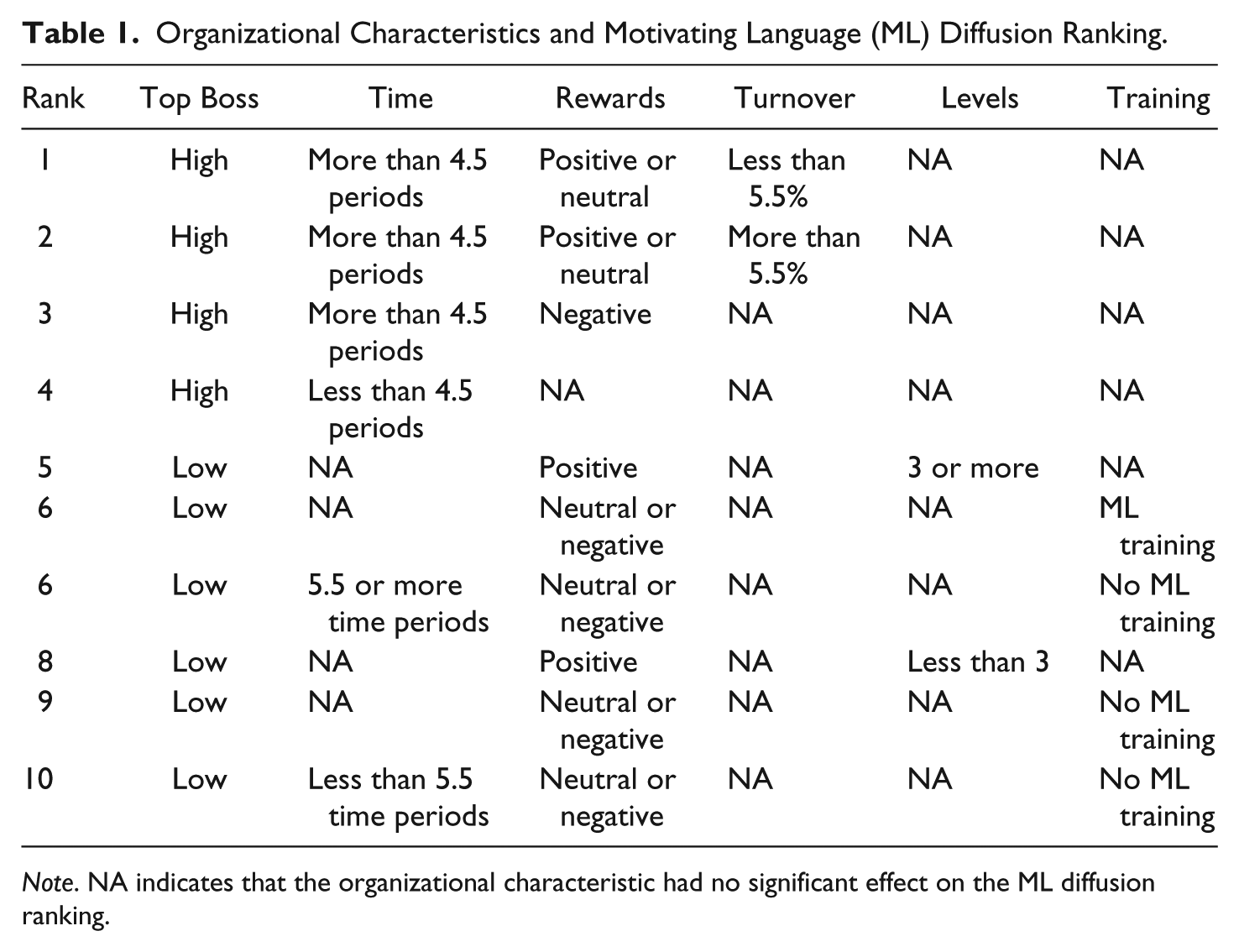
Note. NA indicates that the organizational characteristic had no significant effect on the ML diffusion ranking.
Discussion
This study has contributed new insights into the emergent processes of MLT. As a result, this investigation has uncovered key factors expected to influence ML diffusion at an organizational level of analysis, and which also may be necessary for reaping the benefits gained by this genre of leader oral-communication. While the implications of these findings are exploratory, groundwork has been laid for future hypotheses which can be tested empirically. In addition, new nonlinear methodology has been adopted to examine ML, a longitudinal ML model was employed, and the interaction between oral communication content and network structure was analyzed. Similarly, the contagion potential for leader speech communication styles were examined. All of these research steps have been suggested by experts in management, communication, and social network research.
Surprisingly based on the extant literature, some of the model’s axioms were either supported in unexpected ways or not supported at all. Formal organizational structure had a weak significant effect on ML diffusion which was contrary to expectations. With a high-ML top-leader, formal hierarchical layers did not affect the high-ML diffusion rate. (Perhaps this observation can be attributed to the fact that CEOs speak both directly and indirectly—through their direct reports—to lower level managers.) Yet more layers (over 2.5) slightly boosted the effects of high-ML diffusion when the CEO was a low-ML oral communicator (from 37% to 52%). Aligned with this trend, axioms which predicted significant moderating effects in ML diffusion from recruitment and selection, peer influence, direct supervisor influence, and top boss influence were not supported. Reflecting on previous research, these findings are incongruent with well-respected studies.
We can only speculate about the underlying reasons for these phenomena. Such discoveries make more sense when the multifaceted nature of the ML diffusion model is taken into account. The top-leader’s ML use is usually compatible with the values of an organization’s culture. Furthermore, these attributes, expressed through practices and norms, may be comparatively more powerful than diffusion influences from the other axiomatic variables. These latter factors could well have significant influences which are subsumed by the impact of a culturally congruent, top-leader’s ML use.
Of note, the asymmetric diffusion pattern shown in Figure 2 merits discussion here. Our model indicates that with a high-ML top-leader, time, rewards, and turnover (in descending order of impact) moderated the diffusion process. In contrast, with a low-ML top-leader, rewards, greater number of hierarchical levels, training, and time (in descending order of impact) come into play for organizational adoption of high-ML. Interestingly, non-top-leader turnover did not have any significant impact on high-ML diffusion when the top-leader was a low-ML communicator, whereas longer tenure (5.5 time periods of 6 months or more) did significantly increase the high-ML diffusion rate when the CEO was a high-ML user.
There are some valuable implications for research and practice that can be gleaned from this study. For research, some testable hypotheses for diffusion of high levels of ML have been identified. First, consistent top-leader ML practice, that is congruent with an organization’s cultural norms, is closely related to the ML speech adoption of lower level leaders. Second, ML diffusion will differ in process and in moderator effects, contingent on whether the CEO’s ML use is high or low. Third, time and rewards are both moderating factors in the ML diffusion process for all assimilation scenarios, but their impacts will vary, dependent on top-leader ML use.
For practice, this model strongly supports the dominant influence of top leadership on organizational oral communication practices. Thus, if the benefits of high ML are desired, careful selection of a CEO who is oral communication competent and compatible with the organization’s culture is paramount. Taking a further step, cultural change itself may be needed if more effective organizational communication is desired. Furthermore, among other leaders, rewards for high-ML use encourage its diffusion. Training also has a positive influence on high-ML diffusion, but only when the CEO is a low-ML communicator. In addition, a respectable period of time (over 2.25 years) is needed for the greatest levels of high-ML diffusion. Finally, higher levels of leader turnover can hinder the adoption of high-ML among an organization’s leadership ranks.
Perspective is called for at this time. An agent-based model configuration is preliminary. Empirical studies are needed for more in-depth examination of these findings. Herein is the inherent limitation found in this study. These working hypotheses are intended to explore literature embedded axioms and their interactions with the objective of finding hypotheses for future empirical testing. In brief, we cannot draw definitive conclusions from these emergent properties until such rigorous testing occurs. Hence, the model percentages are only benchmarks, and are not intended to be accurate assessments. A second constraint in this research is that the current literature reviewed has been largely drawn from U.S-based scholarship. Consequently, any generalizability to global settings is restricted. Also, our model captured oral language diffusion within a traditional organizational structure. Networked and other innovative forms of organizational design were excluded for the sake of model parsimony. Another limitation occurs with the restricted domain of oral communication. Finally, model development was premised on a relatively stable organizational culture. Therefore, this model is not expected to apply to organizations that experience a dramatic cultural shift which affects target organizational characteristics (such as a change in training or rewards policies).
Such limitations can be addressed in future research through empirical analysis of our recommended hypotheses. For testing, a first step is to examine the role of top-leader ML use on organizational diffusion. Since the model predicts CEO behavior as having the dominant effect on diffusion both quantitatively and qualitatively, examining this variable will allow researchers to explore the most robustly predicted aspect of the model. If empirical results show little or no difference in diffusion rates, then the entire model will need to be redeveloped. Conversely, empirical support for this proposition will encourage further tests on propositions that may require more subtle analyses.
Another aspect for future testing is to examine how just fractal these phenomenon are. While the model examined an entire organization, conceptually, there is no reason why the model is not applicable to subsets of an organization—assuming ML use congruence between the top-leader and a leader that is in charge of an organizational division. In this scope, the model could be tested in one organizational area (such as production or marketing) to see if diffusion occurs as predicted. Also, investigations should be extended to both global and networked organizational research settings. It would also be potentially beneficial to extend the scope of future, related research to incorporate multiple media ML use, especially with written communication. Finally, since ML diffusion appears to be temporally moderated, continued emphasis on longitudinal research is in order.
In conclusion, high leader ML can potentially unleash valuable contributions to an organization through improved employee performance and quality of work life. Yet in order for these benefits to be realized, successful implementation and practice of high levels of ML must first occur. This article is an important step in that direction.
Footnotes
Authors’ Note
This article has been developed from presentations at the 2014 Association for Business Communication conference and the 2015 Academy of Management conference annual meetings. After each presentation, substantial revisions were made based on reviewer and audience comments.
Declaration of Conflicting Interests
The author(s) declared no potential conflicts of interest with respect to the research, authorship, and/or publication of this article.
Funding
The authors disclosed receipt of the following financial support for the research, authorship, and/or publication of this article: This research was partially funded by a research grant from the A.R. Sanchez Jr. School of Business, Texas A&M International University.