



Abstract
This study investigates the effects of corporate social responsibility (CSR) practices on protecting and restoring company reputation in crisis situations. The results suggest the ability of proactive CSR to counter potential damage to corporate reputation caused by a crisis but not to serve as a remedy after a crisis. The findings further indicate a significant interaction effect between crisis type and the fit of reactive CSR for a company without proactive CSR. For a preventable crisis, a company is better off choosing low-fit reactive CSR than not engaging in reactive CSR at all. In a victim crisis, low-fit reactive CSR is more effective in improving company reputation than high-fit reactive CSR. When a company has been previously engaged in proactive CSR, the impact of fit across crisis types disappears. The mediating role of perceived altruism suggests the importance of sincerity in CSR.
Companies have competing motives for engaging in socially responsible practices, from purely philanthropic to strategic considerations of their bottom-line benefits such as increasing revenue, generating favorable corporate images, and enhancing corporate reputation (Brønn & Vidaver-Cohen, 2009). When a company communicates its corporate social responsibility (CSR), people tend to speculate about the underlying motivations (Sen & Bhattacharya, 2001; Yoon, Gurhan-Canli, & Schwarz, 2006). Research has documented that suspicion regarding a company’s motives rises if the companies are perceived to be too focused on their image only for the promotional benefits of their contributions, which may reduce CSR effectiveness (Bae & Cameron, 2006; Vanhamme & Grobben, 2009; Yoon et al., 2006).
Communicating a CSR campaign after a crisis is a delicate task. Recall British Petroleum’s crisis in 2010, the worst oil spill disaster in U.S. history. Ironically, since 2000, the company had made efforts to change its image to that of a sustainable and environment-friendly company by launching a $200 million branding campaign, and introduced a new logo representing the company’s new initiatives (Landman, 2010). Due to the crisis, however, the company suffered from criticism for the discrepancy between what it said and how it behaved. After the crisis, to restore its damaged reputation, the company actively launched CSR campaigns, but a selection of CSR domains (i.e., a cause perceptually related to the crisis event or one that has no relation to the crisis) remained controversial to public relations practitioners and scholars.
The British Petroleum example raises the following questions: First, how did the company’s prior efforts to use CSR influence the public’s evaluation of the company after the crisis? And how did this evaluation interact with the type of crisis? Second, in terms of postcrisis reactive CSR, should the company have chosen an environment-related domain or would another CSR approach have worked better? And how did the public’s evaluation of the company interact with the type of crisis? Third, with those who already had established CSR associations for the company, did the relevance of the CSR domain influence the public’s evaluations of the company and perceived motivation?
To this end, the study examines the effects of proactive and reactive CSR on protecting and restoring corporate reputation in crisis situations. Applying Wagner, Lutz, and Weitz’s (2009) conceptualization, proactive CSR refers to a promotional method of reputation management strategy when the company voluntarily engages in CSR practices prior to a potential crisis. Reactive CSR, in contrast, reflects a defensive method of reputation improvement in which the company engages in CSR practices in response to or after a crisis (Groza, Pronschinske, & Walker, 2011). As research examining proactive CSR and reactive CSR simultaneously has been limited (Wagner et al., 2009), the current research attempts to examine how effectiveness varies depending on when the company communicates CSR (i.e., whether it is proactive, reactive, or both). In addition, the study examines the effectiveness of reactive CSR fit (i.e., high-fit, low-fit, no reactive CSR) in the postcrisis phase to provide insight into strategic management of CSR.
Linking Impression Management, CSR, and Crisis Communications
Impression management provides a framework for conceptualizing the link between CSR and crisis communications. Impression management is a goal-oriented process intended to create or protect a desired perceived image (Leary & Kowalski, 1990). Like individuals, organizations strive to influence perceptions by creating desirable images and avoiding undesirable ones (Staw, 1991). Organizational impression management is defined as “any action that is intentionally designed and carried out to influence an audience’s perceptions of the organization” (Bolino, Kacmar, Turnley, & Cilstrap, 2008, p. 1095). The motivation to manage impressions is to maximize rewards and minimize punishment (Schlenker, 1980).
In the organizational setting, there are two self-presentation motives for corporations: desire for approval and desire for status (Highhouse, Brooks, & Gregarus, 2009). Research has confirmed that organizations use impression management strategies to restore legitimacy after crisis, to increase acceptance of controversial decisions or practices, to create a desirable corporate image, and to influence the perceptions of key stakeholders (Groza et al., 2011). The impressions that a company manages ultimately constitute the public’s perception of the company and contribute to the company’s reputation, which is defined as a stakeholder’s cognitive evaluation of a company determined by its past behaviors over time (Gotsi & Wilson, 2001).
The prominence of CSR reflects stakeholders’ demands for businesses to have a sense of social responsibility and concern for public interests. Beyond the normative stance of CSR rooted in morality, companies adopt CSR for strategic purposes to enhance their competitive advantage, including their image (Lee, 2008). To maximize CSR effectiveness, corporate managers take strategic approaches to CSR governance and put effort into determining how to best demonstrate the links between CSR initiatives, corporate reputation, and social outcomes (Rangan, Chase, & Karim, 2015). From an impression management point of view, CSR practices are motivated by the goal of social approval and/or status (Highhouse et al., 2009), and these motivations are closely related to organizational legitimacy (Vanhamme & Grobben, 2009).
Meanwhile, impression management can also be applied to understand crisis communication given it concerns strategically influencing the public’s perceptions to offset or repair a damaged organizational image. Corporate crisis broadly refers to an unexpected event that generates a threat to or challenges an organization’s legitimacy (Dean, 2004). Because of its potential impact on the organization’s reputation, public relations scholars have paid great attention to the effects of crisis communication on diminishing negative perceptions of organizations (Coombs & Holladay, 2008) and repairing their images (Benoit, 1997). Crisis communications include the collection, processing, and dissemination of information to people inside and outside of the organization to address a crisis situation (Coombs & Holladay, 2008).
Focusing on “message options,” it emphasizes the importance of communication. When stakeholders question whether the organization meets normative expectations, the organization should strategically communicate and respond to the stakeholders, and this may shape stakeholders’ views of an organization (Benoit, 1997). In a similar vein, Coombs (1995) lists three objectives of crisis response strategies in terms of protecting reputation: shape attributions of the crisis, change perceptions of the organization in the crisis, and reduce the negative influences generated by the crisis. These objectives are aligned with the organization’s impression management. Research has confirmed that organizations use impression management strategies to restore legitimacy after crisis, to create desired corporate images, and to influence the perception of key publics (Highhouse et al., 2009).
Public’s Attribution to Proactive and Reactive CSR
While impression management can link between CSR and crisis communication, attribution theory provides a theoretical guide to understand the public’s response to these public relations practices. Attribution theory explains how people interpret events, how they evaluate the underlying motives of others, and how causal inferences influence their attitudes and behaviors (Forehand & Grier, 2003; Kelley, 1967, 1973). In the CSR context, the theory explains how the public attributes a company’s CSR messages and why perceived motivations for a company’s engagement in CSR matter. It further explains why the public’s attribution may differ depending on the timing of the message delivery.
In the current study, proactive CSR occurs when companies convey CSR-related information consistently to create a picture of being socially responsible before reports of negative behavior (Wagner et al., 2009). A reactive CSR occurs when, to protect its image, a company announces its CSR after reports of negative behavior, such as after a corporate crisis (Wagner et al., 2009). It is important to note that the timing of CSR communication would influence the public’s attribution of CSR motives and thus the CSR evaluation (Yoon et al., 2006).
Studies have also shown that companies’ CSR efforts generally increase positive company evaluation (e.g., Hong & Rim, 2010; Sen & Bhattacharya, 2001). However, several studies have claimed that CSR can backfire on a company’s reputation, highlighting the importance of the public’s attribution of CSR motives (Becker-Olsen, Cudmore, & Hill, 2006; Yoon et al., 2006). That is, when there is a reason to suspect the authenticity of the presented information, people engage in more complex message processing. If the company has recently experienced a crisis or bad publicity, the public may see the nature of CSR as reactive—an effort to restore the company’s image rather than a benevolent effort (Dean, 2004; Vanhamme & Grobben, 2009).
Given that message, recipients of reactive CSR tend to speculate about the underlying motivations of CSR. As a result, it is less likely to generate positive results than proactive CSR (Groza et al., 2011). Specifically, comparing proactive and reactive CSR, Groza et al. (2011) found that proactive CSR is perceived as more strategic- and value-driven than reactive CSR. Based on previous research findings, the study predicts that proactive CSR communication leads to a higher degree of perceived altruism and positive company reputation than reactive communication.
Interaction Effects Between Proactive CSR and Crisis Type
This study suggests that crisis types may influence the effectiveness of proactive and reactive CSR communication. Regarding the effects of proactive CSR, past studies generally suggest the company’s CSR engagement can buffer reputation damage in time of crisis (Vanhamme & Grobben, 2009). The company’s CSR efforts influence what people know about the company (Brown & Dacin, 1997; S. Kim, 2011). Brown and Dacin (1997) emphasized the importance of CSR associations, suggesting that a negative CSR association negatively affects overall product evaluation, while positive CSR association positively influences product evaluation. However, the degree of benefits elicited by proactive CSR may vary depending on the type of crisis.
Situational crisis communication theory (SCCT; Coombs, 2007) explains how people perceive the causes for an event. Primarily focusing on protecting organizational reputation during a crisis, SCCT offers a framework to understand the dynamics of crisis situations that may influence public attributions of crisis responsibility, and ultimately influence attitudinal and behavioral intentions toward an organization (Coombs, 2007). According to SCCT, crisis situations vary depending on how the public assigns responsibility.
This study adopts two dimensions that clearly contrast the responsibility of the organization: victim and preventable clusters. The victim cluster includes crises such as natural disasters, where the company is a victim of the crisis as well (Coombs, 2006). In this case, there is low or no perceived responsibility for the crisis event. In contrast, the preventable cluster includes crises such as organizational misdeeds, where the company has responsibility for the crisis event (Coombs, 2006). Based on SCCT, the study predicts that a victim crisis leads to a higher degree of perceived altruism and company reputation than a preventable crisis.
SCCT theory suggests that in addition to the crisis type impact, the reputational threat can be intensified by crisis history or relational history. Considering the benefits of CSR discussed in the earlier section, the present study suggests that proactive CSR will help a company recover from reputational damage. CSR association will decrease the perceived attribution of crisis responsibility for the company and help protect it from public blame. The study also assumes that the proactive CSR impact will be greater when a company experiences a preventable crisis rather than a victim crisis. Because the victim crisis itself does not trigger company blame, there should be no significant difference between the public’s judgment of a company with proactive CSR and one without. With a preventable crisis, however, CSR helps decrease the degree of blame for crisis responsibility, whereas absence of CSR can increase blame for crisis responsibility. In other words, the effects of CSR on the perceptions of a company’s altruistic motives for protecting company reputation will be greater when the company experiences a preventable crisis versus a victim crisis.
Reactive CSR: Interplay Among Crisis Type, Crisis-Reactive CSR Fit, and Proactive CSR
Crisis communication concerns strategically influencing the public’s perceptions to offset or repair a damaged reputation. Due to its potential impact on the organization’s reputation, public relations scholars have paid close attention to the effects of crisis communication on diminishing negative perceptions of organizations and repairing their images (Benoit, 1997; Coombs & Holladay, 2008). Reactive CSR is one of the popular strategies that many organizations adopt after a crisis to recover their damaged reputation.
Companies promoting CSR after a crisis event, however, are faced with added challenges. Due to the inconsistency or discrepancy, message recipients tend to speculate on underlying motivations. Therefore, reactive CSR is less likely to generate positive results than proactive CSR (Groza et al., 2011). Such messages may result in suspicion and mistrust toward the organization’s messages and behavior (Vanhamme & Grobben, 2009). To understand the public’s evaluation of CSR, particularly in the case of reactive CSR, the study suggests further investigation of the interplay among the perceived fit between a crisis event and a company’s reactive CSR initiative, and how proactive CSR interacts with it.
Congruence or fit has been used to indicate public perception of similarity, when both the brand and social cause share a similar value (Lafferty, 2007). The current study uses fit to refer to the perceived connection or similarity between the company’s crisis event and the domain of reactive CSR following a crisis. Perceived fit is a critical factor influencing the public’s evaluation of the CSR campaign (Becker-Olsen et al., 2006; Lafferty, 2007). In general, scholars suggest that a close match between a company’s core business and a cause is likely to lead consumers to perceive them as experts in the field and to transfer positive feelings about the cause to the company (Hoeffler & Keller, 2002; Sen & Bhattacharya, 2001).
The effects of CSR fit, however, require more scrutiny. Past CSR fit research has documented inconsistent findings, and there is a general consensus that “fit” effects are contingent on certain situations where the company engages and communicates with the public. Some scholars argue that a company is better off choosing the cause that is not perceptually related to the business in order to avoid customers’ cynical reactions (Drumwright, 1996), which can be applied to a reactive CSR campaign. Y. Kim and Ferguson (2010) demonstrated empirically that if the company has a negative prior reputation, a high fit between the company and the cause generates negative attitudes toward the company. That is, if there are any negative attributes that can be transferred, supporting a cause that does not associate to the company’s existing attributes can be a better strategy.
In contrast, people are less suspicious of intent if the message or behavior is consistent with previous behavior (Vanhamme & Grobben, 2009). By proactively engaging in CSR in a consistent manner, the company can accentuate its commitment to socially responsible practices and its concern for society (Brown & Dacin, 1997; S. Kim, 2011). Furthermore, it should be easier for the company to use a bolstering strategy (i.e., addressing good aspects of the company to offset negative perceptions caused by the crisis), and the public should be less sensitive to reactive CSR strategies, including CSR-crisis fit.
Given that the effects of reactive CSR fit can be different depending on the presence of proactive CSR and crisis type, the study predicts a three-way interaction effect among proactive CSR, crisis type, and reactive CSR fit on (a) perceived altruism and (b) company reputation. This study predicts that when a company has positive attribute associations prior to communicating reactive CSR, a high fit can lead to a more positive CSR impact than a low fit. The study suggests the interaction effects of reactive CSR fit and crisis type, and proactive CSR, respectively, as follows:
This study also predicts a three-way interaction effect among proactive CSR, crisis type, and reactive CSR. As discussed, the effects of reactive CSR fit can be different depending on the presence of proactive CSR and crisis type. As theoretical grounds for this inquiry are less strong than previous hypotheses and resulted in inconclusive findings, the following research question is provided:
Perceived Altruistic Motivation of CSR as a Mediator
CSR activities are consistent with the belief that socially responsible behaviors may generate favorable corporate reputation, but it has been observed that the public does not take CSR messages at face value. How the public perceives a company’s motivation for engaging in CSR activities is particularly important because it may alter CSR effectiveness. Applying attribution theory, CSR studies have documented the factors that influence the public’s attribution of companies’ CSR messages and demonstrated that perceived motivation ultimately influences the public’s evaluation of CSR (Ellen, Webb, & Mohr, 2006; Forehand & Grier, 2003). Such studies have found a mediating role of perceived CSR between CSR attributes and the public’s responses to a firm (Bae & Cameron, 2006; Ellen et al. 2006). Research also suggests that there are critical moderating influences that determine whether such strategies achieve their intended effects or backfire (Vlachos, Tsamakos, Vrechopoulou, & Avramidis, 2009). This study focuses on the role of perceived altruism and suggests that the degree of perceived altruistic CSR motives can stimulate a positive evaluation of the company.
Method
The study employed an experiment to examine the effects of proactive and reactive CSR on perceived altruism of CSR and company reputation using a 2 (proactive CSR: CSR vs. no CSR) × 2 (crisis type: preventable vs. victim) × 3 (reactive CSR fit: high CSR-crisis fit vs. low CSR-crisis fit vs. no CSR) between-subject design. Prior to the main experiment, a series of pretests were administered with both college students and general consumers to develop stimuli materials and to confirm the manipulations.
Participants
The research participants were drawn from a consumer panel managed by the marketing research firm USamp. The sample consisted of randomly selected U.S.-based consumers, who received monetary incentives for their participation. The final 371 qualified respondents were used for the analysis. Of the participants, 62% were female and 38% were male. With respect to age, about 28% of participants were 18 to 29 years, 24% were 30 to 39 years, 18% were 40 to 49 years, 16% were 50 to 59 years, 9% were 60 to 69 years, and 3.5% were 70 years or older. About 80% of the participants were Caucasian, while 8% and 6% were African Americans and Hispanic, respectively. About 50% of participants reported an annual family income greater than $40,000.
Pretests and Stimuli Development
Industry and Reactive CSR Domain Selection
Prior to creating stimuli, a pretest was conducted to select the industry and the reactive CSR domain. A total of 31 college students participated in this pretest. Criteria for selecting an industry were that there were neutral attitudes toward the industry to rule out potential effects from existing perceptions of a certain industry, but that the industry ranked high in CSR impact on its reputation. As the main purpose of this study was to examine the influence of CSR pre- and postcrisis, the industry’s sensibility to CSR was an important criterion for industry selection.
The pretest initially included nine industries 1 that often experience crises and measured participants’ attitudes toward each industry and the perceived importance of CSR in each industry. In the end, a pharmaceutical company was selected as it satisfied the abovementioned criteria: neutral attitudes with high variance and high CSR impact on reputation. The pretest also helped select the domains of CSR (i.e., causes) that vary in fit. In high-fit reactive CSR conditions, the cause that the company supports should be highly related to the crisis or business, whereas in the low-fit condition, the cause should not be related to the company’s crisis or business. While the causes vary in level of fit, the causes themselves should be evaluated similarly in terms of perceived importance and personal relevance to rule out potential confounding effects.
Based on documentation that listed areas of CSR domains (e.g., Cone Communictions, 2010; United Nation Global Compact, 2006), 13 CSR domains 2 were included in the pretest, and the participants evaluated perceived social value and personal value for each. Three CSR domains were similarly evaluated on a scale of 1 to 7: health (M = 6.1, SD = 1.05), education (M = 6.5, SD = 0.68), and diversity (M = 6.03, SD = 1.11). Because the study’s crisis case was related to a vaccine recall due to product tampering, the causes would need to be related to either health (i.e., high-fit) or nonhealth (i.e., low-fit). Therefore, a health-related CSR strategy was selected for the high-fit condition, whereas an education-related CSR was selected for the low-fit condition.
Stimuli Development
After determining the industry (i.e., pharmaceutical), crisis case (i.e., vaccine recall), and the domain of reactive CSR (i.e., health vs. education), stimuli materials were created: (1) company profiles, (2) crisis scenarios, and (3) reactive CSR scenarios. The study used a fictitious company name to reduce variations potentially caused by participants’ previous experiences with known organizations. Adopted from previous experimental studies on CSR associations (e.g., Brown & Dacin, 1997; S. Kim, 2011), the company profile for the proactive CSR condition contained the company’s history of CSR and community involvement by emphasizing the discretionary aspects of the company’s CSR practices.
For the no–proactive CSR condition, general company information was used that included descriptions about the company’s recent financial performance and product lines with a neutral tone. Both company profiles were similar in length and organization. Likewise, short descriptions of product-related crises history were developed to manipulate attribution of responsibility. Both conditions used the same crisis case but varied in crisis responsibility. The company-responsible treatment used a preventable type of crisis, focusing on the transgressions of the company, whereas the company-not-responsible treatment described the company as victim of the crisis.
Finally, information regarding the company’s reactive CSR campaign was created. Based on the pretest, in the high-fit condition, the company announced a mass vaccination campaign in Africa, which is perceptually related to the company’s recent crisis. In the low-fit condition, the company’s plan to support IT skill training in Africa was described. In both conditions, the scenarios were presented in a press release format, and all information was identical except the cause itself.
The scenarios were evaluated similarly in terms of readability and believability for the crisis scenario based on the work of Jean-Charles, Gelinas-Chebat, and Hombourger (2003) and Zeynep and Maheswaran (2000). A total of 38 students recruited from a southeastern university participated in the pretest. Extra credits were offered for completing the survey. The company profiles showed no differences for their readability, t(36) = 1.59, p = .12. The readability of both high-fit and low-fit reactive CSR scenarios was evaluated similarly, t(36) = 0.78, p = .44. For crisis scenarios, believability was also checked, followed by readability. A t test revealed that there was no difference in readability between the victim and preventable conditions, t(36) = −1.74, p = .10 as well as believability, t(36) = 0.77, p = .44.
Manipulation Checks
Another set of pretests was conducted with general consumers to confirm the success of the manipulation. Participants were recruited via Amazon Mechanical Turk with a cash incentive ($1), and a total of 54 respondents completed the online survey. With respect to the manipulation of proactive CSR, participants who were assigned to the presence of proactive CSR (M = 5.95, SD = 0.97) reported significantly more socially responsible attributes of the company on a 1 to 7 scale than those in the no presence of CSR condition (M = 2.99, SD = 1.46), t(52) = 8.76, p < .001. For crisis type, participants in the victim condition were more likely to attribute crisis responsibility to the circumstances (M = 5.78, SD = 1.15) than those in the preventable condition (M = 3.10, SD = 1.60), t(52) = −8.08, p < .001). Finally, participants in the high-fit condition (M = 4.56, SD = 1.32) were more likely to evaluate the relevance of the CSR campaign and the crisis event higher than those who were exposed to a low-fit condition (M = 3.54, SD = 1.75), t(52) = −2.42, p < .05, confirming the success of the manipulation.
Procedures
An e-mail invitation with a link directed to the experiment protocols in Qualtrics was sent to subjects who were then randomly assigned to one of the 12 conditions. Each condition had an average of 30 respondents. Once they began the experiment, participants were asked to read the company information. Then, a short statement describing the company’s recent crisis was presented. Participants were then asked to read about the company’s reactive CSR campaign, which varied by perceived CSR-crisis fit (high vs. low fit). One group did not receive any reactive CSR information (the no–reactive CSR condition). After reading three types of stories (i.e., proactive CSR message, the crisis situation, and the reactive CSR campaign), participants were asked to evaluate the perceived company’s reputation and the perceived altruism of its CSR practices. Then, a set of questions about manipulation checks was provided. Last, participants answered the demographic questions.
Measurement Items
Manipulation Check
In the study, proactive CSR is operationalized as the degree to which the public perceives a company’s CSR embedded in its business. Adopted and modified previous research measuring perceived CSR (e.g., Menon & Kahn, 2003), the manipulation of proactive CSR was evaluated with three items (α = .94). Perceived CSR-crisis fit is operationalized as the extent to which the participants cognitively perceive the relevance of the CSR initiative to the company’s crisis and was measured on a 7-point scale adopted from past research on fit (e.g., Becker-Olsen et al., 2006; α = .93). Crisis type is operationalized as leading to the attribution of responsibility for a company’s crisis, which has two levels—victim and preventable. Based on previous literature (Griffin, Barbin, & Darden, 1992), attribution of crisis responsibility was measured with three items (α = .89).
Dependent Variables
Perceived altruistic motives were operationalized as the degree of the public’s understanding of a company’s CSR engagement as public-serving. This perception was measured by Rifon, Choi, Trimble, and Li’s (2004) scale with three items (α = .95). The perceived company reputation was measured based on the Reputation Quotient (Fombrun, Gardberg, & Sever, 2000) with 20 items (α = .96). All items were measured with a 7-point Likert-type scale ranging from 1 (strongly disagree) to 7 (strongly agree). Appendix A presents measurement items used in the study.
Results
Consistent with pretest results, manipulation checks were successful in the main study. Participants in the proactive condition perceived the company to be more socially responsible (M = 5.75, SD = 0.99) than those in the without-CSR condition (M = 2.95, SD = 1.40), t(331) = 22.30, p < .001; participants in the victim crisis group (M = 5.28, SD = 1.43) were more likely to attribute crisis responsibility to external factors than those exposed to the preventable crisis (M = 2.73, SD = 1.43), t(369) = 22.32, p < .001; and participants in the high-fit condition (M = 4.25, SD = 1.90) were more likely to perceive the connection between the crisis and reactive CSR than those who were exposed to the low-fit condition (M = 2.97, SD = 1.64, t(247) = 5.71, p < .001).
To test the hypotheses, a multivariate analysis of variance (MANOVA) was conducted. Additionally, mediation analysis was used to confirm the direct and indirect effects of perceived altruism on these relationships. The dependent variables (i.e., perceived altruism and corporate reputation) were highly correlated (r = .80, p < .001), suggesting the appropriateness of a MANOVA. The results showed significant overall main effects of proactive CSR, Wilks’s λ = .70, F(2, 359) = 77.93, p < .001,
However, a two-way interaction effect was obtained between proactive CSR strategy and crisis type, Wilks’s λ = .93, F(2, 118) = 4.13, p < .05,
Multivariate Analysis of Variance on Combined Dependent Variables.

Note. df = degrees of freedom; CSR = corporate social responsibility.
To avoid the potential of confounded effects caused by the exposure to reactive CSR, participants who were not exposed to any reactive CSR information were included for analysis.
p < .05. **p < .01. ***p < .001.
Hypotheses Testing
As a follow-up test to MANOVA in the general linear model, univariate tests were conducted on each dependent variable in order to test the hypotheses. Prior to examining interaction effects, the main effects of reactive strategies of fit were tested. Our data showed no significant main effects of reactive CSR strategy on perceived altruism. The Bonferroni post hoc test indicated that there were no significant mean differences between each combination of high-fit, low-fit, and no CSR on perceived altruism and company reputation (see Table 2).
Main Effect of Proactive CSR, Crisis Type, and Reactive CSR Fit on Dependent Variables.a
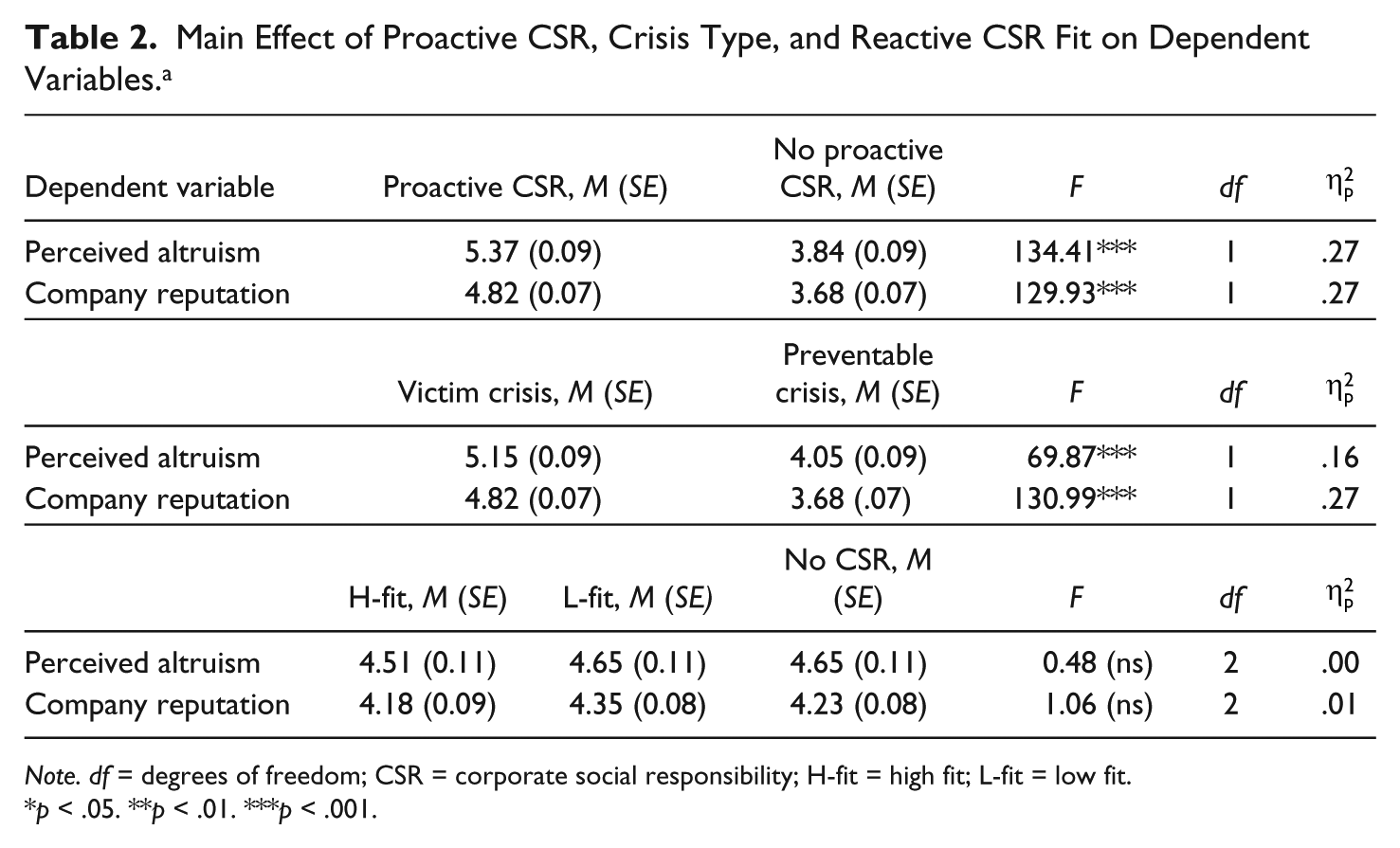
Note. df = degrees of freedom; CSR = corporate social responsibility; H-fit = high fit; L-fit = low fit.
p < .05. **p < .01. ***p < .001.
Interaction Between Proactive CSR and Crisis Type
H1a and H1b predicted that the difference between proactive CSR and no proactive CSR on perceived altruism and company reputation would be greater when a preventable crisis was compared to a victim crisis. The results showed no significant interaction on altruism. However, a significant interaction effect was found for proactive CSR and crisis type on company reputation, F(1, 118) = 8.24, p < .01,
Pairwise Comparisons for Interaction Effects of Proactive CSR and Crisis Type on Dependent Variablesa.

Note. CSR = corporate social responsibility; df = degrees of freedom.
p < .05. **p < .01. ***p < .001.

Interaction effects of proactive CSR and preventable crisis on company reputation.
Interactions Between Reactive CSR Strategies of Fit and Crisis Type
The results showed that there were no interaction effects between reactive fit strategy and crisis type on perceived altruism and company reputation, indicating no effects of reactive CSR fit in both crisis types. H2a and H2b were not supported.
Interactions Between Proactive CSR and Reactive CSR Strategies of Fit
The results showed that there was no significant interaction effect between the proactive CSR versus reactive CSR strategy on perceived altruism and company reputation. A pairwise comparison of the proactive CSR condition with the reactive CSR strategies condition was nonsignificant. Therefore, H3a and H3b were not supported.
Three-Way Interactions Among Proactive CSR, Crisis Type, and Reactive CSR Fit
Research Question 1 asked to examine the interaction effects among proactive CSR, crisis type, and reactive CSR fit. Our results showed that there was no significant interaction on perceived motivation, but it did show significant interaction effects on company reputation, F(2, 359) = 4.52, p < .01,

Three-way interaction effects of proactive CSR, crisis type, and reactive CSR strategies, and of fit on company reputation.
Pairwise Comparisons Among Proactive CSR, Crisis Type, and Reactive CSR Strategy on Perceived Altruism and Company Reputation.a

Note. CSR = corporate social responsibility; df = degrees of freedom; H-fit = high fit; L-fit = low fit.
p < .05. **p < .01. ***p < .001.
Mediating Effects of Perceived Altruism
H4 predicted a mediation role of perceived altruism on the relationship between CSR conditions and company reputation. To test the mediating effects, the study followed Hayes and Preacher’s (2013) mediation analysis, which allows us to calculate direct and indirect effects for multiple and multicategorical independent variables simultaneously. The results revealed that perceived altruism, a proposed mediator, met the above-mentioned conditions and significantly mediated the relationship between CSR conditions (i.e., proactive CSR and crisis type) and company reputation. As Figure 3 illustrates, proactive CSR (coefficient = 1.04, SE = 0.09, p < .001) and crisis type (coefficient = 1.13, SE = .10, p < .001) had a significant influence on company reputation, satisfying the first condition. In addition, proactive CSR (coefficient = 1.40, SE = 0.12, p < .001) and crisis type (coefficient = 1.09, SE = 0.13, p < .001) had a significant influence on perceived altruism, which is the proposed mediator, satisfying the second condition. Then, perceived altruism showed a significant influence on company reputation (coefficient = 0.53, SE = 0.03, p < .001), satisfying the third condition; finally, the effects of proactive CSR (coefficient = 0.30, SE = 0.08, p < .001) and crisis type (coefficient = 0.55, SE = 0.08, p < .001) on company reputation remained significant but at a weakened level when controlling for perceived altruism, satisfying the fourth condition. Table 5 presents results of the mediation analysis.
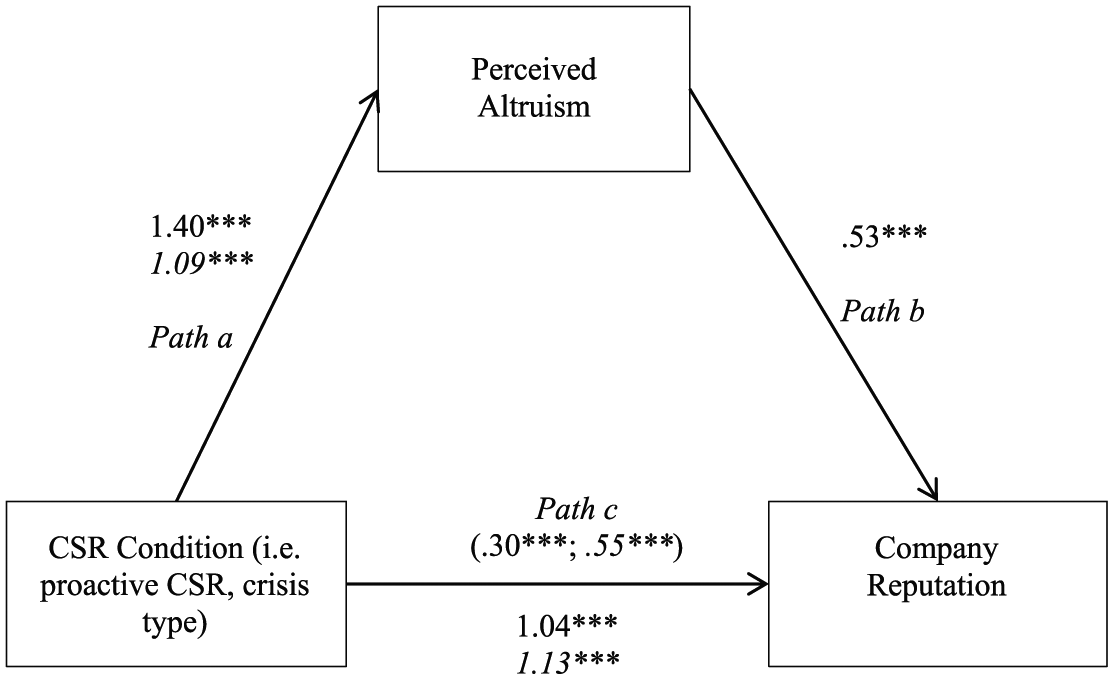
Regression coefficients for the relationship between CSR condition (i.e., proactive CSR, crisis type) and company reputation as mediated by perceived altruism.
Mediation Effects of Perceived Altruism on Company Reputation.
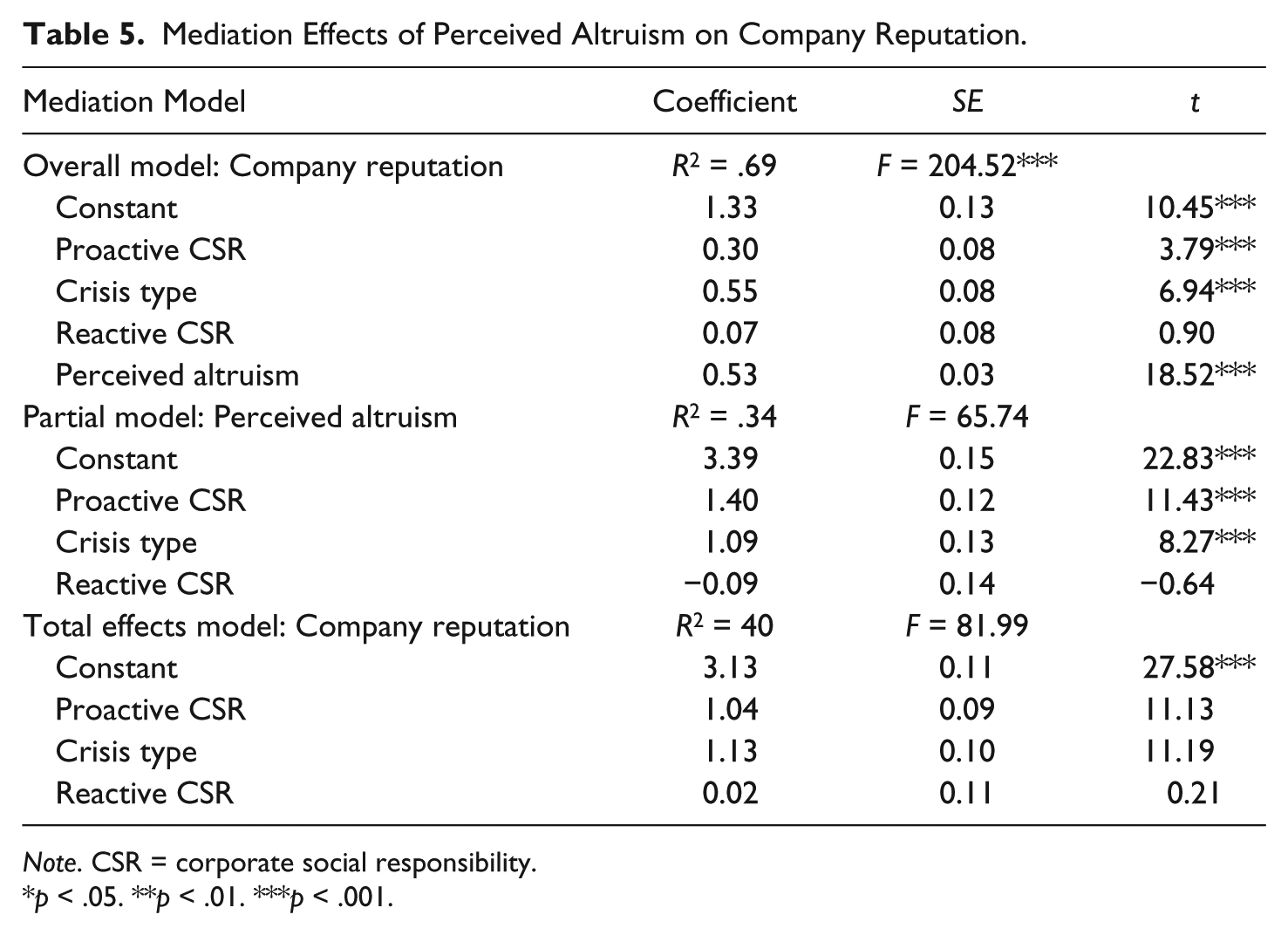
Note. CSR = corporate social responsibility.
p < .05. **p < .01. ***p < .001.
Furthermore, the analysis found significant indirect effects of both proactive CSR (indirect effect = .74; 95% bootstrapped confidence interval [CI; .60, .90]) and crisis type (indirect effect = .58; 95% bootstrapped CI [.43, .74]) on company reputation through perceived motivation. Finally, although the results indicated no direct or indirect effects of reactive CSR strategies, when CSR communication conditions (i.e., proactive CSR, crisis type, reactive CSR) were taken together as predictors, perceived altruism significantly mediated the main effects of CSR communication on company reputation, F(4, 366) = 204.52, p < .001. Findings thus supported the mediating role of perceived altruism on company reputation. Therefore, H4 was supported.
Discussion
Major Findings and Implications
Prior to examining the interaction effects between variables, which was the primary focus of the current study, the findings of the main effects should be noted to understand the baseline of proactive and reactive CSR communication. First, the present study offers empirical evidence of the benefit of proactive CSR communication on enhanced perceived altruism and company reputation. In terms of the main effect of crisis type, the study confirms SCCT, suggesting that a victim crisis has a less negative impact on company reputation than a preventable crisis.
Regarding interaction effects between proactive CSR and crisis type (H1), the findings suggested that the presence of proactive CSR may buffer the company’s reputational damage regardless of crisis type. Supporting H1b, the degree of the influence of proactive CSR on company reputation is greater when a company has a preventable crisis versus a victim crisis. This finding is particularly meaningful for communication managers in that it provides evidence of CSR as insurance for protecting company reputation, especially in the event of a preventable crisis. The crisis type itself is not changeable once it occurs; therefore, determining an appropriate crisis response depending on crisis type is a critical task for communication managers.
From a theoretical perspective, SCCT generally suggests that a company employ an accommodative response strategy when there are serious reputational threats to the company (Coombs, 2007). SCCT also documents crisis history and relationship history as intensifiers of reputational threat. The current study suggests that communication managers should assess a company’s existing CSR image as well, because the public’s positive CSR associations can be used to minimize reputational damages. In summary, the study not only demonstrates the value of the presence of CSR for protecting company reputation in a preventable crisis but also suggests the potential of using a bolstering response strategy, which involves “reminding people of past good works by the organization,” even in the event of a preventable crisis.
It should be noted that due to skepticism about CSR motivation, employing a bolstering strategy can be challenging, especially when the crisis responsibility lies with the organization. This could be one of the reasons that no interaction effect was found on perceived altruism (H1a). Even though a company engages in proactive CSR, when it experiences a preventable crisis, which is known as one of the critical variables that determines the public’s attribution of crisis responsibility, the presence of CSR does not help a company increase perceived altruistic motives. While the study findings support the use of bolstering to minimize reputational damage, some research suggests that it can backfire if used inappropriately by amplifying anger. For example, Vanhamme and Grobben (2009) pointed out that CSR engagement could defend a company’s reputation only when it has a long history of CSR. To avoid potential backfire effects caused by a bolstering response, a communication manager should consider other factors that influence the effectiveness of a bolstering strategy, such as the length of CSR history. Also, future research should be conducted on this subject.
The study investigated how the effects of reactive CSR fit can vary by presence of proactive CSR and crisis type. Specifically, H2 anticipated that when a company has engaged in proactive CSR, high-fit reactive CSR would be perceived to be more altruistic and lead to higher company reputation than low-fit CSR, whereas without the presence of proactive CSR, low-fit CSR would lead to better evaluation. However, the interaction effect was not found in the study.
Likewise, H3 predicted that in the case of a victim crisis, high-fit reactive CSR would lead to higher perceived altruism and company reputation than low-fit CSR, whereas in the case of a preventable crisis, low-fit CSR would lead to better evaluation. The interaction effect between crisis type and reactive CSR fit was not found.
It should be noted that our results show no significant differences across the reactive CSR strategies of fit: high-fit, low-fit, and no CSR. Previous literature has documented inconsistent effects of fit (Becker-Olsen et al., 2006; Y. Kim & Ferguson, 2010). Indeed, Lafferty (2007) provided some evidence of no effect of fit on consumers’ attitudes or purchase intensions in the context of cause-brand alliance. These inconsistent findings imply that fit might not directly influence the public’s attribution of CSR and company reputation, but the effects of CSR and fit can be moderated by various factors such as the public’s level of involvement in the issue (Barone, Norman, & Miyazaki, 2007) and brand consciousness (Nan & Heo, 2007). Additionally, as many companies engage in a variety of CSR practices from the environment to diversity, CSR practices are not limited to supporting one single cause that is closely related to the company’s core business. The public has been exposed to diverse CSR, so their evaluation of CSR practices is not simply influenced by fit with a company’s business or crisis event, and thus, fit may not be a critical factor in CSR effectiveness.
Interestingly, some significant interaction effects were obtained from the three-way interactions among proactive CSR, crisis type, and reactive CSR strategies of fit on company reputation (Research Question 1). Our findings show that there was a significant interaction effect between crisis type and reactive fit for a company without proactive CSR, whereas no interaction was found for a company with proactive CSR. Specifically, the results suggest that when a company previously engaged in proactive CSR, the reactive CSR campaign’s fit strategy does not influence the public’s perceived altruism and company reputation. This result may support a social judgment theory, which advocates that previous expectations influence the public’s perception of the company. For a company that has already formed the public’s CSR association, reactive CSR messages may not necessarily be evaluated or influenced by specific strategies such as fit.
However, when a company had not engaged in CSR prior to the crisis event, depending on crisis type, the fit strategy should be applied with caution, as it influences company reputation. The findings suggest that when a company has not engaged in proactive CSR and experiences a preventable crisis, a low-fit CSR strategy leads to a significantly better company reputation than no reactive CSR. In a victim crisis, low-fit CSR led to a significantly better company reputation than a high-fit reactive CSR strategy. The results indicate that, doing CSR after a crisis may help a company enhance its reputation, but the reactive CSR should not be cognitively associated with the crisis.
The mixed findings of the effects of fit can be considered in the context of postcrisis communication. Scholars have suggested a “discourse of renewal” following a crisis event (e.g., Ulmer, Seegar, & Sellnow, 2007) and maintained that the organization should attempt a renewal discourse, which is a leader-based form of communication with provisional and prospective orientation. The renewal discourse should concern “what will happen and how the organization will move forward” (Ulmer et al., 2007, p. 131) by stating how the crisis provided opportunities for the organization to revive itself. Considering the idea of postcrisis communication of renewal, a follow-up study may need to examine whether the renewal discourse can alter the effects of reactive CSR fit. By communicating postcrisis renewal discourse followed by a reactive CSR campaign, reactive CSR strategy can be more effective in enhancing company reputation and perceived altruism.
The current study also confirmed the mediation effects of perceived altruistic motives on company reputation, supporting H4. This finding supports past studies that suggested that the success of CSR varies depending on perceived motivation (e.g., Bae & Cameron, 2006; Groza et al., 2011; Yoon et al., 2006) and underscores the importance of sincerity in messages. As more and more companies adopt and promote their CSR activities, the public does not simply take CSR at face value, and acknowledges the use of CSR as a marketing strategy. Given that perceived altruism mediates the relationships between CSR communication conditions and perceived company reputation, more work is necessary to understand the factors that enhance perceived corporate altruistic motives.
In summary, proactive CSR helps a company enhance its perceived altruism and company reputation, and the effects of proactive CSR are greater when a company experiences a preventable crisis versus a victim crisis. Considering the negative impact caused by preventable crisis due to greater crisis responsibility, the potential of proactive CSR to act as a buffer to reputational damage is noteworthy for public relations practitioners who are often faced with the challenge of demonstrating the value of CSR investment. In terms of reactive CSR, the study suggests that communicating CSR after a crisis event has no impact on perceived motivation and company reputation. While the public’s evaluation of CSR does not seem to be directly influenced by reactive CSR fit, a low-fit CSR strategy seems more effective than a high-fit CSR strategy (in the case of victim crisis) or no reactive CSR (in the case of preventable crisis) when the company did not embrace CSR prior to the crisis. The interaction effects between crisis type and reactive CSR strategies of fit disappear when the company previously engaged in CSR. Moreover, the findings of the study suggest that CSR can counter potential reputational damage caused by crisis but does not play a role as a remedy after crisis. Finally, the mediating role of perceived altruism suggests the importance of sincerity in CSR messages embedded with the value of proactive, voluntary, and consistent commitment.
The study adds empirical evidence of CSR communication as a promotional method of impression management. However, when CSR communication was employed with a defensive purpose, the study found no significant impact on company reputation. Adopting a SCCT model, future studies should confirm whether CSR history would fit in the model as the variable that can be added as an intensifier of attribution of crisis responsibility. Public relations practitioners who face the pressure of demonstrating the financial value of CSR investment may argue that proactive CSR not only can help a company enhance perceived altruistic motives and company reputation but also may help the company minimize reputational damage, especially when it deals with a preventable crisis.
Limitations and Future Study
The experimental methodology is appropriate in testing causal relationships of controlled communication messages, but only a limited set of variables can be tested; thus, the findings are restricted to the conditions tested in this study. Considering the complexity of CSR and crisis communication in shaping public perception, the effects can be contingent on various factors. For example, companies are exposed to diverse crises, such as workplace violence and natural disasters. How the public evaluates the presence of CSR might differ depending on the crisis context. Due to the scope of the study, the severity of crisis was limited to the same level in both crisis types, but severity can play a critical role in determining the impact of CSR on protecting reputation in a crisis situation. Further research is necessary to understand the degree to which crisis severity may trigger suspicion about a company’s motives in pursuing CSR activities and affect subsequent company evaluation.
The findings of this study did not support the effects of fit. As noted earlier, it would be noteworthy to apply a postcrisis discourse framework when it comes to providing reactive CSR information. Future studies may consider providing a crisis-related renewal response first (e.g., what will happen and how the company will rebuild and overcome) followed by reactive CSR information. Last, a fictitious company was used in the experimental setting to exclude potential influence caused by previous experience with a known company, but this may threaten external validity. Future studies need to apply the findings to a real company.
Footnotes
Appendix
Measurement Items.
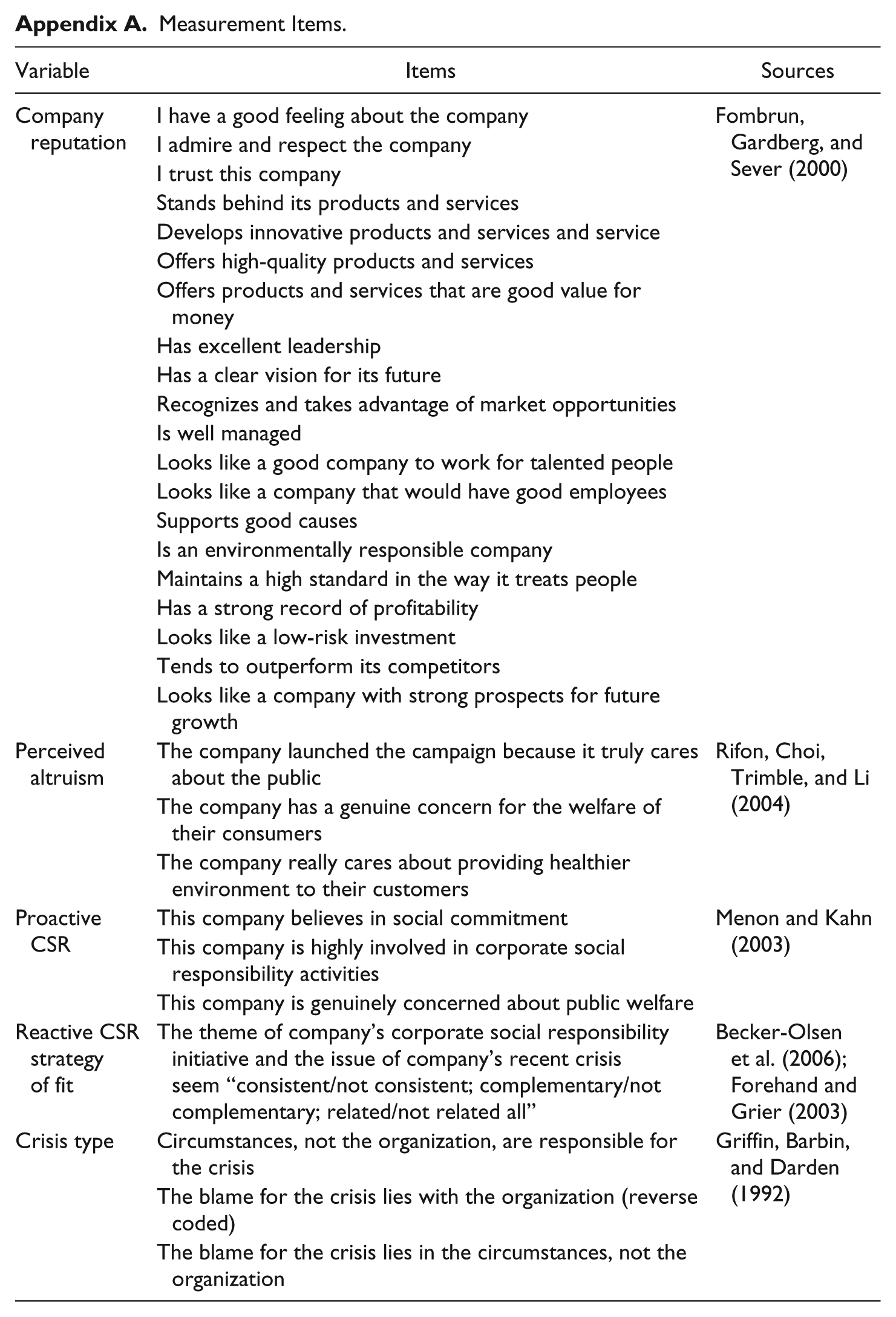
| Variable | Items | Sources |
|---|---|---|
| Company reputation | I have a good feeling about the company | Fombrun, Gardberg, and Sever (2000) |
| I admire and respect the company | ||
| I trust this company | ||
| Stands behind its products and services | ||
| Develops innovative products and services and service | ||
| Offers high-quality products and services | ||
| Offers products and services that are good value for money | ||
| Has excellent leadership | ||
| Has a clear vision for its future | ||
| Recognizes and takes advantage of market opportunities | ||
| Is well managed | ||
| Looks like a good company to work for talented people | ||
| Looks like a company that would have good employees | ||
| Supports good causes | ||
| Is an environmentally responsible company | ||
| Maintains a high standard in the way it treats people | ||
| Has a strong record of profitability | ||
| Looks like a low-risk investment | ||
| Tends to outperform its competitors | ||
| Looks like a company with strong prospects for future growth | ||
| Perceived altruism | The company launched the campaign because it truly cares about the public | Rifon, Choi, Trimble, and Li (2004) |
| The company has a genuine concern for the welfare of their consumers | ||
| The company really cares about providing healthier environment to their customers | ||
| Proactive CSR | This company believes in social commitment | Menon and Kahn (2003) |
| This company is highly involved in corporate social responsibility activities | ||
| This company is genuinely concerned about public welfare | ||
| Reactive CSR strategy of fit | The theme of company’s corporate social responsibility initiative and the issue of company’s recent crisis seem “consistent/not consistent; complementary/not complementary; related/not related all” | Becker-Olsen et al. (2006); Forehand and Grier (2003) |
| Crisis type | Circumstances, not the organization, are responsible for the crisis | Griffin, Barbin, and Darden (1992) |
| The blame for the crisis lies with the organization (reverse coded) | ||
| The blame for the crisis lies in the circumstances, not the organization |
Declaration of Conflicting Interests
The author(s) declared no potential conflicts of interest with respect to the research, authorship, and/or publication of this article.
Funding
The author(s) received no financial support for the research, authorship, and/or publication of this article.