



Abstract
The primary purpose of this study was to learn how and why information and communication technologies (ICTs) are used to initiate, maintain, and dissolve workplace romantic relationships, creating a new model. Workplace romantic relationships are different from traditional romantic relationships in several ways: those in workplace romances may face additional implications following workplace romance disclosure and need to be mindful of how they disclose, they risk damaging gossip that could result in negative professional consequences, and they are influenced by organizational culture. How and why people chose to date those they met at work has important implications for individuals, organizations, and society. Using a constructivist grounded theory approach and collecting in-depth qualitative data, we uncovered a model of ICT use in workplace romantic relationships. We also found privacy was a predominant concern in both the initiation and maintenance stages and that communication was generally avoided during dissolution. Technology was used to end many of these relationships including text messages and social networking sites because they are asynchronous and help both parties avoid more direct communication. Theoretical and practical implications for employees, managers, and organizations are discussed.
Keywords
Though workplace friendships have been the subject of academic inquiry for decades (e.g., Sias & Cahill, 1998; Sias, Gallagher, Kopaneva, & Pederson, 2012; Sias, Heath, Perry, Silva, & Fix, 2004; Sias, Krone, & Jablin, 2002; Sias, Pederson, Gallagher, & Kopaneva, 2012; Sias & Perry, 2004; Sias, Smith, & Avdeyeva, 2003), less is known about workplace romances (WRs). A WR entails “a non-platonic relationship between two members of an organization in which sexual attraction is present, affection is communicated, and both members recognize the relationship to be something more than just professional and platonic” (Horan & Chory, 2011, p. 565). Engaging in WRs seems to be common with up to 38% of workers reporting they have dated at work (CareerBuilder.com, 2013; Society of Human Resource Management [SHRM], 2014). Mainiero and Jones (2013b) argued, “Most romantic relationships at work are sincere, love-motivated, and of the long-term companionate variety as opposed to the short-lived flings or job-motivated utilitarian relationships” (p.188).
How and why people chose to date those they met at work has important implications for individuals, organizations, and society (Mainiero & Jones, 2013b). WR research has primarily centered on antecedents or motives (Cowan & Horan, 2014b; Pierce, Byrne, & Aquinis, 1996), perceptions associated with WRs (Cole, 2009; Cowan & Horan, 2014a; Dillard & Broetzmann, 1989; Dillard, Hale, & Segrin, 1994; Horan & Chory, 2009, 2011, 2013; Malachowski, Chory, & Claus, 2012), and outcomes (Brown & Allgeier, 1995; Mainiero, 1989; Pierce, Aquinis, & Adams, 2000; Pierce et al., 1996). Findings indicate that perceptions of favoritism, claims of sexual harassment as well as incidences of retaliation are all risks associated with WRs from the human resource professional’s perceptive (see SHRM, 2014). We know WRs are different from traditional romantic relationships in several ways: those in WRs may face additional implications following disclosure and need to be mindful of how they disclose their relationship, they risk damaging gossip that could result in negative professional consequences, and they are influenced by organizational culture (Cowan & Horan, 2014a). There is also the potential for negative workplace consequences such as sexual harassment claims (Pierce et al., 2000; Pierce, Broberg, McClure, & Aquinis, 2004), issues with codes of conduct and privacy, being faced with a decision of whether to sign a “love contract” (Mainiero & Jones. 2013b), and negative perceptions/communication (Horan & Chory, 2009, 2011, 2013). Though technology use is a routine part of work tasks, as well as maintaining romantic relationships (e.g., Houser, Fleuriet, & Estrada, 2012), current Information and Communication Technologies (ICTs) research does not fully consider WRs, why ICTs might be used in WRs, and how this use could be similar or different from traditional relationships. This is an important gap the current study sought to shed light on.
Little research has centered on understanding the role of ICTs in the development, maintenance, and dissolution of WRs. An encompassing term, ICTs include technologies such as social networking, mobile phones, and organizational intranets. ICT use is pervasive, explaining why some have argued organizations should have a proactive strategy in dealing with ICT and WR related issues (Mainiero & Jones, 2013b). In order to have a proactive strategy concerning WRs, organizations need to understand how ICTs are used in and out of the office, as it is clear organizational culture is created and sustained through communication between employees (Morgan, 2006; Murphy, 2001; Smith & Eisenberg, 1987). Consequently, the purpose of this study was to learn how and why ICTs are used to initiate, maintain, and dissolve WRs. To that end we first detail the model of WR (Pierce et al., 1996) and then discuss relevant literature.
Workplace Romance Escalation and (De)Escalation
Though researchers have begun to explore ICT use in romantic relationships (e.g., Drouin & Landgraff, 2012; Duran, Kelly, & Rotaru, 2011; Gibbs, Ellison, & Heino, 2006; Hancock & Toma, 2009; Stewart, Dainton, & Goodboy, 2014) less is known about how ICTs operate in WRs. Potentially, Pierce et al.’s (1996) model provides an understanding of this process. Although Pierce et al.’s (1996) model does address reasons employees initiate WRs and details several positive and negative consequences of WRs, it is lacking in that it is dated, untested, and does not address ICT use. We hope to elucidate technology’s role in the process of initiating, maintaining, and dissolving WRs. Below is a review of what we already know on this topic.
Initiating WRs
The Model of Workplace Romances asserts that propinquity, attitude similarity, attraction, job autonomy, attitude, and desire to engage in a WR, as well as culture, were factors that led to the formation of a WR (Pierce et al., 1996). Research has identified work context has also been found to be a motivating factor in the initiation of WRs. Mano and Gabriel (2006), for example, found that that organizational climate plays a role in understanding the development and perceptions of WRs. Moreover, Salvaggio, Streich, Hopper, and Pierce (2011) found factors such as perceived workplace sexualization (e.g., focus/encouragement on appearance, flirting) and high male-female contact were associated with higher levels of WR. Research recently found employees voiced their motives to engage in WRs as time, similarity, easy of opportunity, and hooking up (Cowan & Horan, 2014b). Although there is some overlap between Pierce et al. and Cowan and Horan, and these studies inform WR formation, they do not specifically speak to ICTs unique role in the process of WR (de)escalation.
Maintaining WRs
Studying how and why WRs are maintained is important because multiple negative consequences have been associated with failed WRs (Mainiero & Jones, 2013b; Pierce et al., 1996). One reason WRs may dissolve, resulting in some negative outcomes, may be due to difficulty with WR maintenance. Understanding challenges associated with maintenance is important because research has uncovered positive outcomes of maintained WRs. These include productivity (Anderson & Hunsaker, 1985; Dillard, 1987), a happier work environment, and increased motivation by those in the relationship (Mainiero, 1989). Organizational culture is also a factor important to maintaining WRs.
An organization’s culture entails the attitudes, values, beliefs, ideologies, and norms particular to the organization (Pierce et al., 1996). Mainiero (1989) found those cultures that are more traditional, slow-paced, and conservative discourage WRs. In contrast, organizations with dynamic, fast-paced, and more liberal cultures can stimulate WRs. It follows that those trying to maintain a WR in cultures that are more open to these kinds of relationships might have an easier time. Informing Mainiero’s nearly 30-year-old findings, Cowan and Horan (2014a) found organizational culture and expectations for behavior affected coworkers’ WR reactions. If culture and work context make it easier to stay in a WR (i.e., WR friendly policies, coworker support), successfully maintaining that WR might be easier.
Research reveals that WR participants send about 4 emails a day to their romantic partner (Hovick, Meyers, & Timmerman, 2003), demonstrating that workplace ICTs are used to help maintain WRs. These emails were used for nonorganizationally driven content, including flirting (as well as asking questions, small talk, talk about work, expressing intimacy, starting a relationship, gaining more information, and managing conflict). Given that this research is 13+ years old, and the rate that technology changes, it is important to further examine ICTs and WRs. Modes have changed and other ICTs, such as texting, have become prevalent in society, therefore presenting new challenges that warrant study (e.g., Mainiero & Jones, 2013a). Texting presents its own set of issues, particularly when the employee uses a personal device. This would not allow organizations to save messages or trace them.
Dissolving WRs
As not all relationships result in life-long partnerships, WRs—like other romantic relationships—can result in dissolution. Surprisingly, little research has examined technology’s role in dissolution, instead focusing largely on the consequences of dissolved WRs. Potentially, and as previously discussed, sexual harassment behavior and/or claims might be a consequence (Mainiero & Jones, 2013b; Pierce et al., 2000, 2004). In two studies, Pierce et al. (2000, 2004) investigated subjects’ judgments of sexual harassment complainants and perpetrators with a WR history. Pierce et al. (2000) found judgments were influenced by perceptions of WR motives and recommended personnel actions were influenced by the status of WR participants, the subject’s sex, and raters’ WR attitudes. Importantly, disciplining the accused perpetrator was seen as less appropriate in peer-peer relationships. They also found those with more favorable attitudes toward WRs saw discipline as less appropriate, and compared with women, men felt it was more appropriate to ignore the complaint. Such findings are particularly important considering that most individuals do have some communication with former romantic partners following termination (e.g., Dailey, Hampel, & Roberts, 2010; Lannutti & Cameron, 2002). Importantly, communication following a breakup with a former partner can be unwanted and also occur via ICT (Langhinrichsen-Rohling Palarea, Cohen, & Rohling, 2000) and this could be a very problematic situation when individuals still work together and interact via ICTs. The previously reviewed research helps explain why Mainiero and Jones (2013a) recommend that organizations employ love contracts. They describe these documents as a contract signed by both parties in the relationship explaining the relationship “is consensual, voluntary, welcome, and unrelated to their professional relationship at work, and each employee is free to end the romance at any time without coercion, prejudice, or any job-related consequences” (p. 197).
ICT Use and Romantic Relationships
It is clear ICTs are used throughout relational (de)escalation in relationships outside of organizations (Coyne, Stockdale, Busby, Iverson, & Grant, 2011; Duran et al., 2011; Fox, Warber, & Makstaller, 2013; Hancock & Toma, 2009; Houser et al., 2012; LeFebrve, Blackburn, & Brody, 2014; Pagon & Bizjak, 2009; Ramirez & Broneck, 2009; Stewart, et al., 2014; Tom Tong & Walther, 2010; Tonkunaga, 201l). Although we know of no research systematically investigating WRs and ICT use, there has been a flurry of research examining ICT use in non-workplace romantic relationships. Such research demonstrated ICTs such as Facebook, cell phones, text messaging, e-mail, and instant messaging (Coyne et al., 2011; Fox et al., 2013; Pagon & Bizjak, 2009) are all used in the initial stages of relationship development. After initial contact with a possible romantic partner, Fox et al. (2013) found Facebook was a primary tool used to get to know the person and reduce uncertainty.
Research further indicates relationships are maintained through ICTs including enacting maintenance behaviors (Coyne et al., 2011; Houser et al., 2012; Ramirez & Broneck, 2009; Stewart et al., 2014) and spying on partners (Stewart et al., 2014; Utz & Beukeboom, 2011). Houser et al. (2012) found participants used openness and assurances via communication technologies as a way to maintain romantic relationships; Stewart et al. found similar results studying Facebook use in relationships. Likewise, Coyne et al. (2011) reported cell phones and text messaging are used to express partner affection. Similarly, Ramirez and Broneck (2009) found instant messaging (IM) was used to maintain both romantic and close relationships.
Speaking to the importance of ICT in general, and IM conversations in particular, Slatcher, Vazire, and Pennabaker’s (2008) longitudinal study found that the types of words used in IM conversations predicted both the satisfaction in and stability of relationships. Regarding social networking sites (SNS), Fox et al. (2013) found expressions of affection via Facebook were also used to maintain relationships. Tonkunaga (2011) found SNS sites like Facebook are increasingly being used to spy on romantic partners as they can provide extensive information, status updates, and open message exchange. SNS use can also promote feelings of jealousy and uncertainty (see Stewart et al., 2014; Utz & Beukeboom, 2011).
Not only do ICTs have the potential to be a source of tension and possible termination of the relationship, they are also used in the dissolution process (Fox et al., 2013; LeFebrve et al., 2014; Tong, 2013). Fox et al. (2013) found Facebook could add to relationship stress and conflict when partners used the site to provoke jealously and create uncertainty in the relationship via pictures and provocative postings. These kinds of behaviors can lead to termination of the relationship. LeFebrve et al. (2014) listed a wide range of online behaviors via Facebook used during and after dissolution, including: minimal or no Facebook activity, purging sites of evidence of the relationship, and partner surveillance.
Rationale
Although revealing, current ICT research in traditional romantic relationships does not fully consider WRs, why ICTs might be used in WRs, and how this use could be similar or different from traditional romantic relationships. We know WRs are different from traditional romantic relationships in several ways. As those in WRs face different constraints than traditional relationships, we should not assume ICT use in traditional relationships is the same in WRs. Organizationally, it is important to understand ICT use in WRs because they could be liable for inappropriate and/or harassing use of ICTs, even when the device is not company owned (Mainiero & Jones, 2013b).
Although Pierce et al.’s (1996) model does address reasons employees initiate WRs and details several positive and negative consequences of WRs, it is lacking in several ways. First, it is 20+ years old and does not address ICT use. More generally, WR research suffers from a lack of theory building. Pierce et al.’s (1996) model of workplace romance remains largely untested, dated, and does not speak to possible communication patterns and channels. We aim to contribute to theory building concerning WR relationships by using qualitative methodology to better understand and uncover how and why ICTs are used in WR relationships—thus adding to this stage model. We also seek to answer calls to study “real” WRs using in-depth qualitative methods (Fritz, 2014; Malachowski, et al., 2012). With the aforementioned goals in mind, research question one was posed.
Method
We took a constructivist grounded theory approach (Charmaz, 2000) to data collection and analysis. A constructivist grounded theory approach allows researchers to explore people in natural settings and draws on grounded theory’s (Glaser & Strauss, 1967; Strauss & Corbin, 1990) guidelines for specifying relationships between concepts and building inductive theory (Charmaz, 2000) without adhering to traditional positivism. As Charmaz (2000) argues, “Constructivism assumes the relativism of multiple social realities, recognizes the mutual creation of knowledge . . . and aims toward interpretive understanding of subjects’ meanings” (p. 510).
Participants and Sampling
Participants had to be at least 18 years old and currently or previously engaged in a WR. Following institutional review board approval, both authors recruited participants using convenience and snowball sampling techniques (Lindlof & Taylor, 2011). Both authors contacted possible people in their networks inviting them to participate in the study if they met the aforementioned requirements. The recruitment message included information about the study, who to contact for participation, and anticipated participation time. Email, social networks, and posted flyers were all used for recruitment. These efforts helped us garner 14 participants who met the criteria. Following the snowball sampling technique (Tracy, 2013), we interviewed two additional participants. Students enrolled in the authors’ classes were also given the opportunity to participate in the study if they met the qualifications and received minimal course credit for participation. Using these sampling techniques, we were able to conduct in-depth interviews with a total of 23 participants who met the criteria. The majority of the participants were female (n = 18) and held nonmanagement positions (n = 19). All but two of the relationships were cross-sex. We were able to talk to two couples who eventually married (in separate interviews). The participants’ relationships lasted between 9 months and over 10 years with the majority being between 1 and 2 years (n = 15). All participants were assured confidentiality and were given information sheets with relevant participation information.
Data Collection
The goal of this inquiry was to gain an in-depth understanding of how and why ICTs are used in WRs; because of this, the first author conducted one-on-one semistructured interviews with all participants. The interviews took place outside of participants’ organizations and at a location they felt comfortable. The interviews lasted between 30 and 75 minutes. Because of the distance, 10 of the interviews were conducted via telephone. The interviews were considered “narrative” and “respondent” in nature (Lindlof & Taylor, 2011), because after reading a definition of what is meant by a workplace romance (Horan & Chory, 2011), we asked the participant to tell us their story and then asked questions relating to ICT use in the (de)escalation of the relationship. If the relationship had terminated, we asked questions about this dissolution including if, how, and why ICT was used. Although the interviews were recorded with participant consent, the first author also took notes throughout the interview noting important stories and information. Immediately after each interview, the first author would write down her thoughts and ideas generated during the interview as a form of memoing, noting similarities and differences with other interviewees’ experiences as well as interesting examples and overall questions (Charmaz, 2000). Interviews were conducted until we started seeing high reoccurrence of developing themes (around the 20th interview). We then interviewed the remaining participants and left the field to concentrate on data analysis. Interviews were transcribed by a professional transcriptionist resulting in 308 single spaced pages of text; the first author checked the transcriptions for accuracy. The appropriate institutional review board approved all procedures.
Data Analysis
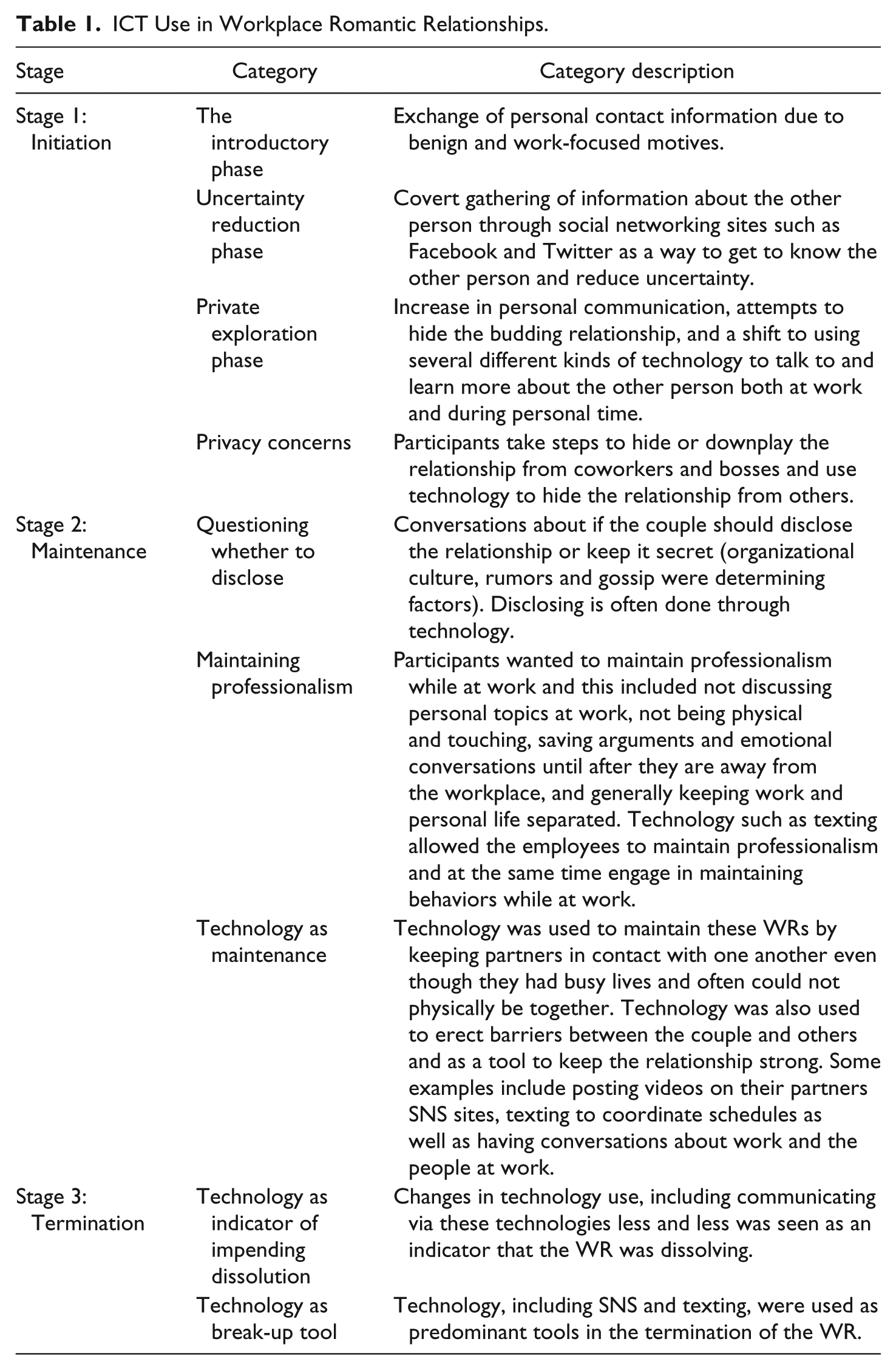
We took a constructivist grounded theory approach to data analysis because we were interested in building theory from the ground up on the initiation, maintenance, and termination stages of WR and ICT use. Constructivist grounded theory (Charmaz, 2000) is a technique used to inductively create theory from textual data. Using the constant comparative method (or uncovering categories, comparing these to new data, adjusting and refining the emerging categories based on new data, comparing again, and so on), we used a two-step coding process (often discussed as open, axial, coding procedures; Charmaz, 2000; Strauss & Corbin, 1990). Analysis began in the data collection phase as the first author began to generate ideas and codes as she took notes and reflected on the interviews about what was being learned from participants in relation to our research question. More focused coding began as both authors conducted more focused readings of the interview transcripts and generating initial codes. During this first stage of coding, data is broken down and emerging concepts are labeled (Charmaz, 2000). We separately open coded the data by asking ourselves, “What is this?” and “what is going on here?” in terms of what types of ICTs were used, how, and why in the three WR stages. Some examples of these initial codes included “hiding,” “privacy,” “fun and secret,” “sneaky use,” “awkward communication,” and “emotional.” We then met to discuss these categories and discuss possible larger themes. During the second stage of coding, the initial categories identified during initial coding were further developed by identifying larger themes in the emerging categories. We asked ourselves how are these initial codes similar or different? How do they fit together and how do they answer our research question? The larger themes suggested a clear process of ICT use in WR development and termination (see Table 1). To better understand whether our interpretation resonated with our participants, we checked our interpretation with four participants who agreed to serve as member checks (Lincoln & Guba, 1985). After reading our findings and interpretation all four related they felt our interpretation reflected their experience.
ICT Use in Workplace Romantic Relationships.
Findings and Interpretation
Analysis of the interviews revealed a wide array of ICTs used to initiate, maintain, and dissolve WRs including cell phones (text messaging, voice calls), SNS (Facebook, Twitter, MySpace, Instagram, Foursquare), FaceTime, Skype, and to a lesser extent, more traditional technologies associated with the workplace including landline work phones, email, and internal intranets. Personal devices were used in the majority of the communication between partners. Overall, the theme of privacy (manifesting in different ways for different reasons) was a major theme seen throughout all three stages of the model. In the sections below we attempt to answer our research question, detailing themes uncovered during analysis.
Stage 1: Technology Use in the Initiation of WRs
Several technologies are used in the initiation of WRs including personal cell phones (particularly, the text feature), SNS sites such as Facebook, Instagram, Twitter, Foursquare, Skype, work email, work landlines, and internal intranets. A wide variety of technologies are used as partners begin to “figure out” one another’s communication preferences and style. We found that there were clear patterns in how and why these technologies are used at this stage of the relationship. We labeled these steps: (a) the introductory phase, (b) the uncertainty reduction, and (c) the private exploration phase. Privacy was an important driver in Phases two and three.
The Introductory Phase
All the people we spoke with began communicating face-to-face because they were physically co-located at work. We termed this phase the introductory phase. However, most began the initiation of the romantic relationship through a mediated form of communication after determining they were socially or physically attracted to the other person. Many commented that the workplace itself is a good place to initiate relationships because often one of the partners was positioned in a place of knowledge and this could be a good reason to just start conversations. Emily discussed how her soon-to-be boyfriend was “one of the first people to say ‘hi’ and show me around, kind of get me used to the whole experience . . . he took time to make sure I was doing everything okay . . .” Andrea commented, “He would always just be like, ‘hey, how are you? Do you need any help?’ And he was very flirty.” Additionally, Maria talked about how Aaron, her soon to boyfriend, helped her out on her first day, “On my first day of working there he really helped me out. He was very, very nice . . . he would give me pointers.” Many of the stories related that training or helping a co-worker led to exchange of personal phone numbers, texting, finding the person on Facebook, and more personal conversations through these media. Participants mentioned they asked for personal contact information or were asked by others for personal contact information in case an emergency arose or they needed to contact a co-worker.
The Uncertainty Reduction Phase
The use of ICTs began to increase in this stage of initiation. Participants discussed how they began to covertly gather information about the coworker through Facebook and other SNSs as a way to reduce uncertainty and learn more about the other person. Several participants talked about how they “friended” the other person on Facebook to gather information about them and to get this information without having to ask the person directly. These covert methods of uncertainty reduction are consistent with the passive form of uncertainty reduction as described by Berger (1979) as well as research identifying Facebook as a primary tool for uncertainty reduction in initial stages of romantic relationship development (Fox et al., 2013). Several participants implied it is risky to be romantically interested and involved with a coworker and that face-to-face communication implies so much more than technology use. They discussed how technology could be used in a covert and somewhat ambiguous manner to check people out, see whether they had a partner, what they are interested in, what they like, and if there was a connection. Lynn commented, “I looked him up to be kind of nosey and stalk him . . . I didn’t want to come off as crazy, but I did look at his Facebook profile and saw if he had any pictures of girls . . .” Similarly, Jenny said she used “social media as a kind of detective work” referring to finding similarities with her potential partner through social media. Diamond, Maria, Jenny, and others talked about using ICTs to try to research the person or see the other person’s working schedule. Several mentioned it would have been “creepy” to ask the person about these things face-to-face at such an early stage in the friendship and this was a way to get the information early on to see if they wanted to pursue further communication with the person. Diamond talked about how using Facebook and liking pictures can have ambiguous meanings so it is a way to flirt without being overt, “It’s easy to have that conversation without having it . . . you are hiding behind your computer . . . it also gave us something to talk about when we saw each other besides ‘hi’.” Tom even commented that he started using Twitter to talk to the coworker he was interested in (who would later become his wife) instead of asking for a number. He did this because it was less direct, “If you are following someone and they are following you back, it doesn’t mean like ‘oh they like you’ or they are dating you. But you are doing it to get to know her.” This following on Twitter turned into talking more face-to-face and texting. This research led to our participants pursuing more communication avenues with the other person including starting more conversations at work and online.
The Private Exploration Phase
The last initiation phase is marked by an increase in personal communication (both face-to-face and through ICT), attempts to hide the budding relationship, and a shift to using several different kinds of technology to talk to and learn more about the other person both at work and during personal time. Shelby commented, “He would call my department phone . . . and just make stupid comments to me, being funny while I’m on the phone at work and I can’t really say anything back because no on one in my department really knew.” Amanda talked about how she and her partner used their internal intranet and AOL Instant Messaging to hide what they were doing and how much they were talking during work hours, “We would use the instant messenger . . . it allowed us to look like we were working but instead we were talking to each other and flirting . . . the technology is free, easy to use, and quick to hide on your computer.” The participants’ use of text messaging through personal phones and devices increased drastically during this time because it is easy to use and allowed privacy. Gabby mentioned that she and her partner began “texting obsessively because it was a new way to communicate without really anybody else knowing.” Relatedly, Michael said, “You will have texting conversations that will last for hours, like we used to use phones.” Several people echoed the idea that they kept up long text conversations and the ease of communicating via this technology while at work. For example, Tammy commented, “We would usually text while at work, we work in the same facility, to keep us in contact.” The participants also pointed to the idea they began talking/texting about more topics and on a deeper level as a way to really get to know the other person. Past experiences, school, family, past relationships, future plans, and careers were all mentioned as topics that were explored.
During this phase, the partners are also trying to figure out each other’s preferred methods of communication and communication style. Diamond relates that she and her partner had different ways of using technology when they first began talking and found these out by trial and error. She had a strict rule to never text and drive and her soon-to-be boyfriend held the expectation that one would text back quickly after receiving a text and if not, something was wrong. After this miscommunication, the two talked about how they would use texting and what to expect from each other. John also discussed how he did not like to talk on the phone but did so when his partner called because he knew this was her preferred way of communicating. Several participants commented that the relationship might not have gotten off the ground if it were not for technology and how it could allow one to overcome shyness. As Michael commented, “I would think that the relationship might not exist without the technology . . . I’m kind of timid, she is too . . . I am not sure it would exist . . .” The ability to overcome shyness and to talk to the other person more often seemed to be major drivers of technology use in this phase.
Privacy Concerns
Privacy was a concern mentioned by our participants at this early stage in the WR. Our participants discussed how they would take steps to hide or downplay the relationship from peers and superiors for a variety of reasons including the idea that the partners wanted to keep work and life separated. Gabby commented, “You are able to keep it on the DL just by messaging, you know? You are able to do it 24/7, you know? We were careful.” John discussed that people at work were asking him if he and his coworker were together he said, “I like to keep my mouth shut and my business on the down low. . . . So I will be like ‘No, we’re just friends. We’re just cool.’ You know she did the same thing.” Kevin also talked about his partner wanting to keep the relationship really private and he thinks this eventually was not good for the relationship because they were, “putting on a show” at work and it was easy to pretend they were not actually together or a couple which made it easier to end the relationship.
Stage 2: Technology Use in the Maintenance of WRs
In terms of WR maintenance, our participants discussed three main factors associated with how and why certain technologies are used in WR the maintenance. We labeled these themes: (a) questioning whether to disclose, (b) maintaining professionalism, and (c) technology as maintenance.
Questioning Whether to Disclose
One factor that proved important to WR maintenance was organizational culture. Sarah described her work environment as “really friendly . . . everyone was light and loose [not uptight] and friendly and would joke about crazy things.” She also discussed how, after finding out about her WR, some coworkers became their “guardians” and would give them advice on how to handle the WR and socializing at work. If the organizational culture was somewhat conducive to the continuing of these relationships, the participants discussed how they were not as strict in trying to hide the WR and even began to reveal the relationships oftentimes through technology. Tom discussed how his organization encourages being friendly with coworkers and because of this there is a lot of dating and married couples in his organization. In Tom’s case, after he and Jenny dated for a while, they began tagging each other more often on Facebook and Foursquare not caring if people found out about the relationship. Because their coworkers were also on these sites, their relationship was revealed. Alexis discussed how after a year of friendship with her partner and 6 months of dating and hiding the relationship from coworkers because of possible gossip, they decided to reveal the relationship because coworkers started asking more questions, “We told them 6 months later because everyone was asking . . . we put ‘In a relationship’ on Facebook.” The tension of feeling as if they want to reveal the relationship, but at the same time have some privacy was apparent in these stories. Such a situation implies a dialectical tension (Baxter, 1990) where WR participants struggle with the tension of openness-closedness. Alexis discussed how she and her partner only revealed the relationship because people kept asking but they did not want to because “then the rumors would start.” The idea of rumors and distraction from work was a strong concern voiced by these participants when determining whether they should reveal their WR. These kinds of issues led many of the couples to talk about how to “do” the relationship including how to use technology with these added pressures. Most decided they needed to “keep it professional.”
Maintaining Professionalism
The idea of “keeping it professional” was heard often to describe conversations on how we are going to do the romance at work. Participants wanted to avoid rumors and also keep their relationship private. Keeping it professional meant many things including not discussing personal topics at work, not being physical and touching, saving arguments and emotional conversations until after they are away from the workplace, and generally keeping work and personal life separated. Lynn commented, “We kept it professional, you know, no PDA [Public Displays of Affection] at work.” Shelby said she is “professional when it comes to work” and would not engage in an argument until after working hours and in private. Technology such as texting allowed the employees to maintain professionalism and at the same time engage in maintaining behaviors while at work. Jenny discussed how she and Tom came to an understanding about how they would do the relationship at work by not talking about personal topics and using technology to communicate. Jenny talked about how technology (SNS and texting) allowed her and Tom to “keep our work life and personal life separated because if we did not have the technology we would probably be talking more and others could tell our interactions were more personal.”
Technology as Maintenance
As has been seen in traditional romantic relationships (Coyne et al., 2011; Fox et al., 2013), technology was used to maintain these WRs by keeping partners in contact with one another even though they had busy lives and often could not physically be together. Emily discussed how her boyfriend would “submit posts of videos on my [Facebook] wall . . . send me messages . . . or send me little emoticons like smiles.” Gabriella’s comment echoed many others when she related about texting, “You know with school, our schedules were completely opposite. Texting definitely kind of kept us connected because we were never really around each other.” Like Gabby, Michael, Kevin, and Shelby, Gabriella discussed using text to coordinate schedules so they could see each other, connect, and check in with each other during the day.
One interesting way many of the participants maintained the relationship, stayed close, and also satisfied the need for privacy was to erect barriers between themselves and their coworkers. These could be verbal, nonverbal, and/or physical and this seemed to be done intentionally or unintentionally in an interest to keep the relationship secure. An example of an intentional barrier came from Emily who discussed having a conversation with her manager about changing departments so that rumors would be less of an issue. Lynn pointed to maintaining her relationship by having text conversations with her boyfriend where she would vent about other coworkers and the stress of work. Lynn was not alone as many of the participants mentioned having involved conversations (through technology and face-to-face) about work and the people at work. After all, as Michael commented, “it is the thing we have in common and it affects us the most on a daily basis.” Michael summed up these barriers when he commented,
The relationship creates somewhat of a wall between us and other coworkers in the sense that now all of the sudden if someone is annoying her or she is angry at someone else, she’ll often tell me which person then it kind of creates a negative view of that person for me. . . . It feels kinda like secrecy . . . there is a certain barrier that exists, that didn’t exist before.
Stage 3: Technology Use in the Dissolution of WRs
Seven of the participants we spoke to were still in a relationship, the rest (n = 16) had been terminated due to several different factors including infidelity, drifting apart, not enough time spent together, and loss of interest. It was clear that technology played an important role in the termination process. In answering how and why technology was used in the dissolution process, we found two main themes, technology use as indicator of impeding dissolution and technology as an essential dissolution tool.
Technology as Indicator of Impeding Dissolution
Our participants discussed they used technology less and less as the relationship began to dissolve and even avoided communication through technology altogether. For example, Emily discussed how her relationship began to dissolve when she left the workplace and did not get to see her partner on a regular basis. Leaving the workplace led to less communication, “He was just like its not the same—he was very distant after I left.” And Lynn discussed how she and her partner had a dramatic slowdown in their technology use and this signaled the end of the relationship. Lynn and her partner realized their texting and communication should not be an obligation “the relationship shouldn’t feel like an obligation it should feel, it should be something that we want to do.”
Technology as Break-Up Tool
It was clear from those who had been through a WR dissolving that it was a very emotional experience and there was a lot of emotional labor that happens because of the break-up. It seems the more emotional or controversial the break up is, the more technology was used and even the avoidance of communication. For example, those whose relationships dissolved due to cheating discussed mainly using asynchronous technology with the option to not reply and the ability to be direct without the emotional repercussions of a face-to-face conversation. For example, after Shelby found out her boyfriend of a year was cheating on her with a coworker she wanted to confront him face-to-face (he worked in another department) but he would not see her and only used text messages to communicate. Shelby commented, “when I confronted him (via text) he said it was none of my business . . . I was never able to confront him in person.” Shelby discussed being hurt and still having to talk to him in a professional context because he got promoted and managed her floor, “It was tough because he ended up being with this girl [the coworker] that every time we would communicate, you know it was strictly work dealing with customers, she would always just lurk around me.” She also talked about how she would handle this by “trying to not let it get to me.” Kevin’s relationship just dissolved without any stated reason, his partner just avoided him atogether and de-friended him on Facebook. Kevin discussed how this was easy to do because they hid their relationship from those at work and worked different shifts. Natalie related that after she confronted her cheating boyfriend of 2 years face-to-face, she blocked him out through the technologies they used to use to communicate including texting, Facebook, and phone calls. She related this is how she got through the break-up and not back together with the cheater. She also put in her 2 weeks [signifying resignation] because it was just too hard to go back to work. Clearly the dissolving of a WR is a highly emotional situation that is often left unresolved due to the lack of closure and a face-to-face conversation.
Discussion
We aimed to better understand ICT use in the stages of WR development and termination. We began our inquiry hoping to extend and inform the model offered by Pierce et al. (1996). Our findings help extend Pierce et al., by adding much needed detail to the maintenance and dissolution phases of WRs as well as demonstrating the importance of communication technology use in these phases. Our reported model describes technology’s role in the initiation, maintenance, and termination of WRs. We recognize that these stages are not mutually exclusive and individuals moved freely between them. It is important to note that our description of relationship development overlaps with others who have proposed relationship development models (e.g., Knapp, 1978). Like other studies examining relational (de)escalation (e.g., Dunleavy & Booth-Butterfield, 2009; Umphrey & Sherblom, 2001), we found that how and why ICTs are used differed between stages. We also found that privacy was a predominant concern in both the initiation and maintenance stages and that communication was generally avoided during dissolution. Technology was used to end many of these relationships including text messages and SNS because they are asynchronous and help both parties avoid more direct communication.
Theoretical Implications
Strauss and Corbin (1990) explain that a good grounded theory will be understood by those studied, be broad enough to apply to a variety of contexts related to the area of investigation, and provide control in the form of conditions in which the theory applies. Our member check responses demonstrate our model does resonate with those who were studied. We also believe the model is broad enough to apply to various types of WRs including peer-to-peer and asymmetrical relationships. However, the model should be used with caution and in consideration of the particular organization’s culture. Regarding control, we believe organizational culture, policy, and norms play a significant role in how ICT use actually plays out in WRs. As the findings demonstrate, our model tends to reflect a culture that is more open to WRs and personal communication and involves experienced technology users, using their own devices and in predominantly long-term relationships (the majority being between 1 and 2 years as previously reported). That said, findings demonstrate support for ideas previously presented, particularly the idea that today’s WRs are largely love-motived and long-term, serious endeavors (Mainiero & Jones, 2013b). Our findings have implications for multiple theories, reviewed below.
Researchers have used Work-Family border theory to better understand WRs, arguing that both blending and spillover occur (e.g., Horan & Chory, 2011). WR participants are border crossers (Clark, 2000), and researchers argued that, for those in WRs: “Work issues are discussed in the life domain (e.g., a date, dinner, etc.) and life issues are discussed in the work domain (e.g., discussing relationship plans at work, scheduling of a personal event, etc.)” (p. 565). The previous description supports the recent description that WRs “involve boundary permeability” (Methot & LePine, 2016, p. 118). Thus, as previously described, these blended domains (Clark, 2000) with permeable borders (Methot & LePine, 2016) allow for spillover (Horan & Chory, 2011). Findings here inform those claims, as ICT use likely facilitates both blending and spillover. Consider results regarding social media as a means to reduce uncertainty. Situations wherein participants used social media to reduce uncertainty while in the life domain about a coworker from the work domain would represent blending. Likewise, feeling frustration with a romantic partner about an organizational situation while at home would represent spillover. Thus, our results add explanation (e.g., Chaffee & Berger, 1985) to this theory.
Work–family border theory’s (Clark, 2000) first proposition argues that “when domains are similar, a weaker border will facilitate work/family balance” (p. 765). Our results regarding technology’s role in WR appear to support this assertion, as those working in organizational cultures perceived to be more “relaxed” also seemed more supportive of WRs. Additionally, this perspective is consistent with Greenhaus and Powell’s (2006) theory of Work-Family Enrichment. They specifically framed instances where “work and family roles are ‘allies’” (p. 72). These situations result in enrichment, which they described as “experiences in one role improve the quality of life in the other role” (p. 73). Based on their theoretical arguments, experiences in WR may result in enrichment for WR participants, as their theory argues, and concurrently, balance as Clark argued. Golden’s (2013) findings illustrate how technology is used at work to communicate with members of the home/life domain and, equally, how ICTs are used in the home domain to communicate about work. As both theories add to our limited understanding of WR, additional research and theoretical framing is necessary to further understand how WR operates in organizations, both for organizations and for members of the WR.
Study participants repeatedly cited the role of privacy concerns in WRs, pointing to the importance of privacy management (Petronio, 2002). These concerns were largely seen during the initiation stage, and also in the maintenance stage when individuals struggled with the decision of whether to disclose their WR. This finding is consistent with Petronio’s theory (2002) as we found those in WRs discuss and negotiate how and when to reveal the relationship to others in the organization. Some participants pointed to the idea that WR information is indeed shared by the relationship partners and revealing this information should include input from both people and entail privacy rules. The unique context of WR as well as fear of disclosure reactions are likely key factors in understanding how individuals form privacy rules (Petronio, 2002).
Applied Implications
Our findings also point to several practical implications that should be considered by employees, managers, and organizations. First, we found ICT use in the early stages of a relationship, and in the maintenance phase, may result in positive spillover for WR participants. Still, during times of conflict and/or dissolution, ICT use may lead to negative spillover. Problematically, situations of unwanted communication following romantic termination can cause negative emotions and may even constitute obsessive relational intrusion (e.g., Spitzberg & Cupach, 2003; Spitzberg, Nicasto, & Cousins, 1998). These situations are linked to a number of negative outcomes for victims of unwanted pursuit and/or stalking (Spitzberg & Cupach, 2003). When unwanted pursuit (Langhinrichsen-Rohling et al., 2000) happens within organizations, a challenging situation emerges. This issue seems particularly important for organizations to be aware of as often employees use privately owned devices at work to facilitate the WR. The “Bring Your Own Device” phenomenon in organizations occurs when employees “use their personal mobile devices to access the resources of the company for both work as well as personal use” (Gajar, Ghosh, & Rai, 2013, p. 62). With this increased use of personal technology comes, of course, an increased risk for the organization and the employee. This increased risk stems from less organizational control of a personal device than a company owned and monitored device. For instance, an employee may use their own device to access company applications/websites that allows the employee to contact his/her former relational partner. In these situations, employees blend personal/professional boundaries to communicate with someone who may not want such communication; this could be perceived, then, as harassment. Using personal devices increases the potential for the organization to not even know the communication is taking place, monitor it, and take different steps to protect employees. Future research would be wise to explore how organizations are managing the “Bring Your Own Device” phenomenon and the increased use of personal devices in WRs.
Based on our findings highlighting the use of technology such as cell phones and the text feature during relationship termination, it seems clear organizations need to be proactive and manage communication following termination between former partners, possibly through pertinent organizational policy. Such a policy would be dependent on norms, culture, and legalities as well as being specific to how organizations use technology and ICTs. Potentially, this policy could be explicitly spelled out in new employee orientation as well as in any potential love contracts. HR practitioners and managers would be wise to consult other studies about workplace romance policies and concerns regarding approaches to management (e.g., Pierce & Aguinis, 2009).
Second, our findings demonstrate that personal communication during the initiation, maintenance, and even termination stages of relationships does occur during work hours and ICT use aids in this type of communication. We also found those in WRs feel a tension with regard to revealing and discussing the relationship with other organizational members and not being so open. Similarly, struggles with openness have been identified in workplace friendship studies: it is a tension in workplace friendships (Bridge & Baxter, 1992), yet also a maintenance behavior (Sias et al., 2012). Though openness has its benefits, maintaining secrets can lead to sources’ rumination about the secret (Afifi & Caughlin, 2006) and avoidance is a negative maintenance behavior (Dainton & Gross, 2008). When secrets are shared about WRs with other organizational members, yet asked to remain private with trusted actors, privacy rule violations could result in gossip about the romance (e.g., Cowan & Horan, 2014a; Mano & Gabriel, 2006) and/or workplace distractions. As discussed previously, our participants mentioned gossip and distraction from work were issues they were aware of and tried to mitigate. Although we know these participants were trying to mitigate possible negative effects of the WR on the work environment, we do not know whether these strategies are effective or whether the people in WRs tend to do this well. The answer to this question is likely complicated, but it seems clear how others find out about the relationship and the organizational culture are important factors. Future research should explore WRs and employee distraction more fully.
Last, findings have implications for the positive functioning of work groups and coworker relationships. We found those in WRs often erect barriers with coworkers as a way to maintain the relationship and keep it healthy and secure. This could have negative implications for work groups and teams especially those that have a high level of interdependence. Cohen and Bailey (1997) reported that when there is conflict between group members (which can happen when WRs are present and barriers are erected between members), the interdependence of coworkers increased the negative impact of conflict. The kinds of barriers discussed by our participants could negatively affect group cohesion which is related to group performance. Future research should explore these issues and determine when these barriers could be positive or detrimental to work groups, individuals, and group functioning.
Conclusion, Limitations, and Future Research
The model of ICT use in WR discussed here adds to our limited understanding of WR (de)escalation by specifically focusing on how and why certain channels are used. Results of this study should be interpreted with limitations—many of which are avenues for future research. First, our sample was largely cross-sex and therefore does not speak to same sex WRs (e.g., Horan & Chory, 2013). Second, the WRs studied were largely noncontroversial; additional studies should explore WRs with large age difference and WRs where one or both parties are married to other people. Other fruitful areas might look at how age, job position, time in the relationship, and other demographic variables might affect WR technology use. Though we used qualitative data to generate a model, future studies should quantitatively test the ideas presented. Naturally, qualitative data can lead to scale development which would allow for additional exploration of the impact of WRs on both organizational outcomes (e.g., satisfaction, motivation, productivity, turnover intentions) and interpersonal communication processes necessary for a productive work environment (e.g., antisocial organizational communication behaviors—see Chory & Hubbell, 2008; Horan & Chory, 2013). Findings of such studies will offer additional understanding for both researchers and practitioners.
As described previously, WRs are common and likely will continue to grow in popularity. Equally, organizations and individuals rely heavily on ICT use in their personal and professional lives. Consequently, our model should be of value to organizations and individuals as they help describe the how and why of ICT use in WRs.
Footnotes
Author’s Note
Sean M. Horan is currently affiliated with the Department of Communication at Fairfield University.
Declaration of Conflicting Interests
The author(s) declared no potential conflicts of interest with respect to the research, authorship, and/or publication of this article.
Funding
The author(s) received no financial support for the research, authorship, and/or publication of this article.