



Abstract
Using corpus-linguistic tools and methods, this article investigates the discourses of climate change in corporate social responsibility and environmental reports produced by major oil companies from 2000 to 2013. It focuses on the frequency of key references to climatic changes and examines in detail discourses surrounding the most frequently used term “climate change.” The analysis points to shifting patterns in the ways in which climate change has been discursively constructed in the studied sample. Whereas in the mid-2000s, it was seen as a phenomenon that something could be done about; in recent years, the corporate discourse has increasingly emphasized the notion of risk portraying climate change as an unpredictable agent. A proactive stance signaled by the use of force metaphors is offset by a distancing strategy often indicated through the use of hedging devices and “relocation” of climate change to the future and other stakeholders. In doing so, the discourse obscures the sector’s large contribution to environmental degradation and “grooms” the public perception to believe that the industry actively engages in climate change mitigation. At the methodological level, this study shows how a combination of quantitative corpus-linguistic and qualitative discourse-analytical techniques can offer insights into the existence of salient discursive patterns and contribute to a better understanding of the role of language in performing ideological work in corporate communications.
Introduction
In light of the evidence of man-made causes of climate change (Intergovernmental Panel on Climate Change [IPCC], 2013), businesses have increasingly come under pressure to put the planet more firmly on the agenda (O’Connor & Gronewold, 2013; van Halderen, Bhatt, Berens, Brown, & van Riel, 2016). The rise of corporate social responsibility (CSR) is seen as a response to these demands (e.g., Livesey, 2002b; Milne & Gray, 2012; O’Connor & Gronewold, 2013). This seems to be particularly pertinent to the so called “environmentally sensitive industries” like the oil industry (Jose & Lee, 2007, p. 319) that contribute to the environmental degradation and are therefore more prone to be objects of social activism and critique. Thus, there is a stronger need for them to justify their stance on sustainability. For them, CSR reports are particularly important tools of maintaining legitimacy vis-à-vis stakeholders and society. O’Connor and Gronewold (2013) report that more than three quarters of the petroleum industry produces CSR reports despite it being voluntary.
The rise of voluntary CSR reporting and the discourses disseminated in the reports have received considerable research interests in business, accounting, and management as well as language and communication studies. Particular attention has been paid to discourses around environmental sustainability (Ihlen & Roper, 2014; Laine, 2010; Lischinsky, 2015; Livesey, 2002b; Livesey & Kearins, 2002; Milne, Kearins, & Walton, 2006) showing how companies strategically utilize the categories of “environment” and “sustainability” to create a positive image of themselves, increase legitimacy, and competitive advantage. Yet with some exceptions (e.g., Ihlen, 2009; Jaworska & Nanda, 2016; Livesey, 2002a; Pollach, 2016) little is known about the extent to which corporations attend specifically to climate change in their CSR reporting and how climate change is rhetorically and discursively built into the discourses of environmental sustainability. Examining the use of terms describing climate change is essential because research suggests that the choice of climate lexis reflects diverging attitudes and values and can influence perceptions and responses (e.g., Schuldt, Konrath, & Schwarz, 2011; Whitmarsh, 2008). Studying lexical choices and discursive uses of “climate change” and related terminology in CSR reports produced by the oil industry can therefore shed light on the ways in which this “environmentally sensitive” sector positions itself against the challenges posed by climate change, what kind of perceptions around climate change the industry “favors” and how climate change is discursively and rhetorically used, if at all, in the complex negotiations between the bottom-line-driven aims and societal critique, and expectations.
CSR and environmental reporting is an indicate source of data that can demonstrate corporate attitudes and positions toward environmental issues. Despite the growing significance of reporting initiatives such as the Global Reporting Initiative (Waddock, 2007), companies have (still) quite a lot of freedom to decide what to include in the reports, how much detail to include and how to write about it. In this way, CSR and environmental reports give companies “ample opportunities for reality construction” (Pollach, 2016, p. 2). What kind of climate change reality is constructed in corpora reporting of the oil industry, how these constructions changed over time and what kind of lexico-grammatical devices are employed is the major interest to this study.
Previous discourse-analytical research on climate change in corporate reporting shows that the attention given to climate change varies between sectors and countries, and corporations that focus on climate change in CSR reporting do so predominantly within the economic frame (Ferguson, Sales de Aguiar, & Fearfull, 2016; Ihlen, 2009; Livesey, 2002a). This research is, however, based on either small samples collected in 1 year or lumps together many different industries and sectors. Businesses are not static entities and the kind of discourses that they produce change over time as companies attend to emerging economic, social, and environmental issues because of the pressure from stakeholders, activists, or media (Pollach, 2016). Not attending to emerging issues might have negative consequences for companies, though it needs to be noted that corporate responses might be symbolic only without any actual changes to their practices (Livesey, 2000a; Mahon & Waddock, 1992). Climate change proses different challenges for different industries and hence different (symbolic) responses might be developed reflecting the stance of the industry (cf. Newell & Paterson, 2010). This justifies the relevance of an industry-based approach undertaken here.
Building on previous discourse-analytical research on the representations of environmental issues in CSR and environmental reporting, this article examines the extent to which “climate change” and related terms such as “greenhouse effect,” “global warming,” feature in CSR and environmental reporting produced by major oil companies and how their use changed over time. Because this research is only concerned with climate change, terms related to other related environmental issues, for example, water, air, soil, carbon included in Pollach’s (2016) study were not considered. Whereas Pollach (2016) stopped at analyzing term frequencies, this study moves beyond the word counts. Frequencies are good indicators of the kind of lexical choices that companies prefer pointing to the degree of attention given to a particular phenomenon (Pollach, 2016). Yet if we want to understand how the phenomenon in question is discursively constructed, it is necessary to move beyond the mere word mention and study its use in context. Research in lexicography has shown that words derive their meanings not just from their single linguistic form but largely from other accompanying or co-occurring words known as collocations (Sinclair, 1991). Just a mere mention of the term “climate change” tells us little about how this phenomenon is constructed and what kind of discourses are associated with it. Moving to the lexical surrounding of “climate change” and studying in more detail words that frequently occur in its vicinity can reveal persistent lexico-grammatical associations with climate change, which in turn can point to evaluations, values, and attitudes.
The understanding of discourse which underpins this study is based on the poststructuralist concept of discourse as used in Critical Discourse Analysis (Fairclough, 1989), which, in turn, draws on the Foucauldian notion of discourse as a social practice. From this perspective, discourse is not just a referential tool that mirrors the social world; it is a symbolic means that constructs social realities through processes of naming, describing, informing, in short, through giving meaning to objects, situations, people, and so on. As Burke (1969, p. 172) reminds us, “Wherever there is meaning there is persuasion” highlighting the never neutral status of discourse; the choice of symbolic means acts as a lens or a screen through which people, objects, and situations are constructed. This lens will foreground certain features while marginalizing others. Language in use alongside other symbolic means (visual images) is a key building block of discourse. Echoing the point made by Burke (1969), van Dijk (1995) points out that language users have a wide range of lexical choices at their disposal. However, when referring to a certain phenomenon (in this study, climate change), they may prefer certain lexical choices over others and in doing so, will construct them in a way that reflect practices and ideologies established in the community to serve the needs of that community. It is not just through lexical choices that practices and ideologies can be indexed in discourse. Grammar too is a powerful linguistic means of performing ideological work through assigning or removing agency. This can be illuminated through the analysis of verbs that occur with the phenomenon in question as well as the subject-object relations in sentences. For example, if the term “climate change” assumes a subject position in the sentence, it will be the “doer” of the action expressed by the verb. Conversely, if climate change is placed in the object position, it will be a receiver of the verbal action (things will be done to it). As the analysis below shows, shifting grammatical positions in corporate reporting are no just stylistic adjustments, but strategic means of framing “climate change” in the ways that suit corporate ideologies. In this article, I therefore argue that through zooming in to the recurring lexico-grammatical choices, or in Gee’s (2014) term small d discourses, we are able to trace the big D Discourses (Gee, 2014) or ideological ways of thinking, believing, and valuing adopted by corporate rhetors. In doing so, this research shows how a combination of quantitative corpus-linguistic and qualitative discourse-analytical techniques to study small d discourses (lexico-grammatical choices) can offer insights into the existence of salient discursive patterns and contribute to a better understanding of the role of language in performing ideological work in corporate communications (e.g., Alexander, 2009; Lischinsky, 2015).
Environment and Climate Change in Corporate Reporting
Discourses around environment and sustainability have been of interest to researchers ever since companies started to release first environmental disclosures in the 1970s. Broadly speaking, two research strands can be distinguished here. There is a considerable body of quantitative and/or content-analytic research interested in the extent to which businesses include or exclude environmental issues in financial reporting (e.g., Abbott & Monsen, 1979; Niskala & Pretes, 1995) and in stand-alone environmental or CSR reports (e.g., Chapple & Moon, 2005; Jose & Lee, 2007; Kolk, Levy, & Pinkse, 2008). Although climate change as a phenomenon was not specifically investigated, some of the studies have shown that from the mid-1990s sectors related to fossil fuels began to attend to climate change in reports or as part of public relation campaigns. The responses varied across continents and countries. Generally speaking, many North American companies opposed the demands to reduce greenhouse gas (GHG) emissions and supported anticlimate lobbying groups, for example, the Global Climate Coalition (Levy & Egan, 2003), while European businesses turned out to show more interests in climate measures (Kolk et al., 2008). With more and more countries signing and ratifying the Kyoto Protocol, the oil industry too had to respond to climate change and develop a more sustainable business approach. Companies have adopted different mitigation strategies but the carbon-intensive sectors seem to overwhelmingly prefer the technology of carbon capture and storage (CCS) and market-based solution of emissions trading, while any rethinking of the business model is yet to be seen (e.g., Cadez & Czerny, 2016; Ihlen, 2009; Kolk & Pinkse, 2004). In terms of the attitude toward climate change, researchers argue that the carbon-intensive industry is now gradually converging toward a middle position, which is either strongly opposing or particularly proactive, a kind of sitting on the fence (van Halderen et al., 2016). Whether this is the case for the oil industry specifically and how such shifting attitudes are discursively communicated is yet to be established.
Parallel to the quantitative and content-analytical research, a number of researchers saw the quantitative content-analytical methodologies as mechanistic and reductionist, and called for a stronger consideration of discursive approaches to voluntary disclosures (e.g., Ferguson et al., 2016; Livesey, 2002a, 2002b; Livesey & Kearins, 2002; Tregidga, Milne, & Kearins, 2007). This research has been much inspired by poststructuralism and Foucauldian notion of discourse as a social practice and Burke’s (1969) theories of symbolic action (Livesey, 2002a). Language used by companies in corporate communications to talk about environment and climate change is from this perspective not just a means of describing and informing; it is primarily a communicative practice of persuasion constituting the ways in which companies construct the debate on their own terms (Milne, Tregidga, & Walton, 2009, p. 1212). In this vein, Livesey (2002b) investigates the discourse of the first social report “Profit and Principles” published by Shell in 1998 and reveals the contradictory nature of corporate views on sustainable development and a strong profit orientation. In a similar study, Livesey (2002a) scrutinizes advertorials produced by ExxonMobil as part of its wider corporate public relations campaign, seven of which focused on climate change. The analysis shows how the company strategically appropriated the language of the environmental movement to present itself as a responsible “protector” of life while simultaneously belittling and challenging the environmentalists and climate scientists. Overall, the market and technology-based solutions are hailed as the best ways to develop a sustainable future and this is presented as a win-win scenario. Banerjee (2003) sees the win-win discourse as a form of ideological dominance, which primarily serves the economic interests of businesses.
Milne et al. (2006) identifies the “journey metaphor without a destination” as another discursive strategy featuring prominently in corporate communications about sustainability. Although the metaphor presumes movement and transition, the lack of destination undermines any “talk” about a sustainable future; all it does is to “reinforce the business as usual” (Milne et al., 2006, p. 801).
Within the discourse-analytical strand, but focusing specifically on language in use, Alexander (2009) examines the lexical environment of the terms “sustainable” and “sustainability” in environmental reports produced by Shell in 1990 and 2000. The analysis shows that these terms are often followed by nominalizations that conveniently erase the agency and responsibility. In this sense, “sustainability” becomes an elusive concept used to demonstrate commitment in a noncommittal way. Using a similar approach, Lischinsky (2015) explores the notion of “environment as a stakeholder” in a corpus of CSR reports produced by Swedish companies. This study shows that in contrast to other stakeholders, environment occurs in restricted functional roles and mostly as an object to which harm was done, but without specifying the causes. The author argues that in doing so the industry deflects the attention from its contribution to environmental degradation and at the same time evades any critical evaluation of its actions.
While there is a large body of research on discourses around environment and sustainability, only a few studies have looked specifically at climate change. Ihlen (2009) examines corporate rhetoric of climate change in nonfinancial reports produced by 30 largest global corporations. His study focuses on the extent to which the companies attend to climate change and topics they use. The analysis reveals that all companies attend to climate change but they do so to a varying degree, which is reflected in the frequencies and use of climate change terminology as well as topics linked with climate change. Four major topics have been identified: “gravity,” “authorities say,” “taking action” and “opportunities.” Most companies point to the gravity of the problem, while less attention is paid to scientific evidence and only a few companies seem to perceive climate change as an opportunity. Overall, the author concludes that most companies attend to climate change but there is little elaboration. The way in which multinational companies “talk” about climate change depends more on the sector than the region because of processes related to globalization.
Pollach (2016) takes a similar approach in that she too examines frequencies of key terms pertaining to issues surrounding environment and sustainability in a large sample of 744 CSR reports produced by 207 companies from 2001 to 2010. In total, she identified 13 environmental issues, one of which was “climate change.” The research suggests that there are discernible patterns of attention cycles; while some issues and terms (such as “ozon”) seem to be in decline, others such as “climate” and “energy” receive continually a heightened attention. She observes peaks of “climate change” and argues that these are consonant with the attention given to climate change in the media (e.g., Boykoff, 2011; Grundmann & Krishnamurthy, 2010; Holt & Barkemeyer, 2012) prompted by some critical climate change events such as the Hurricane Katerina in 2005 and the release of Al Gore’s film An Inconvenient Truth in 2007. Pollach (2016) concludes that businesses attend to the environment consistently but increase attention when high-profile events and environmental disasters happen. In her final remarks, she argues for a more industry-specific approach, as each industry has different motivations to respond to climate change and may develop different (linguistic) strategies and attention cycles.
Using content-analytic techniques, Ferguson et al. (2016) explore linguistic strategies and discourses around climate change in CSR reports published by 24 largest companies. The analysis points to two dominant linguistic strategies used by businesses: rationalization and differentiation. Whereas rationalization is drawn on to construct climate change as a business opportunity, differentiation shifts the responsibility to stakeholders and other constituencies and makes them equally responsible for climate change. The authors argue that in so doing, the businesses reinforce the neoliberal logic of the efficiency of market-based solutions, which in relation to climate change can have potentially disastrous consequences for many people.
The discourse-analytical strand of research concerned with the representations of environment and sustainability in corporate reporting has brought to light several discursive strategies that businesses use to frame issues surrounding sustainability. The overarching theme emerging from these studies is that businesses acknowledge the gravity of the problem and attempt to construct themselves as responsible agents, but the solutions that they offer are firmly grounded in the neoliberal ideology of free market. Critics argue that if a sustainable future is to be achieved, some radical transformations of the business models are needed, but there seems to be virtually no discussion about it and businesses maintain the neoliberal status quo. It is of course not the sole responsibility of businesses to develop sustainable measures; consumers and governmental bodies are equally implicated and responsible. Having said that, companies especially those that contribute to GHG emissions such as the oil industry are some of the largest and most powerful organizations in the world that can—as the history of their responses to environmental issues has shown—exert influence over climate change debates and be drivers of change, both positive and negative (Newell & Paterson, 2010). Hence, we need to closely scrutinize their stances on climate change in order to see what kind of responses and solutions are offered if at all.
Methodology
This study is based on an analysis of a large corpus of environmental and CSR reports produced by major oil corporations from 2000 to 2013. BP, CHEVRON, CNOCC, ENI, EXXON, GAZPROM, LUKOIL, MOL, NORSK, OMV, ONGC, PETROBRAS, PETRONAS, PKN ORLEN, PTT, REPSOL, SASOL, SHELL, SINOPEC, STATOIL, TOTAL. The rationale for using these oil companies is twofold: First, these are the largest companies representing major oil-producing regions; second, they report on environmental activities fairly consistently and many make most of the reports available on their websites. The data were manually collected from the websites of the companies. However, it needs to be noted that for some companies, there were no CSR reports available for specific years and hence, gaps were filled with relevant environmental chapters taken from annual reports. The total sample includes 294 texts, of which 119 are stand-alone CSR or environmental reports and 175 relevant chapters on CSR and environment taken from annual reports. The total size of the corpus is 14,806,512 words. Table 1 provides a summary of the data.
Sample Size With Stand-Alone (S) Reports and Chapters (C) From Annual Reports.
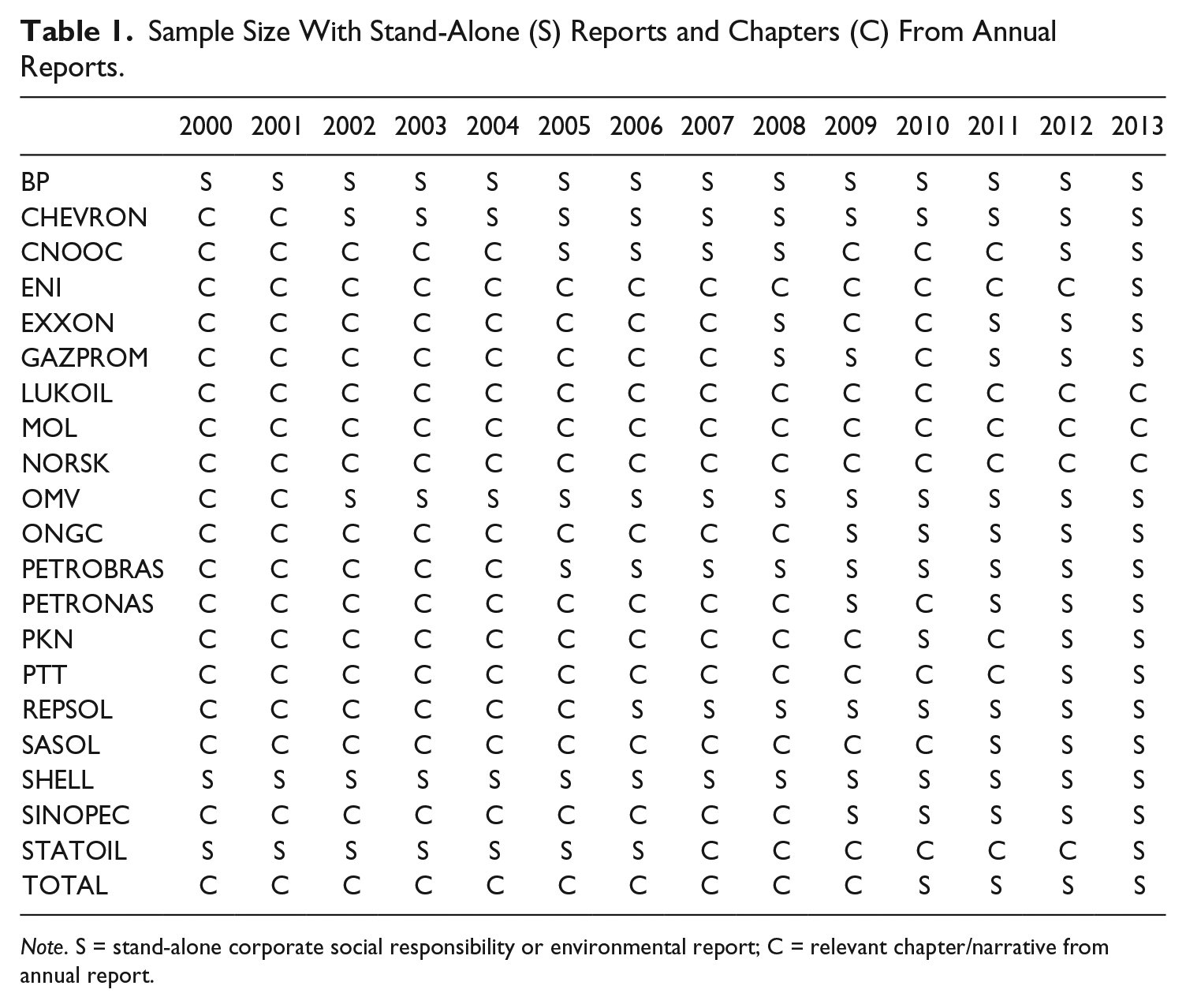
Note. S = stand-alone corporate social responsibility or environmental report; C = relevant chapter/narrative from annual report.
Drawing on previous research on the representations of climate change (Ihlen, 2009; Pollach, 2016), a group of key terms used in corporate reporting to refer to climate change were identified. These include terms that describe the phenomenon such as “climate change,” “greenhouse effect,” and “global warming.” Pollach (2016) examines separately “climate conference,” “climate,” and “Kyoto.” “Climate conference” was thought to be imprecise as they were several climate conferences and extracting frequencies of “climate” would include instances of compounds also with “change” and thus duplicate the results. “Kyoto” is not a term used to describe “climate change” per se.
The data were interrogated using corpus-linguistic tools and methods, specifically, frequencies and collocations, and the corpus-linguistic software program Sketch Engine (Kilgarriff, Rychlý, Smrz, & Tugwell, 2004). First the frequencies of the key terms were extracted from each year and patterns of attention and usage plotted in a graph for a comparison (see Figure 1 below). Based on the frequencies of the term “climate change,” three distinctive phases of attention to climate change in the studied sample could be identified: Phase 1 of low attention from 2000 to 2004, Phase 2 marked by a peak in attention from 2005 to 2008, and Phase 3 showing a considerable decline from 2009 to 2013. The corpus was subsequently divided into three subsets representing the three phases, for example, the subcorpus representing Phase 1 includes all textual data from the years 2000 to 2004.
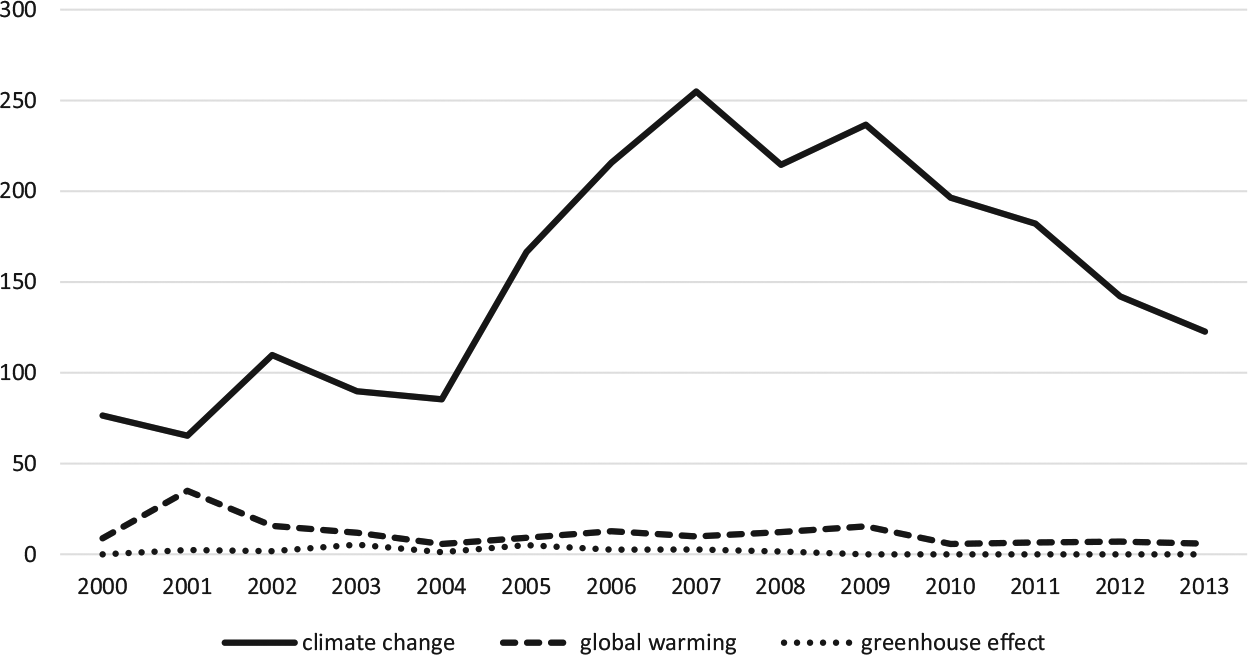
Frequencies of “climate change,” “global warming,” and “greenhouse effect” (normalized per 1 million words).
In order to shed light on the discursive constructions of climate change, collocations of the most frequently used term “climate change” were retrieved using the aforementioned corpus-linguistic software. Collocations are understood as the co-occurrence of two or more words within a certain word span (e.g., five words to the left and five words to the right) and established on the basis of statistical tests that compute the strengths of association. For the purpose of this study, Log Dice was used as a measure of collocational associations (Rychlý, 2008). In contrast to other widely used metrics, such as Mutual Information or t-test, Log Dice is a ratio with a maximum value (theoretically 14) and it does not depend on the total size of the corpus (Rychlý, 2008). It therefore allows to have a consistent comparison measure across the three subcorpora. Collocations with a measure of 7 or above are considered to be strong associations.
Collocations retrieved in this way point to recurrent and hence “preferred” and salient lexical choices that are associated with the phenomenon in question and difficult to discern from a purely qualitative analysis and when reading large amounts of texts (e.g., Gabrielatos & Baker, 2008; Jaworska & Krishnamurthy, 2012). As Stubbs (2001) reminds us, such preferences are not essentially a matter of individual choices, but a manifestation of positionings and practices often grounded in a particular ideological stance. Studying collocations of “climate change” as instances of recurring small d discourses (Gee, 2014) can therefore point to dominant corporate attitudes and practices in relation to climate change. In this respect, collocations are useful pointers but as single lexical items they may also contain a multiplicity of meanings. Thus, it is necessary to examine their use in context through reading stretches of texts in which they occur—a procedures which has been adopted in this study too (Baker et al., 2008).
Results
This section discusses the major results by highlighting the general trends in the use of key references to climate change and how their use changed over time in the studied sample. Subsequently, collocations of the most frequently used term “climate change” is investigated in more depth to highlight discursive representations and constructions of the phenomenon.
“Climate Change” in the Sample of Corporate Reporting: Quantitative Insights
Figure 1 shows the normalized frequencies of the key terms used to refer to climate change and extracted for each year from the total corpus. As can be seen, the most frequently adopted term is “climate change,” while the two other terms “global warming” and “greenhouse effect” are used very rarely.
Thus, it could be concluded that when talking about climatic changes the oil industry prefers the term “climate change.” The preference for “climate change” is interesting and might be a reflection of the efforts in some political and climate sceptic corners to remove the term “global warming” from public discourse because it is generally perceived as more frightening and alarming (Boykoff, 2011; Burkeman, 2003). Both terms are frequently adopted in scientific literature with “climate change” being used to refer to global weather changes including rain patterns, heat waves, and so on, while “global warming” describes a rise in temperature (Oxford English Dictionary [OED], 2016). The OED definition of “global warming” assign agency to human activity and thus makes humans directly responsible for the phenomenon, while references to “human” are omitted from the entry on “climate change.” Both terms are scientifically neutral and are used to describe different phenomena, though Boykoff (2011) rightly notes that the temperature rise does not occur in isolation and is the paramount climate characteristic. Research by Whitmarsh (2008) on the public understanding of both terms shows that people find “global warming” much more serious than “climate change” and link it more strongly with man-made causes. In contrast, “climate change” is perceived as a more distant phenomenon. The author also notes that “global warming” evokes significantly more concerns than “climate change” and is more likely to stimulate public engagement. The differences in perceptions can be due to the fact that “warming” implies a direct consequence, whereas “change” is more ambiguous. As van Dijk (1995) reminds us, the choice of lexis is never neutral; choosing a term gives a preference to a particular vision or ideological stance, while marginalizing others. The overwhelming preference for “climate change” and the near absence of “global warming” in the studied sample suggests a strategy for framing climatic change as a more distant phenomenon and hence less threatening, and not directly attributable to man-made causes.
Studying environmental issues in corporate reporting, Pollach (2016) observes a continuously increased attention to climate change but her data stops in 2010. Looking specifically at “climate change” in Figure 1, we can see peaks and troughs rather than a continuously heightened attention. Three distinctive time frames can be identified: a phase of lower attention from 2000 to 2004, a sudden rise and increased attention from 2004 to 2008, and a falling interest since 2010. Pollach (2016) too identifies an exponential rise between 2005 and 2007 and attributes it to the growing public attention to climate change following a number of events especially the Hurricane Katerina in 2005 and the release of Al Gore’s film An Inconvenient Truth in 2007. Also, some events on the business front might have contributed to the increased status of climate change on the corporate agenda. For example, in 2007 some 150 largest companies, some of which were oil businesses, signed up to the “Bali Communiqué on Climate Change,” which called for the introduction of legally binding treaty to tackle climate change. As Newell and Paterson (2010) observe, this was a ground-breaking event showing a departure from the previous resistance to legally binding agreements. The slight decrease around 2008 was possibly caused by the growing concerns about economic security following the onset of recession, which put climate change to the background. Since 2010, the use of “climate change” has continually decreased suggesting that climate change has lost some of its importance in corporate reporting. Newell and Paterson (2010) show that the increased attention to climate change in mid-2000s was also translated into investments into greener energy sources made by some of the largest oil companies including Shell and BP. Yet this was never a priority and alongside greener investments, some companies expanded on oil exploitation because energy security is the driver. BP is a good case in point; while the company invested £850 million into alternative energy sources, at the same, it increased investments in the controversial oil sands extraction in Alberta, Canada (Newell & Paterson, 2010). The priority of energy security and lower attention to climate change in public and political debates in recent years might have therefore contributed to the decline in attention given to climate change in corporate reporting.
Change but no Climate Change: Qualitative Insights
Table 1 shows the most frequent collocations of “climate change” in the three subcorpora, into which the whole corpus was divided. As Table 2 shows, there are several collocations that occur consistently across the three phases suggesting messages around climate change that have been reinforced over the years by the industry. Those are marked in italics in Table 2.
The 20 Strongest Collocations of “Climate Change.”
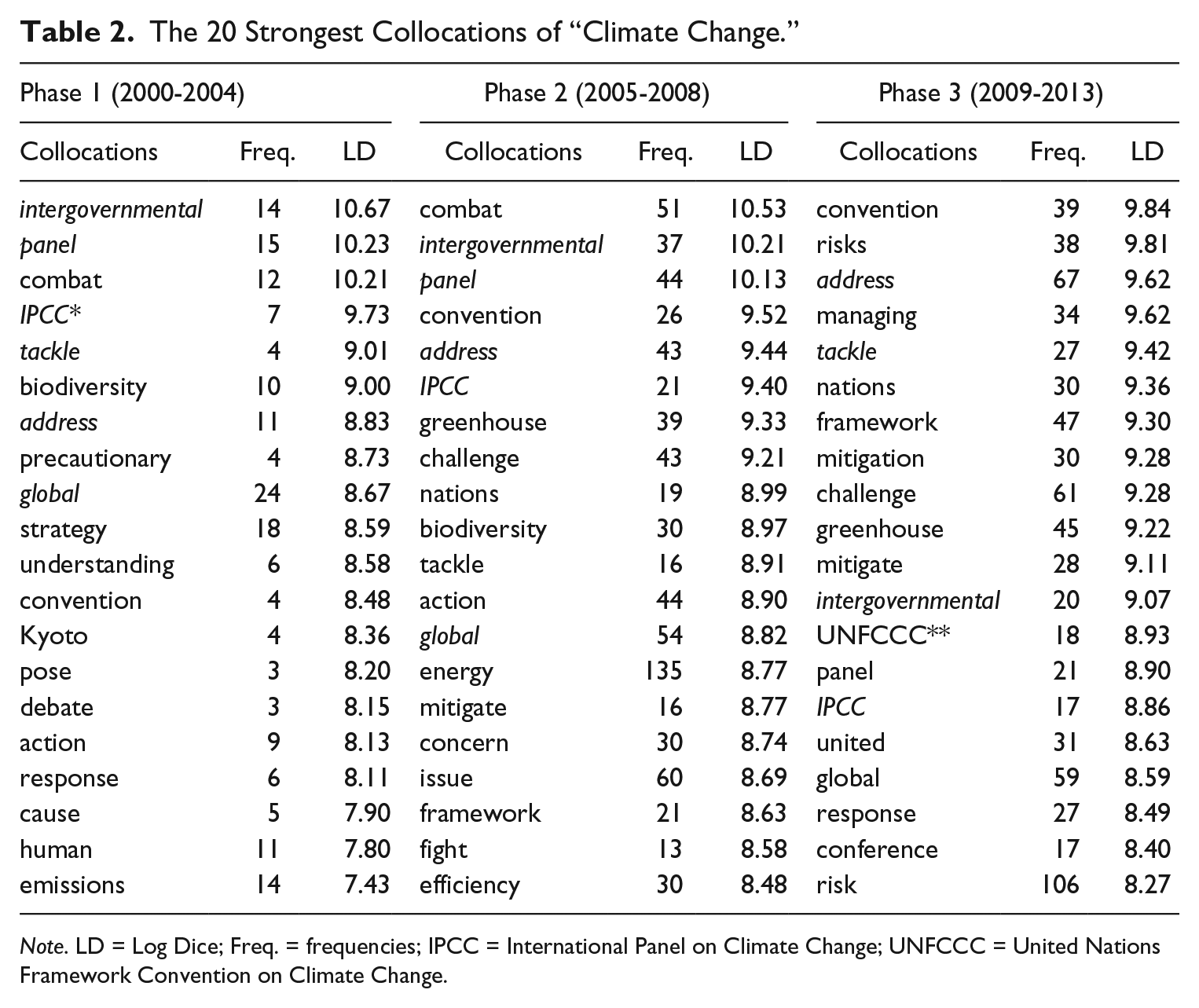
Note. LD = Log Dice; Freq. = frequencies; IPCC = International Panel on Climate Change; UNFCCC = United Nations Framework Convention on Climate Change.
The shared collocations center on two sets of references; one set points to the IPCC and one includes action verbs such as “tackle,” “address,” and the adjective “global.” The strong association of “IPCC” with “climate change” in corporate reporting in the oil industry is interesting and deserves some attention. IPCC is an international scientific body actively involved in reporting on the scientific knowledge about climate change. It does so through the process of reviewing published scientific research and is considered to be the authority on climate change. IPCC has published to date five reports and each reinforces the messages of the man-made climate change and calls for an urgent reduction of GHG emissions. Thus, IPCC represents what was initially seen as a big threat to the oil industry (Newell & Paterson, 2010). Against this background, it is interesting to observe that IPCC features consistently in the reports. The question which ultimately arises is how do companies position themselves against the scientific evidence compiled by the authority on climate change? Examining all the instances of IPCC in Phase 1 shows that three out of seven instances are used to refer to the evidence that GHG emissions contribute to global warming indicating that some oil companies acknowledge the link. The remaining ones are just mentions of IPCC in passing. However, when we look at the ways in which the evidence is reported, a strategy of subtle demeaning becomes apparent. For example, in 2003 report, Total refers to IPCC’s call for the reduction of GHG emissions and at the same time, it points out to the “blanks” in the forecasting which belittles the strength of the evidence by presuming that it is incomplete (see Extract 1):
Extract 1: According to the IPCC experts, if greenhouse gas emissions are not abated, there will be further global warming of 1.5 to 6C in the twenty-first century, with a variety of consequences for humankind and ecosystems. The experts are actively working to fill in the blanks in their forecasting models.
Actions in a response to IPCC are reported too but in most cases, they do not focus on the actual reduction of GHG emissions. For example, in its 2002 report, BP prefers to talk about “stabilizing GHG emissions.”
There are many more mentions of IPCC in Phase 2; the companies felt probably under pressure to respond to the fourth IPCC report, which was the largest and made clear the link between climate change and GHG emissions. Yet this increased attention to IPCC does not mean that the companies were embracing the scientific evidence. While the need to reduce GHG emissions is acknowledged, most of the solutions are formulated as future goals or companies highlight the contribution of some of its members to IPCC activities or debates in relation to climate changes. A good example is a statement produced by Total in its 2006 report, which asserts Total’s participation in discussions about climate change (see Extract 2):
Extract 2: In the light of this observation by the Intergovernmental Panel on Climate Change (IPCC), immediate action is clearly needed to respond to the situation. As a leading player in the energy industry, we actively participate in the international effort to combat climate change. We regularly take part in national and international discussions of climate change.
Another strategy used to “soften” the warnings expressed by IPCC is to juxtapose them with the growing energy demands and costs. In doing so, the companies show their acknowledgment of climate change as being an urgent issue, but the urgency is downplayed by foregrounding the economy and demand. Exxon emphasizes it in its 2008 report, which states as follows (see Extract 3):
Extract 3: As was recently summarized in the Fourth Assessment Report of the Intergovernmental Panel on Climate Change (IPCC), the risks to society and ecosystems from increasing greenhouse gas (GHG) emissions are significant. Meeting the enormous energy demand growth and managing the risk of GHG emissions are the twin challenges of our time.
The use of the hyperbole “enormous” is striking here. Whereas the impact of GHG emissions is described as “significant,” the energy demands are modified with “enormous” presenting the latter as a much bigger challenge than climate change. Rapsol emphasizes the same message in its 2007 report (see Extract 4):
Extract 4: In 2007 climate change remained one of the main concerns expressed by international public opinion. Proof of this can be seen in the interest surrounding the Fourth Assessment Report published by the Intergovernmental Panel on Climate Change (IPCC). Within the current global energy context, characterised by a growing energy demand and, subsequently, for fossil fuels, commitment from the private sector and collaboration from governments and other international institutions are key factors when establishing the basis of an economy that needs to shift to a low-carbon model.
While the importance of climate change is recognized, the real issue here is the energy demand; moreover, climate change can only be addressed if other stakeholders show commitment. Similar to Ferguson et al. (2016), this is an example of differentiation, which shifts the responsibility to other constituencies.
In Phase 3, IPCC is mentioned less frequently signaling lesser importance of the organization in the sample of corporate reports studied here. When IPCC is referred to, the energy demand and high cost of measures to combat climate change are foregrounded. BP makes the case in its 2012 report:
Extract 5: The IPCC believes that warming of the climate is likely to lead to extreme weather events becoming more frequent and unpredictable [ . . . ]. There are several reasons why achieving substantial and rapid GHG emissions reductions will be challenging. Some potentially important lower-carbon technologies including electric vehicles and carbon capture and storage still face significant technology, logistical, infrastructure and cost challenges.
The use of the verb “believe” merits attention. According to the OED (2016), “believe” comes from the domain of religion and means to have a faith in something. Using “believe” as an action performed by IPCC when talking about the link between global warming and extreme weather events places the work done by IPCC in the realm of faith and in doing so, undermines the scientific evidence that IPCC so scrupulously gathers. Total refers to IPCC along similar lines in its 2013 report. While the evidence from IPCC is acknowledged, it is immediately juxtaposed with growing energy demands globally (see Extract 6):
Extract 6: The Fifth Assessment Report published in 2013 by the Intergovernmental Panel on Climate Change (IPCC) has confirmed that human activity is the primary cause of global warming. Reconciling efforts to curb climate change with growing energy needs is one of the major challenges facing the world today.
Such juxtapositioning is an interesting strategy in that the scientific evidence is not denied but its force somewhat “weakened” by emphasizing another “bigger” issue. The companies highlight specific measures and strategies to mitigate climate change as indicated by the strong association with verbs such as “combat,” “tackle,” and “address” (see Table 2). Yet studying the lexical environment in which these verbs occur together with “climate change” suggests that the strategies are predominantly formulated as future goals. For reason of space, this is exemplified by looking at “tackle” which is a constant collocate of “climate change” across the three phases.
According to the OED (2016), the verb “tackle,” which originally comes from the maritime domain, is used in modern English mostly in a metaphorical sense denoting force and immediacy. Thus, its frequent use in the vicinity of “climate change” could suggest that the oil companies really want to do something about it. However, examining the text stretches in which the collocation pair occurs shows that the meaning of force and immediacy of “tackle” is somewhat reduced by the use of hedges, future tenses, and references to other stakeholders. For example, the collocation pair “tackle” and “climate change” occurs four times in Phase 1 but only one example points to an actual solution. The three remaining mentions refer to tackling climate change as problem to be addressed by international collaboration or research, and no concrete ideas are referred to (see Extracts 7-8):
Extract 7: As an oil and gas company, we will participate in reducing global emissions of greenhouse gases. Climate change must be tackled through international collaboration. (Statoil, 2003) Extract 8: Top-quality science is essential for tackling climate change. We therefore support research that can help us set the future direction for our business as well as informing understanding of climate change worldwide. (BP, 2003)
A similar pattern is observed in Phase 2 and 3 with 10 mentions pointing to other actors that need to tackle climate change (see Extracts 9-10):
Extract 9: Tackling climate change remains urgent and requires action by governments, industry and consumers. (Shell, 2010) Extract 10: The need to tackle climate change and the inherently non-renewable nature of fossil fuel resources require us all to do our share to use energy more efficiently and diversify sources, at every level. (Total, 2009)
Undoubtedly, climate change is a global challenge and we all are in it together with consumers having great responsibilities too. Nonetheless, in corporate reporting one would rather expect a stronger focus on company-specific strategies or achieved goals as opposed to generic references to other stakeholders, which appears as an act of diverting attention and responsibilities (Ferguson et al., 2016). Companies do point to their own solutions and strategies, though these are often formulated as future goals or expectations. In Phase 2 and 3, out of all 43 instances of the collocation pair “tackle” + “climate change,” 21 describe tackling climate change as work in progress or something to be achieved in future. Extracts 11 to 13 exemplify this strategy:
Extract 11: Renewable energies will be critical in satisfying demand and tackling climate change. (CNOOC, 2012) Extract 12: Our R&D teams are working on such important goals as increasing our production and resources, improving our environmental performance, tackling climate change through carbon capture and storage, and safer developments. (Total, 2010) Extract 13: But the lower-CO2 impact of the increasing amounts of natural gas and low-carbon biofuel we expect to deliver can contribute to the global effort to tackle climate change. (Shell, 2011)
Similar to the ways in which the scientific evidence produced by IPCC is dealt with, tackling climate change is often juxtapositioned with rising demands for energy. Extracts 14 and 15 illustrate the pattern:
Extract 14: Eni’s flaring down plan implemented in Africa addresses the dual challenge of fighting energy poverty while tackling climate change. (ENI, 2012) Extract 15: To meet growing energy needs while tackling climate change, the limited availability of oil and gas and geopolitical uncertainties is not an easy task. (Total 2010)
Tackling climate change becomes then, form the point of view of the oil industry, an act of balancing energy supplies with environmental consequences—a strategy, which is obviously favorable to the industrial needs of the oil sector. In this sense and despite using the forceful verb such as “tackle,” no radical changes are proposed and this together with the future orientation toward climate change and focus on climate change as a global issue to be addressed by all stakeholders suggests that companies intend to continue, to a large extent, with business as usual.
A striking but perhaps not surprising are the differences in the collocations in each phase. Apart from the four candidates aforementioned, each phase is represented by varying sets of collocations pointing to shifts in the discourse. One such a shift is indicated by “cause,” which occurs in the top collocates in Phase 1 and disappears in Phase 2 and Phase 3. Out of the five instances of “cause,” three attribute climate change directly to GHG emissions, one to human activity and one is a mention of debates on causes of climate change. However, there is a sense of doubt in that all three instances in which climate change is linked with GHG emissions include a hedging device such as “potential,” “eventual,” and the verb “believe” used in an agentless passive sentence. As Extracts 16 to 18 show, in all the statements in which climate changed is brought into the relation with causes specifically GHG emissions, the assertion is softened implying some reservations toward the scientific evidence:
Extract 16: The energy industry must give innovative answers for the development of a sustainable energy system able to reduce external environmental factors and, in particular, the risk of eventual climate change caused by anthropogenic emission of greenhouse gases. (ENI, 2002) Extract 17: Contributing to narrowing the gap between rich and poor, and mitigating the local and global environmental impact, in particular with respect to potential climate change caused by the emission of greenhouse gases. (ENI, 2002) Extract 18: . . . as carbon dioxide (CO2) and methane (CH4) disrupt the thermal balance between energy radiated from the sun and the longwave radiation being radiated to space. This disruption is believed to be the cause of climate change. (Total, 2003)
Using hedges such as “potential” or “eventual” as modifiers of “climate change” in the context when GHG emissions are identified as the cause suggests a distancing strategy used to portray climate change as something which has not happened yet. This, in turn, softens the assertion expressed by “cause” and implies a degree of doubt in the link between the cause (GHG emissions) and the effect (climate change). The same kind of distancing can be observed in Extract 18, in which the use of the verb “believe” positions the connection between the cause and effect in the realm of faith. Also, the use of a passive sentence without an agent makes it impossible to know who these “believers” are. They are numerous options that could have been used including the company, the general public or even climate scientists. Mentioning the company would put too much responsibility and using climate scientists would indicate scientific credentials and make the link too “strong,” which would not work in the favor of the oil industry. Employing a generic agentless “ . . . is believed” signals a degree of acceptance and simultaneously doubt.
Another striking pattern in the second phase is the frequent use of collocations from the domain of military, especially “combat” and “fight.” “Combat” also occurs in the top collocates in Phase 1 and Phase 2 and disappears from Phase 3. Similar to “tackle,” the use of the military metaphor in the vicinity of “climate change” could suggest a forceful and proactive stance toward climate change mitigation. Its absence from the top collocations in Phase 3 could therefore suggest that there has been less emphasis on proactive stance in recent years. Yet even in reports in which “climate change” frequently occurs with “combat,” the force denoted in the meaning of the verb does not necessarily translate into combative actions.
Out of 51 instances of “combat” near “climate change” in Phase 2, 18 point to future plans and goals and 5 to efforts or responsibilities of other social actors (the European Union, governments). There are three mentions of carbon trading in Europe, two of support for scientific research and eight references to self-presentations. Interestingly, there are only two explicit mentions of reduction in GHG emissions with exact numbers and one remark about higher emissions that were traded on the European market. The remaining instances are mentions of “combat” and “climate change” alongside other issues or just generic references pointing to the importance of combatting climate change without providing details on how this is or will be pursued. The self-presentations in the vicinity of “combat” and “climate change” portray the companies as leaders and forerunners in tackling climate change (see Extracts 19-21):
Extract 19: CO2 Management Carbon capture and storage (CCS) is regarded as one of the main means to combat climate change. StatoilHydro has long been a pioneer of CCS within oil and gas production and currently operates some of the world’s largest projects in this area. (Statoil, 2008) Extract 20: The company believes that a policy for carbon capture and storage could represent a major step in combatting Climate Change. We have the know-how and the necessary skills required for advancing in the practical development of this technology . . . (Repsol, 2005) Extract 21: . . . we help to combat climate change by participating in the development of innovative technological solutions, such as CO2 capture and sequestration. (Total, 2006)
The self-presentation of being a technological leader in developing measures to combat climate change reinforces the message that climate change can be tackled, if at all, by developing new technologies. CCS has emerged as an alternative technology to carbon reduction and seems to have been endorsed by the oil industry. There are 361 (57.25 per 1 million words) mentions of CCS in Phase 3 and only 115 (23.07) in Phase 2 and 16 (4.9) in Phase 1 suggesting an increased attention to CCS in recent years. The procedure involves separation of waste CO2, its transportation and storage in a location such as a deep geological formation or deep ocean, which prevents it from entering the atmosphere (Newell & Paterson, 2010). In a nut shell, CCS is a way of dealing with waste and does not imply reduction in consumption and production nor does it stipulate any major change to the current business model. Although this technology may be beneficial for climate change mitigation, concerns are raised regarding its safety and environmental impacts. Leaks from storage locations could have potentially disastrous effects on the environment and humans. Also, research by IPCC suggests that although CCS technology is successful in capturing CO2, it contributes to an increase in the emission of air pollutants (IPCC, 2005). But this is omitted from the reports, which hail CSS as the “major step” (Extract 20) or “main means” (Extract 20) to combat climate change.
An item which appears only in the collocation list in Phase 3 is the term “risk”, which occurs 141 times in the vicinity of climate change, of which 35 occurrences are in plural “risks” and 106 in the singular “risk.” The strong association with risk, which was conspicuously absent from the vicinity of “climate change” in Phase 1 and Phase 2 suggests a shift in discourse and thus it merits further attention.
The concept of risk has profiliated since the end of the Second World War, which can be attributable to the increased importance of scientific research and the growing awareness of the negative consequences that it can cause (e.g., nuclear power; Zinn, 2010). This has contributed in Beck’s (1986) thesis to the spreading of the notion of risk to many domains of social life creating what he famously calls the risk society. Ever since the publication of Beck’s prolific book, sociologists and media scholars have engaged in debates about the meaning of the term and specifically how it is to be distinguished from similar concepts such as danger and harm. Drawing on frame semantics and corpus linguistics, Fillmore and Attkins (1992) show two dominant frames “chance” and “harm” and many optional subframes that constitute the conceptual meaning of risk including actors, deeds, victims, beneficiaries, and motivation. In this sense, the notion of risk opens up many semantic slots that could be filled or left empty and thus some aspects might be empathized, while others left out depending on the context (Zinn, 2010). This makes “risk” a “good” candidate to serve various rhetorical purposes.
In the data under study, “risk” as a collocate of “climate change” occurs only in Phase 3 and is more strongly associated with the plural form implying a multitude of risks. The question which arises is what are the risks that the industry links with climate change? Studying the text extracts in which the collocational pair occurs suggests that out of 39 instances, only 9 mention specific risks, of which 5 are references to environmental consequences such as natural disasters, and 4 discuss a combination of environmental and business harms with the latter including changing demands, higher market prices, and business interruptions. Thus, if risks are specifically mentioned, then the victims seem to be businesses and rarely people who live in the affected areas (see Extracts 22-24). This is prominent in Extract 22, which links extreme weather events with adverse impacts on production and transportation, while human subjects and their experience are absent:
Extract 22: The principal risks associated with climate change include the impact of energy and climate policies; tighter rules on emissions trading; market price risk assessment concerning unknown future costs of CO2, higher insurance premiums and related risks; and extreme weather events that may affect production and transportation. (OMV, 2012) Extract 23: The assessment analyzes both risks and opportunities from climate change considering different scenarios including changes in regulation and reporting requirements related to GHG, changes in consumers behaviors and market demand and, natural disasters which is considered a long-term risk. (PTT, 2012) Extract 24: The raising awareness of the risks connected to climate change can seriously affect energy demand. Consumers are increasingly demanding more sustainable processes and products as well as virtuous energy behaviors to major companies. (ENI, 2012)
The use of the verb “affect” in the last example is striking. “Affect” implies a negative meaning also reinforced by the use of modifiers such as “adversely,” “seriously” and “severely.” Using “affect” in the statement above “imbues” the positive development of growing awareness of climate change with negativity and thus portrays it as a threat to the oil business; lower energy demand is not good news for the industry.
The most frequent item which occurs in the vicinity of the collocation pair is the verb “managing” (16 times) highlighting the stance that climate change is a problem that can be somehow managed. The solutions offered include reduction of GHG emissions (but only four examples refer to specific numbers), carbon trading, and technological solutions. Thus, here too the oil industry favors the technological and market solution as a mitigation strategy. Science is sometimes implicated in the process, but as Extracts 25 to 26 show, it is framed as unhelpful because it is unable to predict risks (Extract 25) and hence is partially responsible for the difficulties that the industry experiences (Extract 26):
Extract 25: Uncertainty of physical risks: The science of climate change modelling has many uncertainties, which lead to difficulties in designing facilities and operations. (ENI) Extract 26: While most scientists agree climate change poses risks related to extreme weather, sea level rise, temperature extremes and precipitation changes, current scientific understanding provides limited guidance on the likelihood, magnitude or time frame of these events. (Exxon)
Climate change is thus increasingly framed as a harmful, unpredictable and out of control subject or agent which poses risks and uncertainties. There are also three instances which make references to other social actors and their responsibility to manage climate change risks including governments and consumers and both come from ExxonMobil (Extract 23-24). This is perhaps not surprising given Exxon’s infamous track record of support for the climate change counter movement (Brulle, 2014). However, this is not only specific to ExxonMobil. As the analysis of “tackle” and “climate change” above has shown, other companies too try to shift the responsibilities by reinforcing the message that we are all in it together. The worryingly deteriorating environment due to the rise in GHG emissions is thus not seen as a responsibility of the industry (Extract 27).
Extract 27: The multifaceted risks of climate change warrant action by governments, companies and citizens [ . . . ]. Managing the risks associated with climate change requires the participation of governments, consumers and private companies. (ExxonMobil)
Discussion and Conclusions
The purpose of this article was to demonstrate how a combination of quantitative and qualitative linguistic analysis of small d discourses, specifically the frequencies of key climate terminology and the lexico-grammatical associations (collocations) with “climate change” in longitudinal data can reveal the existence of salient discursive patterns underlying the construction of climate change in corporate reporting. In contrast to previous content-analytical or purely qualitative discourse-analytical research which was mostly concerned with the what of corporate communication, this study examined both the what is said and how it is said about climate change in the context of CSR and environmental reporting in the oil industry. This is relevant because a mere mention of a word or term, even if frequent, does not tell us much about the meanings, values, and practices associated with it. These can be discovered if we carefully study the lexico-grammatical context in which the term is used. Corpus tools and methods are useful in that they help reveal frequent and strong associative patterns (collocations) that can easily escape attention when reading large amounts of texts.
Frequencies are useful pointers to general trends in the use of a word in longitudinal data, from which some observations about the attention given to a phenomenon can be inferred (Pollach, 2016). Examining frequencies of “climate change” and synonymous terms reveal a strong preference for “climate change” and other terms such as “global warming” or “greenhouse effect” are rarely used in the studied sample. “Global warming” is a term associated with urgency and human agency, and seen as more threatening in contrast to “climate change,” which is more general in meaning (Schuldt et al., 2011; Whitmarsh, 2008). The greater use of “climate change” and the near absence of “global warming” in the studied sample might indicate the preference of the oil industry to frame climate change as a more distant and less threating phenomenon. Having longitudinal data allowed to examine the degree of attention given to “climate change” in the oil industry in the period from 2000 to 2013. In contrast to Pollach (2016), who noted a continuously heightened attention to climate change, this study reveals peaks and troughs, which was possible because data beyond 2010 was included. “Climate change” was frequently mentioned in the period from 2005 to 2008, which could suggest an increase in attention to the issue. A similar pattern has been observed in other contexts, most notably media (Boykoff, 2011). Some researchers (e.g., Pollach, 2016) argue that key events such as the Hurricane Katerina and Al Gore’s movie contributed to climate change being placed higher on the public agenda and corporations might have responded to it too by focusing more on climate change in their reporting. A continued decrease can be observed from 2009 suggesting possibly that climate change has been less of an agenda item in the oil industry in recent years. Other studies have shown that the oil industry increased its attention toward other issues such as human rights (e.g., Jaworska & Nanda, 2016).
The attention to climate change observed through the rise in frequencies does not necessarily mean that the industry has embraced climate change. Studying the strong associations with climate change has shown a number of distancing strategies, of which differentiation, future orientation, and juxtapositioning of climate change evidence with industry’s relevant objectives emerge as the dominant ones. On the one hand, the oil industry seems to accept that climate change does exist and needs to be tackled or combatted. On the other hand, the strong assertions are somewhat offset by repeatedly focusing on future goals and reinforcing the message that we are all in it together. This is not a brainwash, as no misinformation is provided, but rather a kind of discursive grooming (cf. Pilger, 1998) that is used strategically to reassures the public and stakeholders that climate change is indeed on the agenda. The grooming of public perception is also evident in what is absent or backgrounded in the discourse. There is conspicuously little discussion about the causes of climate change and when causes are mentioned, the argumentation tends to be softened by employing hedging devices (“potential,” “eventual”) implying a degree of doubt in the link between GHG emissions and climate change. In this way, causes that obviously link climate change with the oil industry are conveniently “talked down.” As the issue of climate change has been receiving less and less public attention in the recent years, so the industry has responded by decreasing the number of mentions. Also, the somewhat combative attitude prevalent from 2005 to 2009 has been replaced with the increased focus on risks posed by climate change. The increased attention to risks in recent years marks a discursive shift, which turns climate change from an agentless object into an agentive subject. Whereas in the earlier phases, climate change was seen as an object to which some action could have been applied (tackle/combat/fight climate change), now it is increasingly framed as an unpredictable and out of control agent with harmful consequences mostly to businesses. In this way, the discourse and lexico-grammatical choices so strongly associated with “climate change” positions the oil industry not as a contributor but as a victim of the phenomenon. Alongside the “victim-status,” the industry also presents itself as a leader and innovator in attempts to mitigate climate change. The innovations are technological or market-based solutions and thus firmly embedded within the corporate for profit aims, while any social, ethical, or alternative solutions are absent.
To sum up, the CSR reporting in the oil industry, which is one of the most influential sectors in the world closely aligned with political powers, simulates commitment to climate change, while responsibilities are clandestinely shifted to other stakeholders or the future. In doing so, this discourse obscures the industry’s contribution to the environmental degradation (cf. Lischinsky, 2015) and reinforces the neoliberal credo that the market and technology are the only solutions to ecological problems. While the benefits of technological solutions for the mitigation of climate change should not be underestimated, the kind of technologies embraced by the industry such as CCS do not involve any changes to the current market practices. They only “relocate” the problem to storage locations with potentially harmful environmental effects. Thus, the enthusiasm for technological solutions and CCS conceals alternative solutions, does not challenge existing practices and in doing so, further serves to reinforce the business-as-usual mode (Milne et al., 2006). Similar to the term “sustainability” (Alexander, 2009) or “environment” (Lischinsky, 2015), climate change becomes an elusive concept and a rhetorical mean of discursive grooming in the mechanics of impression management, which simulates commitment and simultaneously averts any (public) criticism. This, in turn, contributes to the perpetuation and naturalization of the neoliberal agenda (Alexander, 2009).
This research contributes to the existing body of research on the ways in which climate change is discursively and rhetorically constructed (Ferguson et al., 2016; Ihlen, 2009; Livesey, 2002b; Pollach, 2016). It highlights the benefits of close attention to lexico-grammatical choices that accompany the use of “climate change” in corporate communications showing how these choices are strategically deployed to sustain ideologies suited to the needs of the oil industry. The sample under study was large and carefully designed to include CSR and environmental communications produced by the major international oil corporations that represent different parts of the world. While there is a good case to focus on one global industry or sector, previous research on the topic has shown the importance of local contexts on the way climate change is conceptualized and operationalized by corporations. Climate change presents a different challenge for different companies and not all companies attend to climate way in the same way (cf. Newell & Paterson, 2010). Readers might have noticed that most of the examples come from corporations with headquarters in America and Europe, very few from Asia and none from Eastern Europe. Future research could explore the differences and similarities by comparing discourses produced by individual corporations and across sectors. Finally, this study is based on the analysis of one term only “climate change”; the focus on this term is justified by its prominence and frequency in the studied sample. Yes, climate change entails a range of related phenomenon including specific causes (GHG levels) and effects (extreme weather events; cf. Pollach, 2016). In order to obtain a more comprehensive picture of the variety of corporate discourses related to climate change, future research could expand the analysis by investigating other relevant terms alongside similar methodological lines.
Footnotes
Declaration of Conflicting Interests
The author declared no potential conflicts of interest with respect to the research, authorship, and/or publication of this article.
Funding
The author received no financial support for the research, authorship, and/or publication of this article.
