




Abstract
Building upon the extant leadership research, we explore the phenomenon of leaders’ intentionally withholding of relevant information to subordinates. In particular, we conceptualize leadership silence and propose three distinct forms of leadership silence, including safeguarding silence, undermining silence, and disengaging silence. We also incorporate attribution theory and show how subordinates pinpoint the causes of leadership silence. We then discuss the accuracy of subordinates’ attributions of leadership silence. Finally, we present the theoretical contributions and managerial implications.
Introduction
I am not aware of any wrong doing on my part.
In an organizational context, the leader exerts efforts to influence subordinates and facilitate collective performance needed for attaining shared organizational objective (Yukl, 2012). Among various leadership efforts, communication is the core of daily organizational life (Schneider, Maier, Lovrekovic, & Retzbach, 2015). Recent scandals in Wells Fargo and Volkswagen demonstrate the destructiveness of leaders’ intentional withholding of relevant information. As a consequence, it is reasonable to state that organizational effectiveness is partially determined by a leader’s communicative behaviors aimed at fostering individual and collective performance. In the realm of communication research, scholars have suggested that communicative behaviors are an important relational resource that helps individuals understand human feelings and emotions (Burleson, 2003), which are crucial to the development and maintenance of interpersonal relationships. More importantly, effective communicative behaviors result in a shared understanding of purposes, meanings, and values in a given relational context, which fosters individuals’ motivation to take collective actions (Cushman & Cahn, 1985). In the business communication literature, ample evidence has indicated that leadership communicative behaviors, such as uncertainty-reducing communication (Sullivan, 1988), meaning-making communication (J. Mayfield, Mayfield, & Kopf, 1995), persuasive communication (Neufeld, Wan, & Feng, 2010), and motivating communication (M. Mayfield & Mayfield, 2016), are relevant to subordinate performance and effectiveness.
While research on leadership communicative behaviors has shed light on how effective leadership communication plays a pivotal role in organizational functioning, some studies have explored destructive communicative behaviors exhibited by the leader and subsequent outcomes. For example, abusive supervision, defined as a leader’s engagement in hostile verbal and nonverbal behaviors (Tepper, 2000), has been found to be predictive of subordinates’ job dissatisfaction and intentions to quit (e.g., Tepper, 2000). Petty tyranny, which describes a leader’s intimidating, humiliating verbal and nonverbal behaviors, is related to increased stress and frustration and reduced self-esteem experienced by subordinates (Ashforth, 1994). Similarly, aversive leadership, which refers to the use of intimidating verbal and nonverbal tactics and reprimands to influence subordinates (Pearce & Sims, 2002), promotes various negative employee outcomes (Thoroughgood, Hunter, & Sawyer, 2011).
Clearly, research on leadership and employee communicative behaviors has provided crucial insights into understanding the phenomenon of silence behavior in organizations using an upward approach (i.e., silence behavior exhibited by a subordinate and directed to the supervisor). Nonetheless, we believe that we can contribute to the literature by first providing a downward approach for understanding different forms of silence behavior exhibited by a leader in the organization. More importantly, we can further advance the existing body of knowledge by analyzing how subordinates may make causal attributions to different forms of leadership silence. In other words, making a theoretical connection between the destructive leadership literature and attribution theory offers a new theoretical underpinning for future research examining attributions to leadership silence. Our view of how extant literature can be advanced draws upon the following research gaps. First, although scholars have studied different forms of destructive leadership communicative behaviors (e.g., abusive and tyrannical behaviors; Krasikova, Green, & LeBreton, 2013), much of scholarly effort focuses on understanding overt communicative behaviors (i.e., behaviors that are visible to subordinates). As such, little scholarly effort has been devoted to exploring leadership communicative behaviors that are not visible to subordinates (i.e., covert communicative behaviors). Given this, we extend the literature of employee silence and propose a special form of destructive communicative behavior where a leader deliberately withholds relevant information to subordinates. In line with Pinder and Harlos’s (2001) conceptualization of employee silence, we define leadership silence as a leader’s intentional withholding of genuine expression about behavioral, cognitive, and/or affective assessments of organizational conditions to subordinates who may be influenced by the conditions. Additionally, because leaders may intentionally withhold relevant information due to different purposes, the first goal of this article is to theorize how leaders may exhibit different forms of silence behavior and classify leadership silence into different forms by integrating leadership theories, particularly leader-member exchange (LMX) theory.
Second, from the performance perspective, leaders’ silence behavior may impede a subordinate’s attainment of high performance. Additionally, from the relational perspective, leaders’ silence behavior may convey communicative cues regarding a leader-subordinate working relationship and how the leader regards a subordinate. As a consequence, it is quite reasonable to expect that subordinates make causal attributions in order to understanding the causes and expectations of leadership silence. Indeed, Bisel and Arterburn (2012) note that the expectations of how communication between a leader and subordinate should unfold shape subsequent silence behavior. While a number of studies have examined how individuals make casual attributions to silence behavior (e.g., Brinsfield, 2013; Milliken, Morrison, & Hewlin, 2003; Van Dyne, Ang, & Botero, 2003), almost all these studies have focused on supervisors’ attributions of silence behavior exhibited by employees. Thus, the second goal is to explore how subordinates make casual attributions of leadership silence and the accuracy of their attributions. It is worth pointing out that we presume that leadership silence is exhibited when the leader has complete information and knowledge of certain organizational matters. Hence, in line with Van Dyne et al.’s (2003) view, this article does not consider unintentional silence resulting from having nothing to say or mindlessness as a form of leadership silence.
Given the goals of this article, the remainder of this article unfolds as follows. In the second section, a brief review on the literature of leadership with emphasis placed on constructive and destructive leadership communication is provided. Additionally, we review current research on silence behavior. Next, we present the concept of leadership silence and classify leadership silence in three distinct forms by drawing upon relevant leadership literature. This is followed by the discussion of subordinates’ attributions of leadership silence as well as attribution accuracy. In the fifth section, we discuss the implications for theory and managerial practice and future research directions. The final section provides concluding remarks of this article.
Literature Review
Communication in Leadership
In the organizational context, leadership is a vital factor contributing to organizational effectiveness (Spisak, O’Brien, Nicholson, & van Vugt, 2015). Generally speaking, leadership refers to the behavioral process that facilitates and guides subordinates to work toward collective goals (Yukl, 2012). While leaders may exert proper effort that helps influence subordinate performance, a central function of leadership is communication (Schneider et al., 2015). As such, constructive leadership communication is of interest for leadership research.
According to de Vries, Bakker-Pieper, and Oostenveld (2010), leadership communication reflects a leader’s “distinctive set of interpersonal communicative behaviors geared toward the optimization of hierarchical relationships in order to reach certain group or individual goals” (p. 368). The conceptualization of leadership communication essentially highlights that leadership communicative behaviors and communication effectiveness can be understood by analyzing how a leader interacts with a subordinate (e.g., leadership styles). Indeed, many studies have explored leadership styles and communication effectiveness. For instance, drawing upon the Ohio State (e.g., Hemphill & Coons, 1957) and Michigan studies (e.g., Cartwrite & Zander, 1960), Madlock (2008) found that both relationship-oriented and task-oriented leadership styles are predictive of employee job and communication satisfaction. Neufeld et al.’s (2010) study showed that transformational leadership style enhances the leader’s communication effectiveness through being open to subordinates’ inputs, appealing to subordinates, and gaining subordinates’ trust and commitment. Interestingly, Neufeld et al. also found that transactional leadership style facilitates the leader’s communication effectiveness because such style reduces equivocality and uncertainty. In another study, de Vries et al. (2010) showed that charismatic and human-oriented (i.e., consideration) leadership styles are more communicative, which leads to better leadership performance, whereas task-oriented (i.e., initiating structure) leadership style is less communicative, which results in lower leadership performance. In a recent study, Mikkelson, York, and Arritola (2015) discovered that both task- and relations-oriented leadership styles are positively related to employee job satisfaction, motivation, and organizational commitment.
While research on leadership styles and communication effectiveness has predominantly focused on comparing task- and relations-oriented leadership styles, a number of studies have explored other leadership communicative behaviors and communication effectiveness. For example, Dasgupta, Suar, and Singh (2013) found that a leader’s assertive communication style leads to employee support, which leads to leadership communication effectiveness and employee satisfaction. Men’s (2014) study showed that leaders are able to increase communication effectiveness and employee satisfaction through face-to-face communication channels. Finally, Seyranian (2014) revealed that followers are likely to engage in collective action, experience positive emotions, and feel confident about organizational change when the leader uses inclusive language and positive social identity language. Other leadership communicative behaviors, such as uncertainty-reducing communication (Sullivan, 1988), meaning-making communication (J. Mayfield et al., 1995), persuasive communication (Neufeld et al., 2010), and motivating communication (M. Mayfield & Mayfield, 2016), have been found to be relevant to subordinate performance and effectiveness.
Destructive Leadership Communication
Despite the research progress in leadership communication, some studies, particularly in the destructive leadership literature, have focused on exploring destructive communicative behaviors exhibited by the leader and subsequent outcomes. Perhaps one of the most commonly examined concepts has been abusive supervision proposed by Tepper (2000). In general, abusive supervision describes a leader’s “sustained display of hostile verbal and nonverbal behaviors” (Tepper, 2000, p. 178). This type of destructive communication behavior often leads to negative organizational outcomes such as employee psychological distress (e.g., Tepper, 2001), employee counterproductivity (e.g., Detert, Treviño, Burris, & Andiappan, 2007), and employee intentions to quit. (e.g., Palanski, Avey, & Jiraporn, 2014).
In 1994, Ashforth proposed the concept of petty tyranny that captures a leader’s destructive manner, including the communication aspect. In the context of communication, tyrannical leaders engage in verbal and nonverbal communicative behaviors that intimidate, belittle, and/or humiliate subordinates in public (Aryee, Chen, Sun, & Debrah, 2007), which, in turn, can result in reduced subordinate job satisfaction and work motivation (Einarsen, Aasland, & Skogstad, 2007). In a similar vein, aversive leaders (e.g., Pearce & Sims, 2002) use intimidating verbal and nonverbal tactics and reprimands to influence subordinates, which result in negative consequences experienced by subordinates (Thoroughgood et al., 2011). Padilla, Hogan, and Kaiser’s (2007) work on the toxic triangle of destructive leadership provides three domains of destructive leadership: destructive leaders, susceptible followers, and conducive environments. In the aspect of communication, Padilla et al. suggested that destructive leaders limit subordinates’ communication and dissent, which may lead to detrimental outcomes. Finally, Einarsen et al. (2007) proposed an all-inclusive destructive leadership concept that partly encompasses destructive communicative behaviors such as failing to provide subordinates with relevant information. Einarsen et al. further noted that destructive leadership behaviors, such as tyrannical leadership behaviors, may undermine subordinate motivation, well-being, and satisfaction.
In sum, the literature of destructive leadership has provided crucial insights into understanding the destructive and dysfunctional aspect of leadership communicative behaviors. However, the literature has predominantly focused on destructive leadership communication from the perspective of overt communication behaviors, which, consequently, leads to our lack of understanding of destructive leadership communication from the angle of covert communication behaviors. Thus, we provide a brief review of research on silence behavior in organizations, which is one of the most pervasive covert communication behaviors in organizations.
Silence Behavior in Organizations
Organizational members’ willingness to express their concerns, suggestions, and opinions is crucial for effective organizational functioning. Unfortunately, ample evidence has revealed that employees often choose to remain silent (e.g., Milliken et al., 2003; Morrison & Milliken, 2000), which prior research has labeled such behavior as employee silence behavior. According to Pinder and Harlos (2001), employee silence behavioral is conceptualized as an employee’s intentional withholding of genuine expression about behavioral, cognitive, and/or affective assessments of organizational conditions to organizational members who seem capable of changing the situation. While employees choose to remain silent because of different reasons, their reluctance to speak up can result in detrimental organizational outcomes such as illegal behaviors and unethical practices (Premeaux, 2003; Van Dyne et al., 2003).
Without any doubt, employees’ silence behavior leads to hampering effects in the organization, which has resulted in an increasing amount of scholarly scrutiny (Madrid, Patterson, & Leiva, 2015; Morrison, 2014). One particular area of research focuses on identifying different forms of employee silence behavior in organizations. Perhaps the most prominent work is Pinder and Harlos’s (2001), which classified employee silence behavior into acquiescent silence and quiescent silence. Acquiescent silence represents disengaged workplace behaviors where employees withhold their concerns and opinions passively. In contrast, quiescent silence is exhibited because of fear of receiving negative consequences and retaliation. Building upon Pinder and Harlos’ (2001) work, Van Dyne et al. (2003) further proposed that employee silence behavior can be exhibited not only based upon disengagement at work and fear of retaliation but also based upon a sense of cooperation and altruism, which Van Dyne et al. labeled as prosocial silence. In a later study, Knoll and van Dick (2013) drew upon the concept of opportunism proposed by Williamson (1985) and conceptualized opportunistic silence as an employee’s strategic withholding of work-related ideas, information, or opinions with the goal of obtaining personal advantages while accepting harm of others. Another notable research is conducted by Brinsfield (2013) in which employee silence behavior is classified into deviant, relational, defensive, diffident, ineffectual, and disengaged silence. In particular, deviant silence is a form of deviant workplace behavior; relational silence is exhibited to preserve international relationships; defensive silence is a product of fear of the consequences associated with speaking up; diffident silence is demonstrated because of the lack of self-confidence; ineffectual silence represents the thought that speaking up would not change the situation; and disengaged silence reflects the feeling of not being able to make a difference.
Why Is Silence Behavior Exhibited?
There are various reasons why individuals, particularly employees, are reluctant to speaking up. We reviewed the management literature and found that perhaps the most common reason is that silence behavior is exhibited due to the fear of retaliation for speaking up (e.g., Detert & Edmondson, 2011; Milliken et al., 2003; Morrison, 2014; Morrison & Milliken, 2003). In other words, organizational members consciously choose to remain silent because of their perceived risks associated with speaking up. Bisel, Messersmith, and Kelley (2012) supported this notion by stating that employees are likely to remain silent in order to reduce the likelihood of being viewed negatively by and harming the relationship with the supervisor. Even though perceived risks associated with speaking up are the most prominent reason for silence behavior, workplace disengagement is also relevant to the occurrence of silence behavior (Pinder & Harlos, 2001; Van Dyne et al., 2003). Other identified motives for silence behaviors include high self-monitoring (e.g., Premeaux & Bedeian, 2003), perceived procedural injustice (e.g., Tangirala & Ramanujam, 2008), fascistic personalities (e.g., Timming & Johnstone, 2015), the lack of closeness between the supervisor and employee (e.g., Milliken et al., 2003), the absence of communication opportunities (e.g., Vakola & Bouradas, 2005), and collectivism and power distance (e.g., Rhee, Dedahnov, & Lee, 2014).
In addition to the management literature, extant literature has provided findings on why individuals engage in silence behavior. Some common motives for remaining silent are to save face and be polite. For instance, in Holtgraves’s (2016) experimental study, it was found that face-threatening conditions result in greater intentional withholding of certain information than non–face-threatening conditions. Similarly, in her study of women’s swift in childbearing identity, Moore (2018) drew upon performative face theory and found that silence behavior is an outcome of maintaining pregnant women’s face concerning their change in childbearing identity. Other research in the communication arena documenting the link between facework/politeness and silence behavior includes, but not limited to, Kingwell (1993), Schallert et al. (2009), Juanchich and Sirota (2013), and Fiske et al. (2015). While individuals may choose to remain silent intentionally for the purpose of saving face and/or being polite, they may also withhold relevant information and message due to the lack of a participate climate (Huang, Van de Vliert, & Van der Vegt, 2005), communication norms (Donovan, O’Sullivan, Doyle, & Garvey, 2016), corporate culture (Verhezen, 2010), and communicative practices (Yoshida & Shanouda, 2015) in an institutional and cultural setting.
In sum, our brief review of the literature shows that the vast majority of research on silence behavior in organizations has focused on subordinates. However, the destructive leadership literature has demonstrated that leaders may fail to provide relevant information to subordinates as a form of destructive leadership behaviors. As such, it is theoretically and practically important to explore silence behavior exhibited by leaders. In the following section, we present our classification of leadership silence.
Classification of Leadership Silence
Although silence behavior is pervasive in organizations (Morrison & Milliken, 2000), very little research effort has been devoted to silence behavior exhibited by leaders (i.e., leadership silence). However, existing leadership literature, particularly LMX research, has provided possible evidence for leadership silence. For instance, LMX theory suggests that the leader-subordinate dynamics negotiated through role-making process can influence the leader’s behaviors (e.g., decision-making process, communication styles, resource allocation, information exchange, and managerial support) exhibited toward the subordinate (Graen & Scandura, 1987; Scandura & Graen, 1984). During the role-making process, leaders differentiate among their subordinates and develop different types of exchange relationships with their subordinates (Liden, Wayne, & Stilwell, 1993). The relationships that leaders develop with their subordinates range from high LMX, which is characterized by greater mutual respect, liking, and trust, to low LMX, which is characterized by more formal supervision, less support, and less trust (Mueller & Lee, 2002). In the area of communication, the differentiated LMX relationships that leaders develop with their subordinates heavily influence leaders’ and subordinates’ communication expectations, patterns, and styles (Fairhurst, 1993; Lee, 2001; Yukl & Fu, 1999). Altogether, this leads us to consider that leaders may intentionally withhold relevant information in accordance with the quality of LMX relationships with their subordinates.
To examine leaders’ silence behavior, we adopt the view that LMX is a multidimensional rather than a unidimensional concept given the strong empirical support shown in prior research (e.g., Greguras & Ford, 2006). In particular, LMX consists of four dimensions, including perceived contribution to the relationship, expressions of support, mutual affection, and professional respect (Dienesch & Liden, 1986; Liden & Maslyn, 1998). In line with the literature of LMX, we further argue that a leader’s silence behavior can be a specific communicative pattern shared with a certain subordinate. Additionally, we theorize that the extent of a leader’s exchange of affect, loyalty, contribution, and professional respect with a certain subordinate determines the form of leadership silence exhibited. In the next section, we provide a detailed discussion on the three forms of leadership silence.
Safeguarding Silence
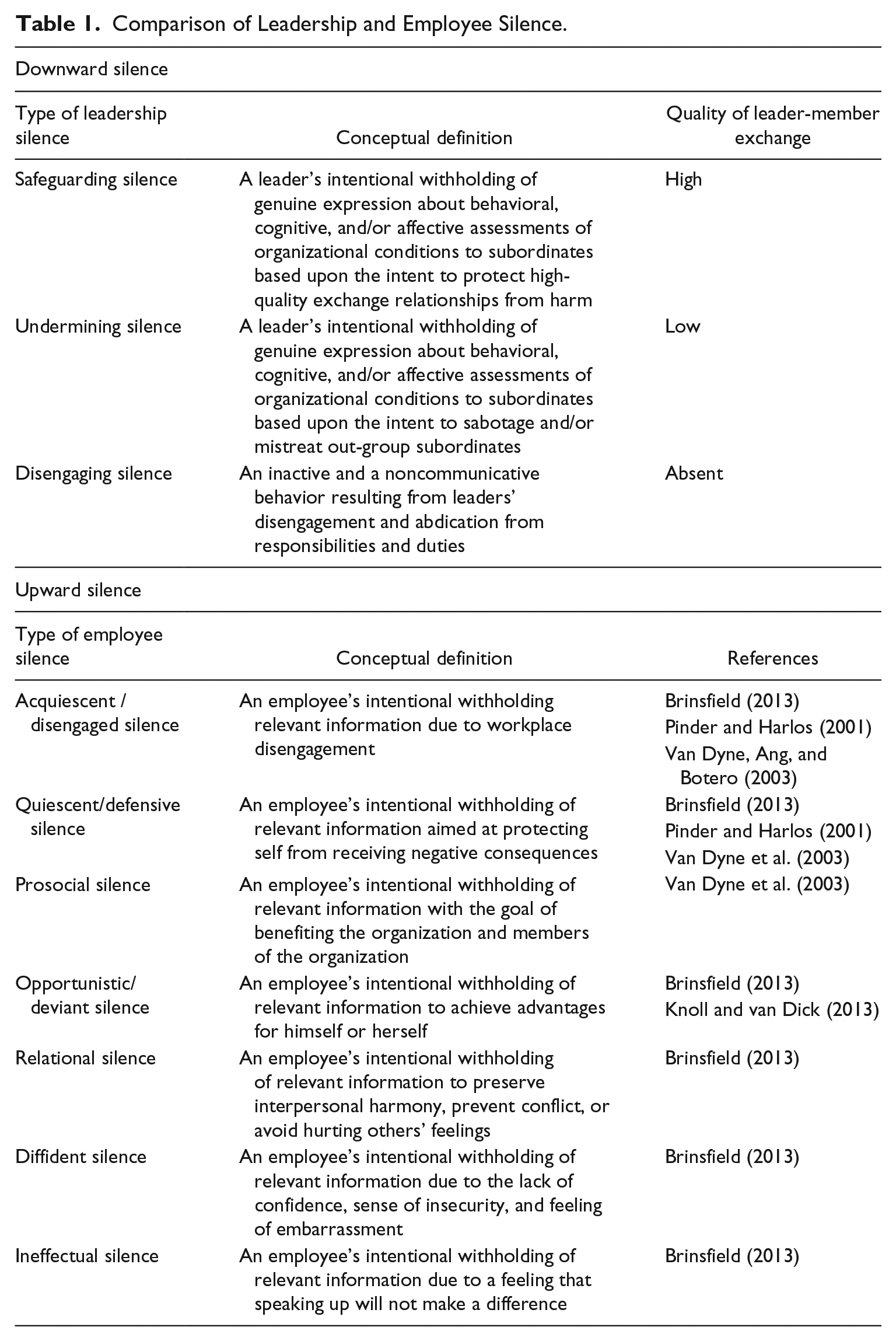
We label the first form of leadership silence as safeguarding silence, which refers to a leader’s intentional withholding of genuine expression about behavioral, cognitive, and/or affective assessments of organizational conditions to subordinates based upon the intent to protect high-quality exchange relationships from harm. In the context of high-quality LMX, a leader enjoys high-quality work-related and social currencies in the forms of affect, loyalty, contribution, and professional respect with an in-group subordinate (Dienesch & Liden, 1986; Liden & Maslyn, 1998). As such, it is likely that a leader will exhibit workplace behaviors that help preserve and foster the existing high-quality LMX. For instance, a leader can exhibit affection (i.e., affect) and personal support (i.e., loyalty) to an in-group subordinate after the subordinate has gone through disadvantageous events and experienced adverse matters. Additionally, a leader can offer positive comments (i.e., professional respect) to and recognize effort (i.e., contribution) exhibited by an in-group subordinate when the subordinate attains mediocre performance. Einarsen et al. (2007) support our view by noting that a particular form of destructive leadership focuses on showing consideration for subordinates’ well-being, establishing camaraderie with subordinates, and nurturing friendly relationships with subordinates. In addition, because high-quality LMX relationships generally leads to high levels of supervisory favors granted to in-group subordinates (Jiang, Chen, & Shi, 2013), it is likely that in-group subordinates receive favorable treatments by the leader such as being evaluated positively and isolated from negative events and information. Indeed, Sparrowe and Liden (1997) point out that high-quality LMX represents the leader’s inner circle or trusted relationships where subordinates enjoy extra benefits and positive experiences. Similarly, research on in-group favoritism has shown that individuals exhibit more positive views toward in-group members than out-group members (e.g., Balliet, Wu, & De Dreu, 2014; Mullen, Brown, & Smith, 1992; Rustemli, Mertan, & Ciftci, 2000).
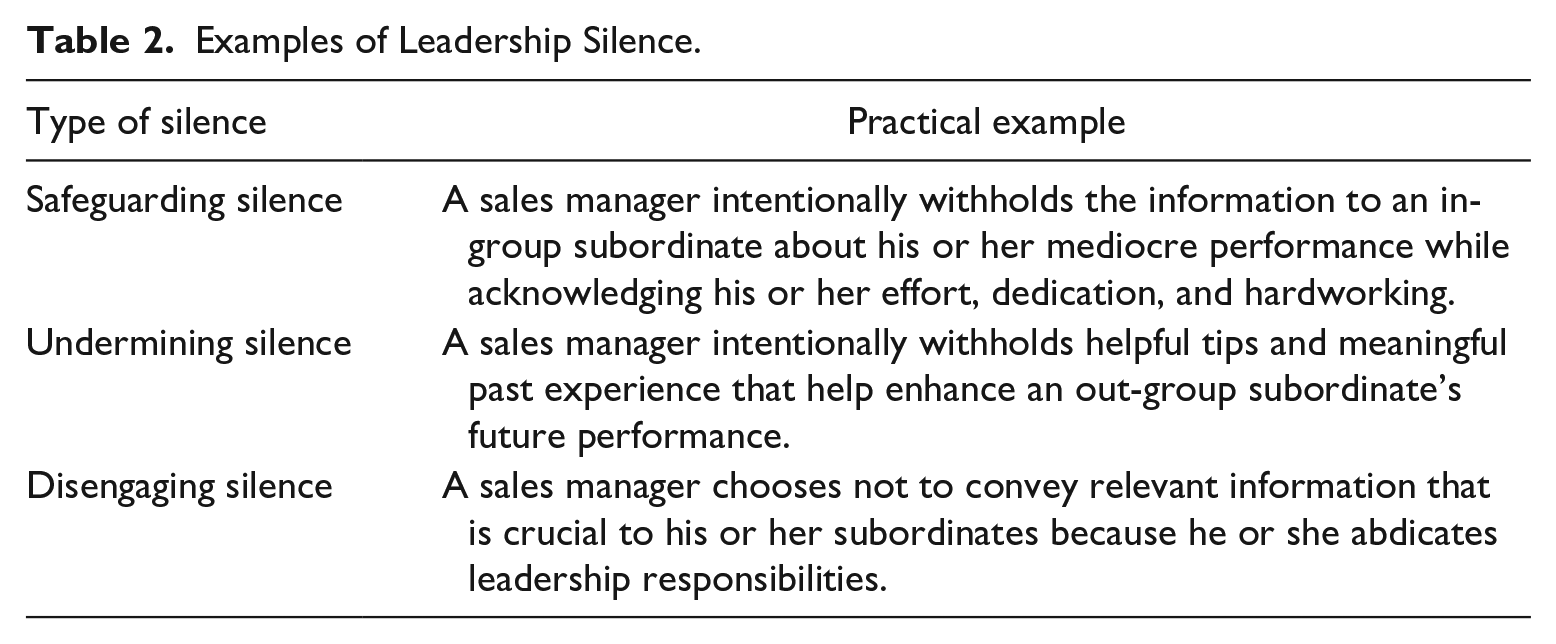
On the basis of prior research findings, we contend that a leader is likely to withhold his or her expression of relevant information to an in-group subordinate intentionally when the information threatens the ongoing exchange of high-quality work-related and social currencies with the in-group subordinate. Put differently, through intentionally withholding relevant information that may harm the existing high-quality LMX, a leader can safeguard his or her continuous exchange of high-quality work-related and social currencies with an in-group subordinate. In the context of sales, for instance, a sales manager may intentionally withhold the information to an in-group subordinate about his or her mediocre performance while acknowledging his or her effort, dedication, and hard work. Consequently, through exhibiting safeguarding silence, the manager shows affection and loyalty to, and displays personal support and respect for, the in-group subordinate.
In the previous example, leadership silence is an attempt to ensure that an in-group subordinate is not exposed to negative news, does not receive unfavorable criticism, and is prevented from getting pubic blame. Essentially, safeguarding silence manifests a leader’s desire for maintaining a rewarding friendship (i.e., affect) with, faithfulness (i.e., loyalty) to, personal support (i.e., contribution) for, and display of respect (i.e., professional respect) for an in-group subordinate. Taken the above together, we propose the following:
Undermining Silence
The second form of leadership silence, undermining silence, represents a leader’s communicative behavior aimed at subordinates with low-quality LMX relationship. Conceptually, undermining silence describes a leader’s intentional withholding of genuine expression about behavioral, cognitive, and/or affective assessments of organizational conditions to subordinates based upon the intent to sabotage and/or mistreat out-group subordinates. As defined by Einarsen et al. (2007), destructive leadership represents “the systematic and repeated behavior by a leader, supervisor or manager that violates the legitimate interest of the organization by undermining and/or sabotaging the organization’s goals, tasks, resources, and effectiveness and/or the motivation, well-being or job satisfaction of subordinates” (p. 208). Essentially, Einarsen et al.’s conceptualization emphasizes that destructive leaders may exhibit workplace behaviors that undermine the effectiveness of subordinates (i.e., antisubordinate behaviors).
In line with Einarsen et al.’s (2007) work, we argue that a leader is likely to withhold his or her expression of relevant information to a subordinate intentionally in the low-quality LMX context. In particular, subordinates who have low-quality LMX relationships with the leader are considered the out-group, which is characterized by low managerial affection, loyalty, support, and interaction (Dienesch & Liden, 1986). In other words, leaders’ workplace behaviors in low-quality LMX are formal and include only those expected under the employment contract (Liden, Sparrowe, & Wayne, 1997). As such, we content that a leader’s exchange of low-quality work-related and social currencies with an out-group subordinate can then result in the leader’s intentional withholding of relevant information and knowledge that weaken the effectiveness of the out-group subordinate. Fairhurst’s (1993) study supports our notion by providing the evidence that communication behaviors in low-quality LMX relationships are antagonistic and adversarial. Fairhurst further notes that leaders in low-quality LMX may reduce their sharing of useful performance-related information with out-group subordinates. Furthermore, Einarsen et al. (2007) suggest that some destructive leadership behaviors may focus on undermining or sabotaging subordinates. Hence, undermining silence represents a leader’s antisubordinate communicative behavior that exemplifies the leader’s intent to undermine and sabotage out-group subordinates’ performance and effectiveness. Following the previous example, undermining silence is exhibited when a sales manager intentionally withholds helpful tips and meaningful past experience that may help enhance an out-group subordinate’s future performance. As such, through the use of undermining silence, the sales manager attempts to undermine and sabotage the subordinate’s effectiveness due to the presence of low-quality exchange relationship.
In the example of undermining silence, leadership silence is an intentional destructive behavior that undermines and/or sabotages out-group subordinates’ effectiveness due to the leader’s exchange of low-quality LMX currencies with the out-group subordinates. That is, undermining silence manifests a leader’s mistreatment, harassment, and disturbance of the effectiveness of an out-group subordinate due to the presence and exchange of low-quality affection, loyalty, contribution, and professional respect. Thus, we propose the following:
Disengaging Silence
Outside of the realm of the LMX leadership approach, much research has adopted the transformational and transactional leadership approach (Hinkin & Schriesheim, 2008; Judge & Piccolo, 2004). Nonetheless, the study of laissez-faire leadership has received growing attention given its prevalence in contemporary organizations (Aasland, Skogstad, Notelaers, Nielsen, & Einarsen, 2010). According to Bass and Avolio (1990), laissez-faire leadership refers to the absence of leadership and/or a leader’s avoidance of leadership intervention. Because laissez-faire leadership highlights a leader’s fundamental disappearance in leading, giving feedback, motivating, guiding, and satisfying subordinates’ needs, it provides a theoretical base for the third form of leadership silence, which we call disengaging silence.
On the basis of previous research on laissez-faire leadership, we contend that a leader may intentionally withhold his or her expression of relevant information to a subordinate due to his or her abdication from the assigned responsibilities and duties (Lewin, Lippitt, & White, 1939). In the exchange relationship between a laissez-faire leader and a subordinate, one would expect that the exchange of work-related and social currencies between the leader and subordinate is nonexistent. Put differently, a laissez-faire leader’s lack of involvement and failure to take leadership responsibility result in the nonexistence of work-related and social exchanges in affect, loyalty, contribution, and professional respect with subordinates. The absence of work-related and social exchanges, therefore, can lead to destructive leadership behaviors such as failing to provide relevant information and remaining silent when subordinates need directions and guidance. Indeed, Neuman and Baron (2005) support our view by stating that destructive leadership behaviors may include a leader’s failure to provide a subordinate with important information and/or feedback. Accordingly, we view disengaging silence as an inactive and a noncommunicative behavior resulting from leaders’ disengagement and abdication from responsibilities and duties. It is important to emphasize that our focus of disengaging silence precludes a leader’s inability to communicate with subordinates due to physical separation, language barriers, and absenteeism. Using the previous example in the sales context, disengaging silence is exhibited when a sales manager chooses not to convey relevant information that is crucial to his or her subordinates because he or she abdicates leadership responsibilities. That is, the sale manager’s lack of concern for goal attainment and leadership involvement triggers the engagement of disengaging silence.
As shown in the example of disengaging silence, leadership silence is an intentional destructive behavior stemming from being absent, hesitating to take charge, and/or avoiding making decisions. Consequently, disengaging silence is characterized by the absence of a leader’s exchange of work-related and social currencies, in the forms of affect, loyalty, contribution, and professional respect, with his or her subordinates. Altogether, we propose the following:
In sum, we have described three distinct forms of leadership silence, safeguarding silence, undermining silence, and disengaging silence, by integrating the literatures of LMX, destructive leadership, and laissez-faire leadership with silence behavior research. Each of these three forms of leadership silence reflects different degrees of a leader’s exchange of work-related and social currencies (i.e., affect, loyalty, contribution, and professional respect) with subordinates. Consequently, this article highlights how downward silence behavior can occur in the organization, which adds a new perspective to the literature that predominantly emphasizes the upward perspective of silence behavior. Table 1 summarizes the three distinct forms of leadership silence and conceptual definitions, as well as the comparison between leadership silence and employee silence drawing from some prominent prior research. Table 2 shows practical examples of the three distinct forms of leadership silence.
Comparison of Leadership and Employee Silence.
Examples of Leadership Silence.
Attributing Leadership Silence: Internal, External, and Relational Attributions
The primary premise of LMX theory is that leaders develop unique relationships with their subordinates via three phases. According to Graen and Scandura (1987), the first phase is role taking where the leader evaluates the subordinates. In the second phase, which is role making, the leader and subordinates formalize relationships through the interaction between the delegation of the leader and the performance of the subordinates. In the final phase where roles are routinized, the relationships between the leader and subordinates become affect laden. As such, LMX theory primarily addresses the expectations of what the other party should provide from each of the leader’s and subordinate’s perspectives. It is worth noting that leaders utilize different formal communication practices directed toward subordinates based upon their classifications of leader-member relationships (K. M. Kelley & Bisel, 2014). More importantly, subordinates are not simply passive role recipients because they can accept, reject, or renegotiate their roles and expectations made by the leader (Wang, Law, Hackett, Wang, & Chen, 2005). As active participants in the exchange process where both the leader’s and subordinates’ role expectations may change over time, it seems plausible that subordinates seek to understand the causes of a certain leadership behavior that is incongruent with their role expectation of the leader (Fairhurst, 2008). For instance, a subordinate may attempt to pinpoint the causes of a leader’s behavioral failure to provide needed resources after role taking, role making, and routinization. The attempt to understand the causes of the leader’s behavior subsequently provides the subordinate with a means to renegotiate the role. More importantly, because leadership is a process of exerting influence over subordinates’ behaviors and actions (Fairhurst, 2008; Yukl, 2012), it is likely that a subordinate, as the observer, attempts to pinpoint the causes of leadership silence based upon what he or she expects from the leader. As a result, attribution theory provides a crucial theoretical foundation for explaining how subordinates might make attributions to leadership silence.
Generally speaking, attribution theory suggests that individuals answer questions of why certain events occur using internal (i.e., self) and external (i.e., others) explanations (Heider, 1958; H. H. Kelley, 1967). Essentially, the explanation that individuals use to pinpoint the causes of a given event determines the locus of causality. While the vast majority of research on attribution has focused on distinguishing between internal and external attributions, there is growing scholarly attention paid to a third category of attribution: relational attributions. According to Eberly, Holley, Johnson, and Mitchell (2011), relational attributions reflect “those explanations made by a focal individual that locate the cause of an event within the relationship the individual has with another person” (p. 732). The conceptualization of relational attributions implies that an individual may make causal attribution to poor (or good) relationship that he or she has with another individual when explaining a negative (or positive) event.
Given that LMX captures the relational dynamics of role expectation and role negotiation between a leader and a subordinate (Graen & Uhl-Bien, 1995), the concept of relational attributions is particularly relevant to the understanding of how a subordinate makes causal attributions to leadership silence. In particular, as we have argued previously, safeguarding silence is typically exhibited to preserve and protect high-quality LMX relationships, and satisfies role expectations when expressing relevant information weakens such relationships and expectations. Additionally, we have noted that undermining silence occurs in the low-quality LMX relationships and dissatisfying role expectations for the purpose of undermining and sabotaging out-group subordinates’ performance and effectiveness. The characteristics of safeguarding and undermining silence, therefore, are likely to reinforce subordinates’ attempt to explain the causes of safeguarding and undermining silence using relational attributions rather than using internal or external attributions.
Compared to safeguarding and undermining silence, disengaging silence represents the absence of leadership involvement and intervention in a dyadic relationship between a leader and subordinate (Bass & Avolio, 1990). A leader’s lack of involvement and failure to provide relevant information can be viewed by his or her subordinates as lacking personal motivation and willingness to lead. From the LMX perspective, a subordinate can view the causes of disengaging silence as the leader’s fundamental disinterest in and apathy toward role taking, role making, and role routinization. As a result, subordinates are likely to make internal attributions rather than external or relational attributions when explaining the causes of disengaging silence. Taken the above discussion together, we propose the following:
Accuracy of Subordinate Attributions of Leadership Silence: LMX Agreement
When attempting to make causal attributions to each of the three forms of leadership silence, subordinates may subjectively assess the accuracy of their attributions. In assessing the degree of accuracy in their attributions of leadership silence, subordinates are likely to utilize their overall quality of interactions with their leaders as the primary means. As mentioned previous, a leader and subordinate exchange work-related and social currencies, including mutual affection, contribution to the relationship, expressions of support, and professional respect in a dyadic relationship (Dienesch & Liden, 1986; Liden & Maslyn, 1998). Thus, during the repeated exchange process occurring in a given leader-subordinate dyad, a leader and subordinate are able to test their perceived quality of relationship with the other party subjectively (Matta, Scott, Koopman, & Conlon, 2015). In the case that a leader and subordinate share more similar experiences in the exchange process, greater LMX agreement is present, which allows the subordinate to interpret leadership behaviors more accurately, including pinpointing the causes of leadership silence. These theoretical arguments lead us to propose the following:
In sum, we have classified different forms of leadership silence, presented how subordinates may make causal attributions to each of the different forms of leadership silence, and discussed the accuracy of subordinate attributions of leadership silence. Table 3 provides a summary of the propositions.
Summary of the Propositions.
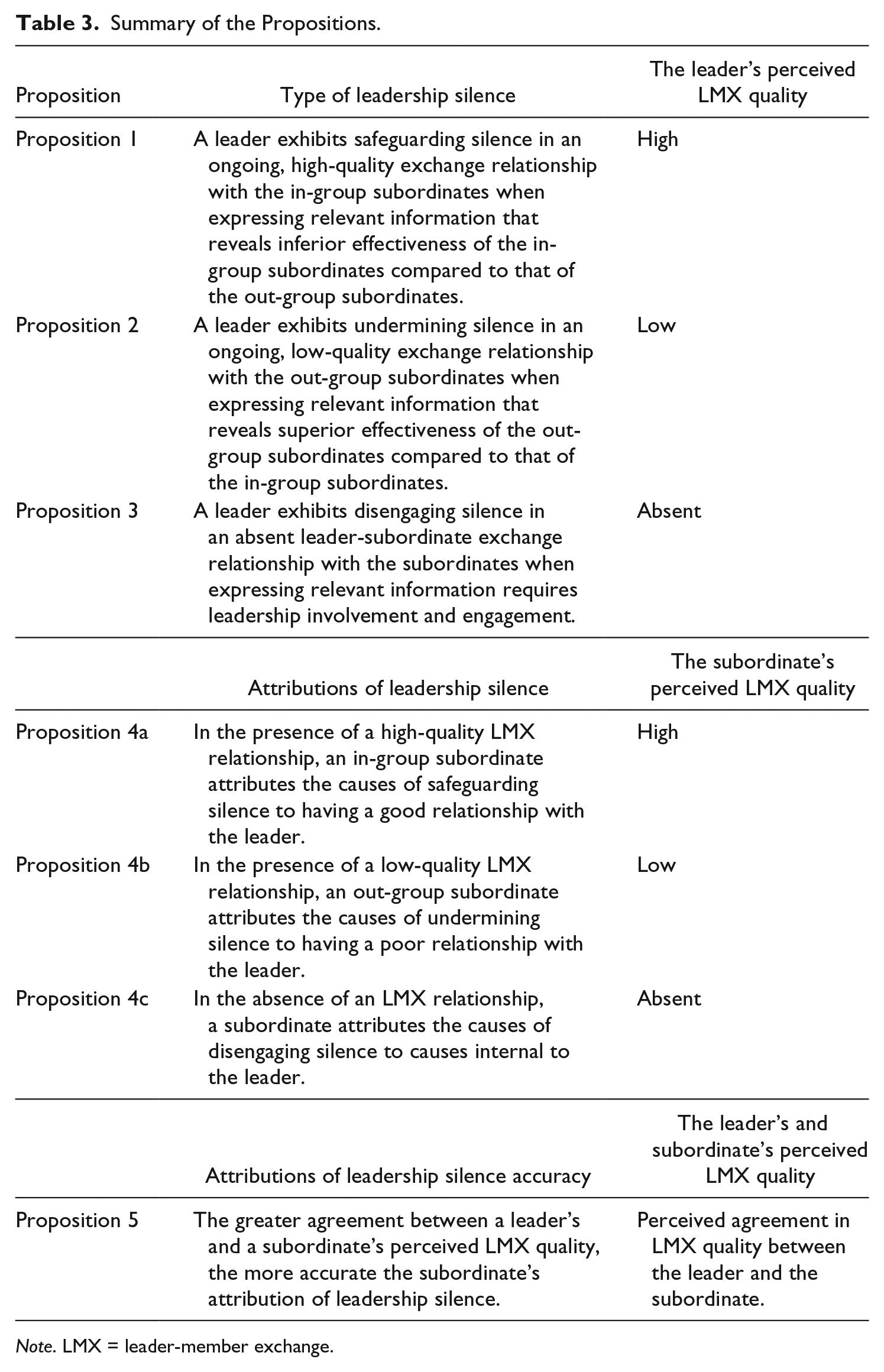
Note. LMX = leader-member exchange.
Discussion
The main purposes of this article are to classify different forms of leadership silence and to discuss how subordinates may make causal attributions to each of the different forms of leadership silence. By investigating these areas, this article provides important theoretical contributions and managerial implications that are discussed in the next section.
Theoretical Contributions
This article makes four contributions to the literature. First, given the pervasiveness and hampering effect of silence behavior in organizations (Madrid et al., 2015; Morrison, 2014), there is an increased amount of scholarly attention paid to exploring silence behavior in organizations. Unfortunately, the vast majority of studies (e.g., Brinsfield, 2013; Milliken et al., 2003; Morrison, 2014; Morrison, See, & Pan, 2015; Pinder & Harlos, 2001; Tangirala & Ramanujam, 2008; Van Dyne et al., 2003) have investigated silence behavior focusing on only one of the groups in the organization: employees. Consequently, silence behavior has traditionally been viewed as an upward communicative behavior. Although this focus has resulted in several crucial insights into understanding the phenomenon of silence behavior, we contend that leaders can also exhibit silence behavior. Through integrating relevant leadership literature, our theorization offers a new perspective for viewing silence behavior as a downward communicative behavior where such behavior is exhibited by a leader and directed to a subordinate. More importantly, together with existing research on employee silence, this article provides a holistic and dyadic view of silence behaviors in organizations.
Second, because one of the fundamental leadership functions involves providing relevant information that may be crucial to subordinates’ performance, leaders’ intentional withholding of expression of relevant information can trigger subordinates’ attempt to pinpoint the causes of such leadership behavior. Given this, we draw upon the literature of attribution theory and offer new insights into how subordinates may make causal attributions to each of the three forms of leadership silence. Consequently, this article not only theoretically integrates leadership silence with attribution theory but also provides a new theoretical underpinning for future research examining attribution of leadership silence.
Third, when exploring the phenomenon of silence behavior in organizations using employees as the focal individual, scholars have claimed that employees assess the costs of speaking up (e.g., Knoll & van Dick, 2013; Milliken et al., 2003). While this approach has offered a vital theoretical perspective on understanding motives for silence behavior, our understanding of silence behavior has been limited to silence as a passive form of and an avoidance-oriented behavior in the organization. However, as pointed out by Scott (1993), not all forms of silence behavior are passive. Through our theorizing and classification of leadership silence, we extend the literature by demonstrating how leaders exhibit silence behavior in the organization.
Finally, in the literature of leadership, the central and traditional research focus has been constructive and effective leadership (Kelloway, Mullen, & Francis, 2006). Over the past few years, there has been growing research effort emphasizing destructive leadership behaviors in organizations (e.g., Aasland et al., 2010; Einarsen et al., 2007; Zellars, Tepper, & Duffy, 2002). Nonetheless, existing research has predominantly addressed destructive leadership behaviors through the lens of overt leadership behaviors (i.e., behaviors that are visible to subordinates). As a result, there is a lack of understanding of destructive leadership behaviors that are not visible to subordinates (i.e., covert leadership behaviors). By discussing leadership silence, as a form of covert leadership behavior, we extend the literature of destructive leadership and provide a theoretical base for future research emphasizing covert, destructive leadership behaviors in organizations.
Managerial Implications
One of the central functions of leadership is communication (de Vries et al., 2010). Such function may include providing feedback to, sharing information with, and offering opinions and suggestions to subordinates. Because it is generally believed that providing subordinates with work-relevant information is part of leadership responsibility (Schneider et al., 2015), the concept of leadership silence introduced in this article suggests that practitioners need to be aware of in-group favoritism bias resulting from the establishment of in-group and out-group subordinates during the LMX process. There is little doubt that certain forms of leadership silence (e.g., safeguarding and undermining silence) can result in favoritism, which further leads to subordinate frustration and destructive interpersonal competition (Mujtaba & Sims, 2011). As such, we suggest that organizations need to ensure that control mechanisms governing leadership workplace favoritism behaviors are in place. For instance, organizations may proactively and routinely provide ethical training and sensitivity education to leaders so that personal biases do not influence decision and behavioral outcomes.
In addition to linking leadership silence with favoritism, this article provides practical insights into unethical leadership practices through the lens of LMX. Specifically, because high-quality LMX promotes mutual liking, affection, and loyalty between a leader and a subordinate (Dienesch & Liden, 1986; Liden & Maslyn, 1998), leaders who have high-quality LMX relationships with in-group subordinates are likely to view maintaining high-quality relationship more important than being ethical. Indeed, Effelsberg and Solga (2015) state that leaders might view being loyal to in-group individuals more important than being truthful and honest to out-group individuals. Given that safeguarding and undermining silence are promoted by leaders’ in-group and out-group orientations, it becomes critical for organizations to establish effective organizational socialization process through which both leaders and subordinates learn the importance of ethical and responsible leadership.
When discussing how subordinates may make casual attributions to leadership silence, we have argued that subordinates may use relational attributions to pinpoint the causes of leadership silence because of the lack of tangible verbal cues. From a practical standpoint, our discussion highlights how subordinates may rely on the quality of formal and informal interpersonal relationships to determine implications of the leader’s nonverbal behaviors. Consequently, leaders need to be not only cautious of visible behaviors but also mindful of nonverbal cues that may be interpreted by subordinates as favoritism and personal biases.
Future Research
Drawing upon extant literature, we have classified leadership silence into three distinct forms and discussed how subordinates may make casual attributions to different forms of leadership silence. Nonetheless, we recognize that this article has several limitations and, consequently, can be extended in the following directions.
First and foremost, when classifying leadership silence, we draw upon the presumption that information asymmetry exists between a leader and subordinate where the leader possesses more relevant and crucial information than does the subordinate. While the view that leaders share information downwardly has been popular in leadership research (e.g., Lam, Huang, & Chan, 2015), there are certainly some contexts where subordinates possess more relevant and crucial information than do leaders. For instance, Hui, Chiu, Yu, Cheng, and Tse’s (2007) study shows that frontline subordinates often know more about how to deliver the best service and satisfy customer needs compared to their supervisors. This implies that leaders may not always be informed and have complete control over relevant organizational information, which may prevent leaders’ engagement in intentional withholding of relevant information. As such, it might be interesting to examine whether and how the process by which a leader obtains information influences his or her silence behavior.
According to Gerhart and Fang (2005), societal cultures have a fundamental impact on how societal members think and behave. Extending this concept, one would expect that cultural values found in a particular society provide the foundation for what leadership behaviors are accepted and expected by subordinates, including leader communication styles. For instance, subordinates with high power-distance values prefer to have less communication with and more social distance from their leaders (Farh, Hackett, & Liang, 2007). Additionally, high–power-distance subordinates display strong respect and deference to organizational authority (e.g., leaders) and, consequently, tend not to expect or request information from leaders (Atwater, Wang, Smither, & Fleenor, 2009; Hofstede & Hofstede, 2005). The impact of context-specific cultural values on individual attitudes and behaviors highlights the need for exploring whether and how leadership silence is distinctively viewed through cross-cultural comparative studies.
Even though most conceptualizations of silence behavior have focused on an individual’s intentional withholding of relevant information, such behavior can encompass different organizational issues (e.g., unethical behaviors, performance deficiency, and innovative ideas) and have different targets (e.g., managers, peers, and clients; Tangirala & Ramanujam 2008). The complexity of silence behavior implies that a leader’s silence behavior may be directed to multiple subordinates while simultaneously focusing on different organizational issues. For instance, when simultaneously interacting with in-group and out-group subordinates, a leader may need to carefully determine the extent of safeguarding silence and undermining silence displayed. Therefore, it would be particularly interesting to investigate the underlying motives for leadership silence when multiple targets and topics are involved.
One of the most prominent premises of LMX is that the quality of leader-member relationship is developed through a series of steps where a leader explicitly communicates with a member regarding role expectations and the member responds to the leader’s expectations, which, in turn, leads to the leader’s evaluation of the member’s response (Sin, Nahrhang, & Morgeson, 2009). The dynamic nature of how leader-member relationships are developed suggests that the quality of leader-member relationships may not remain stable after its initial development. Indeed, scholars (e.g., Bauer & Green, 1996; Sparrowe & Liden, 1997) have supported this view by noting that the exchange relationship between a leader and member is dynamic and reciprocal, and that the maintenance of quality exchange relationship requires both leader’s and member’s continuous investment. Given the temporal nature of LMX, it may be important to incorporate subordinates’ organizational status (e.g., part-time vs. full-time and newcomer vs. insider) into the investigation of subordinates’ attributions of leadership silence. In addition to exploring the temporal nature of LMX, future research may explore if a leader intentionally withholds relevant information to his or her peers who also hold leadership positions.
Finally, due to the pervasiveness of silence behavior in organizations, it becomes important to assess and measure the extent of each of the form of leadership silence. Thus, we highly encourage future researchers to develop scales that capture the three forms of leadership silence. Additionally, even though consequences of employee silence have been investigated extensively (e.g., Argyris & Schön, 1978; Premeaux, 2003; Ryan & Oestreich, 1991; Sitkin, 1992), consequences of leadership silence remain ambiguous. Thus, we welcome future researchers to explore leadership silence at individual, dyadic, and organizational levels.
Conclusion
In this article, we have conceptualized and classified leadership silence by integrating relevant leadership literature. In particular, we propose that leaders can exhibit silence behavior in three distinct forms: (1) safeguarding silence, (2) undermining silence, and (3) disengaging silence. Because the existing literature has been limited to silence behavior exhibited by employees, our theorization of leadership silence provides a new theoretical perspective that may help guide future research on silence behavior in organizations. In addition, this article discusses how subordinates, as the recipient of leadership silence, may attribute the causes of each of the three forms of leadership silence. We conclude this article by stressing that leadership silence along with employee silence provides scholars and practitioners with a holistic and dyadic perspective for managing silence behavior in the organization.
Footnotes
Declaration of Conflicting Interests
The author(s) declared no potential conflicts of interest with respect to the research, authorship, and/or publication of this article.
Funding
The author(s) received no financial support for the research, authorship, and/or publication of this article.