




Abstract
Using conversation analysis and audio recordings of workplace meetings, we analyze stepwise transitions in discussions about ideas during meetings. We demonstrate that, in this context, stepwise transitions have functions related to maintaining cooperative social relationships by offering a way to (a) resist the presuppositions of the presented idea without explicit disagreement and (b) smoothly bypass ongoing or evolving disagreements when assessing the idea. Thus, the mundane view of stepwise transitions as a random disruption to meeting interactions is misleading. We discuss the results in relation to the literature on group interaction related to idea development and topic management and disagreements in workplace meetings.
Keywords
Meetings are an essential arena for conducting several organizational tasks in workplaces, such as making decisions or brainstorming on novel ideas (Hansen & Allen, 2015, p. 204). In spite of the undeniable importance of meetings, survey studies have pointed out that employees often perceive meetings as an unproductive waste of time (Allen et al., 2012; Elsayed-Elkhouly, Lazarus, & Forsythe, 1997). Previous studies have repeatedly mentioned one feature of meetings that is linked with their success—namely, focusing on relevant issues (Allen et al., 2012; Allen, Yoerger, Lehmann-Willenbrock, & Jones, 2015; Bang, Fuglesang, Ovesen, & Eilertsen, 2010; Kauffeld & Lehmann-Willenbrock, 2012; Lehmann-Willenbrock, Allen, & Kauffeld, 2013). However, the ways in which meeting participants end up discussing irrelevant issues or “losing the train of thought” (Kauffeld & Lehmann-Willenbrock, 2012; Lehmann-Willenbrock et al., 2013) have not been examined in detail.
Based on previous interaction studies, it seems that one such way may be a stepwise transition from one topic to another. In mundane interactions, speakers routinely move from one topic to another by using stepwise transitions—that is, by gradually changing topics, with one turn connected to previous turns but also introducing new themes, which are then elaborated. The stepwise transition can smoothly take a discussion far from where it started without anyone explicitly orienting to actually changing the topic (Hobbs, 1990; Jefferson, 1984; Sacks, 1992). In this process, speakers use a so-called pivotal utterance that “though recognizably on topic, has independent topical potential” (Jefferson, 1984, p. 203).
In this study, we used conversation analysis (CA), which is an inductive qualitative method, and audio-recorded data from meetings to investigate the following research question: What are the social functions of stepwise transitions when discussing ideas in workplace meetings? We will demonstrate that when discussing ideas in meetings, stepwise transitions have two social functions related to maintaining cooperative social relationships. This article’s contributions are threefold and cover the interests of organization studies, communication studies, and social-scientific studies of interaction. First, we will sharpen the image of “losing the train of thought” (Kauffeld & Lehmann-Willenbrock, 2012) during meetings by describing the verbal process and social functions of stepwise transitions during meetings. Second, we will advance understanding of and exemplify how discussions on ideas can be analyzed from the viewpoint of social interaction. Our study continues the emerging line of research focusing on the actual interactional processes related to idea development (e.g., Due, 2014, 2016; Matthews & Heinemann, 2012; Nielsen, 2014) by analyzing a particular interactional practice of stepwise transitions when discussing ideas. Third, we complement the social-scientific understanding of stepwise transitions as an interactional practice in their own right by describing their structure and functions in a new setting.
Conversation Analysis as an Approach to Studying Discussions on Ideas
This study builds on the CA approach to social interaction. CA is based on ethnomethodology, which includes the key idea that, moment by moment, people jointly produce an understandable social world using shared methods (Garfinkel, 1967/1984). Accordingly, CA understands social interaction as structurally organized and, as such, available for analysis (Heritage, 1984; Heritage & Clayman, 2010).
This structural organization becomes vividly observable in, for example, the case of actions organized as pairs, such as a question-and-answer pair (Heritage, 1984; Schegloff, 2007). When a speaker poses a question, it makes an answer the next relevant action. If an answer is not provided, the speaker can treat the answer as missing by, for example, repeating the question. Although participants’ motives, intentions, and other psychosocial characteristics inevitably shape the contents of the question and answer, they do not influence the basic organization of a question-answer pair. According to CA, this type of structural organization of interactional sequences is normative but not compelling. That is to say, one can leave a question without an answer, but there may be social sanctions; for example, the coparticipant may consider the other person rude (Heritage, 1984).
To understand interaction as structurally organized leads to a point that is also methodologically crucial—the action done in a single turn can be determined only by looking at the whole course of action and the way the participants treat the turns in talk. This is because each turn both orients to the context that previous turns have built and renews the context for the next turns (Heritage, 1984, p. 242). By being sensitive to this, CA is better able to analyze participants’ orientations to turns than quantitative, coding-based approaches to interaction, which use predetermined categories of actions (see Peräkylä, 2004).
Recently, the CA approach has emerged in the field of study of idea development. Previous studies have addressed settings such as brainstorming sessions (Brouwer & Van Dijk, 2011; Matthews, 2009; Nielsen, 2012), participatory workshops (Heinemann, Landgrebe, & Matthews, 2012; Landgrebe, 2012), intra-organizational meetings focusing on idea development and design (Due, 2014, 2016; Matthews & Heinemann, 2012; Nielsen, 2014), and meetings between developers and collaborators (Nielsen, 2014). The studies have illustrated, among other things, how participants use interactional resources to build and negotiate a shared understanding of ideas (Due, 2016) and stakeholders’ requirements (Nielsen, 2014). Further, previous studies have demonstrated that participants orient to the basic structures of interaction as fundamental despite outside ideals dealing with discussing ideas (Heinemann et al., 2012; Matthews, 2009; Nielsen, 2014).
Our research joins this emerging field of study of idea development with CA and addresses intra-organizational meetings as the setting. We leaned on the tradition of institutional CA by being interested in the practice of stepwise transitions in connection with the institutional goals of meetings related to discussing ideas (see Heritage & Clayman, 2010). More generally, CA is reflected in our study in the way we approached the presentation of “an idea” in meetings. We understand it as a social action rather than a representation of cognitive processing (see Potter & te Molder, 2005). Thus, to present an idea refers to making a proposal (see Asmuβ & Oshima, 2012; Nissi, 2015; Stevanovic, 2012, 2015) or a suggestion, topicalizing something proposed before the meeting, or describing how the world is (Matthews & Heinemann, 2012), as long as the participants treat the action as opening joint treatment on an aspect that can be done in the future relative to what they are developing (cf. Houtkoop, 1987; Stevanovic, 2012).
It should also be noted that presenting an idea not only makes a proposal for a future action but also typically explicitly states or invokes presuppositions of the problems in the current situation (see Matthews & Heinemann, 2012). Other participants can address both these aspects in their response to the idea by (a) accepting/rejecting what has been proposed to be done and (b) confirming/disconfirming the presuppositions invoked by the presentation of the idea (see Heritage, 2010; Raymond, 2003; Stivers & Hayashi, 2010, for questions’ constraints and the ways in which responses deal with these constraints). This leads us to two CA concepts that are relevant for the analysis: preference and alignment.
If we think about first pair parts, such as proposals and suggestions, there are two types of possible responsive actions: acceptance and rejection. Providing either of these types of responses is deemed to be aligning with the action in the first pair part— that is, accepting the presuppositions set by the action (see Stivers, Mondada, & Steensig, 2011). Further, in spite of participants’ feelings about the proposal or suggestion, an acceptance is typically provided straightaway, but a rejection is accompanied by delays and accounts. Thus, participants treat acceptance as a preferred response (Davidson, 1984; Heritage, 1984). Accordingly, CA suggests that the ways in which participants produce their actions as aligned/disaligned and preferred/dispreferred are relevant for how they maintain cooperative social relationships (Heritage, 1984; Pomerantz, 1984; Sacks, 1987; Stivers et al., 2011). However, it should be noted that these interactional structures can be complicated and context sensitive; for example, agreement is typically preferred over disagreement, and as such, it usually maintains social solidarity, but there are contextual differences in how participants in an interaction orient to disagreements (e.g., Kangasharju, 2009; Sifianou, 2012). In our analysis, we will show how stepwise transitions are related to aligned/disaligned and preferred/dispreferred actions and, thus, to maintaining cooperative social relationships.
Data and Methods
Data Collection
Our data were collected from two case organizations as part of a larger research project. Both companies are located in southern Finland and operate in creative industries: one is a large media company, and the other is a small digital animation studio. The primary data consist of 14 audio recordings of meetings (13.5 hours in total), recorded between October 2014 and April 2015, and are complemented with our notes on nonverbal interactions, the physical environment, and seating arrangements during the meetings. All the participants gave their informed consent to data collection.
The data set includes the meetings of three groups at the two companies. The participants in the meetings at the animation studio were members of the company’s managerial group, including representatives of employees and management. In the group’s weekly meetings, the participants presented ideas while discussing current issues in the organization. The data also include the meetings of two groups at the media company: a project group and a steering group focusing on the same development project. The participants in the project group meetings included the project manager of the development project and the operative directors in the relevant business areas. The steering group consisted of the project manager and the executive directors of the organization.
Although these meetings represent slightly different arenas, they have major similarities in their settings. First, all the meetings included three to six participants from various business functions in the organization. Second, the meetings focused on discussions of ideas related to developing the organization’s working methods, business strategies, or management operations, and all the groups had the authority to make at least preliminary decisions on the ideas, while still needing to champion them further. Third, all the meetings were relatively casual: They had some predefined topics but no strict agenda; the participants took notes, but no official meeting minutes were recorded, and the chair introduced the topics but did not control turn taking.
The utilization of recorded interactions from naturally occurring meetings as data is in line with the article’s CA approach (see Heritage, 1984). In practice, using recording as a data collection method is always selective and includes considerations of technical opportunities, empirical adequacy, and ethical questions (Mondada, 2013). A weakness of our data is that it includes only audio recordings. A reliable analysis of all the multimodal aspects of achieving stepwise transitions would have required video recordings. However, having no opportunity to collect such data, we had to consider this limitation when defining the research question. We focused on the social functions of the verbal practices for stepwise transitions, and high-quality audio data gave us access to the interaction at an adequate level for analysis.
The Process and Methods of Analysis
We began our analysis of the meetings by collecting the episodes during which the participants discussed ideas related to organizational development, such as renewing the organization’s working methods, business strategies, or management operations at the organizational level (n = 39). The episodes we collected are typically long and complex in their overall structural organization (Tiitinen, Lempiälä, & Ikävalko, 2015). Because of this complexity, we first approached the discussions of ideas as topical entities, although we recognized that a topic is a difficult analytical tool as it is not simple to identify (Schegloff, 1990). However, this preliminary phase of analysis enabled us to include various types of episodes during which the participants discussed ideas and see how the presentation of an idea as a social action can take many forms. From this collection of episodes, we identified all the sequences of stepwise transitions (n = 18), cases in which the focus of the discussion shifted away from the presented idea without anyone explicitly changing the topic (Hobbs, 1990; Jefferson, 1984; Sacks, 1992).
As we have described above, the presentation of an idea as a social action refers in our data to actions such as making a proposal or suggestion or topicalizing something that someone else (a staff member, consultant, another meeting participant, etc.) proposed before the meeting. Previous CA literature has defined the action of making a proposal or suggestion in relation to the agent of the future activity and the beneficiary (Couper-Kuhlen, 2014). However, in the meetings that we analyzed, the ideas relating to organizational-level issues were typically complex, and the participants often treated the organization in general or someone outside the meeting as both the agent and the beneficiary. Moreover, the meeting participants did not necessarily treat the issues under discussion as something that they must, or even had the power to, decide in the meeting. Although presenting an idea makes its evaluation a relevant next action, this is not always the case for making a decision on it (see Tiitinen et al., 2015).
To capture the details of interaction, the sequences of stepwise transition were transcribed using notations developed by Jefferson (2004). To analyze the data, we used CA, and following those principles, we took an inductive approach to data by beginning with observations on how the episodes of interaction unfold in the data (see Arminen, 2005). In line with CA’s starting point that all turns are both context-sensitive and context-renewing (Heritage, 1984), the turn-by-turn analysis was directed by the question “why that now,” meaning what each turn does in the overall episode (Heritage & Clayman, 2010, p. 32). The aim was to grasp the meeting participants’ orientations to what was going on.
In line with the CA approach to analyzing interactional practices, we analyzed the characteristics and sequential environments of stepwise transitions (Heritage, 2011). The previous CA work provided us a provisional understanding of the characteristics of stepwise transitions (Jefferson, 1984; Holt & Drew, 2005; Sacks, 1992). We utilized the analysis of the characteristics and sequential environment to form preliminary interpretations of the distinctive function of a stepwise transition in a particular context (see Heritage, 2011). The CA approach of prioritizing participants’ own interpretations offered a “proof-procedure” (Sacks, Schegloff, & Jefferson, 1974) for the validity of analytic interpretations. In some of the cases, at some point after the focus of the discussion had shifted, one of the participants retopicalized the idea by explicitly stating it (as we see in Extract 1c) or using interactional devices that implied a return to what had been discussed earlier. The retopicalization makes it convenient to observe participants’ orientation to the previous discussion as a digression. However, responsive turns are often too ambiguous to be applicable for a proof-procedure (Peräkylä, 2011). This was also the case in many of the sequences in our data due to the inherent nature of stepwise transitions as a routine that “ordinarily involves nothing particularly noticeable” (Sacks, 1992, p. 301). Thus, we sought validity primarily by comparing the cases systematically and covering those that deviated from the general pattern (see Arminen, 2005; Peräkylä, 2011).
Results
In this section, we illustrate how stepwise transitions were initiated in different sequential environments during episodes of discussing ideas. We demonstrate that stepwise transitions have social functions relevant for the social organization of discussing ideas in meetings. First, we present cases in which the stepwise transition offered a way to resist the presuppositions of an idea without explicitly disagreeing with it (n = 5). Second, we show how the stepwise transition helped to smoothly bypass disagreements when assessing an idea (n = 13). Finally, we summarize the results and present a contrastive case to highlight the relevance of the sequential environment for social functions.
Resisting the Presuppositions of an Idea Without Explicit Disagreement
The first sequential environment in which stepwise transitions occur in our data is right after someone has presented (or re-presented) an idea related to developing new organizational processes. In this sequential environment, the stepwise transition is launched by an utterance that focuses on pointing out a feature of the circumstances surrounding the idea rather than commenting on the idea itself. We suggest that the stepwise transition offers a way to resist the presuppositions invoked in the presentation of the idea, while at the same time moving forward in the discussion without explicitly disagreeing or topicalizing the resistance. Thus, although the stepwise transition is initiated with the disaligned action of resisting the presuppositions of the idea (see Stivers et al., 2011), the elaboration moves the discussion away from the point of disalignment. Figure 1 presents the steps of transition in these kinds of cases.

The steps of transition starting from the presentation of an idea (P refers to the participant who presents the idea and R to the one who responds to it).
Our data include five such cases, and Extract 1 presents one of them. At the beginning of the extract, Jarmo introduces the idea of a new project by mentioning a current concern—the lack of development of joint decision making on working methods among the staff —that the project would solve (lines 1-2). We present the extract in three parts. The first part shows Step 0, Jarmo’s presentation of the idea. The second part first shows Step 1, which is Severi’s response that initiates the transition; then, Step 2 is Severi’s elaboration, and finally, Step 3 has another participant, Matias, taking up the matter elaborated on by Severi. In the third part, Jarmo later retopicalizes the idea, and Severi rejects it more explicitly. (In all the extracts, we provide the original utterance in Finnish, followed by the idiomatic translation in English. In the middle, we provide a line presenting the English translation in the Finnish word order, if this differs from the translation in the third line. The transcription symbols are presented in Appendix. All the names are pseudonyms, and other details related to the companies have also been anonymized.)
Before concentrating on the transition away from the idea, we will focus on Step 0 and three elements of the idea’s presentation because they form the particular sequential environment for the transition. First, Jarmo begins by stating a problem related to the company’s aim to support open discussion and joint decision making among the staff: “The culture of joint decision making has remained quite weak” (lines 1-2). Then, Jarmo presents an idea as a solution to this problem by connecting it to the problem statement with the contrastive conjunctive but (line 3). In this way, the problem statement serves as an account for the idea (Houtkoop-Steenstra, 1990).
Second, the way in which the idea is presented—“We should invent something like (1.5) a project where we do things together or a forum” (lines 3-5)—treats the meeting participants as the ones who are responsible for inventing the project. This is done by utilizing the personal pronoun we and the conditional form of the verb (should), which gives the directive an evaluative meaning (Hakulinen et al., 2004 [referred to hereafter as VISK] §1668). Jarmo also notes that Ismo has already promised to think about the project’s implementation (lines 5-6), which implies that this is not the first presentation of the idea, nor is it only the management group’s job to think about the project. These consecutive utterances create potential ambiguity about whether the idea presentation is meant as a proposal or as information (see Stevanovic & Peräkylä, 2014).
Third, there is a minimal response, “mm,” in line 12 and then two longish pauses in lines 14 and 19, during which the other participants do not take their turn to comment on the idea. (As we do not have a video, we cannot know if Jarmo uses his gaze direction to mark the transition relevance place during the pauses in lines 14 and 19. However, we can note that both the syntax of the utterances in lines 13 and 18 as well as the terminal intonation contour at the end of them project completion (see Clayman, 2013).) This lack of response, when there is a sequential place for it, anticipates a dispreferred response (Heritage, 1984). Jarmo responds to the lack of responses first with a display of uncertainty (Stevanovic, 2015)—”or what could it be” (line 13)—and then by elaborating on the idea. The questions in lines 13 and 20 frame the action as a proposal rather than just information. At the same time, the latter question—“So what could the place be where that would be discussed” (lines 20-21)—presupposes that the project idea will be accepted (see Heritage, 2010, for presuppositions in questions) and thus sets rather strict limits for the content to be decided in the meeting.
Next, we will look at the successive steps during which the transition is achieved.
In line 30, Severi begins to respond. We can see multiple markers of dispreference in the production of the response—the long silences both before and at the beginning of the response, the turn-initial particles “yes well,” and the mitigating word (“basically”) at the beginning of the statement (see Davidson, 1984; Heritage, 1984; Pomerantz, 1984). However, the response is not the dispreferred alternative of the potential second pair parts (rejection), but in fact, it disaligns with the presuppositions invoked by Jarmo’s first pair part. As we stated earlier, Jarmo’s last question in lines 20-21 enquires about the aspects of implementing the idea and thus presupposes that the project idea in itself will be accepted. Severi’s response disaligns with this presupposition (see Stivers et al., 2011) by not addressing Jarmo’s questions about the place or forum for staff discussions. Instead, Severi notes the challenge of taking advantage of staff resources by distributing work wisely. In this way, he focuses on redefining the circumstances of the process idea in contrast to the process itself. The disalignment is highlighted by the indisputable manner of stating the challenge, “The common challenge in doing is exactly . . .” (lines 30-31), as well as the focus particle juurikin (translated here as “exactly”) (VISK, 2004, §845) and the definite article se (not commonly used in Finnish) (VISK, 2004, §1415), which imply that the matter should have already been known to the participants.
A crucial step for achieving the transition (in contrast to just opening the discussion to alternative definitions of the problems behind the idea) is to then elaborate on the circumstances brought up in Step 1. The sequential place for elaboration is produced in line 34: After the word hyväksi, there is the first possible syntactic completion point (see Clayman, 2013). However, a rise in pitch in the middle of the word hyväksi followed by a level pitch marks the turn as incomplete (see Selting, 1996), and the other participants do not take the turn. The way in which Severi then continues takes the focus of the discussion more toward the particular case of problematic distribution of work. He mentions a former employee who has “fallen apart” as a result of not distributing work (lines 36-40) and defines the role of a particular type of manager in distributing work (not presented in the extract). Although Severi’s response is disaligned with Jarmo’s request for contributions for the proposal, his elaboration on the topic shifts the focus of the discussion further away from the disalignment.
Finally, Step 3 establishes the transition. Another participant, Matias, takes the turn after a long silence and picks up with the matter of distributing work wisely (line 77 onward). He continues to assess the individual case mentioned by Severi. At this point, the discussion, which began with a proposal about arranging a discussion forum for staff to support joint decision making, has shifted step-by-step to addressing the problem of distributing work in a particular team.
The following extract is the third part of Extract 1, later in the same meeting, when Jarmo retopicalizes his idea of developing joint decision making among staff. Severi provides more explicit resistance to the idea this time.
In line 1, Jarmo explicitly returns to the idea of arranging a forum for the staff’s joint decision making: “I will still go back to that.” What is different in this presentation of the idea compared with the first presentation, in Extract 1a, is that Jarmo mentions a specific theme for the staff’s discussion: “how they are distributed more wisely” (lines 8-9). Thus, Jarmo integrates the previous discussion about the problems of distributing work into his original proposal. At the same time, his statements imply a critical view of Severi’s response; he points out that the discussion about distributing work more wisely should be had by the staff and not by the management group in the meeting.
Then, Severi explicitly disagrees with the definition of the problem identified by Jarmo (lines 15-16). Severi continues to elaborate on his view of the solution to the problem (not presented in the extract). The shift in the ongoing action anticipated by the stepwise transition is noteworthy. At the beginning of Extract 1a, Jarmo offers a definition of a problem and a strictly limited proposal to solve it. Severi’s stepwise transition opens up the discussion of alternative views of both the problem and the solution. However, as Severi’s utterance in Extract 1b initiates a prolonged exploration of other ideas that implies resistance to the proposal’s presuppositions, the conversation shifts focus to an alternative problem rather than an open discussion of alternative points of view on the original problem. No other participant presents solutions prior to Severi’s explicit disagreement uttered in Extract 1c. After the conclusion of the extract, the episode evolves. First, Ismo presents a new suggestion, and the participants agree to it; then, Jarmo re-presents his initial suggestion to arrange a face-to-face meeting for the staff as a way to just kick off the development work in this area, and the participants agree to that as well.
To sum up, in Extract 1, the focus of the discussion is shifted away from an idea through an utterance that addresses the circumstances of the idea rather than the idea itself. As the idea is presented in a rather well-defined form, leaving only a limited amount open for discussion, shifting the focus of the discussion offers a way to resist the presuppositions invoked by the idea without explicitly disagreeing with the idea. In addition, using a stepwise transition to shift the discussion enables the discussion to move on after the disaligned action.
Smoothly Bypassing Disagreements
The second sequential environment in our data in which stepwise transitions are initiated is after participants have disagreed about an idea. Figure 2 summarizes the steps of this type of transition. Our data include 13 such cases. They vary slightly with regard to the ways in which the disagreements evolve. Extract 2 presents an example in which the cycle of presenting/re-presenting an idea and rejecting it goes on for quite a while.

The steps of transition starting from the disagreement over the idea (P refers to the participant who presents the idea and R to the one who responds to it).
Extract 2 also illustrates that disagreeing with an idea is not treated as particularly problematic in our data (cf. Angouri, 2012). We will see that, although disagreeing with an idea is formulated as a dispreferred action, the discussion continues without major problems even when a disagreement occurs; the presenter of the idea keeps accounting for it (see Houtkoop-Steenstra, 1990), and the other participant keeps stating his concerns. As the participants do not need to make a final decision about the idea in the meeting, the stepwise transition offers them a smooth exit from this cycle of accounting and disagreeing.
We will present Extract 2 in two parts. The first part is Step 0—how the cycle of accounting for and disagreeing with the idea evolves. The second part presents Steps 1 and 2—the transition away from discussing the idea. The extract opens just after Atte has topicalized a suggestion made by an external consultant. The suggestion deals with the possibility of rearranging the system for renting out the company’s premises. Atte verbally addresses the presentation of the idea to Veikko.
First, let us look at the sequential environment in which the transition occurs—that is, how the disagreement with the idea evolves. We see that, already, at the beginning of the extract, Atte orients to the idea as having the potential to invoke disagreement. His questions in lines 1 and 3 are grammatically designed to give Veikko an interactionally easy opportunity to reject the idea, as the questions’ preference structures are cross-cutting (see Heritage, 2010; Schegloff, 2007). The questions’ grammatical design favors answers that would dismiss the idea as crazy and unlikely to be accepted by the staff (see Heritage, 2010). Yet the action of proposing in itself favors acceptance over rejection (see Houtkoop, 1987, for the preference organization of proposals). Although the idea was not originally Atte’s, the very fact that he topicalizes it shows that he is looking to discuss it. This suggests that he has at least ambivalent feelings about the idea, even if he is not fully in favor of it. In addition, Veikko orients to Atte as the author of the idea, referring to it as “your thesis” (lines 17-18) instead of the consultant’s thesis.
Thus, to maintain social solidarity, Veikko—the recipient of the idea—would need to provide a preferred response—that is, to accept the proposal or minimize the social consequences of a dispreferred response (see Heritage, 1984). We see that he does the latter. There are many indications that his answer will be dispreferred, as the response is delayed many times (lines 2, 6-8, and 10) (Davidson, 1984; Heritage, 1984; see also Boden, 1995, for recurring silences in a conflictual episode in a meeting). Nevertheless, Atte continues to prompt the answer (lines 3, 5 and 9) (see Houtkoop, 1987). Finally, Veikko responds that, in principle, the idea could work (line 15), but then he elaborates on the reasons why he thinks it is not suitable for their company.
Both Atte and Veikko continue to defuse the disagreement over the idea. First, each treats his own deontic rights (Stevanovic & Peräkylä, 2012) as lower than the other’s. In line 22, Atte orients to Veikko’s answer as deciding the matter: “Well, but this solves it then.” In addition, his elaboration—“This is also a good answer,” said with a smile in his voice—further softens the potential awkwardness of rejection (see Haakana, 2001; Kangasharju & Nikko, 2009). Veikko, however, still treats the idea as open for discussion, continuing to justify his view and mentioning a condition that might enable implementation of the idea. Second, the way in which Atte frames his reformulation of the idea—as something he has just thought of (lines 38 and 41)—also softens the presentation and addresses in advance the awkwardness of potential differences in viewpoint (see Stevanovic, 2013). Indeed, Veikko also rejects the modified version of the idea (not presented in the extract). Although both Atte and Veikko make interactional efforts to smooth over the disagreement, they end up in a cycle of presenting/reformulating a proposal and disagreeing about it in their responses. In the next section of the extract, the discussion starts to move step-by-step away from the idea.
From line 1 on, Veikko offers another argument for his opposing view. He says that one of their colleagues, Paula, had visited the campus of a similar type of company in another country and reported that, at that campus, rentals are handled in the way Veikko has argued for. Veikko begins with the particle kyllä (translated here as “indeed”), which, prefacing taking a stance, has been shown to work against potential differing opinions (Hakulinen, 2001). Thus, when Veikko mentions Paula’s visit, it is framed to be a source of information in the service of argumentation.
However, Atte addresses the detail of visiting another campus in such a way that it serves as a pivotal utterance (Jefferson, 1984). First of all, the utterance is produced as “recognizably on topic” (Jefferson, 1984, p. 203); Atte prefaces his question with a direct link to what Veikko has just said by stating that “they had visited that [other campus]” (lines 19-20). At the same time, the utterance is produced as having “independent topical potential” (Jefferson, 1984, p. 203). The turn-initial particle but marks the potential transition to a related topic (VISK, 2004, §1034). Atte first rushes into initiating a question (line 20) and then self-repairs to explain the background (line 20) before posing questions. His questions (lines 25-27) and the explanation (lines 20-23) address the benefits of visiting other campuses generally, and in this way, Atte’s turn shifts the focus away from the original point of using the visits to evaluate the rental system. By using the questions, Atte makes the transition particularly compelling; the questions as first pair parts make the answers relevant next actions (Heritage, 1984). The final step of the transition is achieved when Keijo takes the turn (line 28) to first explain why he is also eligible to answer the question (since he has participated in the same trip as Paula) and then goes on to elaborate on his experiences. Atte further supports the transition by confirming Keijo’s position as a knowledgeable respondent when he repeats that Keijo has been there and modifies the question to address Keijo particularly (line 30).
After the conclusion of Extract 2b, the discussion of a particular campus and what could be learned from it continues for quite a while. This means that the project group does not come to a decision about the consultant’s suggestion to rearrange the rental system. Extract 2 illustrates how shifting the focus from an idea to a related detail helps to move a conversation swiftly to other topics when the discussion stalls in a cycle of presentation, justification, and rejection. However, in Extract 2, the stepwise transition moves the discussion away from the idea before the participants have explicitly finished their discussion or made a decision on how to proceed.
Summary of the Results and Further Evidence From a Contrastive Case
We have presented two sequential environments in which stepwise transitions occurred during discussions of ideas, and we have demonstrated the different social functions of the stepwise transitions in these environments. Table 1 summarizes our results.
Summary of the Results.
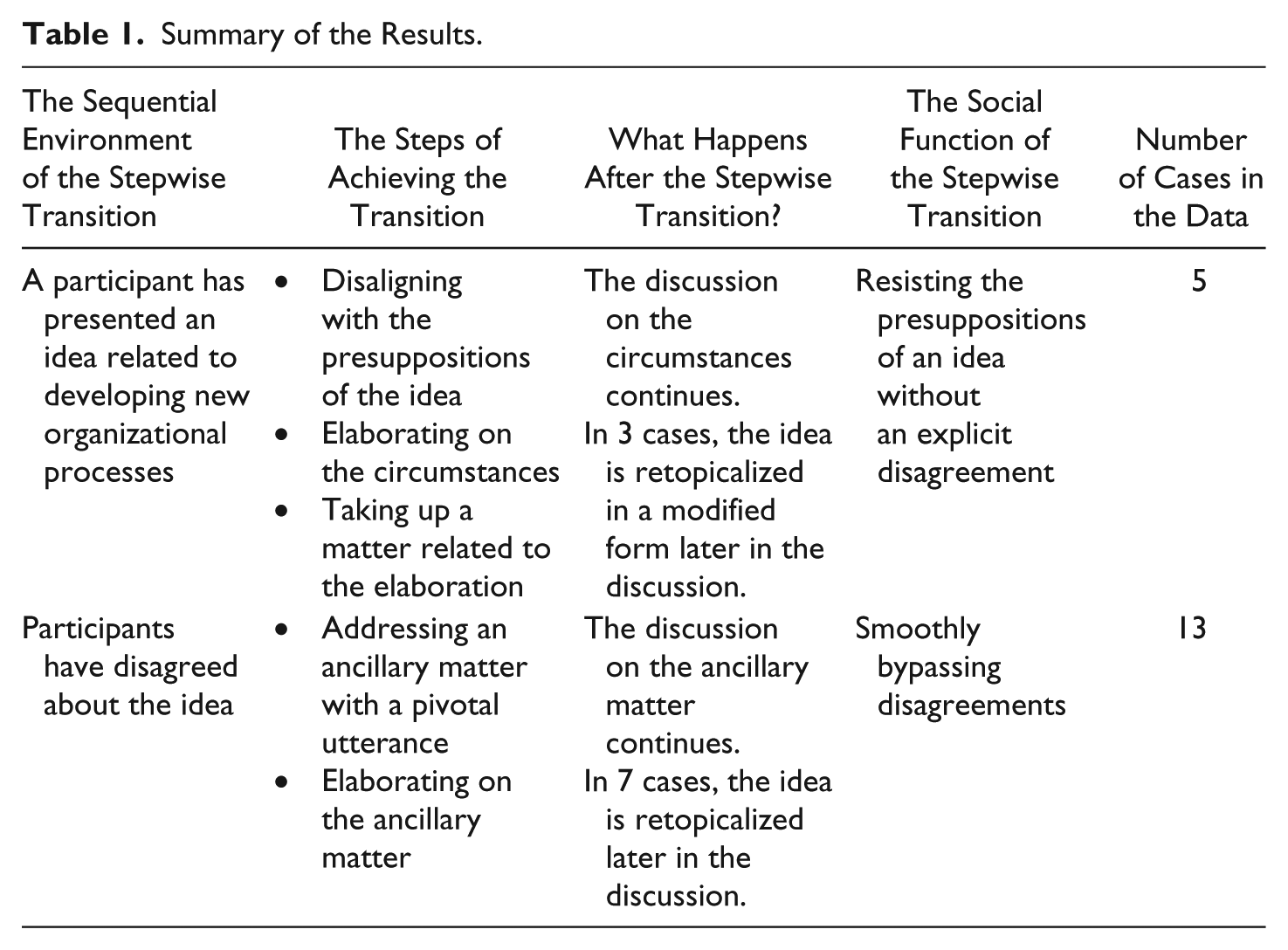
To further demonstrate that the social functions of stepwise transitions are sensitive to the sequential environment in which they occur, we present a contrastive case of a potential transition. In these kinds of contrastive cases, we see an utterance that shares the characteristics of a pivotal utterance described by Jefferson (1984) as having “independent topical potential” although “recognizably on topic” (p. 203). In contrast to the sequential environments presented in the preceding analysis, these potential pivotal utterances are introduced when the participants are in the middle of discussing what the idea means. We will show that in this kind of sequential environment, the participants treat a pivotal utterance as an interruption that is irrelevant to the ongoing discussion by bringing the discussion quickly back to the idea. Thus, no stepwise transition occurs.
Extract 3 is a case in point. We join the extract at the point when the participants are discussing an idea to start a project marketing the company in social media. The participants have already agreed that the project is a good idea and continue to define the potential content and people to be incorporated into the project.
In lines 1 to 3, Ismo is highlighting the importance of marketing for recruitment—that is, ensuring that potential recruits know that the company exists. Jarmo addresses this justification, and his turn in line 8 could serve as a pivotal utterance. On the one hand, he utilizes the clitic -hän (translated here as “you know”) at the beginning of the utterance and, in this way, marks the utterance as a justification for the previous turn (VISK, 2004, §830). Thus, Jarmo’s utterance is produced as “recognizably on topic” (Jefferson, 1984, p. 203).
On the other hand, Jarmo’s utterance has “independent topical potential” (Jefferson, 1984, p. 203), as it includes elements of a complaint (see Drew, 1998; Edwards, 2005). First of all, Jarmo states explicitly that the other company (or a representative of it) has said that they do not exist anymore, which, according to our cultural understanding, is rather negative. Moreover, the increment (VISK, 2004, §1055) “among other things” (line10) implies that this is just one of the negative things that the company has said. With this increment (see Ford, Fox, & Thompson, 2002), and by elaborating (lines 15-17), Jarmo himself treats his previous turn as inviting more talk on the complainable matter. He laughs and explains why the other company’s reactions are “funny” and, in this way, marks his stance toward the matter as nonserious (see Edwards, 2005), inviting others to share his stance.
Although Jarmo himself elaborates on the complainable matter addressed in the pivotal utterance, the other participants treat Jarmo’s elaborations as misplaced. First, let us pay attention to Ismo’s turn in line 7, before Jarmo’s potential pivot. By starting with “so then,” Ismo can be heard as heading toward an upshot, based on his previous turn (see Heritage & Watson, 1980). Thus, he treats the confirmations in lines 4 to 6 as sufficient responses to his previous turn. Then, after Jarmo’s pivotal utterance, the other participants acknowledge it only minimally (lines 9, 11) and continue addressing the idea (lines 12, 14). Pekka begins his turn with “and,” which marks it as continuing something that has been said previously (VISK, 2004, §1030; see also Heritage & Sorjonen, 1994). In line 20, when Pekka makes another attempt to begin, with “but (anyway/erm so),” it becomes clear that his turn in line 12 (before he cuts off) was indeed oriented to continue the discussion about the idea—not about the other company mentioned by Jarmo. The turn-initial “but” makes explicit the transition back to a topic prior to what has been addressed in the immediately previous turns (VISK, 2004, §1034).
We have presented Extract 3 here as a contrastive case to demonstrate that participants can, indeed, treat elaborations on pivotal utterances as “interrupting” discussion about an idea. However, this happens when the pivotal utterance addresses some vaguely related details in the middle of discussing what the idea means. Thus, this contrastive case provides further evidence of what we have demonstrated in the analysis—the social functions of stepwise transitions are sensitive to their sequential environment, in which maintaining cooperative social relationships requires interactional work.
Discussion and Conclusions
In this article, we have illustrated how the focus of a conversation starts to shift verbally in a stepwise fashion when discussing ideas in meetings. Our results show that stepwise topic transitions serve as an interactional resource to avoid and mitigate disagreement by offering a way to (a) resist the presuppositions of the presented idea without explicit disagreement and (b) smoothly bypass ongoing or evolving disagreements when assessing the idea. The CA approach recognizes that, first, disagreeing with a proposal or suggestion is a dispreferred action in interaction and, second, the avoidance of dispreferred actions or their design in ways that take into account their dispreferred nature serves in the maintenance of cooperative social relations (Heritage, 1984; Pomerantz, 1984; Sacks, 1987; Stivers et al., 2011). Thus, we argue that the two social functions of stepwise transitions that we have described are related to maintaining cooperative social relationships when discussing ideas in meetings.
The present study contributes to three fields. First, we have sharpened the image of “losing the train of thought” (Kauffeld & Lehmann-Willenbrock, 2012) during meetings. Previous research as well as popular writings on managing successful meetings have highlighted the importance of focusing on topics defined as relevant through a preplanned agenda during meetings (e.g., Cohen, Rogelberg, Allen, & Luong, 2011; Leach, Rogelberg, Warr, & Burnfield, 2009). As a result, stepwise topic transitions have been approached primarily as disruptions (Allen et al., 2015; Bang et al., 2010) that can be avoided by following the agenda. Our analysis suggests, however, that this approach is misleading; stepwise transitions serve particular social functions in different phases of discussing ideas. If these functions are not considered, and stepwise transitions are treated merely as diversions from the topic, they are likely to be addressed through overly simplified managerial means.
Our results may also explain why speaking up when a topic is sidestepped is negatively associated with the quality of meeting participants’ relationships, as demonstrated in Bang et al.’s (2010) study. When stepwise transitions are used as a smoother way out of a socially difficult situation, refocusing the discussion means that the potential conflict might also need to be faced. If participants have no functional way of handling conflicting views, forcing an explicit decision may be harmful.
Our analysis also advances a methodological point in studying stepwise transitions during meetings as it shows that stepwise transitions require interactional contributions from more than one participant. In Extracts 1 and 2, we saw how a participant other than the one who made the pivotal utterance accomplished the final step of the transition. Moreover, in Extract 3, the stepwise transition did not occur because the other participants did not address the pivotal utterance. This highlights the importance of studying meeting interactions as joint, turn-by-turn accomplishments. Although quantitative approaches to meeting behavior give valuable insights into the factors of successful meetings (e.g., Kauffeld & Lehmann-Willenbrock, 2012; Lehmann-Willenbrock et al., 2013), qualitative descriptions are needed to understand the nuanced functions of interactional phenomena. Stepwise transitions illustrate a complex phenomenon that is not traceable to a single turn and not categorizable as either good or bad.
The second field to which our results contribute is the research on idea development. Within organization studies, the way ideas are discussed has been deemed particularly important for their advancement (see Albrecht & Hall, 1991; Monge, Cozzens, & Noshir, 1992). However, this has received scant attention; instead, the focus has been placed on identifying group characteristics, management practices, and higher-level group processes (see Burningham & West, 1995; West, 2002). The predominant view is that management is expected to steer groups involved in idea development in an effective direction with the help of goal and agenda setting, along with other tools for effective group work. The current approaches do not capture the social underpinnings of discussing ideas in groups, leading to a simplified treatment of functions that actually have a valid social purpose in interaction. Our study joins the emerging practice of using CA to study intra-organizational meetings that focus on idea development (see Due, 2014, 2016; Matthews & Heinemann, 2012; Nielsen, 2014). By focusing on a particular interactional phenomenon—stepwise transitions—we extend the understanding of microlevel verbal practices of idea development as fundamentally social.
In relation to the institutional goals of meetings related to discussing ideas, our results suggest that stepwise transitions, as such, cannot be seen as either a good or a bad practice. Previous research has shown that during brainstorming sessions, for example, participants orient to the general rules of social interaction as dominating the rules of brainstorming (Matthews, 2009). In line with this, stepwise transitions can be interpreted as beneficial because they serve as a resource for maintaining cooperative social relationships, which is the general aim in all social interaction. On the other hand, building on our results and previous research, we propose that stepwise transitions can also have negative consequences for the process of discussing ideas. Recent research on interaction in workplace meetings has differentiated between marked and unmarked disagreements, suggesting that there are ways of displaying deviating opinions that participants will not treat as breaking from the norms of the workplace (Angouri, 2012). In addition, managers have various strategies for dealing with disagreements during meetings, and they can choose a strategy according to the importance of the issue and the workplace culture (Holmes & Marra, 2004). Although avoidance is sometimes a suitable strategy for managing disagreements (Holmes & Marra, 2004), it has also often been recognized as unproductive (Kuhn & Poole, 2000; Tjosvold, 2008). We suggest that when the topic is shifted after a disagreement, potentially important differences in viewpoint are left unaddressed. This means that if the meeting participants do not have the interactional tools to address the (potential) conflict at a later point during the meeting or in subsequent meetings, they cannot make use of the diverse perspectives of the group (noted as important in most of the literature on development work, e.g., Miron-Spektor, Erez, & Naveh, 2011; West, Hirst, Richter, & Shipton, 2004).
Third, the present study contributes to the study of topic management using CA. Our results complement Maynard’s (1980) observation that completely changing the topic is one way of minimizing the occurrence of disagreements and returning to normal turn taking after stating discrepant positions in conversation. We demonstrate that the stepwise transition enables participants to bypass a disagreement without completely abandoning the discussion related to the topic. Further, the phenomenon of stepwise topic transitions was previously analyzed using CA in naturally occurring mundane interactions, and two social functions of stepwise transitions were described: to initiate talk about a topic unrelated to the ongoing conversation (Sacks, 1992) and to exit talking about troubles (Jefferson, 1984). Our analysis advances the previous understanding of stepwise transitions by introducing a new context (meetings) in which these transitions have not been previously studied and by demonstrating two further social functions for them. Based on our results, we believe that future studies could analyze whether the social functions of stepwise transitions described here are relevant in mundane interactions and in other institutional contexts.
Footnotes
Appendix
Acknowledgements
An earlier version of the article was presented at the 7th International Process Symposium, 2015. The authors would like to thank Heini Ikävalko for her contribution on the conference paper.
Author’s Note
Tea Lempiälä is also affiliated with University of California, Merced.
Declaration of Conflicting Interests
The authors declared no potential conflicts of interest with respect to the research, authorship, and/or publication of this article.
Funding
The authors disclosed receipt of the following financial support for the research, authorship and/or publication of this article: This work was supported by Tekes, the Finnish Funding Agency for Innovation [grant number 917/31/2013], and the participating companies. While conducting the research both authors were affiliated to the Innovation Management Institute, Aalto University.