



Abstract
CEOs typically offer apologies after transgressions are discovered whether mistakes were corrected or not. Seemingly insincere apologies, however, may damage the company by impugning its reputation. This study uses neurophysiologic data to identify why people believe apologies and identify when resolutions have occurred. Participants watched videos of corporate apologies and earned $3 for each video they watched. They could wager any of their earnings on whether the mistake was resolved with a chance to double their money. Participants could not consciously identify problem resolution, but the similarity of electrodermal activity and a measure of sympathetic and parasympathetic switching could with 61.3% accuracy (p = .001). Wagers were unrelated to whether problems were resolved or not. Yet electrodermal activity components predicted whether a wager was made with 75% accuracy (p = .001). Analysis of physiologic data showed that when leaders identify the problem in an opening statement, address the audience directly, use concrete language to describe how the company will remedy the problem, and minimize the harm done, physiologic arousal is reduced, signaling that the problem will be resolved. Our analysis shows that people believe insincere apologies when the statements made, whether truthful or not, produce a calming effect in listeners.
Employees at any level can make mistakes that reflect poorly on an organization. If mistakes are substantial, the chief executive may be paraded out to make a public apology. Once the apology is broadcast, consumers must decide if it is sincere and they can choose whether to continue to patronize the business (Bentley, 2018; Fombrun, Gardberg, & Sever, 2000). After serious transgressions, corporations’ reputations can decline rapidly if mistakes are not corrected (Carmeli & Tishler, 2005). In many situations, it is difficult to determine if the company has fixed problems so the apology may negatively influence on revenues if consumers believe the CEO is insincere.
Businesses sustain relationships with consumers by being, or at least appearing, sufficiently trustworthy (Kennedy, Ferrell, & LeClair, 2001). A trusted relationship can be valued as the discounted stream of revenue generated by return sales from consumers (Smith & Barclay, 1997; Zak & Knack, 2001). An ineffective corporate apology that attenuates trust can cost companies millions of dollars (G. T. Lau & Lee, 1999). Conversely, a trusted relationship, if sustained, can protect a company in times of a crisis (Alsop, 2004). Unfortunately, strategies to manage corporate reputations effectively are poorly understood (Alsop, 2004; Ulmer, 2012; Xie & Peng, 2009). It is for this reason that public apologies after an accusation of legal or ethical violations are critically important to understand.
Effective apologies need to convey sincerity and trustworthiness if a company’s reputation is to be salvaged (Alsop, 2004). Therein lies the dilemma: Some corporate CEOs apologize immediately after receiving knowledge of misconduct and fully disclose the extent of the damage, but others choose to avoid making statements or deny wrongdoing entirely without knowing which would be the better strategy (Johnson, 2015).
In 2007, for example, Facebook’s founder and CEO, Mark Zuckerberg issued an apology in response to the introduction of a new feature called Beacon. Unless users opted out of this feature, Facebook was able to track their Internet usage while they were on other sites (Story, 2007). After Zuckerberg’s apology, criticism swelled, led by Facebook members, privacy groups, and advertisers. Initially, the apology appeared ineffective in salvaging the company’s reputation. The financial markets, however, told a different story as Facebook stock continued to rise in value (Story, 2007). A corporation that had very different results was British Petroleum (Diers-Lawson & Pang, 2016). In 2010, British Petroleum was responsible for an oil rig explosion causing a massive oil spill. The CEO, Tony Hayward, issued an apology on behalf of the company immediately after the accident. Although Hayward apologized, accepted responsibility for the offense, and pledged repair, commentators believed the apology failed to convey sincerity and regret (O’Connor, 2011; Smithson & Venette, 2013). Hayward was forced to resign a few weeks after the incident due in part to the response to his apology.
History has shown that many seemingly contrite CEOs were aware that the mistakes they were apologizing for could not be corrected, or would not be fully corrected, or would not be corrected in a timely matter. Their apologies were thus insincere. So how are consumers to know if apologies are sincere or not? People rely on imperfect measurement technologies: their own impressions and the impressions of others, including potentially more informed opinions in news reports (Swann, 2014). Consumers must increasingly develop their own opinions about businesses because the fracturing of news media has led to a decline in investigative journalism. Consumers also obtain online opinions from others, especially from various social media outlets, on how to respond to corporate issues reported in the news (Goldsmith & Horowitz, 2006). As a result, opinions are increasingly influenced by what others think. This can be seen in the impact that word of mouth and posts in social media has on situations as varied as purchasing decisions to protest movements (Dobele, Toleman, & Beverland, 2005; Hennig-Thurau, Gwinner, Walsh, & Gremler, 2004; Mangold & Faulds, 2009).
Apologies have been shown to be more likely to illicit forgiveness if viewers pay attention to the message and an offer of amends is made (Zechmeister, Garcia, Romero, & Vas, 2004). If that is all it takes, however, why do some apologies given by corporate leaders fall flat? One reason is that being aware of another’s suffering due to an offense invokes a feeling of empathic anger toward the individual or entity responsible (Cargile & Salazar, 2016). Individuals who experience empathic anger are less likely to forgive the transgressor (Worthington, Witvliet, Pietrini, & Miller, 2007). Conversely, apologies that are able to mitigate negative emotions are more likely to be effective (McCullough, Bono, & Root, 2007; Worthington et al., 2007).
As recently advocated in this journal, we exanimated respondents’ affective reactions and evaluations of apologies who attempt to eliminate or minimize any harmful effects on society to see if neurophysiologic perspectives could provide new insights into effective and ineffective corporate apologies (A. Chung & Lee, 2019). Following the recent findings that responsibility-oriented apologies significantly reduce more public anger compared with sympathy-oriented apologies (S. Chung & Lee, 2017), we hypothesized that effective apologies need to be crafted to reduce the physiologic arousal associated with empathic anger. This follows from our research on persuasive narratives (Barraza, Alexander, Beavin, Terris, & Zak, 2015; Lin, Grewal, Morin, Johnson, & Zak, 2013; Zak, 2015). These studies showed that narratives that generated parasympathetic responses thereby reducing arousal were more likely to be acted upon than messages for which arousal remained high, consistent with a growing neuroscientific literature on persuasion (Critchley, Melmed, Featherstone, Mathias, & Dolan, 2002; Denburg, Recknor, Bechara, & Tranel, 2006; Falk, Berkman, Mann, Harrison, & Lieberman, 2010; Thomas & Diener, 1990). We measured physiologic responses directly rather rely in often inaccurate self-reports of changes in emotional states in order to build predictive models of post-message actions.
The role of emotional responses on decision making is most clearly seen in patients with focal brain lesions, especially lesions in the orbital frontal cortex (Bechara, Damasio, Tranel, & Damasio, 1997; Bechara, Tranel, Damasio, & Damasio, 1996). In orbital frontal cortex patients, electrodermal activity (EDA) is able to predict the choices they will make even though patients cannot offer reasons for their choices. This is not surprising: Neuroscientists estimate that 95% to 99% of neural activity as unconscious and the brain is not designed to reveal these workings (H. C. Lau & Passingham, 2007; LeDoux, 1998). EDA is also able to predict behaviors in healthy adults, including deception, selfishness in money sharing tasks, rejection of unfair monetary offers, susceptibility to displays of sympathy, acceptance of inequitable offers, based on communication (Falk, Cascio, & Coronel, 2015; Furedy, Gigliotti, & Ben-Shakhar, 1994; Hood, Donnelly, Leonards, & Bloom, 2010; Ibáñez et al., 2016; Van’t Wout, Kahn, Sanfey, & Aleman, 2006; Wu, Luo, Broster, Gu, & Luo, 2013).
The present study asked participants to report their views on the sincerity of apologies, designed a behavioral task to elicit perceptions of sincerity, and measured EDA to assess arousal. We hypothesized that participants would be unable to accurately identify which mistakes were adequately resolved. To further probe participants’ beliefs in whether offenses were resolved, we allowed participants to wager money earned in the study on whether the issue in the apology was resolved or not following protocols we have used previously (Barraza et al., 2015). In addition, we hypothesized that components of the EDA signal would predict when apologies were believed to be sincere or insincere. This approach uses multiple methods to generate convergent evidence for why some apologies are effective and others fail.
Method
Participants and Procedures
Participants were recruited using our participant pool at our university and the local community for a study on “messages.” Prior to inclusion, all participants provided written informed consent and were assigned a random identity-masking code. Participants viewed eight different videos of corporate leaders (CEOs or presidents) making apologies with the order of presentation counterbalanced. There was no deception of any type.
A lab administrator affixed sensors to participants that measured peripheral autonomic activity. After obtaining a 5-minute baseline, participants watched videos and after each one answered questions about their mood and about the speaker in the video. Participants earned $3 for watching each video and were presented with an opportunity to wager whether the issue in the apology was corrected or not.
Apology Videos
The apologies varied from 1 minute to about 4 minutes and were filmed between 2009 and 2016. Each apology addressed a different wrongdoing that occurred in a corporation’s operation. The corporations for which participants watched apologies were United Airlines, Sony, Domino’s Pizza, Barilla (pasta), Eurostar (trains), Whole Foods, Toyota, and Volkswagen. One-half of the apologies were corrected within a year of the apology being released online (United Airlines, Sony, Domino’s Pizza, and Barilla) and were identified as “resolved,” while the other companies did not correct the issue within the year and were identified as “unresolved” (Eurostar, Whole Foods, Toyota, and Volkswagen). No additional information about the events leading up to the apology was given because contextual richness affects the ability to spot deception (Belot & Van de Ven, 2017). Links to the videos are available in the appendix.
Wagers
Following each video, participants were presented with a screen that asked if they would like to wager an integer amount of the $3 they earned for watching the video on whether the corporation featured in the apology had corrected the offense. Wagers did not have to be made and thus varied from $0 to $3. The participants were informed that wagers would be doubled in their accounts if the corporation resolved the problem. Participants were also informed that wagers would be lost in the case where the corporation left the issue unresolved.
Neurophysiology
Participants were asked to wash their hands with nondetergent bar soap and were fitted with two disposable Ag-AgCl electrodes on the distal phalanx surfaces of the middle and index fingers of their nondominant hand. EDA was collected at 250 Hz using a Biopac MP150 data acquisition system and BioNomadix® transmitters (Biopac Inc., Goleta, CA). Changes in EDA measure activity of the sympathetic nervous system (Setz, Schumm, Lorenz, Arnrich, & Tröster, 2009). Higher skin conductance levels (SCL) indicate physiologic arousal (Borkovec & Hu, 1990; Hofmann et al., 2005; Thayer, Friedman, & Borkovec, 1996), while the variation in SCL reflects the switching between arousal and relaxation states (Bach, Friston, & Dolan, 2010).
After collection, EDA data were manually inspected in AcqKnowledge® software version 4.2 (Biopac Inc., Goleta, CA) for signal losses. Data drops shorter than 1 millisecond were replaced with averages from adjacent observations. Next, a 10-Hz low-pass filter was applied to the waveform to remove high-frequency noise (Norris, Larsen, & Cacioppo, 2007), and a square root transformation was applied to adjust for inherent skew (Dawson, Schell, & Filion, 2007; Figner & Murphy, 2011). After these transformations, average SCL was extracted for the final two minutes of the baseline and for each of the eight videos. These values were used to calculate the percent change in SCL from baseline to the apology. We also calculated the standard deviation of the change in SCL. This measure reflects variations in sympathetic versus parasympathetic arousal (Bach et al., 2010).
Intersubject Correlation and Analysis
Recent findings have shown that individuals can become coupled physiologically during events producing similar behavioral and emotional responses (Golland, Arzouan, & Levit-Binnun, 2015; Kreibig, 2010; Levenson, 2003). We examined the intersubject correlation (ISC) of SCL while participants viewed apologies. ISC measures the degree to which the physiologic time-course of individuals covary. If a participant’s ISC is high, they are exhibiting a similar SCL response to others; low ISC indicates that the response is dissimilar to others (Hasson, Furman, Clark, Dudai, & Davachi, 2008).
ISC was originally applied to functional magnetic resonance imaging (fMRI) data to show cross-participant correlations were associated with similar emotional responses to a stimulus (Hasson, Nir, Levy, Fuhrmann, & Malach, 2004; Jääskeläinen et al., 2008). ISC was then used with high-density EEG to show that group responses to a narrative reflect cortical activity associated with attentional and emotional engagement (Cohen, Henin, & Parra, 2017; Dmochowski, Sajda, Dias, & Parra, 2012). Using these techniques, ISC has been shown to predict social phenomena such as understanding between interacting individuals (Stephens, Silbert, & Hasson, 2010), episodic memory (Cohen & Parra, 2016), and differences in risk perception (Schmälzle, Häcker, Renner, Honey, & Schupp, 2013).
Our analysis extends ISC research by applying it to EDA data. We do this both to examine shared responses to apologies that can provide insights into why they may be effective, as well as to seek to improve our ability to predict which apologies will be interpreted as sincere by listeners. We calculated ISC for each video following Hasson et al. (2004) by correlating each participant’s z-normalized EDA time series with the average z-normalized time series across all individuals. The average of these individual correlations measures the similarity of individual reactions to an apology. We created a vector of ISCs and related this to the resolution or nonresolution of the problem. For each apology individuals had both negative and positive ISC values that tended to cancel each other out when averaged across participants. Our primary interest is to use ISC to improve the prediction of resolved apologies and wagers. As a result, we transformed the raw ISC values by taking the Euclidean distance of each participant’s ISC to the group mean ISC. We found that a similar transformation using Euclidean distance had been used for fMRI ISC studies (Glerean, Salmi, Lahnakoski, Jääskeläinen, & Sams, 2012). For clarity with the existing literature, we denote the Euclidean-distance-transformed ISC as eISC. A smaller eISC indicates that a participant’s SCL is more similar to the group average during a video apology.
Surveys
Prior to viewing apology videos, participants completed surveys on demographics, mood (using the Positive and Negative Affect Schedule [PANAS], Watson, Clark, & Tellegen, 1988), opinions about the videos, and personality. After watching each video, changes in mood were assessed by asking participants to rate adjectives from PANAS (determined, upset, irritable, distressed, enthusiastic and attentive) on a 7-point Likert-type scale. Participants were also asked to rate the leadership strength that the CEO showed, the amount of trust they had in him, how sincere he was, and their belief that the company would not repeat the offense on a 1 to 7 scale.
Results
Data were collected and analyzed for 33 participants (52% male; mean age = 28.2 years, SD = 11.6) each of whom watched eight video apologies (n = 264). Changes in EDA responses were analyzed using paired t tests and analyses of variance, contrasting individuals who made wagers and those who did not. Independent-samples t tests were used to test differences between the sincerity of apologies and the participant ratings and to assess correlations. Ordered logit regressions were used to assess the accuracy in predicting problem resolution and wagers.
Self-Reports
There was no relationship between participant self-report of the sincerity of the CEO (r = −0.016, p = .80), trust in the CEO (r = −0.034, p = .59), sincerity of the company (r = −0.10, p = .082), or the CEO’s leadership strength (r = −0.042, p = .50), and whether the company had resolved the offensive behavior. Changes in positive and negative mood were also unrelated to whether the problem in the apology was resolved or not (ps > .18).
Wagers
Participants placed wagers after 71% of the apologies (M = $2.10, SD = $0.81). Wagers were evenly split between companies that resolved and had not resolved the issue in the apology. Wagers were larger for apologies that were unresolved compared with those that were resolved (M unresolved: $1.66, SD = 0.82, M resolved: $1.36, SD = 0.81; p = .02; Figure 1). Indeed, wagers were negatively correlated with whether the offense was corrected (r = −0.13, p = .03).
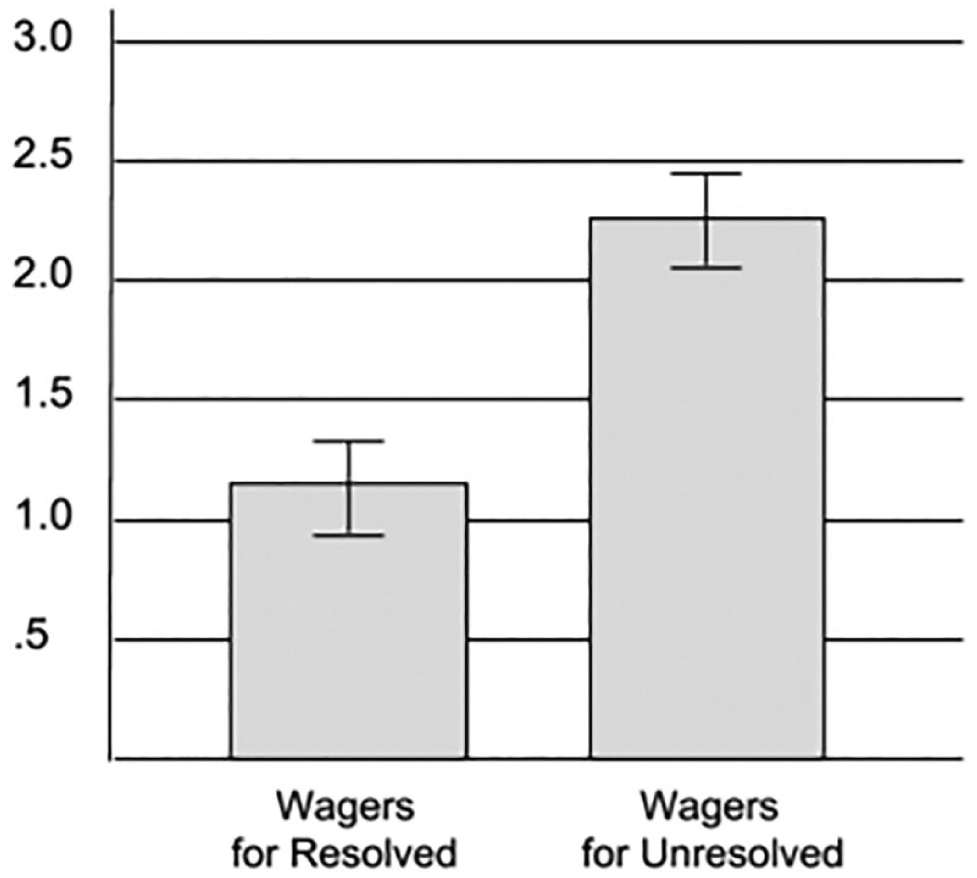
Average wagers were 22% higher after apologies that were not resolved compared with apologies for issues that were resolved (p = .02).
Wagers were influenced by conscious assessments of the person speaking, including trustworthiness (r = 0.673, p = .000), leadership strength (r = 0.619, p = .000), the sincerity of speaker (r = 0.668, p = .000), and the sincerity of company (r = 0.659, p = .000). Changes in mood also influenced wagers. When mood improved, wagers followed (r = 0.35, p = .0001).
Next, we tested whether demographic and personality traits affected wagers. Older participants wagered more than younger ones (r = 0.14, p = .034), but gender and self-reported measures of economic and social conservatism had no effects (ps > .23). We also did not find an association with the prior viewing of the video and sincerity appraisal as measured by wagers (p = .39).
Neurophysiology and Problem Resolution
The standard deviation of the change in SCL (sSCL) predicted problem resolution (M resolved = 0.063, SD = 0.072, M unresolved = 0.081, SD = 0.074, p = .025). The apology produced a lower sSCL in viewers when the problem was resolved (Figure 2). The average percentage change from baseline SCL (pSCL) did not predict resolution (M resolved = 0.431, SD = 0.504, M unresolved = 0.461, SD = 0.503, p = .63).

The standard deviation in skin conductance level (sSCL) was 29% higher after apologies that were not resolved compared with apologies for issues that were fixed (p = .025).
We also tested whether common SCL activity across participants during an apology predicted offense resolution by constructing the Euclidean distance of the ISC (eISC) for participants as described above. This analysis showed that eISC was smaller for apologies for which the transgression was resolved than for apologies that were not resolved (M resolved = 0.366, SD = 0.272, M unresolved = 0.454, SD = 0.282, p = .006). This indicates that greater variation in neural responses to apologies provides unconscious signals of insincerity (Figure 3).

Average changes in Euclidean distance of the intersubject correlation (eISC) were 24% higher after apologies that were not resolved compared with apologies for issues that were resolved (p = .006).
A classifier test was used to determine the accuracy of sSCL in predicting problem resolution. We found that sSCL accurately predicted resolution of the problem significantly better than chance (60.18%, p = .027 McNemar’s chi-square test; Dietterich, 1998; West, 2000) including age and gender as controls. We also performed a classifier test to assess how well eISC predicted that the problem was resolved using the same controls. This analysis showed that eISC predicted problem resolution with 58.7% accuracy (p = .009). Next, we used all three physiologic variables (pSCL, sSCL, eISC) to assess how accurately we could predict problem resolution from neural data, again including gender and age controls. This analysis showed that the model predicted if the problem was resolved with 61.3% accuracy (>50%, p = .001).
Why People Wager After Apologies
An open issue is why people made wagers. We investigated if neurophysiologic data would help explain this. The pSCL response predicted whether people wagered on whether the problem was resolved as well as the amount of the wager. We found that when pSCL was small, participants made wagers, while large values of pSCL inhibited wagers (M pSCL wager = 0.413, SD = 0.516, M pSCL no wager = 0.527, SD = 0.459; two-sample t test with unequal variances, p = .041; Figure 4). The amount of the wager decreased linearly as pSCL rose (r = −0.12, t test p = .053). An ordered logit regression showed that pSCL predicted wagers with or without controls for gender and age (pSCL: β = −0.53, p = .019; female β = 0.56, p = .019; age β = 0.02, p = .039; R2 = .06, variance inflation factor [VIF] = 1.02).

Average percent change in skin conductance level (pSCL) was 22% lower when participants wagered that the problem was resolved compared with when they did not wager.
We estimated a binary logit model to assess the accuracy of the change in pSCL in predicting wagers (β = −0.461, p = .098, R2 = .021, VIF = 1.02). This analysis showed that pSCL is able to correctly classify 66.03% percent of cases (>50%, p < .0001). As above, we also estimated a binary logit model to assess the accuracy of the three neurologic variables in predicting wagers and included age and gender as controls. Estimating a binary logit model for wagers (R2 = .028, VIF = 1.07) revealed that sSCL was significant (p = .004) and the classifier accuracy improved to 75.2% (>50%, p = .0001). The neural signals that influenced the decision to wager were lower physiologic arousal (pSLC), higher sympathetic-parasympathetic switching (sSCL), and less similar autonomic responses across participants (eISC).
Linguistic Signals of Perceived Apology Sincerity
Why are people persuaded to believe and wager that an apology is sincere? Companies may be able to achieve forgiveness by directing consumers’ attention to either brand-relationships or justice depending on the orientations of their audience (Sinha & Lu, 2016). We used the EDA time series to search for common language and mannerisms across apologies that reduced pSCL and thereby signaled that the speaker was genuine in his desire to resolve the problem. Using EDA data to identify effective ways to communicate could be used by practitioners to coach corporate leaders to make more effective apologies. It also reveals why people are fooled by apologies.
We averaged the second-by-second time series of pSCL across participants and identified epochs lasting 5 seconds or longer for which the average pSCL was one standard deviation below the mean for each apology irrespective of whether the problem was resolved or not. Our idea was to find clues that influence the conscious decision (wager) that the problem was resolved. The language and mannerisms used in each epoch were then extracted. We reversed this criterion to examine the autonomic drivers of insincerity appraisals: we isolated 5-second or longer segments of apologies for which average pSCL was one standard deviation above mean pSCL for each insincere apology.
Table 1 shows that parts of apologies that reduced pSCL occurred when the speaker used “you” language and focused on how the offense affected individuals. A decrease in pSCL was also found when the apology-giver emphasized how the company would correct the problem. For example, Patrick Doyle, the Domino’s Pizza President, reduced arousal when he said that the offense was “an isolated incident, and that the two team members [responsible] have been dismissed, and there are felony warrants out for their arrest.” Similarly, Kazuo Hirai of Sony, calmed viewers by apologizing for the “inconvenience the service outage has caused you.” He also stated that “since the attacks on the network, we have been working around the clock to bring game and media services back online.” Table 1 also reports the visual aspects of the speaker: the only visual commonality was speaking directly to the camera. These analyses provide evidence in support of Sinha and Lu (2016). Apologies that focused on the brand relationships and those that emphasized justice reduced physiologic arousal and were therefore more likely to be viewed as sincere.
Moments in Apologies When Participants Experienced a Drop in Arousal.

Table 2 shows the components of apologies that produced substantial increases in pSCL. These occurred when statements focused on harmed groups or failed to signal that the corporation would remedy the situation. For example, Richard Brown, the CEO of Eurostar, induced arousal in viewers during his apology for his trains breaking down when he told the audience that “tomorrow, all the trains will be on limited service so do not try to travel.” Matthis Miller, the CEO of Volkswagen, caused physiologic arousal in participants when he said that “[Volkswagen] is getting partners to help with technical solutions” suggesting that his company is unable to fix the problems they have caused. Whole Foods’ co-CEO John Mackey induced arousal with a rambling opening statement. His lack of polish, along with the disheveled look of Eurostar CEO Richard Brown may have also contributed to arousal surges, in addition to the statements they made.
Moments During Insincere Apologies When Participants Experienced a Peak in Arousal.

Discussion
We examined the physiologic and behavioral responses to corporate apologies to understand why some apologies are viewed as sincere. Participants were unable to identify whether the mistake that prompted the apology was corrected or not. Wagers on whether the issue was resolved were similarly inaccurate indicators of problem resolution. Our analysis of EDA responses, however, showed that they predicted offense resolution with 61% accuracy, exceeding what is expected by chance (p = .001). This confirms our hypothesis that unconscious neurophysiologic responses would discriminate between apologies that were sincere or not and supports previous literature showing that effective leadership produces different neurologic responses than ineffective leadership (Waldman et al., 2013). The physiologic signals we found show that sympathetic-parasympathetic switching (sSCL) and similarity in EDA signals across participants (eISC) were statistically related to whether the problem was resolved.
Parasympathetic tone is associated with positive emotional states (Cosley, McCoy, Saslow, & Epel, 2010). Our measure of sympathetic-parasympathetic switching, sSCL, was correlated with an improvement in mood (p = .03). These results are subtle because a change in positive mood was associated with wagers that were on average incorrect. This suggests that as the unconscious sSCL signal provided insights into problem resolution, the conscious appraisal of improved mood influenced wagers on the wrong outcomes. The way that the sSCL signal is processed in the brain to produce this outcome should be addressed in future research using, for example, fMRI and diffusion tensor imaging. More generally, the present study’s findings that sympathetic-parasympathetic switching signals resolution of corporate offenses supports previous research showing that unconscious responses can reliably identify deception and other antisocial behaviors (Furedy et al., 1994).
The other predictive signal of apology sincerity, EDA synchronization, has been associated with emotional contagion (Ekman et al., 2012). When individual neurophysiologic responses to stimuli are synchronized, neural data predict population outcomes (Hasson et al., 2004; Hasson, Ghazanfar, Galantucci, Garrod, & Keysers, 2012; Nummenmaa et al., 2012). This finding could be valuable to those writing and delivering apologies: a sufficient number of people need to have similar responses if sincerity is to be believed. The eISC signal, similar to the sSCL signal, was associated with improved positive mood (p = .056) again showing the complex behavioral impact of conscious choices and unconscious neural responses.
Opinions of apology-givers also influenced perceptions of problem resolution. These included the perceived sincerity, trust, and leadership of the CEO. We also examined what influenced participants to act on the perceived sincerity of the apology by waging that the problem in the apology was resolved. Wagers occurred when physiologic arousal (pSCL) fell. This supports previous findings that individuals are often unable to consciously articulate the reasons for their actions or feelings while brain states and physiological mechanisms can often predict behavior (Denburg et al., 2006; Falk et al., 2010). Our finding is similar to the reduced physiologic arousal by consumers viewing brands for which they have long-standing relationships (Reimann, Castaño, Zaichkowsky, & Bechara, 2012). Unlike in research on positive mood increasing forgiveness (Worthington, 2006; Worthington et al., 2007), we did not find a relationship between pSCL and changes in mood (p = .89).
Although we analyzed a limited sample of apologies, we looked for common linguistic cues that reduced arousal and influenced sincerity perceptions. These included a focus on individuals and specific ways the problem would be resolved. This finding squares with previous research showing that a caring and composed apology is calming and more likely to result in forgiveness (Cargile & Salazar, 2016). Leaders who show ethical consistency induce perceptions of future ethical leadership (Waldman, Balthazard, & Peterson, 2011; Waldman, Wang, Hannah, & Balthazard, 2017). Calling attention to the larger social harm that occurred, on the other hand, shows a lack of consistency and social legitimacy between the corporation’s espoused values and realized practices and is associated with lower corporation performance (Cording, Harrison, Hoskisson, & Jonsen, 2014; Veil, Sellnow, & Petrun, 2012) and the perceived appropriateness of the apology (Wooten, 2009).
This study has important practical implications for communication professionals. It adds methodologically strong evidence to the body of research demonstrating that unconscious responses are more valuable in gauging a communication’s effectiveness than self-reports. It also reveals how important social contagion is to an effective apology. Apologists must be able to transmit essentially the same message to multiple audiences if they are to be effective. The study also highlights the need to avoid identifying a specific group or social harm resulting from a transgression; this can stir empathic anger that is a formidable obstacle to conveying credibility and sincerity. There is a place for communication professionals to train and rehearse those who must delivery an apology so he or she projects confidence and ardor: those who appear feckless in delivering an apology are unlikely to convince listeners that the problem has been resolved.
The present study has a number of limitations that future research should seek to address. First, the sample size was moderate. As in many neuroscience studies, we compensated for the moderate sample by collecting multiple observations per participant and collected neural data at high frequency. A larger sample and one that is more diverse ethically, geographically, and educationally would provide confidence that our results generalize. This could be done, for example, in a field study by measuring responses to an apology at an investor meeting or press conference. Advanced in neurologic measurement technologies such as wearable neurosensors would permit a replication of our neural findings outside the laboratory. For these reasons, our findings should be considered preliminary.
How should a CEO make an effective apology? The best approach would be to ensure that the problem for which one is apologizing has actually been corrected. This reduces displays of nervousness or uncertainty that viewers of apologies may unconsciously perceive that can drive arousal responses signaling insincerity. In addition, CEOs who appear to be strong, trustworthy, and sincere leaders increase the likelihood that their apologies will be believed. If the situation prompting the apology is too fluid and the apology must be made quickly, a second-best solution is to craft statements that will be perceived as sincere and practice these with feedback until the speaker appears comfortable and calm. Our analysis also shows that testing apologies using EDA signals of reduced arousal could be used to reduce damage when companies are in peril.
Footnotes
Declaration of Conflicting Interests
The author(s) declared no potential conflicts of interest with respect to the research, authorship, and/or publication of this article.
Funding
The author(s) received no financial support for the research, authorship, and/or publication of this article.
