



Abstract
In this study, we investigate a sample of 15 popular crisis management books (PCMBs), written by crisis consultants and published between 1986 and 2018 in the United States or in the United Kingdom. The aim of the study is to examine (1) how the authors of PCMBs position themselves in front of their readers, clients, and competitors, including public relations professionals and academics; (2) how they understand and present organizational crises and the practice of crisis management and crisis communication as their field of expertise; and (3) how they promote this expertise using various types of message strategies and rhetorical packaging. The findings of the study reveal that PCMBs are more diverse than expected and that they cover important aspects of crisis management often neglected by academic publications. The article concludes with some implications for practice, research, and education.
Keywords
Introduction
Most managers, including those who are responsible for conceptualizing, implementing, maintaining, and activating the crisis preparedness of their organization, depend on various types of explicit and implicit management knowledge in order to “get things done.” This knowledge derives from at least four different sources: (1) formal education, (2) personal knowledge and experience accumulated over time, (3) collective knowledge and experience shared with other members of the organization and/or the profession, and, finally, (4) expert knowledge provided by external consultants and consulting firms (Nohria & Eccles, 1998). In this article, we concentrate on a specialized format of this expert knowledge, namely, the crisis management knowledge distributed and promoted in the shape of books written by consultants. We call them popular crisis management books (PCMBs). 1
Crisis management did not originate as an academic discipline in business schools and universities. It began as a simple practice. One of the first and most influential books on crisis management, Steven Fink’s Crisis Management: Planning for the Inevitable (1986), was written by a practitioner who a few years earlier had served on the crisis management team in the administration of Pennsylvania Governor Richard L. Thornburgh during the Three Mile Island nuclear crisis (1979).
Since then, there has been a substantial increase in books with catchy titles such as Damage Control (Dezenhall & Weber, 2011), Masters of Disaster (Lehane, Fabiani, & Guttentag, 2012), Crisis Management: Get Ready! Get Ready! Get Ready (Beaty, 2016), and Corporate Smokejumper (Meyer, 2017; see Appendix A, available online). Despite the popularity of these books, however, we only know very little about them. To our surprise, nobody has so far found it interesting or relevant to study PCMBs to determine their differentia specifica. Who writes these books? Who reads them? What kind of knowledge about organizational crises, crisis management, and crisis communication do they promote and disseminate at one and the same time? How does this knowledge differ from the knowledge based on academic research? And why are they so popular?
This study forms part of a larger research project that has been running since 2007. The overall aim of this larger project is to investigate how crisis consultants define organizational crises, how they understand and practice crisis management and crisis communication, how they present and promote their expertise, how this expertise has developed after the financial crisis in 2008, and how it is put into practice by their clients (see, e.g., Frandsen, Johansen, & Pang, 2013; Johansen, 2017; Pang, Frandsen, Johansen, & Su Lin, 2013).
A study of popular crisis management books is relevant in many respects. First, such a study provides the community of crisis management consultants and consulting firms with a detailed overview of the market for PCMBs. This also applies to their clients, who will get a chance to become more competent buyers of advice. Second, such a study provides an idea of how consultants understand and conceptualize crisis management. This represents an opportunity for crisis management and crisis communication researchers to observe to what extent the authors of PCMBs refer to and make use of academic research. We academics can also learn a thing or two from these books. Consultants who have been deeply engaged in handling organizational crises for a long time may have seen aspects of crises that we have not yet been able to see. Finally, the findings of such a study can serve as valuable input for public relations or corporate communication textbooks. They can teach our students to be more critical and quality conscious in their approach to crisis consulting.
Literature Review
There seems to be consensus on the fact that the interest in management and leadership has increased considerably in Western societies since the 1980s and that, simultaneously, the field of management consulting has transformed into an important knowledge industry (Armbrüster, 2006). One of the manifestations of this development is the emergence of popular business books (Furusten, 1999).
Tom Peters and Robert H. Waterman’s In Search of Excellence: Lessons from America’s Best Run Companies (1982) is perhaps the best example of such a popular business book. It was this book that ignited the business book market at the beginning of the 1980s. It sold more than three million copies in its first 4 years and continued to be a best seller for a long time despite the fact that Peters and Waterman’s exemplary firms turned out to be less “excellent” than expected. Today, popular business books are widespread. They are recommended to us by our colleagues at work and reviewed and ranked by journalists in the newspapers we read at home. We can buy them at seminars with international management gurus or at more mundane places such as airports and railway stations. We may not have read them all, but we remember their titles: Good to Great, The Seven Habits of Highly Effective People, and The One Minute Manager, to name a few.
The popular business books serve many different functions. Some researchers highlight their role as “carriers” of new management knowledge (Kipping & Engwall, 2002). In Search of Excellence (Peters & Waterman, 1982), for example, was instrumental in “carrying” the idea of excellence across many organizations and organizational fields, including the field of public relations and strategic communication, from the Excellence Theory developed by James Grunig and his colleagues between 1985 and 2002 (Grunig, 1992), to the Theory of Communication Excellence developed by people behind the European Communication Monitor (Tench, Vercic, Zerfass, Moreno, & Verhoeven, 2017). Other researchers (e.g., Clark & Greatbatch, 2004) focus on the role of popular business books as “star vehicles” able to launch, not only a new guru or a new consulting firm, but also a new management fashion.
Despite the popularity of these books, there has been only little empirical work on popular business books. However, it seems possible to identify some streams of research focusing on the role and function of management books.
The first stream of research represents a rational and instrumental approach to the field. At the beginning of the 1990s, Jon L. Peirce and John W. Newstrom, the authors of The Manager’s Bookshelf (1988, 2013), were among the first to write about popular business books, or to be more precise, about the concept of best sellers. They established an analytic framework for assessing popular business books (Newstrom & Pierce, 1993), and they also examined if popular business books could be of any use in management development programs (Newstrom & Pierce, 1989). Crainer (1997) developed further the idea of best sellers in The Ultimate Business Library (Crainer, 1997).
The second stream of research is the institutional or symbolic approach. Furusten (1998, 1999) searched for the characteristics of the supply and production of popular management books defined as textualizations of the general management discourse in society. Inspired by the neo-institutional idea that norms and beliefs in the institutionalized environment of organizations have an influence on the identities and activities of these organizations, he concluded that popular business books represent a “globally standardized ideology of management” (Furusten, 1998, p. 160) instigating what we have to understand by “good” management.
The third stream of research is the critical approach. Clark and Greatbatch (2004) argued that best-selling management books are indicative of broader social developments with respect to communication. Inspired by Debord (1967) and Boorstin (1961/1992) and based on interviews with authors, editors, and ghostwriters, they examined the creation of six best sellers as image-spectacle. The management fashion literature (Abrahamson, 1996) and the guru literature (Huczynski, 1993) are relevant to both the second and the third streams of research.
Engwall and Kipping (2002) noticed that the literature on consultants and consulting firms that began emerging in the 1990s took a “very critical tone” focusing on the rhetorical or theatrical tricks used by management consultants to gain and retain clients. A decade later, Nikolova and Devinney (2012) criticized the critical approach for being too simplified: “It stresses the symbolic character of consulting and regards consultants as impression managers seeking to make their clients dependent on the management fads they produce” (p. 390). Thereby, they risk to reduce the complexity of the consulting phenomenon.
The fourth and last stream of research is the discourse-analytic approach. This approach has gained terrain recently. Lischinsky (2008) investigated how knowledge and authority are legitimated in the discursive structure of popular management books (the titles of the books, their metadiscourse, the narratives of personal experience, and the use of examples and presuppositions). In contrast to most of the previous literature, Lischinsky’s study is based on a large corpus of popular business texts.
We would like to conclude this review by mentioning Lewis, Schmisseur, Stephens, and Weir (2006). The purpose of their study was to describe “the trends in advice available in best-selling popular press books on communicating during organizational change implementation” and “the dominant themes in that advice” (p. 129). This study has served as a direct source of inspiration for our study. However, this does not imply that we agree on everything (see section on Research Strategy).
Research Questions
In the previous section, we talked about popular business books in general, but what about popular books on crisis management? Here we are confronted by a major research gap. Although the institutionalization of crisis management as an organizational practice and as an academic discipline began in the mid-1980s—the very same decade in which the interest in managerial manifestations increased dramatically—the genre of popular crisis management books (PCMBs) has not yet been subject to empirical analysis. A plausible explanation could be that this subcategory of popular management books belongs to the “dark side of the street.” It has never been popular to handle, let alone, talk about in business crisis circles (Coombs, 2011). In order to fill this gap, we would like to answer the following three research questions:
This research question focuses on the relationship between crisis consultants, clients, competitors, academics, and public relations professionals.
This research question focuses on the representation of the field. What is (not) included in the PCMBs? It is probably the most important of the three questions because it allows us to evaluate the quality and originality of the representations.
This research question focuses on how they use titles, book covers, metaphores, “war stories,” personal narratives of success and failure, exemplifications, and so on.
Research Strategy
Given the amount of data and their complexity, our initial research strategy was to get a preliminary overview of the content of the 15 books selected for this study. Bligh and Meindl (2004) rightly observed that identifying a suitable sample of PCMBs (in their case: popular leadership books) is more challenging than one would expect. Unlike journal articles, books are not equipped with abstracts and keywords that we can use for bibliometric purposes. Different databases use different classification systems, and it is not easy to get access to information about book sales and bestseller lists.
How can we identify a PCMB? We applied the following four criteria. First, a PCMB (print book or ebook) must be written by a consultant, and not by an academic. Second, a PCMB must be promoted as part of the whole consulting process in which the author serves as an expert. Third, a PCMB must be written in a specific “consulting” style (including, e.g., impression management strategies, war stories, and handy acronyms). Finally, a PCMB must be a generic book on crisis management, that is, it must cover the whole crisis management process.
Given that we did not know very much about PCMBs and that we would probably need to develop new concepts, we decided that the best way to study PCMBs was to conduct an exploratory study. The purpose of an exploratory study is not to test a hypothesis, but to develop ideas, concepts, and theories and to assess if it is appropriate to continue investigating the area.
Data Collection
The corpus of PCMBs examined for this study was primarily collected from the online retailor Amazon.com. All books were written in English and published in the United States or the United Kingdom between 1986 and 2018. As we are mainly interested in books about the total crisis management process, and not in specialized aspects such as media training, we only used one subject term: crisis management. On December 1, 2017, Amazon.com had no less than 4,415 titles on crisis management for sale. All duplicates (including new editions), books written by academics, books on crisis management outside the field of management, organization, and communication studies (e.g., crisis management in acute health care settings), crisis management in specific industries (tourism), all books based only on case studies, books with a historical perspective, books with an ironic use of the title (e.g., Crisis Management or Two Weeks Without a Wife), and all otherwise irrelevant books, were eliminated from the list before the 15 books were selected randomly.
Lewis et al. (2006) also collected data from Amazon.com for their study. However, instead of having a pure random sample, they wanted to focus on best-selling books based on the idea that these books would be the ones with the highest degree of influence in managerial practice. Sales rankings, however, do not necessarily tell us something about the influence of a book, let alone that it has been read by someone. They only tell us something about how many copies are sold.
Text Analytical Model
Lewis et al. (2006) conducted a thematic content analysis consisting of iterative readings to identify the dominant themes of the books. They defined a dominant theme as a “recurring trend in advice” (p. 116). The text analytical model we have applied in our study of PCMBs is inspired by Michael Halliday’s theory of the three metafunctions of language: (1) the interpersonal metafunction is about the interactions between author and reader (target group), (2) the ideational metafunction is about the representation of the natural or social world, (3) the textual metafunction is about the rhetorical strategies. Instead of functions, we prefer to talk about dimensions to emphasize that every act of communication can be examined from all these perspectives. Each of the three research questions corresponds to a cluster of more specific questions, which then again are related to one of the three metafunctions or dimensions in Halliday’s communication model (for details on the analysis, see the model in Appendix B, available online).
Findings and Discussion (1): The (Inter)personal Dimension of PCMBs
In this and the following two sections, we present, interpret, and discuss the most important findings of our exploratory study of the sample of PCMBs.
Who are the authors behind these books? Almost all of them are senior consultants serving as CEOs, presidents, and/or partners of consulting firms located in the United States or the United Kingdom (see the overview in Table 1). Three (co)authors are women; the remaining authors are men. The authors have many years of practical experience. Eight of them also have a bachelor’s degree, whereas seven of them have a MA, MS, or MBA degree.
Overview of Authors of the 15 Popular Crisis Management Books (PCMBs).
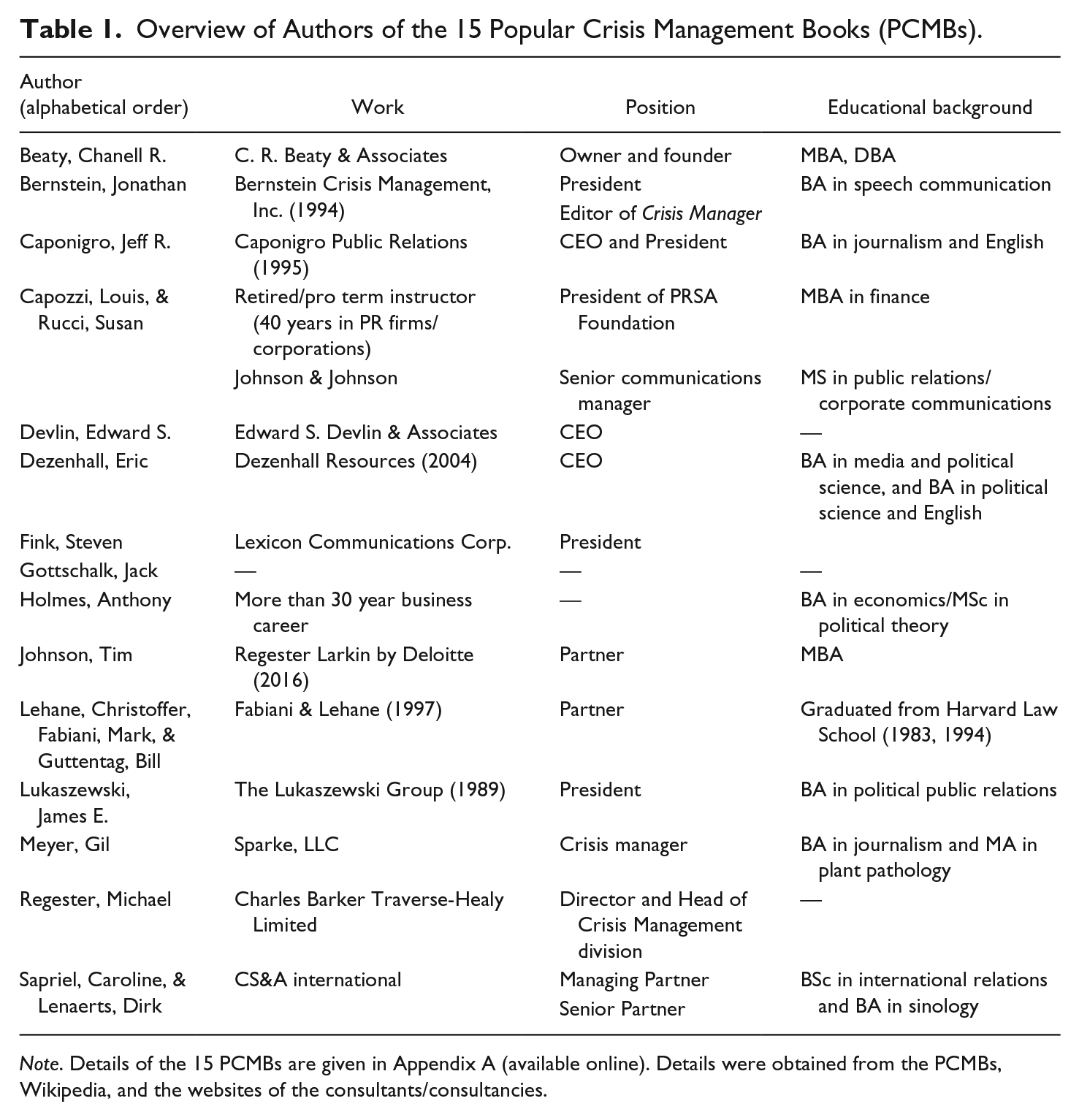
Note. Details of the 15 PCMBs are given in Appendix A (available online). Details were obtained from the PCMBs, Wikipedia, and the websites of the consultants/consultancies.
Many of the authors have a favorable (or unfavorable) personal reputation. Fink has been called “the Dean of Crisis Management” (www.crisismanagement.com), and Dezenhall has been nicknamed “the pitbull of public relations” (O’Dwyer’s) and “the Mafia of the industry” by popular media (Wikipedia/Eric Dezenhall).
Some of the consultants promote themselves as management gurus on their website. James Lukaszewski from the Lukaszewski Group, for example, names himself “America’s Crisis Guru” on his website. Other consultants are promoted as management gurus by fellow consultants or by organizers of seminars or conferences who want to promote the event. Ian I. Mitroff, for example, who is also an internationally renowned crisis management researcher, is often named a crisis management guru. This also applies, at least indirectly, to Lukaszewski. Gottschalk (2002) has devoted a section to Lukaszewski in a chapter on “Key concepts and thinkers” in the field of crisis management.
In general, when promoting themselves as crisis experts, the authors of PCMBs refer to two qualities: (1) their many years of experience and (2) their connection to the “real world.” This is where it seems most obvious to introduce some of the insights produced by the streams of research that we presented in the literature review (for the use of impression management, see Clark, 1995, and guru theory, see Huczynski, 1993).
Regarding the interpersonal metadimension of PCMBs, the authors very often address their readers directly. Sometimes, this turns into a short “dialogue”: “Want to know what tools can make your crisis prevention and response easier? Good, there’s a chapter that answers that question (Chapter 13)” (Bernstein & Bonafede, 2011).
One of the most interesting aspects of the interpersonal metadimension concerns how authors of PCMBs perceive the relationship between the disciplines of crisis management and public relations. Some of the consultants clearly have a public relations approach to crisis management emphasizing the important role of the news media. Gottschalk (2002) is obviously a representative of this approach: “What sets crisis management, in a public relations sense, apart from both crisis action planning and emergency management is its media aspects” (p. 7). Other authors describe this approach as “traditional” and “conventional” and highlight what they define as the differences between the two disciplines: “PR is about building an image. Crisis management is about protecting that image” (Bernstein & Bonafede, 2011, p. 6). “PR and crisis management are not the same. They share some tactics, but rarely strategies, because they don’t share the same goals” (Bernstein & Bonafede, 2011, p. 7). “PR people aren’t inherently crisis managers. Accustomed to constantly promoting the positive, they aren’t always ready to manage the negative. But of all the organizational players, they are the ones most equipped to take on crisis management duties” (Bernstein & Bonafede, 2011, p. 84).
There are also authors who take a more critical perspective. Dezenhall and Weber (2011), for example, are almost aggressive when they describes the public relations approach in the following terms: Conventional public relations is enamored with “reputation management”, “empowerment”, “trust”, “the message”, and other guru-driven happy talk that serves little purpose other than to give people in very tough situations the illusion of control” (p. 3). “The latest rage in public relations is ‘building bridges’ between corporations and their ideological adversaries. [ . . . ] One of the greatest myths of public relations is that you can get hostile audiences to like you” (p. 72). “One objective of this book is to disabuse the reader of the current dogma of surrender that permeates the public relations industry [ . . . ]. Tactical apologies and sensitive, new-age rhetoric should not be shibboleths of a superior morality. Assertive defenses should not be condemned as signs of immorality.” (Dezenhall & Weber, 2011, p. 100)
Another interesting aspect of the interpersonal metadimension concerns how authors of PCMBs perceive the relationship between academics and practitioners. In an introductory interview at the beginning of their book, Sapriel and Lenaerts (2016) comment on this: After 20-plus years in the field we felt we had a lot of stories and experiences to share. Most people buy books and they read a lot of theory and it’s quite stiff in the way that the information is presented. Even though there are lots of books that are very good, we felt that sharing these cases in story form would be much more compelling and valuable to readers. (p. 4)
However, some of the PCMBs, especially the newer ones, refer to numerous academic concepts, models, and theories. This applies to Holmes (2009) and Johnson (2018) who follow a more academic style in their approach.
Findings and Discussion (2): The Ideational Dimension of PCMBs
The ideational metadimension is the richest of the three dimensions in our model. It is through this dimension that we get access to how the authors of PCMBs perceive and understand crisis, crisis management, and crisis communication. It goes without saying that we cannot possibly present, interpret, and discuss all our findings within this dimension.
Defining Crisis
All the 15 PCMBs include crisis definitions. The oldest crisis definition in our sample of PCMBs is provided by Fink (1986), one of the consultants who is frequently cited in academic publications. However, his definition is more practical than theoretical.
From a practical, business-oriented point of view, a crisis (a turning point) is any prodromal situation that runs the risk of: 1. Escalating in intensity. 2. Falling under close media or government scrutiny. 3. Interfering with the normal operations in business. 4. Jeopardizing the positive public image presently enjoyed by a company or its officers. 5. Damaging a company’s bottomline in any sense. (pp. 15-16)
The authors of PCMBs define crisis in many different ways. In some cases, the definitions are rather common place. In other cases, they can be very original. Gottschalk’s (2002) definition clearly belongs to the first category. In fact, he has not established a definition of his own, but adopts the definition made by Larry Smith and the Institute for Crisis Management, which revolves around “extensive news media coverage” (p. 6) and the potential consequences of a crisis. Lukaszewski definition belongs to the second category (Lukaszewski and Noakes-Fry, 2013). He defines crisis as the “sudden, unexpected creation of victims, accompanied by unplanned visibility for an organization” (p. 12). The originality of this definition does not reside in the identification of the suddenness and unexpectedness of crises—two characteristics that we find in many other crisis definitions—but in the focus on and understanding of victims. “Crisis-created internal and external victims are the greatest threat to the organization” (p. 23). However, it is important to know that by victims Lukaszewski (2013) does not mean only innocent actors who are involved in a crisis event against their will. In his representation of crises, victims also behave as strategically oriented actors.
Lehane et al. (2012) present what we may call a sociological definition of crisis: “Crisis is everywhere and impacts everyone [ . . . ] Crisis is a constant state of nature in our Information Age” (p. 5). Holmes (2009) defines crisis as turbulence or unstable complexity: “a state of disorder characterised by confusion resulting from unexpected deviation or agitation. What has been called a period of permanent white water” (p. 3). Johnson (2018), for example, does not agree with Holmes (2009): “It has become so terribly fashionable today to talk about turbulence” (p. X).
Crisis Typologies
Several of the authors introduce one or more crisis typologies using different criteria, such as time, cause, intensity, or nature of crisis. Bernstein and Bonafede (2011) divide crises into three general categories: (1) creeping crises, (2) slow-burn crises, and (3) sudden crises. Dezenhall and Weber (2011) divide crises into two categories: (1) sniper-fire crises and (2) character-driven crises. Johnson (2018) applies a typology established by another consultant, Griffin (2014), who combines external and internal crises, risks, incidents, issues, and reputation management, but stresses the dynamic character of a crisis.
Crisis Management and Crisis Leadership
The oldest crisis management definition in our sample of PCMBs is provided by Fink (1986): “Crisis management—planning for a crisis, a turning point—is the art of removing the risk and uncertainty to allow you to achieve more control over your own destiny” (p. 15).
Several of the authors prefer to talk about crisis leadership instead of crisis management. Inspired by a meeting with Mitroff and Dubrin, Johnson (2018) defines crisis leadership, not as the ability of leaders to “show different leadership competencies but rather to display the same competencies under the extreme pressures that characterize a crisis” (p. 15).
Although the authors apply a prescriptive approach to crisis management when talking about the crisis management plan, some authors apply an emergent approach as well. According to Meyer (2017): “Crisis management is by its very nature, high risk and highly inpredictable” (preface). Therefore: “Crisis management is a journey of constant approvement. There is no end to the journey” (p. 11).
Crisis Plans
The authors introduce their readers to several of the tools and disciplines that may be useful in the pre-crisis, crisis, and post-crisis stages of the total management process (or lifecycle of a crisis). In the pre-crisis stage, for example, we find the crisis plan. Most of the authors seem to agree on the fact that the crisis preparedness of an organization must include one or more crisis plans. Nevertheless, they approach the issue of crisis planning differently. Meyer (2017) is in favor of short plans focusing on vulnerability assessment. Bernstein and Bonafede (2011) warn against template crisis plans and going “plan crazy” (p. 25). Dezenhall and Weber (2011) talk about “our collective plan-worship” claiming that “personality trumps planning” (p. 176). According to them, the world does not run on strategies, but on emotions, and the key factor is not plans.
Crisis Communication
All of the 15 PCMBs include one or more sections or chapters on how to communicate during crisis. Some authors dismiss this issue with a few pages (Gottschalk, 2002). Others devote one or more of their chapters on “principles of crisis management” (Holmes, 2009) or “commandments of damage control” to this topic (Lehane et al., 2012). Contrary to the academic literature on crisis communication where the study of the various types of crisis response strategies and their effectiveness often is the main concern (cf. Benoit’s Image Repair Theory [Benoit, 2015] and Coombs’ Situational Crisis Communication Theory [Coombs, 2019]), PCMBs seldom address this issue. They regard it as “some form of public relations activity” (Holmes, 2009, p. 171) and from time to time, they even criticize this approach: “One of the great mirages of crisis management is the notion that an apology will lead to a catharsis.” “Public relations people tend to embrace a singular dogma: Events are communications problems that can be addressed with a prescription of ‘positive messaging’” (Dezenhall & Weber, 2011).
Findings and Discussion (3): The Textual Dimension of PCMBs
How are the PCMBs organized as texts? How do the authors of PCMBs “pack” their expertise in handy rhetorical formats? Does their structure follow the stages in the strategic process-oriented approach to crisis management? Do they use the same narratives and “war stories”? In short, what are the characteristics of the rhetorical packaging of these books, which forms part of the specific “consulting” style of PCMBs?
Some of the books are rather short (Gottschalk, 2002, the shortest of them all, has only 96 pages), while others are long (Holmes, 2009, contains 300 pages). To be short and fast is viewed as an advantage: Gottschalk (2002) is described as a “fast track route to understanding crisis management,” and Bernstein and Bonafede (2011) is described as a “Briefcasebook” specifically written “for today’s busy manager.”
The PCMBs are not structured in one and the same way. Most of the books, however, follow the lifecycle model made popular by the strategic, proactive, and process-oriented perspective on crisis management (Fink, 1986; see also Frandsen & Johansen, 2017). This is clearly the case in Meyer (2017), which has a tight structure, and where the chapters clearly follow the stages in a lifecycle. The book begins with chapters on “How Do I Know If a Problem Is Really a Crisis?”, “The Fire Alarm,” “Anatomy of a Crisis,” and “Context of the Crisis” (core values of the organization, crisis management principles, public expectancies). Then follow “Crisis Planning,” “Crisis Preparedness,” “When a Crisis Strikes,” “Structuring for Efficiency and Effectiveness,” “Getting the Word Out,” “Making Tough Decisions,” and “Managing a Crisis in the Media.” The book ends with chapters on the “Aftermath” and “Learning.” However, there are PCMBs with a more loose structure, often presented in a very normative way: The 7 Rules of Crisis Management (Holmes, 2009), The Essential Lessons (Dezenhall & Weber, 2011), or The Ten Commandments (Lehane et al., 2012), or as a narrative: Tales from the Frontline (Sapriel & Lennarts, 2016).
While some PCMBs refer to cases experienced by the authors themselves, many PCMBs refer to, present, and discuss a rather fixed repertoire of cases that rarely changes. Among the most popular cases, we find Tylenol (Johnson & Johnson), Audi 5000, and Coca-Cola 1999. However, not all the authors are happy about this. In a chapter titled “The Tylenol Case Isn’t the Model for Every Crisis,” Dezenhall and Weber (2011) criticize the Tylenol case for having transformed into “unchallenged dogma.” According to Dezenhall and Weber (2011), academics love this case study because it is teachable and validates the ethic of social responsibility: that “acting responsibly” is always rewarded by the marketplace. Public relations people love this case study because it suggests that there is a proprietary technique—one they happen to know—for resolving crises. (p. 14)
The authors use many different metaphors in their attempt to present and promote the field of crisis management and their expertise in front of the reader (clients and competitors). Many of these metaphors are “dead” and have lost their original imagery, but in some cases they are revitalized by the authors. Some authors are using the metaphor of war, and talk about presenting “war stories.” One of the most popular metaphors in PCMBs is fire: a crisis is like a fire that has to be extinguished. Meyer (2017) refers to the crisis manager as a “corporate smokejumper” (cf. the title of the book), that constitutes a special type of firefighter because “they parachute into remote areas” to combat wildfires, which is an “exceedingly dangerous work” with extreme personal risk (p. 12). Bernstein and Bonafede (2011) refers to the “brave firefigthers” who “earn headlines for their efforts at fighting fires,” but he immediately expands the metaphor to include fire inspectors.
The second commandment in Lehane et al. (2012) may illustrate how metaphorical the PCMBs can be. The commandment is about identifying the core audience. “To respect this commandment (1) Identify the bull’s eye; (2) Provide five star concierge service; and (3) Understand that communications begin at the top” (p. 86). Only the last of these three steps is immediately understandable.
These examples represent but a few of the multiple message strategies applied by the authors of PCMBs in their attempt to make the text fast and easy to read and to avoid a more strict academic style.
Concluding Remarks
In this study of popular crisis management books, the first of its kind, we have investigated how the authors of PCMBs position themselves in front of their key audiences (senior consultants with many years of experiences and contributions from the “real world”). We have also examined how they understand crises and present the practice of crisis management and crisis communication as their field of expertise (they mostly perceive crises as wars to fight applying a lifecycle approach, to name but a few), and how they promote this expertise using various types of message strategies. The PCMBs selected for the study were more different from one another than expected. Nevertheless, we have been able to identify important aspects that add new insights to scholarly crisis management knowledge.
First of all, popular crisis management books cover the same components of crisis management as academics (prevention, preparation, response, learning, etc.), but in contrast to academic books, PCMBs are typically taking a prescriptive approach to crisis, focusing on advice, methods, and tools about how to prepare, plan, and learn from crises. Hence, PCMBs are very classic in their approach to crisis management, in an attempt to live up to crisis management services and advice-giving as expected by their “clients.” However, they also add components and have critical reflections on topics that academics rarely cover. Bernstein and Bonafede (2011), for example, includes crisis management and the law, crisis management and publicly owned companies, and there is even a chapter on crisis management consultants. In the aftermath stage, Meyer (2017) includes when and when not to reward employees for their handling of a crisis. Many authors also have invented new concepts and models, such as Bernstein and Bonafede’s (2011) I-reporter and C-factor.
Second, the PCMBs are mostly not research-based. This finding confirms a study of crisis management consulting in Denmark in 2012 based on interviews with 12 crisis communication consulting firms (Frandsen & Johansen, 2017; Johansen, 2017). The PCMBs do not directly lean on theories, models, and concepts from academic research. On the contrary, it is mostly emphasized that they are experience based and that the authors have many years of experience within this field. They all present case studies. Some of the cases they have experienced themselves when they have acted as professionals in specific companies or have been called on as consultants giving advice during crisis situations. One explanation of this can be that they, by nature, have to sell their own “Tools, Tales and Techniques” (Meyer, 2017).
Third, the PCMBs provide us with valuable knowledge about client–consultant interactions expanding the study of Nikolova and Devinney (2012), including the close and often personal relationship between CEOs, CCOs, and consultants during a crisis (see also Johansen, 2017).
Finally, compared with academics who only seldom have direct access to the internal dimension of an organization in crisis, the authors of PCMBs have a privileged access to various aspects of the internal crisis management due to the simple fact that they are invited inside the organization in crisis in order to perform their consulting work. In short, the two professions can learn a lot from one another.
Implications for Practice, Research, and Education in Public Relations
Why is it important to study popular crisis management books? First of all, because managers in private and public organizations often are dependent on external expert knowledge offered by crisis consultants, for example, when they have decided to implement a crisis preparedness in their organizations or when they have to handle a crisis. This expert knowledge is textualized in different ways: from the face-to-face interaction between clients and consultants to websites, and from lectures and seminars to PCMBs. Our study provides not only the clients but also the consultants themselves, with fundamental insights into PCMBs.
However, the crisis consultants and their clients are not the only ones who can benefit from a robust study of PCMBs. Public relations scholars can also gain new insights from our study, as described above. It is essential to recognize how important the work of crisis consultants is to companies in need of external advice during crisis, and educators can enlarge their understanding of the disciplines of crisis communication and crisis management by including perspectives from the world of crisis consulting. Finally, also public relations students can benefit from a study of PCMBs. The various textbooks used by these students often include a chapter on how to work for consultancies. Our study can contribute to a more critical and quality conscious approach to crisis consulting in general, and to popular crisis management books, in particular.
Supplemental Material
Appendix – Supplemental material for Advice on Communicating During Crisis: A Study of Popular Crisis Management Books
Supplemental material, Appendix for Advice on Communicating During Crisis: A Study of Popular Crisis Management Books by Finn Frandsen and Winni Johansen in International Journal of Business Communication
Footnotes
Declaration of Conflicting Interests
The author(s) declared no potential conflicts of interest with respect to the research, authorship, and/or publication of this article.
Funding
The author(s) received no financial support for the research, authorship, and/or publication of this article.
Supplemental Material
Supplemental material for this article is available online.
Notes
Author Biographies
References
Supplementary Material
Please find the following supplemental material available below.
For Open Access articles published under a Creative Commons License, all supplemental material carries the same license as the article it is associated with.
For non-Open Access articles published, all supplemental material carries a non-exclusive license, and permission requests for re-use of supplemental material or any part of supplemental material shall be sent directly to the copyright owner as specified in the copyright notice associated with the article.
