



Abstract
The study attempts to understand corporations’ efforts to communicate their values and commitment to stakeholders after a crisis. Specifically, the study explores the characteristics of communication efforts that may differ depending on the reputational crisis types: corporate ability (CA) and corporate social responsibility (CSR) crises. Employing a series of semantic network analyses, the study examined the sustainability annual reports of two Korean airlines (i.e., Korean Air and Asiana Airlines) published before and after their recent crises. Results showed how sustainability reports’ central keywords, social issues the companies support, and prioritized stakeholders varied in response to the different types of crises. Word frequency results showed that there was an increasing trend in emphasizing the word “safety” after both types of crisis, while a noticeable decrease in emphasis on the word “ethics” was observed after CA crisis. The results of semantic network analyses showed that Korean Air’s sustainability reports seemed to focus more on aspects of the relationship with stakeholders after the CSR crisis, while Asiana Airlines appeared to place more emphasis on business-related notions after the CA crisis. Theoretical and practical implications are discussed.
Crisis is a threat for organizational performance and sustainability. Yet it also offers an opportunity to reshape and reform its governance (Jaques, 2007; Seeger & Ulmer, 2001). Scholars have emphasized the importance of post-crisis management and communication to rebuild the tarnished reputations of corporations and increase the trust of stakeholders (e.g., Coombs, 2007; Y. Kim, 2016). Despite the importance of this issue, the vast majority of crisis communication research has focused on examining the effects and the effectiveness of the immediate crisis response strategies (e.g., J. Kim et al., 2009; Liu et al., 2011).
To better understand corporations’ efforts to communicate their values and commitment to stakeholders in the long-term perspective, this study proposed to conduct semantic network analysis to examine the sustainability annual reports of companies that experienced a reputational crisis. Mainly concerned about a consequence of an incident that can damage a specific aspect of reputation, Sohn and Lariscy (2014) suggested two types of crises: corporate ability (CA) crises and corporate social responsibility (CSR) crises. A CA crisis refers to a “critical event that adversely affects reputation associated with expertise of product and service,” whereas a CSR crisis refers to an “event that poses a threat to reputation associated with norms and values cherished by society, and socially expected obligations” (Sohn & Lariscy, 2014, p. 25). For example, a product-harm crisis involving explosion of laptop computer batteries is considered a CA crisis and an ethical-harm crisis involving the leader’s misbehavior that violates ethical standards is considered a CSR crisis. Past research surveying European communication professionals indicated that a product-harm (i.e., CA) crisis and management or leadership (i.e., CSR) crises were the types of crises they encountered most frequently, following institutional crises (Verhoeven et al., 2014). However, there are only a few studies focused on comparing these subtypes of crises.
The purpose of this study is to examine characteristics of communication efforts that may differ depending on the reputational crisis type: CA crisis or CSR crisis. As an example of CA crises, the study selects the Asiana Airline crash at the San Francisco International Airport. For CSR crises, the study selects Korean Air’s “Nut Rage Return,” where the vice president of Korean Air violated airline safety laws and mistreated a cabin crew member.
Given that crisis type and attributions of crisis may inform corporate governance and communication efforts including CSR commitment (e.g., Coombs, 2007; H. S. Kim & Lee, 2015; S. Kim & Choi, 2018), the study analyzes the pre- and post-crisis sustainability reports of two corporations. A company uses the report to communicate what it has achieved with regard to environmental, social, and economic issues, and what it intends to achieve in the future (Willis, 2003). By adopting semantic network analysis, which allows understanding of semantic relations among words based on their co-occurrence (S. Lee et al., 2009), this study also documented evidence about how an organization’s sustainability communication efforts changed over time.
Literature Review
Organizational Crisis and Crisis Type
A crisis is an unexpected event that results in high uncertainty and threatens an organization’s goals and performance as represented by the amount of financial, physical, environmental, or emotional harm (Coombs, 2007, 2015). A crisis is also a threat or challenge to an organization’s legitimacy (Jaques, 2007). In exploring a reputational crisis, Sohn and Lariscy (2014) defined it as “a major event that has the potential to threaten collective perceptions and estimations held by all relevant stakeholders of an organization and its relevant attributes” (p. 24) and suggested two types of reputational crises (i.e., CA and CSR). Building on Brown and Dacin’s (1997) two dimensional systems of corporate association, Sohn and Lariscy (2014) argue that corporate moral aspects conflicted with social norms and values cause a distinct crisis from CA associated with negative evaluations from corporations’ products or services.
Specifically, a CSR crisis is caused by a corporate morality defection, which violates socially shared norms and expected obligations including environmentally friendly business practices and human rights protections (Sohn & Lariscy, 2014). The present study considers CSR crises more broadly, which embrace ethical-harm crises, such as workplace violence, an organization’s inappropriate practices deception, law/regulation violation, and organizational misdeeds (e.g., Coombs, 2007). According to an article by Forbes, of the 10 biggest business scandals, five crises were attributed to unethical business operations or the unethical behavior of CEOs (Shen, 2017). In contrast, corporations experience ability-related crises (i.e., CA crisis) when expertise about their products and services is associated with negative evaluations or accidents (Sohn & Lariscy, 2014). Dawar and Pillutla (2000) defined product-harm crises as well-publicized crises involving products that are defective or dangerous to consumers. The specific causes of the CA crises include a technical error (i.e., mega damage, technical breakdown accidents, and recalls), and human errors (i.e., human breakdown accidents and recalls: Coombs, 2007). Sohn and Lariscy (2014) pointed out that stakeholders use the crisis dimensions as a cue to understand the situation and process information accordingly. Because different attributes of crises influence the way stakeholders interpret the events, it may damage a particular aspect of corporate reputation, corporate morality and ability.
In dealing with crisis situations, effective communications are crucial to restore organizational reputation and to rebuild trust with stakeholders (Coombs, 2007; J. Kim et al., 2009; Y. Kim, 2016). To optimize the effects of crisis communication, crisis strategies should be specified according to crisis type. Although the specific guidelines are still controversial, findings of previous research imply that corporations expect different levels of communication effectiveness, depending on which crisis strategies they choose for the crisis typology. For example, P. H. Kim et al. (2004) showed that a denial might be the best solution in an integrity violation matter, while an apology is the most effective strategy for repairing trust from issues of competence. On the other hand, Coombs and Holladay (2002) suggested that the more responsibility stakeholders attribute to the organization, the more the crisis strategy must seem to accept responsibility for the situation.
Sustainability Reporting
An organizational crisis may influence its strategic goals and business objectives, and the value it provides for the stakeholders. Etzion and Ferraro (2010) note that sustainability reports reflect a corporation’s values and commitment. Therefore, this study uses sustainability reports to gauge how the organization’s communication efforts after a crisis event. Unlike other communication channels that provide an immediate corporate response after a crisis occurs, such as a press release or social media posts, sustainability reports are published on an annual basis in a consistent manner. Corporations also publish their reports with fully controlled messages and manners (S. Y. Lee, 2016). Thus, the sustainability reports reflect the organization’s deliberative communication strategy without external interference.
Organizations disclose their CSR efforts and social commitments voluntarily through diverse media channels, including annual CSR or sustainability reports (Hahn & Kühnen, 2013; S. Y. Lee, 2016). Sustainability reports have been used as a channel between a corporation and its stakeholders to communicate its CSR activities, such as preventing human rights violations and environmental pollution and supporting fair international trade and production (Kolk, 2003). Sustainability reports also include the code of ethics for the organization (Ulmer, 2001), which builds social legitimacy for its actions. Sustainability reports tend to be written following a template with instrumental logic and institutional topics that industries share (Kolk, 2003; Willis, 2003), while deviations from the sustainability reports template might be shown when a corporation intends to present innovative values or strengthen existing values (Kolk, 2003). In doing so, sustainability reporting may reflect a corporation’s values and communication intentions.
This study assumes corporations not only differently describe the two crises but also have variations in mentioning CA and CSR crises on sustainability reports because of the degrees of expected damages. In these regard, the following research questions are proposed:
Corporate Engagement as Crisis Management Strategy
As a crisis management strategy, this study highlighted on corporate sustainability or CSR efforts described in sustainability reports. Beyond responding reactively to the crisis, growing attention has also been given to a longer-term process of organizational renewal (Jaques, 2007). Given that crisis provides opportunities to reshape organizational structure, the forward-looking commitment is critical in the aftermath of a crisis. For example, if a company went through a CA crisis, post-crisis management and communication should be centered on how the organization will make its products safer in the future to regain legitimacy.
A corporation’s sustainability or CSR efforts, defined as the way corporations participate in nonfinancial activities to meet social needs (Davis, 1973), are motivated by a desire to get approval from the stakeholders for organizational legitimacy. Stakeholders refer to individuals who are considered important in evaluating organizations, such as suppliers, stockholders, customers, and employees (Ulmer, 2001). They are related closely to corporate behaviors with regard to setting norms, experiencing effects, and evaluating performance.
Previous research has noted that active engagement in, and communication of, CSR can be used as an instrumental method to facilitate effective crisis communications, which includes building a concrete reputation prior to a crisis (H. S. Kim & Lee, 2015; J. Kim et al., 2009), and countering negative publicity after a crisis (Vanhamme & Grobben, 2009). S. Kim and Choi (2018) suggested that when a company launches a CSR initiative congruent with a crisis, consumers demonstrate a favorable attitude about its activity. Past research also indicated that response to public pressure, the need to legitimize business activities, reputation protection, crisis management, and need to increase transparency are all motives companies employ to implement CSR (Luhmann & Theuvsen, 2016).
In addition, an organization’s crisis may influence not only its communication strategies but also its CSR program visions, such as an issue domain, stakeholders targeted, and beneficiaries. Scholars have emphasized the importance of selecting an issue domain and the target stakeholders when performing CSR practices (Du et al., 2010), especially when a company engages in CSR after a crisis (Rim & Ferguson, 2017). Even if the social issues a company supports with CSR tend to focus on idealistic values (Du et al., 2010), they imply that which the company wishes to be acknowledged for and referred to by its stakeholders when evaluating its business (J. Lee & Rim, 2018). Thus, corporations may select social issues that reflect their core values strategically for their CSR practices. Those discussions lead this study to the following research question:
Communication Network Represented in Sustainability Report
To examine each organization’s sustainability reports corresponding to their crisis, the current study focuses on the communication semantic relations by exploring the semantic networks of sustainability reports with the eigenvector centrality approach. Going beyond merely counting the frequency of words or concepts, semantic network analysis reveals paired relations based on shared meaning (Doerfel, 1998), which enables researchers to examine how words are used and interpreted to form a web of meaning (Carley, 1993; Shumate et al., 2013). Furthermore, eigenvector centrality shows the extent a specific node (i.e., word) is central in a network based on its connectivity with other well-connected nodes in a network (Aktamov & Zhao, 2014). Eigenvector centrality is chosen among other centrality measures because the most dominant themes appeared in text should show higher levels of connectivity among others in the network. Given the advantages of the semantic network analysis, the study analyzes pre- and post-crisis communication networks represented in the organization’s sustainability reports. Scholars have argued that a company that publishes sustainability reports regularly has a greater tendency to scrutinize stakeholders’ expectations and may try to adopt relational methods to improve its social legitimacy (Etzion & Ferraro, 2010; Hahn & Kühnen, 2013). Therefore, as discussed earlier, corporations may specify and prioritize stakeholders in their post-crisis communication efforts, which could be reflected in sustainability reports in their communication networks.
Sustainability reporting is communication targeted to specific stakeholders who have direct connections with a corporation, rather than mass audiences. Those who read sustainability reports are likely to be the active public and stakeholders who are highly engaged with the organization compared to the general public (i.e., mass media audiences) and are willing to participate in communication (J. N. Kim et al., 2010). These active stakeholders are more likely to be interested in corporate governance and their sustainability efforts, especially in the aftermath of a crisis (Y. Kim, 2016). For these reasons, a corporation can stand actively for its stakeholders’ values and relationships through its sustainability reports (Schaltegger & Figge, 2000). In addition, different types of crises may influence the way in which they prioritize stakeholders who may be more or less important in receiving post-crisis responses. Therefore, this study proposes the research question as follows:
Method
Data Collection Scope
This study conducted a multiple case study, which examines a collection of cases having common characteristics (Stake, 2013). Two crisis cases involving Korean Airline companies in the same crisis cluster (i.e., preventable) but representing different types of crisis (i.e., CSR and CA crisis) were selected. The two cases shared many commonalities: the time of crises, industry sectors, headquarter locations, and crisis locations (i.e., occurred in the United States).
Korean Air’s “Nut Rage Return,” which occurred on December 5, 2014, was selected as an exemplar ethical crisis. The vice president of Korean Air violated airline safety laws and insulted a member of the cabin crew because she was unsatisfied with the way Macadamia nuts in first class were served (Myung & Choi, 2017). That employee was asked to kneel down and beg for forgiveness, and the vice president ordered the aircraft to taxi back to the airport’s gate to remove the chief cabin crew at the JFK international airport. In turn, Korean Air received harsh criticism. This crisis demonstrated the way a leader’s unethical behavior influenced a corporation’s relationship with its stakeholders (Fearn-Banks, 2016). Such crisis was different from Asiana Airlines’ crash at the San Francisco International Airport on July 6, 2013, which was caused by pilots’ error. While landing, Asiana Airlines Flight 214 hit the airport’s seawall, spun out and slid down the runway. Then a fire erupted. Among the 307 passengers and crew members on board, the crash killed three girls and more than 180 were injured (Hamilton, 2017).
Both these crises received considerable media coverage and public attention, and each corporation invested a tremendous amount of effort in communicating with both the United States and Korean publics. In addition, scholars consider airline crises a good subject for crisis study (Helm & Tolsdorf, 2013; B. K. Lee, 2005). Haruta and Hallahan (2003) argued that airline crashes generate wide media coverage because the accidents provide highly visible and dramatic images and stories related to death. They also asserted that “a crash or on-the-ground mishap” are important issues for public relations practitioners in the airline industry because those events are related to diverse stakeholders who are waiting for corporate responses (Haruta & Hallahan, 2003).
The scope of the data analysis was set to before and after each crisis’ occurrence. The date on which each crisis occurred served as an anchor point. The selected reports were published before the crisis (t1), immediately after the crisis (t2), and 2 years after the crisis (t3). Since the exact publication dates of each report were unavailable, this study used third-party assurance dates (i.e., the dates when the third-party experts verify the information) for data selection. Considering the assessment is completed when a publication is ready, the assurance date may be used as a proxy of the report’s publication date.
Thus, we selected sustainability annual reports from two Korean airlines that were published before and after their recent crises. Korean Air has published a sustainability report annually since 2006. The reports published in August 2014, 2015, and 2016 were selected for data analysis. The contents of these reports are business philosophy and ethics, governance, crisis management, growth and employment, and environmental and social responsibility. Asiana Airlines has also published sustainability reports annually since 2010, and the reports published in April 2013, July 2014, and September 2015 were selected for data analysis. The contents include sustainability management, financial and risk management, customer service and marketing, and environmental and social responsibility.
Data Preparation
First, sustainability reports were downloaded in .pdf format from each corporation’s website. Words in the reports were preprocessed using R with the “tm” package, which Meyer et al. (2008) developed. The tm package is a popular text mining package that provides corpus handling, data preprocessing, term-document matrix creation, and so on. (Meyer et al., 2008). All words were converted to lowercase and stemmed, and stopwords (i.e., “a” or “the”) and numbers were removed. In preprocessing the data, some transition words (e.g., also) were removed from the frequency analysis. For the final data set, the researchers manually reviewed the postprocessed data and transformed similar words that had the same meanings into the form of a noun. For example, the words “ethical,” “ethic,” and “ethics” are combined to “ethics.” The tm package was used to extract the frequencies of each word and create co-occurrence matrices based on the top 100 words used most frequently in each of the reports. For each set of the top 100 prominent words, term-document matrices with K (the number of words included in the top 100 ranking) * 1 were transformed to K * K co-occurrence adjacency matrices.
Term Frequency and Augmented Normalized Term Frequency (ANTF)
Term frequency (i.e., word frequency) is a simple and intuitive text-mining technique method that counts how many times a word/term repeatedly occurs in a document (Lv & Zhai, 2011). Term-frequency analysis detects to what extent a particular word appears, and in turn, dominates a document (Hou, 2006), which indicates the degree of emphasis of the work in a document. This analysis is often adopted for document component analysis in the business communication context (Benhardus & Kalita, 2013; Ghiassi et al., 2013; Hou, 2006; Liew et al., 2014). For example, Liew et al. (2014) adopted the term-frequency analysis on the sustainability reports to investigate the sustainability trends in the process industry. Other studies conducted the term-frequency analysis with Twitter data, to explore which words were pervasive in brand-related discussions in tweets (Benhardus & Kalita, 2013; Ghiassi et al., 2013).
In the term-frequency analysis, a term (i.e., word) is defined as a lexical item included in a document (Premalatha & Natarajan, 2010). Since term frequency can highly depend on document length (Lertnattee & Theeramunkong, 2004), scholars often perform frequency normalization. Augmented normalized term frequency (ANTF) is one of the popular term frequency normalization techniques (Gadge et al., 2013). Croft (1983) proposed this approach and defined it as 0.5 + 0.5 * tf/max tf, where tf is the term’s occurrence frequency (i.e., word frequency) and tfmax is the maximum term frequency in a document (Lertnattee & Theeramunkong, 2004). This formula assigns a weight of 0.5 for appearance in the document, and extra weight to words that appear more frequently (Gadge et al., 2013). Croft (1983) suggested that the weight must be set at a low level (0.3) for large documents and a high level (0.5) for shorter documents. Each term frequency is divided by the term’s maximum frequency in the text (Croft, 1983), so that each term frequency is guaranteed to lie between 0.5 and 1.0 (Crouch, 1988), which indicates a word’s relative emphasis in a document. By restricting the maximum word frequency to 1.0, this technique compensates for the problem of word frequency dependence on document length (Gadge et al., 2013).
Semantic Network Analysis
A series of semantic network analyses was conducted to explore the different communication patterns in each crisis. A semantic network refers to the way words are semantically related to each other. Thus, semantic network analysis determines the structural differences among texts with regard to word frequency and clusters (Doerfel & Barnett, 1999; S. Lee et al., 2009). Semantic network analysis reveals texts’ semantic organization by examining the relations among words based on their co-occurrence, frequency, and distance (S. Lee et al., 2009). Thus, the map of the relations among words contained in a text can be visualized (Carley, 1993). Semantic network analysis can complement the term-frequency analysis listed above by revealing text structures and meanings (Carley, 1993; Yang & Veil, 2017). For these reasons, semantic network analysis used in this study can shed light on discovering what the dominant words were and how the words are structured and related to each other in creating meanings and identifying subtle patterns in the text (Yang & Veil, 2017).
Particularly in public relations and crisis communication research, semantic network analysis helps demonstrate “. . . mutually associated issues, stakeholders, attributions such as causes, consequences, and solutions” (Schultz et al., 2012, p. 97). Schultz et al. (2012) also used semantic network analysis to study framing strategies for the BP oil spill crisis. The semantic analyses were conducted using UCINET.
To answer RQ2, eigenvector centrality was examined for each word. Eigenvector centrality is a relative measure indicating to what extent a node is central in a network based on its connectivity with other nodes it has connection with (Aktamov & Zhao, 2014; Borgatti et al., 2002). A higher eigenvector centrality score means a node is connected to other well-connected nodes (Mazzola et al., 2016). Therefore, eigenvector centrality indicates the importance, popularity, or prominence of an individual node in a network (Dang et al., 2019). In this study, the eigenvector centrality scores are normalized, divided by the maximum centrality score observed.
Results
Descriptive Statistics
A total of 103,208 words extracted from the six reports was analyzed. For Korean Air (CSA crisis), 14,537 words were drawn from the 2014 report, 21,250 from the 2015 report, and 18,055 from the 2016 report, respectively. For Asiana Airlines (CA crisis), 16,346 words were derived from the 2013 report, 16,954 words were selected from the 2014 report, and 16,066 words were from the 2015 report.
Before applying the term-frequency analysis and semantic network analysis, two preliminary analyses (i.e., document similarity analysis and quadratic assignment procedure [QAP] correlation) were conducted to see whether the sustainability report sets for each airline were meaningfully different from each other to capture the differences between pre-and post-crisis. Similarities among the sustainability reports were assessed by computing cosine similarities between each pair of documents. Cosine similarity is a measure of similarity used to gauge the overlap between documents, which ranges from 0 (no match) to 1 (the greatest match), based on the frequency of word occurrence (Han et al., 2011; Jang et al., 2019). The text mining R package, “stylo,” developed by Eder et al. (2019) was used. The similarity analysis results showed that Korean Air’s sustainability reports were the most similar between post-crisis years (cosine similarity between 2015 and 2016 = 0.89), followed by pre- and post-crisis years (cosine similarity between 2014 and 2015 = 0.88), and pre-crisis and crisis after 2 years (cosine similarity between 2014 and 2016 = 0.85). As for Asiana Airline, the results were different. Asiana Airline’s sustainability reports were the most similar between pre- and post-crisis years (cosine similarity between 2013 and 2014 = 0.91), followed by post-crisis years (cosine similarity between 2014 and 2015 = 0.83), and pre-crisis and crisis after 2 years (cosine similarity between 2013 and 2015 = 0.81). The document similarity analysis results indicated that there were small differences among pre-and post-crisis times for each airline, yet at least, those reports were not identical.
In addition, QAP correlation analysis was conducted to explore the similarities among the semantic networks for each airline (i.e., pre-and post-crisis networks for each airline). QAP correlation analysis is an algorithm-based nonparametric technique that performs the Pearson’s correlation between corresponding cells in two networks (Jiang et al., 2016). Regarding Korean Air, no significant network correlation between the pre- and post-crisis years was observed. However, weak network correlations were observed between pre-crisis and crisis after 2 years (r = 0.18, p < .05), and post-crisis years (r = 0.33, p < .01). For Asiana Airline, there was a moderate semantic networks correlation between pre-and post-years (r = 0.57, p < .001), but weak correlations between pre-crisis and crisis after 2 years (r = 0.21, p < .05) and post-crisis years (r = 0.19, p < .05) were found. The QAP correlation results indicated that, for each airline, the semantic networks among the pre- and post-crisis times did not repeat and showed meaningful differences.
After conducting the preliminary analyses, the top 100 words based on word frequency were selected as the final data set and compared across reports as the analysis sample. For further comparison, each word frequency was normalized with the ANTF approach.
RQ1 asked how a crisis type differently emphasized the crisis-related terms in sustainability reports. Among the top 100 words lists mentioned above, we selected “ethics” as the ethical-harm related word and “safety” as the product-harm related word. The word “safety” is selected as this is the main attribution of Asiana Airlines’ CA crisis. These results showed that the CSR crisis (i.e., Korean Air’s Nut Rage crisis) was not associated with the emphasis of the notion of “ethics” in the reports, but the CA crisis (i.e., Asiana Airlines’ crash crisis) was. There was no noticeable difference for “ethics” observed in Korean Air’s reports before or after the CSR crisis. The word “ethics” appeared 31 times before and 42 and 34 times after the crisis. The difference in the ANTF for “ethics” in Korean Air’s reports was trivial (0.55 before and 0.54 and 0.55 after the crisis).
However, Asiana Airlines’ reports showed noteworthy changes in their use of the word “ethics” with reference to the CA crisis. “Ethics” appeared 49 times before and 23 and 27 times after the crash, and the ANTF confirmed that the frequency of the word “ethics” decreased after the crash. The ANTF for “ethics” before the crash was 0.57, and it decreased to 0.53 and 0.54 after the crash.
Regardless of the crisis type, the emphasis on the notion of “safety” showed increasing trends in the word’s emphasis after the crash. The word frequency of “safety” increased in Korean Air’s reports after the CSR crisis. The word “safety” appeared 89 times before and 121 and 159 times after the crisis. Similarly, the ANTF of “safety” in Korean Air’s reports was 0.65 before and 0.63 and 0.74 after the crisis. With regard to Asiana Airlines’ CA crisis, the word “safety” appeared 91 times in the reports before and 123 and 112 times after the crash. The ANTF of the word “safety” was 0.64 before and 0.65 and 0.72 after the crash.
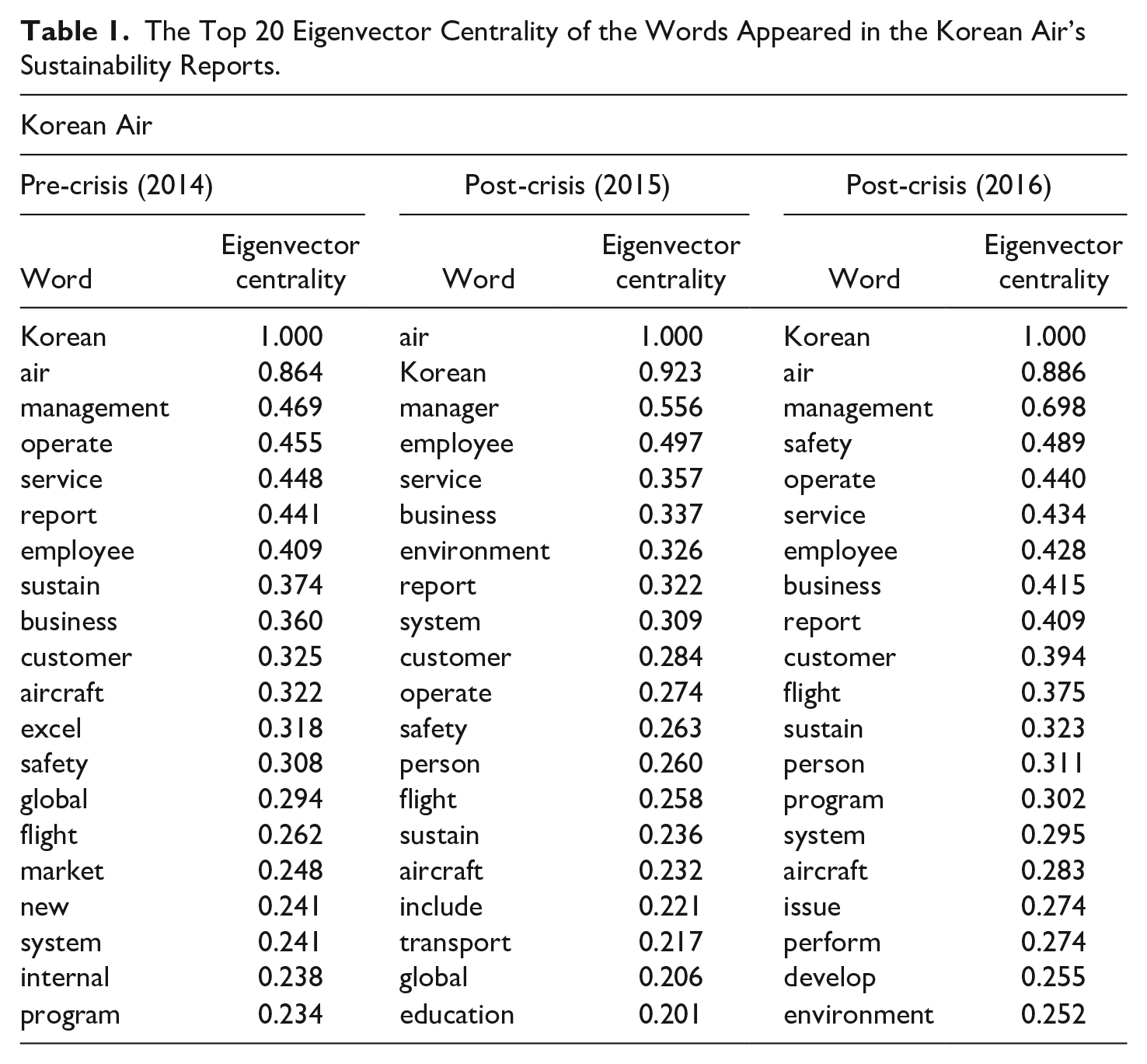
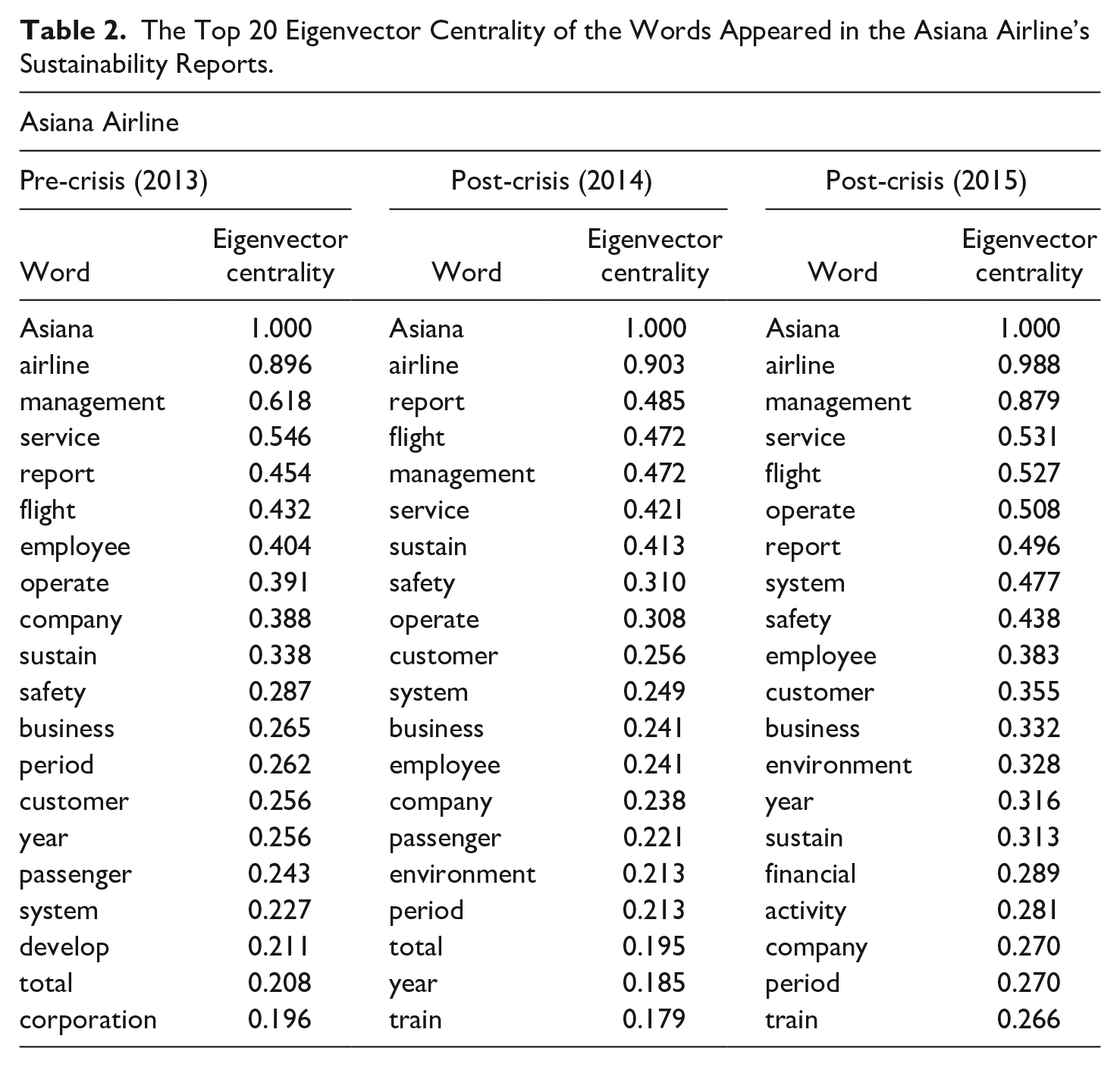
RQ2 asked how the central keywords in sustainability reports are related to a crisis type. A series of separate semantic network analyses was performed with the top 100 frequently appearing words in each report. Table 1 and 2 summarize the eigenvector centrality of the top 20 words among those. Each word’s eigenvector centrality was examined to find influential words that are connected to other well-connected words in each semantic network, which may play an important role in a corporation’s communication strategies with its stakeholders.
The Top 20 Eigenvector Centrality of the Words Appeared in the Korean Air’s Sustainability Reports.
The Top 20 Eigenvector Centrality of the Words Appeared in the Asiana Airline’s Sustainability Reports.
The results showed that, before the crisis, the most influential nodes were “management,” “operate,” “service,” “employee,” “sustain,” and so on, excluding brand and report-related words (i.e., Korean, air, report). After the crisis, the most influential nodes found were “manager,” “employee,” “service,” “business,” “environment,” and so on, excluding brand and report-related terms. Two years after the crisis, the most influential nodes were “management,” “safety,” “operate,” “service,” and “employee,” excluding brand and report-related terms. However, after 2 years from the crisis, their communication focus moved to performance-related terms (i.e., management, safety, operate, service).
Whereas, before the Asiana crash, the most influential words were “management,” “service,” “flight,” “company,” “employee,” “operate,” “sustain,” and so on, excluding brand and report-related words (i.e., Asiana, airline, report). After the crash, the most influential nodes were “flight,” “management,” “service,” “sustain,” “safety,” “operate,” “customer,” and so on, excluding brand and report-related words. Two years after the crash, the most influential nodes were “management,” “service,” “flight,” “operate,” “system,” and so on, excluding brand and report-related words.
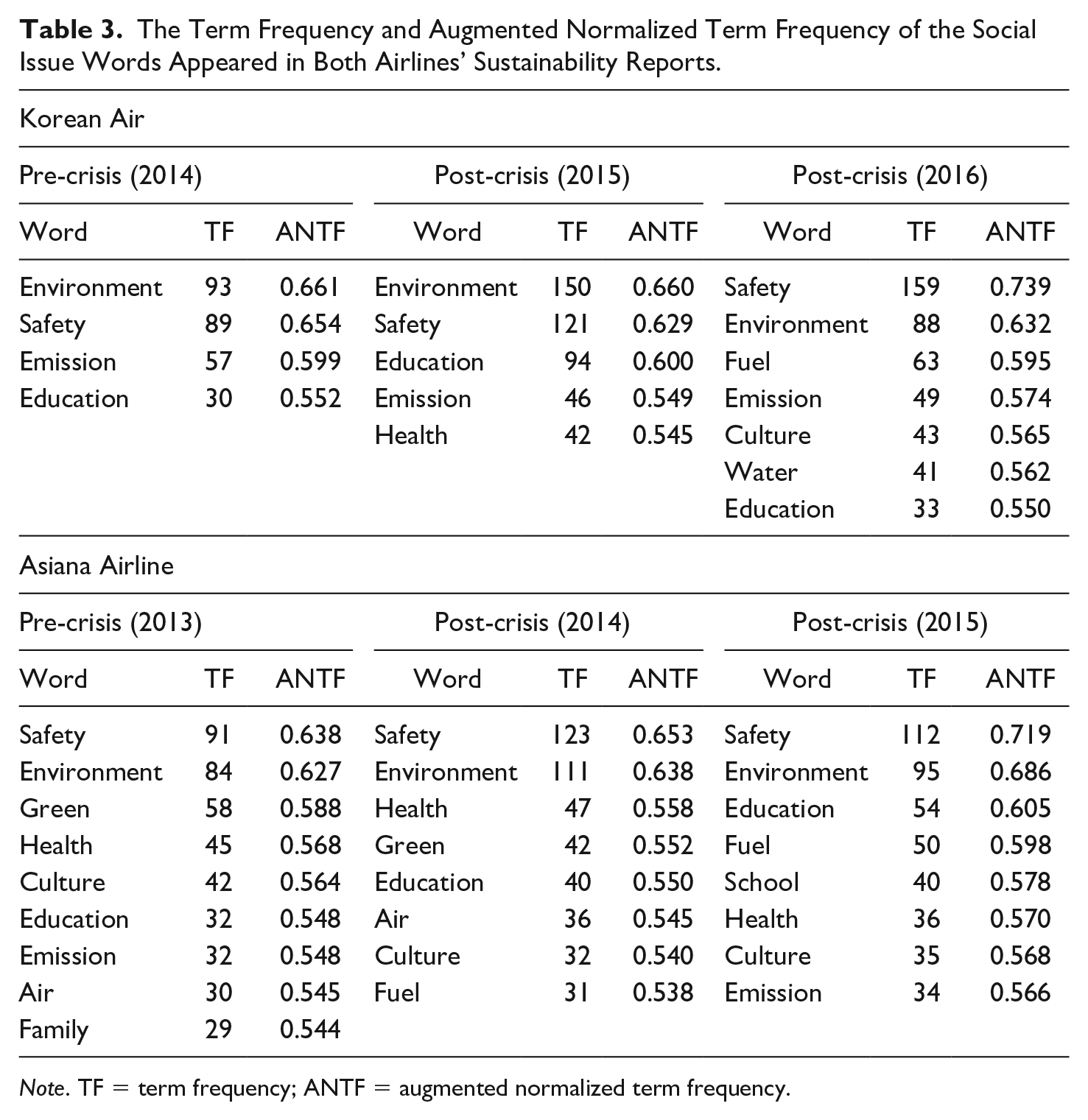
RQ3 asked what social issues corporations emphasized in sustainability reports, and how they differ by a crisis type. To gauge how frequently the social issue words defined in the typology appeared in each report, the study adopted J. Lee and Rim’s social issue types (2018): (1) environment, (2) art/culture/sports, (3) health/disease/safety, (4) education, (5) support for animals, (6) equal rights/diversity/family/women, (7) hunger, (8) homelessness/housing, (9) crime/violence prevention, and (10) others. It appears that Korean Air’s reports did not overtly emphasize any particular social issues after its CSR crisis, while Asiana’s reports put emphasis on safety issues after its CA crisis. Table 3 summarizes the term frequency and ANTF of the social issue words that appeared in each report.
The Term Frequency and Augmented Normalized Term Frequency of the Social Issue Words Appeared in Both Airlines’ Sustainability Reports.
Note. TF = term frequency; ANTF = augmented normalized term frequency.
With regard to the Korean Air’s CSR crisis, “environment,” “safety,” “education,” and “emission,” were the words most frequently observed in the term frequency and ANTF. In particular, “education” increased slightly after the CSR crisis and the numbers dropped again after 2 years in terms of their absolute (i.e., term frequency) and relative emphasis (i.e., ANTF) while “emission” showed a decreased pattern first, and the number increased again after 2 years. The relative emphasis of “environment” remained the same before and after the crisis, but it dropped slightly after 2 years. The relative emphasis of “safety” slightly dropped after the CSR crisis, but it significantly increased after 2 years of crisis.
For the Asiana Airline crash, “safety,” “environment,” “health,” “culture,” and “education,” were the common words that appeared frequently. Interestingly, the emphasis of “safety” gradually increased after the crash, and “education” and “school” were highly emphasized in the 2 years after the crash.
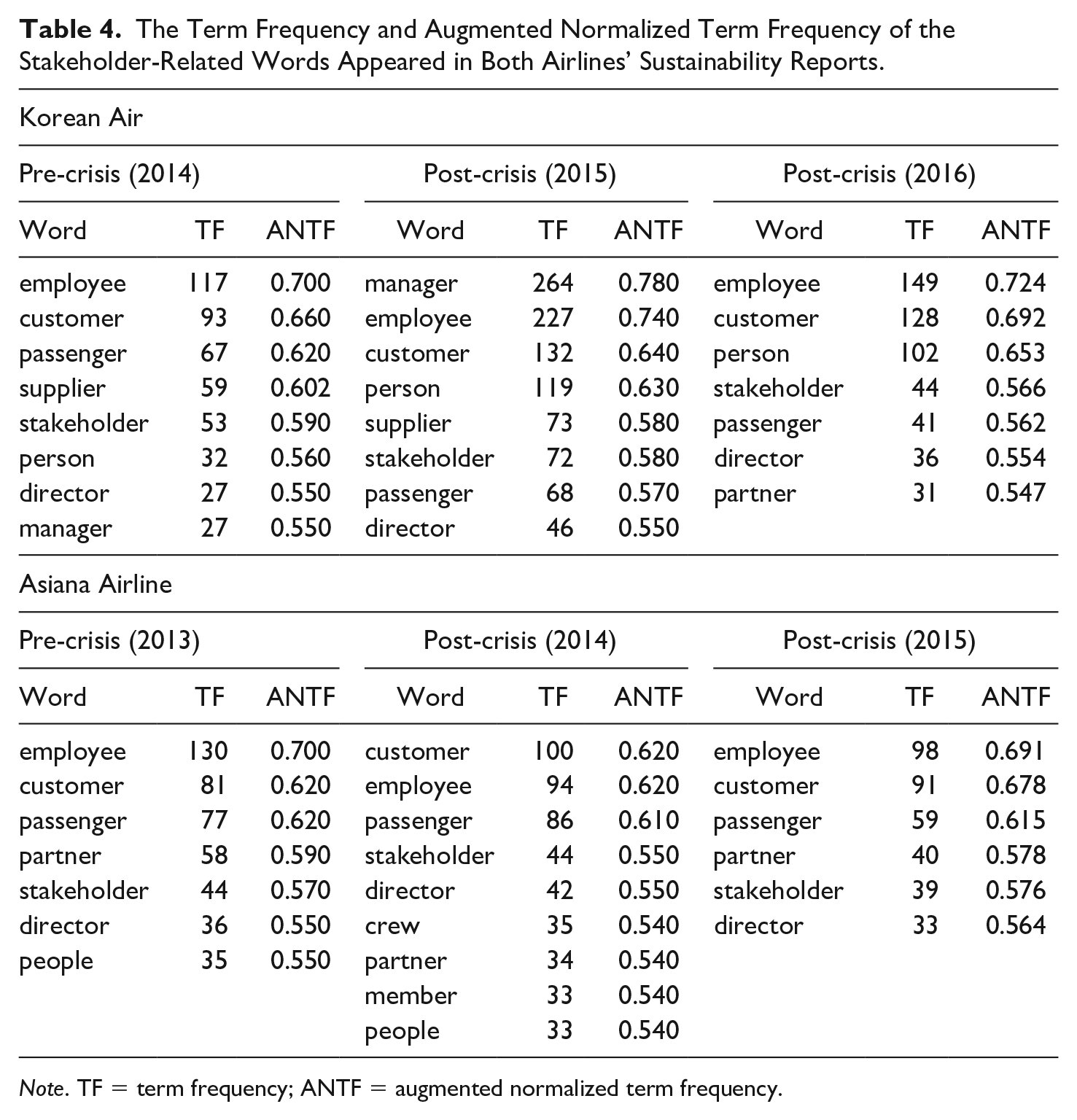
RQ4 asked which stakeholders the corporations prioritize in sustainability reports and how those differ by a crisis type. There appeared to be some noticeable differences after the CSR crisis, but the CA crisis was not related to the way in which relationships with stakeholders were built to any great degree. Table 4 summarizes the term frequency and ANTF of the stakeholder-related words among the top 100 words that appeared most frequently in each report.
The Term Frequency and Augmented Normalized Term Frequency of the Stakeholder-Related Words Appeared in Both Airlines’ Sustainability Reports.
Note. TF = term frequency; ANTF = augmented normalized term frequency.
With regard to the Korean Air’s CSR crisis, some noticeable changes in stakeholder-related words were observed. “Employee,” “customer,” “passenger, “stakeholder,” “person,” and “director” were the stakeholder-related words used frequently in both the term frequency and ANTF, before and after the crisis. In particular, there were noteworthy changes in the words that indicated internal stakeholders. “Manager” showed the most remarkable increase in both term frequency and ANTF right after the crisis. Term frequency of the word “employee” showed an increasing tendency of emphasis. Before and after Asiana Airlines’ product-harm crisis, there were minimal differences in the appearance of stakeholder-related words. “Employee,” “customer,” “passenger,” “stakeholder,” “partner,” and “director” were those used most frequently both pre- and post-crash. Interestingly, Asiana Airlines also tended to mention the word “crew” in its reports after the crash, but the tendency was not observed 2 years after the crash.
Discussion
Corporations’ sustainability reports are one of the primary communication channels with their close stakeholders, where they deliver messages about corporate missions, goals, values, and commitment to the stakeholders and communities (Du et al., 2010; Perrini & Tencati, 2006). Accordingly, this study analyzed the sustainability reports to explore how CA and CSR crises are related to their stakeholder communications in terms of the use of words representing the attributes of crises, central keywords, social issue supports, and prioritized stakeholders. Applying Sohn and Lariscy’s (2014) categorization of a reputational crisis, the results of this study provide empirical evidence for how corporations employed different communication efforts to protect and recover their tarnished reputations after CSR and CA crises.
Our RQ1 examined how a company’s CSR and CA crisis differently emphasized the crisis-related terms in sustainability reports. The word frequency analysis focusing on “ethics” and “safety,” which are selected as representing words of the CSR and CA crisis, respectively, revealed that after Korean Air’s CSR crisis, there were not many differences in the emphasis of the word “ethics,” while there was an increasing trend in the emphasis of the word “safety.” Asiana Airlines’ reports showed a gradual increase in “safety,” but there was a noticeable decrease in the emphasis on the word “ethics” after the crash in 2 years.
Given that stakeholders take the crisis dimensions as a cue and that may damage a particular aspect of corporate reputation, communication efforts should be tailored based on the attributes of a crisis event (e.g., Coombs, 2007; Sohn & Lariscy, 2014). However, our results showed that, regardless of crisis types, both companies’ communication efforts tend to focus on emphasizing safety issues. As a crisis event in the same industry sparks not only the consumer public’s attention but also the media’s attention, it often considers as an industrial crisis. Our findings perhaps reflect the industry’s collective efforts in reducing the public’s fear on airline safety. It should be noted that after the Korean Air’s CSR crisis, there were no meaningful changes for the use of “ethics” terms found in the company’s sustainability reports. When corporations are suspected of unethical behaviors, they are pressured to make appropriate responses to mitigate negative public opinions and defend their image by choosing optimal communication responses (Coombs, 2007). Communication professionals should be mindful that appropriate post-crisis communication efforts are required for the CSR crisis to minimize reputational damage.
With regard to the changes in the sustainability reports’ central keywords (RQ2), Korean Air showed a tendency to emphasize words related highly to its internal stakeholders, such as “manager” or “employee,” but did not show the keywords directly related to ethical crisis. In response to its crisis, Asiana Airlines appeared to place more emphasis on words related to business, such as “flight” or “service.” Given that Korean Air’s CSR crisis was related closely to the leader’s unethical behavior and the employee–employer relationship, it may imply the company’s attempts to communicate with its stakeholders by emphasizing the words indicating internal relationships (e.g., manager, employee) right after the crisis. However, when it comes to the sustainability reports published 2 years after the crisis, Korean Air did not maintain the changes it made right after its crisis. In contrast, Asiana Airlines’ crisis was related strongly to its service and management and showed a propensity to emphasize more performance-related terms (e.g., flight, service, safety) to communicate with its stakeholders right after the crisis. The emphasis of communication appears to remain the same after 2 years from the crisis considering the influential nodes with performance-related terms.
The different emphasis on words by crisis type might indicate that a corporation that experienced a CSR crisis might not want to explicitly refer to the words associated closely with the crisis in communicating with its stakeholders. Similarly, the results of Korean Air’s sustainability reports also show no meaningful change in mentioning the term ethics. The 2015 Korean Air’s sustainability report was the only one that explicitly mentioned its corresponding crisis (i.e., “We deeply regret that the incident involving Korean Air stirred up a huge social controversy and caused a great deal of distress to our stakeholders. However, I would like to assure you that we have learned our lessons and that we remain determined to take this opportunity to transform the way we do our business, rather than merely viewing it as a case of crisis management, so that we can regain your trust and confidence”). Interestingly, when a corporation which experienced a CA crisis might use explicit and direct communication in relation to their own crisis. The explicit communication might be because organizations are likely to consider the crisis related to product safety as the critical factor affecting their corporate reputation (Burson-Marsteller & Penn Schoen Berland, 2011) so they might want to directly address it.
Our RQ3 examined whether there are any changes in social issues the company supports before and after crises and how those differ by the crisis type. The results also showed that there were no changes in Korean Air’s reports before and after its CSR crisis. It is possible that Korean Air, which experienced an ethical-harm crisis, did not tweak or integrate their CSR efforts in crisis communication actively, although scholars have discussed the important role of CSR in crisis management (e.g., H. K. Kim & Yang, 2009). However, Asiana Airlines consistently emphasized safety and education issues after its CA crisis. The results appeared to show that those social issue words seemed to have some relationship to their CA crisis.
With regard to stakeholder relationships (RQ4), the occurrence of the ethical crisis was found to influence the approach to building relationships with internal stakeholders and showed a noteworthy leap in the frequency of the word “manager,” as well as a slight increase in “employee” in 2 years after crisis. In contrast to Korean Air’s crisis, the communication strategy with regard to Asiana Airlines’ stakeholders remained largely unchanged, except for the frequent mention of “crew” right after its product-harm crisis. Based on previous research, we expected that corporations would make situationally sensitive stakeholders a priority group in their communication activities (Lin et al., 2011). Our results supported this argument; Korean Air tended to mention words related to those who might be considered the victims of its CSR crisis (i.e., “manager” or “employee”). On the other hand, in responding to the CA crisis, Asiana Airlines’ reports mentioned “crew” who were responsible for the CA crisis more frequently only right after the crisis.
The study provides both theoretical and practical implications. Comparing a corporation’s sustainability reports written before and after crises, this study attempted to investigate corporate crisis communication strategies in the long run. According to the situational crisis communication theory, corporations can protect and rebuild their reputations by selecting optimal response strategies based on crisis types, attributions of crisis responsibility, and initial reputation damage (Coombs, 2007). The optimal strategies should be specified into short-term (primary crisis response) and long-term (secondary crisis response) strategies. Along with the line of research, this study suggested empirical evidence on how corporations take long-term crisis response strategies in the real-world situation, which reinforces the body of crisis communication management literature.
Our results showed a more explicit communication style after the CA crisis. Perhaps, Korean Air’s response strategy to its CSR crisis can be considered as ingratiation, a deal response option, which indicates that the organization reminded stakeholders of its past commitment to society (Coombs, 2007) rather than mentioning the crisis explicitly. However, communication professionals should be mindful that if a corporation does not suggest any communication response to its unethical behavior, people develop a negative image toward the corporation (Bradford & Garrett, 1995). An organization’s unethical image can threaten not only its reputation but also its economic performance (Lindenmeier et al., 2012). Similarly, in their experiment research, Shon and Lariscy (2014) found that people tend to be more sensitive to moral-hazard cue than an ability-defection cue in evaluating attitude to and trust in a company, which implies the importance of managing ethical-harm or CSR-related crises.
Using computational analysis approaches (i.e., term frequency and semantic network analysis), which allowed the researchers to explore the real-world crisis communication cases without human coding biases, the findings of this study revealed the corporations’ crisis communication efforts that gradually changed over pre- and post-crisis years. In addition, this study showed the viability of corporate sustainability annual reports in examining the crisis response strategies that gradually change over the years. This study posited that sustainability reports reflect the organization’s deliberative communication strategy because corporations publish sustainability reports on an annual basis with well-controlled and managed content (S. Y. Lee, 2016). As findings showed, this study confirmed corporations adopt communication strategies differently depending on their crisis type (i.e., CA and CSR crisis) and when they publish each report. Therefore, as an initial attempt to investigate corporate crisis strategies using sustainability reports, this study not only provided the empirical evidence for what values corporations prioritize after crises but also confirmed that corporations strategically use sustainability reports in crisis communication.
This study has limitations that call for readers’ caution when interpreting the findings. First, this study focused on discrete words as a unit of analysis, which did not allow the researchers to explore the sentence structures of the words in a continuous context or the conceptual frames emerged from the word groups. Future research is strongly encouraged to explore the way different types of crises influence the contiguous sequence of each word included in a report (e.g., n-gram analysis or co-occurrence of terms), or explore what concepts/frames emerge depending on crisis types by grouping the words in a meaningful way that goes above the word level. Second, the scope of data collection for this study was limited to recent crises in each airline. Furthermore, as mentioned in the method section, there was high similarity among the sustainability reports, which might have been drawn from the genre conventions of sustainability in wording and structure. To better understand how corporations reform or shape the governance aftermath of a crisis, further research should consider examining the research questions with a broader scope of data to explore trends in the long term. Last, although sustainability reporting provides evidence of the way corporations’ communication approaches and CSR programs change over time after a crisis, the readers are limited to active publics. In addition, the contents and formats can be generic due to the institutional pressure. For more robust comparisons and generalizations, we urge future scholars to extend the scope of reports and investigate other types of corporate publications (e.g., press releases or internal newsletters). Exploring such research questions in other industries or in other types of crises related to ethical issues may advance the crisis communication literature further.
Footnotes
Declaration of Conflicting Interests
The author(s) declared no potential conflicts of interest with respect to the research, authorship, and/or publication of this article.
Funding
The author(s) received no financial support for the research, authorship, and/or publication of this article.
