




Abstract
The purpose of the current study was to extend prior research by examining the impact of policies that allowed or not-allowed employees access to their smartphones while at work on employee job satisfaction and organizational commitment. This study also examined the relationship between technology addiction, impulsivity, and entitlement. Participants (N = 266; 123 male and 143 female) were full-time working adults. Findings indicated significant differences in job satisfaction and organizational commitment between employees who worked for organizations that allowed versus not-allowed employees access to their smartphones during the workday. Strong relationships between technology addiction, impulsivity, and entitlement where also found.
Keywords
Since the development of modern technology, the human desire to feel connected is being satisfied through social media, text messaging, email, and others. This has created a unique interest in technology’s impact on psychology, addiction, and organizational communication. As technology and its accessibility become more prevalent, the need to assess its impact on individuals, their lives, and their career aspirations have increased. Previous research indicates that individuals can become addicted to technology (Charlton, 2002). As a result, research on new technology, along with its influence on employee outcomes, have developed (Charlton, 2002).
The goal of the present study is to extend prior technology addiction research by examining how organizational policies that allow versus not allow employees access to their smartphones (for personal reasons) during the workday influence their job satisfaction and organizational commitment. In doing so, the authors utilized attachment theory, technology addiction, impulsivity, and entitlement. Further, it is the authors’ stance that the “technological smoke break” (time allotted during the workday for employees to satisfy their technology addition) has now replaced the traditional smoke break of the past. Attachment theory (Bowlby, 1969) will serve as the theoretical underpinning for the current study and its inclusion will be discussed in greater detail below.
Attachment Theory and Smartphone Use
Originally, attachment theory examined the relationship between caregiver and child (Bowlby, 1969). Trub and Barbot (2016) describe attachment as being an instinctual system of behaviors that, during times of extreme stress or danger, prompt the desire for closeness or interaction with a caregiver. When unable to gain access to a caregiver, children will develop strategies to fulfil the role of caregiver, such as relying on another person or inanimate object as a secondary source of comfort (Harlow, 1958; Trub & Barbot, 2016). Similar to children, adults form attachments to inanimate objects. In recent studies, attachment theory has been utilized to examine the relationship between humans and inanimate objects, such as smartphones (Kyungsik et al., 2016). The accessibility of smartphones can provide adults with a sense of security and reliability comparable to that provided by a caregiver to a child. In addition, smartphones provide adults with a means to connect with others by providing them with a way to connect and maintain attachments with other individuals from a distance (Levine & Stekel, 2016). Kyungsik et al. (2016) suggest that individuals are utilizing mobile technology to create a community identity where they share values, traditions, experiences, and form attachments. Therefore, the desire to create and maintain an attachment may lead to an addiction to the device itself or the information it can access. In that technology addiction was the focus of the current study and that attachment and addiction to technology may be related, technology addition was included in this study.
Technology Addiction
Technology addiction, also referred to as problematic technology use, is the unwanted habitual usage of technology that leads to negative consequences on daily life (Horwood & Anglim, 2018; Goodman, 1990). Prior research indicates the likelihood of technology to act as a facilitator of other behavioral addictions (e.g., gambling), rather than a source of addiction itself (Charlton, 2002; Griffiths, 2000; Porter & Kakabadse 2005; Widyanto et al., 2011). Although much research has been conducted on the effects of technology addiction on relationships, physical and mental health, and fiscal responsibility (Horwood & Anglim, 2018), to date, scant research exists on how technology addiction affects the workplace. Porter and Kakabadse (2005) identified a possible bidirectional causality between technology and work addiction. This finding suggests that addiction to work and technology may not develop because of increased work demands, but that individuals with addictive tendencies seek out employment opportunities that allow them to indulge in their compulsion toward technology. Prior research has also identified five factors of smartphone addiction which include tolerance, withdrawal, compulsive symptoms, time management, and interpersonal and health problems (Khoury et al., 2017; Lin et al., 2014). Further, addiction to smart phones impedes the personal well-being of users, causing increased anxiety, and unnecessary pressure compared with their counterparts (Vinayak & Malhotra, 2017). Prior research also indicates that traits such as entitlement and impulsivity serve as predictors of technology addiction (Ekşi, 2012; Vinayak & Malhotra, 2017). Given the aforementioned relationships between entitlement, impulsivity, and technology addiction, it could be extrapolated that a similar relationship between the variables exist here. Therefore, entitlement/self-entitlement was included in the current study.
Entitlement and Technology Addiction
According to Harvey and Dasborough (2015), a large number of today’s workforce demonstrate an inflated sense of self-importance and uniqueness that resulted in expectations of special treatment, high rewards, and rapid career advancement in exchange for mediocre performance. Entitlement is seen as “a stable and pervasive sense that one deserves more and is entitled to more than others” (Campbell et al., 2004, p. 31). In other words, entitlement is an individual’s belief that their needs are greater than those of others. Put another way, entitlement includes the expectation that other people and institutions should support individual needs (Harvey & Harris, 2010). Research also found entitlement to be related to conflicts with supervisors (Harvey & Martinko, 2009), conflicts with coworkers (Harvey & Harris, 2010), negative reactions to criticism, and high levels of selfishness (Campbell et al., 2004). Employees who feel entitled also tend to display low levels of job satisfaction and organizational commitment (Asenova & Koleva, 2018).
Those with a sense of self-entitlement have a tendency to believe “that they deserve what they want because they want it and want it now” (Lippmann et al., 2009, p. 197). Ekşi (2012) also examined the extent that narcissistic personality traits, such as entitlement, predict internet addiction and impulsiveness. In following with Ekşi’s (2012) line of research, the current study included impulsiveness as an important variable to consider.
Impulsiveness and Technology Addiction
Whiteside and Lynam (2001, 2003), indicated that impulsive behaviors reflect personality traits that have strong affective (sensation seeking), cognitive (low planning), and behavioral (low persistence) components. Gentile et al. (2012) illustrated a bidirectional causality of impulsiveness and attention problems. Specifically, technology use increased impulsiveness and impulsiveness caused an increased desire to use technology. Previous research also indicated that impulsivity was related to addictive smartphone use (Billieux et al., 2008, Billieux et al., 2010). Furthermore, it has been suggested that a lack of impulse control is a hallmark of addictive behaviors (Dawe & Loxton, 2004). Additionally, impulsiveness is a risk factor for participating in maladaptive behaviors, and mobile phone use can assist in regulating or relieving negative behaviors (Vinayak & Malhotra, 2017; Kim et al., 2016).
In sum, it appears that impulsive individuals send countless messages as a result of anxiety or anger (Vinayak & Malhotra, 2017) and this type of impulsivity is called “urgency” (Vinayak & Malhotra, 2017). Specific to this study, Vinayak and Malhotra (2017) found a significant positive relationship between mobile phone addiction and impulsiveness. Thus, it can be inferred that impulsive entitled employees may also be addicted to technology and this addiction may, in turn, influence their job satisfaction in both positive and negative ways. It could also be reasoned that job satisfaction may be contingent on organizational policies that allow versus not allow the use of smartphones (for personal use) throughout the workday. Therefore, job satisfaction was included in the current study.
Job Satisfaction
In its simplest form, job satisfaction is a valued attitudinal variable that describes the extent to which employees like or dislike their job (Saari & Judge, 2004). Job satisfaction has been defined as “a pleasurable or positive emotional state resulting from the appraisal of one’s job or job experiences” (Locke, 1976, p. 1304). More recently Hulin and Judge (2003) extended the definition by conceptualizing job satisfaction as a construct with emotional, cognitive, and behavioral elements. Job satisfaction has been found to influence a broad range of organizational outcomes such as commitment, turnover, and job performance (Judge et al., 2001). Additionally, Wright and Davis (2003) found that satisfied workers were more productive, while others found strong correlations between communication and job satisfaction (Goris, 2007). Two specific groups of work-related attitudes, job satisfaction and organizational commitment, have been examined for their relationship to the attitudes employees hold about their work and the organization (Miller & Monge, 1986). Further several factors have been found to determine an individual’s level of job satisfaction including task significance, skill variety, task identity, autonomy, and feedback (Fried & Ferris, 1987).
Holland et al. (2016) found a relationship between mobile phone use at work and job satisfaction, but only for Generation Y employees. This finding makes sense in that Generation Y, (generally accepted birth years of early 1980 to 2000) were the first to grow-up with computers and social media and currently use technology at a higher rate than any other generation (Junco & Mastrodicasa, 2007). Prior research on social media use while at work yielded mixed results (Garrett & Danziger, 2008). Some found counterproductive workplace behaviors such as “cyber-loafing,” which is the use of the Internet/social media for nonwork-related or personal activities (Martin et al., 2010), while others found that social media use at work had a positive effect on job satisfaction, performance (Koch et al., 2012; Moqbel et al., 2013) and productivity (Shepherd, 2011).
Specific to the current study is the impact of organizational policies that allow versus not allow employees use of their smart phones (for personal reasons) throughout the day as a means to satisfy their technology addiction, similar to smokers who are permitted to take smoke breaks to satisfy their nicotine addiction. While there has been significant supposition as to the antecedent factors related to job satisfaction, research examining the impact policies that allow versus not allow employees the use of their smartphones (for personal reasons) throughout the workday on the job satisfaction is scant. However, it could be surmised that employees who are permitted to use their smartphones during the workday (for personal reasons) may be more satisfied than those employees who are not permitted to do so. Therefore, the following hypotheses were put forward.
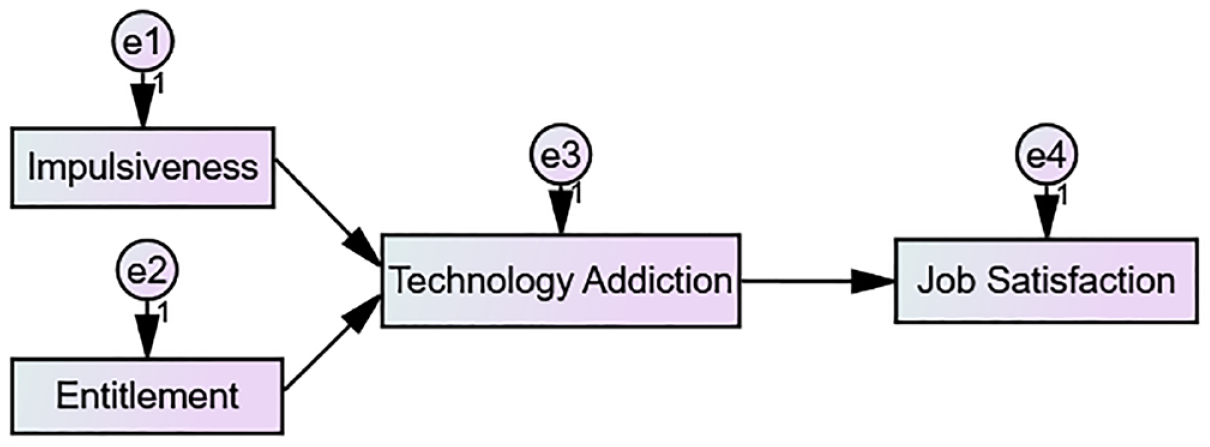
Hypothesized model of technology addiction, entitlement, impulsiveness, and job satisfaction.
Job satisfaction deals with a person’s perceptions of their job, while organizational commitment addresses the person’s beliefs about the organization and whether employees stay or leave an organization (Wright & Davis, 2003). Therefore, organizational commitment was a valuable addition to the current study.
Organizational Commitment
Organizational commitment is characterized by a strong belief in and acceptance of the organization’s goals and values, a willingness to employ considerable effort for the organization, and a desire to retain membership in the organization (Sager & Johnston, 1989). Prior research indicates that employees’ control over their jobs, involvement in decision making, sense of security, autonomy, and support positively affect their organizational commitment (Ruokolainen, 2011). Other research has shown that use of social media at work has a positive effect on organizational commitment, (Ali-Hassan et al., 2011).
There appears to be a scant amount of prior research that examined the relationship between smartphone use (for personal reasons) during the workday and organizational commitment. It could by hypothesized as with job satisfaction that policies that allow versus not allow employees the autonomy to use their smartphones (for personal reasons) throughout the workday would positively affect their organizational commitment. Therefore, the following hypotheses were advanced.

Hypothesized model of technology addiction, entitlement, impulsiveness, and organizational commitment.
Method
Participants
Participants were 266 working adults from a variety of organizations (n = 123, 46.2% male) and (n = 143, 52.8% female). Their overall tenure ranged from 1 to 38 years (M = 7.41 years, SD = 8.52), and age ranged from 18 to 66 years (M = 34.2 years, SD = 13.6). They reported working for a variety of organizations including, education 24.8%, service 40.6%, high tech 4.1%, manufacturing 6.0%, civil service 3.0%, government 6.0%, and other 15.4%. The participants also reported to using their smartphones during the workday ranging from 1 (none) to 5 (a great deal) (M = 3.85, SD = 1.14). No racial/ethnic background of participants was gathered for the current study. This will be addressed further in the limitations section of this study.
Procedures
A network sample was used for the current study consisting of nonmanagerial employees recruited by authors and undergraduate students enrolled in various communication courses at a medium-size university located in the central United States. The students were instructed to deliver the questionnaire to full-time working adults. To ensure that the participants were working adults, the participants were given an email address in which they were asked to report their name, the name of their organization, and a telephone number. Participants were also asked to return the completed questionnaire in an envelope with the return address matching the company name they indicated in the email. Only envelopes containing completed questionnaire whose return address matched the emails were used in the study. Of the 300 original questionnaires, 267 were returned, resulting in an 89% return rate. Of the 267 returned questionnaires, only one could not be used due to missing data, leaving 266 useable questionnaires.
Since common method bias can be a significant problem in some study designs (Spector, 2006), the authors of this study took some steps to guard against this. First, it is important to use well-tested and valid scales (see Podsakoff et al., 2003), which we did. The authors then conducted a Harman’s single-factor test, which is one of the most widely used to address the issue of common method bias. The authors loaded all the variables in the study into an exploratory factor analysis (Aulakh & Gencturk, 2000) and examined the unrotated single-factor solution to determine the variance accounted for by one factor. The variance should be less than 50%. For the current study, the variance accounted for in the single factor was 21.12%, which indicates an acceptable amount of variance in the measures.
Measures
Technology addiction was measured using the nine-item measure developed by Charlton (2002) to measure the degree to which a person is addicted to their smart phone/I-Phone. The items were measured on a 5-point Likert-type scale (1 = strongly disagree to 5 = strongly agree). Sample item includes the following: “When I am not using my smart phone/I-phone I often feel agitated.” Prior research (Charlton, 2002) indicated that the technology addiction scale had strong reliability with a Cronbach’s coefficient alpha of .93. Cronbach’s alpha for the current study was .89 (M = 29.35, SD = 8.73).
Impulsiveness was measured with 24-item revised version of the Barratt Impulsiveness Scale Version 11(BIS 11) by Haden and Shiva (2008). The items were measured on a 5-point Likert-type scale (1 = strongly disagree to 5 = strongly agree). Sample item includes the following: “I do things without thinking.” Prior research (Haden & Shiva, 2008) indicated that the revised version had adequate reliability with a Cronbach’s coefficient alpha of .71. Cronbach’s alpha for the current study was .82 (M = 60.80, SD = 11.83).
Entitlement was be measured by the nine-item Personal Entitlement Scale developed by Campbell et al. (2004). The items were measured on a 5-point Likert-type scale ranging from (1 = strongly disagree to 5 = strongly agree). Sample item includes the following: “Great things should come to me.” Prior research (Campbell et al., 2004) indicated that the Personal Entitlement Scale had adequate reliability with a Cronbach’s coefficient alpha of .88 to .83. Cronbach’s alpha for the current study was .83 (M = 21.91, SD = 6.45).
Job satisfaction was measured by the eight-item Abridged Job in General Scale (AJIG; Russell et al., 2004). A 5-point Likert-type response format (1 = strongly disagree to 5 = strongly agree) was used in the current study instead of the original scale formatting (i.e., using 0 for “no,” 1 for “?,” and 3 for “yes”) to be consistent with other parts of the questionnaire. The scale is comprised of single word or short statements regarding an employee’s overall perception of their job (e.g., Good, Better than most, Undesirable). Prior research (Russell et al., 2004) indicated that the AJIG Scale had strong reliability with a Cronbach’s coefficient alpha of .92. Cronbach’s alpha for the current study was .90 (M = 30.53, SD = 6.94).
Organizational commitment was measured using the 15-item Organizational Commitment Questionnaire (OCQ; Mowday et al., 1979). A 5-point Likert-type response format (1 = strongly disagree to 5 = strongly agree) was used in the current study. Sample items include the following: “I am proud to tell others that I am part of the organization” and “The organization really inspires the best in me in the way of performance.” Prior research reported scale reliability of .89 (Madlock & Sexton, 2015). Cronbach’s alpha for the scale was .80 (M = 51.30, SD = 10.12).
Results
Hypothesis 1 predicted that there would be significant difference in job satisfaction between employees who work for organizations that allowed versus not allow them to use their smartphone (for personal reasons) during the workday. Independent-samples t test indicated that there was a significant difference in job satisfaction between employees who work for organizations that allow versus not allow them access to their smartphone (for personal reasons) during the workday, t(76) = 14.91, p < .001. Specifically, employees who were permitted to access their smartphone (for personal reasons) during the workday reported higher levels of job satisfaction (M = 32.94, SD = 4.88) than those employees who were not permitted to do so (M = 21.48, SD = 5.96). Therefore, the hypothesis was supported.
Hypothesis 2 predicted that the data would fit the proposed model indicating a higher level of job satisfaction from employees who work for organizations that allowed versus not allow them use of their smartphone (for personal reasons) during the workday. The actual path model for organizations that allowed employees use of their smartphones (for personal reasons) during the workday showed that the data were consistent with the hypothesis. Results of the structural equation model indicated that the data fit the model: χ2(3) = 6.71, p = .08; goodness-of-fit index (GFI) = .94, normed fit index (NFI) = .89, RMSEA = .05 (see Figure 3). The actual path model for organizations that did not allow employees use of their smartphones (for personal reasons) during the workday showed that the data were consistent with the hypothesis. Results of the structural equation model indicated that the data fit the model: χ2(3) = 6.89, p = .076; GFI = .94, NFI = .89, RMSEA = .051 (see Figure 4). Hypothesis 2 was supported.
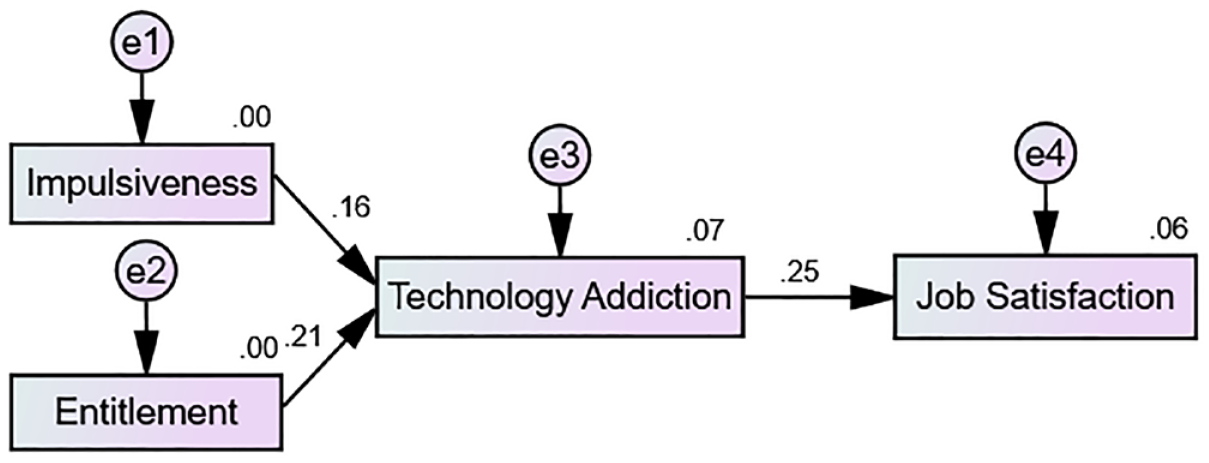
Model of technology addiction, entitlement, impulsiveness, and job satisfaction where employees were allowed to use their smartphone during the workday.
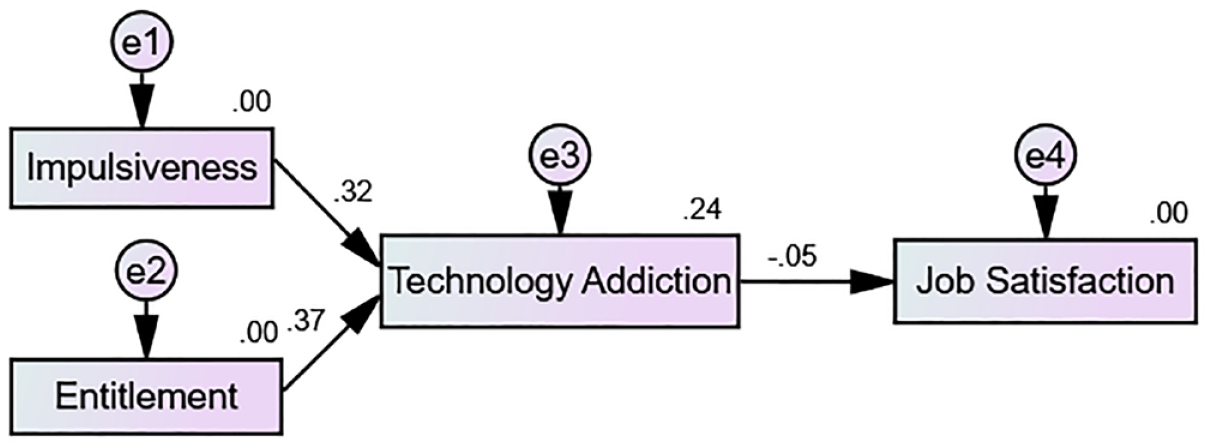
Model of technology addiction, entitlement, impulsiveness, and job satisfaction where employees were not allowed to use their smartphone during the workday.
Hypothesis 3 predicted that there would be significant difference in organizational commitment between employees who work for organizations that allow versus not allow them access to their smartphone during the workday. Independent-samples t test indicated that there was a significant difference in organizational commitment between employees who work for organizations that allowed versus not allowed them access to their smartphone during the workday, t(88) = 15.52, p < .001. Specifically, employees who were permitted to access their smartphone during the workday reported higher levels of organizational commitment (M = 54.90, SD = 7.37) than those employees who were not permitted to do so (M = 37.79, SD = 7.20). Therefore, the hypothesis was supported.
Hypothesis 4 predicted that the data would fit the proposed model indicating a higher level of job satisfaction from employees who work for organizations that allowed versus did not allow them use of their smartphone during the workday. The actual path model for organizations that allowed employees use of their smartphone during the workday showed that the data were consistent with the hypothesis. Results of the structural equation model indicated that the data fit the model: χ2(3) = 9.11, p = .128; GFI = .94, NFI = .90, RMSEA = .046 (see Figure 5). The actual path model for organizations that did not allow employees use of their smartphone during the workday showed that the data were consistent with the hypothesis. Results of the structural equation model indicated that the data fit the model: χ2(3) = 8.72, p = .09; GFI = .928, NFI = .89, RMSEA = .051 (see Figure 6). Therefore, the hypothesis was supported.
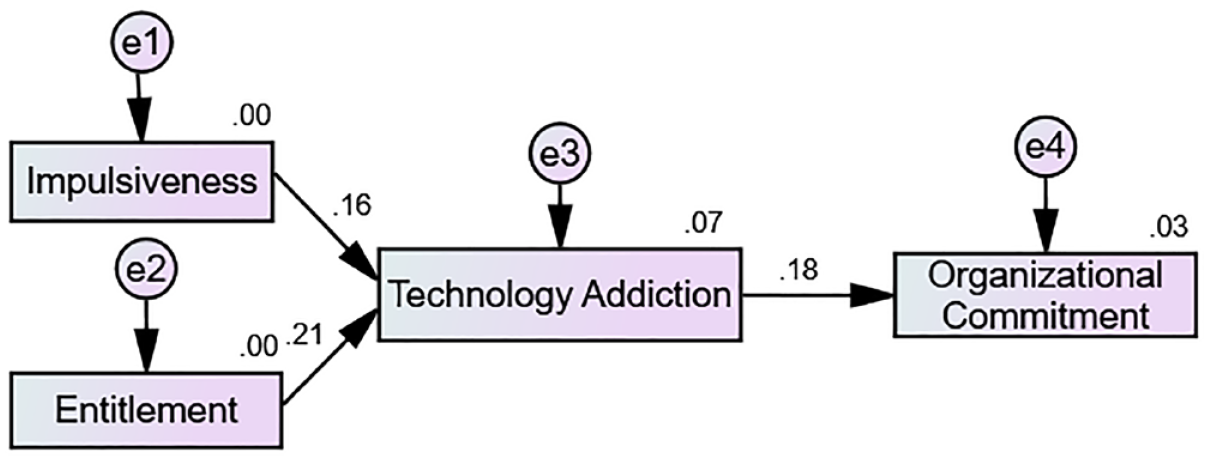
Model of technology addiction, entitlement, impulsiveness, and organizational commitment where employees were allowed to use their smartphone during the workday.
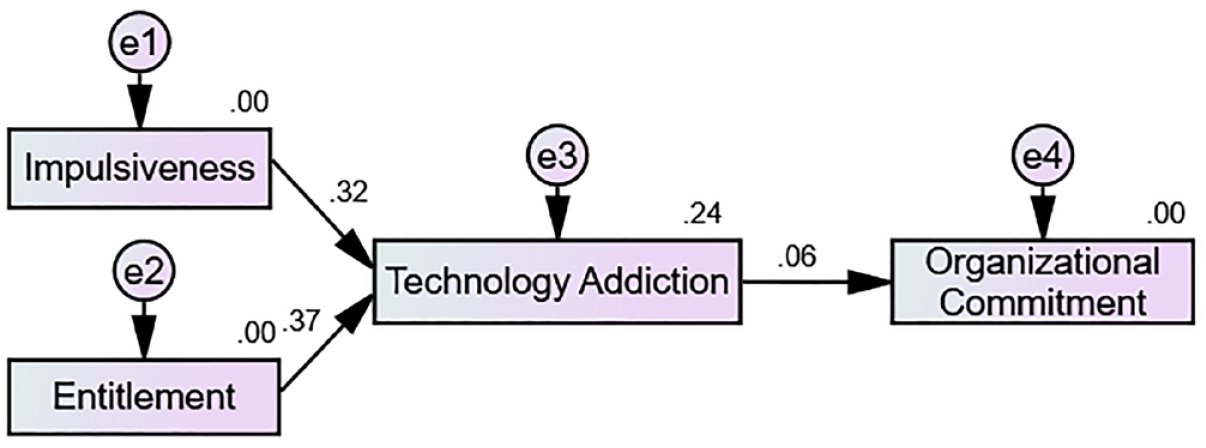
Model of technology addiction, entitlement, impulsiveness, and organizational commitment where employees were not allowed to use their smartphone during the workday.
Post Hoc Analyses
The post hoc analysis examined if employees of organizations that prohibit the use of smartphones during the workday would use their smartphones in spite of the restrictions? Findings indicated that 100% of the employees who worked for organizations that prohibited the use of smartphones during the workday used them anyway. Further there was no significant difference in smartphone use between those permitted to do so and those who were not, t(264) = 0.89, p > .05. Specifically, there was no difference in smartphone use between employees who were permitted to access their smartphone during the workday (M = 3.89, SD = 1.01) and those employees who were not permitted to do so (M = 3.73, SD = 1.28).
Discussion
The purpose of this study was to extend prior technology addiction research by examining the influence organizational policies that allow versus not allow employees’ use of their smartphones (for personal reasons) while at work have on employee job satisfaction and organizational commitment. In doing so, the authors utilized attachment theory and its relationship to smartphone use, along with technology addiction, impulsivity, and entitlement. It was the author’s position that the “technological smoke break” (time for employees to satisfy their smartphone, addition) needs to replace or at least accompany the traditional smoke breaks of the past.
The current study also added support for attachment theory related to inanimate objects such as smartphones and served as the underpinning for the current study. Even when organizational policies prohibit personal smartphone use, employees tended to use this technology anyway. In other words, not even negative consequences associated with the use of personal smartphones could interrupt their use during the workday. It appears that risk-taking behaviors accompany the need to be connected. Perhaps, as with the comfort a child receives from a blanket, smartphones offer similar comfort to users. From another point of view, like cigarettes are delivery devices for nicotine, so may the smartphone be the delivery device for the information accessed through this technology, and this strengthens the addiction to the smartphone. This is an area for future research to examine. From both points of view, it seems that attachment theory explains or at least partially explains the connection users develop with their smartphones.
The current study also indicated that employees who work for organizations with policies prohibiting the use of smartphones reported significantly lower levels of job satisfaction and organizational commitment than those employees who worked for organizations with policies that permitted the use of smartphones. This finding is in line with prior research of Moqbel et al. (2013), who indicated that the use of social media at work has a positive effect on employee job satisfaction and performance. However, it seems that employee job satisfaction and organizational commitment may also be influenced by restrictive organizational policies regarding smartphone use. It is interesting that actual time using the smartphone throughout the day was not significantly different between those with or without restrictive policies, yet the current models indicate that job satisfaction and commitment were different. This may be an area to consider for future research. Perhaps entitlement has an influence on the negative feelings employees have about policies that restrict smartphone use in the workplace.
One final finding of interest here is the relationship between smartphone addition, impulsiveness, and entitlement. Prior research supported this finding in that impulsiveness causes an increased desire to use technology (Gentile et al., 2012) and impulsive individuals cannot stop sending countless messages (Vinayak & Malhotra, 2017). Specific to entitlement and smartphone addiction the current findings here are in line with prior research relating entitlement to internet addiction. Today there is a large population of new employees entering the workforce with an inflated sense of self-importance and entitlement (Harvey & Dasborough, 2015). These impulsive entitled employees are also often addicted to technology. One way for organizations to be proactive to “smartphone dependence” (the need to access technology throughout the day) is to adopt policies that include the technological smoke break.
Limitations and Future Direction
Even though the current study improved our understanding of technology addition and factors that can increase job satisfaction and organizational commitment such as policies that allow employees to use their smartphone during the workday, it is not without limitations. It would have been useful to have had a qualitative component to the current study. A rich methodology may have teased out nuances that survey research could not by tapping into the actual feelings of employees who were restricted or free to use their smartphones during the workday. Another limitation is the lack of data collected associated with participants’ race/ethnicity. There may be differences in smartphone use and addiction associated with unique groups. A final limitation is associated with how the type of job, influences employee job satisfaction and organizational commitment. It seems that types of jobs that prohibit smartphone use (e.g., retail or fast food) might be jobs that participants are not that committed to, no matter the smartphone policy. This might also explain the jobs that prohibit smartphone use, yet participants are still using them—that is, they do not care as much about the job or losing it. In other words, jobs that are not career oriented may garner lower levels of employee job satisfaction and/or organizational commitment regardless of smartphone policies. This is an area not included in the current study but would be of interest for future research.
Overall, the current study served as a preliminary investigation into the association between technology addition and the need to provide employees with an outlet to satisfy their addiction. Given the impact policies that allow employees access to their smartphone have on job satisfaction and organizational commitment, companies may want to continue or modify their current guidelines. As with nicotine addiction (more from the past), and now technology/smartphone addiction, negative results may ensue if outlets are not provided to satisfy such addictions.
Footnotes
Declaration of Conflicting Interests
The author(s) declared no potential conflicts of interest with respect to the research, authorship, and/or publication of this article.
Funding
The author(s) received no financial support for the research, authorship, and/or publication of this article.
