



Abstract
This article examines the role of canonical stories in sensemaking. Canonical stories are known by members of a group; storytellers can refer to the shared narratives as repositories of meaning. While the sensemaking literature includes multiple studies of stories and storytelling, no studies have explicitly examined the role of canonical stories in sensemaking. Interviews with 55 top leaders in U.S. Catholic universities confronting a fraught issue in their institutions (undocumented student access) indicate a variety of ways that canonical stories operate in their sensemaking. Respondents referred to community narratives, canonical stories that hold specific meaning for their university communities. They told generic or stereotypical stories and fragments as shorthand in their communication. They also used counterfactuals as referents for their sensemaking. These findings help us better understand the role and importance of canonical stories in organizational sensemaking.
Introduction
Stories play an important role in how we understand the world around us. They help us articulate what is strange in our workplaces (Erbert, 2016), they aid us in creating our personal identities (Maclean et al., 2015), and they help us communicate our research to others (Pollock & Bono, 2013). Stories enable us to overcome duress and take collective action, as in the case of United Airlines Flight 93 (Quinn & Worline, 2008); they help us store away meaningful experiences into our memories (Boje, 2008; Bruner, 1990; Johnson & Mandler, 1980); and they serve as foundational building blocks for organizations (Robichaud et al., 2004).
Story and storytelling appear with some frequency in the sensemaking literature, describing various aspects of how we make sense of our world. We can even summarize the entire process of sensemaking as an attempt to answer the question, “What’s the story?” (Weick, 2008, para. 1). Stories have been shown to play diverse roles in sensemaking, from helping entrepreneurs shape their feelings and expectations about unknown future situations (Ganzin et al., 2019) to aiding in the construction of personal identity for sensemakers (Bird, 2007; A. D. Brown et al., 2008). Scholars have explored the role in sensemaking of antenarrative, which is “fragmented, non-linear, incoherent, collective, unplotted and pre-narrative speculation, a bet” (Boje, 2001, p. 1); and they have shown that simplexity, “the requirement for requisite complexity of thought combined with appropriate simplicity of action” (Colville et al., 2012, p. 6), aids sensemakers in updating older stories for modern applications. No studies yet, however, have explored the role of canonical stories in organizational sensemaking.
Canonical stories are “shared narratives” (Rappaport, 2000, p. 6) that serve as repositories of meaning to which storytellers can refer. Their meaning is understood by others, which means they can serve as shorthand in communication and as basic building blocks for a culture. In order to investigate their role in sensemaking, I listened for their presence in the interviews of 55 leaders in 12 Catholic colleges and universities in the United States. The primary research question for the study asked leaders to reflect on their experience with undocumented student access to their institutions and to consider the various sensemaking inputs and processes they were engaging as they encountered the issue. While my interview protocol was designed to examine the primary research question, I examined participants’ responses to those questions in search of narrative forms in their answers, including canonical stories. Respondents utilized canonical stories in a number of ways as they made sense of the issue.
Theoretical Foundations
Story in Sensemaking Research
Stories are an important part of how people make sense of the world around them. Weick (1979) explains that sensemaking serves to provide stories in the organizing process. “Much sense-making in the selection process can be viewed as writing plausible accounts, histories, and sequences for enactments. Equivocality is removed when an enactment is supplied with a history that could have generated it” (Weick, 1979, p. 195). Storytelling serves a central function in sensemaking in groups both large and small (Bietti et al., 2019), and can be a central metaphor for understanding organizations (Boje, 2008; Chlopczyk, 2019). Stories also play an important role in how we interpret our situations from the past and present (Dawson & Sykes, 2019), hearkening back to Bruner’s (1990, 1991) work on the importance of narrative in human cognition.
Story plays an observable role in not only organizations but also in organizational research itself. Gioia and Chittipeddi (1991) describe the first step of the work of the ethnographer as creating a “journalistic narrative or story” (p. 435). Ethnographic researchers, from their perspective, utilize stories to make sense of their research. In a longitudinal study of British orchestras, Maitlis (2005) identified a similar process, as orchestra members created stories to help them understand the world and to enable collective action. This resonates with Polkinghorne (1988) who argues that narrative is “the primary form by which human experience is made meaningful” (p. 1). Weick and Browning (1986) agree, contending that narration has a metaphorical power that can bring together “sense, reason, emotion, and imagination” (p. 250) into succinct units. Stories serve as keys for unlocking truths about organizational members and their perspectives and feelings (Gabriel, 1991) and can help us understand organizational systems and how they work (Tsoukas & Hatch, 2001). Stories are so foundational that organizations have even been said to “live and die by the narratives and stories they tell” (Boje, 2008, p. 4).
Though the empirical literature exploring the role of narrative in sensemaking is still emerging, recent research is expanding our understanding. Table 1 includes studies of narrative and storytelling in regards to sensemaking. The literature illustrates the pivotal role stories play in both sensemaking and sensegiving for jazz musicians who are used to an improvisational style in both music and culture (Humphreys et al., 2012). The use of moral stories in sensegiving can protect the reputations and character of people whose actions are in question (Whittle & Mueller, 2012), and embodied narratives can help us connect our past, present, and future into coherent stories so that we can make sense of them (Cunliffe & Coupland, 2012).
Story in the Sensemaking Literature.

Storytelling can help elite leaders make sense of their careers and to preserve their personal legacies (Maclean et al., 2012). As various individuals and groups within organizations attempt to gain influence, numerous and contradictory stories emerge (Näslund & Pemer, 2012). Ultimately, however, dominant stories backed by powerful political actors tend to take precedence within organizations and exercise the greatest influence, even exerting hegemonic power over sensemaking within the organizations.
Stories also play an important role in the articulation of leader visions for organizations (Schildt et al., 2019), with the differences between member relationships and common experiences in organizations due to the various narrative structures different people assign to the experiences (A. D. Brown et al., 2008). Stories can serve as a means for shared sensemaking of new phenomena, as in the case of doctors making sense of new digital health records as part of the Affordable Care Act in the United States (Heath & Porter, 2019). Though the importance and impact of stories are being explored in the literature, we still have much to learn about how they figure into organizational sensemaking.
Vaara et al. (2016) provided an exhaustive review of the role of narrative in understanding organizations, grouping the literature into three primary functions of narratives: realist, interpretive, and poststructuralist. The interpretivist approach focuses “on people’s constructions of organizational phenomena” (p. 497), as they “build composite narratives that capture the collective meanings of a group” (p. 504). As noted by the authors, an opportunity remains to deepen our understanding of all three narrative functions, including the interpretive role, the category into which canonical stories fall.
Canonical Stories
“[A] crucial feature of narrative,” claims Bruner (1990), “ . . . is that it specializes in the forging of links between the exceptional and the ordinary” (p. 47). Here, he is referring to the idea of canonical stories which contribute to the creation and maintenance of culture: “The viability of a culture inheres in its capacity for resolving conflicts, for explicating differences and renegotiating communal meanings” (p. 47). In other words, as people refer to canonical stories—stories whose meaning is taken for granted by members of a cultural group—they reinforce or rework the common meanings that constitute the “standard grammar” (Czarniawska-Joerges, 2004, p. 83) of a culture.
At the same time, canonical stories serve as wells of meaning from which storytellers can draw for comparison or contrast. These stories draw strength by resonating with members’ understanding of canonical themes, or they set up intriguing—if not unsettling—dissonance by deviating from the canon. Such deviations may require elaboration on the part of the storyteller to resolve the dissonance. Bruner (1990) explains, “The function of the story is to find an intentional state that mitigates or at least makes comprehensible a deviation from a canonical cultural pattern” (pp. 49-50).
Canonical stories share some common features with other narrative forms, such as root metaphors and organizational/institutional narratives. In their seminal paper on the culture of Disneyland, Smith and Eisenberg (1987) explore the symbolic role of metaphors in organizations. They explain that differences in how root-metaphors—in this instance, the root-metaphors drama and family—are applied and understood can lead to organizational conflict. Drama and family exerted significant symbolic power that resulted in deep disagreements and even an employee strike.
Institutional narratives (also known as organizational narratives) also share similarities with canonical narratives. Institutional narratives are “symbolic orders that make sense of social context and events and, with that, also construct identities” (Drori et al., 2016, p. 168). These narratives and their associated symbols and icons combine to communicate the identity of organizations. M. H. Brown and McMillan (1991) show that multiple and varied organizational narratives often exist simultaneously within organizations, depending on which members are narrating their experience. Whereas the official story might come from top leaders who are working to legitimate company culture through storytelling (Mumby, 1987)—this would be an example of sensegiving—many alternative institutional narratives exist within organizations that speak of the average member’s experience. These stories are communicated in a variety of ways, including increasingly online (Tunby Gulbrandsen & Nørholm Just, 2013). Institutional narratives serve, thus, as both fleeting tales of daily events (Linde, 2001) and as authoritative accounts for legitimating what leaders believe is central to an organization’s culture (Thompson, 2019).
Institutional narratives play an additional role in organizations. According to Linde (2001), they can be understood as “nonparticipant narratives” (NPNs; p. 522), stories retold by people who were not directly involved in the events but heard them from another person. NPNs help an institution remember its past and serve an important role in identity creation for the institution and its members. This form of institutional narrative comes closest to the concept of the canonical story, in its capacity to serve as a repository of meaning to which organizational members can refer. A key difference in NPNs, however, is in the way members appropriate parts of the story for their own identity creation. In the case of new agents in an insurance agency, the NPN served not as a well of shared meaning for the communication of some other meaning—as in the case of canonical stories—but as a mechanism for developing a deeper understanding of one’s own career. By considering the “paradigmatic narrative” (Linde, 2000, p. 621) of career trajectory in the company new agents can reflect on their own future. In this example, the paradigmatic narrative (NPN) is a tool used for one’s own meaning making, rather than a reference shared with others to quickly communicate shared meaning.
The key feature of canonical stories that makes them so potent is their ability to dip into pools of shared meaning. They are not merely metaphors that hold symbolic meaning within them. They are also not institutional or organizational narratives, nor are they NPNs, each of which serve as tools for ordering context and constructing identities. Rather, canonical stories are tales whose meaning is understood and shared deeply enough by various members that they can refer to the stories as shorthand in communication and meaning making.
We can identify various levels of embeddedness for the stories that give our lives meaning. The personal stories that shape our lives are worked out in the larger arena of stories that are meaningful for the broader culture. Rappaport (2000) calls these “shared narratives”: Shared narratives are the surrounding substance of our social world. The psychological sense of community can be indexed by its shared stories. People who hold common stories about where they come from, who they are, and who they will, or want to be, are a community. A community cannot be a community without a shared narrative. Shared narratives are the currents in which our individual lives move down the river of time. They are resources that empower or impede. They give our lives direction and meaning. (p. 6)
Shared narratives are resources for making sense of our own lives and the ways we relate to the various communities and groups of which we are members. They appeared in my study in a variety of ways, especially as leaders sought referents for comparison and contrast in their sensemaking.
Canonical stories are stories that have been overlearned and retold so often that they claim a unique meaning for a person or group. Mandler and Johnson (1977) explain how canonical stories operate: “A canonical story need not specify the causal connections between nodes in the surface structure; these are automatically supplied by the listener” (p. 131). Because canonical stories are so well known and their meaning so well shared, all members of a group can use them as tools for sensemaking and the creation and refinement of other shared narratives.
While some stories are canonical for very large groups, such as all who were educated in U.S. primary schools—George Washington telling the truth about using his new hatchet to damage his father’s cherry tree, for example—other stories are canonical for one person or for a relatively small group such as an immediate or extended family. An example of such a restricted canonical story might be the tale of the hardships one’s great-grandparents experienced in their emigration to a new country. Like other canonical stories, these shared narratives have been retold so many times that they embody values for the person or group. In addition, they can serve as rich building blocks for the person or group’s identity and are frequently referenced in people’s ongoing sensemaking.
Rappaport (2000) describes the different scopes of canonical stories: “A community (setting) narrative is a story common among a group of people. It may be shared through social interaction, texts, pictures, performances, and rituals. These narratives tell the members important things about themselves” (p. 4). This contrasts with “dominant cultural narratives [which] are overlearned stories communicated through mass media or other large social and cultural institutions and social networks. The dominant cultural narratives are known by most people in a culture” (p. 4).
Not only are dominant cultural narratives well known by members of a group, they also share a very useful characteristic. Rappaport (2000) notes, “They are often communicated in shorthand, as stereotypes (welfare mother, college student, housing project resident) that conjure up well practiced images and stories” (pp. 4-5). Salzer (2000) conducted a study of narratives written by college students about occupants of public housing and found that the students often used negative stereotypes to refer to cultural narratives present in the lives of those about whom they wrote. So influential are these stereotypes, argues Salzer (2000), “It is plausible that the belief that public housing residents tend to make poor decisions will undermine the implementation of policies aimed at increasing resident participation in the decisions made about the communities in which they live” (p. 135).
This idea of narrative shorthand or stereotypes—which is inherent in the ways canonical stories operate for sensemakers—is key for understanding how story fits in retrospective sensemaking. As we perceive the world around us with our senses, we structure events narratively either by referring to canonical stories or elaborating to account for the noncanonical. The more easily we have access to dominant cultural or community narratives—which generally happens as the stories are overlearned and repeatedly retold among group members—the more powerful they serve as tools for organizing our experience.
Such a conceptualization of stories that are especially meaningful for groups of people is not new, even in higher education. Burton Clark’s (1972) famous essay, “The Organizational Saga in Higher Education” describes how these community narratives develop within colleges and universities. Clark (1972) explains, “Organizational saga refers to a unified set of publicly expressed beliefs about the formal group that (a) is rooted in history, (b) claims unique accomplishment, and (c) is held with sentiment by the group” (p. 179). Organizational sagas, however, tend to be more epic in scope than the community narratives described by Rappaport (2000). They tend to be heroic tales of inspirational people who accomplished something lasting and distinctive. As members of the group come to identify with the saga, the story “becomes a foundation for trust and for extreme loyalty” (Clark, 1972, p. 183).
Robinson and Hawpe (1986) describe how this type of story evolves: Sometimes an event is so salient that it becomes a reference point for entire classes of experience. In these instances the originating incident is schematized and abstracted to form a prototype. Prototypes straddle the upper ranges of the structural continuum: they are more general than analogues, but not so generalizable as to become rules. (p. 120)
Whether we call them sagas or prototypes they operate in much the same way—as referents that organizational members use to relate newer experiences to meaningful events from the past.
The notion of violation of canonicity can also help us understand how stories operate in sensemaking. Louis (1980) explains that it is “discrepant events, or surprises, [which] trigger a need for explanation, or post-diction, and, correspondingly, for a process through which interpretations of discrepancies are developed” (p. 241). These discrepancies and surprises sound very similar to Bruner’s (1990) description of children’s responses to anticanonical stories.
To illustrate this phenomenon, Bruner (1990) cites a study of kindergarten children by Joan Lucariello (1990) in which the researcher told a group of four- and five-year-old children a simple story of a birthday party. The control group heard a standard story that could describe any child’s typical birthday party: cake, candles, gifts, and so on. The experimental group, on the other hand, heard a story that violated the typical, canonical version—in one instance the child put out her candles by pouring water on them.
When Lucariello (1990) asked the children about the stories they had heard, she found that “the anticanonical stories produced a spate of narrative invention by comparison with the canonical one—ten times as many elaborations” (Bruner, 1990, p. 82). The children who heard the anticanonical story were vexed by the unexpected events and invented numerous and ingenious stories to describe why the birthday girl was unhappy and threw a tantrum. Lucariello’s experiment illustrates the ways that even the very young rely on narrative structures to make sense of their world and points to the importance of canonical stories in both the development of understanding and our communication of it to others.
Spanish Regional Television
The case of regional television in Spain provides an illustration of how stories function in the creation and perdurance of culture. Following the 1975 death of Francisco Franco, a dictator who ruled the country for 40 years, Spain began transitioning to democracy (Llorens, 2010). Among the various ways Franco asserted his influence over the country was by strictly controlling media and its content. According to Gutiérrez Lozano (2010), the Spanish government first began allowing autonomous regional television channels in the 1980s. In contrast to the “political propaganda” (p. 53) more characteristic of Televisión Española (TVE) under Franco’s regime, the regional channels “[provide] their viewers with a common pool of knowledge, memories and emotions” (Gutiérrez Lozano, 2010, p. 54). This common pool serves to communicate and strengthen regional culture in important ways, including by supporting the spread of regional languages, such as Basque (Garitaonandia & Casado, 2007).
There is also evidence that media—including television programming—plays an important role in the social development of children and young adults. Role playing among young children often mimics the themes they view on television and can lead to stronger group identity and relationships with their peers (Suess et al., 1998). Though the research does not associate this phenomena directly with canonical stories, television programming (and other media) provides a shared language of characters and themes that children use as a shorthand in the development of their personal and group identities. In its capacity for strengthening vernacular dialects of various regions (Garitaonandía, 1993), regional television quite literally provides a language for the perpetuation and preservation of local cultures. Spanish regional television thus illustrates how stories operate within groups and regional cultures.
Method
Data Collection
This article draws on interviews with top leaders in 12 Catholic colleges and universities. I restricted the sample to Catholic institutions primarily to provide better access to data, as I have numerous connections in Catholic higher education. Focusing on only Catholic institutions also allowed for the examination of religious and spiritual values in leader sensemaking. I hypothesized that the centuries’ old tradition of Catholic higher education serving immigrant populations would result in mission and other institutional values that might speak to the plight of the undocumented. In addition, it is not uncommon for some of the most generous benefactors to Catholic higher education to be religiously or politically conservative; examining how university leaders navigated those perspectives provided another possibility for collecting rich data. Finally, private and religious institutions have more freedom than their state affiliated peers when it comes to setting admissions and financial aid policies.
To control for regional differences, I grouped the 12 institutions into three geographical areas (four universities in each region). According to the Association of Catholic Colleges and Universities (“Complete List of Catholic Colleges and Universities,” 2012), in 2012 there were 251 Catholic institutions that grant degrees in the United States—compared with the total of 3,552 public and nonprofit 2-year and 4-year institutions in the United States.(Ginder et al., 2014), which is 7% (251/3,552). I first focused my analysis of the list on geographic regions that had higher concentrations of undocumented populations, compared with other regions of the United States. The Pew Hispanic Center (Passel & Cohn, 2011, p. 23) listed California (2.55 million) and Texas (1.65 million) as the states with the largest number of unauthorized immigrants, while Illinois ranked sixth (525,000). These three states/regions are also home to numerous Catholic colleges and universities.
My sample of 12 universities includes a diversity of institutional types and sizes; listed here by Carnegie Classification (“Carnegie Classifications,” 2012): Master’s—Larger Programs (7), Doctoral/Research Universities (4), and Research Universities/Very High Research Activity (1). The distribution of enrollments in the sample is: 2,000 to 4,000 students (4), 5,000 to 8,000 students (4), and more than 8,000 students (4).
Interviews
I conducted 55 semistructured interviews in the fall of 2013. In each of the 12 institutions, I identified six top leaders to be interviewed: presidents, provosts, vice presidents for mission and enrollment management (if the institution had such positions), and directors of admissions and financial aid. These leaders are among those most responsible for setting and enacting institutional policies, especially regarding admissions. Of the 71 leaders I invited to sit for interviews, 55 agreed to be interviewed, for a response rate of 77%. See the appendix, “Interview Protocol,” for the list of questions I asked each participant.
My decision to restrict my sample to Catholic colleges and universities noticeably affected the demographics of my sample. Whereas 22.3% of presidents nationwide are female (“Integrated Postsecondary Education Data System,” 2013), 3 of the 10 in my study were female (see Table 2). My overall sample was 51% female (28/55), which matches the Integrated Postsecondary Education Data System gender breakdown for Catholic institutions, and is notably higher than the percentage of female administrators nationwide as reported by the Chronicle (43.3%). My sample included a slightly greater percentage of White respondents than the Catholic average (80% vs. 73%, respectively), which is simultaneously a lower percentage than the average at all institutions, including both Catholic and non-Catholic. While my sample included roughly the expected number of Black leaders (7.3%), it included a significantly higher percentage of Hispanic leaders (12.7%).
Demographic Characteristics of Study Participants.

Note. IPEDS = Integrated Postsecondary Education Data System.
Source. Adapted from Integrated Postsecondary Education Data System (2014) and Almanac of Higher Education (2013).
I conducted the open-ended, semistructured interviews in person, in private, usually in the respondent’s office. With each participant’s written consent, I recorded the interviews, which were later transcribed. Mean interview length was 43 minutes. At the conclusion of each interview, I immediately sought a quiet space near to the interview location to make fieldnotes. I dictated my fieldnotes, which Emerson et al. (1995) explains consist of “remembering, elaborating, filling in, and commenting upon” (p. 39) the experience of interviewing. This allowed me to be attentive to even the small details, such as describing the settings of the interviews and the body language and attire of the people I interviewed—these details became helpful in the analysis phase when I was able to more clearly remember each of the 55 interviews.
Data Analysis
My data set consists of 55 transcribed interviews (totaling 380 single-spaced pages); fieldnotes (totaling 29 single-spaced pages); and various methodological memos, analytical memos (Corbin & Strauss, 2008), and integrative memos (Emerson et al., 1995; totaling 9.5 single-spaced pages). While some new material was appearing even in the last of the 55 interviews, it was also clear that I had reached saturation (Glaser & Strauss, 1967). Data analysis consisted of iterative rounds of coding, beginning with ATLAS.ti. Though I used a constant comparative method of data analysis (Merriam, 2009)—beginning analysis before data collection was complete—I did not alter my collection methods or interview protocol at any point in the study, to ensure consistency across the entire sample.
Results
As noted above, this study was designed for two parallel purposes. The primary research question asks how leaders in Catholic universities make sense of undocumented student access to their institutions. The secondary research question explores how stories operate in their sensemaking. As I examined the data in this study, I looked carefully for the presence of narrative forms in their responses. Of the 1,873 open codes I assigned in the preliminary coding phase, 286 identified stories that leaders used in their responses. Leaders used stories in roughly four ways in their responses to my questions, including the following general categories: (a) as evidence to support a claim (100 stories), (b) as referents for contrast/comparison (54 stories), (c) as anchors for past experience (84 stories), and (d) as personal experience that led to compassion or advocacy (46 stories). Canonical stories fall under the second category, stories used as referents for contrast or comparison; my analysis will focus on how these stories operated in leader sensemaking.
Stories in Sensemaking
The presence of the 286 stories in my data confirms my expectation that people use stories to organize their experience. By comparing the types of stories leaders used and by considering the ways in which they used them we can add to our understanding of how stories fit in sensemaking. Though leaders in my study repeatedly used stories in their answers, they almost never explained what the stories were supposed to do or what they were meant to communicate. They presumably either believed the stories were communicative enough on their own and needed no clarification, or, perhaps they were not even explicitly conscious that they were using stories for specific purposes. If the latter is true we might hypothesize that their experiences are structured narratively in their memories and it is natural to present them as stories when sharing them with others. This would resonate with Bruner’s (1990) assertion that “the typical form of framing experience (and our memory of it) is in narrative form, and [there is] evidence showing that what does not get structured narratively suffers loss in memory” (p. 56).
As illustrated in Figure 1, 51 of the 55 leaders in my study used one or more stories in their responses. The most stories used by any leader was 27 by a vice president of enrollment management; the mean was 5.61 stories per each of the 51 leaders. The correlation between interview length (in minutes) and number of stories in responses is 0.5911, indicating only a very limited relationship between the two. Because I did not design my study to explore differences in the frequency of stories between leaders, I offer only this descriptive analysis of the frequency data.
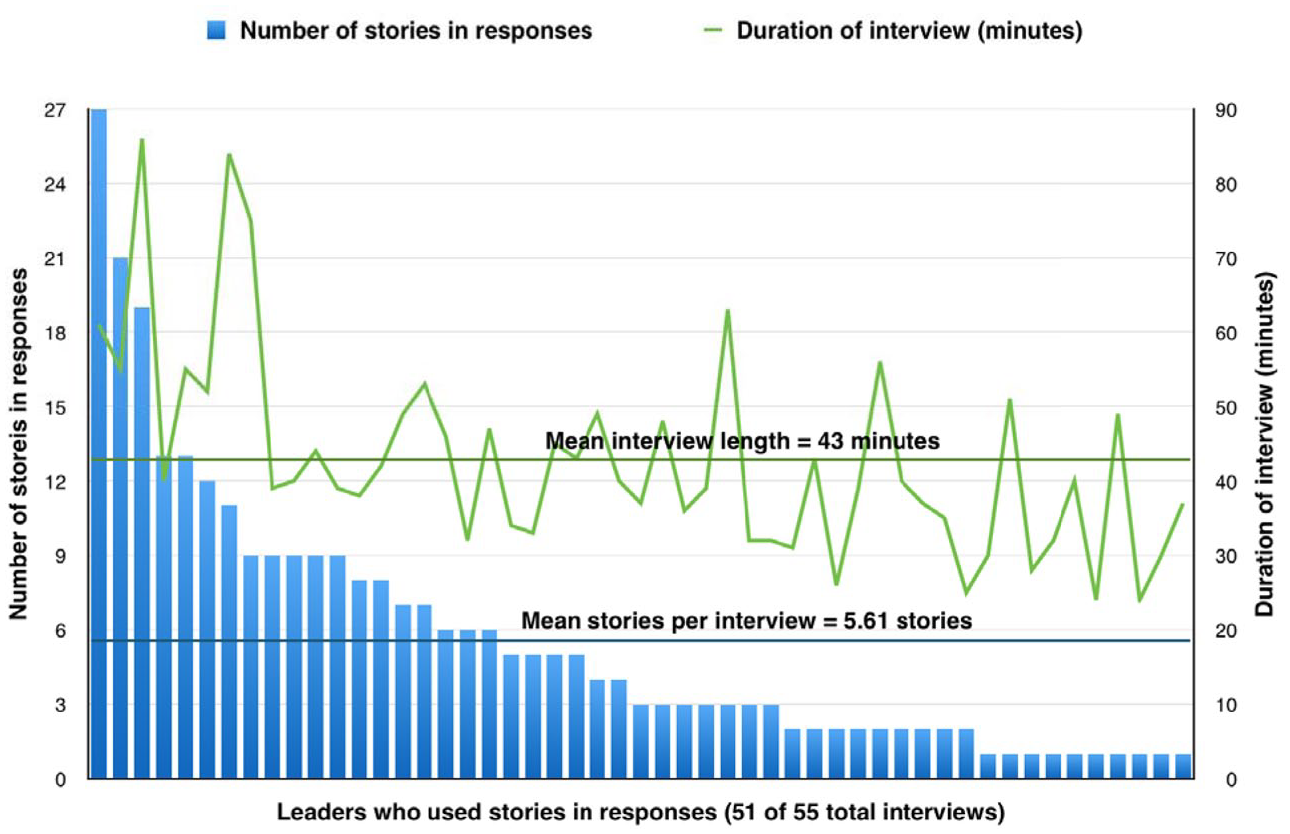
Number of stories in responses and duration of interviews (for the 51 leaders who used stories).
I should also note that the stories I identified from the data set are not distinctly differentiated from one another—various stories could reasonably fit into more than one of the story categories into which I grouped them. I did not design this study to probe the narrative elements of the stories leaders used in their sensemaking. Rather, the stories that follow serve to illustrate different ways leaders incorporated narrative forms into their sensemaking.
Canonical Stories as Referent for Comparison or Contrast
Leaders in my study used forms of shared narratives in various ways as they made sense of undocumented student access. Indeed, 29 of the 55 respondents (52.7%) to this study included one or more canonical stories in their responses. Leaders referred to community narratives such as the stories of the founding of their institutions, and they referred to more dominant cultural narratives such as the history of Catholic universities reaching out to the poor and disenfranchised. They referred to generic or stereotypical stories and story fragments about working with students—stories that often served as shorthand in their sensemaking—and they referred to novel stories against which to compare or contrast their own sensemaking. Several leaders also made use of counterfactuals—describing alternate potential realities—as referents for making sense of undocumented student access.
It is important to note that respondents did not necessarily tell me detailed stories in their responses. Though some did use very detailed narratives in answer to my prompts, especially when using canonical stories, more often leaders simply made reference to important shared narratives or other canonical story forms. Considering how the stories they told and referred to fit into their answers, we can better understand how those stories operate in their sensemaking.
Community Narratives
In their grappling with access for undocumented students, six leaders turned to important community narratives to aid their sensemaking. As explained above, community narratives are stories “common among a group of people. . . . [That] tell the members important things about themselves” (Rappaport, 2000, p. 4). To describe how her institution’s Catholic character relates to undocumented student access, a vice president of enrollment management referred to the experience of the priest who founded the religious community that would eventually establish her university: I would really go back to the time of [the founder] in the French Revolution and think about [him] living in exile and so could in some way somebody draw a parallel with [him] and somebody who’s undocumented. . . . If [he] or the others could come and speak to us now, I would think that they would say, “But these are all God’s children and we should take care of them and have them as part of our lay communities and continue to spread God’s word and help people explore their faith through doing this.”
Though this vice president did not give a detailed account of the story, she nevertheless referred to a narrative that is common within her university community to provide a frame for thinking about undocumented students; this shared narrative is important enough for her university community that she spontaneously referred to it as a referent to inform her thinking about a contemporary issue.
A vice president for mission at another institution shared a story that similarly related the founder’s charism to undocumented students. This laywoman explained as follows: For our particular charism as a [Catholic] institution, our founder was an immigrant himself. He was an immigrant from Italy and he had a remarkable sensitivity to the diversity of culture that he experienced in his day, what was then the frontier. So . . . in our formation programs with our faculty we often point to an educational program that he developed for native peoples that was in their own language, that was intended for not only the young—the children—but for the parents, and his insistence that their culture be respected. So I think in the tradition of our founder is also the responsibility for us to be as sensitive to the people who are threatened and at risk and to whom our present day government takes a punitive stance.
This leader describes how the story of the founder’s sensitivity to diversity is used in the ongoing formation of faculty in the university. My protocol did not contain measures to explore the salience of this story as a community narrative throughout the institution. The fact that the vice president included the story to elaborate on her institution’s Catholic character, however, and the fact that they use the story in the ongoing formation of university constituents suggests that it does function for them as a community narrative.
Dominant Cultural Narratives
In reflecting upon the ways that their universities’ Catholic character speaks to undocumented student access, numerous leaders referred to the dominant cultural narrative of Catholicism in the United States and throughout the world. The stories they told were generally broad and expressed one or more virtues that are foundational in Catholicism. Diversity was one such characteristic that leaders identified in the universal church and that they believed resonated with how we should consider dealing with the undocumented. A president explained as follows: We’re more naturally an international university because of our Catholicity. I mean you argue that the Catholic Church is, as they say often, the most diverse—nationally, culturally, ethnically—body in the world today. I mean there’s no more diverse. And so it’s sort of part of who we are to feel that people of different nationalities or different ethnic groups are part of us and so that goes to the issue of undocumented students, it goes to the issue of diversity, it goes to the issue of internationality—all that’s part of who we are. I mean I see this as a sort of rich fabric. These aren’t distinct areas but they’re all interwoven with one another, that nobody’s a stranger, that all are part of the Body of Christ. All human beings we live in solidarity with and so it grows naturally for who we are.
Leaders also referred to dominant cultural narratives at the national level, as opposed to the worldwide Catholic Church. A president described his initial response when first hearing of the issue of undocumented student access: I think my intuitive response was more to sympathize and to side with my colleague who was speaking to me that, of course, the Catholic universities—my understanding, in the United States—were founded in significant part to educate immigrants. And so it struck me that if we were talking about the role of a Catholic university [on] this issue we were probably more on the side of the angels to be enrolling undocumented students than not.
As explained by Gleason (2008), the historical narrative of Catholic higher education in the United States is very broad and takes many different shapes. Most colleges and universities were founded by religious orders—or were taken over by religious orders shortly after their founding—and most of the orders had been founded outside of the United States. The religious sisters, brothers, and priests who immigrated to the United States came chiefly to serve the immigrant populations of Catholics from various countries that had come to the New World. Catholic higher education did not exist solely to serve Catholics, however—some schools were founded by religious orders committed to serving the poor of any creed (or none whatsoever). Regardless of each school’s specific charism, nearly all Catholic colleges and universities have a history of serving immigrant populations.
Respondents also spoke about the Catholic Church’s commitment to serving the poor and the suffering as a lens through which to understand access for undocumented students. A vice president of enrollment management explained as follows: I’m very proud of our Catholic Church because I think in every case that’s ever been documented—and ever is a lot, and that’s an absolutism—when something happens in our world, you ask Democrats and you ask Republicans, who steps up to the plate? Historically, financially, humanistically in terms of power and service and whatnot, it’s been the Catholic Church, every disaster. And I hear that from lay people, from ardent Baptists, probably some Atheists and everything else who work at a United Way or work in this corporate arena and will say, “You gotta give it to those Catholics, man. You guys are on your game when it comes to a crisis, you’re right there.” And we’ve always been focused on the Rocky Balboas: those underprivileged, underserved, disadvantaged human beings who want to give them their title shot, give them their dream, give them an opportunity.
The narrative quoted here seems incomplete on its face and implies specific details and some of the elements that constitute a story. The vice president’s assertion nevertheless broadly describes a story of a value-driven response to crisis on the part of Catholics. That groundedness becomes not only a source of pride for this leader, but an inspiration that helps him understand how we should reach out to the undocumented. A director of financial aid echoed a similar sentiment: I mean the Catholics have been rescuing people—people who don’t fit into everything—and working with them for generations. So I think Catholicism has that history; so to me it’s very logical why they would not have a terrible bias against people who are here and have gotten in the wrong way.
Again, if we focus less on the narrative elements that are present or missing in this telling, and situate the story within the director’s response, it is clear that she was referring to a dominant cultural narrative of Catholic action that informs her thinking about undocumented students.
Stereotypical Story Fragments
A narrative form that appeared in numerous interviews was what we might call a generic or stereotypical story. These are stories not of specific incidents but of more general episodes, and the respondents usually left some of the details unspoken and implied. As noted by Rappaport (2000), dominant cultural narratives “are often communicated in shorthand, as stereotypes (welfare mother, college student, housing project resident) that conjure up well practiced images and stories” (pp. 4-5). An example of this story form comes from a vice president for mission who was describing why she cares about undocumented student access. She explained as follows: And that’s what keeps it real for me—not the politics, not the government, not anything else—it’s that individual that comes into this door and says, “I don’t have any money anymore, I’ve done all that I can do, and I can’t ask for federal monies ‘cause I’m undocumented. Can you help me?” That I will respond to. The other stuff I think is just too vast for me sometimes—honestly, it really is—and too complicated.
This story describes the kind of interaction the vice president has with undocumented students—not any specific student at any specific time or place, but the typical encounter she has with students seeking her intercession. We recognize some of the usual story elements here: a protagonist (the student), a beginning (the student comes to the door), a middle (the student is worried about lack of funding and asks for assistance), and additional characters (the vice president who may be able to offer assistance, the federal government which is unwilling to help). What we do not see here—at least not directly—is an ending. The ending we must infer, based on the vice president’s initial framing of the story. Because of how she set up the story, as the sort of interaction that “keeps [undocumented student access] real for her,” we can infer that she is motivated by these encounters with students to take action on their behalf.
It is important not to overlook how story fragments such as the one cited above operate in leader sensemaking. When she thinks about this issue that is complex, political, and difficult to solve it is the stories of interactions with the students themselves that offer her a way to understand it. She does not feel she has the tools or the influence to personally resolve the conundrum of access for undocumented students, but she is moved by her personal interactions to advocate on behalf of the people who knock at her door. For this particular administrator, the stereotypical story of the student at her door resonates with her own personal and family experience. She explains the context for the previous stereotypical story: Because I have a position of leadership in this institution, it doesn’t erase my experiences growing up in a Hispanic family. It doesn’t erase my grandfather coming from across the border; it doesn’t erase the struggles. I mean I’m very clear—my memory’s strong, and it’s good—but I think those memories, if it wasn’t for those memories, I’m not sure if I would be in a position to bring about change. And I do change one at a time because that’s how it was done when I was growing up. It was one at a time. If we look at the global problem, if we look at immigration in the country, I hear people say, it’s just too big, too vast, too complicated. What can one person do? And I always come back with, well let’s see if we can help this individual get through the cracks . . . let’s see if this individual can walk across a stage. She needs two more years; she needs three more years. How are we going to walk with this individual till they can finish?
The vice president’s own identity as a woman of Hispanic descent and her own stories of family struggles with immigration issues predispose her to pay attention to the individuals at her door. Though she is aware of the broader social cues that pertain to access for undocumented students (e.g., federal, state, and institutional policy), she more readily recognizes and extracts cues associated with individuals who need assistance. When she is spurred to reflect upon how she personally engages undocumented student access, she relates the issue to meaningful events in her own family history and describes the contemporary issue with the generic story of the student at her door. Her stereotypical story fragment serves, thus, as a representation of the dominant cultural narrative of immigration to the United States, which becomes a referent for making sense of the undocumented students in the modern day.
Other leaders used stereotypical stories in a similar fashion. A director of admissions described the reason for his compassion for undocumented students: And so it becomes interesting because these [undocumented] adults have children. What do you do with your children? Put yourself in their situation as, “My life is hard, I have to wake up at 5 a.m. and I have to do physical labor all the way till the sun goes down, but my child has to go to school. I want them to have a better life, not the life that I’m having right now, that’s why I came to this country.”
For this director, the stereotypical parent of an undocumented student is an adult motivated to work from dawn to dusk in order to provide a better life for his or her children. The director has distilled numerous encounters with parents of students into one stereotypical account or characterization of a concerned, devoted, hardworking person who, despite his or her best efforts, still needs assistance to help his or her children achieve something more. These multiple encounters are distilled and stored in the director’s experience as a single story that he tells himself and others to create empathy.
Novel Stories
Some leaders used novel stories—which were unrelated to undocumented students or even their own university leadership—as referents for comparison. A provost was explaining to me the relationship between America’s rich diversity and how we should treat undocumented students. He chose to tell me a story about some friends of his to illustrate the diversity of the United States. He recounted as follows: We have friends visiting from Australia right now . . . and [one of them] said something that was so simplistically profound the other night. He said, “You know in Australia . . . even though we have New South Wales . . . Australians are Australians. We’re pretty much the same. As large as our country is, we’re pretty much the same whether you’re in Perth or you’re in Sydney or you’re in Melbourne or Brisbane.” And he said, “But as we’ve traveled around”—and they love to travel—“the United States,” he said, “this actually is the United States of America.” He said, “Virtually every state, the people in this state don’t act like the people in this state or in this state or in this state or in that state. There’s nuances,” and he said, “but you’re united.” I mean that was profound to me. And it’s so true. So I think that for me, that’s the hallmark of who we are is recognizing the underpinnings of and the foundation of what this country was founded on and built on.
This provost could have simply referred to the notion of U.S. diversity—the image of the “melting pot” or an equivalent—to make his point. Instead, he chose to tell a story about the experience of friends visiting from another country. Why did he choose to use such a story to communicate his thinking? Perhaps the story was in his consciousness because the friends were visiting at the time of the interview. Or perhaps we can read in the story itself how impressed he was with his friends’ insight about the profound diversity in the United States. The juxtaposition of the diversity of the American people to the diversity of the Australian people provides a clear illustration of the point he wanted to make.
In addition, by putting the story on the lips of his Australian friend, the provost has recourse to increased authority—it is not merely he himself who is judging the diversity of the American society, but a foreigner from a country that is roughly equivalent in land mass but inferior in the diversity of its citizens, at least according to the speaker. The story of the interaction with his foreign friend thus serves as a helpful referent for the provost in his sensemaking about undocumented student access, and the story, though novel, is a type of canonical story inasmuch as it relates to the dominant cultural narrative of U.S. diversity.
Counterfactuals
According to Dannenberg (2008), “Counterfactual thought experiments about what might have been constitute a key form of human consciousness” (p. 3). This narrative form often appears in fiction, such as when a character imagines a different reality for herself, had she made different choices in the past. While in literature counterfactuals may be quite elaborate—describing alternate worlds in great detail that allow characters to transcend time and space—leaders in my study used them as brief stories against which to contrast the current state of affairs.
A prime example is the response of a financial aid director to my question about her intuitive response to undocumented student access. She replied as follows: Good. I’m glad that they do that; it’s probably wrong but I’m glad they’re in school somewhere. I don’t want uneducated, undocumented people in the country. To me, this whole issue of 12 million, approximately, people in this country—what if they didn’t want to be citizens? What if they wanted to be insurgents? I mean they want to be citizens. We should take the opportunity to allow them to become citizens so they can become taxpayers and be part of the system. We’re lucky they want to be citizens. They could be in here wanting to do evil and they aren’t. So I think that it’s stupid not to find a way to give them a way of becoming citizens.
This director offered the counterfactual worldview of a militant undocumented class to describe how fortunate we are that the millions of undocumented people in our country want to be productive members of society. It is much easier for her to be compassionate to these people when she considers “what might have been” in an alternate world. The counterfactual story here is limited—she does not go to great length to develop the consequences of the alternate reality. The simple consideration of an alternate potential reality is enough for her to frame how she views undocumented students.
Another leader referred cursorily to counterfactuals in his own story to illustrate how his education shaped the way he views undocumented students: My education taught me that what if I’d been an English major or a French major, would I have the understanding that I had as an econ. major? So that’s not really Catholic social teaching but what did I choose to learn in economics when I was here—I learned about Latin America, Third World—that’s why I chose not to go work for the World Bank. When I graduated, when I started, I thought I might go work for the World Bank, by my senior year I realized they were part of the problem, not part of the solution. They were part of the exploitation. So I think the Catholic social teaching taught me to care about that, don’t go work for the dark side.
In this example, the vice president of enrollment management briefly sets up an alternate personal reality in which he did not choose to study economics. The counterfactual story helps him recognize how the field of economics provides him with a unique lens for understanding undocumented students.
In sensemaking terms, this vice president is setting up a counterfactual identity for himself as an English or French major who would likely understand the issue differently. Because he chose to study economics, however, his identity as an economist shapes the way he frames the issue as one of exploitation. We can hear his sensemaking here as, “How can I know what I think until I see what I might have said?” He imagines how he might have related to undocumented students if his self-image and worldview had been shaped by a discipline other than economics. Though the exercise is tangential and very brief, it nevertheless puts his identity as an economist in relief and helps him understand why he sees the issue as he does. The alternate reality of life as an English or French major thus makes it possible for him to more clearly elaborate his perspective that our society exploits undocumented people for economic benefit.
How do counterfactuals serve as canonical stories? Though it may seem at first that counterfactuals are not canonical—after all, they are hypothetical, so how could their meaning be shared?—they do fit into our understanding of canonical stories. The counterfactual, as presented here, is meaningful because it represents an alternate reality in a way that relies on shared meaning and understanding for it to be effective. In the first instance above, the shared meaning revolves around the contrast between peaceful neighbors and violent insurgents. In the latter case above, the contrast is between a foregone potential life trajectory. In both of these instances, the average person will have little trouble understanding the canonical ideas set up in the hypothetical counterfactuals. The respondents know this intuitively, which may be why they used the counterfactuals to communicate their point.
Discussion
This study investigates the role of story in retrospective sensemaking. Though I designed the interview protocol to answer my primary research question: “How are leaders in Catholic universities making sense of undocumented student access,” I also listened in each interview for stories. In designing this study, I hypothesized that stories play a significant role in organizational sensemaking; I was able to identify the presence of canonical stories—alongside other story types—in participants’ responses.
Canonical stories appeared 54 times in this study in a variety of forms. Participants included community narratives and dominant cultural narratives, generic or stereotypical stories and story fragments, and counterfactuals in their responses to interview prompts. Their use of these canonical stories allowed them to draw on the meaning of the shared narratives without having to retell the stories and explain their significance. Some shared narratives served to support the messages leaders were communicating; others served to provide contrast against which respondents could embolden a point.
It is important to note that I did not prompt participants to share any stories (see the appendix, “Interview Protocol”). Any stories that appear in their responses, therefore, were spontaneously included by participants. As I did not design this study to explicitly investigate how studies appear in responses—I simply listened for stories in responses—my analysis is mostly limited to descriptions of how the stories appeared and how participants seemed to be using them. Nevertheless, the fact that certain types of stories appeared in different ways in the interviews does help us understand something about how stories operate in organizational sensemaking. Canonical stories, in particular, appeared in interesting ways.
As I have stated repeatedly above, I did not design this study to investigate how stories function in organizational sensemaking. Though there is some disagreement among scholars about how stories fit into sensemaking, including those who argue sensemaking has traditionally made no room for narrative (Boje, 2008), on the basis of the sheer number of stories I identified in my data (286 instances), I am confident that story plays a significant role in how we make sense of the world around us. Due to the constraints of my study design, I offer mostly descriptive comments about how stories fit into sensemaking; these comments are nevertheless grounded in the substantial data I collected.
Stories Are Interesting
The mean interview length in my sample was 43 minutes. For most leaders, the bulk of their interviews were devoid of much emotional investment. These top leaders in higher education are busy people with busy schedules and they seemed to be trying their best to faithfully answer my questions without unnecessarily extending the interviews. There was one striking exception to this general norm, however—in every instance of storytelling in the interviews, the leaders’ affect changed noticeably. Smiles replaced stoic glances, furrowed brows softened, and leaders leaned forward in their chairs as they recalled meaningful episodes from the past. On several occasions, leaders were moved to tears by the stories they related.
An example of the raw power of stories for respondents came from a provost who, in response to the question, “Has your thinking on the issue changed since you first encountered it?” responded with a lengthy story about his ongoing interaction with a student from a very poor background. The student had asked for a meeting in the early weeks of a class taught by the provost; in the course of the conversation, the provost interrupted the student to summarize his thinking by stating, “Education is power.” The student looked back at the provost and said, “No. Education is freedom.” Both the tears on his cheeks and his slowed tempo in the retelling indicated that this story had not only been important to the provost in the past—it remained meaningful, continuing to teach and inspire him. It was clear throughout the interviews that the most meaningful information was characterized by some sort of narrative framing. Not all episodes were complete stories—some were story fragments or shorthand—but narratively structured information consistently piqued respondents’ interest.
Stories Transcend People and Situations
Perhaps another reason stories were so meaningful to leaders in my study is that the stories transcend people and situations. As Bruner (1990) argued, stories include the following characteristics: agentivity, sequential order, canonicality, and a narrator’s perspective (p. 77). Unlike intellectual arguments that can often stand on their own, stories require agents and a narrator’s perspective. From Bruner’s perspective, the stories then become placeholders that symbolize the tragedies and triumphs of their owners; the agents themselves may retell their stories as may others who did not take part in the tales. In retelling stories that belong to others, storytellers can conjure up many of the same responses from listeners as the agents themselves could in the original telling.
Canonical stories, in particular, are characterized by this transcendence. These shared narratives belong not to the storyteller, but to groups of people, of whatever scale. Some of the canonical stories told by respondents were specific to their institutions, such as the story told by the vice president of enrollment management about the priest who founded her university. That priest’s time spent in exile is a commonly known community narrative at the institution to which the vice president and her fellow decision makers could refer when making sense of the volatile issue of undocumented student access. Though the priest’s exile did not directly answer the question of how to make sense of the issue, it provided important and shared meaning that communicates the deeply held values of the university.
Stories Are Symbolic
Much of the utility of canonical stories resides in their ability to draw from a pool of shared meaning and understanding (Rappaport, 2000). Storytellers only use canonical stories effectively if listeners easily understand the referenced meaning. Absent this shared understanding, canonical stories become simple tales. If, however, all parties to a story have access to the shared meaning, canonical stories can become quite powerful tools for storytellers and listeners alike.
Even stories that do not have access to a commonly accepted and shared meaning, however, may still exhibit some of the symbolic power of canonical stories. Respondents in this study repeatedly used stories that symbolized meaning and events for them. A president, for instance, described encountering a student riding his bicycle to school in a deep snow—she explained how that student came to symbolize for her the tremendous struggle for education and the substantial grit of so many undocumented students. Simply referring to that snowy morning encounter allows her to encapsulate significant meaning in one symbolic story, a story she has told over and over again as she has worked to serve the undocumented students in her community and across the country. This anecdote offers considerable utility to the storyteller and becomes a shorthand for communicating that meaning to others, especially as the story is repeated again and again, which, of course, leads to it becoming a canonical story for those who repeatedly hear it.
Stories Enable Retention
Given the ways respondents used canonical stories in their responses, we might consider their place in sensemaking itself. If we turn to Jennings and Greenwood’s (2003) model of organizational sensemaking (see Figure 2), we see that some ecological change triggers the need for more explicit sensemaking. Even in the immediate sensemaking impulse, the actor introduces variation into the environment—this is enactment. As the sensemaker retrospectively extracts cues, he or she goes through a process of selection in which the new information is bracketed and simplified. Finally, the sensemaker filters the bracketed data through the lenses of his or her own sense of personal identity, in plausible terms, and retains the new meaning. The process is not strictly linear, though it does have a beginning—some ecological change—and an end—the retention of some new meaning. The model illustrates various loops that signify the ongoing nature of the sensemaking process and the impact of various sensemaking processes on one another.

Conceptual model of sensemaking in organizing processes.
Retention is located at the far right side of the model. Though sensemaking is ongoing, retention happens later in the process as sensemakers process what they have sensed and assign meaning to it. If the extracted cues are not infused with this meaning, or are not striking or remarkable on their own, they will likely be lost to memory (Bruner, 1990). Stories thus seem to fit best into the retention phase of sensemaking. The canonical stories leaders told in their interviews were done changing and their meaning was fixed—this is a key characteristic of canonical stories that allows them to serve as shorthand for communication and sensemaking. Canonical stories seem, thus, to fit best in the retention phase of sensemaking as people bring an element of emplotment, a sense of plausibility, and an understanding of their identity to what may earlier have simply been various extracted cues. As they are assigning meaning to the cues they have extracted—to store that meaning away, or, in the case of leaders exercising leadership, to communicate that meaning with others—they may refer to canonical stories to grant access to collective meaning in organizations. These shared narratives, with their recourse to key, symbolic values in institutions, then help the sensemakers pull together the sensemaking process.
Canonical Stories and Volatility
It is important to keep in mind the environmental volatility surrounding undocumented student access in the United States. As recent studies have shown (Patler et al., 2019; Ramos et al., 2019), immigration issues in the United States are highly politicized in the present day, including undocumented student access to higher education. This volatility raises the stakes for leaders who are sensitive both to protecting their institutions and the students they serve. This environmental instability provides important relief for the functioning of canonical stories in sensemaking.
In the absence of clear organizational policies and procedures, and without clear guidance from others, such as the government, leaders in higher education have fewer resources at their disposal for making sense of undocumented student access to their institutions. With the spectre of serious consequences if they make mistakes—the deportation of undocumented students, the loss of federal funding, and so on—respondents found themselves looking more deeply for sources of meaning to help them make sense of the issue. Canonical stories provide just this sort of enduring, settled meaning as a resource in such volatile settings. Perhaps this is why, in the absence of policies or procedures for addressing the issue, numerous respondents used stories of institutional foundings, famous former institutional leaders, or long-held institutional values to inform their thinking about undocumented students. Though this study was not designed to interrogate the role of canonical stories, it raises interesting possibilities for future research that might examine their role in sensemaking in volatile environments.
Implications for Theory, Practice, and Future Research
This study has a number of implications for theory, practice, and future research.
Narrative Framing of Leadership
If we agree with Pye (2005) that “To understand leadership as a sensemaking process helps illustrate more clearly what happens in the daily doing of leading” (p. 31), and if we accept the narrative framing of sensemaking suggested in this study, then we can come to frame leadership itself in narrative terms. This idea is not novel in the leadership and sensemaking literature. Boje (1991) argues, “In organizations, storytelling is the preferred sense-making currency of human relationships among internal and external stakeholders” (p. 106). Scholars have examined the presence of stories in various leadership contexts, including organizational identity construction (Humphreys & Brown, 2002), organizational restructuring (Balogun & Johnson, 2004; Maitlis & Sonenshein, 2010), and in leadership role negotiations (Kelley & Bisel, 2014). Beyond simply understanding it from a theoretical perspective, leaders may stand to reap various benefits by framing their own leadership in narrative terms.
When leaders experience an interruption that spurs more intentional sensemaking, they might encourage themselves to ask, “What’s the story here?” This causes them to enter into a narrative framing of the sensemaking process from the very beginning. Understanding their sensemaking in narrative terms allows them to investigate the elements of story. From this perspective, leaders may look beyond the simple cues they extract from the environment and seek to understand them as parts of a larger narrative whole. This perspective also serves to concretize for leaders their roles among the chief storytellers in their organizations, those responsible for retelling important organizational stories and encouraging constituents to continually consider the bearing of an institution’s foundational values on the issues at hand. Finally, framing their leadership in story terms helps leaders better appreciate that their leadership consists not of dealing with impersonal issues, challenges, and opportunities, but with real people who are actors and agents in a variety of stories.
Canonical Stories and Narrative Shorthand
The sensemaking literature includes numerous considerations of how narrative operates in sensemaking: describing sensemaking broadly as the process of creating meaningful narratives (Polkinghorne, 1988), naming storytelling “the preferred sense-making currency” (Boje, 1991, p. 106), exploring how narrative operates in the shared sensemaking of team members (A. D. Brown et al., 2008; Humphreys & Brown, 2002), and examining “organizational change as an unfolding set of narratives, inevitably shaped by power relationships” (Maitlis & Sonenshein, 2010, p. 571). With the exception of Joan Lucariello’s (1990) related work on children’s development of language, however, none of the sensemaking research considers the role of canonical stories in sensemaking. The limited results of this study suggest the potential of future research to further explore the role of canonical stories in retrospective sensemaking. I ultimately identified 54 instances of canonical stories—some told in long form and others used as narrative shorthand—suggests that canonical stories may play an important role in retrospective sensemaking, perhaps especially during the retention phase. Future research could build on the research on shared narratives (Rappaport, 2000) and narrative shorthand and stereotypes (Salzer, 2000) to strengthen our understanding of how canonical stories work to organize experience.
Limitations
This study includes a number of limitations. First, I restricted the sample to Catholic colleges and universities. While Catholic institutions experience some freedom from legal requirements that their public peers do not, their Catholic character influences their thinking on undocumented student access. Second, the fact that all institutions in my study had a relatively welcoming stance toward undocumented students also limits the findings. Had I been able to identify one or more institutions that were not welcoming to undocumented students, responses may have been more diverse.
Another significant limitation of this study is its dual purposes. I shaped the interview protocol primarily to answer the first research question, exploring how leaders are making sense of undocumented student access. The findings that address the second purpose, identifying the role of stories in leader sensemaking, come chiefly from my own observations within the interviews. Though there were some clear differences in the types of stories leaders told and in the ways in which the stories seemed to function within interviews, I am not able to tie those observations back to my study design. If I choose to study stories in sensemaking in the future I will be more intentional about crafting a protocol and study design that is more methodologically robust.
Also limiting this study was my decision to restrict my sample to Catholic university leaders. Had I included non-Catholic institutions as a control I might have come to a better understanding of what is unique about leader sensemaking in Catholic universities. There were benefits of restricting the sample—I was able to explicitly explore the effect of Catholic values and organizations on leader sensemaking. I would consider including a control group in similar future studies, however, to allow for comparison and contrast between leaders at different universities.
Footnotes
Appendix
Author’s Note
This article is original and is not under consideration or published elsewhere, except in my dissertation from which it has been adapted. The dissertation is titled: What’s the story here? How Catholic university leaders are making sense of undocumented student access.
Declaration of Conflicting Interests
The author(s) declared no potential conflicts of interest with respect to the research, authorship, and/or publication of this article.
Funding
The author(s) received no financial support for the research, authorship, and/or publication of this article.
