



Abstract
As a widely practiced form of corporate social responsibility (CSR), cause-related marketing (CRM) programs have been considered effective in generating reputational, relational, and financial returns for companies. This study examines a new form of CRM: choice-of-cause programs, in which companies empower consumers to determine which social causes to support. Based on self-determination theory, reputation management literature, and CSR research, this study proposes a conceptual framework that theorizes the effectiveness of the choice program, mapping out consumers’ psychological experiences and consequential attitudinal and behavioral intention responses toward companies and their nonprofit partners. Results of an online experiment offer partial support to the framework. They showed the relative advantage of the choice program over traditional cause-without-choice practice and highlighted the importance of creating an autonomy-supportive CSR program environment where consumers can exercise self-determination. Furthermore, results demonstrated the crucial role of corporate reputation in influencing consumer responses in CSR programs.
Keywords
As a widely practiced form of corporate social responsibility (CSR), cause-related marketing (CRM) is a fundamental component of business communication because of its contribution to corporate reputation, relationships with stakeholders, and financial bottom line (Smith, 2017). It is defined as a type of marketing activity “characterized by an offer from the firm to contribute a specified amount to a designated cause when customers engage in revenue-providing exchanges that satisfy organizational and individual objectives” (Varadarajan & Menon, 1988, p. 60). As consumers become more socially conscious, CRM activities grow exponentially (Howie et al., 2018). Responding to this growth is a burgeoning stream of academic research in the fields of business communication, advertising, and marketing dedicated to examining the antecedents, processes, and effects of CRM (Guerreiro et al., 2016). This body of literature reveals a critical trait of CRM: Companies predetermine most aspects of such activities (e.g., determining the benefiting social causes), while the participatory role of consumers is limited to product purchase (Kull & Heath, 2016).
This trait of CRM has recently been criticized by scholars as it signifies a lack of communication and dialogue with consumers to cocreate values (Morsing & Schultz, 2006). This concern has become increasingly pressing as industry reports showed that a majority of consumers desired to select their own social causes and become “cause shareholders” in CSR campaigns (Cone Communication, 2008). Driven by this concern, companies are starting to give consumers a more active role in the process of creating value through a new form of CRM: choice-of-cause campaigns. In a choice-of-cause campaign, companies empower consumers to determine which social causes to support from a list of available causes (Robinson et al., 2012). In other words, the term “choice” emphasizes consumers’ choice or decision-making power in CSR. Choice-of-cause campaigns therefore represent corporate provision of such choice (Kull & Heath, 2016). They differ from traditional CRM, wherein the cause beneficiaries are determined by the companies rather than the consumers. An example of this new CRM practice comes from Working Assets, a San Francisco-based telecommunications service provider. The company encouraged consumers to choose a cause from a list of three to receive donations in its monthly CSR campaigns. Other larger companies such as Suntrust Bank, J. Crew, and Gucci also integrate similar choice-of-cause campaigns into their CSR agenda.
While the positive impact of CSR/CRM and the benefit of consumer participation in general corporate activities have been demonstrated in business communication literature, the effectiveness of consumer choice campaigns remains largely unexplored (Ruiz de Maya et al., 2016). To fill this void, the present study aims to (1) test its effectiveness and (2) examine the underlying psychological mechanism that explains its effectiveness. Additionally, this study intends to (3) identify the boundary condition (i.e., corporate reputation) that determines when such campaigns are beneficial and when they become counterproductive.
Toward these purposes, a conceptual framework on choice-of-cause effects is proposed from the consumers’ perspective. The framework is grounded in theoretical insights from multiple disciplines including social psychology (i.e., self-determination theory [SDT]), reputation management, and CSR literature. It is tested through an online experiment among 109 U.S. consumers. Results of this study advance business communication scholarship on the topics of CSR and consumer participation. They also provide valuable consumer-based insights that can guide businesses on how to effectively design CSR campaigns by engaging consumers in the value cocreation process.
Traditional Cause-Related Marketing Versus Consumer Choice-of-Cause Marketing
In traditional CRM, the power of decision making pertaining to CSR resides inside a company—the company decides on which social causes to support and how to support them (Kull & Heath, 2016). Consumers are only passive receivers of these decisions as they make purchases and benefit firm-determined causes. This process, from the making of CSR decisions to the finishing of CSR initiatives, signifies a power imbalance between the company and its consumers (Kull & Heath, 2016). It represents the company’s one-way communication to its consumers about CSR (Morsing & Schultz, 2006).
In contrast, consumer choice-of-cause campaigns are a form of participatory CSR (Howie et al., 2018). They represent a process of value cocreation between firms and consumers (Ruiz de Maya et al., 2016). The cocreation process, as a business model, has been widely practiced and well-studied in fields outside CSR (e.g., product cocreation; Hsieh & Chang, 2016). However, it has not been popularized in the domain of CSR until recently (Robinson et al., 2012). According to Morsing and Schultz (2006), involving consumers in the process of coconstructing corporate CSR efforts is essentially engaging them in two-way communication about CSR. Instead of imposing a particular initiative on consumers as in traditional campaigns, consumers participate in CSR and suggest corporate actions such as which social causes to support. By empowering consumers to determine the benefiting causes and thereby direct corporate resources (e.g., a percentage of product sales) to these causes, companies shift more decision-making power to consumers (Tao et al., 2018). This value cocreation or two-way communication process is particularly important in the current market environment where consumers increasingly demand empowerment by and interaction with companies (Botan, 2018).
The end results of consumer choice campaigns are likely to be positive. Among a handful of studies that examined such campaigns, Robinson et al. (2012) showed that CSR with choice outperformed CSR without choice in generating positive company attitudes, purchase intentions, and donations to nonprofits. They also found that consumer choice compensated for a critical weakness in some traditional campaigns—a poor fit between the company and the cause selected by it. Similarly, Howie et al. (2018) supported the advantage of choice over no-choice campaigns in cultivating consumers’ CSR involvement and future participation intention.
Given the benefits of the choice-of-cause campaigns and the growing trend of engaging consumers in the value creation process, it is critical for businesses to develop a deep understanding of consumers’ psychological experiences in these campaigns to maximize CSR effectiveness. However, business communication literature has been largely silent on the psychological drivers, processes, and outcomes associated with choice-of-cause. To fill the gap, this study draws on SDT from social psychology (Deci & Ryan, 2000) and proposes a conceptual framework centering on consumer motivation for CSR engagement.
The Proposed Conceptual Framework on Choice-of-Cause
The fundamental assumption of the proposed framework (Figure 1) is that autonomy-supportive factors (e.g., corporate provision of cause choice) can invigorate and sustain consumer intrinsic motivation for CSR engagement whereas controlling factors (e.g., corporate determination of causes) can curb such intrinsic motivation (Deci & Ryan, 1987). These divergent effects occur because autonomy support fulfills while controls frustrate the three basic psychological needs among consumers: autonomy, competence, and relatedness (Deci & Ryan, 2000). Only when these three needs are satisfied would consumers be intrinsically motivated to engage in CSR initiatives and internalize the psychological values of their CSR engagement (Gagné, 2003). This process is believed to maximize the positive outcomes for companies as well as for cause beneficiaries. In addition, the conceptual framework posits that CSR with choice is more likely to produce positive gains than traditional CSR without choice. However, the advantage of choice is not invariant. Instead, it can become a disadvantage depending on where the choice is situated. Some contextual factors, such as corporate reputation, will influence consumers’ interpretation of corporate provision of choice, such that offering choice is considered controlling and therefore backfires (Kull & Heath, 2016). In the following text, this study will elaborate on the specific predictions outlined by the framework.
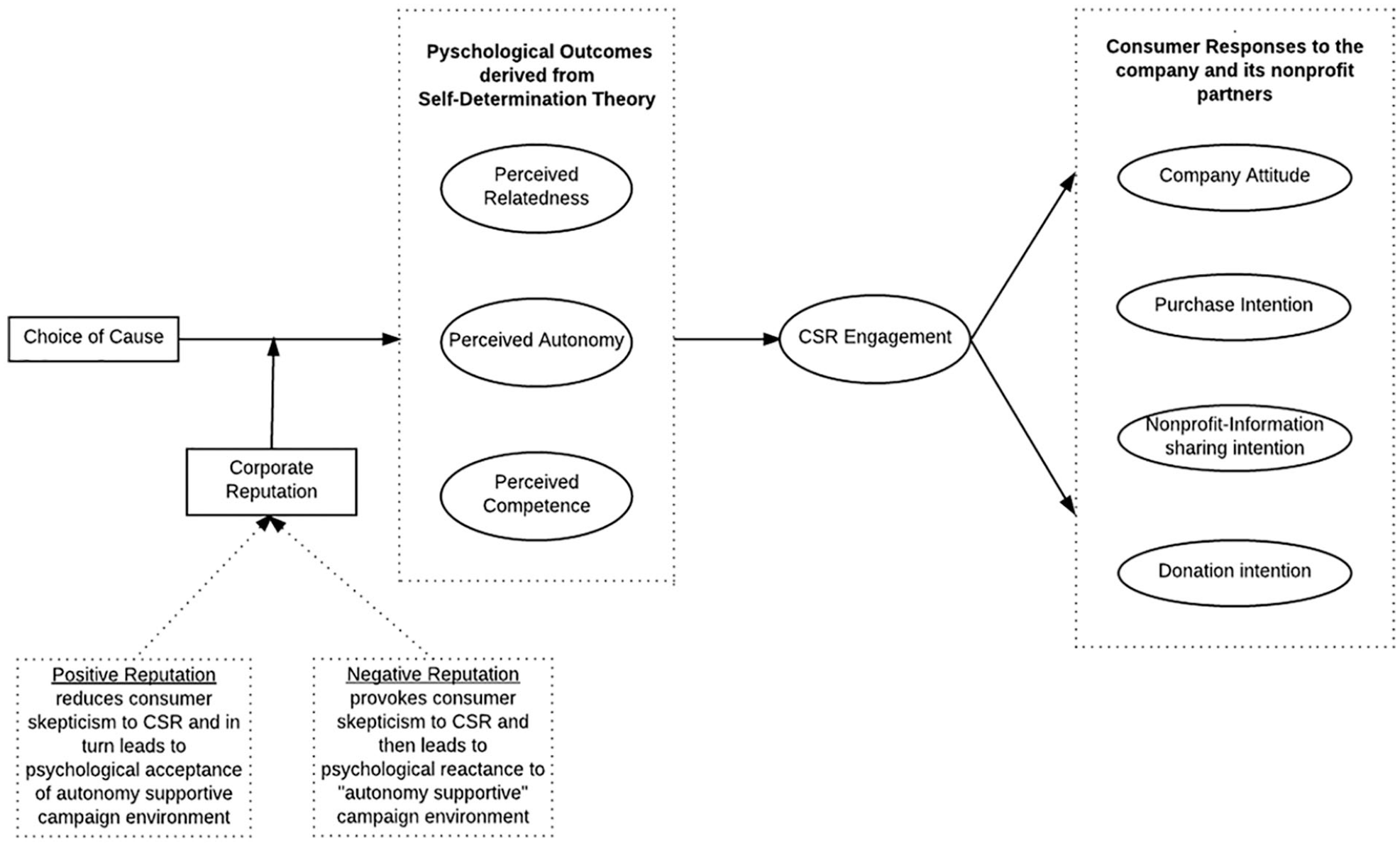
The proposed conceptual framework on choice-of-cause.
Choice-of-Cause Effects
One major proposition of our framework is that choice-of-cause campaigns would generate greater CSR engagement from consumers than traditional cause-without-choice campaigns. As a crucial construct in consumer-oriented CSR literature, CSR engagement refers to a positive affective-motivational-behavioral state of involvement and immersion in CSR activities (Devin & Lane, 2014; Kull & Heath, 2016). To date, only a limited number of studies have examined the impact of consumer choice on CSR engagement (e.g., Kull & Heath, 2016). Among these studies, even fewer have provided theory-based explanations for this effect. To fill the void, this study draws on insights from SDT.
According to SDT (Deci & Ryan, 2000; Ryan & Connell, 1989), motivation behind any intentional act differs by its degree of volition. That is, any motivation and its manifest outcomes can locate somewhere on a continuum anchored by “being controlled” on the one end to “being autonomous” on the other end. From an attributional perspective, controlled behaviors are characterized with an external locus of causality: their enactment is not at all reflective of one’s integrated self; instead, they serve as functional means to obey or adapt to environmental demands. On the contrary, autonomous motivation prompts behaviors that are emanated from one’s true self and experienced as self-chosen. With an internally perceived locus of causality, autonomous behaviors tend to reflect one’s personal values and interests. Furthermore, SDT argues that it is crucial to cultivate autonomous motivation through ways such as developing an autonomy-supportive environment. The reason behind this is that contrary to controlled motives, autonomous motives have been repeatedly found to generate positive outcomes including greater psychological and behavioral engagement as well as persistence.
The motivational divergence between autonomy and control as emphasized by SDT (Deci & Ryan, 2000) is particularly useful in informing the current research. To elaborate, in a choice-of-cause campaign, consumers experience an autonomy-supportive environment for their prosocial behaviors. This is because they are able to freely select social causes from a set of given causes as campaign beneficiaries according to their own will (Robinson et al., 2012). Such autonomous prosocial behaviors reflect consumers’ intrinsic values and interests with respect to societal issues. Motivated by this autonomy support in the choice campaign, consumers enact an active role in the donation process, which promotes their engagement in the campaign (i.e., CSR engagement; Robinson et al., 2012). Additionally, it is worth noting that consumer choice in such campaigns “is not only about providing help to a specific charity [i.e., the specific social cause selected by the consumer] but also about the act of opting for a cause and being part of the donation process” (Robinson et al., 2012, p. 127). That is, regardless of the characteristics of the selected social cause (e.g., perceived cause importance by consumers, company-cause fit), “the act of choosing enhances consumers’ personal role in helping the cause” (Robinson et al., 2012, p. 127, italics added). This enhanced perception of consumers’ personal and active role contributes to a sense of consumer control and autonomy, which is essential to boost their CSR engagement (Kull & Heath, 2016). In contrast, a traditional CRM campaign does not allow choices. The cause beneficiaries are determined by the companies (i.e., external agents) rather than by consumers themselves. This means that autonomy support from the companies is relatively absent. Instead, a high level of corporate control permeates the campaign process (Kull & Heath, 2016). As a consequence, the outcomes of the campaign may be incongruous with consumers’ inner interests and intentions. Hence, consumer CSR engagement becomes limited. Simply put, this study predicts that consumer choice-of-cause campaigns will generate greater CSR engagement than cause-without-choice campaigns.
It is important for businesses to consider the construct of consumer CSR engagement along with its major antecedents such as autonomy support (i.e., consumer choice) that may facilitate such engagement (Devin & Lane, 2014). This is because a wide array of desirable outcomes would occur to both the company and the cause beneficiaries when consumers are deeply engaged with the company’s CSR initiatives. For example, CSR engagement has been found to promote consumers’ positive attitudes toward the company and their product purchase intention (Sen & Bhattacharya, 2001). In addition, with greater CSR engagement, consumers are more likely to support the causes such as actively sharing cause-related information and making donations (Lichtenstein et al., 2004). Consistent with these prior insights, this study expects that greater CSR engagement will generate more positive consumer responses, including more favorable company attitude, greater purchase intention, and greater intention to share information about and donate to the nonprofits.
Need Satisfaction as the Process Explanation
Another main prediction of this study is that the differing effects of allowing choice versus no choice-of-cause on CSR engagement would be mediated by consumers’ perceived satisfaction of three basic psychological needs: autonomy, competence, and relatedness. Apart from the distinction between autonomous and controlled motivation discussed previously, SDT also posits that human beings have basic needs for autonomy, competence, and relatedness (Deci & Ryan, 2000). Autonomy refers to the degree to which one experiences “choice and volition in one’s behaviour and to the personal authentic endorsement of one’s activities and actions” (Milyavskaya & Koestner, 2011, p. 387). Competence reflects feelings of effectiveness in one’s efforts and the ability to achieve desired outcomes (Deci & Ryan, 2000). Relatedness involves feelings of connection and closeness with one’s surroundings (Deci & Ryan, 2000). These needs are as important to our psychological growth as food and water to our physical growth (Pavey et al., 2011). Hence, contexts that help fulfill these needs would enhance one’s enjoyment of activities initiated in these contexts, which would in turn lead one to actively seek similar contexts in the future to initiate activities alike (Hsieh & Chang, 2016). In other words, “when a particular need is satisfied, this may lead to further engagement with experiences that satisfy that need (Ryan & Deci, 2000a)” (Pavey et al., 2011, p. 905).
Following the SDT precepts above, the autonomy-supportive environment provided by companies in a choice-of-cause campaign is one type of context that helps increase consumers’ basic need satisfaction for autonomy, relatedness, and competence. With choices, consumers can select causes from a cause set according to their own interests and values rather than obey the company’s decisions. In other words, the presence of choice would increase consumers’ perceived satisfaction of the autonomy need. Meanwhile, in a choice-of-cause campaign, consumers experience their connections with the larger society because they are helping others in need (Weinstein & Ryan, 2010). That is, the campaign to some extent allows consumers to strengthen their social relationships and develop a sense of belonging to their communities, which would facilitate their need satisfaction with respect to relatedness (Ryan & Deci, 2000). Furthermore, CSR campaigns with consumer choices would help fulfill consumers’ need for competence in that consumers are able to make positive social changes and achieve their prosocial goals (Weinstein & Ryan, 2010). In short, only when these three needs are better satisfied would consumers appreciate and internalize the value of doing prosocial activities and thereby engage more in CSR campaigns. This increased CSR engagement would eventually bring favorable attitudinal and behavioral outcomes for the company and the supported causes. Thus, synthesizing the above discussion, this study proposes:
Note that consumer responses in this hypothesis and the following hypotheses include (1) company attitude, (2) purchase intention, (3) intention to share nonprofit-related information, and (4) intention to donate to the nonprofits. 1
Corporate Reputation as the Moderator of Choice-of-Cause Effects
CSR campaigns, with or without consumer choice of cause, do not occur in a vacuum. One contextual factor, corporate reputation, has been repeatedly documented in CSR literature as a crucial cue for consumers to evaluate the motives behind a company’s CSR campaigns and thereby affect their campaign experiences (Tao & Ferguson, 2015). Corporate reputation refers to “a collective representation of a firm’s past behaviour and outcomes that depicts the firm’s ability to render valued results to multiple stakeholders” (Fombrun et al., 2000, p. 243). A positive reputation signals desirable corporate characters (Barnett & Leih, 2018). When a company has a positive (vs. negative) reputation, consumers tend to attribute more altruistic, society-serving motives to the company’s CSR activities (Bae & Cameron, 2006), show more favorable attitudes toward the company and its CSR efforts (Rim & Song, 2013), demonstrate greater intention to purchase its products (Lii & Lee, 2012), and support its partnership with nonprofit organizations (Rim et al., 2016). Given the importance of corporate reputation in impacting consumers’ CSR-related evaluations, this study predicts a moderating role of corporate reputation on the effects of choice (vs. no choice) of cause.
As noted previously, abundant CSR research (e.g., Y. Kim, 2014; Yoon et al., 2006) has shown that when a company has good standing, consumers would believe that the company’s CSR efforts are made out of the firm’s sincere intention to give back to the society rather than any disguised intentions such as profit-making and image-building. This robust finding can be explained by attribution theory (Weiner, 2012), which suggests that people tend to be less suspicious about intent if one’s behavior is consistent with his or her past action (Rim et al., 2016). In the current context, a company’s commitment toward doing good through choice-of-cause campaigns is in line with its previous record of being a reputable member of society. Thus, consumer distrust or skepticism toward such campaigns is limited. In other words, consumers will not be suspicious about corporate motives behind its provision of choice in selecting the benefiting causes; they will be more receptive of corporate sharing of decision-making power in the choice campaigns. The absence of skepticism allows the effects of choice-of-cause discussed earlier to emerge (Ruiz de Maya et al., 2016). That is, when allowed to determine the benefiting causes, consumers will experience greater fulfillment of autonomy, competence, and relatedness needs, and greater CSR engagement, which will eventually lead to more favorable responses toward the company (company attitudes and purchase intention) and its nonprofit partner (intention to share information about and donate to the nonprofit). This positive chain effect will be weaker, however, when consumers are not given the opportunity to select which causes to support (i.e., firm-determined causes). To sum up, we expect that:
In contrast, when a company has a bad reputation, consumer skepticism toward its CSR would be high (Elving, 2013). This is because the company’s efforts to promote societal well-being is incongruent with its previous unfavorable standing in society (Tao & Ferguson, 2015). According to attribution theory (Weiner, 2012), this inconsistency prompts people to suspect the validity of the company’s action and question the sincerity of its prosocial involvement (Tao & Ferguson, 2015). With a high level of skepticism, consumers tend to develop avoidance and reactance toward the firm and its CSR (Yoon et al., 2006). They are more likely to consider the CSR campaigns, both choice-of-cause and cause-without-choice, as the company’s persuasive attempts or behavioral-inducing tactics to fulfill its image-building and profit-making purposes (i.e., self-serving motives; S. Kim & Lee, 2012). As such, consumers become guarded and wary when exposed to its CSR information and attempt to distance themselves from its manipulative marketing tactics (Friestad & Wright, 1994).
Particularly, in a choice-of-cause campaign, consumers are asked to further engage with the company through elaborating on social cause options, immersing in the decision-making process of cause selection, and establishing a shared ownership of the CSR initiative with the firm (Kull & Heath, 2016). The combination of these requests are likely to surpass consumers’ tolerance threshold (Howie et al., 2018). Consumers may feel that their freedom to distance themselves from the company’s persuasive attempts is restricted (Kull & Heath, 2016). This threat to freedom prevents them from feeling as an autonomous agent during campaign participation. It also diminishes perceived relatedness and competence, given that a lower level of felt autonomy has been found to trigger reduced feelings of relatedness and competence (Deci et al., 2001). To reaffirm their freedom, consumers tend to modify their attitudes and behaviors in a way that is undesirable for the company (Edwards et al., 2002). This means, consumers would develop a lower level of CSR engagement and thereby less favorable responses toward the company and its CSR initiatives involving the nonprofit partners. Comparatively, a cause-without-choice campaign to some degree allows consumers to distance from further involvement with the company because it does not require them to immerse in the decision-making process of cause selection and partner with the firm in cocreating such a campaign (Kull & Heath, 2016). As a result, it may work better than the choice campaign.
Method
An online experiment was conducted to test the proposed hypotheses. The experiment had a 2 (choice-of-cause: consumer-determined vs. firm-determined) × 2 (corporate reputation: positive vs. negative) between-participant design. A total of 109 U.S. consumers were recruited via Amazon Mechanical Turk (MTurk) and rewarded with $1.60 each. They were randomly assigned to each experimental condition (see Table 1).
Means and Standard Deviations of Mediating Variables and Dependent Variables (N = 109).
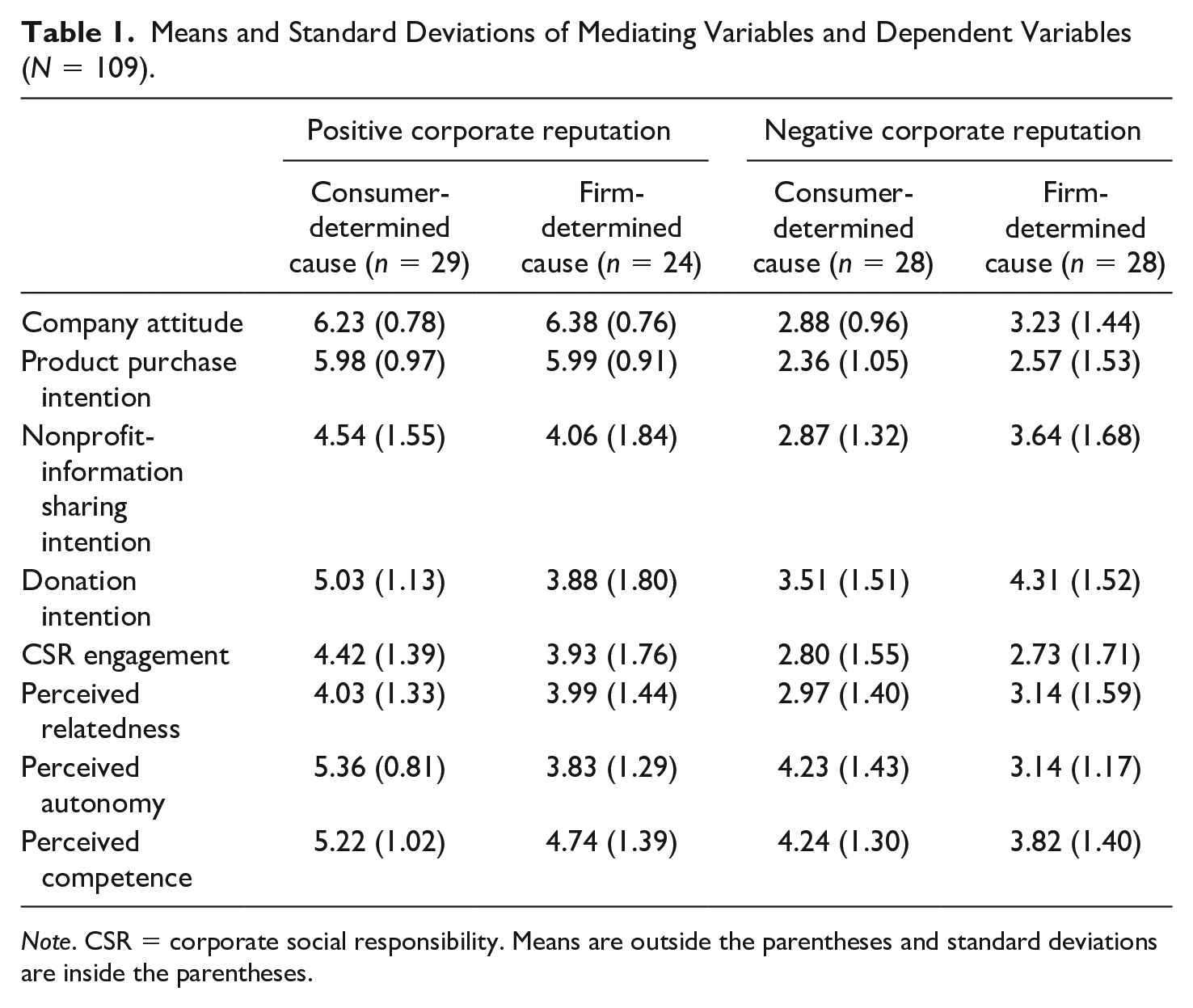
Note. CSR = corporate social responsibility. Means are outside the parentheses and standard deviations are inside the parentheses.
Mason and Suri (2012) suggested an adoption of 90% and above approval rate of MTurk workers for behavioral research. To ensure data quality, we followed their suggestion and made the criteria more stringent by allowing workers with an approval rate of 98% and above to participate. Their location was restricted to the United States.
Stimulus Development and Manipulation Checks
The experiment featured a CRM campaign by a fictitious toothpaste company. The toothpaste company was selected because pretest results showed that MTurk participants (n = 47) were familiar with toothpaste companies and considered toothpastes as a product relevant to their daily life. The fictitious company was used to avoid any potential confounds associated with participants’ prior experiences with existing companies.
To manipulate positive versus negative corporate reputation, this experiment developed two fictitious Consumer Report articles of similar length (see Appendix A, available online). Each contained six paragraphs that described the company’s performance in terms of product quality, technological innovation, manufacturing ability, corporate giving, and community involvement. To stimulate positive reputation, all these descriptions were framed in a positive tone in favor of the company. In contrast, to generate negative reputation, all the descriptions were framed in a negative tone, which portrayed the undesirable performance of the company. To check the reputation manipulation, a pretest was conducted among 59 MTurk participants. In the pretest, corporate reputation was measured by 16 seven-point Likert scale items adopted from Fombrun et al. (2000). Results supported the success of the manipulation: The good-reputation article (M = 5.93, SD = 0.76) generated significantly more positive reputation ratings than the bad-reputation article (M = 2.78, SD = 1.30), t(57) = 11.19, p < .001. Also, the two articles did not differ in message strength.
To manipulate consumer versus firm-determined choice-of-cause, this study used a list of four real nonprofits as the company’s partners: Feed the Children, American Diabetes Association, World Wildlife Fund, and United Way. 2 These organizations were chosen through a pretest, where another 52 MTurk participants evaluated 27 highly visible nonprofits drawn from various published rankings of U.S. top nonprofits. Results showed that the four nonprofit organizations received equally high familiarity ratings and equally high attitude ratings (ps > .07). Thus, they were selected for the stimulus design. For the consumer-determined condition, participants were asked to choose a nonprofit of their own preference from the list of the four as the campaign beneficiary. For the firm-determined condition, participants were told that the company would select a nonprofit from the list as its campaign beneficiary (see Appendix B, available online). Another pretest (n = 30) showed that the choice manipulation worked as intended: Participants were able to recognize whether the campaign allowed them to select the nonprofits of their own choices or let the company determine the choice of cause.
Main Experiment Procedure and Participants
At first, all the 109 participants, who also did not participate in any of the aforementioned pretests, read some basic information about the toothpaste company. They then read an article manipulating positive reputation or negative reputation. After that, they were directed to the company’s retailing webpage, which stated that the company was donating a portion of its product sales to the community. Participants then proceeded to the checkout page that displayed a list of four nonprofits. In the consumer-determined cause condition, participants were invited to pick a nonprofit from the list and told that their chosen nonprofit would receive the donation. In the firm-determined cause condition, participants were told that the company would select a nonprofit from the list for donation. Following that, participants reported their company attitudes, product purchase intention, intention to share nonprofit-related information, and intention to make future donations to these nonprofits. Participants also reported their CSR engagement, and perceived autonomy, relatedness, and competence based on their experiences, along with completing two attention checks (see Appendix C, available online). Then, they completed two covariate measures: (1) cause-company fit, referring to the degree to which a promoted cause/nonprofit was related to the sponsoring company’s core business (K. Kim et al., 2015); and (2) cause importance, defined as how important and relevant consumers felt the promoted cause/nonprofit was to them (Howie et al., 2018). Last, they answered demographic questions and were debriefed and thanked. Please see Appendix C, available online, for variable measures and measure reliabilities.
These main experiment participants (N = 109) consisted of 62.4% males and 37.6% females with an average age of 34 years (SD = 7.9). Most were Caucasian (81.7%), had a high school degree or higher (98.2%), and reported their annual income between $10,000 and $69,999 (69.7%). Please see Appendix D, available online, for more details on demographic information.
Results
CSR literature showed that demographic characteristics may affect people’s evaluations of CSR campaigns (e.g., Hur et al., 2016; S. Kim & Ferguson, 2014; Moosmayer & Fuljahn, 2010). Thus, before testing the hypotheses, this study conducted preliminary analyses to check whether participants’ demographic characteristics affected their ratings on the dependent and mediating variables examined herein. Results showed that all the dependent and mediating variables did not differ by demographic factors listed in Appendix D, available online (ps > .05), except that CSR engagement and nonprofit information sharing intention differed by gender. Specifically, consistent with prior studies’ findings (Hur et al., 2016), female participants reported greater CSR engagement, t(107) = 2.19, p < .05, and a greater intention to share nonprofit-related information, t(107) = 2.21, p < .05. Hence, gender was included as a covariate for subsequent hypothesis testing. Please see Table 1 for descriptive statistics for outcome variables per condition.
To test Hypothesis 1, a series of mediation analysis was conducted using Model 6 of the SPSS PROCESS macro with 10,000 bootstrap samples (Hayes, 2013). Specifically, choice of cause was entered as the predictor; perceived need satisfaction (autonomy, relatedness, and competence) and CSR engagement were entered as sequential mediators; consumer responses were modeled as outcomes; gender, cause-company fit, and cause importance were treated as covariates. As shown in Table 2, perceived autonomy and CSR engagement (Hypothesis 1a) were found to be significant mediators linking the impact from choice of cause to company attitude (Β = .11, standard error [SE] = .05, 95% confidence interval [CI: .05, .24]), purchase intention (Β = .13, SE = .05, 95% CI [.05, .26]), nonprofit-information sharing intention (Β = .16, SE = .05, 95% CI [.08, .28]), and donation intention (Β = .12, SE = .04, 95% CI [.06, .23]). Hence, Hypothesis 1a was supported. Furthermore, perceived competence and CSR engagement (Hypothesis 1b) were significant sequential mediators of the choice-of-cause effect on company attitude (Β = .06, SE = .03, 95% CI [.01, .15]), purchase intention (Β = .07, SE = .04, 95% CI [.01, .17]), nonprofit-information sharing intention (Β = .07, SE = .04, 95% CI [.01, .16]), and donation intention (Β = .05, SE = .03, 95% CI [.004, .15]). Thus, Hypothesis 1b was supported. However, perceived relatedness and CSR engagement (Hypothesis 1c) did not mediate any path between choice of cause and consumer response outcomes. Therefore, Hypothesis 1c was not supported. To summarize, among Hypothesis 1, Hypothesis 1a and Hypothesis 1b were supported.
Hypothesis 1: Path Coefficients and Indirect Effects for Mediation Analysis Using Hayes’ (2013) Model 6 of the SPSS PROCESS Macro.

Note. SE = standard error; LLCI = lower limit confidence interval; ULCI = upper limit confidence interval.
p < .05. **p < .01. ***p < .001.
Hypothesis 2 and Hypothesis 3 together expected a two-way interaction effect of corporate reputation and consumer choice of cause on (1) need satisfaction, (2) CSR engagement, and (3) consumer responses. Specifically, to examine Hypothesis 2a and Hypothesis 3a, a two-way multivariate analysis of covariance (MANCOVA) was conducted. In the test, perceived autonomy, competence, and relatedness were three dependent variables; reputation and choice of cause were two fixed factors; gender, cause-company fit, and cause importance were three covariates. Results showed no interaction effect across the three dependent variables (p = .76, η p 2 = .01). Yet both choice, Pillai’s Trace = .32, F(3, 100) = 15.72, p < .001, η p 2 = .32, and reputation, Pillai’s Trace = .12, F(3, 100) = 4.68, p < .01, η p 2 = .12, had significant main effects on the multivariate outcome. Follow-up analysis of covariance (ANCOVA) displayed a significant main effect of reputation on each of the three perceived need satisfaction outcomes, Fs(1, 102) = 8.44 to 9.84, ps < .01, η p 2s = .08 to .09. The tests also showed a significant main effect of choice on perceived autonomy, F(1, 102) = 38.11, p < .001, η p 2 = .27, and perceived competence, F(1, 102) = 4.15, p < .05, η p 2 = .04. Therefore, Hypothesis 2a and Hypothesis 3a were not supported.
To test Hypothesis 2b and Hypothesis 3b, a two-way ANCOVA was performed on CSR engagement, controlling for gender, cause-company fit, and cause importance. Although no significant interaction was detected (p = .83, η p 2 < .001), reputation was found to have a significant main effect on CSR engagement, F(1, 102) = 17.39, p < .001, η p 2 = .15. Thus, Hypothesis 2b and Hypothesis 3b were not supported.
To examine Hypothesis 2c and Hypothesis 3c, a two-way MANCOVA was conducted. In the test, company attitude, purchase intention, nonprofit information sharing intention, and donation intention were four dependent variables; reputation and choice of cause were two fixed factors; gender, cause-company fit, and cause importance were three covariates. Results revealed an overall significant multivariate interaction between corporate reputation and choice of cause on the four consumer response outcomes, Pillai’s Trace = .09, F(4, 99) = 2.50, p < .05, η p 2 = .09. In addition, corporate reputation had a significant main effect on consumer responses, Pillai’s Trace = .73, F(4, 99) = 64.46, p < .001, η p 2 = .73, while choice did not (p > .20, η p 2 = .05). Follow-up ANCOVA showed a significant main effect of reputation on each of the four consumer response variables, Fs(1, 102) = 6.52 to 218.59, ps < .05, η p 2s = .06 to .68. More important, there was a significant interaction effect of reputation and choice-of-cause on donation intention, F(1, 102) = 9.24, p < .01, η p 2 = .08. Further pairwise comparisons with sidak adjustment revealed that when exposed to a positive reputation, participants were more likely to donate to the company’s nonprofit partners if they were allowed to select the nonprofit cause (Mdiff = 0.93, p < .01). However, when the company had a negative reputation, no significant difference in donation intention was found across the two choice-of-cause conditions (Mdiff = −.47, p = .15). Furthermore, ANCOVA results showed no significant interactions between reputation and choice of cause on company attitude, purchase intention, and nonprofit information sharing intention (ps > .17, η p 2 < .02). Thus, Hypothesis 2c and Hypothesis 3c were partially supported. Please see Table 3 for more details.
Hypotheses 2 and 3: MANCOVA and ANCOVA Results.
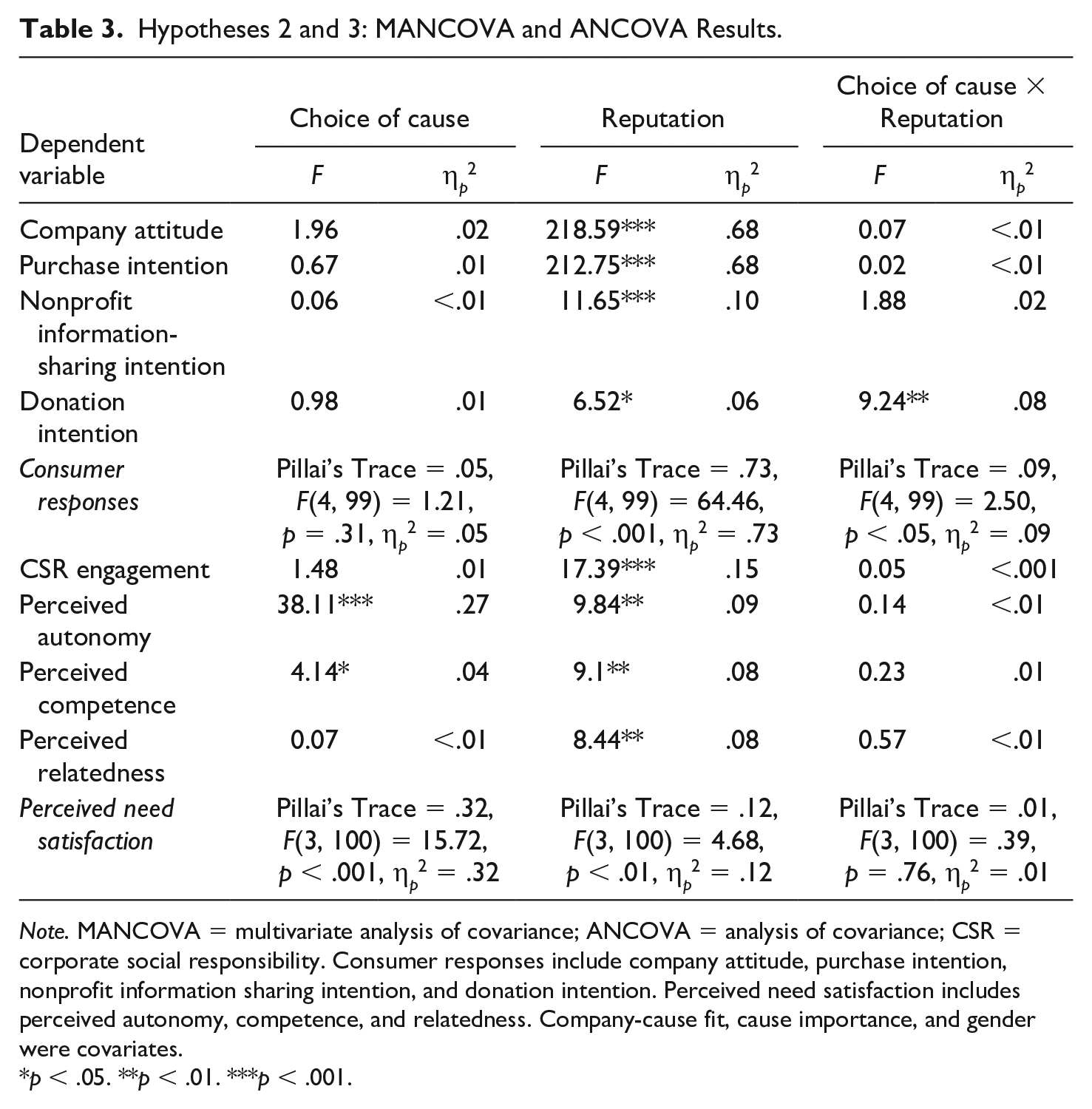
Note. MANCOVA = multivariate analysis of covariance; ANCOVA = analysis of covariance; CSR = corporate social responsibility. Consumer responses include company attitude, purchase intention, nonprofit information sharing intention, and donation intention. Perceived need satisfaction includes perceived autonomy, competence, and relatedness. Company-cause fit, cause importance, and gender were covariates.
p < .05. **p < .01. ***p < .001.
Discussion and Conclusions
Integrating perspectives from psychology literature on the SDT and business communication and marketing literature on reputation management and CSR, this study provides fresh, interdisciplinary insights on consumer experiences with the newly emerged choice-of-cause campaigns versus traditional no-choice campaigns. Specifically, its results bring original contributions to business communication literature by first revealing the relative advantage of the new CSR practice, as a form of two-way communication or value cocreation with consumers, in generating perceived need satisfaction for autonomy and competence. Its results also provide partial support to the usefulness of the SDT in explaining the underlying psychological experiences (i.e., basic psychological need satisfaction) that drive downstream consumer responses in these campaigns. Furthermore, the results advance our knowledge on CSR by providing initial evidence that the advantage of the choice over nonchoice campaigns can only be optimized when the company has a good reputation but not a bad reputation, especially when it comes to consumers’ future intention to donate to the nonprofit partners.
The Predominant Impact of Corporate Reputation on Consumer Responses
One major finding of this research points to the predominant impact of corporate reputation on consumers’ psychological experiences associated with self-determined (i.e., consumer choice) versus firm-determined (i.e., no consumer choice) CSR campaigns and their ultimate responses to these campaigns. As shown by the results for Hypotheses 2 and 3, corporate reputation affected campaign-related, company-related, and cause-related evaluation outcomes outlined in the conceptual framework (see Figure 1 and Tables 1 and 3). Specifically, when the company had a good reputation, consumers experienced greater autonomy, competence, relatedness, and overall engagement in the CSR campaign. However, when it comes to a company with a bad reputation, these campaign-related experiences were relatively limited. The result regarding the impact of corporate reputation in shaping consumers’ basic psychological needs satisfaction experienced in a CSR campaign has not been identified in previous studies. It enriches our understanding of the scope of the corporate reputation effect in business communication literature.
Meanwhile, regarding the company-related evaluations, company attitude and purchase intention ratings almost reached the “ceiling”—their mean scores ranged between 5.98 and 6.38 on 7-point scales—when the company was reputable. In contrast, when consumers learned that the CSR campaign was conducted by a company with a bad reputation, they evaluated the company negatively and demonstrated weak intention to purchase its products—the mean scores ranged between 2.36 and 3.23 on 7-point scales. These findings are in line with the well-established reputation effect in corporate reputation and CSR literature. First, corporate reputation has been shown to affect consumers’ interpretations of CSR campaign information (Y. Kim, 2014; S. Kim & Lee, 2012; Yoon et al., 2006). Second, given that corporate reputation has been acknowledged as a highly diagnostic factor for consumers to make company-related judgments (Kull & Heath, 2016; Rim et al., 2016; Tao, 2018; Tao & Ferguson, 2015), its strong influence on company attitude and purchase intention is expected.
The significance effect of corporate reputation also occurred with consumer evaluations of the nonprofit partners. Participants showed a strong intention to share information about and donate to the nonprofits supported by the reputable company but not the company of bad repute. We believe that this finding is somewhat novel because previous business communication research has primarily examined how a good reputation or social capital of a nonprofit can influence its corporate partners through CSR alliance (Roosens & Dens, 2019). However, this study found that the reputation of the corporate partner could also affect consumer evaluations of the nonprofit. Accordingly, we offer the following important recommendation to nonprofit professionals. It is necessary for nonprofit organizations to evaluate the reputation profile of their potential corporate partners before any nonprofit-corporate alliance is formed (Irmak et al., 2015). This is because a good reputation of the corporate partner can potentially create more awareness (via information sharing) and financial support (via donations) for the nonprofit. However, a bad reputation of the corporate partner can possibly limit these outcomes for the nonprofit.
Furthermore, it is likely that the reputation effect became so preponderate that it dampened the hypothesized choice-of-cause effect. This possibility might help explain the unexpected, nonsignificant interaction effects of corporate reputation and choice-of-cause observed in Hypotheses 2 and 3 results. As shown by our findings, corporate reputation became the sole determinant for participants to make their campaign-related, company-related, and nonprofit-related evaluations (except for donation intention), regardless of the campaign characteristic: whether the campaign featured consumer-determined or firm-determined causes.
Another possible explanation for the nonsignificant interaction effects may deal with the nature of the choice manipulation in our experiment: consumer choice provision in one single campaign. Previous research has shown that corporate reputation summarizes relatively stable traits of a company because the construct, by definition, represents stakeholders’ cumulative and collective perceptions of the company’s past behavior (Fombrun et al., 2000). Comparatively, the choice-of-cause manipulation (consumer-determined vs. firm-determined) simulated one single episode of consumers’ CSR experiences with the firm. This one-time experience was unlikely to be considered equally diagnostic and thereby weighed the same as the reputation factor, in consumers’ evaluations of the company (e.g., company attitudes and purchase intentions), its CSR campaign (e.g., CSR engagement), and its nonprofit partners in the campaign (e.g., nonprofit-related information sharing intention). Moreover, psychology studies (e.g., Baard et al., 2004; van der Kaap-Deeder et al., 2017) have suggested that one would experience greater need satisfaction when the autonomy-supportive environment (e.g., corporate provision of consumer choice) surrounding one’s action (e.g., consumers’ prosocial behavior) is stable and can be repeatedly experienced. Hence, had the consumer choice provision been shown as long-lasting CSR practice of the firm that was repeatedly experienced by consumers, its impact on consumers’ need satisfaction and other evaluative outcomes might have become more pronounced, which in turn might allow the predicted interaction effects to emerge. Reasonable as these speculated explanations might sound, this study calls for future research to verify them and further examine the interaction between choice-of-cause and reputation.
It is noteworthy that the choice-of-cause factor still matters, even when the effect of corporate reputation prevails. Specifically, our results for Hypotheses 1 supported the significant effect of choice-of-cause on consumer responses mediated by perceived need satisfaction (autonomy and competence in particular) and then CSR engagement. Furthermore, our results for Hypotheses 2 and 3 demonstrated that despite the presence of the strong reputation effect, consumer choice had a significant main effect on two campaign experience outcomes: perceived autonomy and competence. When participants were given the opportunity to support the causes they chose, they perceived greater autonomy and competence during the campaign. These findings are consistent with our predictions derived from the SDT (Deci & Ryan, 2000). Thus, it is reasonable to conclude that providing support for consumer autonomy/choice in a CSR campaign can be a viable strategy for companies to adopt, especially when their campaign goal is to create a stronger sense of autonomy and empowerment among consumers.
The Interactive Influence of Choice-of-Cause and Reputation on Donation Intention
Another key finding of this research was the significant interaction effect between choice-of-cause and corporate reputation on consumer intention to donate to the nonprofits supported by the company. With the campaign context featuring a reputable company, participants became more willing to donate to the company’s nonprofit partners when encouraged to support the nonprofits of their own preferences, compared with when the company determined the cause beneficiary. However, when the campaign context involved a company with a bad name, participants demonstrated a moderately low intention to donate regardless of whether the cause beneficiary was determined by them or by the company. This novel finding supported the importance of corporate provision of consumer autonomy in a CSR campaign, as suggested by the SDT (Deci & Ryan, 2000; Weinstein & Ryan, 2010). More important, it provided moderate support for our projection that the benefit of a consumer choice-of-cause campaign (e.g., its benefit in generating donations) can be maximized when the company has good standing.
Theoretical Contributions and Practical Implications
Motivated by scholars’ calls to examine CSR that involves two-way communication and value cocreation (Kull & Heath, 2016; Morsing & Schultz, 2006), this study represents one of the first few attempts in business communication literature that theorizes the newly emerged choice-of-cause phenomenon. It provides a relatively holistic view on the contingent effectiveness of the choice-of-cause practice by integrating insights from psychology, reputation literature, and CSR research. It unveils the psychological processes that consumers may experience when participating in this new CRM program. It also predicts the downstream impact that these psychological processes may bring to companies and social causes. The results of its mediation analysis substantiate consumers’ need satisfaction as a viable process explanation bridging consumer self-determination to their psychological engagement as well as subsequent attitudinal and behavioral intention outcomes in a CSR campaign. All these insights have not been fully established in previous CSR research. They provide business communication scholars with much-needed theoretical understanding of consumer experiences in participatory CSR.
This study also offers business communication professionals guidance on strategic planning for CSR programs. It makes a compelling case for companies’ careful consideration of consumer self-determination in social cause selection when planning their CSR programs. As demonstrated by our findings, when consumers’ CSR experiences celebrate their intrinsic values and interests via choice-of-cause, they tend to feel greater autonomy-need and competence-need satisfaction. This positive outcome is crucial for businesses to obtain nowadays, as consumers increasingly desire to be empowered and become autonomous agents who cocreate societal values with companies (Botan, 2018; Kull & Heath, 2016). Additionally, this study recommends companies to invest in establishing and maintaining a favorable reputation, considering that the variance of the reputation factor may alter consumers’ CSR experiences. While prior research primarily champions the importance of incorporating consumer choice provision in CSR program design (e.g., Robinson et al., 2012), this study complements such an insight by pinpointing the significance of ensuring a favorable corporate reputation as the context of the choice provision. In other words, strategic consideration of both consumer self-determination and corporate reputation is crucial to enhance the effectiveness of CSR campaigns.
Future Research and Conclusion
Despite the aforementioned contributions, this study has several limitations. First, it used a fictitious company in its experimental design. This helped safeguard the internal validity of the experiment because it eliminated potential confounds associated with participants’ priors. However, such artificiality limited the study’s external validity. In addition, the artificial setting of the choice of cause manipulation might have contributed to the finding that the consumer choice effects were not as pronounced as predicted. Therefore, future research should use a real company and its choice campaign to replicate our study. Second, in traditional CRM campaigns, consumers are often presented with one single nonprofit organization as the beneficiary predetermined by the company. This study, however, did not present only one nonprofit beneficiary to participants in the firm-determined cause condition. Instead, participants were told that the company would choose one from a list of nonprofits as its campaign beneficiary. This was purposefully done because an unequal number of nonprofit beneficiaries presented in the firm versus consumer-determined cause condition would create a potential confound. That is, if the firm-determined cause condition only presented one nonprofit partner while the consumer-determined cause condition presented a list of nonprofit partners, participants may infer the company in the firm-determined condition to be less resourceful and/or less socially responsible than that in the consumer-determined condition (Robinson et al., 2012). This inference may confound participants’ responses to the CSR campaign and their evaluations of the company, regardless of whether they were given cause choices (Robinson et al., 2012). Nonetheless, future research can compare the effectiveness of CRM campaigns with consumer choice versus with a single, firm-determined nonprofit partner via methods such as survey.
In conclusion, it is hoped that this study can serve as a springboard that inspires future research to further examine the underlying psychological mechanism that drives the effects of the newly emerged CSR-with-choice phenomenon.
Supplemental Material
Effects_of_Consumer-Determined_CSR_-_Appendices_R2 – Supplemental material for Firm-Determined or Consumer-Determined Corporate Social Responsibility (CSR)? Examining the Effects of Choice-of-Cause in Cause-Related Marketing
Supplemental material, Effects_of_Consumer-Determined_CSR_-_Appendices_R2 for Firm-Determined or Consumer-Determined Corporate Social Responsibility (CSR)? Examining the Effects of Choice-of-Cause in Cause-Related Marketing by Weiting Tao and Yi Grace Ji in International Journal of Business Communication
Footnotes
Authors’ Note
Note that the article is original and is not under consideration or published elsewhere.
Declaration of Conflicting Interests
The author(s) declared no potential conflicts of interest with respect to the research, authorship, and/or publication of this article.
Funding
The author(s) received no financial support for the research, authorship, and/or publication of this article.

Supplemental Material
Supplemental material for this article is available online.
Notes
Author Biographies
References
Supplementary Material
Please find the following supplemental material available below.
For Open Access articles published under a Creative Commons License, all supplemental material carries the same license as the article it is associated with.
For non-Open Access articles published, all supplemental material carries a non-exclusive license, and permission requests for re-use of supplemental material or any part of supplemental material shall be sent directly to the copyright owner as specified in the copyright notice associated with the article.
