



Abstract
Media fragmentation represents new challenges for product placement strategies to become an increasingly effective way to reach consumers and non-users. In this frame, this paper has been developed with three main objectives: (i) to carry on a performance analysis to measure the visibility/impact of the scientific product in product placement (most cited authors, journals, and themes), (ii) to visually present the scientific structure by topics of research in product placement as well as its evolution to identify future research lines, and (iii) to compare both objectives in generic journals and specific communication ones. To this end, the resources in the Web of Science Citation Index were used. Scimat software was applied on a sample of 694 indexed papers from 1992 to 2021 containing “product placement” with 8,521 global citations (176 of the papers were indexed in communication journals with 3,190 citations). Our results show that MEMORY is a key motor theme—the future of research tends to new themes in the communication field (i.e., ATTITUDES/BEHAVIORS or VIRTUAL). Three industries have been key: alcohol, tobacco, and food. This research adds value to previous analysis as long as we have included: (i) a multidisciplinary approach; (ii) an unfolded analysis focusing strictly on communication journals; and (iii) a longitudinal analysis to compare different periods showing dynamic scientific maps.
Introduction
The first paper in the Social Sciences Index about “product placement” dates from 1992 (Synder, 1992). Since then, media fragmentation, media proliferation, and declining advertising efficacy have opened new challenges for product placement strategies to become an increasingly effective way to reach consumers and non-users (Williams et al., 2011). This explains the exponential increment of papers in this field of research during the last 5 years, mainly focused on the cognitive and persuasive processes for how product placement impacts the audience (Russell, 2019).
Therefore, it seems that more and more researchers (both in management and in communication-specific journals) are relying on “product placement” as a powerful communication tool; which allows interesting adaptations in the new virtual environment where companies operate. Thus, research on product placement is taking a new direction as this paper will show.
In this scene, the general aim of the present paper is to complete the previous theoretical revisions of “product placement” by doing a bibliometric analysis to diagnose promising lines of research and future applications of this traditional communication tool. Moreover, general and communication-specific journals will be inspected to identify future applications of “product placement” in the new hyper-competitive and hyper-connected environment in which businesses operate.
This is important because “product placement” has represented and still represents an interesting and challenging area for communication research (Balasubramanian et al., 2006; Karrh, 1998; Russell, 1998, 2019; Van Reijmersdal et al., 2009). More specifically, “product placement” is recently understood as a renewed marketing communication tool that uses “hybrid messages” combining elements of advertising and publicity that can be more effective than other more traditional advertising tools (Balasubramanian et al., 2006). That’s because “product placement” is a paid attempt to influence the audience without identifying the sponsor (Van Reijmersdal et al., 2009).
By doing the present bibliometric study of “product placement,” we will be able to evaluate and analyze academic production in all scientific disciplines quantifying bibliographic production at different levels and considering diverse agents: researchers, institutions, or journals (Montero-Díaz et al., 2018).
Two main objectives guide our work (Cobo et al., 2014). First, to measure the visibility/impact of the scientific production on product placement research. To reach it, a performance analysis based on a multidisciplinary approach was done using the scientific impact (h-index) and the citations obtained by the different agents, such as journals or researchers. Second, to identify the scientific structure by themes in product placement research, as well as its evolution in two different periods. To reach this second objective, dynamic scientific maps were used to visually identify the most prolific themes of research based on productivity (number of papers referring to each theme in each period). By following a longitudinal approach, we will be able of identifying emerging and dying themes of research.
As in the work of Veloutsou and Mafe (2020), this paper adds value to previous analysis as long as a multidisciplinary approach is adopted, including works from business, management, psychology, food, and communication journals. At the same time, we have unfolded our analysis to focus strictly on communication journals. Additionally, compared to previous bibliometric analyses on this topic, three additional contributions are made. First, a longitudinal approach has been followed, considering two different periods because a turning point was identified in 2013. In this year, the number of JCR indexed papers on product placement doubled (and almost quadrupled in Communication journals). So, this year was the starting point of the second period. As Russell (2019) highlights, the development of the practice of product placement has significantly surpassed that of traditional advertising. Therefore, this turning point must be considered. Second, only indexed papers’ in Web of Science were considered, to ensure the rigor of the articles analyzed. The suitability of this procedure can be seen in works published in high impact journals (Rodríguez-López et al., 2020). Third, dynamic scientific maps were visually represented using perceptual representations to show simply the outstanding topics, their relationships and their evolution, both from a generic and communication-specific point of view.
Literature Review
From the beginning, some theoretical revisions have been developed in product placement communication strategy from different
Regarding the
Two years later, and focusing on the
One year later, and focusing on the
Recently, Guo et al. (2019) did an excellent bibliometric analysis from a communication approach including common forms of film and television product placement, and also
In sum, comparing previous literature revisions, we can conclude three major points. First, the studies by European authors in Europe have been less frequent than in the United States because commercial broadcasters in Europe are much more restricted than are those in North America (Smit et al., 2009). Internationally, however, the regulatory barriers against placements begin to disappear some years ago (Van Reijmersdal et al., 2009). Second, product placement strategy has turned into a promising field of research in the specific communication field, as recent publications have demonstrated (De Veirman et al., 2017). Third, research on product placement has focused on diverse themes (studies about types of product placement, messages, results, audience, methods, or sectors). Different schools of thought have adopted a generic-transversal or a communication-specific orientated focus to analyze these topics.
In this frame, following previous bibliometric analysis on product placement (Díaz et al., 2018; Kim & McMillan, 2008), our first objective is to measure the visibility/impact of authors and scientific production on product placement solving three research questions:
Lastly, we can conclude that the research on product placement has not remained stable over time. In terms of Russell (2019, p. 38), this research field could be considered mature, moving toward a greater concern “with the entertainment content, the integrated marketing communications (IMC) context, and the socio-cultural environment in which product placements are received.” That is, it seems that product placement is gaining weight as a business communication issue, as far as journal citations act as a type of business spreading. Following the Actor-Network Theory, a network of product placement research is built when information is redistributed (Latour, 2011): “What was invisible becomes visible, what had seemed self-contained is now widely redistributed” (p. 798). Then, although the evolution of product placement is analyzed in the present paper from a multidisciplinary global approach, additional analysis will be done based on communication-specific journals to better understand this diffusion process. To illustrate the spreading of product placement research on communication journals, we can have a look at the handbook of Galician (2013), which reviews the evolution of product placement in the mass media to identify: new product placement strategies, new merchandizing tools, new ethical features to be considered, new environmental synergies, new legal questions to attend, and so on. So, and based on these points, we have addressed a last question to reach our second objective: to analyze the evolution of the scientific structure of the principal themes on product placement.
Solving these questions will add value to the status of product placement investigation, an important field as shown by the exponential increase in this research. A bibliometric analysis, including citation analysis, has the potential to set a baseline for this field of research that will enable future scholars to see where the field began and trace its shift over time (Kim & McMillan, 2008).
Research Methodology
Software
Our bibliometric analysis allowed a quantitative analysis of all scientific publications indexed in the Journal Citation Reports containing the word “product placement.” To this end,
As Muñoz-Leiva et al. (2015) have explained, this software uses co-work analysis to identify the interests and aspirations of academic researchers. “This technique reduces a large set of descriptors (or keywords) to a set of network graphs that effectively illustrate the strongest associations between descriptors” (p. 682).
For clustering keywords, we employed outstanding thems frequently used by previous theoretical and bibliometric reviews (Balasubramanian et al., 2006; Cornwell, 2008; Guo et al., 2019; Karrh, 1998; Russell, 1998; Van Reijmersdal et al., 2009). For example, the outstanding theme CELEBRITIES includes the following keywords: digital-celebrity, celebrity-endorser, athlete-endorsement, celebrity-endorsement, celebrity-endorsements, endorsement, endorser. The outstanding theme VIRTUAL includes the following keywords: online-advertising, internet-advertising, internet, youtube-advertising, brands-in-internet, internet-mass media, internet-technologies, marketing internet communications, virtual reality, internet marketing, virtual worlds, virtual environments, virtual advertising, virtual product placement, virtual electronic business, virtual e-business. The outstanding theme GAME includes the following keywords: advergames, in game advertising, video games, games, game speed, violent video games, video game advertising, game, sport video games, game brand congruity, game based learning, game product congruence, online game, game involvement, food advergames, in game advertising outcome, game attitude, game context, computer game, social game, mobile games, advergames targeting children, digital games, online games, in game advertising, racing advergame, computer games, game control, advergaming, violet computer games, video game, video-game, videogames, in game advertisements. The outstanding theme MODEL includes the following keywords: model, models. The outstanding theme MEMORY includes the following keywords: consumer memory, brand memory, emotional memory, explicit memory, explicit memories, adaptive memory, false memory, implicit memory, implicit memories, implicit memory tests, memories, memory.
Data Collection and Data Set
We retrieved the information from the Web of Science using the query “product placement.” A final set of 694 papers from 1992 to March 1, 2021 were considered (8,521 citations within those papers were recorded and analyzed). Also, an additional specific anlaysis was done focusing on communication-specific journals: 175 papers from 2000 to March 1, 2021 (3,190 citations within those communication papers were recorded and analyzed).
Data collection was based on Cobo et al. (2014), applying a de-duplicating process over the keywords. The author’s keywords and the Keywords Plus were considered to group words representing the same concept. Some keywords meaningless in this context, such as stop words or words with a very broad and general meaning were removed (Cobo et al., 2014). For example, the generic themes “product placement” or “consumers” were not included in our analysis.
More specifically, as in the work of Rodríguez-López et al. (2020), bibliographic records were downloaded from the main WoS collection.
Periods
Two periods of time were defined to augment the rigor of the present research. A turning point was identified in 2013 (see Appendix Figure A1). In this year, the number of JCR indexed papers on product placement almost doubled (in communication-specific journals an augment from 5 papers to 20 was observed; which means that is research on product placement quadrupled this year). The eruption of new technologies and new communication media explains this boom. The identification of two periods (an incipient one and a growth period) can also be seen in the work of Rodríguez-López et al. (2020). Following these authors, we did a normalization procedure on the keywords while maintaining their original meaning. We obtained a final sample of 2,332 keywords (646 in communication-specific journals), from 1,534 different sources (331 in communication-specific journals), cited globally 8,521 times (3,190 times in the communication journals).
A similar trend was found in the bibliometric analysis of Guo et al. (2019), with papers retrieved from Web of Science, Scopus, EBSCOhost, and Google Scholar databases to cover also conference proceedings that published seminal papers.
Since 1992, no papers were indexed in WoS. Russell (1998) indicates that “even though its effectiveness as an advertising tool appears accepted among practitioners, product placement has not generated much research interest in the marketing discipline” (p. 357).
In sum, two groups of research papers have been compared: 217 indexed papers (55 in communication-specific journals) in 20 years (from 1992 to 2012) and 477 papers in the last 5 years (120 in communication-specific journals).
To better understand the usefulness of Scimat tool to carry on longitudinal analysis, readers can examine Montero-Díaz et al. (2018) and Rodríguez-López et al. (2020).
Research Plan to Solve the Research Questions
To answer RQ1 and RQ2, citation analysis was used. This is a method of tracking publishing patterns based on the assumption that a heavily cited author, paper, or book is considered important by many scholars in a discipline (Kim & McMillan, 2008). Frequencies were used to solve both questions (authors and journals with the highest visibility/impact) (see Figures 1–3). A sample of 1,534 authors was considered.

Authors and indexed papers about product placement in the WoS.

Authors and indexed papers about product-placement in communication journals.

Authors and number of cites in the Wos.

Authors and number of cites in communication journals.
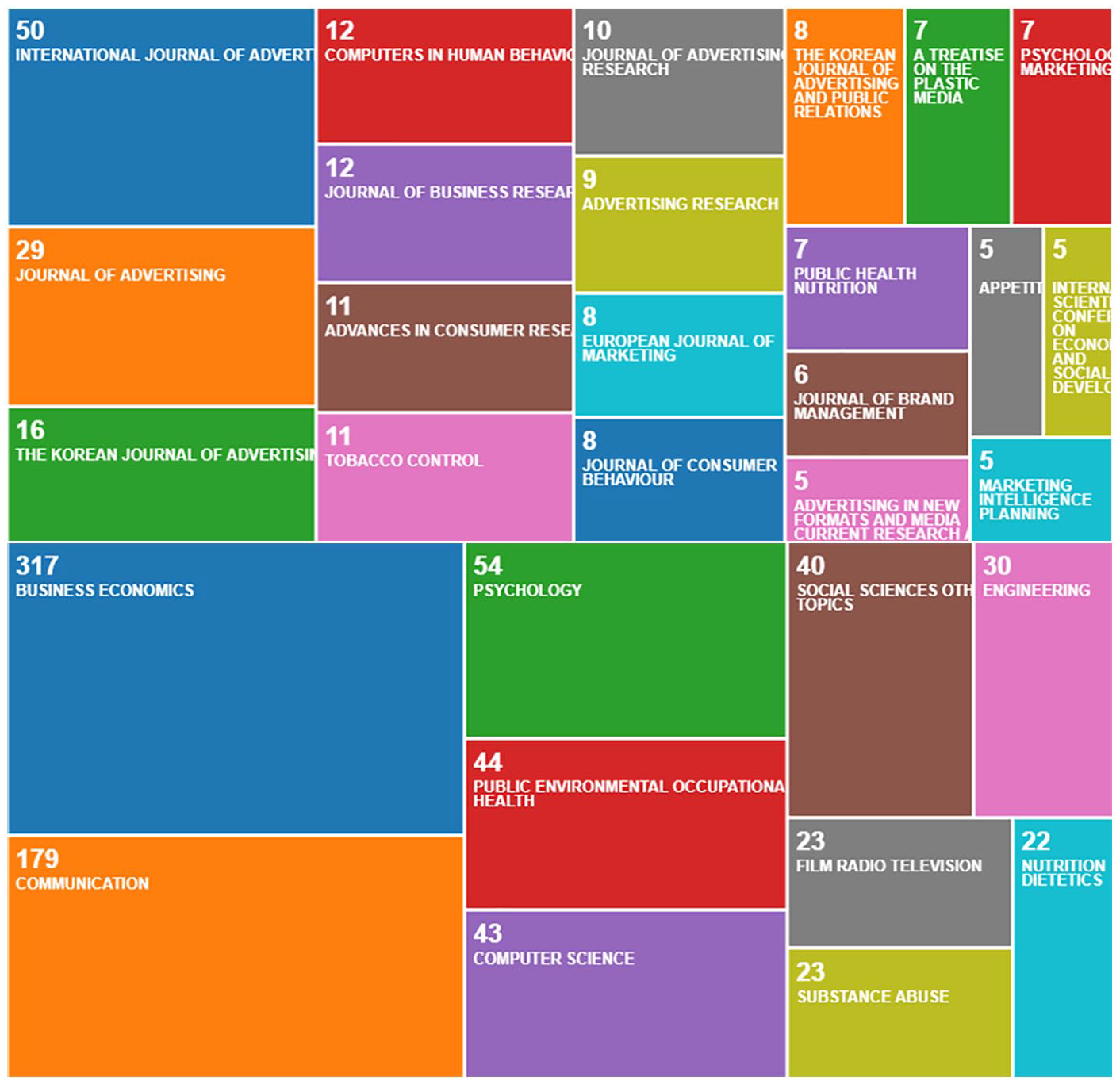
Number of indexed papers published per journal and per thematic areas.
To solve RQ3 (thems with the highest visibility/impact), two scientific maps were obtained: (i) one map for period 1, from 1992 to 2012 with 217 documents (55 in communication-specific journals); and (ii) another map for period 2, from 2013 to 2018 with 477 documents (120 in communication-specific journals). A clustering algorithm was applied to generate a scientific map for each period, specifically the simple center algorithm was chosen (see Figure 4). To do this, the keywords of each publication or document were previously identified, which could be considered as the fingerprint, or DNA of each publication. From there, the algorithm analyzed the similarity/equivalence between documents based on the co-occurrence values of their keywords. The calculation of the similarity between two keywords is based on the normalization of the co-occurrence values. Thus, a keyword with a low frequency but which usually co-occurs with the same keyword is given a higher value. Conversely, a keyword with a high frequency but which co-occurs with a large variety of different keywords will be given a lower weight. In other words, normalization is an attempt to enhance the keyword pairs that adequately represent the corpus under analysis. In this research, the equivalence index was used as a measure of similarity to normalize a bibliometric network.

Themes with highest visibility/impact for each period (h-index).
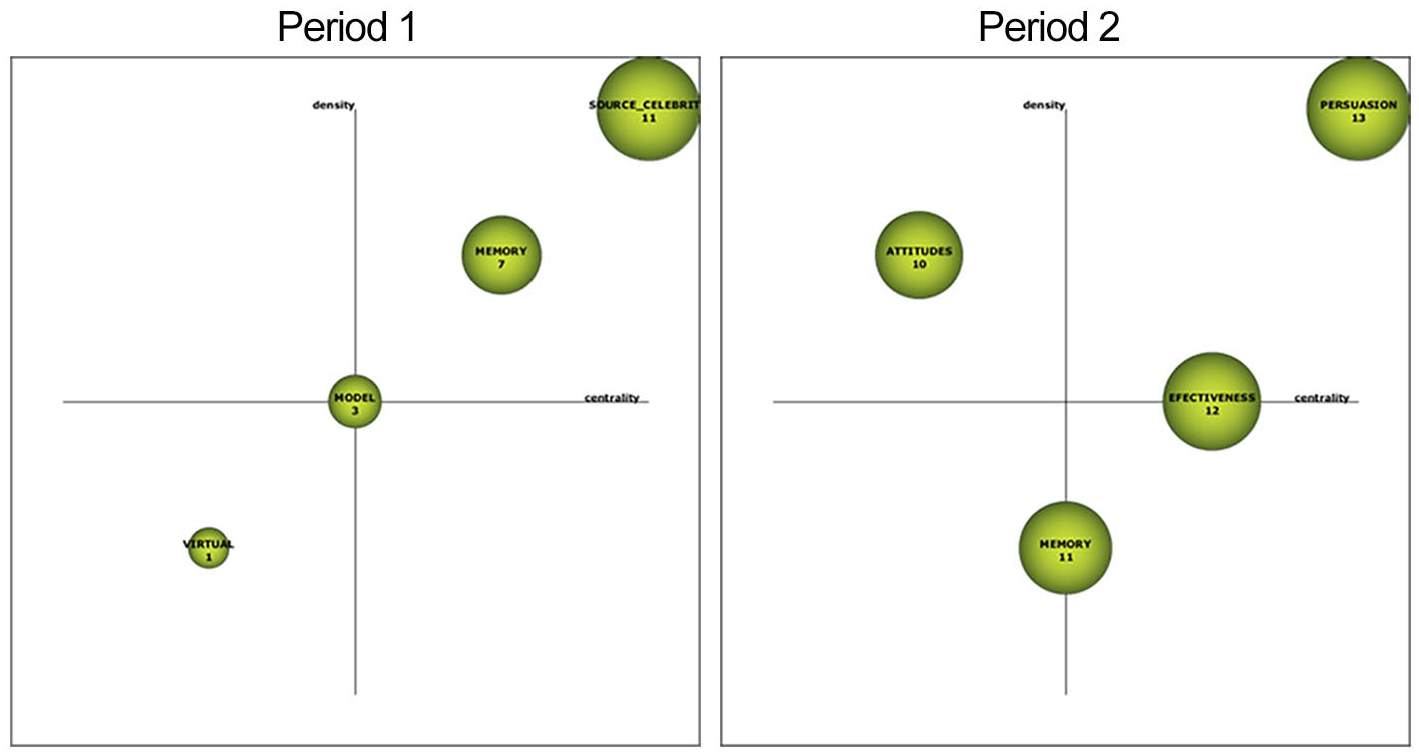
Themes with highest visibility/impact in communication journals.
So, using keywords and their interrelationships, a thematic network or a graph/map was obtained for each period. The volume of the spheres in a map is proportional to the number of documents associated with the keywords associations that each sphere represents. The importance of a thematic nexus was measured through the elements that two thematic networks had in common (the inclusion index was chosen in this study to measure proximity in thematic networks).
To solve RQ4, a longitudinal graph was obtained (see Figure 5) to measure the evolution over time of the thematic networks. To get it, two equivalence indexes were used: the Jacard index and the inclusion index.

(a) Evolution of the topics based on the h-index and (b) evolution of the topics based on the h-index (communication journals).
Research Results
As Kim and McMillan (2008) underlined, a visibility study is based on analyzing which authors and papers are cited frequently to go beyond simple counting of publications to an analysis of which authors and publications have “value” to other researchers. The following data shows which authors, journals, and themes have obtained the highest visibility/impact to solve RQ1, RQ2, and RQ3.
Authors With Highest Visibility/Impact in Product Placement Research in Web of Science: RQ1
Based on the number of indexed published papers in the Web of Science about product placement, Figure 1a (general analysis) and b (specific-communication analysis) summarize which have been the
First, with 14 papers (10 of them in communication-specific journals), we find Joerg Matthes (University of Vienna, Austria; h-index = 38). He is also the top author when specific communication journals are analyzed. So, the most important product placement studies have been published to a greater extent in communication journals.
In the same position, we find Eva Van Reijmersdal (University of Amsterdam; h-index = 21) with 14 papers (four of them in communication journals). She occupies the sixth position in communication journals ranking. Some of her research is shared with Esther Rozendaal (Radboud University, Nijmegen, The Netherlands; h-index− = 13): eight papers (four of them in communication journals).
The second place is for Brigitte Naderer (University of Vienna, Austria; h-index = 6), with 12 papers (six of them in communication journals). She also occupies second place in communication-specific journals ranking; sharing part of her research with the top author in product placement: Joerg Matthes.
In third place is Sophie Boerman (University of Amsterdam, h-index = 19) with 10 papers, (seven of them in communication journals). She occupies the fourth position in communication journals ranking.
The fourth position in the ranking belongs to Esther Rozendaal (Radboud University, Nijmegen, The Netherlands; h-index− = 13) and Liselot Hudders (Ghent University, Belgium; h-index = 14) with eight publications each. Half of her publications in communication-specific journals.
Fifth, Cristel Antonia Russell (American University, Washington D.C.; h-index = 27) with seven publications (five of them in communication journals) follows the ranking. She also occupies the fifth position in communication journals raking. She shares some of her publications with Peter Neijens (University of Amsterdam; h-index = 35), also in the fifth position.
In summary, and to solve RQ1, we can conclude that there is a group of prolific authors from North European countries (Netherlands, Belgium, and Austria) with vast experience in the communications field that has paid a lot of attention to product placement. There is also a strong line of research in the health field developed in Germany and the USA by experts in the medical industry. In the work of Guo et al. (2019), based on all types of papers and conferences, the most prolific authors are framed on the communication field of research. Our results show that the top authors are practically the same when considering the Web of Science as a whole, and when focusing only on communication journals.
According to the number of citations (Figure 2a and b), Russell (1998, 2002) is an outstanding author, both in the global ranking and in the communication-specific ranking respectively. She has investigated product placement from a consumer perspective, publishing her results in the Journal of Consumer Research and Advances in Consumer Research and also in the Journal of Advertising (Russell & Stern, 2006). This result supports Guo et al. (2019) findings.
The same occurs for Lee and Faber (2007) work, published in the Journal of Advertising. This is the third most cited work in the global ranking and the top one in the communication-specific ranking.
On the contrary, there are some outstanding works in terms of cites in the global ranking not mentioned in the communication one. This is the case of the second most cited work about product placement in the global ranking, published by Dreze et al. (1994) in the Journal of Retailing from a distribution perspective. The same occurs for the third most cited work in the global ranking, developed by Wakefield et al. (2003) to investigate the role of product placement in youth smoking from a health perspective. This kind of research was published in medical journals such as Addiction. Also, two other groups of authors do not appear in the communication-specific ranking, but have been deeply metioned in many generic journals: Auty and Lewis (2004) and Law and Braun (2000). Both have published their work in Psychology & Marketing.
In sum, our results evidence the multidisciplinarity nature of the product placement concept, nevertheless, cutting-edge research comes from the field of communication.
Journals With the Highest Visibility/Impact in Product Placement Research: RQ2
Figure 3 shows the
In the Web of Science, we can find some other relevant journals that publish papers on product placement, including a psychology journal (Psychology and Marketing), a business journal (Journal of Business Research or European Journal of Marketing), a scientific-medical journal (Tobacco Control), new-technologies related journal (Computers in Human Behaviour), and food-related journals (Appetite). These results have been also remarked by Guo et al. (2019).
To answer RQ2, we have also classified the journals by thematic areas. As Figure 3 shows, the main body of literature on product placement has been published in communication and advertising journals, followed by marketing and business journals. The third position belongs to health publications and psychology, while the fourth place belongs to computer science.
In sum, the highest number of papers about product placement has been published in specific communication journals; although other disciplines (marketing/business, health, consumer/psychology) and some specific industries (foods, alcohol/tobacco, new technologies, and tourism) have also played an important role in enhancing product placement research.
Themes With Highest Visibility/Impact in Product Placement Research and Evolution: RQ3
The previous sections have addressed which authors and which journals have been most cited, reaching higher levels of impact. This section focuses on which themes have obtained the greatest impact. The topics covered will be shown in capital letters following previous bibliometric studies. Based on Cobo et al. (2014), the performance analysis of research themes compared to the whole research field was measured using three kinds of bibliometric indicators: number of published documents, number of received citations, and h-index. Table 1a and b show the values for these three bibliometric indicators for each period both in generic journals and in communication-specific journals respectively. This informations will be used to solve RQ3.
(a) Performance Measures (Bibliometric Indicators) for Both Periods.

(b) Performance Measures (Bibliometric Indicators) in Communication Journals.

Our results are innovative in two main points: (i) we have obtained strategic maps that visually represent the networks of a wide range of themes that have emerged between terms over time; and (ii) longitudinal results are presented differentiating two periods of time because a turning point was identified in 2013 (in this year, the number of JCR indexed papers on product placement doubled). On the contrary, the interesting revision of Guo et al. (2019) defined three transversal clusters that were created based on the media used to develop product placement (movies-television, games, and disclosures), analyzing the weight of each cluster for each year.
So, our results show, that, based on the
Based on the maximum
These results partially converge with those obtained for communication-specific journals (Figure 4b), where the theme MEMORY is also the top one in the first period and the theme EFFECTIVENESS-IMPACT in the second one. As Communication Network Theories examine (Monge et al., 2003), authors from different disciplines collaborate and many journals are shared. For this reason, “Communication networks are the patterns of contact that are created by the flow of messages among communicators through time and space” (p. 18). On the contrary, the themes MEMORY and PERSUASION appear in the second period (and not in the first one) in communication-specific journals; and some new themes obtain large diffusion (Figure 4b): ATTITUDES, SOURCE-CELEBRITY, MODELS, and VIRTUAL.
Based on the
Four main conclusions are supported by our research in the general analysis (Figures 4a and 5a) and the specific-communication analysis (Figures 4b and 5b).
First, in period 1, there are four outstanding themes when all the journals of the WOS are considered (Figures 4a and 5a): MEMORY (h-index = 18), ADOLESCENT-YOUTH (h-index = 17), FRAMEWORK (h-index = 11), PERSUASION (h-index = 5), FILM-MOVIES (h-index = 5), and CONGRUENCE (h-index = 2).
Second, some themes in period 1 are consolidated in period 2 in the general analysis (Figure 5a): (i) the theme ADOLESCENT-YOUTH gains weight. That’s because the theme ADOLESCENT-YOUTH in period 1 shares strong links with new terms in period 2 (such as VIRTUAL or FOOD-BEVERAGES) and (ii) the theme MEMORY is also reinforced, connecting with themes such as GAMES, ATTITUDES, MODELS, or EFFECTIVENESS (see Appendix Figure A2). As the Signaling Theory posits, the number of citations in an area/topic influences future research in the area. As Connelly et al. (2011) underline “information affects the decision-making processes used by individuals in households, businesses, and governments. Individuals make decisions based on information” (p. 41). This means that researchers investigate based on the diffusion and popularity of previous research.
Third, new themes hatch in period 2 in the general analysis (Figures 4a and 5a). These are in the cases of the themes SPONSOR, CHARACTER, or INVOLVEMENT among others. This could be due to the relevant role that adolescents and young people play in food and beverage consumption.
When specific communication journals are analyzed, some themes such as ATTITUDES and PERSUASION appear in period 2 (Figure 4b).
In sum, we can conclude, to answer RQ3, that some themes in period 1 have decreased and evolve to new themes in period 2. For example, in the generic analysis, the theme FILM-MOVIES in period 1 disappears in period 2, because other virtual channels gain weight. In the specific communication analysis, the term MEMORY, in period 1, has evolved to PERSUASION and ATTITUDES in period 2. In other words, previous literature focused on how product placement can affect consumer memory concerning future buys; while recent research has evolved to focus on how persuasion leads to attitude improvement.
Scientific Structure (Central Themes and Evolution): RQ4
Table 1a and b show the indicators used to analyze the centrality and density of each theme in each period. Figure 6 visually shows the strategic diagrams for the two periods in the generic analysis. Based on the idea that “centrality” measures the degree of interaction of a network with other networks, and “density” measures the internal strength of the network (Cobo et al., 2014), four groups of themes are identified that allow us to answer RQ4.: (i) motor themes, (ii) basic and transversal themes, (iii) emerging or declining themes, and (iv) highly developed and isolated themes. Sphere size is proportional to the number of published documents associated with each research theme (Cobo et al., 2014). Table 2a and b show the centrality and density of each theme.
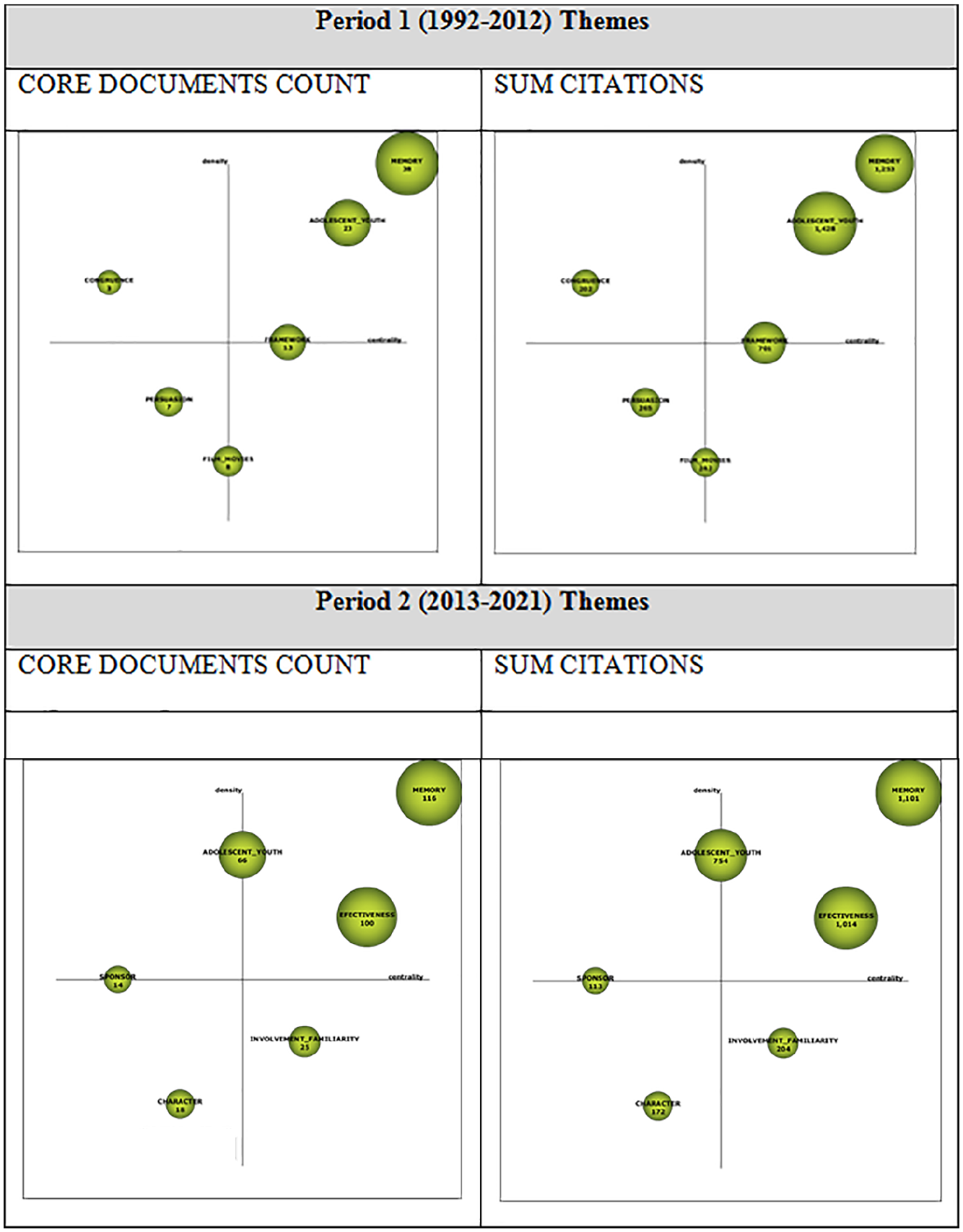
Strategic diagrams.
(a) Centrality and Density of the Themes on Each Period and (b) Centrality and density of the themes in communication journals.

(b) Centrality and Density of the Themes in Communication Journals.

Motor themes (high density and centrality)
These are highly developed and indispensable themes for building the research field. When all the journals of the WOS are considered, we have found two motor themes (central nodes) in period 1 (Table 1a): MEMORY (1,253 citations), and ADOLESCENTS (1,428 citations). In period 2, MEMORY (1,101 citations) and ADOLESCENTS (754 citations) are consolidated and EFFECTIVENESS-IMPACT (1,014 citations) emerge as another motor theme (central nodes).
When only specific-communication journals are considered (Table 1b), the theme PERSUASION replaces the theme MEMORY which became a declining one. That is, in the first period is strongly supported that brand placement prominence has a positive effect on brand memory (MEMORY). This effect has been found for placements in audio-visual media using CELEBRITIES. In the second period, is strongly supported that brand placement is EFFECTIVE (impacts) leading to behavior without memory of the placement. This means that brand placement can have implicit effects, an area of research over the last decades.
Declining/emerging themes (low density and low centrality)
In the global anlaysis, with all the journals of the WOS, we found in period 1 one declining theme: PERSUASION; and in period 2 the declining theme is CHARACTER.
In the specific-communication analysis, there are two declining themes linked to period 1: MODELS and VIRTUAL. The reason is that both themes flourish in period 2. For example, virtual research has been linked to a large extent during the last years to digital games (Cauberghe & De Pelsmacker, 2010; Russell, 2019). Our results support that research on advergames, in-game advertising, video-games, online-games, and digital games, as well as other virtual placements has null-declining importance in period 1 because it will be in period 2 when new technologies are developed and used to efficiently place advertisements to promote brands while enjoying digital activities.
Highly developed but isolated themes (high density but low centrality):
These themes have strong internal ties, but weak external links. They are peripheral themes. In the global analysis, we identified in period 1 one peripheral theme (CONGRUENCE) and another in period 2 (SPONSOR). Both themes have been developed without relevant connections to other outstanding themes.
In the specific communication analysis, there is only one theme in this group and it belongs to period 2: ATTITUDES.
Basic-transversal themes (high centrality but low density)
This group of themes has been investigated with other relevant ones, but its weight is light because it lacks development. Themes in this group have been named as transversal, basic, and general topics. In the global analysis, the basic themes in period 1 are FRAMEWORK and FILM-MOVIES; and in period 2 are INVOLVEMENT-FAMILIARITY.
In the specific communication analysis, there is only one basic theme and it belongs to period 2: MEMORY. That’s because cognitive models based on memory are been replaced recently by attitudinal models that stimulate persuasion.
To conclude, Appendix Figure A2 shows a deeper analysis of the research networks identified for each period.
Discusion of the Results
Our results have shown the most prolific themes on product placement, and those that are declining from an academic and practical point of view. Therefore, in light of the results obtained in terms of the impact and growth of different topics and schools of thought, it is possible to conclude six major points.
Media: From Traditional Media to New Modern Media
Brand placement in motion pictures and television is an old phenomenon (Dens et al., 2012). However, our results show that product placement research, mainly published in communication journals, has evolved from traditional media (such as music videos, radio programs, songs, video games, plays, and novels, Gupta & Lord, 1998) to modern media (such as social networks, webpages, and blogs).
So, based on our results and following Williams et al. (2011), we can recommend the use of diverse media for product placement, including such media as films, broadcast and cable television programs, computer and video games, blogs, music videos/DVDs, magazines, books, comics, Broadway musicals and plays, radio, Internet, and mobile phones. However, it’s important to remark that, as our results have probed, product placement using modern media is becoming more popular as the effectiveness of traditional advertising formats is declining (Cauberghe & De Pelsmacker, 2010). The evolution of the media used to support product placement can also be seen in the conclusions of Guo et al. (2019).
Effects: From Cognition (Memory) to Emotions (Attitudes) and Behaviors
Product placement has interesting effects that Williams et al. (2011) summarized as: (i) to achieve prominent audience exposure, visibility, attention, and interest; (ii) to increase brand awareness; (iii) to increase consumer memory and recall of the brand or product; (iv) to create instant recognition of the product/brand in the media vehicle and at the point of purchase; (v) to bring the desired change in consumer attitudes or overall evaluations of the brand; (vi) to bring a change in audience purchase behaviors and intent; (vii) to create favorable practitioner views on brand placement; and (viii) to promote consumer attitudes toward the practice of brand placement and the various product placement vehicles. All these effects have been synthesized by Van Reijmersdal (2009) into three outstanding effects: memory, attitudes, and consumption.
As our results have probed, early studies in product placement (the first period investigated in our analysis) have measured the effectiveness of product placement in terms of memory or brand recall (Gupta & Lord, 1998; Russell, 1998), usually forgetting conative/behavioral effects (Baker & Crawford, 1995; Van Reijmersdal et al., 2010). On the contrary, in recent studies (the second period investigated in our analysis), these conative/behavioral product placement effects have gained weight, mainly in communication journals. For example, authors such as Dens et al. (2012) started to combine alternative product placement effects: memory (based on prominence) and attitudes. As they remarked, “early studies yielded mixed results concerning consumers’ memory of brands placed in films or television programs, and generally showed weak or non-existent effects of placement on brand attitude” (p. 35).
In sum, nowadays conative/behavioral product placement effects have gained weight, mainly in communication-specific journals as our results have demonstrated. This is because one of the major challenges for brands is to target audiences and influence them to try and adopt new products and help diffuse them (De Veirman et al., 2017). Matthes and Naderer (2015) also highlight product placement effects in terms of conative responses.
Sources: From Celebrities to Influencers
Celebrities were investigated from the beginning from the Subjective Source Effect Gheory. As Russell (1998) remarked, “everyone remembers seeing Reese’s Pieces candies in the movie ‘E.T.’ and Audrey Hepburn’s Givenchy apparel in ‘Breakfast at Tiffanys’” (p. 357).
Recent literature has replaced the term celebrities with influencers because they can also act as opinion leaders and often fail to disclose their commercial relationships with brands and organizations (Woodroof et al., 2020). Williams et al. (2011) consider the growth of brand/sponsor image strategy, based on the idea that influencers sponsored products and services to affect attitudes toward the brands or products they endorse (De Veirman et al., 2017). Influencers may generate frequent interaction with the target favoring the endorsement of a product placed in virtual support by common people that share information with others (De Veirman et al., 2017).
To conclude, our results demonstrate the tendency in recent years to carry on product placement investigations in the virtual context using influencers to enhance effectiveness. Rozendaal et al. (2013) have also pointed out the need to further investigate peer-to-peer influences, as this is an important predictor of consumer desire to adopt a brand, especially among children.
Product Category and Vulnerable Consumers: From Unhealthy Habits (Alcohol and Tobacco) to Healthy Ones (Food)
Our results in Appendix Figure A2 corroborate that previous studies on product placement (period 1) were focused on investigating the negative effects of dangerous brands (i.e., tobacco and alcohol) showed in current situations (Karrh, 1998). A robust stream of research was developed from a Science/Medical Approach at Darmouth University (Hanover, New Hampshire, EEUU) and at the University of California Center for Tobacco Control Research and Education, Institute for Health Policy Studies (Charlesworth & Glantz, 2005). They wanted to investigate how product placement could affect vulnerable consumer behaviors (mainly adolescent/younger respondents) in terms of alcohol and tobacco consumption (Bergamini et al., 2013; Sargent et al., 2001). In this framework, Bergamini et al. (2013) reviewed trends in tobacco and alcohol brand placements in popular US movies from 1996 through 2009.
On the contrary, in our second period of research, a greater interest in how product placement can be used to stimulate healthy consumption has been identified. For example, to stimulate healthy food, specifically among children (Matthes & Naderer, 2015) and young consumers. For this reason, other industries such as foods and beverages are becoming more important in product placement research, maybe because the increasing prominence of food placements on television stands in sharp contrast to the uncommon empirical evidence in the literature (Matthes & Naderer, 2015).
In summary, given that we have observed an evolution in terms of the main industries investigated (from the tobacco/alcohol industry to food/beverages), future research is needed to measure the potential of product placement strategies in stimulating consumer healthy habits.
From Mere Exposure and Prominence to Persuasion, Especially Among Younger Consumers
In his seminal work, Zajonc (1968) investigated the extent to which the frequent exposure to a stimulus object enhanced an individual’s attitude toward it. Our results corroborated the interest in this topic in the first period analyzed.
Recent research shows that the study of mere exposure effects is being complemented with other factors that modulate these effects. For example, Matthes and Naderer (2015) underlined the relevance of considering children’s developmental level when predicting how message characteristics affect the persuasion process. Besides, literature over the last 5 years has paid increasing attention to persuasion effects (Rozendaal et al., 2013; Van Reijmersdal et al., 2012), relegating the isolated study of mere exposure effects to a second plane. From this point of view, it is supported that persuasion could potentially work better than exposure among younger individuals. Not in vain, “a number of studies have shown that children’s recognition and understanding of embedded forms of advertising, such as brand placement in movies, in-game advertising, and advergames, develops considerably later than their understanding of television advertising” (Rozendaal et al., 2013, p. 144).
In conclusion, the increasing relevance of modern communication media has been accompanied by an augment of product placement studies interested in persuasion effects. While previous studies focused on brand prominence and mere exposure effects in traditional media considering cognitive responses, recent studies are paying higher attention to game involvement and new media considering the affective responses that they can trigger (Van Reijmersdal et al., 2012).
From Experimentation Analysis to Modelization Analysis
Following Karrh (1998, p. 40), we can affirm that previous research in product placement has used content analyses of placement in various media, surveys of practitioners, qualitative studies of placement’s meaning to audiences, studies of audience knowledge of and inferences about placement in films, and experimental studies testing memory, attitude change, and/or purchase intention. Researchers have mainly used experimentation procedures. Van Reijmersdal et al. (2009) remarked that academic research on product placement was mostly laboratory-based, whereas practitioners favor field research. As they noted, the theater methodology pioneered by Russell (2002) was a notable departure.
Recent studies are applying modeling, including moderating and mediating variables, in product placement research to investigate the complex relationships of multiple constructs (Balasubramanian et al., 2014; Shoenberger & Kim, 2019). Figure 5 shows the evolution of the theme MODELS in period 2.
Conclusions
Based on the previous results, it is possible to conclude the following academic and management implications for the future.
Media: From Traditional Media to New Modern Media
Based on our results, our first implication is that new research on product placement should focus on new media, for example, to investigate how Instagrammers can endorse their products among their followers and beyond in virtual environments (De Veirman et al., 2017).
Second, a strong school of research investigating product placement in advergames is increasing in communication journals (Rozendaal et al., 2013; Sung & Lee, 2020; Terlutter & Capella 2013; Van Reijmersdal et al., 2012). Therefore, it is recommended to carry out more research focused on youth and children, and on the virtual games so popular in this target.
Effects: From Cognition (Memory) to Emotions (Attitudes) and Behaviors
Our third recommendation is based on the development of product placement research within the hierarchy-of-effects (HoE) model to encourage positive emotions and behaviors. As Van Reijmersdal et al. (2009) indicated, “temporally orders message outcomes into three broad classes—cognition, affect, and conation—that respectively correspond to consumers’ mental stages for awareness/understanding, interest/liking, and purchase intention/buying a product” (p. 115). The last two classes (affect and conation) have been a focus of investigation during the 5 years studied in period 2, as our results demonstrated. So, more research on product placement and experiential marketing to explain product placement effects in terms of behaviors looks promising.
Sources: From Celebrities to Influencers
A fourth implication is to incline product placement efforts toward the marketing of leisure and entertainment (Russell, 2019) using influencers. As this author anticipated some decades ago (Russell, 1998), a higher connectedness/association with the show/actor augments the affective transfer and the transformational effect of product placement. So, in the new virtual environment, influencers have emerged as a research priority.
Product Category and Vulnerable Consumers: From Unhealthy Habits (Alcohol and Tobacco) to Healthy Ones (Food)
Given that the main industries investigated in product placement research have not remained stable (from the tobacco/alcohol industry to food/beverages), our fifth implication is to orient fuuturee product placement research and practices to find a place in the fields of social marketing and cause-related marketing due to its potential to promote healthy habits and ethical behaviors.
From Mere Exposure and Prominence to Persuasion, Especially Among Younger Consumers
Given that the relevance of the context seems key to get persuasion effects (Rozendaal et al., 2013), our sixth recommendation is to place future research on the attitudinal components of persuasion knowledge to better understand product placement effects.
From Experimentation Analysis to Modelization Analysis
Therefore, our last recommendation is to use new statistical tools and new methodologies to analyze and interpret the data. In this framework, data mining is a promising tool to investigate the effectiveness of product placement.
Limitations
Our research has some limitations. First, we conclude that, as in the work of Díaz et al. (2018), our results only reproduce scientific production indexed at WoS. Since this is biased toward the English language, other databases could be used in future research to broaden the conclusions.
Footnotes
Appendix 1
Declaration of Conflicting Interests
The author(s) declared no potential conflicts of interest with respect to the research, authorship, and/or publication of this article.
Funding
The author(s) received no financial support for the research, authorship, and/or publication of this article.
