



Abstract
This introduction explains our vision, inclusion criteria, and mission for a curated issue about business communication and COVID-19. We focus on the big picture of communication agility lessons from a VUCA (volatility, uncertainty, complexity, and ambiguity) environment. We also present a definition and a typology of agile business communication, largely drawn from the papers in this collection. These manuscripts investigate COVID-19 organizational communication measures and related strategies plus their outcomes across diverse stakeholders in multiple countries. Drawing from these contributions and other research, we conclude by outlining an agile business communication research agenda. Finally we inaugurate a new IJBC column, Spotlight on a Thought Leader in Business Communication.
“Nothing is more authentic than being transparent and empathetic.”
This special issue has a simple vision. It casts a scholarly lens on why business communication thrives or doesn’t in the chaotic environment of the COVID-19. We seek to glean long-term, valuable, and global organizational communication lessons that can be learned from this still developing scenario (Barthes, 1978). At this point you may ask why IJBC is exploring pandemic business communication now, 2 years after the world was unhinged by COVID-19. First, the pandemic is still very much with us—Omicron is nearing a peak as we write—and its ramifications remain profound for business. Our key organizational challenges can be described as environmental VUCA - volatility, uncertainty, complexity, and ambiguity which require agility (the capacity to adapt flexibly, effectively, and quickly) (Hesselberg, 2018) in order to move forward. Hence, we face the VUCA world, which is not going to disappear in the foreseeable future (Baran & Woznyj, 2020). Secondly, IJBC has been regularly publishing a number of relevant COVID-19 business communication articles online since 2020. However, this curated issue combines selected manuscripts which share meaningful and instructive findings that can guide future business communication research while also being applied to other disruptive events.
Agile Business Communication in a VUCA World
The VUCA world includes but extends beyond crisis management (and its partner, crisis communication) in theory and practice (Baran & Woznyj, 2020; Hesselberg, 2018; Marsen, 2020). There are few discrete strategies for problem resolution in a complex and chaotic environment. Even full communication transparency is a delicate balance since new data and knowledge are emergent. Thus, in the face of environmental disruption, the organizational focus should be on learning by all stakeholders (Weick & Ashford, 2001) and with responding quickly, adeptly, and flexibly, often with communication practices described in High Reliability Organizations (HROs) which also face ongoing crisis events (Roeder et al., 2021; Weick & Sutcliffe, 2015). Yet communication agility must reach farther than HRO interactions due to the pandemic’s low predictability and wide ranging impacts. Case in point, COVID-19 may have its origins in one nation but the effects soon reverberated world wide and the outcome expectations are far from stable.
Business communication is integral to thriving in the COVID-19 reality since feedback loops realign changing organizational systems (Dühring & Zerfass, 2021; Fuller et al., 2022; Plowman et al., 2007). Business communication is also vital to adapting organizational cultures and their people especially since it co-creates reality and perceptions (Fairhurst & Uhl-Bien, 2012; Keyton, 2017; Sias, 2013) at all organizational levels: strategic, leadership, teams, and individuals. Similarly, effective business communication in VUCA leverages respect and humility (Cojuharenco & Karelaia, 2020; Van Quaquebeke & Felps, 2018) reflecting servant leadership (Gutierrez-Wirsching, 2019; Liden et al., 2014) as well as transparency (sharing all information that is needed for well-being). Transparency and clarity are indispensable to VUCA because ambiguity is a challenge, and gaining internal and external stakeholder trust via verbal and nonverbal empathy is critical to positive outcomes (Coombs, 2014; Dulek et al., 2003). Going further, these results should be empirically measured on a continuing basis (Fuller et al., 2022; Hesselberg, 2018) and include attitudes/behaviors such as trust in organizations and leaders, positive health practices, high employee engagement and motivation, successful organizational voice and silence strategies, and improved psychological well-being and stress management (Bashir et al., 2022; Batova, 2022; Charoensukmongkol & Phungsoonthorn, 2022; Men et al., 2022; Pang et al., 2022).
Ironically, the specifics or the how, when, and why of communicating for ongoing, tumultuous organizational changes such as the pandemic are often treated as implicit, described in anecdotes, or as mere HRO attributes (Plowman et al., 2007; Weick & Sutcliffe, 2015). More recently, a multi-disciplinary research team laid out a longitudinal risk communication research plan for health care settings (Sutton et al., 2021). Along similar lines, scholars developed HRO communication strategies for intense weather events that can be used in multiple occurrences (Roeder et al., 2021).
We commend these researchers for recognizing agile communication’s pivotal role, but also advocate for more articulate insights, specifically in the COVID-19 environment that may be generalized. Responsively, the scholars in this curated edition advance business communication knowledge by shedding more explicit light on just how communicative agility can be achieved in the pandemic and possibly in the expansive VUCA world.
Even though experts observe that business communication agility has often been explained tangentially in the literature (Coombs, 2014; van Ruler, 2021), there are some guideposts. One recent article clarifies and forges a research agenda for communication agility in organizations (Dühring & Zerfass, 2021). We draw upon their conceptualization and that of Hesselberg (2018) to present both a preliminary definition (which we hope scholars will refine and extend) as well as a mission for this curated issue. Business communication agility includes the verbal and nonverbal interactions which engage people to relentlessly focus on stakeholder value, learning and continuous improvement, and to quickly adapt to change. Congruently, this issue adopts the mission to further investigate the authors’ call for new knowledge about strategic, leader, and cultural communication agility processes and outcomes (Dühring & Zerfass, 2021).
Let’s step back to refine this definition a bit more. The term business refers to any organization that serves external constituents, be they citizens, customers, students, shareholders, etc. Thus government, non-profit, health care, and educational organizations are included with private enterprise. Just as important and integrating stakeholder theory (Freeman et al., 2018; Rowley, 1997), stakeholders are all those with important ties to an organization including internal (employees) and external stakeholders (customers, students, suppliers, the public, and society among others.) And value reflects positive outcomes from agile organizational communication such as trust, work engagement, and psychological well-being. Trust, or stakeholder confidence that an organization and its leaders are competent decision-makers and will take benevolent actions on their behalves (Boies et al., 2015; McAllister, 1995), is robustly and positively linked to such behaviors as performance, creativity, self-efficacy, and resilience (Karatepe et al., 2019; Men et al., 2022).
Modeling Communication Agility in Disruptive Times
All the articles selected for this issue address communication agility and our stated mission. These manuscripts uniformly identify two pivotal attributes of business communication agility: empathetic and transparent organizational messages. We next offer an exploratory typology constructed from this collection’s innovative scholarship. Then each article’s unique contributions to business communication knowledge and the model creation are briefly discussed. To conclude, we present novel—ripe for generalizability testing—insights for research and practice.
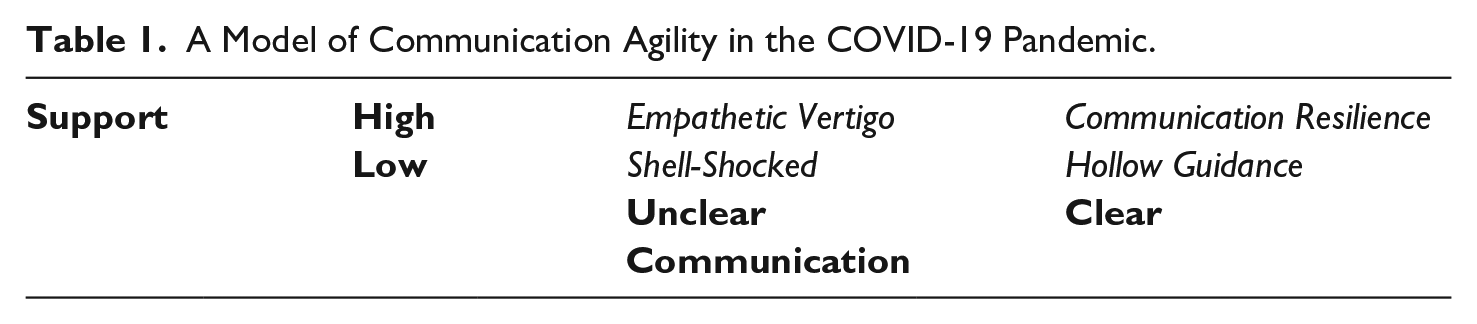
Our model has two key dimensions and four classifications. This typology synthesizes VUCA communication into four quadrants based on strength of business communication transparency and empathy from four organizational levels: strategic, leaders, teams (reflecting co-worker relationships), and individual (see Table 1). Organizational culture is embedded in each of these levels since it is co-created by all these constituents, including external stakeholders (Cheney, 1983; Cheney & Christensen, 2001). These external constituents include the collective and individual sense-making of strategic communication to an organization’s public. Relatedly, internal groups members’ messaging to each other can foster psychological well-being as can leader communications to many and to individuals (Charoensukmongkol & Phungsoonthorn, 2022; Men et al., 2022). In practice, leaders are often perceived as organizational messengers who deeply effect the psychological safety and self-leadership of individuals, valuable employee characteristics in a pandemic context (Mayfield et al., 2021; Men et al., 2022). Our model also incorporates a global, diverse perspective extracting insights from many organizational settings including some from Asia and Africa, and is not confined to the USA (Bashir et al., 2022; Charoensukmongkol & Phungsoonthorn, 2022).
Let’s discuss the model in more detail. The two axes, transparency and empathy, are derived from research consensus that these factors encourage positive stakeholder responses. The groundbreaking crisis communication survey by Fuller and colleagues (Fuller et al., 2022) is theoretically and empirically robust and reveals two pillars of agile communication: clarity and order. The latter factor, order, encompasses perceived stakeholder support from the organization (empathy) because it lessens the psychological stress of uncertainty. When both factors are strong—the upper right model quartile, Communication Resilience, emerges. Resilience, previously explored by LaGree and colleagues (LaGree et al., 2021), is characterized as “when beset by problems or adversity sustaining or bouncing back and even beyond (resilience) to attain success” (Luthans & Avolio, 2014). In this way, we interpret business communication resilience as organizational messages which nurture desirable outcomes for stakeholders in times of disruptive change.
Referring back to the model, Batova (2022), Bashir et al. (2022), and Pang et al. (2022) investigate what constitutes communication resilience or its deficits on an organizational level of analysis with external stakeholders as the public. Batova in “To Mask or Not to Mask” employs qualitative analysis of CDC tweets about mask wearing. Public reaction is gauged to include dominant needs for transparency, consistency or order (reflecting Fuller et al.’s measure in “Creating Order Out of Chaos”), and being cared for. Trust or lack of is an overarching result. Without transparency and a logical narrative, communication agility morphs into Empathetic Vertigo or weakness in requisite communication credibility, a feel good sandwich that leaves stakeholders hungry. The worst option materializes when communication agility becomes Shell Shocked in the lower left model quadrant (or deficient in transparency, order, and support). Trust and positive attitudes/ behaviors are much less likely to occur in this context.
These inferences are underscored in “Information Adequacy and Strategic Behavioral Change Communication as a Pandemic Management Tool” (Bashir et al., 2022). This study, set in Uganda, finds that transparency is imperative but not sufficient in successfully achieving behavioral change in health care practices. Put simply, transparency must be integrated with high quality interactions to positively persuade community health officials and the public toward goal commitment. These authors’ discoveries highlight the model’s lower right quadrant of Hollow Guidance or mechanistic clarity with low emotional connection. The empathetic communication void can be remedied by seeking stakeholder feedback, leader and organizational listening (Brandt, 2022; Cardon et al., 2019; Kluger & Itzchakov, 2022), and collaboration. Bashir et al. intertwine culture and complexity theory as a foundation (Chiu & Qiu, 2014), where stakeholder engagement plays a major role.
Business communication to a broad and diverse public base is the setting for Pang and co-authors’ “Breaking the Sound of Silence” (Pang et al., 2022). This transformative experimental investigation emphasizes non-verbal communication, silence, and looks into how it can be strategically broken. While not specifically about the pandemic, Pang et al.’s discoveries are quite relevant.
Moving to different analytical levels, “The Interaction Effect of Crisis Communication and Social Support on the Emotional Exhaustion of University Employees during the COVID-19 Crisis” (Charoensukmongkol & Phungsoonthorn, 2022) and “Fostering Employee Trust via Effective Supervisory Communication during the COVID-19 Pandemic (Men et al., 2022) diagnose effective (and ineffective) communication agility between leaders and individual followers as well as among group members. In the first cited paper, Charoensukmongkol and Phungsoonthorn (2022) measure the power of organizational, leader, and peer communications for transparency and support on reducing emotional exhaustion. Their study was conducted among Thai university employees during the pandemic. As predicted, both transparent and empathetic messages were positively significant. But contrary to expectations, peer support had a greater influence on combating staff member emotional fatigue than did supervisory communication.
On the other hand, Men and co-authors (Men et al., 2022) found that leader motivating language (Mayfield & Mayfield, 2017) during the pandemic elicited intrinsic drive—self-determination theory—(Ryan & Deci, 2000)—which forged a substantial link with greater follower trust as an outcome. This article progresses motivating language theory by framing it as an advantageous crisis and change communication intervention. Other important contributions were the paramount influence of empathetic language (expressing leader caring and emotional bonding) and a valid/reliable adaptation of the motivating language scale (Mayfield et al., 1995) for a crisis situation.
Insights and Where to Go Next
These articles and their emergent model offer noteworthy lessons in business communication agility and suggest promising new research paths which can be transformed into practice. Evidence points to requisite empathy/inclusion and transparency in organizational, leader, and group messages. Looking more closely at empathy and inclusion, symmetrical communication (Men & Sung, in press) and listening strategically combined with respectful inquiry nurtures higher stakeholder trust, propensity to adapt, and promotes psychological well-being and resilience (Cardon et al., 2019; LaGree et al., 2021; Men et al., 2022; Van Quaquebeke & Felps, 2018). Specific guidance also arises from metrics, strategic planning for breaking silence, conveying a logic of order, group member communication training, and motivating language (Charoensukmongkol & Phungsoonthorn, 2022; Fuller et al., 2022; Men et al., 2022; Pang et al., 2022). Relatedly, a new study suggests that leader motivating language has a compelling relationship with enhanced follower psychological safety—security in being able to more fully express oneself at work (Edmondson, 2018; Mayfield & Mayfield, 2021).
This knowledge opens doors for fresh scholarship in business communication agility that responds to the pandemic and broader horizons of inquiry. Here are a few, but certainly not all inclusive, scholarship recommendations organized by level of analysis: organizational, leader, group, and individual. On the organizational plane these studies emphasize the need to better communicate organizational learning in the VUCA environment, especially about reorganizing systems which manage chaotic events. How can ambidexterity (Parker, 2014) or the equilibrium between order and flexibility that Fuller and colleagues’ measure be effectively messaged? Organizational discourse (Fairhurst & Uhl-Bien, 2012) offers a possible route, but few scholars have explored this agenda. Additional studies on organizational listening will also be instrumental.
What is more, COVID-19 has ushered in the Zoom era. Virtual work including with teams was already building momentum before the pandemic. Now it is firmly integrated in organizational communication and will most likely not return to previous usage (McHale, 2022). Effective communications in this channel must be investigated more deeply on all levels of analysis. For example, Cardon et al. (2019) show that leaders can listen and elicit employee voice successfully in a digital universe. Referring to the leader, group, and individual levels of business communication agility, Men and co-authors emphasize the benefits of leader communication that coordinates messages which dispel ambiguity, convey emotional good will, and are replete with meaning. Likewise, Charoensukmonkol and Phungsoonthorn find that work is full of emotions which co-workers can positively cultivate on the group level. More knowledge about leader motivating language as a compass for navigating disruption and supportive team communication under the same circumstances is called for.
For individuals, our articles infer that agile business communication has a profound influence. Environmental uncertainty breeds burnout and lowers trust. Conversely, communicating empathy, fostering intrinsic motivation, and demonstrating clarity have much more positive outcomes. The current Great Resignation may be in part linked to the negative effects of deficient agile business communication. One assumption from these investigations is that we need to know more about agile business communication processes and outcomes on all levels of analysis. How can we subsequently offer a blueprint for agile communication strategies that optimize stakeholder benefits? As we write, agile business communication outcomes are grossly understudied on all levels. How do these factors align with organizational, leader, team, and individual performance as well as with engagement, customer and job satisfaction, and retention? To best fulfill this agenda we call for new metrics, and more cross-cultural, longitudinal, mixed methods, and multi-disciplinary explorations.
Final Thoughts
To conclude, this issue seeks to spark new conversations among business communication scholars that adopt a long-term perspective. We expect that the VUCA world will remain with us and believe that our field can offer vital guidance for thriving in this ongoing disruption. COVID-19 gives us a learning laboratory for honing transferable new skills and wisdom. Finally, as an extra feature, we introduce a new column titled Spotlight on a Thought Leader in Business Communication. This column will present various business communication scholars who have advanced our community in outstanding ways. The inaugural column, authored by Kim Sydow Campbell, discusses Ron Dulek’s unique and valuable contributions to our discipline. Enjoy!
A Model of Communication Agility in the COVID-19 Pandemic.
Footnotes
Declaration of Conflicting Interests
The author(s) declared no potential conflicts of interest with respect to the research, authorship, and/or publication of this article.
Funding
The author(s) received no financial support for the research, authorship, and/or publication of this article.