



Abstract
Using the framework of uncertainty management theory (UMT), this study qualitatively explores the extent to which entry-level job seekers engage in online information seeking, or cybervetting, about employers, why they do it, and how cybervetting influences their subsequent communication. We conducted 19 focus groups, involving 100 participants across three universities, to capture the rich experiences of early-career job seekers. Findings offer evidence of cybervetting from the perspective of a potential employee, exploring how information-seeking foregrounds the modern employee-employer relationship. The findings indicate that many job seekers use social media and employee-generated review websites as an initial mode of communication to find organizational information that helps to manage their uncertainty and anxiety, prepare for interviews, engage with their existing interpersonal networks because of information they find online, and to aid in their decision-making about joining organizations. In line with UMT, many participants also use cognitive and behavioral alternatives to information seeking to manage their uncertainty.
Keywords
For early-career job seekers, the job search is novel, response time regarding job applications varies greatly, and feedback, when available, is of wide-ranging quality (Chawla et al., 2019). Belle et al. (2021) explain that college graduates are already in an anxiety-prone life stage, “the prospect of unemployment can be unnerving,” and finding work fulfills universal personal needs for feeling competent and autonomous, making the job search inherently uncertain for new job seekers (p. 3). The more uncertainty a job seeker experiences, the more likely their process ends in longer unemployment, underemployment, worse job fit, and a general difficulty in finding jobs (Fetherston, 2019; Koen et al., 2012). However, the “always-on” and participatory nature of the internet has also enabled any job seeker additional access to potentially helpful job information (Piercy & Lee, 2019, p. 1174). The widespread use of search engines, social networks, and social media has increased online information seeking by employers and employees in a process commonly called cybervetting. Cybervetting refers to the practice of employers obtaining information about a target from informal, non-institutional, online sources to inform hiring decisions, such as social media posts and search engine results (Berkelaar, 2017; Berkelaar & Buzzanell, 2015; McDonald et al., 2016). Cybervetting is a convenient strategy that increases evaluators’ certainty of a job candidate (Carr & Walther, 2014). Traditionally and since its inception, cybervetting has been explored through the lens of employers obtaining information about potential employees. However, the participatory internet model, whereby website content is generated by many users often via aggregations (e.g., a social media feed or a review website; Walther & Jang, 2012), suggests the flow of information may be more two-way than originally conceptualized.
For employees, cybervetting is one component of a larger process called organizational anticipatory socialization. Organizational anticipatory socialization refers to “the process of selecting an organization to join,” based on both passive information received (e.g., observing others, hearing stories) and active information search processes (e.g., searching online, seeking out the experiences of others; Kramer, 2010, p. 6). Much of the anticipatory socialization process is moving online with more than eight of ten job seekers searching online for work (Piercy & Lee, 2019). This indicates that cybervetting of employers could be part of the overall information seeking and anticipatory socialization experience of the job seeker. Therefore, this study investigates how early-career job seekers experience the increasingly online and uncertain job search process, using sensitizing frameworks of, anticipatory socialization, cybervetting, and uncertainty management theory (UMT) we pose and answer questions relevant to the modern job searching process.
Job Searching, Anticipatory Socialization, and Cybervetting
Job searching is a personal and interpersonal communicative process. Given the wide variety of job information sources, job searching is a competitive and uncertain process that “requires the use of complex strategies, substantial self-control, and self-regulation skill” (Price & Vinokur, 1995, p. 192). The uncertainty of job searching can be particularly high among entry-level job seekers because they have limited job searching experience and typically have a smaller professional network.
Securing employment is directly related to the job search behaviors that a job seeker performs and the amount of effort a job seeker exerts (Van Hoye, 2018). Exploring the process of how people find information about work is important because these behaviors are “one of the most important predictors of job attainment and employment” (Wang et al., 2017, p. 139). Job search behaviors include activities that an individual engages in to acquire knowledge about employment opportunities and can be preparatory such as gathering information and securing leads, as well as active like submitting applications and interviewing (Van Hoye, 2018).
Anticipatory Socialization
Anticipatory socialization, or the social process of learning about the role or job prior to joining an organization, helps individuals make sense of the meaning of work (Kramer & Miller, 2014). There are two broad categories of anticipatory socialization: Role anticipatory socialization focuses on learning about a given career or field, this information typically comes from family, education, talking with friends, previous organizational experience, and the media. Organizational anticipatory socialization focuses on gaining information about a particular organization for which one might work, this information is more specific than role anticipatory information and is used for a more “short-term decision made quite consciously,” that is deciding to apply or join a particular organization (Kramer, 2010, p. 47). Given these dynamics, this paper focuses on organizational anticipatory socialization when using the term anticipatory socialization.
Existing anticipatory socialization evidence suggests that employees often seek information in advance of employment (Aley & Levine, 2020). Fetherston (2019) explains, “Anticipatory socialization occurs prior to individuals becoming members of organizations, when organizational norms and expectations are less prevalent and key information source relationships (e.g., supervisor-subordinate) are not yet defined” (p. 260). In the absence of information about norms or existing relationships with insiders, anticipatory socialization represents a state of uncertainty which often prompts information seeking (Kramer, 2010).
Job seekers typically engage in the anticipatory socialization process using one of, or a combination of, three methods: formal means, personal contacts, or direct application (Granovetter, 1995). Formal means include communications such as advertisements and employment agencies. The defining characteristic of job searching through formal means is the job seeker uses the services of an intermediary to find prospective employers. In contrast, job searching through personal contacts relies on the help of an individual who is personally known by the job seeker in a context unrelated to job searching, such as a friend or family member. Finally, direct application techniques describe how a job seeker may contact a potential employer directly (online, via phone, or in person), and does not rely on an intermediary of any sort. Research about early-career job seekers indicates that most primarily use the direct application strategy; however, job seekers typically use multiple methods to search for jobs and, increasingly, conduct the majority of their job search online (Mau & Kopischke, 2001; Piercy & Lee, 2019; Smith, 2017). More than 80% of job seekers are using online sources (Piercy & Lee, 2020). This study explores how early-career job seekers, who are both more digitally-skilled and more likely to use online job information (Fetherston, 2019; Piercy & Lee, 2019), use the internet as part of their process.
Cybervetting
Compared with traditional approaches to finding work and hiring workers, cybervetting is a unique information-seeking method that provides employers and employees information that would be difficult to collect otherwise. Cybervetting originated as a tool for employers to pre-screen applicants (Clark & Roberts, 2010). Some organizations believe that cybervetting “provides more insight into a candidate than an entire day’s worth of formal interviews” (Morgan & Davis, 2013, p. 3). Two-thirds of companies believe that cybervetting helps them achieve their compliance or due diligence reference requirements (Berkelaar & Buzzanell, 2015). Cybervetting software can even help firms reduce recruitment and hiring costs by screening applications much more effectively (Jeske & Shultz, 2016). Cybervetting includes gathering public information about the candidate online without the job candidates’ consent (Ghoshray, 2013) and represents a legal gray-area (Coutu, 2007). Furthermore, candidates who know their data may be used in the hiring process may adjust and/or remove it to create a better impression of themselves (Davison et al., 2011; Harrison & Budworth, 2015; Roth et al., 2016).
Employee Cybervetting
The majority of both anticipatory socialization and cybervetting research focuses on the role of employers looking into potential employees (Berkelaar & Buzzanell, 2015; Fetherston, 2019). The participatory internet model facilitates egalitarian content generated by a wide-variety of parties. A participatory website is one characterized by decentralized content, user-generated content, deliberate aggregate user representations, and incidental aggregate user representations (Walther & Jang, 2012). These types of websites can both facilitate and complicate social information flow and suggests cybervetted information might also move from current and former employees to potential employees (Kramer & Miller, 2014; Walther & Jang, 2012). Therefore, it is sensible that potential employees can also engage in cybervetting, and this study serves as an early exploration of the employee perspective of cybervetting an organization.
Users of publicly oriented websites like Vault.com (Kulik et al., 2012) and more niche communities like Radioshacksucks.com (Gossett & Kilker, 2006) have been voicing (anonymous) opinions about workplaces online for some time. However, researchers have scarcely considered how users engage with online review information about organizations as part of the job search process. This lack of research is concerning because the number of, especially younger, job seekers using online information sources is growing exponentially (Piercy & Lee, 2019; Smith, 2017). As Americans increasingly rely on reviews as valuable sources of decision, choice, and action (Jensen et al., 2013), more research is needed to explore how job-relevant information found online is used in the job search process. Given the increased use of online sources and the inherently uncertain task of job search (Belle et al., 2021), we next turn our attention to uncertainty management theory as a sensitizing explanatory mechanism for how job seekers engage in cybervetting.
Uncertainty management theory (UMT)
Classic uncertainty reduction theory (Berger & Calabrese, 1975) posits that initial uncertainty in new encounters prompts high-levels of information seeking. This initial position presents uncertainty reduction as an “autonomous determinant of information seeking” (Kramer, 1999, p. 309). However, subsequent evidence has shown that uncertainty is not only or always reduced by information seeking. Information seeking may generate additional uncertainty, be seen as ineffective at reducing uncertainty, and may be avoided when individuals find additional information is not helpful or desirable (Afifi & Weiner, 2004). Thus, uncertainty has a tenuous relationship to information seeking. For these reasons, Kramer (1999, 2004) proposed the uncertainty management theory (UMT). UMT is a descriptive theory which contends communicators simultaneously deal with several uncertainty-driven motives: the experience of uncertainty, competing motivations to reduce uncertainty, cognitive attempts to reduce uncertainty, communication behaviors, and the real and expected outcomes of managing uncertainty.
The UMT framework is contingent on the idea that people are cognitive and behavioral misers, seeking simpler and less effortful solutions or engagements whenever possible, and engage in a tradeoff between effort, energy, and anticipated outcomes (Kramer, 2004). Limits to time, skill, or energy coupled with overlearned cognitive schema (i.e., behaviors which individuals engage in almost thoughtlessly in everyday interactions; e.g., saving face, acting politely) and social costs can inhibit information seeking under conditions of uncertainty. In job searches, disconfirming information about job compatibility may prompt a job seeker to stop seeking information about the position or move on to alternative positions. In short, evidence suggests people avoid potentially costly information-seeking behaviors whenever possible (e.g., preferring search engines over interactions with friends on social media; Oeldorf-Hirsch et al., 2014), and the job search seems to be no exception (Piercy & Zhu, 2021).
According to UMT there are several communicative behaviors individuals engage in to manage uncertainty: observe unsolicited information, observe and monitor the information environment, seek information indirectly, and directly seek information (Kramer, 1999; Kramer & Miller, 2014). Further uncertainty management is both communicative and cognitive, and individuals may use introspection to manage uncertainty (Kramer, 2010). For instance, a job seeker might “rely on their past experiences, stereotypes, or imagined conversations” to mitigate feelings of uncertainty (p. 12). Further, job seekers might use classical cognitive dissonance techniques such as derogating the source of the message to manage discrepant information and perceptions (Festinger, 1962). Thus, UMT explains there are a wide variety of methods which job seekers might use to deal with experienced uncertainty. Given the many techniques for managing uncertainty, we next explore the evidence surrounding online job seeking as part of the anticipatory socialization process.
Online anticipatory socialization and managing uncertainty
The ubiquity of the internet has altered how individuals look for work, and online job information sources are convenient, require little effort, and provide quality information (Piercy & Lee, 2020; Piercy & Zhu, 2021). Review websites, company webpages, social media, and other online sources represent new categories of continuously available digital information. Following the assumptions of UMT, that information seekers generally opt-for uncertainty management approaches which require the least energy and effort to access and use, it is unsurprising that early career job seekers rely heavily on the internet during job search processes. The question, then, is how is online information related to anticipatory socialization used?
Previous research explores different methods for information seeking and managing uncertainty such as active information seeking and extractive information seeking. Extractive information seeking involves situations where users glean information from vast storehouses, like review websites or social media (Ramirez et al., 2002, p. 219). As a tool for managing uncertainty, online sources circumvent common issues with uncertainty management: limited time, low skills in information seeking, or low motivation or energy (Kramer, 1999). Online information sources are a very useful tool for users seeking to conserve energy and effort are part of their search because of their accessibility and reduced social costs (Piercy & Zhu, 2021). Thus, we anticipate that the uncertainties of finding a post-college job are well-managed by using information found online. Many companies have or maintain numerous online presences including a website, social media pages, publicly posted reviews, and job listings. In sum, the very nature of the job search process is being altered with the availability of numerous technologically driven anticipatory socialization tools (Fetherston, 2019). Still, there are many reasons job seekers may also not use this easy-to-access information and opt for alternative uncertainty management tactics including using a variety of online sources; thus, we ask:
Understanding how cybervetting may be used by job seekers, the next natural question is why they engage in this practice. The internet provides any user the opportunity to tap the knowledge of a stranger quickly and with little effort (Jensen et al., 2013; Ramirez et al., 2002; Walther & Jang, 2012). Thus, online information represents a source of novel and, often, influential information (Piercy & Zhu, 2021). Further, personal efficacy with media is an important predictor of information seeking (Fetherston, 2019) and younger users often have higher efficacy (Piercy & Lee, 2019). On websites, potential employees can engage in unobtrusive information seeking as a means to manage the uncertain job seeking process (Kulik et al., 2012). They might find information about the culture, the leadership, pay, and even information to aid in the interview. Carr (2019) explains it succinctly: “Social media increasingly facilitate access to other-generated information online, which can complicate how prospective employees learn about employers” (p. 371). Given the increased availability and novelty of organizational information online, we ask what motivates job seekers to engage in cybervetting:
Finally, access to information does not necessarily lead to reduced uncertainty. So, the final question is what do job seekers do with the information they find through cybervetting. Uncertainty management suggests that sometimes additional information prompts inaction or information avoidance (e.g., “You don’t want to work here” for a company the job seeker previously admired; Kramer, 1999, 2004). Information uncovered online might be seen as useful, contrived, dubious, or even blindly trusted (Jensen et al., 2013). Glassdoor.com’s own research suggests that reviews posted on the website skew toward high and low ratings and, in general, are positively biased (Chamberlain & Smart, 2017). To make matters worse, disingenuous review information is difficult to detect and linguistically similar to sincere review information (Carr & Piercy, 2021). Considering the issues of perceived veracity of online information, such information may lead to a wide variety of interpretations and outcomes.
Still, information posted on review websites offers the viewpoint of others about a potential employer (Saini & Jawahar, 2019). Information posted on interactive sites and social media about a company is subject to public ratings, comments, and reviews and this information often has value to early-career job seekers (Carr, 2019). Assuming that users find information posted online to be diagnostic, as those making hiring decisions have (Carr & Walther, 2014), and that users might consider potential exaggeration-biases in user-generated reviews online, this information represents a potential inflection point for future choice and action such as whether or not to pursue employment at the organization, how to prepare for an interview, and whether or not to accept a job offer, among other things. Thus, we consider how cybervetting practices might affect entry-level job seekers subsequent communication:
Method
Following IRB approval at each institution, this study engaged focus groups with students at three U.S. universities. Focus groups offer an open yet defined space for the collaborative, synergetic, and spontaneous pursuit of knowledge (Hartman, 2004; Robles & Ho, 2014). Focus groups also allow participants to build common ground and manage the communicative, task, and social goals and responsibilities inherent in group conversation (Lindegaard, 2014). Data generated from focus groups are analogous to everyday types of talk that occur within routine communication in which meaning is socially produced and reproduced (e.g., ‘water cooler talk;Lunt & Livingstone, 1996).
Cybervetting was operationalized as the practice of job seekers obtaining information about individuals and organizations from both informal and formal online sources including but not limited to social media, company websites, review websites, and search engine results. This operationalization was built on the definitions of employer cybervetting forwarded in previous research (Berkelaar, 2017; Berkelaar & Buzzanell, 2015; McDonald et al., 2016).
To develop our interview protocol, we consulted existing literature on cybervetting, technology as part of the job search, early career job search, and leveraged existing findings and the tension between existing structures and agency to develop a protocol designed to solicit both. The protocol was collaboratively developed by all three authors, using our experience researching job search processes using both quantitative (Piercy & Lee, 2019; Piercy & Zhu, 2021) and qualitative (Smith, 2017; Strawser, Smith, & Rubenking, 2021) approaches. Specifically, we initially used a structurational analysis to create questions centering on structure and agency in the job search as it relates to technology (Kramer & Zanin, 2021). As we engaged with focus groups and began coding, structuration was a less suitable theoretical framework to explain technological job search than was uncertainty management.
Participants
A total of 100 (44 female, 56 male) university students were recruited from enrollment in communication courses at three U.S. public and private universities. At each school we listed this focus group among other departmental opportunities and participants selected this study if they wanted to participate and were at least 18 years of age and currently searching for a job or internship. Participants were undergraduate students from majors and areas including communication/journalism, business, and marketing.
Focus Group Interviews
Participants engaged in one of 19 focus group sessions, across three universities. On average, there were about five participants in each focus group. Following a brief period of informal chat to build rapport, the moderator provided instructions, consent forms, welcomed participants, and broadly described the goals of the study. Participants were invited to express even incomplete thoughts and to encourage other participants to share their thoughts, and ask questions. The moderator followed the semi-structured interview guide provided in the Online Appendix A. Each session was audio recorded for verbatim transcription. The focus groups ranged from 20 to 72 minutes (M = 43 minutes).
Data Analysis
This study used an iterative approach of constant comparison during data analysis and UMT as a sensitizing framework (Glaser, 1978; Tracy, 2019). Therefore, data analysis was both inductive, based on participants’ lived experiences, and deductive, leveraging published research and theory to aid in the interview and analysis. Constant comparison is a process of data-to-data comparison across and within data sets, then data-to-category and category-to-category comparisons (Strauss & Corbin, 1998). This iterative approach values the data over any a priori theory with the goal of creating a cohesive understanding of participants’ experiences shared in interviews (Tracy, 2019). The data collection created a verbatim transcript of each focus group which provided a sufficient level of detail required for analysis such as preserving exact language (Bailey, 2008). Throughout the data analysis, many steps were taken to ensure trustworthiness, we summarize these steps in Table 1.
Trustworthiness Criteria.
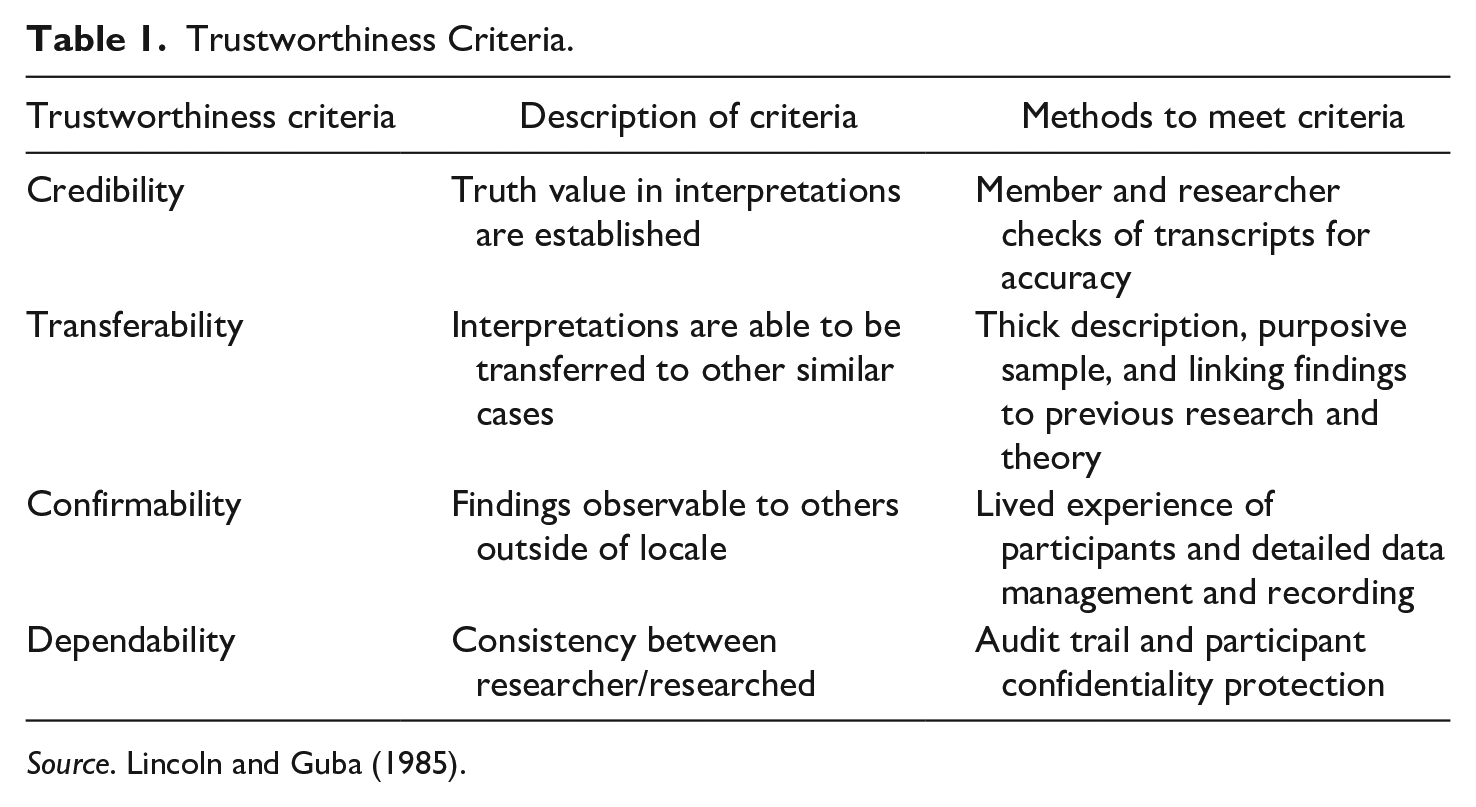
Source. Lincoln and Guba (1985).
First, all of the transcripts were independently reviewed by each of the three researchers to increase familiarity with the data and the researchers kept memos of their thoughts (Lindlof & Taylor, 2011). The unit of analysis for this study was a complete thought from a participant. After the researchers had read and memoed through the data, they met to begin collaboratively coding using a constant comparative, iterative process. Reviewing the data independently and then collaboratively helps to reduce groupthink and takes a holistic view of data analysis. Collaborative coding also facilitated agreement between the researchers.
Following Glaser’s (1978) constant comparison coding techniques, the first phase of coding helped move the data into discrete codes/categories. Collectively, there were 46 categories inductively identified by the researchers (see Table 2). From the discrete codes, the researchers continued the iterative and collaborative coding process and entered phase two of coding where the data was sorted into themes. It was during this phase that structuration was dropped and UMT was adopted as a sensitizing framework to assist in organizing the coding. This involved checking the fit of emergent data against existing categories and modifying those categories and/or adding new ones when necessary to represent the data, ensuring the categories earned a place (Glaser, 1978). Further, using UMT as a sensitizing framework during this stage guarded against forcing or selecting data to fit a priori categories (Glaser, 1978). Owen’s (1984) guidelines of recurrence, repetition, and forcefulness were used for additional rigor to help determine themes. The researchers condensed the previous 46 categories into 15 codes, and then further into the final seven themes presented in the findings driven by the research questions (see Table 2). Coding ended when observable patterns and sub-themes did not result in any new categories, signifying that theoretical saturation had been reached.
Codes, Themes, and Findings.

Findings
RQ1: Using Cybervetting to Manage Uncertainty During Anticipatory Socialization
During the focus groups, participants were asked several questions to help determine whether or not they engage in cybervetting practices as part of the anticipatory socialization process. Questions included asking if/how they use employee-generated review websites, to what extent they research the organization and/or interviewer on social media, and about any other ways they gather information while job searching. Participant responses indicated that all participants except for three engaged in some type of cybervetting activity. We assume that each participant is facing uncertainty regarding future employment, as only one participant reported having a job lined up after graduation. During the focus groups candidates expressed learning new cybervetting tactics from their peers throughout the conversation. Two themes emerged from the data related to how entry-level job seekers engage in cybervetting: through the use of social media and through the use of employee-generated review websites.
(Not) Using social media
During the focus groups, participants explained how they rely on social media throughout their pre-entry organizational socialization process using the following social media websites: LinkedIn, Instagram, Facebook, and Twitter. Many participants indicated they currently follow organizations they want to work for, or are pursuing, on social media channels. One participant explained: “I like to stay up-to-date on what’s going on in the company. That way, if I were to get an interview, I kind of also know what’s going on and I can sort of show I have an interest in them.” Similarly, another participant echoed their reasons for following organizations on social media stating: “I think it’s a good way of seeing the day-to-day activities, or also seeing what the company values. “These behaviors represent a simple action, following companies, to enable passive monitoring of the job environment via unobtrusive observations (Ramirez et al., 2002). Online venues enable uncertainty management through the passive receipt of feed information by users.
In addition to following organizations and brands on social media, participants also reported using social media to cybervet interviewers, other employees, and the workplace. One participant explains this process: “After I had my first interview for my current job, I did hardcore stalking of everybody just to see kind of my best first impression I could get from social media, and also just to see what it was about.” Several other participants noted using social media for cybervetting to see if they would fit in with the other employees, as one participant explained that they cybervetted to see “honestly, if you fit in with the people who you might be working with.” Another participant explained that he opened Snapchat, looked at the public stories posted at the companies’ geo-location, an inferred what it was like to work there based on those stories. Therefore, participants reported using social media for cybervetting to assess how well they might fit into an organization, and to learn more about current employees. However, one participant expressed her reasoning for using social media stating: I actually do look people up because that’s something that my dad has always said. He’s like ‘Well, hey if they’re gonna look you up, who’s to say that they’re not just as equally as. . .’ I wouldn’t consider myself weird, but you know what I mean. If they’re looking you up, you can look them up. It works both ways. Just because you’re going to be the new employee doesn’t mean you don’t have the right to know who the person that you’re going to be talking to or who the person is that you’re potentially going to be working for.
As reflected in the quote, some participants felt comfortable with active and engaged information seeking (i.e., looking up the profiles of workers) while others felt more comfortable engaging only in extractive cybervetting via some public sites or social media. Thus, participants varied on using either an active information seeking process or an “extractive” approach to manage uncertainty (Ramirez et al., 2002, p. 219). As one participant explained, using social media is “all just a big judgment of a company. I’m not totally sure how I felt about it.” Similarly, another participant put it this way, “I think I’d use company websites, but not necessarily Facebook, just because I don’t really use that in my life already, and I don’t know. I’m more inclined to use Indeed or Glassdoor, LinkedIn.” In fact, one focus group unanimously agreed that it is flat-out wrong to use social media to look up people who work at a company. Another group was entirely split about the appropriateness of looking up company employees on social media. In all, there was a mixture of comfortability using social media, and particular platforms, to cybervet employers.
Employee generated review websites
Participants were explicitly asked about their knowledge and use of employee generated review websites during each focus group. The majority of participants knew about these websites and many reported using them for cybervetting and information seeking about organizations. One participant explained: “It exposes how the workplace is ran. Because it’s kind of blind when you’re applying for a job so that kind of pulls the curtain back a little bit.” Another participant noted: “It’s kind of like stalking someone on social media. You’re like, let me look a little more.” Finally, participants noted how the use of employee generated review websites was one of several information seeking and cybervetting strategies they used. As one participant explained, “I’ve gone to a career fair before and then if I have a good conversation with company, I’ll look them up on Glassdoor to see if it’s something I actually want to follow through to see, or if it’d just be a waste of time because it’s not a good company.” Thus, we found that employee generated review websites are being used for cybervetting to find information about employees and organizations while job searching. Overall, almost all early-career job seekers turn online, some utilize social media, and most feel comfortable using review websites as potential sources of information about the company.
RQ2: Why Do Entry-Level Job Seekers Engage in Cybervetting?
Research question two examined why entry-level job seekers engage in cybervetting behaviors. Consistent with the UMT two themes emerged from the data: cybervetting aids decision-making and cybervetting helps manage uncertainty and reduce anxiety.
Cybervetting to aid with decision-making
Through the use of social media and employee-generated review websites, participants explained how they use information found online to help them make decisions related to applying to organizations, engaging in interviews, assessing personal fit with employees and an organization, and even deciding to accept job offers. Participants also reported looking for information such as how employees are treated, what the boss is like, company culture, and benefits related information to help them make decisions. One participant explains: Hearing employees or former employees’ opinions on, like, work environment and personalities that people are working with, whether it was difficult, engaging or fun, helps a lot when you’re trying to find an environment that you want to work in, so I like using these sites.
Another participant’s point of view is a good example of using cybervetting to make decisions about personal fit, he argued: “It helps, especially with benefits and all that, trying to figure out if one is better fitted for you, it can definitely help to narrow down your search, per se.” Collectively, participants note the importance of cybervetting through social media channels and employee-generated review sites to help them gather information to make more informed decisions related to their job search.
At the same time, many participants signaled that they were skeptical of the information posted on review websites. As one participant explained, I would “definitely consider [using online reviews], but take it with a grain of salt, because I’ve always. . .I’m a believer in people only write reviews when they’re mad or upset. So, I don’t completely rely on it.” This view was shared in many focus groups, “grain of salt” was a theme in four different groups and many others talked about this tension, one participant explained: “What if that was just one person and the person really just hated the manager and he said, ‘You can’t get off this weekend.’ ‘Oh, I’m going to write a review, I hate you’.” Another participant was direct in her feelings: “So I think that a lot of the reviews are probably super negative because they’re just maybe a shitty employee.” The tension between finding useful information and assuming a bias in review websites was matched by views that reviews are useful. In line with UMT, preconceptions, or cognitive schema, about the usefulness of online information affected how central the information was to how participants managed uncertainty. The less (more) useful or diagnostic participants viewed online information, the less (or more) often participants envisioned turning to these sources.
Cybervetting to manage uncertainty and reduce anxiety
Another theme that emerged through the focus group data, and the sensitizing UMT framework, was the use of cybervetting to manage and reduce uncertainty and anxiety through information gathering. Participants expressed that cybervetting through social media and employee-generated review websites helped them assess the culture of an organization, learn more about pay and benefits, and better prepare for interviews. One participant explained, “If it’s a company I don’t know much about, looking them up, making sure there hasn’t been any huge scandals, or making sure the company’s run well, has good executives and all that” is useful.
One participant explained how he uses social media before visiting an organization during his job search stating: Sometimes I’ll just go to LinkedIn and kind of look at the pictures of people and see what the culture would be like and just assume from that. If there’s like, older people working there, I just know that’s what I’m walking into. . .it was nice because I knew walking in that I was going to be the youngest one there and it’s good to know before and you can get that from looking at the employees.
As this participant explained, online information represents one among several resources in finding information about the company. One participant described online reviews as a “first preemptive step” in the job search process. Indeed, many across these groups viewed online information as one of several important information sources.
Many participants targeted specific information they considered useful or helpful in managing uncertainty and anxiety. As one participant put it “I use those sites because you can learn salary negotiation and it gives you an idea like where to start at.” Another participant argued, “It really gives you a, like, kind of a better understanding of what it would be like.” Participants thought reviews could reveal “culture,” “pay,” “interview questions” and many other facets of organizational life. Even as participants questioned the value of information posted in reviews, knowing specific aspects about the jobs they were applying to was uniformly seen as a benefit to managing uncertainty in the anticipatory socialization process. This reveals the interplay between cognitive, social, and communicative uses of information. Participants experienced uncertainty, gathered social evidence communicated by others online (though they did, at times, derogate these sources), utilized this information to guide their decision-making, and re-assessed their own uncertainty in the anticipatory socialization process. Lastly, we turn our attention to how participants engaged in communication in light of information obtained online.
RQ3: How DOES Cybervetting Influence Subsequent Communication Strategies?
The final research question examined how cybervetting behaviors influence job seekers’ subsequent communication. Consistent with UMT, three prominent themes emerged: aiding interviews, engagement with one’s networks, and reduced interest.
Cybervetting Influences Interview Preparation and Interview Questions
Several participants noted their use of employee-generated review websites to gather information about the interviewing process to better prepare themselves. The use of employee-generated review websites emerged as especially helpful throughout the interview process for job seekers. One participant noted: I had an interview with Bank of America and I had no idea what I was going into and I used Glassdoor because former people posted what the interview questions will be like. This really helped me mentally prepare because I had no idea what was going to go down.
Similarly, another participant explained how he uses employee-generated review sites before an interview: “I think Glassdoor is a good tool to use right before you go into an interview to kind of gauge the company culture and whether or not you would be a good fit there.” Another respondent echoed his reliance on employee-generated review websites stating: “I have looked at Glassdoor just to see what people were saying before I had an interview there and to hopefully make my messaging more accurate and help it cater to the company I was interviewing with.”
Participants were particularly taken by the specificity of information available from others online which could aid in the interview process. One explained: “A lot of companies ask situation-based interview questions and reading these ahead of time helps you go into the interview a lot more prepared, knowing how to answer and stand out.” Employee generated review websites were also helpful to identify information job seekers want to learn more about. For example, one participant explained: “If I saw a lot of the same comments and I didn’t like them or wasn’t sure, I’d probably just ask about it during the interview and see what they tell me.” Additionally, another participant explained: “In an interview process they’re going to ask if you have questions and you can use those as base questions and compare their answers to what the reviews say.”
Participants also overwhelmingly explained another reason for cybervetting through social media prior to an interview, which is to inform their own questions and to create talking points. This not only helped with their decision-making process but also increased their efficacy. One female participant said: “Yeah, I mean, I know going in, I know their job title, their job description, where they previously worked, I know this so I can find talking points with them. Knowing things like that is really important.” This example further illustrates how people can use information gathered online to help them communicate during a subsequent interview.
Prompts engagement with social networks of relevant ties
The second theme of RQ3 demonstrates how cybervetting leads to increased communication within a job seeker’s existing network(s). Participants explained how they use the information they find through cybervetting to start conversations with people to learn more. One participant noted, he might contact someone who worked at a company he was considering because, “Just how you use people to vouch for your character, I would use them to vouch for company culture and stuff because I think that’s a lot more meaningful than some anonymous thing that someone wrote on a website.” Similarly, another participant echoed the importance of communicating with someone about what they found while cybervetting explaining: [Talking] to someone who actually worked at the company would be a big deal. They would give you a better sense of company culture and how it would actually be because online reviews can, you can read one that says ‘Oh the president sucks and is a total jerk’ and then if you ask someone that works at that company and they’ve read that review online, they can be like ‘Oh I know exactly who wrote that and they just didn’t get along.’ So just be a tit-for-tat thing.
Collectively, participants explained that when they read online reviews about organizations, they take them with a grain of salt, because it is hard to know whether or not the information is honest and accurate. One participant explained that after seeing information online, you might want to ask a recruiter what it is like to work there. “Obviously, they’ll start out by saying all the great things about working there and why it’s a great thing. But then if you get a little more real and ask, ‘What wouldn’t I like about working at the company’?” Many participants echoed that additional conversations with someone with direct experience would serve as a valuable supplement to information uncovered in the cybervetting process. As another participant explained, the value with contacting social ties is “because it’s an actual person working there.” To this end, however, the information they gather through cybervetting influences their subsequent choices to seek out relevant social ties to either affirm or reject the information they found.
Influences a withdrawal of interest
The third and final theme of RQ3 reveals how some participants reduce their communication with organizations through a withdrawal of interest-based on the information they find through cybervetting. One participant clearly illustrates her experience stating: “I applied for a job and then I canceled my application because I read former employee negative reviews about how, like, the higher-ups kind of run the business and how they don’t care about their employees and stuff like that.” Participants also noted how they looked for patterns while cybervetting and when negative patterns were present, that could persuade them to look elsewhere for employment. A participant explained: “Like if a lot of people are saying management sucks, that would be a major factor. But like if one person said that, I might not take it as seriously. But if you’re seeing a distinctive pattern, that might be something to consider.” Another participant upheld this idea explaining his thinking: “I really value security. . .knowing I can count on having my job, like, a year from now or not worrying. . . So, if I saw a lot about, like, layoffs or unexpected changes in PTO, that would put me off.” Thus, negatively valenced information uncovered in the process of cybervetting a potential employer can, at times, prompt potential employees to withdraw interests.
In sum, nearly all participants use cybervetting to help them gather information, many use this information to aid in decisions and help reduce anxiety. Further, the information gained during cybervetting prompts subsequent communicaiotn including deciding if they want to continue their pursuit of specific organizations. These findings validate and extend the UMT proposition that information can both reduce or amplify uncertainty. It is worth noting, across focus groups, none of the participants discussed how they found positive information on employee-generated review sites, and thereby, we are unable to offer evidence to support a counter-argument that positive information can increase willingness to pursue employment at specific organizations (see Walther & Jang, 2012).
Discussion
This study uses the rich, descriptive, lived experiences of early-career job seekers to uncover how they use the internet to cybervet potential employers, why they engage in cybervetting behaviors, and how online information affects subsequent communication. Our findings reveal that some feel comfortable using social media while others are hesitant to tap social media specifically as a source of anticipatory socialization. However, our participants generally found employer review websites to be useful information sources for managing uncertainty and anxiety, but simultaneously derogated these sources as written by emotional employees (Carr & Piercy, 2021; Festinger, 1962). Further, they contrasted these valenced reviews with “actual people” working at the company they might have a follow up conversation with. These tensions closely mirror the UMT principles that managing uncertainty is not just about information seeking, it is also intimately linked to cognitions and behaviors which mitigate unknowns.
In line with past evidence on anticipatory socialization, prospective employees leverage information from a wide variety of sources. But in line with recent claims, the internet is an increasingly useful source of job information (Fetherston, 2019). Employer review websites add an unobtrusive means to engage in information seeking as part of the anticipatory socialization process. As our findings indicate, early-career job seekers are looking for information about day-to-day life inside organizations, how management treats employees, and salary/benefit information. Thus, our first major contribution is articulating how online resources are used (or not) by early-career job seekers as part of the (increasingly mediated) job search process.
The findings suggest many entry-level job seekers cybervet in the same ways that employers do (through social media and public searches; Berkelaar, 2017). However, these findings also reveal that while employees accept that employers might cybervet them, these job seekers feel less entitled to investigate employers online, suggesting an imbalance in the bidirectional organizational socialization process (Kramer, 2010) and potentially extending the view of UMT. Qualitative communication research seeks to reveal discourses of power which shape communication processes (Tracy, 2019). Hesitancy by job seekers to engage in cybervetting might be reflective of the power-dynamics and cultural discourse about expected social media use. Restated, these job seekers seem to believe employers have the right to look up information about employees, and employees also assume that all information posted on their own pages is fair game (Backman & Hedenus, 2019; Coutu, 2007). While online information sources were empowering for many participants, others did not feel as entitled to engage in online research about the company. The reality, that participatory websites provide more egalitarian access to novel information (see, Walther & Jang, 2012), may be less important than deeply entrenched power-dynamics that employers have resources and new employees have few. Thus, job coaches and job seekers must keep in mind that overcoming perceived power dynamics is a matter of efficacy as much as or more than challenges of information availability.
The job search process creates a sense of uncertainty about both the prospect of the job and one’s own abilities. Online reviews and publicly available information are freely accessible resources that offer information that might aid in uncertainty management (Piercy & Lee, 2019). However, some individuals are either more comfortable or feel more efficacious avoiding online sources or may feel they do not have the right or ability to cybervet (see also, Fetherston, 2019). One participant explained this tension when asked if she would look at companies on social media, “I mean, I don’t know how you would. . .” when asked directly if they would use social media to research a job or company, several other participants replied “no” and “never.” Thus, early-career job seekers might be empowered by coaching and encouragement to use not only review websites, which many already feel quite comfortable engaging, but also social media platforms as potential sources of insight to the companies they are considering applying for jobs.
UMT acknowledges there is no direct link between motivations for managing uncertainty and particular management strategies (Kramer, 2004). The data reported here show a human-sourced bias in finding jobs that are contrasted by evidence that many job seekers are turning to the internet to find work. There is a tension between how people are finding jobs (81.4% use the Internet, 26.9% say it was the most important source; Piercy & Lee, 2019) and prospective employees’ views that finding a job often happens via social networks (Van Hoye, 2018). Early research which guides UMT suggests that information seekers’ use of a variety of sources is key to managing uncertainty (Brashers, 2001). With the mix of on an offline job information sources, some sources may be chosen over others because they are perceived to differ in terms of perceived efficacy, availability, or user familiarity with the source. Again, job seekers likely benefit from coaching that while social ties are useful information sources (Granovetter, 1995) so too are practices that increase efficacy and potentially influence hiring decision-makers (Piercy & Zhu, 2021).
Our study also suggests that social information posted online is still seen as personally biased (by posters) and personally relevant (to the job seeker). Participants largely viewed using online review information as unique to each job seeker, as one participant explained, the value of review information is to “see what’s more important to me, specifically.” In this way, cybervetting is a personalized process. The results from our second and third research questions highlight this conclusion: potential employees considered a wide variety of information to several different outcomes including expanding the search to one’s social network and even discontinuing a relationship with the organization based on the information. Again, UMT is informative as information prompts some early-career job seekers to expand their search, others to feel discouraged, still others to question the information or source, and can even prompt some to withdraw from an active search process. Future research ought to explore what messages and personality traits promote varied forms of information-seeking, or even prompt some users to stop seeking work as part of their uncertainty management process.
Entry-level employees are using employee-generated review sites, but recent evidence suggests review information is often not their first or primary information source (Aley & Levine, 2020). Perhaps these sites are more popular with job seekers who have previous experience and are at different stages of their careers and may have different priorities when looking for a job. That is, what works for one individual in a given situation (i.e., job searching) might not mitigate or manage uncertainty for another person (Kramer, 2004).
Many participants signaled that under high levels of uncertainty they would prefer face-to-face communication, even if it was with a recruiter whose interests were tied to the company–a finding which matches classic theorizing about medium choice and uncertainty (Daft & Lengel, 1986). An alternative possibility is that participants’ familiarity with the source dictates which source they turn to. Lim and van der Heide (2015) demonstrated familiarity with a given platform (i.e., Yelp) affects how a user processes information available on the platform. Restated, though our participants largely espoused a familiarity with online sites, their uncertainty about the context, scope, and focus of the site may have prompted them to avoid it as a tool for uncertainty management. This point is further echoed by the finding that our participants stressed the importance of intersubjective agreement by posters in online review websites as a way to evaluate the trustworthiness of information.
Finally, these findings reveal that employers ought to be aware of the information circulating online about the company. This is particularly relevant given the reality that though reviews are actually more likely to be biased positively (Chamberlain & Smart, 2017), our job seekers only referenced negatively valenced review information they found online. Further, this finding is compounded by the derogation of the sources (i.e., taking the information posted on review sites “with a grain of salt”). Thus, this study may implicitly further validate the negativity bias, or the tendency of negative information to be more memorable (Carr & Walther, 2014; Walther & Jang, 2012). Future research ought to explore if negativity bias is particularly salient for experiential reviews, like those of organizations. Additionally, companies may be interested in knowing the relative influence and trustworthiness of organizationally-created messages relative to messages about the organization from third parties (Carr, 2019), as negative reviews could influence the morale of current employees and, as our findings underscore, recruitment efforts of organizations to attract and retain employees (Patton, 2018).
Future Directions and Limitations
This study is one of the first to qualitatively examine cybervetting as a tool for potential employees, not just employers in the anticipatory socialization process. This is a burgeoning and robust area for future research. Our findings and previous research indicate that cybervetting is used by both employers and job seekers. As online platforms connect previously disparate audiences, cybervetting of organizations is becoming more normative. Previously, cybervetting was seen as an organization-to-individual concept. Our study highlights that cybervetting is a tool not only used by organizations, but also by job seekers as part of the anticipatory socialization process. Individual-to-individual cybervetting is increasingly common, and this practice provides several avenues for future research. Other areas for future research based on this study include examining how job seekers determine the validity of information they find through cybervetting, reputation management for organizations, exploring power and recirprocity in uncertain processes like job search, and the ongoing exploration of how cybervetting influences recruitment and retention communication, on both sides of the employee-employer social contract.
As with all studies, this one is not without limitations. Qualitative research lacks generalizability. Although this study had a healthy sample size of rich descriptions of lived experience, the findings cannot generalize to all entry-level or early-career job seekers. Moreover, demographic data beyond gender was not captured, so there could be distinct differences based on socioeconomic factors that are not accounted for in this study. Also, we lacked diversity in terms of majors, with more communication and business majors than a typical graduating class, which could vary the findings. Similarly, our theoretic framework (UMT) highlights that some uncertainty is cognitively managed or goes unmanaged because it does not feel actionable to the participant. Future work could begin the important process of operationalizing the complex cognitive, behavioral, and communicative UMT processes. In asking about how early-career job seekers engaged with new media we may have invited participants to think how they would, rather than how they did, engage in cybervetting. However, given the evidence that the use of online sources is on the rise for both employers and job seekers, there is a high need for additional research that considers how both experienced and novice job seekers cybervet their potential employers, and the outcomes of this behavior.
Supplemental Material
sj-docx-1-job-10.1177_23294884221096673 – Supplemental material for Exploring Early-Career Job Seekers’ Online Uncertainty Management
Supplemental material, sj-docx-1-job-10.1177_23294884221096673 for Exploring Early-Career Job Seekers’ Online Uncertainty Management by Stephanie A. Smith, Cameron Piercy and Yaguang Zhu in International Journal of Business Communication
Footnotes
Declaration of Conflicting Interests
The author(s) declared no potential conflicts of interest with respect to the research, authorship, and/or publication of this article.
Funding
The author(s) received no financial support for the research, authorship, and/or publication of this article.

Supplemental Material
Supplemental material for this article is available online.
Author Biographies
References
Supplementary Material
Please find the following supplemental material available below.
For Open Access articles published under a Creative Commons License, all supplemental material carries the same license as the article it is associated with.
For non-Open Access articles published, all supplemental material carries a non-exclusive license, and permission requests for re-use of supplemental material or any part of supplemental material shall be sent directly to the copyright owner as specified in the copyright notice associated with the article.
