



Abstract
Crowdfunding has become an attractive option to raise funds in recent years. Several studies have examined language use in crowdfunding campaigns, and a few have attempted to understand entrepreneurs' language use on these platforms precisely. All assume that those categorized as entrepreneurial are inherently different from those categorized as other. We aim to explore that assumption while adding to the growing body of literature on the use of language in crowdfunding. We examine how entrepreneurs use language differently than other creators on crowdfunding platforms and how language relates to successful and unsuccessful campaigns for entrepreneurs and other creators. Findings indicate differences in language usage exist between entrepreneurs and other creators and also between successful and unsuccessful campaigns for both groups. However, more than that information is needed to increase the possibility of funding. While there isn’t a magic formula for success, all crowdfunding campaigns appear to have the best chances by balancing the language they use.
Introduction
From Shark Tank to social selling, entrepreneurs will try almost anything to obtain the needed capital to start a new business or take their existing one to the next level, and it is no wonder why. Only a fraction of new businesses receives professional investment, an essential milestone toward venture success (Picken, 2017). This study examines how entrepreneurs use language differently than other creators on crowdfunding platforms and how language relates to successful and unsuccessful campaigns for entrepreneurs and other creators. As defined by Lehner (2013), crowdfunding entails “tapping a large, dispersed audience, dubbed as ‘the crowd,’ for small sums of money to fund a project or a venture.” (p. 289). Crowdfunding is an increasingly popular method of raising funds to launch projects by entrepreneurs and others. The failure rate of crowdfunding campaigns is relatively high, with only 40% of campaigns on Kickstarter, a popular crowdfunding platform, successfully getting funded (Kickstarter, n.d.). Given the structure of online crowdfunding platforms, the language and story published on the campaign page by its creator have shown to influence campaign success and failure (Anglin et al., 2018; Babayoff & Shehory, 2022; Cappa et al., 2021; Desai et al., 2015; Kaminski & Hopp, 2020; Mitra & Gilbert, 2014; Parhankangas & Renko, 2017; Peng et al., 2022; Tajvarpour & Pujari, 2022).
This study examines if a fundamental difference exists between entrepreneurial and “other” campaigns in crowdfunding through the lens of language. For this study, we define entrepreneurial crowdfunding campaigns as those in the categories of hardware, software, technology, computer (video) games, and product design (Chan et al., 2020; Chan & Parhankangas, 2017; Mollick & Kuppuswamy, 2014; Parhankangas & Renko, 2017). In addition, our study examines how successful crowdfunding campaigns use language differently than those that fail. An exploratory design was chosen for this study because they are open-ended and flexible and designed to investigate new insights into phenomena (Blanche et al., 2006; Hair et al., 2019; Naidoo & Dulek, 2017). An exploratory approach would allow us to build on the current literature and explore new avenues.
Entrepreneurs are consistently on the lookout for new funding sources. One source that has recently risen in use due to its ease in finding investors is crowdfunding (Hsieh et al., 2019; Ibrahim, 2015; Ordanini et al., 2011). Crowdfunding enables anyone to fund new products and projects, allowing entrepreneurs to acquire startup capital outside of traditional angel investors, venture capitalists, and debt financing. Reward-based crowdfunding is the fastest-growing form of crowdfunding and boasts the largest number of platforms (Kuppuswamy & Bayus, 2018).
With crowdfunding emerging as a new source of funding for entrepreneurs and other startup organizations that traditionally have had limited access to traditional forms of financing in the past, there has been an increased interest in how to execute crowdfunding campaigns successfully. Previous studies have examined particular categories of campaigns, and others have examined all campaigns. One group that has garnered interest among scholars is entrepreneurs. Much of that research has focused on the language of the campaigns in attempts to understand how entrepreneurs use language differently in successful versus unsuccessful campaigns (e.g., Chan et al., 2020; Parhankangas & Renko, 2017). Though these studies provide important findings, they are based on the untested assumption that specific campaign categories on crowdfunding platforms are more representative of traditional commercial, entrepreneurial endeavors, for example, software or product design, than other campaign categories, for example, food or comics. Our study addresses this by providing evidence of heterogeneity between these assumed entrepreneurial categories and other categories.
Some scholars have been interested in all crowdfunding campaigns, not differentiating between entrepreneurial and other campaigns (e.g., Desai et al., 2015; Mitra & Gilbert, 2014). This has led to another challenge for the field, as a split in the literature has developed. There is now a bifurcated understanding of how language enables crowdfunding success, with the two literature areas detached, one from the other. This may lead to difficulties for scholars and practitioners alike as one might question whether findings of general crowdfunding language studies should be applied in entrepreneurial contexts, and vice versa, should results specific to entrepreneurial campaigns be applied to other campaigns. Our study’s second contribution to the literature is by connecting these two areas of literature. We examine how entrepreneurial campaigns use language differently from other campaigns and how their respective language use leads to funding success. Additionally, as a practical contribution, we believe this will lead to a better understanding of how practitioners (both entrepreneurs and other creators) may use language to frame their crowdfunding stories to convey cognition and motivation that might persuade funders (Bettinghaus & Cody, 1994; McClelland et al., 1989) when raising capital through crowdfunding platforms. Therefore, our research questions are:
RQ1: How do entrepreneurial campaigns use language differently than other crowdfunding campaigns, focusing on motivation, thinking styles, and time orientation?
RQ2: How do entrepreneurial and other crowdfunding campaigns use language differently in successful versus unsuccessful campaigns?
Background
Crowdfunding
Crowdfunding is a relatively new and popular form of financing new ventures. Referred to as a disruptive innovation in new venture financing, crowdfunding is a way for entrepreneurs and other creators to raise smaller amounts of money from large numbers of individuals using an online platform (Assenova et al., 2016). As funding opportunities are not readily found for new ventures (Cosh et al., 2009), many entrepreneurs are turning toward crowdfunding as an alternative funding approach giving them the financial boost they need to start a new business (S. Chen et al., 2016). From an academic perspective, crowdfunding has received significant attention from researchers. The existing literature tends to either: (1) examine antecedents of successful crowdfunding campaigns or (2) examine characteristics and motivations of potential funders (see Agrawal et al., 2015; Cholakova & Clarysse, 2015; Gerber et al., 2012; Hörisch, 2015; Kim et al., 2017; Kuppuswamy & Bayus, 2018; Lagazio & Querci, 2018; Lehner, 2013; Mollick, 2014; Piva & Rossi-Lamastra, 2018). One assumption has been that entrepreneurs and other creators on Kickstarter were two different groups of people. This assumption has not yet been tested to any degree. Our study seeks to address this by differentiating these two groups through the language in their crowdfunding project requests. To begin with, it is essential to understand crowdfunding better and the online platform used to seek funding.
Crowdfunding typically has three main parts: (1) the project creator, (2) the funder, and (3) the platform that brings the two parties together (Ordanini et al., 2011). The project creator promotes their project to potential funders hoping to receive funding. The funder reviews the information about the project and makes a funding decision based on intrinsic values and extrinsic benefits (Ryu & Kim, 2016). The platform that brings the two parties together usually has four components: a campaign page to promote the details of the project, an area dedicated to funding-related data, a payment system, and a communication tool that allows potential funders to communicate with the project creator (Agrawal et al., 2015).
Kickstarter is one of the largest rewards-based platforms, with over 225,000 projects worldwide being funded with more than 6 billion dollars since its beginning in 2009 (Kickstarter, n.d.). Because of the site’s popularity, it is a favorite of entrepreneurship researchers. Kickstarter is a crowdfunding site where entrepreneurs and other creative individuals promote projects to raise funds to launch these ventures into reality. A campaign is successful if it reaches its funding goal by the deadline. Campaigns are composed of text, videos, and graphics (where individuals pitch their projects to the audience and include a project story), the risks and rewards associated with the project, frequently asked questions, and updates on the project. With an overall funding success rate of only 40%, project creators seek insights on running successful campaigns (Kickstarter, n.d.).
Theoretical Framework
The primary area of theory that we will explore is motivation theory. Based on the long-standing work of James McClelland et al. (1989), motivation theory identifies three specific and implicit needs that motivate behavior: affiliation, power, and achievement. The need for affiliation is “the desire to establish, maintain, or restore warm relationships with other people” (McClelland et al., 1989, p. 692). The need for power is defined as “the desire to have impact on others by influencing, persuading, helping, arguing with, or attacking them” (McClelland et al., 1989, p. 694). Lastly, the need for achievement is defined as “a concern to do things well—a kind of general process goal that in time, assuming no special self-conscious types of achievement goals, may lead people into entrepreneurial activity” (McClelland et al., 1989, p. 692). More recent literature reviews, including a meta-analysis, confirmed the relationship between a need for achievement and entrepreneurial motivation (Collins et al., 2004; Shane et al., 2003). Importantly, Collins et al. (2004) found that the need for achievement was a reliable differentiator between entrepreneurs (higher) and the general population (lower). We argue that not only do these needs motivate behavior, but they also impact the language that an entrepreneur chooses to use. Based on McClelland’s theory (Collins et al., 2004), it is anticipated that crowdfunding campaigns identified in the entrepreneur category should have more evidence of achievement, affiliation, and power language than those in the other category.
Another area of theory is thinking style. A review of previous Kickstarter studies using Linguistic Inquiry and Word Count (LIWC) categories has identified that thinking style is also an essential factor in the success of crowdfunding campaigns. There are four factors: clout, power, authenticity, and emotion. Naidoo and Dulek (2017) referred to these summary variables as “Perceived Leader Communication Traits (PLCT)” (pp. 38–39). These dimensions convey to the potential funder if the project creator is confident, authoritative, honest, and positive (Naidoo & Dulek, 2017). Because these directly impact the perception of the would-be funder, this is an important factor differentiating funding campaigns. We anticipate that entrepreneurs will be more skilled in crafting an image or persona and, hence, their campaigns will have higher clout, neutral emotion, and lower authenticity than other campaigns. This is because they are more adept at creating a persona in the marketplace than others.
Finally, it is vital to understand the role of time in language. Time plays an important role in crowdfunding campaigns. Prior research shows that present and future-tense words are associated with unsuccessful campaigns (Peng et al., 2022). Therefore, identifying if there is heterogeneity between entrepreneurs and other creators would be valuable for both practical application and research. Early analysis of the role time plays in the decision-making process can be exemplified in Bergadaa’s (1990) work, who created a model that broke consumer action points into two distinct categories: actions the consumer is doing now and actions the consumer will do in the future. From here, there have been many studies of the role time plays in the perception and actions of players in the market. Building on this work, Hornik (1993) developed a Past–Present–Future model that connected affect to a state in time. This provided additional support for work in time and mood and theory that linked positive and negative feelings with different rates of the passage of time (Hornik, 1993). This is an important finding and added to the growing body of literature in this area in the 1980s and 1990s. While it may not sound earth-shattering on its surface now, it and similar works became foundational in understanding the perception of time.
Method
Study Design
We seek to answer two questions: (1) How do entrepreneurial crowdfunding campaigns use language differently than other crowdfunding campaigns, focusing on motivation, thinking styles, and time orientation, and (2) How do entrepreneurial and other campaigns use language differently in successful versus unsuccessful campaigns? To answer these questions, this study used exploratory techniques by applying computer-aided text analysis (CATA) with the LIWC software to classify the language of the campaigns along several dimensions and then perform descriptive analysis (Ang & Van Dyne, 2015; Liu et al., 1999; Naidoo & Dulek, 2017; Ostle, 1963). LIWC has been used in psychological, linguistic, and management research for several decades, establishing confidence in its content and construct validity. Additionally, many of LIWC’s intercoder reliability dimensions tend to fall between 86% and 100% (Francis & Pennebaker, 1992; Naidoo & Dulek, 2017; Pennebaker & Graybeal, 2001).
Sample and Data Collection
The website Web Robots has datasets of Kickstarter campaigns available for download. Each campaign represents an attempt to raise funding for a project. Data for this study were collected via download from the Web Robots website or by employing “web scraping” techniques directly on the Kickstarter website. Data for 374,045 campaigns were analyzed for the years 2009 through 2019. We excluded campaigns after 2019 from the data collection to avoid introducing the COVID-19 pandemic as a confounding variable in any analysis.
We removed duplicate campaigns, those outside the U.S., those not denominated in U.S. dollars, those that were canceled, suspended, or still live, those with a duration of more than 100 days, those where the funding obtained was less than the funding goal, those marked as successful, those that were marked unsuccessful but met their funding goal, those with funding goals less than $100, and finally, those campaigns with less than 100 words (combining the title, subtitle, and story text). Excluding texts containing fewer than 100 total words is consistent with previous studies (Josef & Helena, 2022; Tata et al., 2017) and ensured enough words were present to obtain an accurate and reliable analysis of the text content using the LIWC software. The remaining 186,908 campaigns made up our final sample.
The combined text representing campaign titles, subtitles, and stories was cleaned before analysis by removing extra whitespace, tabs, newlines, and URLs. Then, word frequency tables and word clouds were generated from a corpus of a random sample (N = 10,000) of campaigns (due to computer processing limitations). The corpus was cleaned by converting all texts to lowercase, removing numbers, removing punctuation, and removing familiar English stop words (e.g., “a,” “the,” “is,” and “our”) that provide scant information. The cleaned texts were converted into a document-term matrix (DTM), from which frequency tables and word clouds were generated.
Variables
Our primary variable of interest for the first research question is campaign type. Campaign type is represented by 1 for entrepreneurial (ENTP) and 0 for other campaign types. Kickstarter campaigns seek funding for diverse kinds of projects, for example, books, art, non-profit initiatives, technology, software, and apps. A top-level category identifies each campaign. Kickstarter currently offers 15 top-level categories, along with a multitude of subcategories. While conducting linguistic studies, some researchers have focused their attention on all Kickstarter categories (Desai et al., 2015; Mitra & Gilbert, 2014), while others have limited their research to a specific category, such as films (Peng et al., 2022), games (L. S. Chen & Shen, 2019), or technology and product design (Kaminski & Hopp, 2020). We define entrepreneurial campaigns as those that were listed in one of the following categories previously identified as entrepreneurial (Chan et al., 2020; Chan & Parhankangas, 2017; Mollick & Kuppuswamy, 2014; Parhankangas & Renko, 2017): hardware, software, technology, computer (video) games, and product design. The two variables of interest for the second research question are campaign type and goal status. Goal status is represented by 1 for successful and 0 for unsuccessful campaigns and indicates whether the campaign reached at least the minimum funding goal declared by the project creator.
We examined several variables generated by the LIWC software. LIWC software analyzes a corpus of texts and assigns a numerical score for each text for each dimension requested. Most LIWC dimensions have a dictionary holding a list of words that represent that dimension (e.g., “angry,” “rude,” and “sad” are three words contained in the negative emotion dictionary). LIWC dimensions represented by a dictionary are measured with scores ranging from 0 to 100. These scores represent the percentage of words in the target text that appear in the dictionary of interest. For example, for a target text consisting of 50 words total and three words in the positive emotion dictionary, LIWC would assign a score of 6% for positive emotion. Word count (WC) and the summary variables, analytic, clout, authentic, and tone, are scored differently. Word count is simply the raw word count for a given text, and the summary variable scores are generated using proprietary algorithms with scores ranging from 0 to 100 (Pennebaker et al., 2015).
We used the LIWC software to generate three variables representing achievement, power, and affiliation. Motivations are thought to unconsciously impel individuals toward taking particular actions that may lead to a psychological reward (McClelland et al., 1989). McClelland et al. (1989) have developed staunch support for their theory of needs and motives based on the need for achievement, power, and affiliation (Atkinson et al., 1954; McClelland, 1961; Winter, 1973). Achievement is thought to drive individuals to enjoy mastering challenging tasks (Schultheiss, 2013). Power is a desire to control, impress, or influence others (Fodor, 2010). Finally, affiliation is a desire to enjoy close, agreeable relationships (Schultheiss, 2013).
We generated four variables representing thinking styles using LIWC. Analytic, clout, authentic, and tone represent summary variables generated by LIWC and are scaled to a 1 to 100 range using a proprietary algorithm, as previously mentioned (Tausczik & Pennebaker, 2010). Naidoo and Dulek (2017) referred to these summary variables as “Perceived Leader Communication Traits (PLCT)” (pp. 38–39). High analytic numbers represent “formal, logical, and hierarchical thinking; lower numbers reflect more informal, personal, here-and-now, and narrative thinking” (Pennebaker et al., 2015, p. 22). High clout numbers indicate “the author is speaking from the perspective of high expertise and is confident; low clout numbers suggest a more tentative, humble, even anxious style” (Pennebaker et al., 2015, p. 22). High authentic numbers reflect “a more honest, personal, and disclosing text; lower numbers suggest a more guarded, distanced form of discourse” (Pennebaker et al., 2015, p. 22). Lower authenticity scores can also result from lying or deception (Newman et al., 2003). A high emotional tone represents “a more positive, upbeat style; a low number reveals greater anxiety, sadness, or hostility. A number around 50 suggests either a lack of emotionality or different levels of ambivalence” (Pennebaker et al., 2015, p. 22). LIWC’s summary variables have been used extensively in psychology and management research, from examining the Twitter communications of business school deans (Naidoo & Dulek, 2017) to analyzing crowdfunding campaigns (Mahan et al., 2021).
Three time-oriented variables were also generated using LIWC. Specifically, we analyzed past, present, and future focus, all three variables being LIWC dimensions. These variables include both verb tenses and temporal references and can supply information on one’s “priorities, intentions, and thoughts” (p. 30) and one’s temporal focus (Tausczik & Pennebaker, 2010). Past focus includes words such as “ago, did, talked,” present focus, “today, is, now,” and future focus, “may, will, soon” (Pennebaker et al., 2015, p. 4).
Finally, we collected and analyzed several additional variables commonly used as control variables in crowdfunding research. Year is the year campaigns started. Campaign Days represent how many days campaigns were available to receive commitments from funders. Updates represent the number of updates posted to campaign pages and could indicate campaign creators’ effort level. Comments represent the number of comments posted on campaign pages by page visitors. Collaborators represent the number of people listed as owners of campaigns. Previous Projects represent the number of campaigns the project creator started in the past. Previous Success Rate is the number of successful campaigns divided by the number of previous campaigns for project creators. Finally, WC is the number of words in a campaign (combining the title, subtitle, and story) analyzed by LIWC.
Findings
Our data collection of Kickstarter campaigns from 2009 through 2019 resulted in 186,908 (100%) total campaigns analyzed, consisting of:
21,160 (11.32%) entrepreneurial campaigns
8,529 (4.56%) successful
12,631 (6.76%) unsuccessful
165,748 (88.68%) other campaigns
86,446 (46.25%) successful
79,302 (42.43%) unsuccessful)
Table 1 displays the descriptive statistics for the 23 variables analyzed, including sample size, mean, and standard deviation. Though this study focuses on language, Table 1 includes common control variables from earlier work. Table 2 displays correlation coefficients and two-tailed significance levels for all variables. Table 3 displays language usage broken out for entrepreneurial and other campaigns.
Descriptive Statistics.

Campaign type, 1 = ENTP, 0 = other.
Goal status, 1 = successful, 0 = unsuccessful.
Correlation Matrix.

Correlation is significant at the .001 level (two-tailed).
Correlation is significant at the .01 level (two-tailed).
Correlation is significant at the .05 level (two-tailed).
ENTP vs. Other Campaigns.

Mean (SD).
Welch two sample t-test.
Part I: Examining Entrepreneurial Versus Other Campaigns
The first research question examines how entrepreneurial campaigns use language differently than other campaign categories, specifically along the dimensions of motivation, thinking styles, and time orientation. First, we address how motivations are conveyed in entrepreneurial crowdfunding campaigns versus other campaigns. Welch Two Sample t-tests were conducted to test whether there were differences in variable means between entrepreneurial and other campaigns. As can be seen in Table 3, entrepreneurial campaigns used less affiliation language (M = 3.73 vs. 4.05) t(28,880.01) = −17.26, p < .001, more achievement language (M = 2.40 vs. 2.29), t(26,281.64) = 12.34, p < .001, and more power language (M = 2.65 vs. 2.54) t(27,127.70) = 10.66, p < .001 than other campaigns. Regarding the first research question, the data suggest that the language in entrepreneurial campaigns conveys more achievement and power motivation and less affiliation motivation than in other campaigns.
Second, we address how thinking styles are conveyed in entrepreneurial crowdfunding campaigns versus other campaigns by examining Table 3. Entrepreneurial campaigns used more analytic language (M = 85.52 vs. 83.74) t(30,282.83) = 22.70, p < .001, more clout language (M = 77.53 vs. 74.22) t(29,458.44) = 26.89, p < .001, less authentic language (M = 22.03 vs. 25.22) t(30,332.65) = −26.01, p < .001, and less tone (i.e., less positive emotion/more negative emotion) language (M = 72.48 vs. 76.58) t(27,252.95) = −25.53, p < .001) than other campaigns. Regarding the first research question, the data suggest that entrepreneurial campaigns convey more analytic and clout language, less tone, and less authenticity than other campaigns.
Third, we address how time orientation is conveyed in entrepreneurial crowdfunding campaigns versus in other campaigns by examining Table 3. Entrepreneurial campaigns used less past focus (M = 1.90 vs. 2.14) t(29,033.01) = −26.71, p < .001, and less future focus (M = 1.42 vs. 1.57) t(27,200.43) = −22.28, p < .001, while present focus (M = 8.71 vs. 8.70) t(28,818.10) = 0.63, p = .527 was not significantly different. Regarding the first research question, the data suggest that the language used in entrepreneurial campaigns conveys less past and future focus than in other campaigns.
Part II: Examining Goal Success for Entrepreneurial and Other Campaigns
Our second research question examines how entrepreneurial and other crowdfunding campaigns use language differently in successful and unsuccessful campaigns. Table 4 displays our language variables of interest for entrepreneurial campaigns grouped by goal status. Welch Two Sample t-tests were conducted to evaluate whether there were differences in variable means between successful and unsuccessful entrepreneurial campaigns. All variables significantly differed between successful and unsuccessful campaigns, excluding the LIWC language category quantifier t(19,992.00) = 1.60, p = .109. Successful entrepreneurial campaigns used more WC (higher word count) (M = 948.33 vs. 684.42) t(17,584.05) = 29.30, p < .001, more analytic language (M = 86.97 vs. 84.53) t(20,999.37) = 17.83, p < .001, more clout language (M = 78.96 vs. 76.57) t(20,001.56) = 10.64, p < .001, less authentic language (M = 20.26 vs. 23.23) t(20,528.50) = −13.64, p < .001, more tone (i.e., more positive emotion/less negative emotion) language (M = 76.49 vs. 69.77) t(20,773.27) = 23.22, p < .001, less affiliation language (M = 3.57 vs. 3.85) t(20,160.73) = −8.50, p < .001, less achievement language (M = 2.28 vs. 2.48) t(20,096.96) = −11.52, p < .001, less power language (M = 2.58 vs. 2.69) t(20,486.43) = −6.59, p < .001, more past focus language (M = 1.94 vs. 1.88) t(20,360.84) = 3.73, p < .001, less present focus language (M = 8.34 vs. 8.96) t(20,437.10) = −20.69, p < .001, less future focus language (M = 1.20 vs. 1.57) t(21,057.73) = −29.67, p < .001, and more number language (M = 2.77 vs. 2.21) t(18,482.82) = 22.63, p < .001. Regarding the second research question, the data suggest several language differences between successful and unsuccessful entrepreneurial campaigns.
Successful vs. Unsuccessful ENTP Campaigns.

n (%); Mean (SD).
Welch two sample t-test.
Table 5 again displays our language variables of interest, in this case, for other campaigns grouped by goal status. Welch Two Sample t-tests were conducted to test whether there were differences in variable means between successful and unsuccessful other campaigns. All variables were significantly different between successful and unsuccessful campaigns. Successful other campaigns used more WC (higher word count; M = 672.70 vs. 467.67) t(162,696.4) = 82.26, p < .001, more analytic language (M = 85.41 vs. 81.91) t(152,224.7) = 54.66, p < .001, more clout language (M = 76.87 vs. 71.32) t(154,176.6) = 57.30, p < .001, less authentic language (M = 22.84 vs. 27.81) t(154,297.7) = −49.56, p < .001, more tone (i.e., more positive emotion/less negative emotion) language (M = 77.82 vs. 75.22) t(157,712.8) = 23.25, p < .001, more affiliation language (M = 4.23 vs. 3.85) t(163,388.4) = 27.05, p < .001, less achievement language (M = 2.27 vs. 2.31) t(153,807.8) = −6.42, p < .001, less power language (M = 2.51 vs. 2.59) t(154,201.9) = −11.93, p < .001, less past focus language (M = 2.08 vs. 2.19) t(152,737.5) = −16.54, p < .001, less present focus language (M = 8.34 vs. 9.10) t(157,838.3) = −59.97, p < .001, less future focus language (M = 1.52 vs. 1.64) t(154,299.8) = −25.08, p < .001, more number language (M = 2.69 vs. 2.17) t(165,591.7) = 56.18, p < .001, and more quantifier language (M = 2.41 vs. 2.33) t(161,543.0) = 15.48, p < .001. Regarding the second research question, we find support for several language differences between successful and unsuccessful other campaigns.
Successful vs. Unsuccessful Other Campaigns.

n (%); Mean (SD).
Welch two sample t-test.
Analysis of High-Frequency Words
For the second research question, in addition to examining LIWC language categories above, we also examined the most frequent words used in campaigns, grouped by campaign type and goal status. See Table 6 and Figure 1. In Table 6, “will” and “can” are the first and second most frequently used words in both entrepreneurial and other campaigns. While “will” is future-focused and “can” is present-focused, their high frequency in both campaign types could be attributed to their use as auxiliary verbs, which are used to form other verbs’ tenses. Except for “will,” these data show that present-focused words were used more frequently than past or future-focused words in Kickstarter campaigns. For example, “make” and “get,” both present-focused verbs, are in the top 10 most frequent words for all campaign types, regardless of goal status. In Figure 1 and Table 6, each group has 12 present focused words, except unsuccessful other campaigns containing 13 such words. Entrepreneurial campaigns contained present-focused words at a slightly higher rate (3.85% and 4.14% for successful and unsuccessful entrepreneurial campaigns, respectively) than other campaigns (rate of 3.36% and 3.78% for successful and unsuccessful campaigns, respectively). Besides “will,” no future-focused words appear in the word clouds. The word clouds reveal three past-focused words—“made,” “designed,” and “used.” All three past-focused words appeared in successful entrepreneurial campaigns, whereas the other three groups only used two or fewer. This suggests that both entrepreneurial and other campaigns focus primarily on the present. However, successful entrepreneurial campaigns' relatively more frequent use of past and present focus words could indicate founders broadcasting “signals of quality through detailed descriptions and biographic information” (Mollick, 2014, p. 14).
Top 50 Word Frequencies.

Note. A random sample of 10,000 of 186,908 campaigns was used to generate the word frequencies.
These symbols represent special characters present in some stories.
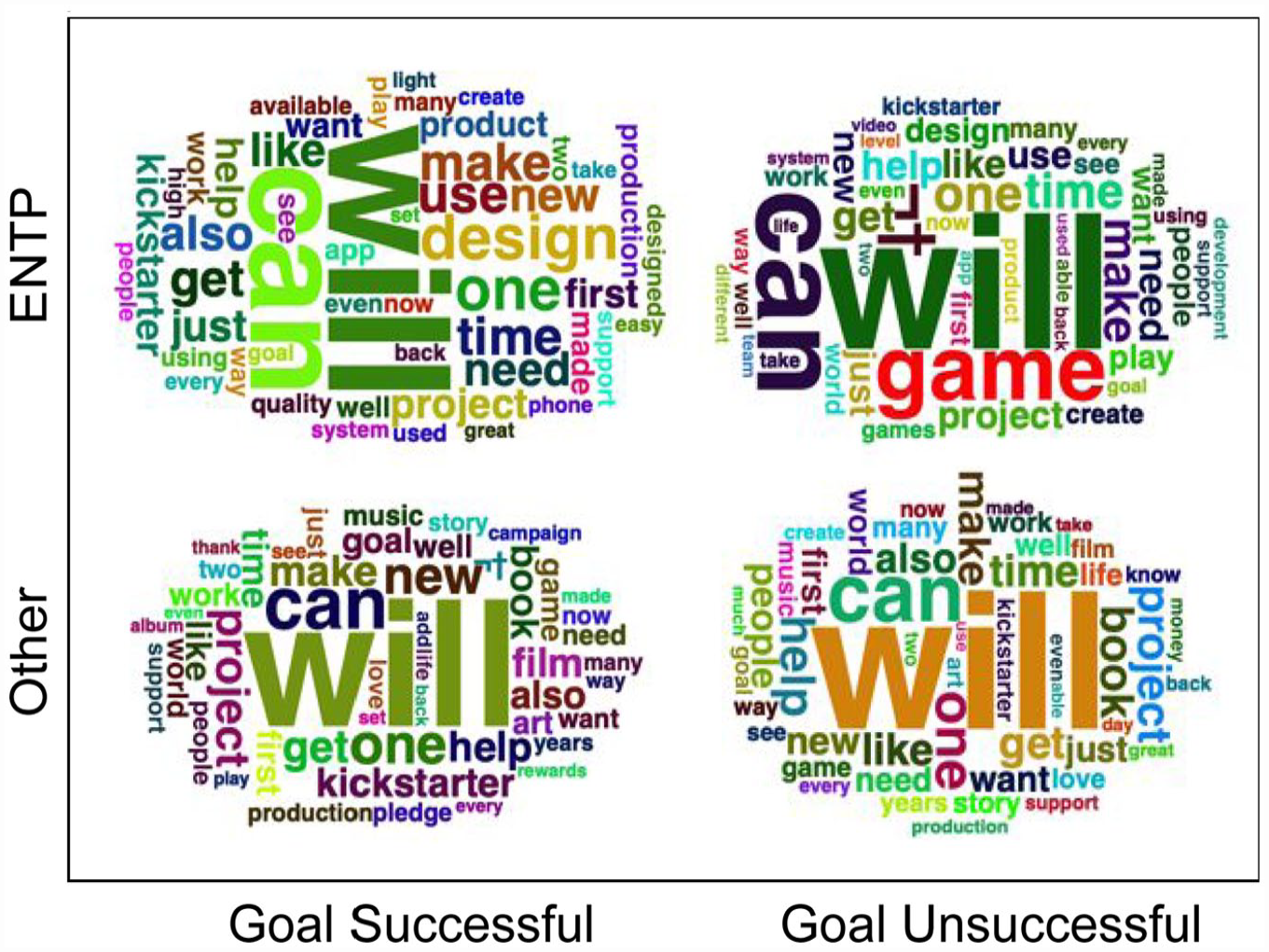
Word clouds represent the 50 most frequent words appearing by category and goal success.
A comparison of the four-word clouds in Figure 1 found several words unique to entrepreneurs: “design,” “product,” “app,” “using,” “used,” and “system.” The words “design,” “product,” and “system” are not in the LIWC dictionary. Using these words in entrepreneurial campaigns could result from the definition of entrepreneurial Kickstarter categories used in this study. For example, product design is one of the Kickstarter categories identified as entrepreneurial. Similarly, certain words were only present in the other campaigns: “film,” “book,” “art,” “music,” “story,” and “love.” Many of these words imply artistic projects and would lend themselves to more frequent use in other campaigns. These word choices are most likely a result of the campaign categories and did not appear related to goal success.
When comparing successful entrepreneurial and other campaigns, “new” is a top 10 word. While “new” appears in both campaign types, it seems more often in successful other campaigns. This could suggest that backers may want to be part of an original and innovative endeavor. Additionally, both campaign types used “help” regardless of goal status, but “help” was used relatively less by successful entrepreneurial campaigns. Overall, “help” was used more often than “support” in all campaign types, regardless of goal status. However, successful other campaigns used “support” frequently.
Successful entrepreneurial campaigns included seven unique words in their top 50 words: “quality,” “designed,” “high,” “available,” “easy,” “phone,” and “light.” Some of those words, “quality,” “designed,” “available,” and “phone,” are not in the LIWC dictionary, but one could deduce that “quality” has a positive connotation and backers would want to fund a campaign that would produce a “quality” product. Similarly, the concept of available or availability suggests positive connotations.
Unsuccessful entrepreneurial campaigns included six unique words in their top 50 words: “games,” “videos,” “different,” “development,” “level,” and “team.” “Games” and “videos” are words found in Kickstarter category names chosen as entrepreneurial, so it is interesting to see them associated more often with unsuccessful campaigns. The study did not examine success for individual Kickstarter categories. “Different” and “development” were also found in unsuccessful campaigns. Perhaps calling out a campaign as different or in development reflects poorly and prevents potential backers from investing. Backers may want to invest in fully developed campaigns and be ready to move forward once funding is achieved.
Successful other campaigns contained the unique words “rewards,” “thank,” and “pledge.” “Reward*” is included in the achievement, reward, and positive emotion LIWC categories. “Thank” is included in the positive emotion category, and “pledge” is in the power category.
Unsuccessful other campaigns contained four unique words: “know,” “money,” “much,” and “day.” All creators on Kickstarter are asking for money, but perhaps the actual use of the word “money” is distasteful or too direct for other campaigns. For backers of other campaigns, asking for “support” or a “pledge,” words that appeared more frequently in successful other campaigns than unsuccessful, may be more appealing.
Discussion
This exploratory study firstly set out to understand if entrepreneurial and other campaigns are different, as assumed in the crowdfunding literature, and if they are, how language is used differently between these two groups of campaigns. To this end, we focused on motivation, thinking styles, and time orientation. Secondly, we identified how both entrepreneurial and other campaigns use language in successful and unsuccessful campaigns. Theoretically, given the prevalence of studies examining how language affects funding success in crowdfunding literature, it was surprising to find the literature bifurcated on selecting campaign categories in study samples. Some studies used a specific selection of so-called “entrepreneurial” Kickstarter categories (e.g., hardware, software, technology, computer (video) games, and product design), while other studies used all categories. Studies using entrepreneurial categories gave minimal empirical or theoretical justification for their choices. This begs the question, are these so-called entrepreneurial categories different than other Kickstarter categories? In other words, are the so-designated entrepreneurial categories attracting a different group of creators than other Kickstarter categories? Findings show that, at least for language usage, the entrepreneurial categories differed in multiple areas. As expected from the extant literature (e.g., Collins et al., 2004; McClelland, 1961; Shane et al., 2003), the entrepreneurial campaigns had higher achievement and lower affiliation language than other campaigns (see Table 3). Future crowdfunding researchers interested in studying entrepreneurs on Kickstarter should strongly consider using the categories of hardware, software, technology, computer (video) games, and product design to define entrepreneurial campaigns.
Another important goal of this study was to supply practical applications for entrepreneurial and other campaign creators to consider utilizing when initiating a crowdfunding campaign. Given that our findings indicate differences in language usage exist between entrepreneurial and other campaigns, creators must understand these differences to apply the preferred language for the category in which they will be fundraising. However, more information is needed to increase the possibility of funding. Creators must also understand the language of a successful entrepreneurial campaign—an essential distinction. While this study does not provide a magic linguistic formula, the following discussion provides practitioners with guidance on applying language to better emulate successful entrepreneurial crowdfunding campaigns.
Entrepreneurial campaigns utilize higher word counts than other campaigns, and successful campaigns have much higher word counts. Creators should use these higher word counts to their advantage—finessing the words into the correct language. Creators should not shy away from sharing their stories and supplying details about the project. Our findings show that the campaigns that receive funding tend to present more information to potential backers. The Kickstarter categories defined as entrepreneurial for this study may lend themselves to more technically complex products or endeavors, requiring more detail and explanation to potential backers. Creators should use a higher word count to tell a story that focuses on the past and present with a narrow focus on the future. In Table 4, successful entrepreneurial campaigns had higher usage of past focus words and lower use of present focus and future focus words than unsuccessful ones. Perhaps these past-focused words tell potential backers about past achievements and progress. Successful entrepreneurial campaigns used “will”—the one future focus word in Figure 1—at the lowest rate of all campaign categories. According to Tables 4 and 5, successful entrepreneurial campaigns have the lowest usage of future focus words; also, according to Tables 4 and 5, successful entrepreneurial and other campaigns used present focus words at the same percentage (8.34%). This usage was lower than their unsuccessful counterparts, providing additional support for Peng et al. (2022), who identified present and future tense words with unsuccessful campaigns. Entrepreneurial campaigns should focus on the past and present. Potential backers do not want to hear about future plans as much as they want to know what has been achieved in the past and what is being done in the current campaign.
This study identified language using more analytic, more clout, less authentic, and more negative tone in entrepreneurial campaigns than in other campaigns. This finding was also present when comparing successful entrepreneurial to unsuccessful entrepreneurial campaigns, except for one notable difference in tone. Even though overall entrepreneurial campaigns use more negative tone language, a successful entrepreneurial campaign uses more positive tone language. Research has noted that positive emotional language is seen more often in successful campaigns (Desai et al., 2015; Peng et al., 2022). Therefore, entrepreneurial campaigns should balance their emotional tones by using more positive language in their story. Additionally, entrepreneurial campaigns utilize more analytic language than other campaigns. Entrepreneurial campaigns may lend themselves to more logical thinking (imagine the logic in the design of software or a video game), and creators should include more formal and logical thinking in their stories.
An interesting finding of this study was that entrepreneurial and other campaigns used relatively inauthentic language (given that the scores are well below 50). Overall, the entrepreneurial campaigns were less authentic than the other campaigns, indicating that entrepreneurs may be more guarded or distant in their campaigns than other creators. An alternative possibility could be that entrepreneurial campaigns are more deceptive in how they present their product or the benefits of the product to backers (Newman et al., 2003; Pennebaker et al., 2015). Further, when examining both successful entrepreneurial and other campaigns, less authentic language is used, possibly showing the power of stretching the truth or otherwise embellishing what will ultimately be delivered to backers.
Many Kickstarter studies have examined persuasion theory and its presence in successful campaigns. Mitra and Gilbert (2014) identified the authority principle in successful campaigns. Authority can be conveyed in diverse ways—having a title, appearing credible, acting as an expert, etc. Expertise is also associated with higher clout language, and successful campaigns of both types exhibited more clout language. Therefore, creators of entrepreneurial campaigns should demonstrate their authority through expertise because using this language may induce potential backers to fund the campaign.
However, creators must take care to balance their use of expertise. According to Bettinghaus and Cody (1994), one base of power is expertise, when a source has “superior knowledge and ability” (p. 144). In this study, power motivation is utilized more by successful entrepreneurial creators than successful other campaign creators. However, unsuccessful entrepreneurial creators demonstrated the highest power motivation. Achievement motivation brought equivalent results. Successful entrepreneurial creators display achievement motivation more than other successful campaign creators. However, unsuccessful entrepreneurial creators showed the highest achievement motivation. Since achievement is thought to drive individuals to enjoy mastering challenging tasks (Schultheiss, 2013), one could argue that experts are masters at some difficult tasks (e.g., designing computer software or video games). They were demonstrating too much expertise, whether as a power or achievement motivation, which could be an unwanted signal to potential investors.
The above guidance has focused on LIWC categories of language that creators should consider when developing entrepreneurial campaigns. This study has also identified some specific words that entrepreneurial campaigns should consider. Successful other campaigns utilized “rewards,” “thank,” and “pledge” in their top 50 words when no other creators did, but entrepreneurial campaigns should consider their use. Rewards and incentives are considered another base of power in social influence (Bettinghaus & Cody, 1994). Since entrepreneurial campaigns are already motivated at higher rates by power, using reward-related words would continue along that motivation spectrum. “Thank” is included in LIWC’s positive emotion dictionary, and successful entrepreneurial campaigns use positive tone language more than unsuccessful entrepreneurial campaigns. Prior research has noted that positive emotional language is seen more often in successful campaigns (Desai et al., 2015; Peng et al., 2022). Offering rewards and using more positive, appreciative language for those who back a campaign could result in more funding.
In Figure 1, “help” and “support” are found in all word clouds, but the use of these words differs by entrepreneurial and other campaign categories. “Help” is associated with power and affiliation language and was used more frequently than “support,” which is related to positive emotion language. In this study, successful entrepreneurial campaigns were motivated less by power and affiliation than their unsuccessful counterparts. Additionally, successful entrepreneurial campaigns had a more positive emotional tone than unsuccessful ones. Those observations are further supported by successful entrepreneurial campaigns’ use of “help” at a lower rate than all other campaign categories. Successful entrepreneurial campaigns used “support” at a slightly lower rate than successful other campaigns. As a result, entrepreneurial campaigns should consider increasing their use of “support” while maintaining or decreasing their use of “help.”
As this study and other studies have found, there is no magic formula for creating a campaign that is guaranteed to be funded. However, crowdfunding creators need to understand that language can influence the possibility of success. The challenging task is that entrepreneurs must develop a story that induces funding. Entrepreneurial campaign language usage indicates that their motivations are different from other campaigns. Entrepreneurial campaigns use less affiliation and more achievement and power language. However, successful entrepreneurs and other creators do have similarities. In the sample studied, successful creators of both types used more analytic, clout, positive emotional tone language and less authentic language than their unsuccessful counterparts. However, successful entrepreneurial creators used more analytic and clout language and less authentic and emotional tone language than successful other creators. Creators should take particular care when choosing words for their campaign stories.
The limitations of this study also offer opportunities for future research. The first limitation of the study is that Kickstarter projects beyond the year 2019 were not included to limit COVID-19 as a variable. This is an area for possible future research. This study focused on specific words used by campaigns as identified in the LIWC dictionary. However, the study did not examine the context of the words, which is the second limitation of the study. Through examining the context, researchers can more clearly identify the intent of the words. For example, project creators in this study used the word “reward,” but the meaning is unclear without context. The word could be used to describe a rewarding experience of the creator or reference a gift given to funders in exchange for funding the project. Another avenue of further exploration is a study utilizing one or more persuasion theories (e.g., language expectancy theory and Cialdini’s (1993) principles of persuasion). The current study focused on the project creator’s implicit factors, but a study of persuasion theory would focus on explicit factors. Now that we know differences exist between entrepreneurial campaigns and other campaigns from an implicit standpoint, more explicit factors can be examined.
Footnotes
Author Note
This manuscript is original and not under consideration for publication elsewhere.
Declaration of Conflicting Interests
The author(s) declared no potential conflicts of interest with respect to the research, authorship, and/or publication of this article.
Funding
The author(s) received no financial support for the research, authorship, and/or publication of this article.
