




Abstract
Taking conflict at work personally is associated with a decrease in well-being and more suboptimal conflict management behavior. Drawing from literature on workplace conflict, conflict expression, and employee voice, we explored how the focus (solution vs. problem) and tone (constructive vs. destructive) of a message influence message recipients’ level of conflict personalization. In a vignette study (n = 683), we asked participants to identify with a task-related workplace conflict, communicated through email. Results supported our two hypotheses: Both a problem focus and a destructive tone resulted in higher levels of conflict personalization. There was no significant interaction of focus and tone on conflict personalization. Additional analyses revealed that message tone had a significantly stronger effect on conflict personalization than message focus. This study is a first step in understanding communication-related antecedents of conflict personalization at work. It provides workplace conflict- and voice scholars with recommendations for future research and uncovers potential organizational interventions to improve (digital) conflict communication.
Keywords
Introduction
“So many men, so many minds” is a well-known and widely used saying. Applied to the workplace, workers often perceive incompatibilities and exchange their differing viewpoints and perspectives. As such, they engage in workplace conflict (de Wit et al., 2012; Folger et al., 2021; Jehn, 1995). Scholars agree on the Janus face of workplace conflict, reporting both positive (e.g., an increase in performance, quality of decision-making, creativity; Bradley et al., 2015; Nemeth et al., 2004; Tjosvold et al., 2014), and negative (e.g., a decrease in performance, well-being, job satisfaction; de Wit et al., 2012; Dijkstra et al., 2005; Küçük & Konuk, 2023) effects for individuals, teams and/or the organization.
Despite the agreement about workplace conflict being potentially beneficial as well as detrimental, research results on why particular workplace conflicts are related to particular outcomes are not that clear (De Dreu, 2008 ). Arguably, this is due to a strong focus in empirical studies on conflict issue (either task related or non-task related) and scholarly neglect of the personal experience of parties involved (Hoogenboom et al., 2024; Jehn et al., 2008; Weingart et al., 2015). Specifically, an experienced conflict, whether task-related or not, may not necessarily be perceived as being about the issue at hand, but rather about the person themself. As such, the conflict is being personalized (Dallinger & Hample, 1995; Mooney et al., 2007).
Following Hoogenboom et al. (2024), conflict personalization is defined as “the negative affective- as well as cognitive reaction to the self being threatened and/or in danger as a result of a social interaction about perceived incompatibilities” (p. 322). Conflict personalization is associated with adverse outcomes: high personalizers report negative effects to their mental and physical health (Worley & Aloia, 2019). Furthermore, they are more likely to employ sub-optimal conflict management behavior by avoiding or forcing (e.g., Todorova et al., 2022; Young et al., 2023), which can lead to a decrease in performance, satisfaction and/or trust (Behfar et al., 2008). Building upon this, we contend that it is important to look for ways to prevent high levels of conflict personalization at work. A first step is to explore and document potential antecedents of conflict personalization, and this is the aim of our paper.
In this experimental study, we focus on the style of delivery of conflict messages as a potentially important antecedent of conflict personalization. Firstly, we build on conflict expression theory for the development of our hypotheses. According to Weingart et al. (2015), the strength, force, or energy of the expression is expected to affect whether recipients perceive threat, experience negative emotions, and/or are less able to use the information provided. Studies on conflict expression theory have not yet included conflict personalization as a construct, but the notion of personal experience (i.e., perceived threat, negative emotion, and cognitive effect) in conflict expression theory resembles the key elements of the integrative definition of conflict personalization that we apply (Hoogenboom et al., 2024). Thus, we can draw from available empirical conflict expression research on how recipients perceive particular expressions (e.g., Brykman & O’Neill, 2023; Todorova et al., 2022).
Secondly, to formulate our hypotheses we also build on the employee voice literature, as this literature specifically focuses on the way certain messages are received in the context of work. Voice theory is applicable to conflict personalization of workplace conflict because employee voice behavior is associated with conflicts between employees and supervisors, and voice behavior can be taken personally (Burris, 2012; Kassing, 2011; Kim et al., 2018; J. Liang et al., 2012; Redmond et al., 2016; Wåhlin-Jacobsen, 2020). According to voice scholars, both a focus on a solution and a focus on solely the problem (also referred to as promotive and prohibitive content, respectively), 1 and the extent to which the message is conveyed in a constructive rather than a destructive manner determine the way supervisors perceive employee’s messages (J. Liang et al., 2012; Romney, 2021; Welsh et al., 2022; Whiting et al., 2012). However, the voice literature has not yet clarified whether supervisors’ conflict personalization of these messages underlie their experience.
We will answer the following overarching research question: Do focus and tone of a conflict message affect the degree of conflict personalization by the recipient? In a first attempt to fill the current gap in knowledge, and departing from voice literature, this study is centered on the specific context of supervisor-employee conflict in which the supervisor is the recipient. This focus is appropriate, as for such conflicts the potential effects on the supervisor, employee, and the organization – both positive and/or negative – are substantial due to the powerful and exemplary position of the supervisor vis-à-vis the employee and within the organizational system (Gächter et al., 2012; Medina et al., 2008; Renwick, 1975; Rosenbruch et al., 2023; Seppälä et al., 2011; Urbach & Fay, 2018).
Our theoretical contribution to the field of workplace conflict lies in providing insights on the personal experience of workplace conflict. While workplace conflict scholars have discussed the danger of taking conflict personally (e.g., Bradley et al., 2012; Jehn & Mannix, 2001; Mooney et al., 2007), empirical research on conflict personalization at work is scant (Hoogenboom et al., 2024). Our experimental study sheds light on whether what conflict parties say and how they express it, as communication-related antecedents, could affect the level of conflict personalization.
Furthermore, we contribute to the field of employee voice. Although voice scholars agree that both message focus and tone are important for how voice is received (e.g., Burris, 2012; Morrison, 2014; Romney, 2021), in the currently used conceptualization and operationalization of voice messages (i.e., Promotive- and Prohibitive Voice scales, see J. Liang et al., 2012) message focus and tone are entangled. That is, promotive messages – solution-focused – are conceptualized and operationalized as inherently rather constructive in how they come across. In contrast, prohibitive messages – problem-focused – are studied as inherently risky and embarrassing to the other party even though all employee voice is defined as constructive in intent (Morrison, 2023). Therefore, a first contribution to the voice literature is that we explore how the focus and tone of conflict messages could be separated in an experimental setting because we assume that a solution-focused message can be delivered in a destructive tone as well, and a problem-focused message in a constructive tone.
Secondly, the level of conflict personalization could be a key determinant to explain voice endorsement (i.e., expressing support or positive reception, Brykman & Raver, 2023) of messages by receiving parties. Within the voice literature, scholars have recently expressed their interest in the digital voice context and called for more research to capture the receiver’s attitude and emotions to enrich the available models (Brykman & Raver, 2023; Jebsen et al., 2022; L. Liang et al., 2024). Amongst others, they found that voice persuasiveness of digital messages (i.e., strong logic and evidence in the form of pictures) on organizational platforms was positively related to voice endorsement by the receiving supervisors (L. Liang et al., 2024). Similarly, voice message quality in the form of rationale, feasibility, organizational focus, and novelty, increased the likelihood that the suggestion was (intended to be) implemented (i.e., voice enactment, Brykman & Raver, 2023; Farh et al., 2020), mediated by peer endorsement (Brykman & Raver, 2023). Our explorative study can add to the development of the recent niche of digital voice, with firstly a better understanding of focus and tone as additional digital message characteristics and secondly the introduction of supervisors’ conflict personalization levels as a potential factor that might firstly affect voice endorsement and subsequently impacts the chances for voice enactment.
Practically, we aim to contribute to the awareness of workers and supervisors of the potential negative effects of their conflict messages in terms of conflict personalization. Moreover, as we concentrate solely on message focus and tone as antecedents of conflict personalization, we take a first step in developing guidelines for crafting conflict email messages, thereby enabling employees to more effectively express their dissent (Garner, 2009, 2016). This is desirable as employees often remain silent – even though they actually would like to speak up – due to fears of being viewed negatively, damaging the relationship, or being punished (Milliken et al., 2003).
Additionally, with email being the prevalent communication tool in the workplace (Derks & Bakker, 2010), our experiment with a conflict message sent through email is relevant. Many other scholars have called attention to potential interpersonal conflict through email, for example caused by egocentrism, stereotyping, the minimal amount of social cues, and escalation (Epley & Kruger, 2005; Friedman & Currall, 2003; Kruger et al., 2005; Taylor et al., 2008). Interestingly, workers have been found to opt for email during workplace conflict as a way of protecting themselves and to control the interaction (Bülow et al., 2019). So, clarity on how to choose the focus and tone of a message can help employees to more readily communicate their disagreements, make conflict communication through email more effective and prevent conflict escalation. When people succeed in lowering conflict personalization at work, they likely mitigate potential negative outcomes like repercussions or degrading relationships. As a result, both parties have a more positive conflict experience, increasing the chances that employees share their competing viewpoints again in the future (King et al., 2019).
Theoretical Background
Conflict Personalization
Conflict personalization is a personal experience and can occur during any conflict, regardless of the issue the parties disagree about (Hoogenboom et al., 2024). It occurs when the person’s focus is on the self rather than the topic (Dallinger & Hample, 1995; Guenter et al., 2016; Mooney et al., 2007); the conflict is experienced as person-centered, rather than issue-centered (Hample & Anagondahalli, 2015). The tendency to personalize conflict can both derive from a personality trait (i.e., some people are more likely to take conflicts personally than others) and from a temporary, situation or relationship-dependent, state (i.e., some situational factors make it more likely that conflicts are taken personally; Hample & Dallinger, 1995; Hample & Richards, 2015, 2019). Furthermore, the inclination to take conflict personally depends on cultural background, as interpersonal arguing is done and understood differently between cultures and nationalities (Hample, 2018).
Conflict personalization has three key elements (Hoogenboom et al., 2024). First, a negative affective reaction, for instance feeling anxious and hurt (Young et al., 2023), stressed and/or experiencing discomfort and tension (Aloia & Worley, 2019; Hample & Irions, 2015). Second, a cognitive reaction, such as attributing harmful intentions to the other (Guenter et al., 2016; Hample & Richards, 2019) or anticipating damage to the relationship with those involved (Hample, 2015). Third, the perception of a threat or danger to the self. For example, having a sense of being devalued and insulted, and a feeling that the event is aimed at the self (Hample & Dallinger, 1995; Wallenfelsz & Hample, 2010).
Those that personalize conflict have been shown to experience a decrease in their well-being through a decline in their mental and physical health (Worley & Aloia, 2019; also see T. Curran & Allen, 2017; Honeycutt et al., 2014). Moreover, results indicate that higher levels of conflict personalization cause adverse effects through sub-optimal conflict management behavior. On the one hand those that personalize conflict want to avoid confrontation and escape the interaction while on the other they want to hurt the other person (Hample & Cionea, 2010; Miller & Roloff, 2014; Young et al., 2023).
Particularly, Todorova et al. (2022) performed a vignette study on the effects conflict type (task vs. relationship) and conflict expression intensity (lower vs. higher) on subsequent conflict management. Results showed that those participants who had been asked to imagine a high intensity (vs. low intensity) expression – “an attack on you personally” (pp. 271–272) – reported a higher inclination to respond in a forcing, destructive manner that disadvantages both parties (Todorova et al., 2022; also see Behfar et al., 2008). In sum, these results suggest that people with higher levels of conflict personalization are more likely to handle conflict detrimentally. But the communication-related antecedents of conflict personalization remain unclear.
Conflict Messages Causing Conflict Personalization
For the development of our hypotheses concerning the effect of message focus and tone on the level of conflict personalization for the recipient, we draw from conflict expression theory as well as employee voice literature. Firstly, conflict expression theory introduced by Weingart et al. (2015) is centered around the degree of strength, force or energy with which the sender conveys their opposition (Weingart et al., 2015). Amongst others, words and the tone of voice are considered cues that can vary in intensity. For instance, people can use aggressive and/or subversive language. In contrast, they can use a less threatening way of communication, resembling a debate, which is less entrenched, demonstrating a willingness to understand the other’s perspective (Brykman & O’Neill, 2023; Todorova et al., 2022; Weingart et al., 2015). The tone of the message is likely to provide recipients with an indication of received opposition. Therefore tone is theorized to impact the recipient in terms of their inferences of the sender’s intentions and their perception of threat (Weingart et al., 2015). Conflict expression theory thus predicts that the tone of the message affects the personal experience of the recipient.
Furthermore, we draw from literature on employee voice behavior; commonly defined as the voluntary, internal, and upward communication by employees aimed at bringing about improvement for one’s team, department, or organization (Morrison, 2023; Pfrombeck et al., 2022). For instance, employees might speak up when they experience the work schedule as unbalanced, worry about errors due to a lack of protocols, or consider a training for new employees necessary for organizational improvement.
In the organizational behavior literature, voice is commonly conceptualized as behavior aimed at bringing about improvement for the team or organization (Morrison, 2014). Therefore, the voice message is in theory not intended as a criticism of the supervisor, but as a criticism of an organizational aspect (Morrison, 2014; Romney, 2021). Yet, voice scholars have discovered that supervisors may experience such instances of communication as threatening to their image and ego (Isaakyan et al., 2021), their reputation (Chen & Treviño, 2023), or their position at the company (Burris, 2012). So, although employee voice is commonly conceptualized as constructive in its intent (Morrison, 2023), supervisors can take employee voice personally.
Voice scholars have argued that how supervisors experience voice behavior from subordinates potentially depends on the type of voice. That is, solution-focused voice – speaking up with suggestions for future improvement – is considered to be better received than problem-focused voice; speaking up about current harmful situations or wrongdoings (e.g., Chamberlin et al., 2017; Duan et al., 2024; Huang et al., 2018; Romney et al., 2025; Sessions et al., 2020).
For our hypotheses on conflict personalization, we build on this theoretical notion that solution-focused messages are more likely to be well-received than problem-focused messages. However, we diverge from the conceptualization and operationalization of voice messages in a crucial way. Namely, we assume that both solution-focused and problem-focused messages can be delivered in a constructive tone as well as a destructive tone. In contrast, in the commonly used conceptualization and operationalization of voice messages by J. Liang et al. (2012) the focus and style of delivery are entangled. Critically reviewing the items in the Promotive and Prohibitive scales shows that solution-focused (i.e., promotive) voice is operationalized more positively than problem-focused (i.e., prohibitive) voice. For instance, an item in the promotive voice scale is “makes constructive suggestions”; J. Liang et al., 2012, p. 79), while an item in the prohibitive voice scale includes a negative element “(. . .) even if that would embarrass others” (p. 79).
The apparent consensus on the more positive reception of solution-focused vis-à-vis problem-focused messages could be explained by the confound in the measurement instrument. To explore whether focus, tone, or both affect the level of conflict personalization, we attempt to separate these message characteristics in the hypotheses, design and measures.
Hypotheses
Message Focus
Based on the discussed theoretical and empirical work, we expect messages that only express concerns about current practices (i.e., problem-focused messages) are perceived more negatively and thus personalized to a higher extent than messages that explicitly offer suggestions for improvement (i.e., solution-focused messages).
Research by Whiting et al. (2012) showed that subordinates who identify a problem and offer potential solutions were generally liked better and perceived as providing more constructive suggestions by their supervisors, than those who left out suggestions. In contrast, a focus on the current problematic situation without offering suggestions for improvement will more likely provoke a sense of fault-finding and complaining, feelings of inadequate leadership, blame and personal failure, and the perception of a sender who is entrenched in their own position and has more malevolent intentions (Burris, 2012; Fast et al., 2014; J. Liang et al., 2012; Sessions et al., 2020; Weingart et al., 2015).
Based on these previous findings, we expect to see a difference in conflict personalization levels for problem- versus solution-focused messages:
H1 Problem-focused conflict messages will lead to higher conflict personalization than solution-focused conflict messages.
Message Tone
We propose that in written messages, such as the ones we focus on in this study, tone is a critical factor in determining how a message is perceived by its recipient (Morrison, 2014; Weingart et al., 2015). Here, tone is defined as the style or manner of expression in speaking or writing (Merriam-Webster, n.d.). We distinguish two types of message tone: constructive and destructive. In line with the work of Romney (2021) and Van Dyne et al. (1995) on constructive voice delivery, we conceptualize constructive tone as positive, pleasant, and friendly and destructive tone as negative, unpleasant, and unfriendly. We prefer this conceptualization as it is less likely to confound with our dependent variable conflict personalization than other available conceptualizations of constructive and destructive tone such as respectful, considerate, or threatening (e.g., Geddes & Linnehan, 1996; Raver et al., 2012).
We expect tone to affect the level of conflict personalization, because first, the recipient makes attributions and judgments about the sender based on the tone of the message (Chiaburu et al., 2015; Hine et al., 2009). A constructive tone likely prevents the recipient from attributing malicious intentions (Brykman & O’Neill, 2023; Friedman & Currall, 2003; Kruger et al., 2005). Instead, recipients expect the feedback to be constructive (Harnish & Bridges, 2011), and are less likely to feel attacked and threatened (Todorova et al., 2022; Weingart et al., 2015).
Second, the tone of a message can be interpreted by the recipient as a cue for how the sender thinks about the recipient, even if the sender does not make that opinion explicit (Griessmair & Koeszegi, 2009; Watzlawick et al., 1967). The tone can convey information about the bond between them: a constructive tone likely comes across as “you have my respect” making the recipient feel approved of. In contrast, a destructive tone gives the impression of being dismissed: “I don’t respect you.”
Considering these previous findings, we would expect a difference in levels of conflict personalization for destructive- versus constructive tone:
H2 Conflict messages with a destructive tone will lead to higher conflict personalization than conflict messages with a constructive tone.
Interaction of Focus and Tone and Conflict Personalization
With respect to the interaction of message focus and tone, we take an exploratory approach due to the lack of knowledge on their distinct effects. This is caused by the confound in the current operationalization of solution-focused and problem-focused voice messages. Nevertheless, it is understood that tone is crucial in how messages come across. Highlighting the saying “it’s not what you said, but how you said it,” Romney (2021) emphasizes that “the content of voice can often be overshadowed by the delivery” (p. 2). In other words, the effect of the tone of the message on conflict personalization might exceed in importance vis-à-vis the effect of message focus.
Based upon Romney’s (2021) argumentation, tone may act as restraint or exacerbator of the positive or negative effect of message focus. That is, while a solution-focused message is expected to signal joint responsibility and lower levels of threat, a destructive tone could cause a recipient to be unable to recognize these positive characteristics. In contrast, while a problem-focused message could make the recipient feel judged, threatened and perceive the sender as deflecting responsibility, a constructive tone might soften these negative attributions and/or even supplement counterevidence. In line with our explorative approach, we formulated a research sub-question: Do message focus and message tone have an interaction effect on the level of conflict personalization?
Method
We conducted a 2 × 2 experimental vignette study (Atzmüller & Steiner, 2010) to examine the effects of focus (solution vs. problem) and tone (constructive vs. destructive) on levels of conflict personalization.
Materials
To explore how focus and tone affect conflict personalization, we created vignettes to describe a realistic and plausible task-related workplace conflict to the recipient. A vignette experiment was the appropriate method because the aim of this first study was to test existing theories through causal hypotheses (Berkowitz & Donnerstein, 1982; Mook, 1983). The experimental approach allowed us to examine the effects of message focus and tone on conflict personalization as separate factors by manipulating these variables, while keeping other potential influential factors constant.
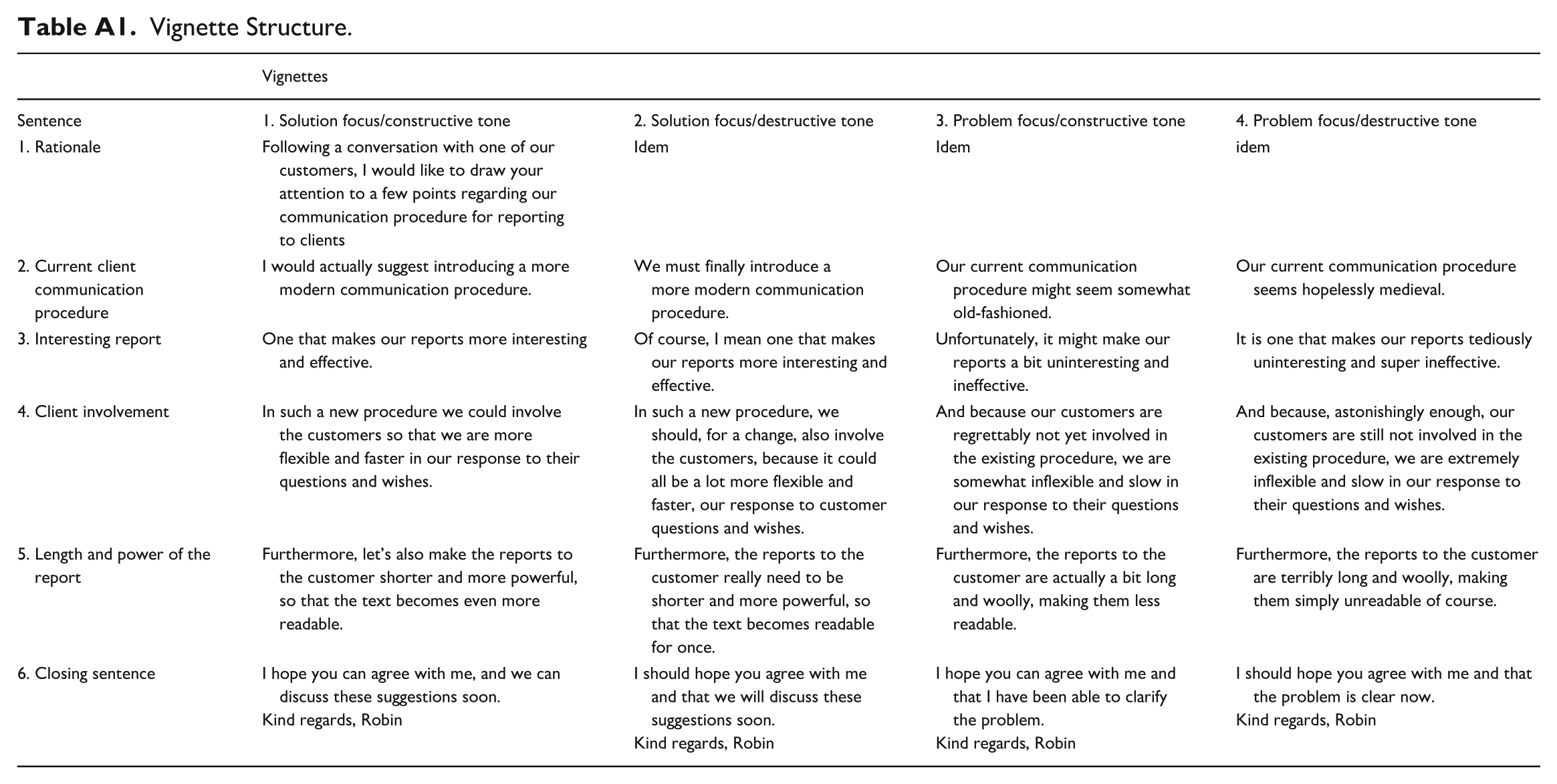
The four vignettes were designed to be identical with regards to their subject, that is the current communication procedure to clients, yet different in solution-versus problem-focus and constructive versus destructive tone (see Appendix 1 for the vignette texts). In the introductory text, participants were asked to imagine themselves as supervisors in a hypothetical management consultancy firm. Then, they read about the current client communication procedure: its development was their first assignment when they started their job, and it now comprised an extensive written report, an extensive final report, and a compact management summary. Importantly, participants were told that they considered the communication procedure engaging and effective. Finally, they were alerted to an incoming email by a subordinate team member, Robin (a gender-neutral name in Dutch), who “has a different opinion than you.” As such, we made the situation of incompatibility, that is a workplace conflict, salient (de Wit et al., 2012; Folger et al., 2021; Jehn, 1995).
The vignettes were kept as similar as possible except for the manipulations, and all vignettes contained six sentences. The first sentence provided the rationale for sending the email and was identical in all four vignettes. Each of the subsequent sentences was designed to be either solution- or problem-focused and either constructive or destructive in tone. Table A1 differentiates the vignettes sentence by sentence and can be found in Appendix 2. To create the impression of an authentic email, the email text was formatted differently from other text in the questionnaire through a larger font size.
Message focus was manipulated by incorporating suggestions to change the status quo (solution focus) or solely stating problems with the status quo (problem focus). For instance, “let’s also make the reports (. . .) shorter and more powerful” versus “the reports (. . .) are actually a bit long and wooly” (sentence 5, vignette 1 vs. vignette 3, Table A1, Appendix 2).
Following our conceptualizations of message tone, the two constructive tone vignettes were written in positive, pleasant, and friendly phrasing, such as “we could” instead of “we should” (sentence 4, vignette 1 vs. vignette 2, Table A1, Appendix 2) and “it might make” versus “it (. . .) makes” (sentence 3, vignette 3 vs. vignette 4, Table A1, Appendix 2). For the two destructive tone vignettes, we altered the sentences to negative, unpleasant and unfriendly phrasing. For instance, “we must finally introduce” versus “(. . .) actually suggest introducing” (sentence 2, vignette 2 vs. vignette 1, Table A1, Appendix 2) and “astoundingly enough (. . .) still not involved” versus “regrettably not yet involved” (sentence 5, vignette 4 vs. vignette 3, Table A1, Appendix 2).
Participants and Procedures
Participants with more than 5 years of work experience and at least 1 year of experience as a supervisor were recruited through a Dutch online research panel (Flycatcher). This ensured a sample of workers who most probable have real-life supervisory experience with receiving email messages such as the one in our study, which makes them more likely to respond naturally (Du-Babcock & Chan, 2022). In this research panel participants can collect points they can exchange for gift vouchers or a donation to charity.
Participants received a link to the online survey with the University’s theme colors and logo. First, they were asked to provide their informed consent and were told that the study revolved around communication and collaboration between supervisors and their employees. Next, they were randomly assigned to one of the four experimental conditions. After reading their assigned vignette, participants indicated their reaction to Robin’s email via the Conflict Personalization measure (Appendix 3). These items were shown below the email to allow participants to reread the message. Manipulation checks for focus and tone were shown on a new page (Appendix 3). In the introductory text (Appendix 1) participants were explicitly told that Robin had a different opinion. To check whether participants indeed recognized the email as a workplace conflict we used the following inclusion check: “In this situation, Robin had a different opinion than me about the communication procedure”, on a four-point scale (1 = disagree, 4 = agree). Lastly, participants answered questions on vignette clarity and were thanked for their time.
In total, 712 people completed the survey. We excluded one participant who – despite preset requirements for participation – indicated to have 0 years of experience in a supervisory position. In addition, we excluded one participant after applying long string analysis (indicating carelessness or insufficient effort, P. G. Curran, 2016). Finally, participants who answered the inclusion check on their perception of a workplace conflict with “disagree” (n = 27) were dropped. In total, 29 cases were excluded from the dataset. The final sample consisted of 683 participants, of which 433 male, 249 female, and one identifying as other. The average age was 47, and 9% had a secondary school diploma, 21% enjoyed a vocational level of education and 70% enjoyed a higher professional or university education. The average work experience was 24 years of which 13 in a supervisory position, and 76% worked more than 32 hours per week. The vignettes were quite evenly distributed over the final sample: solution focus/constructive tone n = 170, solution focus/destructive tone n = 172, problem focus/constructive tone n = 170, and problem focus/destructive tone n = 169. Below, we report results for the final sample consisting of 683 participants, but a rerun of our analyses with the total sample (N = 712) produced a similar pattern of results and identical conclusions. 2
Measures
Conflict Personalization
We measured the degree to which the conflict message (i.e., Robin’s email) was personalized using 3 five-point scales (1 = barely or not at all, 5 = strongly). Two scales were adapted from the Taking Conflict Personally scales (TCP Scales; Hample & Dallinger, 1995): Direct Personalization (7 items, e.g., “I take Robin’s criticism in the email personally”) and Persecution Feelings (6 items, e.g., “After reading Robin’s email I felt like a victim”). The third scale was an adapted version of Conflict Stress (4 items, e.g., “This email from Robin makes me feel uncomfortable,” Giebels & Janssen, 2004), and was used instead of Hample and Dallinger’s (1995) TCP subscale Stress Reaction. The Conflict Stress scale was preferred over the TCP Stress Reaction Scale because the former refers to stress due to a conflict that just occurred, which we are interested in, while the TCP Stress Reaction scale asks for people’s inclination to feel stressed about conflict and arguing in general and is quite specific (e.g., “I feel like I’m getting an ulcer”).
We performed an exploratory factor analysis (KMO = 0.95, Bartlett test, χ2 = 8525.185, df = 136, p < .001) to confirm that our adaptations to the scales were accurate (Table 1). Most items (12) loaded on a single factor, three loaded on two factors, and two loaded on a separate factor. The two items that constituted the second factor (item 3: “I don’t take Robin’s email personally” and 6: “It doesn’t bother me that Robin criticizes me,” see Table 1) were the only reverse-scored items in the scale. Possibly, participants misinterpreted them, and the reverse-scored items were dropped. The item that cross-loaded and had a higher loading on the second factor was also dropped (Item 1: “I take Robin’s criticism in the email personally”).
Exploratory Factor Analyzes Conflict Personalization.
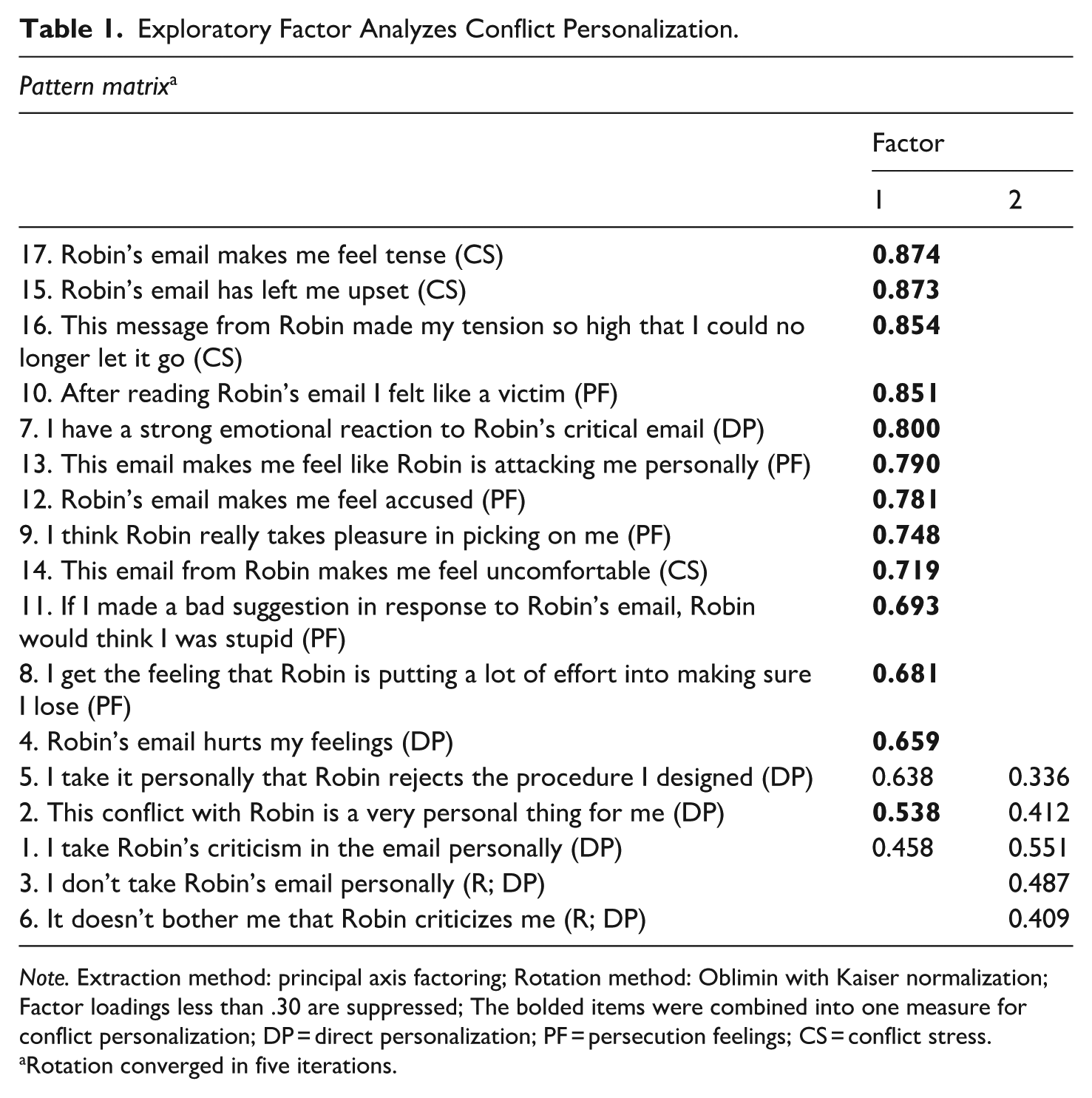
Note. Extraction method: principal axis factoring; Rotation method: Oblimin with Kaiser normalization; Factor loadings less than .30 are suppressed; The bolded items were combined into one measure for conflict personalization; DP = direct personalization; PF = persecution feelings; CS = conflict stress.
Rotation converged in five iterations.
Subsequently, we performed a confirmatory factor analysis (Appendix 4) to determine the fit of the one-factor conflict personalization model. Several error terms had a large modification index, which occurs in other empirical work using the TCP scale as well. Therefore, similar to other studies (Hample & Cionea, 2010; Miller & Roloff, 2014), we allowed some error terms to correlate. The seven high error terms (modification indices >35, Appendix 4) among sets of items within subscales were allowed to correlate, with an acceptable model fit as a result χ2 (70, N = 683) = 439, p < .001, CFI = 0.95, TLI = 0.94, RMSEA = 0.09. The three subscales were computed into one new variable for conflict personalization (14 items, α = .95), an approach similar to other studies that apply the TCP scales (known as Core TCP, e.g., Hample & Cionea, 2010; Honeycutt et al., 2016; Miller & Roloff, 2014; Young et al., 2023).
Demographics
Participants completed a set of demographic measures on their gender, age, work hours per week, and educational level.
Control Variables
Work Experience
We controlled for participants’ work experience by asking for their years of work experience and years of experience as a supervisor. Higher tenure in combination with higher age has been linked to stronger coping mechanisms to handle stress at work (Shirom et al., 2008), so we considered it plausible that participants with more years of (supervisory) work experience have a lower inclination to personalize conflicts at work.
Mood
Additionally, we controlled for participants’ mood, since earlier research confirmed that negative mood is associated with the perception of more workplace conflict in the work unit, presumably due to a mood-congruent bias (Chi & Yang, 2015; Ismail et al., 2012). Mood was measured by asking participants to rate their positive and negative affect during the past 3 months (PANAS, Watson et al., 1988), by indicating to what extent they experienced 10 positive descriptors (e.g., “enthusiastic,” “active,” “proud”) and 10 negative descriptors (e.g., “upset,” “ashamed,” “hostile”) on a five-point scale (1 = barely or not at all, 5 = strongly). The time frame of 3 months was chosen to get participants to average their mood over a longer time frame and multiple occasions (Watson et al., 1988), instead of having a recent impactful event in mind when answering the questions. Confirmatory factor analysis (Appendix 4) confirmed that the data fit the two-factor PANAS model in which items were assigned to their respective positive and negative mood factor (χ2 (169, N = 683) = 890, p < .001, CFI = 0.91, TLI = 0.90, RMSEA = 0.08). We therefore computed two variables: positive mood (10 items, α = .92) and negative mood (10 items, α = .91).
Clarity and Manipulation Checks
Vignette Clarity
Participants were asked to give their opinion on the clarity of the vignette they had just read through three statements (five-point scale, 1 = disagree, 5 = agree): “The vignette is clearly described,” “It was difficult to identify with the vignette” (reversed), and “the vignette is believable.”
Manipulation Check Focus
To check the extent to which participants perceived the email as either solution-focused or problem-focused, they were asked to give their opinion on four statements about the email on four-point scales (1 = disagree, 4 = agree). Two items on solution focus (“In the email, Robin indicates how the communication procedure can be improved in the future”; “In the email, Robin proposes new ideas regarding the communication procedure”) and two items on problem focus (“In the email, Robin raises problems with the communication procedure as it is now”; “Robin indicates in the email that the communication procedure is currently not going well”). These statements were adapted from J. Liang et al. (2012). We computed two variables: one to determine the level of perceived solution focus (1 = low, 4 = high, Spearman-Brown Coefficient .84) and one for perceived problem focus (1 = low, 4 = high, Spearman-Brown Coefficient .69). As we wanted to be thorough in our manipulation check, we calculated the perception of solution focus and problem focus for all vignettes.
Manipulation Check Tone
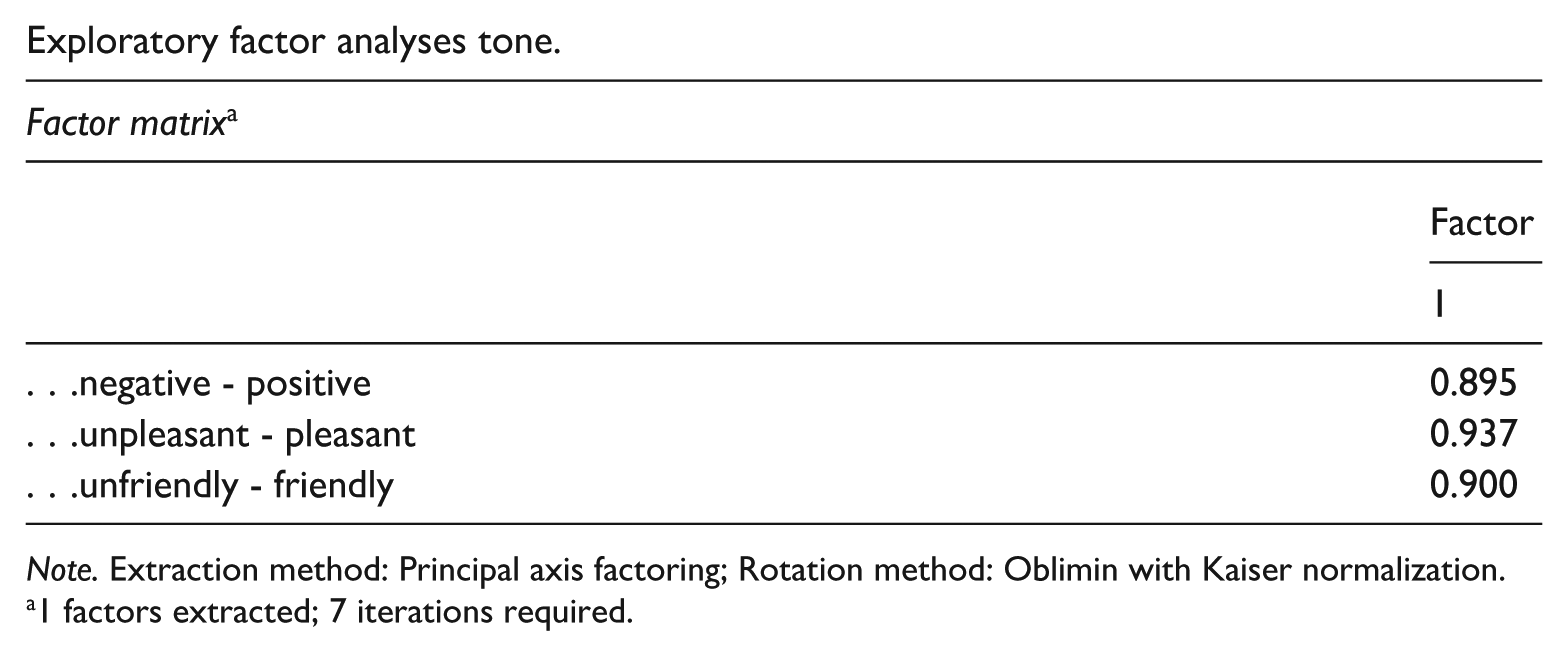
To check how participants perceived the tone of the voice message, we constructed 3 four-point scales and asked participants to judge the email. To ensure that participants rated the tone and not the sender’s intentions or voice behavior, we introduced this scale as follows: “At this point, answer three questions on the tone of Robin’s email. Indicate how you judge the tone of Robin’s email message on the scales below.” Destructive tone was at the lower end (negative, unkind, unpleasant) and constructive at the higher end (positive, kind, pleasant). Exploratory factor analysis (Appendix 4) showed the items loaded on one factor, so we combined them into a single variable perceived constructive tone, ranging from 1 = destructive to 4 = constructive (three items, α = .93).
Analytical Procedure
We analyzed our data using SPSS version 29 and Jamovi (2025) as follows. First, we conducted exploratory analyses in SPSS and confirmatory factor analyses in Jamovi on the conflict personalization measures and control variable mood (see Appendix 4). Second, to test whether the vignettes brought about the intended manipulations of focus and tone, a 2 (solution-focused vs. problem-focused) × 2 (constructive vs. destructive tone) ANOVA in SPSS version 29 was conducted on perceived solution focus, perceived problem focus, and perceived constructiveness of tone as dependent variables. Dummy coding was applied as follows: solution focus 0, problem focus 1 and constructive tone 0, destructive tone 1. Finally, we conducted a hierarchical regression analysis in SPSS version 29 to test our hypotheses, with conflict personalization as the dependent variable. The data is openly available at https://osf.io/36qyw/overview?view_only=d0f41af23c62432b8779589374fc9fc8.
Results
We controlled for the large sample size (n = 683) by calculating the p-value for our sample that would be the equivalent of a p = .05 level in a n = 100 sample (Woolley, 2003). The formula for this calculation is p = q/√(n/100), with q being the standardized p-value, leading to p = .05/√(683/100), p = .02. Thus, to account for our sample size, in our study we consider p-values at or below the .02 level as significant.
Clarity and Manipulation Checks
Clarity
With respect to the clarity of the vignettes, participants thought the vignette was (a) clearly described (M = 3.99, SD = 1.05, ranging from 3.87 to 4.12), (b) felt they were able to identify with the vignette (M = 3.93, SD = 1.13, ranging from 3.87 to 3.96), and (c) believable (M = 3.92, SD = 0.98, ranging from 3.62 to 4.19)
Manipulation Check Solution Focus
We conducted 2 × 2 ANOVAs for our three manipulation checks. As intended, participants in the solution-focused condition perceived the email as more solution-focused (M = 3.07, SD = 0.90 than those in the problem-focused condition (M = 2.18, SD = 1.01, F (1, 679) = 165.49, p < .001, η2 = .20). There was a crossover effect of tone on solution focus: participants in the constructive tone condition reported higher levels of solution focus (M = 2.93, SD = 0.98), than those in the destructive tone condition (M = 2.33, SD = 1.04, F (1, 679) = 76.49, p < .001, η2 = .10). However, a Wald-test indicated that the main effect of message focus on perceived solution focus was significantly larger than the main effect of message tone (z = 2.89, p < .001). Thus, the effect of perceived solution focus was primarily driven by the manipulation of focus, and we considered the manipulation successful enough to continue with our analysis.
Manipulation Check Problem Focus
Furthermore, as intended, participants in the problem-focused condition reported a higher degree of problem focus (M = 3.29, SD = 0.67) than those in the solution-focused condition (M = 2.68, SD = 0.84, F (1, 679) = 124.95, p < .001, η2 = .16). We also found significant main- and interaction effects of message tone on perceived problem focus. Participants in the destructive tone condition reported higher levels of problem focus (M = 3.16, SD = 0.72), than those in the constructive tone condition (M = 2.80, SD = 0.87, F(1, 679) = 42.20, p < .001, η2 = .06). A Wald-test indicated that the main effect of message focus on the level of perceived problem focus was significantly larger than the main effect of message tone (z = −3.27, p < .001). Thus, the effect of perceived problem focus was primarily driven by the manipulation of focus.
There was a significant (F(1, 679) = 39.45, p < .001, η2 = .06) interaction effect between message focus and message tone on the level of perceived problem focus. Within the problem focus condition, participants in the constructive tone condition experienced an equal degree of problem focus as those in the destructive tone condition (problem focus/constructive tone M = 3.28, SD = 0.64, problem focus/destructive tone M = 3.29, SD = 0.69). But participants in the solution focus condition reported significantly different levels of perceived problem focus depending on the message tone: the perceived problem focus was lower in the constructive tone condition (M = 2.33, SD = 0.80) than in the destructive tone condition (M = 3.03, SD = 0.72). Apparently, participants perceived Robin’s destructive tone messages to be highly focused on a problem, even though the message in the solution-focused condition did not explicitly address problems. A simple effects test (see Figure 1) showed that participants in the problem focus/destructive tone condition reported significantly higher levels of problem focus than those in the solution focus/destructive tone condition (the dashed line in Figure 1; t(679) = 3.47, p < .001).
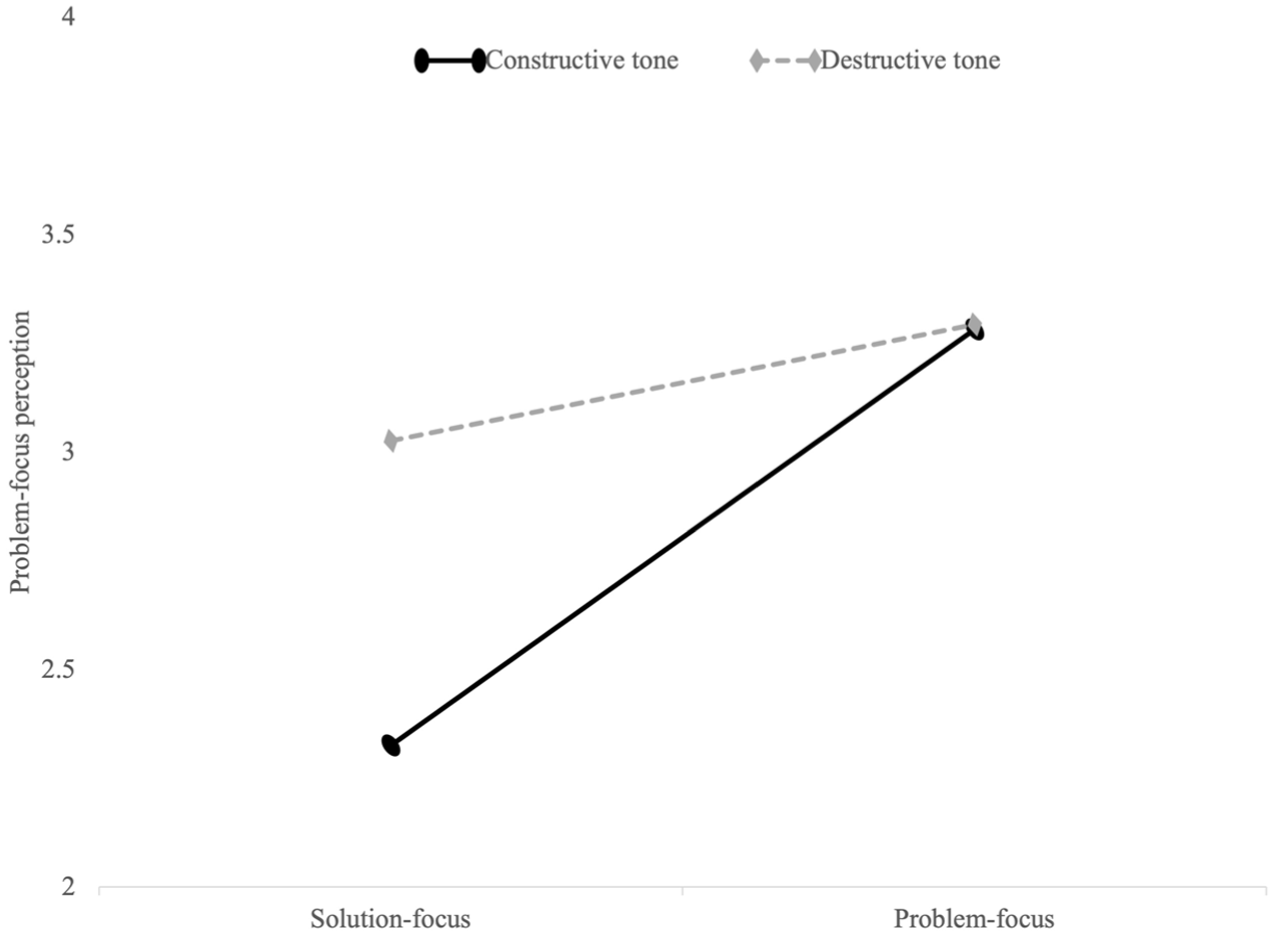
Simple effects of the perception of a problem focus.
The difference in perceived problem focus between the solution focus/constructive tone and problem focus/constructive tone condition (the solid line in Figure 1) was also significant (t(679) = 12.32, p < .001). Participants in the problem focus/constructive tone condition reported higher levels of problem focus than those in the solution focus/constructive tone condition. In sum, the effect of focus on the level of perceived problem focus was significant in both conditions of tone, hence we consider the manipulation of problem focus successful enough to continue with our analysis.
Manipulation Check Tone
As intended, participants in the constructive tone condition perceived Robin’s email as more constructive in tone (M = 2.90, SD = 0.70) than those in the destructive tone condition (M = 1.94, SD = 0.76, F(1, 674) = 297.78, p < .001, η2 = .31). There was a cross-over effect of focus on perceived constructive tone. Participants in the solution-focused condition reported their email messages as being more constructive in tone (M = 2.54, SD = 0.85) than those in the problem-focused condition (M = 2.29, SD = 0.88, F(1, 674) = 20.96, p < .001, η2 = .03). Still, a Wald test confirmed that the main effect of the tone manipulation on the level of perceived constructiveness of tone was significantly stronger than the main effect of the manipulation of focus (z = 8.71 p < .001). This implies that the manipulation of tone was successful enough to continue with the analysis.
Descriptives and Correlations
Descriptives for, and correlations between all variables are outlined in Table 2. As hypothesized, both message focus and message tone correlate significantly with conflict personalization (r = .136, p < .001; r = .268, p < .001, respectively). Compared to the solution-focused condition, we observed that participants in the problem-focused condition reported higher levels of conflict personalization. In addition, those in the destructive tone condition reported higher levels of conflict personalization compared to participants in the constructive tone condition. Furthermore, years of experience in leadership (M = 13.27, SD = 9.80, r = −.129, p < .001) and positive mood (M = 3.53, SD = 0.73, r = −.106, p = .005) were associated with lower levels of conflict personalization. Additionally, there was a significant positive correlation between negative mood and conflict personalization (M = 1.81, SD = .74, r = .391, p < .001). Thus, a more negative mood was related to higher levels of conflict personalization. Therefore, we incorporated leadership experience, positive-, and negative mood as control variables in the subsequent hierarchical regression analyzes. 3 Notably, we observed that the average score for conflict personalization was relatively low (M = 1.60, SD = 0.74, ranging from 1.33 to 1.92), we discuss this in the Discussion section.
Descriptive Statistics and Intercorrelations of Variables.
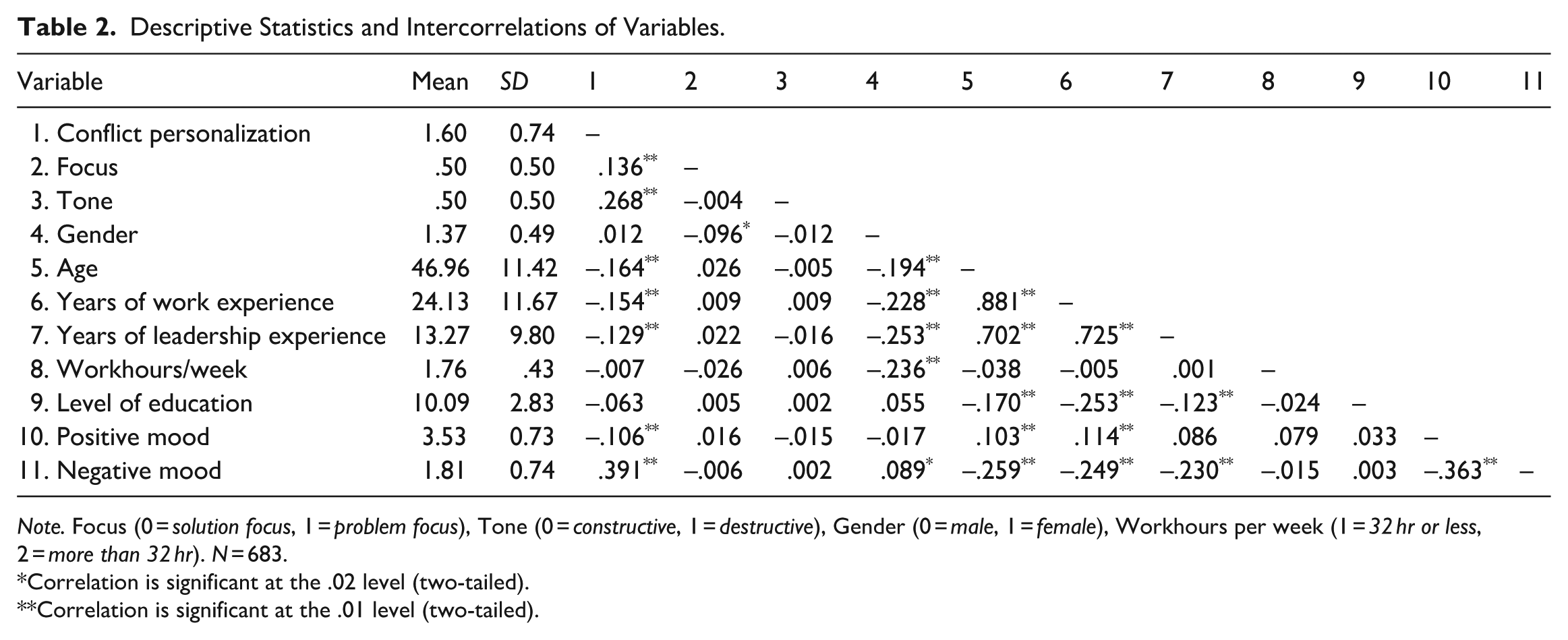
Note. Focus (0 = solution focus, 1 = problem focus), Tone (0 = constructive, 1 = destructive), Gender (0 = male, 1 = female), Workhours per week (1 = 32 hr or less, 2 = more than 32 hr). N = 683.
Correlation is significant at the .02 level (two-tailed).
Correlation is significant at the .01 level (two-tailed).
Test of Hypotheses
To test the two hypotheses, we performed a hierarchical three-step regression analysis with conflict personalization as the dependent variable. 4
Table 3 shows the results of our hierarchical regression and Figure 2 shows the level of conflict personalization for each of the four vignettes. In the first step of the hierarchical linear regression, we entered the control variables years of experience in leadership, positive mood, and negative mood. They explained a significant amount of variance (R2 = .16, F(3, 677) = 41.74, p < .001). This effect is mainly driven by negative mood (b(SE) = 0.39 (0.04), t(677) = 10.21, p < .001, 95% CI [0.32, 0.47]).
Results of a Hierarchical Regression Analysis.

Note. Focus (0 = solution focus, 1 = problem focus), Tone (0 = constructive, 1 = destructive); N = 681.
Predictors: (Constant), Leadership Experience (years), Positive Mood, Negative Mood.
Predictors: (Constant), Leadership Experience (years), Positive Mood, Negative Mood, Focus.
Predictors: (Constant), Leadership Experience (years), Positive Mood, Negative Mood, Focus, Tone.
Predictors: (Constant), Leadership Experience (years), Positive Mood, Negative Mood, Focus, Tone, Focus*Tone.
Dependent variable: Conflict Personalization.
p < .02; **p < .001.
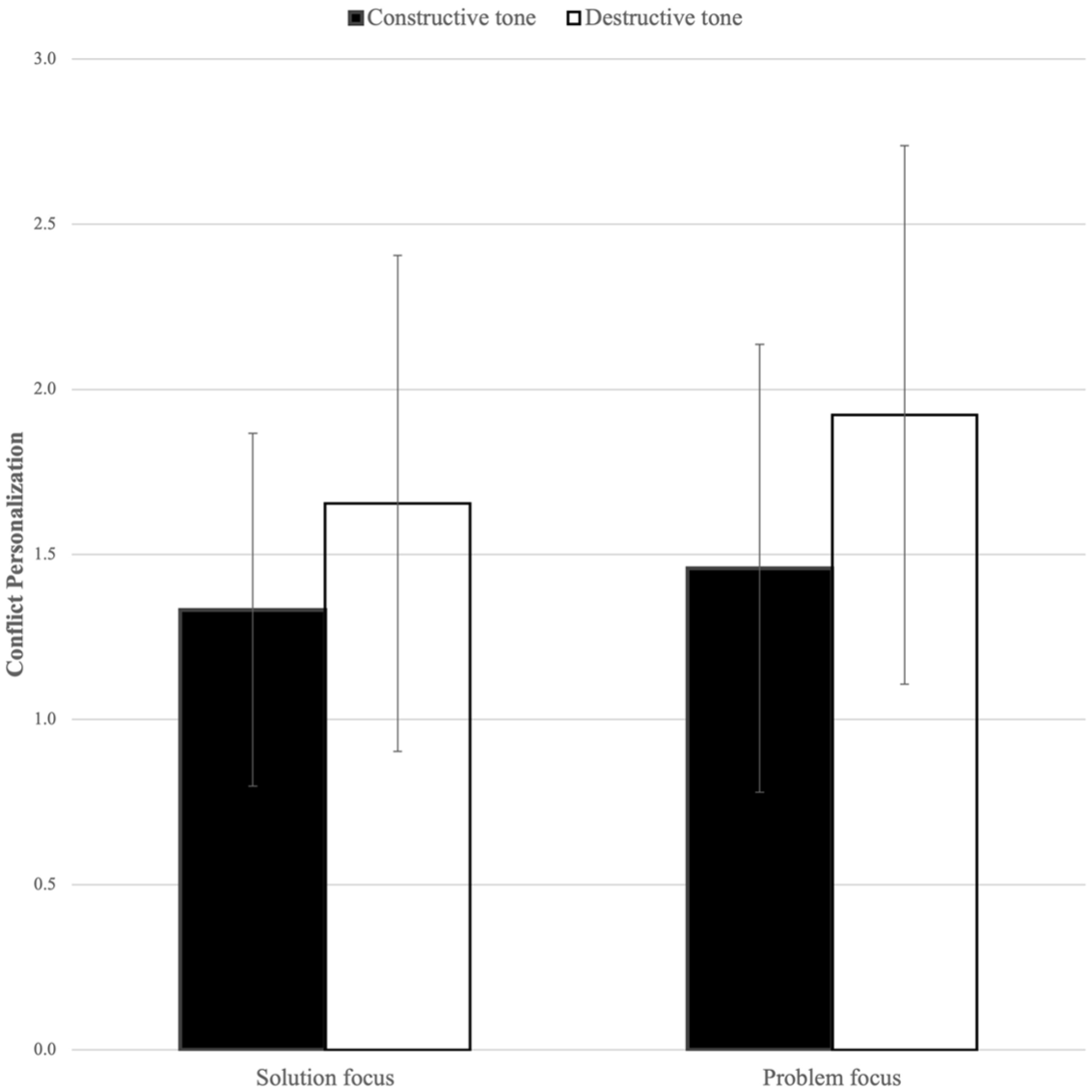
Levels of conflict personalization per vignette.
For H1, we expected that conflict messages with a problem focus would lead to higher conflict personalization levels than messages with a solution focus. To test this hypothesis, we entered the manipulation of focus in the second step of the analysis, resulting in a significant additional amount of variance being explained (ΔR2 = 0.02 F(1, 676) = 15.11, p < .001). We observed that problem-focused messages caused higher levels of conflict personalization for the participant than solution-focused messages (b(SE) = 0.20 (0.05), t(676) = 3.89, p < .001, 95% CI [0.10, 0.30]). Thus, H1 is supported.
For H2, we expected that conflict messages with a destructive tone would lead to higher levels of conflict personalization than messages with a constructive tone. To test this hypothesis, we entered the manipulation of tone in the third step of the analysis. A significant additional amount of variance was explained by tone (ΔR2 = 0.07 F(1, 675) = 63.69, p < .001). We observed that if the tone of the email was destructive, participants experienced more conflict personalization (b(SE) = 0.39 (0.05), t(675) = 7.98, p < .001, 95% CI [0.30, 0.49]) than when the tone was constructive. Thus, H2 is supported.
Additionally, we tested whether the effects of focus and tone on conflict personalization were equally strong. A Wald test indicated that message tone had a significantly stronger effect on conflict personalization than message focus (z = 2.86, p = .004).
Finally, we analyzed the data to see if message focus and tone had an interaction effect on conflict personalization. Adding the interaction of focus and tone (Step 4) did not significantly improve the model (ΔR2 = 0.00 F(1, 674) = 1.28, p = .26). There was no significant interaction of focus and tone on conflict personalization levels (b(SE) = 0.11 (0.10), t(674) = 1.13, p = .26, 95% CI [−0.08, 0.30]).
Discussion
We conducted this experimental study to explore whether the focus and tone of a written conflict message would lead to different levels of conflict personalization for the recipient. Drawing from literature and empirical work on the potential impact of tone during conflict expression and supervisor’s reception of employee voice messages, we formulated hypotheses. The experiment constituted an online 2 (solution focus vs. problem focus) × 2 (constructive tone vs. destructive tone) vignette study (n = 683) on a workplace conflict between a fictive employee and the participant as the recipient in a supervisory role. We observed that, as hypothesized, problem focus as well as destructive tone led to an increase in conflict personalization. With respect to the focus of the message, participants that read a problem-focused message reported more conflict personalization than those who read a solution-focused message. For message tone, participants reading messages with a destructive tone reported more conflict personalization compared to those reading messages with a constructive tone. Moreover, message tone was a stronger predictor of subsequent conflict personalization levels than message focus. We did not find a significant interaction effect of message focus and message tone. Although the manipulations of focus and tone were considered successful enough to continue with the regression analyses, these results need to be interpreted with some caution as manipulation checks showed that not all participants were able to completely separate the two (see Limitations).
Theoretical Implications
Our study contributes to both the workplace conflict literature as well as the employee voice literature. Remarkably, these two fields have largely developed in isolation of one another, while they focus on a similar phenomenon and therefore either could benefit from more collaboration. Moreover, both fields are interested in which factors determine whether the situation is beneficial or detrimental to those involved and the organization in general. Recognizing conflict personalization to be a central, yet implicit, factor in both fields, this study is amongst the first to provide the theoretical dialog between the conflict and voice literatures as recently called for by Kim et al. (2018).
First, we contribute to the workplace conflict literature by exploring the effect of message focus and tone on the level of conflict personalization by the recipient in the context of a task-related conflict in the workplace. The results show that in our experiment, both message focus and tone were determinants of conflict personalization, with message tone explaining a significantly larger share of the variance than message focus. Specifically, our observations contribute to theory on conflict personalization by showing that focus and tone of messages could be potential antecedents of conflict personalization during workplace conflict.
Our experimental study contributes to the field of workplace conflict, by showing how to incorporate conflict personalization in a theoretical model on conflict messages and subsequently measuring it in an empirical study. Moreover, conflict expression scholars could benefit from our study on conflict personalization to narrow their operationalization of conflict perception. This could help to decouple how an expression of conflict is perceived and what the conflict is about (i.e., task- and relationship conflict, Bendersky et al., 2014), which in turn could improve the understanding of conflict expression effects. Namely, according to Jehn et al. (2008) relationship conflict should more neutrally be defined as non-task conflict between staff, on for instance political views, clothing preferences or social events. Subsequently, dimensions like conflict importance – and as we suggest conflict personalization – could be added to the framework as moderators to clarify the conditions under which conflict is detrimental or beneficial (Jehn et al., 2008).
Nevertheless, in empirical studies relationship conflict is often understood and operationalized as what we would prefer to call “personalized relationship conflict,” by confounding issue and perception factors like emotionality, tension or personal attack (e.g., Ismail et al., 2012; Mooney et al., 2007; Todorova et al., 2022). Academic research on conflict at work, and the effect of how that conflict is expressed, will benefit from an approach wherein conflict issue, the particulars of message delivery, and personal experience are distinct factors. The results of our study indicate that an interesting suggestion from Todorova et al. (2022) could prove to be true: the level of intensity during conflict expression might counteract the benefits of task conflict.
Second, our study contributes to the voice literature through our effort in the research design and measures to manipulate the message’s focus and tone as separate conditions. Although employee voice behavior is defined as constructive in its intent (Morrison, 2023), focus and style of delivery appear to have become confounded. Currently, empirical studies on solution-focused (i.e., promotive voice) and problem-focused (i.e., prohibitive voice) messages employ an operationalization in which a solution-focused message is considered more positive and constructive, while problem-focused messages are theorized to inherently come across as embarrassing to the recipient and risky to relationships (Promotive and Prohibitive scales, J. Liang et al., 2012). Instead, we build on the idea that both solution-focused and problem-focused messages could be expressed in a constructive as well as destructive tone, mirroring the shift in academic thinking that actually all workplace conflict can cause negative emotions (Behfar et al., 2011; Jehn & Bendersky, 2003). We operationalized perceived solution- and problem focus in a rather clean manner, solely with items on conveying solutions or problems. Manipulation checks showed that participants did perceive a difference between solution focus and problem focus and constructive tone and destructive tone, even though we observed spill-over effects that indicate participants have some difficulty with the written conflict messages.
All in all, our design and results suggest that studying message focus and tone more distinctly is possible and worthwhile. We observed that message tone is a stronger predictor of conflict personalization than the message’s focus. And that solution-focused messages are not necessarily always well-received, as conflict personalization levels were higher for solution-focused messages in a destructive tone compared to solution-focused messages conveyed in a constructive tone. We kindly recommend voice scholars to experiment with an operationalization of promotive and prohibitive voice (i.e., solution focus and problem focus respectively) in which the focus and tone – or other measures for “style of delivery” – are disentangled. The current confound in the available employee voice scales hamper voice researchers to pinpoint how the style of delivery – focus, tone, or both – drives the effects of employee voice. The results of our experiment provide a starting point for separating focus and style of delivery in future research, which can improve the understanding of employee voice behavior.
Practical Implications
With this study, we aimed to contribute to practice by shedding light on how the characteristics of conflict messages, in terms of focus and tone, could influence conflict personalization by the recipient. Hopefully, our results support senders in expressing their disagreement more effectively.
We do not suggest that an employee should be held accountable for their supervisor’s or colleague’s ability to handle conflict. And although supervisors in particular should be expected to employ proper conflict management skills and be emotionally intelligent with respect to conflict (Holmes & Marra, 2022; Saeed et al., 2014; Schlegel et al., 2025), in reality supervisors can take conflict very personally. Moreover, with email being much preferred by staff and employees being more and more expected to show proactive work behavior (Spychala & Sonnentag, 2011), it is quite likely that workers find themselves in a conflict such as the fictive one in our study.
Despite the benefits of email, employees should be aware of its disadvantages (Taylor et al., 2008), such as conflict personalization for recipients. In the absence of nonverbal cues, focus and tone are key in determining how colleagues interpret email messages (e.g., Brett et al., 2007; Griessmair & Koeszegi, 2009; Ramirez et al., 2002). Our results indicate that senders can influence the reception of their message, by strategically choosing a solution focus and constructive tone and thereby limit the level of conflict personalization by the recipient.
Actually, employees are currently advised by scholars to “whenever possible, (. . .) invest the time and effort required to devise a potential solution to a problem before bringing the problem to the attention of others in the organization” (Whiting et al., 2012, p. 176). Yet, while in our experiment problem focus led to higher conflict personalization vis-a-vis solution focus, tone was the strongest predictor of conflict personalization levels of the recipient. This implies that opting for a problem focus might not be as unfavorable as is currently suggested, as long as the tone of the message is constructive instead of destructive.
So, perhaps it is time to polish the image of problem-focused messages in the workplace and give room to those employees that are not able to come up with a solution but do want to voice their concerns. Especially if time is an issue or the subject is emotionally charged and needs collective decision-making, it might be best to communicate with a problem focus than to come up with a solution because problem focus messages do generate a sense of response urgency (Dutton & Ashford, 1993; J. Liang et al., 2012; Romney et al., 2025). Problem-focused messages with a constructive tone are probably better than avoiding the workplace conflict altogether, as remaining silent has undesirable effects like an increase in turnover and the overlooking of errors (Detert & Edmondson, 2011; McClean et al., 2013; Milliken et al., 2003; Morrison & Milliken, 2000).
Limitations and Suggestions for Future Research
There are some limitations we wish to address here, as they reveal interesting avenues for further research. Firstly, even though the manipulation checks for focus in the solution- and problem-focused messages and tone in the constructive/destructive messages showed manipulations worked correctly, it did seem that participants had some difficulty completely separating focus and tone, at least in written messages like emails. It could be that the participants in our sample considered problem-focused message to inherently have a more negative tone. Romney et al. (2025) applied textual analysis software on written voice message, and found that the problem-focused messages did have a slightly higher score on negative tone than solution-focused messages (on a scale of 1–100, the negative tone score was 27 for solution focus and 33 for problem focus). Moreover, due to our choices of certain adjectives participants might have interpreted the problem as more serious in the destructive tone condition or think the employee had tried to convey their opinion multiple times and shows frustration about that.
In future experimental studies, it would be interesting to use a design with the message conveyed through audio or video material or an actor. Such designs could enable even stronger differentiation between message focus and tone, as tone could be manipulated through sound and pitch of voice, or nonverbal cues (see, for promising steps in this direction, (Dudenhöffer, 2025). In addition, there might be a difference in conflict personalization levels for email versus audio, video or face-to-face because email is a more distant way of communication. Nevertheless, all four vignettes in our study were perceived as a workplace conflict and participants felt they were able to identify with the situation. Furthermore, the extent to which conditions can be manipulated has its limits. Vignettes with too explicit cues on the conditions, for example by having the sender state that they have absolutely no suggestions for a solution, run the risk of becoming unrealistic.
Secondly, we feel applying the Taking Conflict Personally scales (TCP scales, Hample & Dallinger, 1995) is a limitation to this study, although this is the only instrument currently available. There is an imbalance in the scale: the subscales are mostly focused on the affective part of conflict personalization (Hample, 2015), while the recently constructed integrative definition that we applied has a cognitive element as well, in addition to a key role for “the self” (Hoogenboom et al., 2024). Moreover, respondents might give socially desirable answers to the items that explicitly refer to personalization of workplace conflict (e.g., “I take it personally that Robin rejects the procedure I designed”), as taking those conflicts personally can be perceived as a lack of professionalism. We therefore recommend to develop a new instrument to measure conflict personalization at work, incorporating all the elements of the integrative definition (Hoogenboom et al., 2024): negative affective reaction, cognitive reaction, and the perception of a threat/danger to the self.
Thirdly, the average scores on our adapted conflict personalization scale were relatively low, ranging between 1.33 to 1.92 on a five-point scale. This might be a symptom of the suboptimality of the TCP scales for assessing conflict personalization in a work context as we discussed above. Indeed, other empirical studies on conflict personalization that use the original TCP scales report relatively low scores as well (e.g., Demir & Hample, 2019; Hample et al., 2021; Labrie et al., 2020; Rapanta & Hample, 2015). Moreover, the low average might be due to the Dutch nationality of our sample, which has been shown to have a moderate inclination to take conflict personally (5.2 on a 10-point scale, Labrie et al., 2020). Compared to a U.S. sample, Dutch respondents reported lower levels of direct personalization, and they were less afraid conflict would hurt the relationship.
Most importantly, however, the goal of our experiment was to test theory-driven causal hypotheses on whether varying message focus and tone could lead to significant differences in conflict personalization levels, and the relatively low overall average of conflict personalization does not obstruct that goal. It is important to keep in mind that participants were asked to respond to a hypothetical conflict described in an experimental vignette. Obviously, this experimental context does not represent all, or even most, of the conditions present in naturally occurring conflicts at work, where people interact with, and behave toward one another over a prolonged period of time (see Berkowitz & Donnerstein, 1982; Ilgen, 1986). Yet, even in this artificial context, in which participants arguably should care less about message focus and tone than in a real-world conflict, we were able to observe differences in conflict personalization that were causally driven by differences in message focus, and, more importantly, tone. In line with the goal of our experiment, this supports our theory-driven predictions (see Mook, 1983 for an interesting discussion on the purpose of experimental research). We suggest conducting field research with samples drawn from different nationalities and cultures to test whether our findings are replicated and/or nuanced.
Lastly, the design of our experiment revolved around a subordinate employee and supervisor who were in conflict. So, we do not know whether our findings only apply to supervisor-employee conflicts and not to conflicts between peers. However, we would expect that similar patterns occur in peer-to-peer conflicts as well. For instance, the mechanism of perceiving the sender as expressing disrespect likely occurs in a similar way for peer-to-peer conflicts. It would therefore be interesting to test our hypotheses within a context of peer-to-peer conflict.
With respect to the mechanisms behind our findings, we would like to put forward some additional interesting avenues for future research on why particular messages might lead to different levels of conflict personalization.
Firstly, the level of relational satisfaction has been shown to be negatively associated with the level of conflict personalization (Hample & Richards, 2019), and relational satisfaction might be a mediator of interest in the message focus and/or tone – conflict personalization model. With respect to message focus, the inclusion of solutions might divert attention from the difference of opinion, and put the recipient’s focus on the issue at hand instead, perceiving loyalty, preserving the relationship, and a sign that the sender has benevolent intentions with a win-win approach toward the conflict (Kassing, 2002; Redmond et al., 2016; Weingart et al., 2015). A solution focus likely increases relational satisfaction, while a problem focus would decrease relational satisfaction.
Similarly, message tone might also cause an increase or decrease in relational satisfaction. Recipients are considered to use the tone of the sender to deduce information about the emotional state of that sender (Hine et al., 2009; Laubert & Parlamis, 2019). So, a constructive tone might be interpreted as a sign of the sender being neutral or even positive in emotionality, which would reduce the recipient’s negative affect and attributions of being blamed for the current situation; increasing relational satisfaction (Bechtoldt et al., 2013). In contrast, a destructive tone might cause the recipient to attribute harmful intentions to the sender, feel blamed, and this might lead to a more negative emotional state and decrease of relational satisfaction (Friedman & Currall, 2003; Hine et al., 2009; Laubert & Parlamis, 2019).
Secondly, the perceived origin of the criticisms – in-group or out-group – would be worth studying. Empirical work shows that out-group criticism was viewed as less accurate, and receivers experienced more feelings of defensiveness and resentfulness, while in-group criticisms has been found to be viewed as more legitimate and to reduce feelings of defensiveness and resentfulness (Hornsey et al., 2002). While problem-focused messages are possibly perceived as judgmental out-group criticism and deflecting responsibility, a solution focus might come across as ingroup criticism; having the group interests at heart and a sign of joint responsibility (Hornsey et al., 2002; J. Liang et al., 2012).
A final suggestion for future research we would like to make, is to learn more about how to prevent conflict personalization at work. For instance, Nelson and Proell (2018) discovered that supervisors displayed irritation when employees raised certain issues, especially when the suggestion would increase the amount of work. But, in later performance ratings the same supervisor would rate the employee more positively than employees who did not speak up. It is possible that in that study, supervisors personalized the employee’s message but were able to self-regulate and reduce the impact of this personalization on their behavior over time. Potentially, high conflict personalization decreases the likelihood that a supervisor supports or positively receives the suggestion (i.e., voice endorsement, Brykman & Raver, 2023; Lam et al., 2019) in the short term. But, it does not necessarily decrease the extent to which the supervisor subsequently implements or indicates their intentions to implement the voiced suggestion (i.e., voice enactment, Brykman & Raver, 2023; Farh et al., 2020) when supervisors have had some time to digest.
Uncovering potential buffers and/or catalysators of conflict personalization is important for intervention development. Potential characteristics to study could be perspective taking (Ku et al., 2015), as that has been found to increase forgiveness (Rizkalla et al., 2008) and limit negative cognitive responses to intergroup threat (Yang & Zhao, 2013). Additionally, organizational concepts like psychological safety (e.g., Bradley et al., 2012; Subhakaran & Dyaram, 2018) or trust (Jehn et al., 2008; Simons & Peterson, 2000; Son, 2019) are potentially relevant to study in conjunction with conflict personalization.
Conclusion
Conflict is common in the workplace, and recipients potentially take such conflict personally due to the style of delivery of the conflict message. The antecedents of conflict personalization at work need to be considered to balance the long-standing emphasis on conflict issue, as conflict personalization likely impacts the course and value of such conflicts. This vignette experiment revolved around a fictive employee who communicated a different opinion on current client communication procedures toward the participant who had a supervisory role. Drawing from theory on conflict expression and employee voice, the objective was to explore whether the focus and tone of written conflict messages lead to different conflict personalization levels. We observed that as hypothesized, a focus on the problem (vs. focus on the solution) and a destructive tone (vs. a constructive tone) increased the level of conflict personalization of participants. Moreover, message tone appeared to be a stronger predictor of conflict personalization levels than message focus. Our results indicate that to fully benefit from a proactive staff who dare to speak up when they disagree with the current situation, organizations might guide their employees to consciously choose their focus and tone. As a result, employees are likely to be able to limit the level of conflict personalization of the recipient, who in turn are more likely to respond in an integrative, problem-solving manner.
Footnotes
Appendix 1 – Vignettes (Translation)
Participants all read the same introductory vignette. This was followed directly by one of four possible emails sent by subordinate Robin, at random designated to each participant.
Appendix 2
Vignette Structure.
| Vignettes | ||||
|---|---|---|---|---|
| Sentence | 1. Solution focus/constructive tone | 2. Solution focus/destructive tone | 3. Problem focus/constructive tone | 4. Problem focus/destructive tone |
| 1. Rationale | Following a conversation with one of our customers, I would like to draw your attention to a few points regarding our communication procedure for reporting to clients | Idem | Idem | idem |
| 2. Current client communication procedure | I would actually suggest introducing a more modern communication procedure. | We must finally introduce a more modern communication procedure. | Our current communication procedure might seem somewhat old-fashioned. | Our current communication procedure seems hopelessly medieval. |
| 3. Interesting report | One that makes our reports more interesting and effective. | Of course, I mean one that makes our reports more interesting and effective. | Unfortunately, it might make our reports a bit uninteresting and ineffective. | It is one that makes our reports tediously uninteresting and super ineffective. |
| 4. Client involvement | In such a new procedure we could involve the customers so that we are more flexible and faster in our response to their questions and wishes. | In such a new procedure, we should, for a change, also involve the customers, because it could all be a lot more flexible and faster, our response to customer questions and wishes. | And because our customers are regrettably not yet involved in the existing procedure, we are somewhat inflexible and slow in our response to their questions and wishes. | And because, astonishingly enough, our customers are still not involved in the existing procedure, we are extremely inflexible and slow in our response to their questions and wishes. |
| 5. Length and power of the report | Furthermore, let’s also make the reports to the customer shorter and more powerful, so that the text becomes even more readable. | Furthermore, the reports to the customer really need to be shorter and more powerful, so that the text becomes readable for once. | Furthermore, the reports to the customer are actually a bit long and woolly, making them less readable. | Furthermore, the reports to the customer are terribly long and woolly, making them simply unreadable of course. |
| 6. Closing sentence | I hope you can agree with me, and we can discuss these suggestions soon. Kind regards, Robin |
I should hope you agree with me and that we will discuss these suggestions soon. Kind regards, Robin |
I hope you can agree with me and that I have been able to clarify the problem. Kind regards, Robin |
I should hope you agree with me and that the problem is clear now. Kind regards, Robin |
Appendix 3 Measures
Appendix 4
Exploratory factor analyses tone.
| Factor matrix a | |
|---|---|
| Factor | |
| 1 | |
| . . .negative - positive | 0.895 |
| . . .unpleasant - pleasant | 0.937 |
| . . .unfriendly - friendly | 0.900 |
Note. Extraction method: Principal axis factoring; Rotation method: Oblimin with Kaiser normalization.
1 factors extracted; 7 iterations required.

Ethical Considerations
The design was checked with the university’s Research Ethics Review SCC guidelines, and according to the institution’s and national directions no full review was required.
Consent to Participate
All participants were asked for their informed consent to use their anonymized answers for scientific study and publication before they could partake in the experiment. Participants had to give their consent by ticking the box “yes” on the Qualtrics form. At the end of the experiment, participants were offered to be informed about the findings by providing us with their e-mail address.
Funding
The authors received no financial support for the research, authorship, and/or publication of this article.
Declaration of Conflicting Interests
The authors declared no potential conflicts of interest with respect to the research, authorship, and/or publication of this article.