



Abstract
This article investigates student behaviour on collaborative assignments, looking at the relationship between task type and interaction, and considers the implications for task design. Students reported on interactions in a year-long workplace-focussed group communication project, comparing these with interactions on other academy-based group assignments. Differences were seen in the amount of brainstorming, the criteria for dividing up work, the intensity of editing, and how conflict was managed. Contributing factors to these differences included the presence or absence of a creative element, the instrumental nature of the task, and the need for a collective approach inherent in the task design.
Keywords
Introduction
The importance and prevalence of collaborative writing as a feature of workplace activity are now for the most part taken as given. Since the pioneering research into workplace collaboration conducted byParadis, Dobrin, and Miller (1986);Ede and Lunsford (1990); and others, it has been demonstrated in a variety of contexts that a substantial proportion of the writing that takes place in organizations is carried out collaboratively. Indeed,Burnett (2001)suggested that as much as 75% to 85% of writing is collaborative in nature. More recently the importance of teamwork in general has been reiterated (Keyton & Beck, 2008;Thacker & Yost, 2002), whileChen, Donohue, and Klimoski (2004)claimed that “teamwork KSAs (knowledge, skills and abilities) have become an integral component of workforce readiness” (p. 35). Similarly, the need to give students experience of collaborative activity is also largely accepted: AsNelson (2003)concluded, “It is important to expose students to . . . collaborative writing practices in the classroom if we want them to seek out these practices as professionals” (p. 274).
Research into collaboration considers a variety of issues, some relating to the notion of teams and teamwork, and others more specifically to the writing process. This study is concerned with collaborative writing, but collaborative writing as a concept can be broadly interpreted, and in this article we take the term to refer to all activity and communication surrounding the construction of texts by multiple contributors, whether written or spoken, and whether planned or incidental.
The potential benefits of collaboration in academic contexts have been given considerable attention. According toSpilka (1993), for example, classroom collaboration can build interactivity and teamwork, and develop negotiation skills.Nelson (2003)spoke of the group as a “learning mechanism,” andHansen (2006)mentioned a wide range of benefits accruing from “the learning-by-doing approach of group projects” (p. 12) when compared to more traditional teaching approaches, such as higher levels of motivation and achievement; elsewhere, he spoke of improved decision making as a potential outcome, which was also touched on byStorch (2005). Another area discussed in the context of student collaboration is the benefits of “working out disagreements” (Rentz, Arduser, Meloncon, & Debs, 2009, pp. 108-109).Ding and Ding (2008)also listed advantages of teaching with team projects, including “understanding about diversity in the workplace, and experience coping with group dynamics” (p. 458).
Recent research has investigated the kinds of competencies needed for successful collaboration: A range of skills has been suggested, some relating to teamwork in general and others more specifically connected to collaborative writing.Newstrom and Scannell (1998), for example, talked about what makes for high-performance teams, citing elements such as “an overall team purpose” and “high cohesiveness” (p. xi) as important. Further enumeration of skills that can contribute to successful collaborative writing can be found inColen and Petelin (2004), who mentioned team reflection and the ability to assume multiple roles, among others.Onrubia and Engel (2009), meanwhile, focussed on strategies for collaborative writing that relate to the ways in which group members divide up and tackle elements of a task. Attempts have also been made to translate team characteristics into individual competencies.Chen et al. (2004)designed a course intended to develop teamwork KSAs (knowledge, skills and abilities); their study showed that this course led to an increase in students’ teamwork knowledge and skills.
As can be seen, then, the potential benefits of collaborating are well documented, and a variety of competencies conducive to effective collaboration have been identified. The challenge for teachers is to create scenarios that will enable students to experience meaningful collaboration and to develop the necessary competencies in collaborative writing. Approaches to teaching students to collaborate vary considerably, and a number of researchers have suggested that this aspect of learner development is given little attention (Chen et al., 2004;Rentz et al., 2009).Hansen (2006)was very candid on this issue, saying that “it appears that the majority of faculty who place students into teams do nothing more than that” (p. 15), a claim echoed bySnyder (2009). Further support for this contention can be seen in the lack of concrete advice and activities proffered in textbooks in relation to teamwork and collaboration (Bremner, 2010).
There is nevertheless a certain amount of research that considers the kinds of environments and activities that might encourage meaningful collaboration. Looking in particular at the benefits of pairwork and the joint production of texts,Storch (2005)suggested that “from a social constructivist perspective, learners should be encouraged to participate in activities which foster interaction and co-construction of knowledge” (p. 154). Indeed, many approaches to the teaching of collaborative writing have concerned themselves with the social aspect of the process, in particular the need to provide a community in the classroom (Doheny-Farina, 1986;Gollin, 1999), and opportunities for students to interact (Couture & Rymer, 1989) and play multiple roles (Dias, Freedman, Medway, & Paré, 1999).
For some, this is not enough.Fredrick (2008), citingBolton (1999), said that teachers have to go beyond simply giving students the opportunity to collaborate and that they have to work as facilitators. The facilitation strategies she proposed include intervening effectively, actively teaching teamwork (e.g., getting students to read about collaboration and analyzing previous teamwork projects), grading teamwork, and self- and peer evaluation.Gollin (1999)took a similar stance, saying, “Collaborative writing is a complex activity and needs to be actively taught” (p. 289), a belief also expressed byColen and Petelin (2004), andDovey (2006). A number of studies have examined the impact of instigating collaborative processes in academic settings (Baker, 1991;Bekins & Merriam, 2004;Hemby et al., 2004), yet there is no clear consensus on how an effective pedagogy might be achieved. A central concern is the fact that the academy and the workplace differ in many ways as sites of collaboration. An illustration of this concern can be seen in discussions of the value of skill sets of the kind alluded to earlier in this article.Fredrick (2008)claimed that most research in professional communication “assumes that the teamwork strategies suggested for working professionals apply to students as well” and contended that these do not address what she called “complicated authority issues” (p. 440) relating to the hierarchies found in the different contexts. Meanwhile,Seibold and Kang (2008)suggested that there is a mismatch between what is taught about teamwork and what actually happens in teams. They also questioned the value of lists of desirable teamwork skills: “At best, such lists provide students with templates . . . At worst, they perpetuate the chasm between education and real workplace dynamics” (p. 435). This issue of the gap between the academy and the workplace will be taken up again later in the discussion of the findings of this study and their implications.
There is a growing body of research, then, that has developed a picture of what it takes to be a successful collaborative writer, along with some studies of the effects of specific collaborative activities. It has been found that teachers vary in their approach to collaborative tasks, ranging from those who simply organize students into groups for the purposes of a given assignment, to those who seek to facilitate collaboration that resembles “real workplace dynamics” (Seibold & Kang, 2008), to those who actively train students in the competencies that have been identified as conducive to such dynamics.
A central element in the process of teaching or facilitating collaborative activities and related skills is the tasks that teachers assign to their students.Fredrick (2008)said that “teachers should begin by critically questioning whether their assignments really value theprocessof teamwork” (p. 446, original emphasis), and went on to say, “Successful collaboration begins with a well-designed assignment that highlights the necessity and benefits of working as a team” (p. 447). She then described an example of such an assignment in which students team up “to address an environmental issue on a local level by carrying out a project for a client of their choice” (Fredrick, 2008, p. 453). Yet, despite the acknowledged need for appropriate tasks, there has been little in the way of research that looks specifically or in any depth at the relationship between task design and collaborative interaction.Wickliff’s (1997)survey, for example, while highlighting the value of client-based group projects, did not discuss their specific features. Much of the work cited in this article (Baker, 1991;Bekins & Merriam, 2004;Fredrick, 2008;Hemby et al., 2004;Snyder, 2009) was more concerned with managing the processes of collaboration than with the features of the task.Thompson’s (2001)survey of research on collaboration in technical communication mentioned different collaborative assignment types for the classroom but did not consider these in depth. Meanwhile,Hansen’s (2006)review of literature relating to pedagogy for collaboration offered 10 suggestions for improving team projects (e.g., conducting team-building exercises, requiring students to have specific assigned roles, and using peer evaluations), but none of these pertain to the issue of task design. Finally,Rentz et al. (2009)proposed a decision-making table for designing a group report experience for students, relating to problem, group, process, and evaluation design, alongside some examples of assignments that they have found successful, such as using real clients or Harvard Business School case studies. However, the relationship between these is not addressed in any detail.
The review of research relating to collaboration enumerated in this article suggests that there is a need for more conscious efforts on the part of researchers and teachers to consider tasks and assignments that will furnish learners with opportunities to experience meaningful collaborative activity. But what kinds of tasks are likely to provide such experiences in an academic context?
This article looks at the issue of task design and collaboration from the perspective of students in Hong Kong and is concerned with how they behave and interact when assigned tasks to perform in groups. Based on in-depth interviews relating to students’ experiences of group assignments and projects they engaged in during their university studies, the article attempts to identify the types of tasks and the elements of task design that lead to interactions of a collaborative nature and which therefore might be beneficial to the learner. Specifically, the study investigates the following research questions:
What kinds of activities do students engage in when doing tasks in groups?
What is the relationship between the task type and the resulting behaviours?
What implications does this have for the kinds of tasks that could be assigned to foster meaningful collaboration among students?
The study adds to our understanding of the relationship between task design and student interaction—most notably, by drawing on a wealth of student experience and insight. It provides pointers to the kinds of tasks that teachers should be considering if they are to make serious attempts at providing useful collaborative experiences for their learners. However, because this is a qualitative study conducted in a specific local context—namely, Hong Kong—a potential limitation is the extent to which one can extrapolate to contexts beyond this. AsMaykut and Morehouse (1994)pointed out, “What can be discovered by qualitative research are not sweeping generalizations but contextual findings” (p. 21).
The Study
The data for this study, funded by the Hong Kong–SAR government, come from a large-scale research project aimed at investigating the nature of collaboration among both workplace practitioners and students. This study focusses on the student experience, looking at a population who were studying for a degree in English for professional communication in an English-medium university and for whom Chinese is their first language. The students taking part in the study all participated in a professional communication project (PCP) that served as a capstone for their degree. In this project, final-year students (on a 3-year programme) worked in groups ranging in size from four to eight members. Student groups were in some cases self-selected, and in others, groups were arranged by the PCP coordinator. Each group was attached to a host organization for a year, and, during that period, they carried out tasks intended to promote the organization in some way. Typical activities included designing and updating websites, and organizing promotional or fundraising events. These activities required them to communicate both internally (within the group and with the host organization) and externally (with the general public, potential sponsors, etc.). In so doing, they produced a wide range of texts. Internal texts included proposals, reports, and emails, whereas external texts included press releases, leaflets, posters, and other promotional documents. The entire cohort of students was given an introductory briefing on the PCP, during which the importance of working together was stressed. However, they were not given any specific guidelines in this regard.
Specific data were taken from 32 individual semistructured interviews with students, each lasting 30 to 60 minutes. During the interviews, informants talked about their experience of working together during their university studies, with particular focus on the differences between the PCP and other group projects they had been assigned at secondary school and university. Group tasks are common at the university under study; typical tasks might include a research assignment culminating in a presentation or report, or an analytical task. A number of students had also been assigned group tasks while in secondary school, and some of them reflected on these experiences as well. Interviews were conducted in Chinese and then translated. In all, the 32 respondents (out of a possible 64) represented 16 different project groups. Not every member of each group was interviewed but only one to three students per group. Ethical clearance was given for the project by the relevant university committee, and all participants agreed that data could be used for purposes of reporting the research.
Data Collection and Analysis
The research framework is partially derived from the work ofLowry, Curtis, and Lowry (2004), who developed a taxonomy that “helps guide questions that need to be asked in applying CW (collaborative writing) to a target domain” (p. 93). They proposed four key inputs that pertain to the process: task, group, tools, and context. Given that the focus of this study is the relationship between tasks and activity, the input of task is given greatest prominence in the investigation. The components of task are explained as strategies, which are glossed as “a team’s overall approach for coordinating the writing of a collaborative document” (Lowry et al., 2004, p. 74); activities (brainstorming, outlining, reviewing, etc.); document control modes; roles (writer, editor, facilitator, etc.); and work modes, which are summarized as decisions between the degree of proximity (how physically close a group is) and the degree of synchronicity (when a group writes). The combination of these components is the group’swork mode. Work modes directly influence the level of group awareness, which Lowry et al. defined as “better understanding one’s own work activities through understanding the activities of other group members” (p. 88). Their work represents a fairly comprehensive effort to bring together the wealth of research that has been conducted in relation to collaborative writing, and it has functioned as a basis for other studies of collaborative writing (e.g.,Jones, 2005;Onrubia & Engel, 2009).
This framework informed rather than dictated the direction of the interviews; it was important to allow respondents sufficient freedom to talk about aspects of their experiences without the potential constraints of a rigid set of questions. Thus, the questions were very open in nature and were intended to address a range of issues:
The collaborative processes they engaged in while doing their various projects
The roles they played
The channels of communication used
How they handled conflict
The role of creativity in the projects
Differences between the PCP and other group tasks they had been involved in
The first three questions relate to the five components of task enumerated byLowry et al. (2004). Questions relating to two further issues were added, namely, conflict and creativity. Conflict is a potential component of any group interaction, and it has been discussed in the context of both the workplace (Cross, 1994,2001) and the classroom (Burnett, 1993;Rentz et al., 2009). As for creativity, given that the PCP groups were largely being hosted on PR-related projects, it was anticipated that the presence of a creative element might influence the way that participants approached the tasks involved. The final question was based on the expectation that differences would be seen between the PCP, given its partial location in the workplace, and other academy-based group assignments.
The interviews were conducted around the questions indicated above, and the initial findings were grouped around these questions. A thematic analysis strategy was adopted, and there emerged from further reading of the data a number of themes that related to the processes that the students engaged in and how these differed from project to project. The findings have been regrouped on the basis of the recurrent themes that emerged and are presented in the “Findings and Discussion” section, supported by comments from individual respondents. It was found that within groups, although students were interviewed individually, their answers were sufficiently similar to suggest that the nature of the task and the way in which that particular group collaborated were perceived in largely the same way.
Findings and Discussion
The findings showed that, with few exceptions (which will be addressed later in the article), the groups tended to adopt the same strategies with regard to the collaborative writing tasks assigned to them. The process they followed went thus:
Brainstorm ideas as a group.
Create a document outline (referred to asflowby some groups).
Divide up tasks.
Each student or subgroup, or the whole group, creates their allocated part of the document.
Different parts are combined.
Review and edit.
This is perhaps to be expected given that students are likely, in most cases, to have been socialized in their schooling to adopt normative approaches of this nature, acquiring “learned habits that reward and encourage particular ways of thinking” (Cockburn-Wootten & Cockburn, 2011). However, there were differences in the ways that this process played out from group to group and on the various task types. These differences were reported not so much in the order of events, but rather in the degree to which they were practised in the various assignments. Specifically, differences were seen in the amount of brainstorming that took place ahead of allocating roles, the criteria deployed for dividing up work, the intensity of editing and attention to detail, and the causes of potential conflict and the ways in which this was dealt with by the group members.
1. Brainstorming
Brainstorming was seen as an important activity in the PCP. Nearly every group reported a lengthy brainstorming session to discuss the task before roles were allocated. One student explained that this was “to make sure everyone is clear about the task”; a second said that “you . . . need to have a basic understanding of the whole project” before being able to proceed; and another reasoned that “we need to arrive at a consensus.”
As for other university projects, respondents in general reported spending less time brainstorming when compared to the PCP. This ranged from no discussion at all to a limited amount of interaction ahead of the division of work. “For the small-scale project we might skip the discussion,” explained one respondent; a similar approach was reported by another student, who said they tended to allocate Year 1 tasks without discussion because of time constraints. Typical comments relating to this initial part of the process in such projects included, “[We] don’t brainstorm a lot . . . mainly have an outline and then we assign,” and “not discussing too much, and just do it and merge [sic].” Further illustrations can be seen in references to specific courses. For a Communication Management course, one group held a 15- to 30-minute meeting after class to divide up tasks, whereas another said that they had “no proper discussion.” This group dealt with the different sections of the assignment individually and combined them at the end, but they reported “problems with consistency.” Another group consisted of eight students who did not know each other prior to the course assignment. They did not hold a meeting to discuss the assignment or allocate roles and tasks, but communicated throughout the project by text messaging. A final example related to a course called Gender Discourse, in which group members “didn’t discuss anything and just jumped to the work distribution and finished work at home individually.”
2. Division of Work
In the PCP groups, the main factors reported when it came to the division of work related to the perceived skills of the participants, the nature of the task, and to some extent the issue of equity of workload. In some cases, specific roles and tasks were allocated according to the relevant skills of different students, such as writing, website or poster design, or editing. As mentioned in this article, students in the study are L2 users of English, and there would be varying levels of proficiency within each group; thus, as one student explained, “Students with better English revise and edit”; another student said of the group member assigned the role of editor, “That is her talent, so why let it go to waste?”
Other PCP groups let the nature of the task itself be the driver of role allocation: in one instance, parts were assigned “based on understanding of the project,” while another student explained that “distribution depends on the nature of the texts.” A related approach reported by one group was to see “if anyone was prepared to volunteer for certain parts.”
In some PCP groups, a third factor that influenced the division of work was the question of fairness, with one group leader assigning tasks “depending on the workload.” Various additional strategies for dealing with this particular issue were reported. A number of groups put down on paper the roles that had been decided, including in their proposal to the host organization a section “stating each member’s role and speciality.” Another group used Facebook to document the agreed roles and tasks, so that, as one group member put it, “No one could escape from their responsibility.”
When it came to dividing up work in non-PCP assignments, two factors were reported: a concern for fairness in allocating workload, and students’ preferences or willingness to do a task. These two factors were also reported in the case of the PCP, but they had only a minor influence on the ways in which PCP students divided up the work; the key difference is that in the case of non-PCP assignments, these two factors played a greater role and were the primary influences affecting the division of work. Some students would volunteer to do particular tasks, for example: “I would worry that the projects are not done very well. I mean, if no one does the final edit, I would feel very uneasy,” said one, concerned about the quality of the end product. Motives for not wishing to do certain tasks were often personal. Comments such as “I’m lazy,” “I don’t like this,” or “This doesn’t interest me” were made regarding some of the tasks as the groups attempted to allocate roles. In those cases where students expressed little interest, they were simply allocated tasks either by the group as a whole or by the appointed group leader. One respondent even described an assignment in the course Media and Society in which “[they] got [their] parts by lucky draw.”
3. Editing and Attention to Detail
A noticeable contrast was observed in the students’ attitudes toward editing their work on the PCP and the non-PCP assignments. In the PCP, they reported carrying out several cycles of editing and reviewing before sending their documents to the host organization or placing them in the public domain. An illustration of this can be seen in one group’s account of how they went about writing a press release, with all members going through the drafts. As each updated or revised part of the text was completed, it would be circulated throughout the group; every group member was involved at every stage. Similar behaviour was reported elsewhere: “We would review our tasks constantly. We would check all the time,” said one respondent from another group. A telling recognition of the difference between the demands of the PCP and other work they had done can be seen in this comment from one student, talking about their particular PCP: “At first I treated the experience as like a school experience . . . They gave me a deadline, and I handed it in, like it is just homework . . .” Later, as they adjusted to the project, they conceded that “in the real world, every single piece of work has to be detailed, perfect and professional.”
In non-PCP projects, the revising and editing process appeared less intensive. There tended to be fewer stages in the process, and usually fewer group members involved. This approach is reflected in comments such as “everyone was supposed to look through at the end, but because they did it so late, only half saw it,” or “so we just worked separately . . . just merged the work to present it.” Clearly, there are a number of factors at play here; these will be considered later in the discussion of possible reasons for these attitudes and approaches.
4. Dealing With Conflict
The fourth area in which differences were seen between the PCP and non-PCP assignments related to the role of conflict and its possible causes. The termconflicthere refers to any interaction that involves the negotiation of difference, whether cognitive or emotional.
It should be noted that students in Hong Kong tend to steer away from confrontation, particularly emotional conflict, in their dealings with one another, evidence perhaps of a collectivist approach to interaction. Indeed, conflict of an emotional nature was rarely reported in the data. For the PCP, most respondents described their groups as very cooperative; many of them had worked together before and “got on well.” When there were differences of opinion—and these were primarily seen during the brainstorming sessions—students emphasized that they focussed on the cognitive rather than the emotional. “It’s fine when it’s a question of ideas, but when it’s emotional . . .” said one, implying that they would try to avoid conflict of this nature, while another offered the view that one should “criticize the idea, not the person.” Generally, they seemed open to other people’s suggestions: “If your idea is better, it’s okay. It doesn’t matter at all” was one comment. Another respondent said, “If others’ ideas are good, I will accept it. If the members reject my ideas just because they don’t like me, I will not accept it . . . But, of course, they have reasons to support why they reject my ideas directly.” Again, these statements emphasized the difference between cognitive and emotional differences.
Some focussed on the fact that these disagreements provided an opportunity for learning: “When our ideas are rejected, there’s a reason for it. So when we realize what’s wrong, we will learn something.” This sentiment was expressed more generally by another respondent: “We learn from each other. I don’t think anyone in my group is useless.” It was clear that a key concern was that there should be discussion rather than argument, reflected in statements such as “We settled disagreements through discussions,” and “The most important thing is that members are willing to share and discuss.”
In non-PCP projects, the main source of potential conflict was the question of workload (mentioned earlier as a factor in allocating tasks), rather than disagreement over ideas or approaches. However, although this was seen as an issue by many of the respondents, their approach was to avoid confrontation. One respondent described a Communication Management project in which fewer than half of the group members were involved in the discussion, yet the group leader did not force the others to work. Another described a similar scenario regarding the group’s approach to uncommitted students, explaining that they would complete the task by themselves. Yet another reported a project in which one member did not contribute in any way, but still the group would not omit this student’s name when submitting the work.
It can be seen, then, that there are a number of noticeable differences in the students’ approaches to the PCP when compared with other collaborative projects they had been tasked with at school or university. These are summarized inTable 1.
Differences in behaviour in PCP and non-PCP tasks.
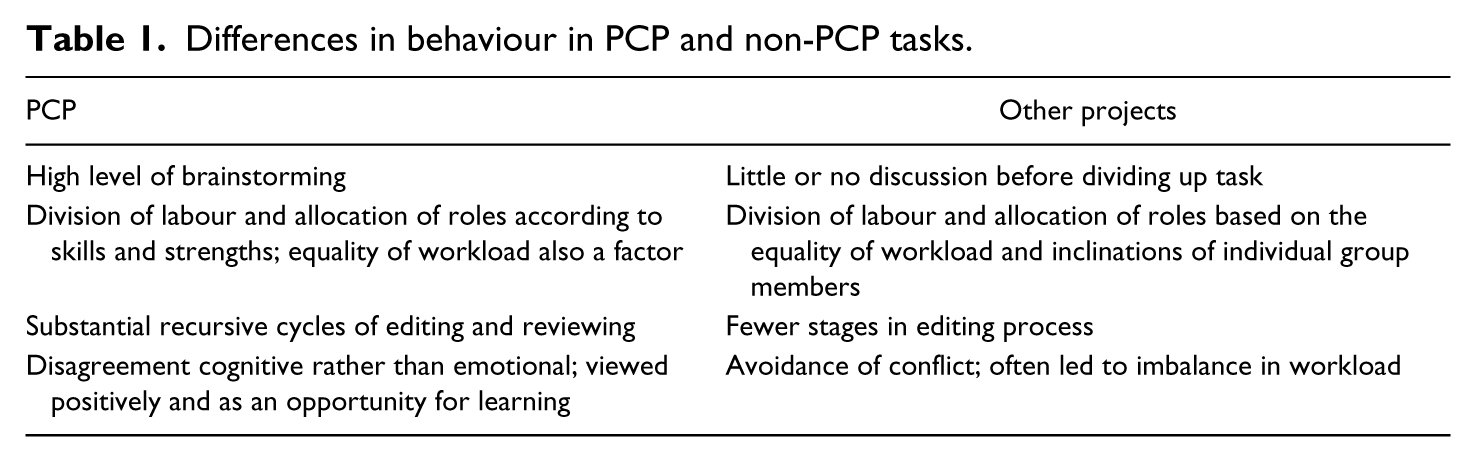
What also emerged—and this is very much a consequence of the differences listed inTable 1—was that students experienced higher levels and more varied types of interaction on the PCP. There was more discussion, not least because there were more topics considered worthy of discussing, and there were more opportunities for learning as a result.
It was hypothesized here that the “real-world” nature of the PCP itself (i.e., that it had an instrumental purpose and that the textual outcomes were to be read by external audiences) rendered it different from other types of group assignments found in the academy. The data bear out the expectation that different student behaviours would be seen in the different task types, but this leads to the question of exactly what features of the PCP made it conducive to these practices and behaviours when compared to the other task types. A number of possibilities, articulated by the student respondents engaged with these various tasks, can be extracted from the data and are discussed throughout the remainder of this section.
Presence or Absence of a Creative Element
A major explanatory factor in the data that helps account for differences in behaviour and interaction patterns was the presence or absence of a creative element in the assigned task. The PCP generally required a greater element of creativity, given that students were for the most part involved in generating publicity for their host organizations, and this usually led to more discussion within the group. Most PCP groups put the entire product together themselves, whether it was an event, a campaign, or some other promotional initiative. Several comments bear this out: “We created the whole thing ourselves,” said one group. A member of another group made a similar observation: “We created a successful event from zero. I was delighted by the triumph we achieved.” Not only did involvement in a creative project afford a sense of achievement, as can be seen in this last comment, but also it served as a motivational factor. One group described how they were given a “large amount of freedom” to organize a promotional event, with the result that “we would do everything we could think of,” and with the whole group being involved in discussion, drafting, and editing of the various texts involved. Another group explained that they were motivated because “we wanted something good to show in the exhibition,” which would be put on as a form of grand finale to the projects. One individual respondent made a more general comment regarding creativity and motivation, saying, “If the course is more directed toward the creative side, I will be more interested and more devoted.”
In contrast with the PCP, many of the other group assignments that respondents had experienced did not contain this creative element. One student talked of group projects they had been required to do in secondary school, saying that there was little need for face-to-face interaction because they were “accessing facts from textbooks.” Similar observations were made by other students, with one explaining that in Year 1 work, they tended to allocate tasks without discussion because “it’s just a case of researching information,” and another saying (about non-PCP group work) that “most group projects are based on theories. It is question and answer. You mostly apply theories.”
An interesting illustration of the impact of a creative element in a group assignment can be seen in the account of one PCP group whose brief did not contain this element: “Our host didn’t have many tasks for us to do,” they said, explaining that it was “simply a question of following what had been done before.” Their reactions to this situation were somewhat negative, with one commenting that “it was no different from any other experience,” and another saying, “I didn’t learn anything . . . It’s just like the normal way.” Further evidence of their disillusionment—and of the effect of the absence of creativity—was seen when they were required to write a press release. As it was to be based on a sample given to them by the host organization, they saw no need to meet in order to draft or discuss it. “It’s a waste of time,” they concluded.
Need for a Collective Approach
The second factor that had an effect on student behaviour and interaction was whether the nature of the task itself necessitated a collective approach or was at least perceived to require a collective approach. To some extent, this need to tackle a task as a group resulted from the sheer size of the task; the fact that the PCP groups were expected to plan and deliver a substantial promotional event meant that they felt they had to be involved as a group from the outset. One group saw the value of group work when tasks are “impossible to handle alone”; a different angle on this same issue was seen in the comment of one respondent, who said, “One plus one is more than two.” Meanwhile, a member from another group pointed out that “even if you’re not required to do some parts, you still need to have a basic understanding of the whole project.” These comments and approaches can be contrasted with the practices reported relating to other, non-PCP projects in which group members divided up the writing, often without even meeting to discuss how best to apportion different parts of the task.
Levels of Interest and Commitment; Importance of Assignment and Weighting in Course Grade; Time Factors
These factors are dealt with together here because they are, to some extent, interlinked. As was observed above, students on the PCP were motivated to a degree by the creative element in the project. The fact that they were taking on projects of some substance for hosts outside the university, and that the various products in the form of texts, events, and so on would be read and seen by external audiences, was also a motivator.
When it came to non-PCP projects, however, evidence suggested that lack of interest led to lower levels of involvement and interaction. One respondent was very explicit about this: Describing a group assignment, they explained that only a few students got involved because it “seemed that they didn’t care about the work,” attributing this attitude to the “level of interest, grade weighting, [and] importance [of the project].” Another respondent talked of uncommitted students in a project leading to low levels of interaction and collaboration, with the result that “we would complete the task by ourselves.” This lack of interest was also seen as a reason for the absence of conflict in the non-PCP projects: “Most group mates are passive. They do not care much.”
Another factor offered as an explanation for lack of interaction or collaboration was the weighting, meaning what percentage of the overall course grade the task was worth. This was seen in the comments of a respondent cited above; other students were more explicit about the relationship between this aspect of the task and their levels of interaction. One described a project in which “everyone was supposed to look through at the end, but because they did it so late, only half saw it . . . it wasn’t a big percentage of the grade.” Another explained a similar scenario: “Marks are not counted, and we only had to make a pass for the course, so we just worked separately . . . Just merged the work to present it.” It should be noted, though, that this was not seen universally as likely to affect interaction, with one respondent saying that in their case, “Importance and weighting is not a factor.”
Time was cited by some students as a factor relating to how much they interacted on non-PCP projects, as can be seen in one of the comments in the paragraph above. Other comments included, “We didn’t have time to meet—we divided a group of four into two pairs,” and “People allocated tasks without discussion because of time constraints.” As mentioned at the beginning of this section, there is a possibility that students’ willingness to allocate time to a project may be in some way linked to their general commitment to and interest in a task. Indeed, one respondent, talking about the PCP, agreed that time was an issue, “But when we all knew that we had to discuss something or make decisions, we would squeeze some time for meetings.” This statement suggests that a task being perceived as important obliged them to create time to address it.
The original hypothesis underlying this study posits that different types of assignments will lead to different types of interaction and behaviour; this relationship between task type and interaction is to be expected, and the findings from this study bear out this hypothesis. More importantly, though, by examining the issue from the students’ perspective, the study provides particularly pertinent insights as to what features of a task might lead to collaborative interaction—or lack of it. Indeed, it seems we can learn as much from group tasks that do not lead to meaningful collaboration as we can from those that do.
It is perhaps helpful here to suggest a distinction between what might be termed, on one hand,group work, and, on the other,collaborative work. The former can be seen as work in which students are simply brought together to perform a task, and, for reasons possibly relating to the nature of that task or to other factors, they experience low levels of interaction. Typically, they do not engage in discussion to any large extent, and much of the work is conducted individually. Collaborative work, in contrast, entails higher levels of interaction. Students spend more time in brainstorming, discussion, and exchange of ideas; they engage more with the task and with each other, and these higher levels of interaction increase the likelihood of their learning from the process.
The findings indicate that many of the non-PCP tasks did not lead to collaboration; rather, the kinds of interactions reported in these tasks more closely resemble group work. The PCP tasks, in contrast, largely resulted in more collaborative work. Indeed, there is ample evidence in the accounts of the students who participated in this study that, in most cases, PCP tasks led to kinds of interaction that provided them with insights into the challenges involved in collaboration, and they also allowed them to experience a range of collaborative activities with potential for learning.
These findings have clear implications for the design of tasks that have collaborative activity as their goal; however, before addressing this issue, it is worth pointing out that not all PCP tasks resulted in collaborative interaction, and reflecting on the reasons for this. Certainly, there were varied responses to the PCP, and in a few instances collaboration in the sense described here did not feature heavily. Several possible reasons suggest themselves. In one group, students claimed that a “dictatorial group leader” meant that there was less room for discussion and negotiation than was seen in other, more democratic groups. Indeed,Nurmi (1996)contended that a dictatorial leadership style can lead to a scenario in which “no teamwork has taken place” (p. 11). Another explanation for lower levels of collaboration was that one or two groups came across as generally apathetic. However, perhaps the most influential factor was the concern for fairness, which as a consideration often overrode other concerns. Friendship was also influential in this regard; in many cases, students in the various groups had worked together before and knew one another quite well. As one respondent explained, “Group members are not only classmates, but also good friends.” This situation was very likely to have an effect on the ways in which they worked together. Interestingly, one student recognized this as a potential problem, saying, “I think good relationships may not lead to good results in the project . . . Too relaxed and not serious [sic].” Another explained the effect of working with people they did not know well: “In PCP, the relationship with group members was not close. We only talked about the work, so I learnt to cooperate with them only like colleagues.”
The fact that not all PCP tasks automatically resulted in “workplace-like” collaborative activity is a reminder that there are considerable differences between the academy and the workplace as contexts for interaction and learning, the different hierarchy being a case in point. Indeed, the broad consensus among researchers in this area is that there is a difference between the kinds of collaboration seen in the classroom and those seen in the workplace.Gollin (1999)said that workplace collaborative writing processes “are embedded, [and] differ significantly from the writing processes of individuals modelled in traditional pedagogy” (p. 268). The differences between the two contexts have led researchers such asMabrito (1999)to comment that “we will never be able to exactly duplicate in our classrooms many of the constraints and pressures that writers experience in the workplace” (p. 105), citing the different types of relationships found in the two contexts, a point also made byDebs (1991)andFredrick (2008). Certainly, it is fair to say that few, if any, activities will exactly capture the realities of workplace collaboration. The differences that obtain in terms of context and the makeup of student and workplace collaborative groups—and the ensuing collaboration itself—are discussed in a number of papers (Bremner, 2010;Freedman, Adam, & Smart, 1994).
Implications and Concluding Thoughts
These differences in context notwithstanding, the findings from this study can provide pointers with regard to the design features of a “good collaborative task.” The elements enumerated in this section are discussed separately, but they are to a considerable extent interrelated, as will be seen.
Ideally, the task should necessitate a collective approach to a communication problem, a previously mentioned point made byFredrick (2008). This might be achieved through devising a task so large that it is, as described by one of the respondents, “impossible to handle alone,” although this could be seen as a somewhat crude approach to task design, and the constraints of the course might not allow for large tasks. Nevertheless, it is important to provide a task that is not easily divisible in the sense of students being able to perform or write different elements without reference to the other members of the group; the various elements should be interrelated. Thus, although a task might require the group to call on a range of skills and levels of knowledge that not all of them possess, such as technological know-how or design skills, the subtasks that this expertise is brought to bear on should be intertextually linked as part of a larger overall product. An example of this is a promotional campaign that includes multiple textual outputs such as invitations, flyers, and press releases.
A second important feature of a collaborative task is that it should have an endpoint that is not simply a display or application of knowledge or theory; the fact that students were, in many non-PCP assignments, able to divide up such tasks and do their parts independently is a clear argument against such tasks (if they are intended to be collaborative, that is).
A central consideration, linked to the point above, is the need to include opportunities for creativity in the task. Not only do these take students beyond the regurgitation of knowledge and theory, but also they can serve as a motivator, as seen in the students’ comments regarding creativity.Nurmi (1996)noted that “trainers of creativity have found teamwork to be a splendid instrument of innovation” (p. 9); in this study, the converse has been demonstrated, namely, that the provision of a creative element can lead to effective collaboration. This element can lead to greater engagement on the part of the participants in that the creative brief would be likely to provide the need and opportunities for exchange and discussion of ideas, and therefore opportunities for learning. Recent examples from the PCPs in the university where this study took place are promotional campaigns, fundraising events, and projects in which students attempted to harness social media to the promotion of their host organizations.
Finally, the task should be important in the eyes of the students, and this importance should derive from the intrinsic nature of the task—from the challenges of creating textual products for authentic purposes and authentic audiences, rather than from simply giving the task a high weighting in grading terms. AsFreedman and Adam (1996)explained, “A key criterion of success . . . relates to the degree to which the learner sees the task as authentic—that is, one that has consequences in its context” (p. 411).
If the task displays some or all of these features, there is a good chance that it will engender interaction of the kind discussed above. An illustration of this comes from an account from one of the PCP groups. As they described it, they carried the “old” approach into the PCP and “treated the experience as like a school experience.” This involved group members dividing up the project-related tasks without doing any brainstorming, with participants working alone at home and communicating when necessary by email or phone. However, as they explained, this “led to confusion among group members.” As a result, they decided to change their approach: They met more often and used more channels to communicate generally. Essentially, they became more interactive. They were obliged by the nature of the task to move from group work to collaboration.
Footnotes
Author’s Note
This study was approved by the Human Subjects Ethics Sub-Committee of City University of Hong Kong. Student comments are reproduced by permission.
Declaration of Conflicting Interests
The authors declared no potential conflicts of interest with respect to the research, authorship, and/or publication of this article.
Funding
The authors disclosed receipt of the following financial support for the research, authorship, and/or publication of this article: The research on which this article is based was made possible by an HKSAR Government Funded Research Project (GRF) 2007–2010, titledCollaborative Writing in the Creative Communication Industries: Professional and Pedagogical Perspectives(GRF Project No. 9041281).
Author Biographies