



Abstract
With the increase in the use of mobile devices in the workplace, both employer supplied and personally owned, and the major role social media has begun to play in today’s world, businesses face many new challenges with their employees. Social media may be seen by some employers as a virtual Pandora’s Box. Though it may seem to hold bountiful riches, employee posts can unleash a firestorm of unforeseen challenges and consequences ranging from financial, to legal, to ethical. In looking at business use of social media, this article will discuss the prevalence of social media use, possible legal liabilities thereof, and policies to consider.
Keywords
Introduction
With the increase in the use of mobile devices in the workplace, both employer supplied and personally owned, and the major role social media has begun to play in today’s world, businesses face many new challenges with their employees’ use of social media. With the touch of a button, information can be disseminated to millions of people across the globe. Businesses have never before had the opportunity to communicate with customers with such immediacy, providing “intriguing new communication channels for organizational members to share information and talk to various stakeholders” (Meredith, 2012, p. 89). Because of these benefits, social media may be seen by some employers as a virtual Pandora’s Box. Pandora expected wonderful treasures to be contained in her beautiful box, and social media, on the surface, may appear as a wondrous, magnificent tool that holds bountiful riches. However, on unlocking the box, Pandora found that things such as lust, envy, hate, and jealousy were unleashed instead. Likewise, in opening the virtual box of social media, company or employee posts that seem beneficial, or at worst harmless, can unleash a firestorm of unforeseen consequences.
As organizations use various forms of social media to improve the bottom line and maximize profits, individuals tend to share details of work and private life on social networks that broadcast information to thousands. Everyone is a storyteller; “humans . . . assess stories as listeners and recreate a reality based on what is presented to them” (Barker & Gower, 2010, p. 300). The communication technique of storytelling, and its value in the workplace, has drawn research attention through Narrative Paradigm Theory (NPT) (Barker & Gower, 2010). These authors also advocate application of the Storytelling Model of Organizational Communication (STMOC) to promote improved understanding in a business culture that presses for swift communication among diverse groups.Barker and Gower (2010)also contend that shared stories help individuals make sense of their environment, lead to more effective relationships both within and between organizations, and encourage trust based on the exchange of electronic communication.
The exchange of electronic communication increasingly occurs through social media, as more individuals use this burgeoning method of communication to express themselves and share their stories. This sharing has potential benefits for the individuals involved and society as a whole. Shared narratives, particularly shared “norms, reminiscences, stories, rites and rituals” (Bormann, 1982, p. 50), are part of human culture. Communication, the “human social processes by which human beings create, raise, and sustain consciousness” (Bormann, 1982, p. 50), may initiate “tendencies within systems of social interaction that cause communicative practices and forms to evolve” (p. 51). This “symbolic convergence” happens when “two or more private symbolic worlds incline towards each other, come more closely together, or even overlap . . . to create community, to discuss their common experiences, and to achieve mutual understanding” (Bormann, 1982, p. 51).
While this sharing of stories through social media has tremendous potential benefits, its use in business is not without risk. Since these media outlets and tools are so easy to use and nearly everyone has access to a device to engage in the communication, most people simply dive in and start using the media. This ease of communication creates the potential for purposeful or accidental release of information that could be damaging to other people or organizations. Because of these risks, there are companies that have created social media policies providing some broad guidance to employees on social media use; however, very few people have had formal training in using this new media. This potential for widespread, untrained utilization brings new challenges for employers. These new challenges can come in several contexts—financial, legal, or ethical. In looking at business utilization of social media, this article will discuss the use of two prominent social media tools, Facebook and Twitter, in the context of prevalence of their use based on both primary and secondary research, possible legal liabilities, and policies to consider.
Prevalence of the Media
There are no definitive answers for just how many companies or people use any given social media site. When searching the current data on the use of social media in business, there seems to be a deluge of numbers, few of which seem to coincide with each other. This can, no doubt, be attributed to the fact that the use of social media is constantly evolving, and this fluidity causes numbers to also constantly change. When sifting through the conflicting numbers, a quote popularized by Mark Twain may come to mind: “There are three kinds of falsehoods: lies, damned lies, and statistics” (Department of Mathematics, 2012). However, while there may be conflicting statistics on social media use, all surveys to date show that the overall use of social media in American society is very prevalent and rising.
In an effort to quantify business organizational use,Barnes, Lescault, and Wright (2013)examinedFortune500 companies’ use of social media in an annual survey on digital presence conducted at the University of Massachusetts. They reported that of theFortune500 companies, 70% have Facebook accounts and 77% have Twitter accounts. This reported use of both Facebook and Twitter represented an increase from the previous year when Facebook use was reported at 66% and Twitter use at 73%. A survey conducted by InSites Consulting (Van Belleghem & Pallini, 2012) reported that 80% of all American companies used Facebook, and 45% used Twitter. According to the Pew Research Center (Duggan & Brenner, 2013), 67% of individual adult Internet users in America are also social networking users. The same report stated that 40% of cell phone users use a social networking site on their phones. In using these social networking sites, it was reported that 56% of Internet users either post or repost original photos or videos online. When looking at individual platforms, the study reported 67% of Internet users were Facebook users—the same percentage as those using any social networking site. The number of Internet users who use Twitter was reported to be 16% (Duggan & Brenner, 2013). Twitter reports more than 200 million Twitter users and more than 400 million tweets per day. The Twitter site provides a sizeable library of examples and information about companies and organizations that are using the service, complete with information about how, why, and the successes they have encountered (Twitter, 2013). On an aggregate basis, these numbers clearly show that the overall use of social media in our society by both individuals and businesses is prevalent, but they do not provide stratified data regarding personal use versus business use.
Primary Research of Social Media Utilization
The primary research discussed in this article helps fill in the gap left by these previous surveys. A survey of 262 business people was administered in the summer of 2012 as part of a study on the use of business communication technologies. One of the purposes of this data collection was to ascertain the use of social media both from a business and personal use perspective (Jennings, 2012).
Participants
The 262 participants comprised 68% (179) males and 32% (83) females. Participants self-selected to participate after receiving personal emails sent through their LinkedIn accounts. All participants were members of alumni groups from one of three universities, all located in the southern United States, but their current residences comprised 22 states, primarily in the central and eastern United States (seeFigure 1).
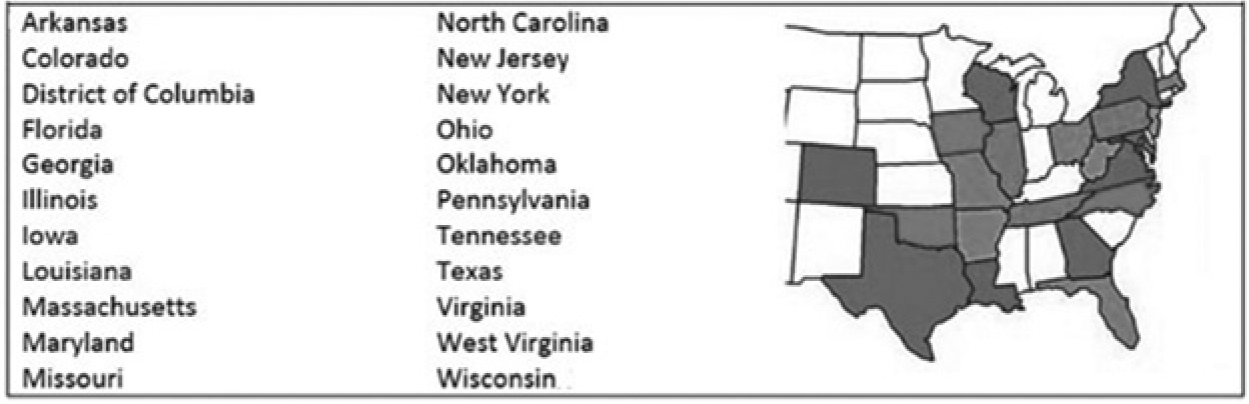
Locations of survey participants.
With regard to the educational level of respondents, all but eight held a bachelor’s degree or higher, as shown inTable 1. Of these eight, three were owners of their own businesses. The majority of participants are currently employed, and those who are not currently employed have been recently in the workforce.
Educational Level of Participants.

Participants in the survey were employed in a wide range of industry types. In addition, there was a wide range in company size based on the number of people employed in the companies. The breakdown of company size by employees is provided inTable 2.
Company Size of Survey Participants.

Note. Size based on number of employees.
As shown inTable 2, 38.9% of the respondents worked for companies with fewer than 100 employees, and 39.3% worked for companies with more than 1,000 employees.
Results of the Survey
Participants were asked, “Which of the following communication technologies does your business or do you personally utilize?” Among the items listed were Facebook and Twitter. By virtue of the fact that participants were recruited using LinkedIn databases, 100% of the respondents had some use of social networking. Further survey questions provided additional information regarding how social media was used by the participants.
Social Media Business Use
When responding to whether the business they worked for had a social networking site, 73.3% responded yes. This is slightly less than the 80% reported by InSites Consulting (Van Belleghem & Pallini, 2012). When looking at the responses based on number of employees, those working in companies with 1 to 50 employees reported the highest percentage (80.6%) of having a business social networking site, as shown inTable 3.
Survey Participants Reporting Facebook Page by Company Size.
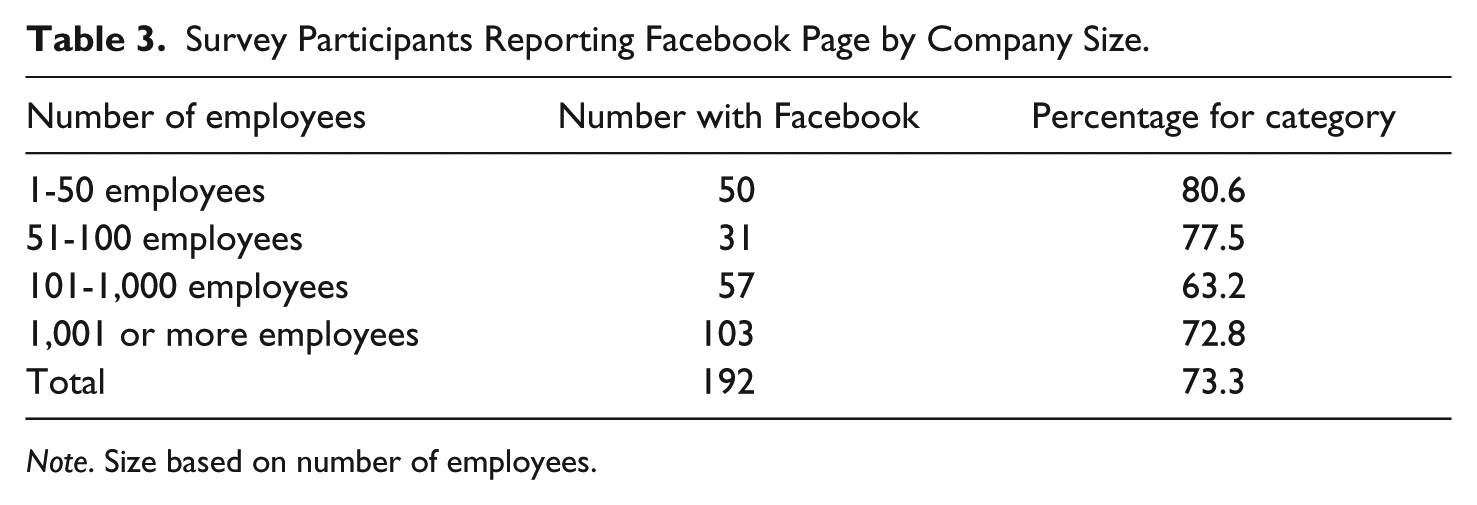
Note. Size based on number of employees.
There were 35.9% reporting that the company they worked for had a Twitter account. As shown inTable 4, the lowest percentage reported was from companies with 101 to 1,000 employees, and the highest percentage was from companies with 51 to 100 employees. This number was lower than the 45% previously reported byVan Belleghem and Pallini (2012).
Survey Participants Reporting Business Twitter Accounts by Company Size.
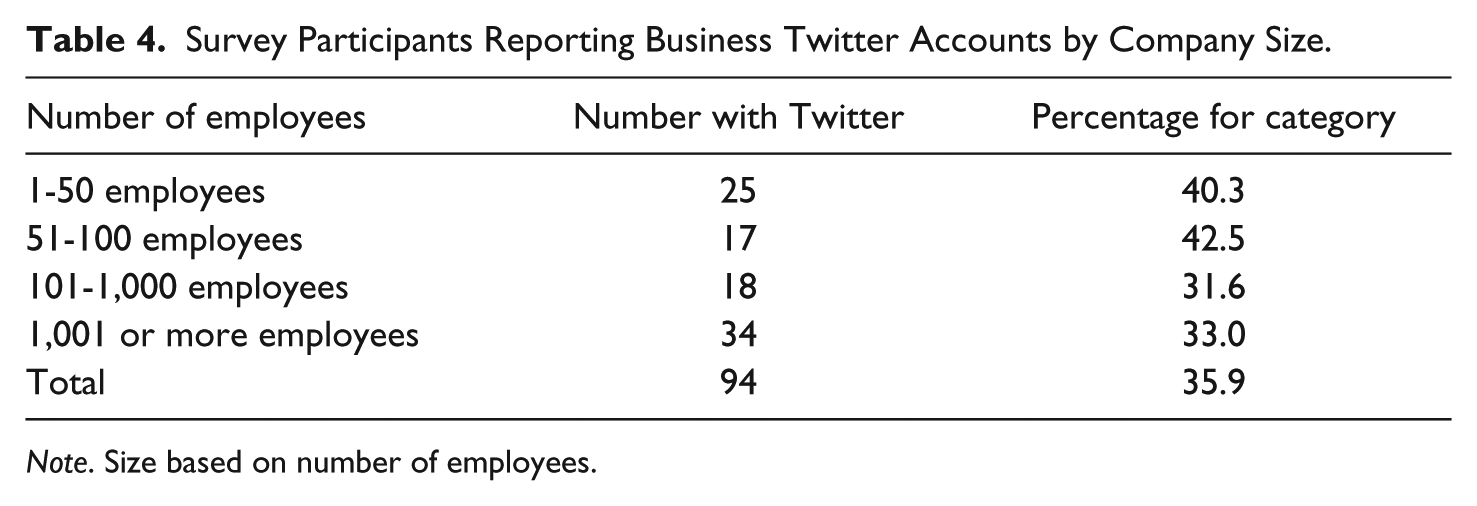
Note. Size based on number of employees.
For the two social media technologies, regardless of company size (number of employees), Facebook is by far more commonly used by companies than Twitter, based on the current research data as shown inFigure 2. Though both numbers for Facebook and Twitter use were slightly lower in the survey data for the current study as compared with the study by InSites (Van Belleghem & Pallini, 2012), they still follow the same trend (Facebook adoption is greater than Twitter). This does not, however, coincide with the results reported forFortune500 companies by a previously cited study showing Twitter use higher (77%) than Facebook use (70%;Barnes et al., 2013). One source of this discrepancy may involve the size of the companies surveyed.Van Belleghem and Pallini (2012)provided no detailed breakdown by company size.
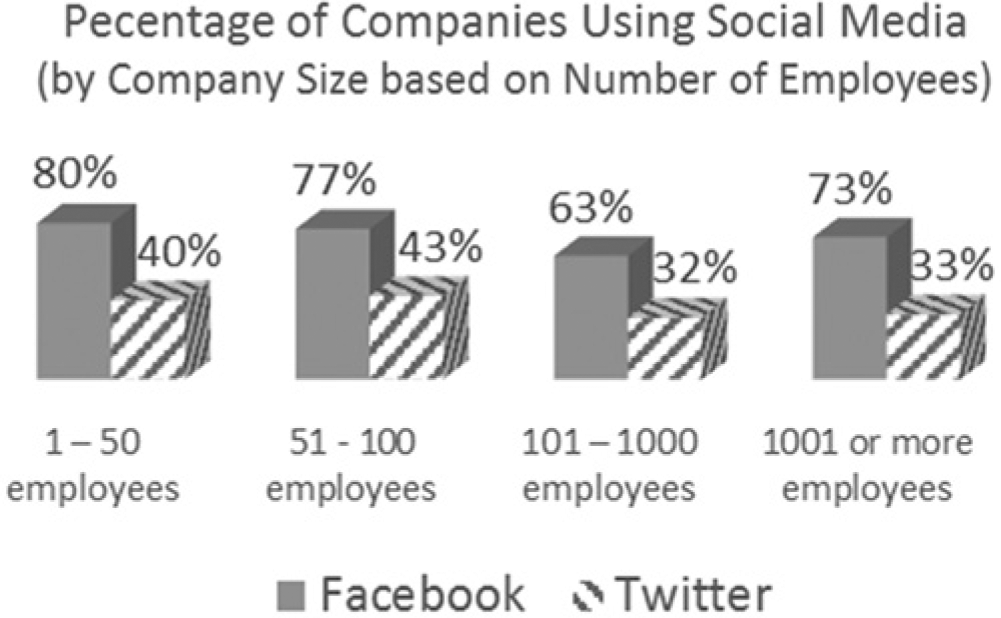
Social media use by company size.
Though a substantial percentage (73.3%) of total respondents indicated that their place of employment has a social network page, the number of the respondents who were actually responsible for those posts was much smaller. There were 44% who reported making posts for their organization. There were 35.9% of respondents indicating that their place of employment has a Twitter account for their business. However, only 20.2% reported making these Twitter postings for their organizations themselves.
Another question posed on the survey was: “When looking at the level of use, how many of each of the following would you estimate that you initiate?” Again, the items listed included Facebook and Twitter. The choices ranged from fewer than three per month to more than four per day. Of the 105 participants who indicated they make Facebook posts on behalf of their company, 57% of those indicated they made more than four posts per day, and 35% indicated they made fewer than three posts per month with the remaining percentage falling in the fewer than three per week or fewer than three per day categories. Fifty-three of 262 (20.2%) respondents indicated they made Twitter postings or tweets for their company. Of this group, 47% indicated they made more than four posts per day, and 28% indicated they made fewer than three posts per month with the remaining percentage falling in the fewer than three per week or fewer than three per day categories.
Social Media Personal Use
In addition to looking at the business use of social media, participants were also asked to indicate their personal usage for the same technologies. For both Facebook and Twitter, the percentage of personal use was higher than that of business use. Personal use of social network sites was 100% (with LinkedIn included) compared with 73.3% for business use. For Twitter, the percentage of respondents reporting personal use was 40.5% compared with those with business accounts being 35.9%.
Implications of Social Media Use
Regardless of the statistics examined, it is clear from survey data that social media use is prevalent in both business and personal lives. Millions of posts and tweets occur every day from millions of users. It only takes one ill-worded or ill-timed post to create a company nightmare, so the sheer number of employees using social media opens a floodgate of opportunities for disaster. In most organizations there is a designated employee(s) responsible for the “official” posts of an organization. This does not always offer any degree of protection, as even well-meaning employees, official or not, can make posts that have devastating effects. Sometimes these effects come not in the form of legal liability, but in marketing and public relations nightmares. For example, having a topic “trending” in Twitter can be a great boost in visibility. Trending (determined on Twitter by an algorithm) means that the topic is popular and is being discussed heavily in a specific time period. However, in the wake of the mass shooting tragedy in Aurora, Colorado, online retailerCelebBoutique.comtweeted on its official account “#Aurora is trending, clearly about our Kim K inspired #Aurora dress;)” followed by a link to the product web page (Golijan, 2012). This offensive tweet created widespread negative publicity for this retailer, but not legal liability. However, other business uses of social media may result in adverse legal effects from private parties or even the government. Being aware of these legal implications of social media use can help organizations more carefully and effectively use the potential of this powerful communication tool.
Possible Legal Liabilities From Social Media Use
There are numerous ways in which employers risk legal liability due to employees’ use of social media. Mitigating this liability and monitoring employee conduct is made far more difficult by the fact that most employees now have multiple personal electronic communication devices from which they can access and interact with their, or the company’s, social media accounts. Some of these legal risks, such as general tort liability for an employee’s conduct, are relatively well known and mirror the types of risks that employers have commonly dealt with for quite some time. However, there are other legal risks arising from employee use of personal electronic communication devices that are not obvious and can be difficult to account for in a traditional employee policy and monitoring framework.
General Tort Liability
Because social media represents such an attractive marketing opportunity, more and more companies are maintaining an official company social media presence on websites such as Twitter and Facebook. Based on the tort law principle ofrespondeat superior, a company will generally be liable for any torts—civil wrongs for which there are legal remedies (Garner, 1999)—committed by its employees in the course of managing these social media efforts on behalf of the company. This is the case whether an employee is managing a company social media page while at work or managing it outside of the workplace via a personal electronic communication device (Zion, 2002). For example, if the employee commits defamation, fraud, deceptive advertising, or any other tort in the course of managing the company’s social media efforts, the company can be held liable. This type of legal liability does not deviate significantly from the general tort liability that any company can incur through employees’ acts, but the fact that employees can incur this liability around the clock via their own personal electronic communication device widens the scope of harm to the employer and makes monitoring employees more difficult.
Employee Endorsements on Social Media
Another potential area of legal liability is employee endorsement of products or services via social media. Part of the allure of advertising via social media is not only the large number of users who can be reached but also that it allows for customer feedback or interaction with the company regarding its products or services. While this can be an effective means of building a rapport with customers, it can also be an area of unexpected legal liability. The Federal Communication Commission regulates the endorsement of products or services (Guides Concerning Use of Endorsements and Testimonials in Advertising, 2013). This includes endorsements made by a company’s own employees. If employees endorse their employer’s products or services, they are required to disclose their employment connection in the endorsement. Federal Communication Commission regulations expressly state that this includes endorsements via social media in the following example: Example 8: An online message board designated for discussions of new music download technology is frequented by MP3 player enthusiasts. They exchange information about new products, utilities, and the functionality of numerous playback devices. Unbeknownst to the message board community, an employee of a leading playback device manufacturer has been posting messages on the discussion board promoting the manufacturer’s product. Knowledge of this poster’s employment likely would affect the weight or credibility of her endorsement. Therefore, the poster should clearly and conspicuously disclose her relationship to the manufacturer to members and readers of the message board. (Guides Concerning Use of Endorsements and Testimonials in Advertising, 2013)
Endorsements such as these can subject both the endorser (the employee) as well as the employer whose products are being endorsed to legal liability. Thus, employees must be cautioned that if they post any online endorsement or review of company offerings, they must fully disclose their connection with the company. This liability can attach to endorsements made via the company’s own social media sites, through the employee’s personal social media sites, or through a third party’s website. Additionally, liability can attach even if the endorsement is made off-hours using the employee’s own personal electronic communication device (Guides Concerning Use of Endorsements and Testimonials in Advertising, 2013).
Online Employee Speech Protected by Labor Laws
Not only can employee social media use directly create liability for employers, but employer attempts to restrict employees from speaking online may also result in adverse legal action. Many companies understandably seek to restrain employees from discussing work matters, particularly negative issues or conflicts at work, via social media. People tend to use their social media accounts as a place to vent their workplace frustrations, and employers would rather resolve these matters in-house instead of in a public forum online. This is particularly the case when the worker complaint may involve discriminatory conduct or other employment law issues that are better addressed through formal complaint resolution procedures. Accordingly, many employer social media policies contain restrictions against employees discussing internal company matters or painting the company in a negative light online (Kearney, 2012). However, blanket restrictions on such speech can expose employers to legal liability for violations of federal labor laws.
Federal law has long protected employees’ rights to discuss work related matters, particularly discussions that can be construed as concerted action by employees to improve wages or working conditions. The National Labor Relations Board (NLRB) in recent rulings (Hispanics United of Buffalo, Inc., 2012) and advisory opinions has cautioned companies against overly broad restrictions on employee speech through social media, as such restrictions may violate these laws (Kearney, 2012). Since communication via personal electronic communication devices and social media is now so prevalent, the NLRB has held that employee discussions in this channel are afforded the same protections as traditional face-to-face communications held by union workers. However, employers do have the right to restrict negative employee speech online when it is simply complaining or ranting about the company (Kearney, 2012). The line between the two is not entirely clear, and employers find themselves in the difficult position of crafting a social media policy that is broad enough to protect the company from the potential negative legal and business consequences of employees publicly airing their grievances, but also narrow enough to allow employees to exercise their rights to discuss working conditions.
For example, in the case ofHispanics United of Buffalo and Carlos Ortiz, Lydia Cruz-Moore, an employee of Hispanics United of Buffalo (Hispanics United), was known for being very critical of other employees (Kearney, 2012). Cruz-Moore texted a coworker, Marianna Cole-Rivera, on a non-work day to inform Cole-Rivera that she intended to report her concerns about her performance to the Executive Director of Hispanics United. Cole-Rivera decided to post about the issue on Facebook, stating, “Lydia Cruz, a co-worker, feels that we don’t help our clients enough at [Hispanics United]. I about had it! My fellow coworkers, how do u feel?” (Kearney, 2012). Four other off-duty employees responded on Facebook, via their own personal computers, generally objecting to Cruz-Moore’s assertions regarding their work. Cruz-Moore also responded to the post, claiming that it was a lie, and then complained to Hispanic United’s Executive Director. Hispanics United discharged Cole-Rivera and her four coworkers on the basis that their posts violated the company’s bullying and harassment policy.
In this case, the NLRB held that the postings on Facebook constituted concerted action between employees and thus were protected under federal law. Accordingly, the NLRB ruled that the termination of the employees was improper (Hispanics United of Buffalo, Inc., 2012). This was in spite of the fact that neither the initial posts nor its responses called for any particular action with respect to the work issues, and consisted generally of complaints about work. Because the complaints were in response to another worker and were about working conditions, terminating the employees was an improper retaliation against concerted action. However, the NLRB has stated in advisory memos that employers can have policies that restrict employees from posting harassing or discriminatory remarks via social media provided that their restrictions are tailored to avoid restricting protected concerted action (Kearney, 2012). The NLRB’s guidance on this issue advises companies that their social media policies must be specific enough that they advise employees of what conduct is restricted without restricting conduct that could reasonably be construed as protected concerted action between employees.
Guarding against this risk is somewhat difficult, as employers must walk a tightrope when policing employees’ negative online speech about the company or work in general. Employers clearly have an interest in trying to limit employees from criticizing the company or working conditions to a public audience, which the NLRB acknowledges, but this interest must give way to employees’ rights to communicate with each other regarding the workplace. However, when drafting a social media policy or disciplining employees, many employers likely do not think about their policies infringing on these rights, as they are more closely related in most minds to formal union action. Now that many employees rely heavily on personal electronic communication devices and social media networks to communicate, the forum for concerted action has moved from the physical to the virtual world, and employment policies must adapt accordingly. Walking this tightrope requires careful and thoughtful implementation of a social media policy so that employees are apprised of when their online complaints can result in termination or when they will be protected.
Disclosure of Proprietary, Confidential, or Material Information
Another area of legal risk that can catch employers unawares is the disclosure or dissemination of proprietary, confidential, or material information online. Because employees have ubiquitous access to social media via personal electronic communication devices, organizations are subject to the ever-present potential for leaks of proprietary and confidential information by low-level employees as well as executives and board members. Additionally, there are some types of information which to many employees seem innoucuous to disclose online but when publicly disclosed can result in a business loss or legal liability.
Trade secret law is one of the most common and well-known areas of the law where protection of confidential information is critical. A company maintains intellectual property rights in their trade secrets only as long as they take reasonable precautions to keep them secret. If an employee discloses them online, either inadvertently or intentionally, the company risks losing their intellectual property rights in the trade secret (Foster & Greene, 2012). This risk should be well known and appreciated by organizations that are reliant on the value of their trade secrets, and the usual precautions companies put in place to protect trade secrets have the same applicability to the online world. The risk of the disclosure on social media via a personal electronic communication device or otherwise should not be significantly more difficult to manage than what companies previously incurred, as long as only the employees who “need to know” have access to the trade secret, know of their obligation to keep it confidential, and have executed confidentiality agreements requiring them to keep the trade secret confidential.
Perhaps more worrisome is the potential for the disclosure of information that creates legal liability when the employee does not recognize or understand the risk inherent in its disclosure. A particular example of this is the area of securities law. If a company is publicly traded, the release and use of “material” information related to that company is highly regulated by the Securities and Exchange Commission (SEC). For example, the release of false material information with the intent to influence the trading of a company’s stock can lead to securities fraud charges (General Rules and Regulations, Securities Exchange Act of 1934, 2013). Additionally, Regulation FD (Fair Disclosure) requires that any material information that is disclosed must be publicly disclosed such that it is available to all members of the public at the same time, not selectively disclosed to certain parties (General Rule Regarding Selective Disclosure, 2013).
These and other securities regulations can be difficult to explain to employees because securities laws are complex, and what information will be considered “material” is not always readily apparent. Information is considered “material” if there is a substantial likelihood that a reasonable investor would consider it significant to their investment decisions ( Basic Inc. v. Levinson, 1988). When most people think of the disclosure of material information, they think of the disclosure of financial metrics or earnings. However, information can be considered material even if it is not a direct disclosure of financial information, and an innocent “tweet” or online Facebook posting of fairly innocuous information can lead to legal liability.
A recent occurrence with Reed Hastings, the CEO of Netflix, Inc., highlights how liability can be created in this manner. Hastings posted on his Facebook page that Netflix users were viewing “nearly a billion hours per month” of video on Netflix (Netflix 8-K, 2012). Shortly after this posting was made, there was upward movement in the stock price of Netflix, which is publicly traded. This led to the SEC investigating the matter as a potential violation of Regulation FD. The SEC contended that the post by Hastings’s was material, and was selectively disclosed only to Hasting’s Facebook followers, and not to the public at large, thus violating Regulation FD (SEC Report of Investigation, 2013). Netflix countered that the information was not material to investors; that the Facebook account on which the information was posted had approximately 200,000 followers, so the disclosure was public; that the information was already known to the public via a previous blog post; and that the uptick in price on the day of the posting was more likely due to a positive analyst report, not the Facebook posting (Netflix 8-K, 2012). Ultimately the SEC, while not admitting that Netflix did not violate Regulation FD, decided not to bring an enforcement action (SEC Report of Investigation, 2013). However, Netflix still incurred the legal expenses and public image problems associated with dealing with the SEC’s investigation.
This Netflix case highlights the difficulty in protecting against this type of legal liability; the information that was disclosed is arguably not the type of information that most people would be the least bit concerned with posting online. It was not negative, discriminatory, inflammatory, or of a financial nature. The disclosure did not come from a rogue or low-level employee; the information was disclosed by the company’s chief executive officer. As personal electronic communication devices and social media become more and more a part of our daily lives, organizations now must be wary that even well-educated, upper-level management employees can easily and inadvertently create legal liability for the company. Because the definition of materiality under the securities laws is quite broad, every public company has a virtually infinite number of potential leaks of material information in the form of employees and their personal electronic communication devices. When information as innocuous as this can lead to legal liability, crafting a policy that adequately conveys to employees what information can and cannot be publicly disclosed requires significant communicative effort.
Policies for Social Media Use for Organizations to Consider
Despite the proliferation of social media in society and the workplace and the possible legal issues that can accompany its use, data indicate few employers have a policy governing social media access and usage. Information on social media policies compiled by Cisco indicated “only about one in five employers have a policy” (Lyncheski, 2010, p. 32). More recently, a 2011 survey of 141 public and private companies indicated that “more than three-quarters (76%) of companies do not have a social media policy” (Thompson, Hertzberg, & Sullivan, 2011, p. 1).Grant (2012)noted that this lack of social media policies is particularly disheartening because “having a good set of social media policies is one way . . . to empower employees to act” (p. 1). This lack of social media policies—and subsequent lack of management of social media—is evident despite the fact that social media “represents a fundamental shift in how companies do business, how consumers interact with them, and how a brand’s voice is established in a new marketplace” (Barone, 2011, p. 76).
One potential solution to this problem is simply banning employee use of social media in the workplace. Though this is certainly within the realm of a business’s authority, such a ban could have a negative impact on morale and would be difficult to regulate (Dryer, 2010). Indeed, there are people in segments of society who rely on social media as much as their predecessors relied on books and telephones. Additionally, because social media use by employees on their own time can still subject employers to potential legal liability, an outright ban still leaves significant risk for the company. Organizations are advised by legal experts that a better course of action is to develop a policy that clarifies for employees the boundaries of social media participation (Dryer, 2010). Just as a business plan is essential to a successful company, a social media policy is essential to serve as a roadmap for employee use of social media (Barone, 2011).
As previously stated, very few people have had formal training in the use of social media communication channels.McEachern (2011)pointed out that although students may be highly competent in their use of social media for their own personal uses, that competence is likely not the same as they will need in a professional arena. Additionally, because social media use is more heavily concentrated in younger members of the population (Duggan & Brenner, 2013), many employees already in the workforce have even less experience using social media than these students. However, while there seems to be a consensus, if not unanimous, view recommending the use of social media policies in organizations, there are divergent views with respect to the scope and content of a good social media policy.
According to D. Pope (personal e-mail communication, April 3, 2013), who serves as an employment and human resources counsel for businesses, organizations, and governmental agencies, While there are laws and other legal concerns employers should be aware of, employers should also remember that social media is about developing community and organic, two-way communication with customers. Putting too many restrictions in a social media policy shows a lack of trust in your employees and is a fundamental failure in understanding and harnessing this communication medium.
As an attorney who deals with the legalities of social media use, he says, “One of the best policies I’ve seen simply stated, ‘Be professional. Represent us well.’”
Though most may think a simple statement like that should suffice, the effectiveness of such a statement might then hinge on a subjective definition of “professional.” This may be why, contrary to this advice, the NLRB suggests that companies use more specifics in their policies to provide better guidance for employees and to avoid any potential violations of the federal labor laws previously discussed (Greenhouse, 2013). Indeed, there are numerous publicly available resources, including sample policies, providing information and advice regarding what legal issues should be covered in a social media policy. Several examples of such resources can be found athttp://socialmediagovernance.com/policies.phpandhttp://davefleet.com/2010/07/57-social-media-policy-examples-resources/.
While extensive resources and assistance can be found in drafting a policy, the “rules” set forth in any social media policy will not be of much use if employees do not know they exist or do not understand or follow them. Accordingly, regardless of the breadth of legal issues an organization chooses to address in its social media policy, the more critical issue is that these issues be addressed in a way that employees are likely to understand, retain, and utilize the information the policy presents. In spite of this fact, human resource and compliance professionals will find little specific guidance in either practical or academic literature regarding how best to communicate social media policies to employees such that they are actually understood and followed.
Conclusions and Recommendations
As noted previously, we as humans are compelled to share our storied lives with others, and we tend to better understand and retain information when it is conveyed through stories (Barker & Gower, 2010). Barker and Gower previously advocated the use of stories in business communication, which they refer to as the storytelling model of organizational communication (STMOC).Morgan and Dennehy (1997)asserted that information that is presented in the form of stories is more believable and memorable, noting, “Each listener sees himself/herself in a story and unconsciously relates it to his/her own experience, asking questions such as ‘When did something like that happen to me?’” (p. 495).
The authors of this article advocate a narrow application of STMOC and recommend that employers make strategic use of the power of story in their social media training and policies. Using stories and examples, whether through a policy or through employee training, is a much better mechanism to inform employees of what they can and cannot do via social media than simply giving them a document with a list of hard-to-understand rules. This is particularly important because, as previously noted, some legal violations that can occur through social media are not easily conveyed to employees because they are so innocuous.
For example, if a company wishes to advise employees not to violate federal securities laws, then they can easily include such a provision in their social media policy. However, if the provision simply advises employees not to disclose any nonpublic, material information via social media, employees are unlikely to fully understand what information will be considered material such that it cannot be discussed online. Even if the legal definition of materiality is explained in the policy, given the breadth of the definition, employees are still unlikely to fully grasp what they can or cannot post about. A potential remedy to this problem is to simply have a policy that restricts employees from discussing any work-related matters online. However, the NLRB has stated that such broad policies run afoul of federal labor laws, as previously discussed herein.
The authors propose that the better course of action is to use storytelling in the policy, either through real-world or contrived examples that illustrate to employees situations where the policy could potentially be violated. In the above example, rather than merely stating the rule regarding disclosure of information, the policy can explain how broad the standard of “materiality” can be, and provide the recent example of Netflix, previously discussed herein. Since most employees will be familiar with a large, popular company like Netflix, this story provides employees with a vivid, easily remembered example of how fairly innocuous information can be considered material. This story should be all the more compelling to employees because the CEO created the problem. Who, in their heart of hearts, does not want occasionally to be the one to point out that the emperor is not wearing any clothes? Given this information in a story, employees are more likely to retain and internalize it, and hopefully seek counsel from experienced compliance personnel before posting potentially infringing information online. While no policy will be 100% effective, using the STMOC in social media policies and training will increase the likelihood of employee retention and follow through. Social media may have come to businesses as a wondrous, beautifully wrapped gift. However, it did not come with the same “Do Not Open” warning provided with Pandora’s Box. Social media users do not always realize the consequences of their actions and the escalating repercussions that can ensue. With no such warning, this virtual Pandora’s Box has already been opened, and a host of new trials and tribulations have been unleashed. According toClipson, Wilson, and DuFrene (2012), “Social networking affects nearly every aspect of life: education, communication, employment, social relationships, and personal productivity” (p. 66).
Social media use is firmly rooted in the culture of both individuals and companies. It is another means by which humans may connect through communication and/or storytelling while simultaneously creating rhetoric that may conflict with the corporate vision and its supporters, both inside and outside the organization (Cragan & Shields, 1999). As organizations attempt to harness and control this burgeoning new form of communication, there must be some degree of trust between employees and organizations with respect to the use of social media. However, organizational policies must also take into account the fact that many potential legal violations through social media can be difficult to understand and grasp.
Another important application of storytelling as a channel for introducing complex topics related to social media use and misuse in a business context is as a topic of study in the business communication classroom. Students who may be highly proficient in using social media may be surprisingly uninformed about ramifications of careless use of social media in the workplace. Students generally view social mediaonlyas a treasure and not a potential hazard. The classroom offers a safe environment for students to gain understanding of the potentially negative ramifications of careless use of social media when they become part of the workforce. Responding to case studies, conducting in-class discussions, and interviewing experts in the workplace are all possible methods for broadening students’ perspectives of social media.
We recommend storytelling as a communication tool to bridge these gaps in understanding both in business and in the business communication classroom. Storytelling provides compliance information in a way that is easily understood and is more likely to build a rapport between employees and the organization through shared stories. The last thing to fly from Pandora’s opened box was hope. The “hope” included in the virtual Pandora’s Box may come for organizations in the form of the easy and immediate communication provided by social media. However, effective policies and training are necessary for organizations to fully use these benefits of social media.
Footnotes
Declaration of Conflicting Interests
The author(s) declared no potential conflicts of interest with respect to the research, authorship, and/or publication of this article.
Funding
The authors disclosed receipt of the following financial support for the research, authorship, and/or publication of this article: The data collection used in this study was partially funded by a C. R. Anderson Grant from the Association for Business Communication.
Author Biographies