




Abstract
This nationwide study of 169 business communication instructors examines the following issues: (a) ideal and actual class sizes in business communication courses, (b) delivery modes of business communication courses, (c) types of written and oral assignments, and (d) topics covered and depth of coverage. Findings suggest that business communication course offerings are growing on the national stage. The vast majority of class sizes have stayed the same or gotten smaller. One significant change over the past 5 years is the increased focus on interpersonal communication and teamwork. While some courses offer significant coverage of social media, the majority does not.
Keywords
For the past 40 years, nationwide audits of the business communication course have been conducted roughly every 5 to 10 years. With the most recent national audit roughly 5 years old (Russ, 2009), this nationwide study of 169 business communication instructors is the latest of these studies to provide current information about the state of the business communication course and business communication instructors.
Our focus here is exclusively on the content of business communication classes, their size, and how they are taught and by whom. Furthermore, because our focus is on the content of classes and not the field of study, we use business communication to include similar classes, such asmanagement communicationandprofessional communication, which cover the basic communication skills for undergraduate students to succeed in business environments (Shelby, 1993).
By providing up-to-date information about class size, modes of class delivery, types and number of assignments, and depth of coverage of various topics, this study equips business communication instructors with a sense of how to develop their courses for the upcoming years. It also equips administrators with the knowledge needed to make more informed decisions about business communication courses and instructors.
Background and Literature Review
The business communication course has undergone many changes during the past 40 years, and periodic national audits and evaluations of the course have helped identify best practices and trends (David, 1982;Glassman & Farley, 1979;Knight, 1999;Nelson, Luse, & DuFrene, 1992;Nixon & West, 1993;Ober, 1987;Ober & Wunsch, 1983,1991,1995;Persing, Drew, Bachman, Eaton, & Galbraith, 1976;Russ, 2009;Sharp & Brumberger, 2013;Wardrope, 2002;Wardrope & Bayless, 1999). The most recent national study of the business communication course wasRuss’s (2009)study from 5 years ago.
Initial audits of the business communication course from 30 to 40 years ago showed that the business communication course provided comprehensive coverage of business writing, moderate coverage of interpersonal communication, and relatively light coverage of speeches and presentations. The most common types of business writing assignments involved reports and résumés. As far as format, these courses also emphasized letter and memo writing (Glassman & Farley, 1979;Ober & Wunsch, 1983;Persing et al., 1976). One legacy of the business communication course was the central focus on business writing. One metric of the intensive writing nature of this course is that the average and median number of written assignments during a course was generally around 10 assignments (David, 1982;Ober & Wunsch, 1983).
About 25 years ago,Nelson et al. (1992)showed that the course still contained comprehensive coverage of business writing, a slight shift to more coverage of oral presentations, and less coverage of interpersonal communication. About 15 years ago,Wardrope and Bayless (1999)further documented this change, revealing that a typical business communication course covered written communication and employment communication heavily. Coverage of oral presentations followed next, and team communication was mentioned.
However, they found that most business communication courses offered relatively little coverage of this topic. They also showed that, in addition to report and résumé writing, good news/positive messages, bad news/negative messages, and persuasive messages received extensive coverage. About 5 years ago,Russ (2009)showed that business writing and business speaking and presenting received the most coverage, closely followed by employment communication. Interpersonal communication received moderate coverage, followed slightly by team communication. The most common formats for written assignments were reports, letters, memos, and résumés.
Overall, these various audits indicate a course that has always provided comprehensive coverage of business writing, with an emphasis on reports, letters, and memos. Initially, the focus of writing was primarily reports and résumés. Over time, the course has evolved into providing extensive coverage of other types of messages, including routine/positive messages, persuasive messages, and negative/bad-news messages. Business presentations have increasingly received extensive coverage in most of these courses. In recent years, some topics have garnered slight to moderate coverage, including team communication, interpersonal communication, and intercultural communication.
SinceRuss’s (2009)study, the following factors may have strongly affected business communication courses: (a) the Great Recession and its impacts on university budgets, (b) the growth of online course offerings, and (c) the increased use of social media for business communication. This study was originally conceptualized by the first author because of his interactions with university administrators about class size in business communication courses. In 2008, the business communication course at his institution had about 180 students. In spring of 2013, almost 400 students were enrolled in the same class. Equipped withRuss’s (2009)study, he showed administrators that 98% of business communication classes had fewer than 50 students. A university official responded that the data were dated, and surely the financial crisis of 2008 had resulted in much larger classes.
This was an intriguing question that needed to be answered. It is true that at the height of financial crisis, many educational institutions were affected. While the impact was most severe at the K-12 level with 62% of districts reporting increases in class sizes (Shambaugh, Kitmitto, Parrish, Arellanes, & Nakashima, 2011), public universities and community colleges were also affected (Werly, 2011).
A survey of 188 public universities in November of 2009 reported that nearly half of the universities were experiencing cuts in state support that were greater than 10% (Serwach, Flood, Rechnitzer, & Stasinski, 2009). In California, where the first author’s public institution is located, 26% of the state’s budget is composed of funds that are called Core Funds. Core Funds directly support the system’s instructional programs and rely on state funding for 50% of its resources. In 2009-2010, the University of California system faced a 20% reduction in state funds or approximately 813 million dollars (O’Leary, 2009).
The impact of these cuts was indeed hurting the University of California system. Its 10 campuses were operating at budget levels of 1997 while accommodating 75,000 more students (Medina, 2012). However, the mere fact of reduced state support does not necessarily imply a large increase in class sizes. For instance, at University of California, Los Angeles, the increase in student enrollment began to outpace state support well before the financial crisis of 2008, but the resulting increase in average class size was only about 20% (O’Leary, 2009).
Abundant literature from around the world shows that large class sizes present quite a few pedagogical, management related, and affective challenges for instructors and students alike and reduce students’ learning outcomes. Negative outcomes of large class sizes include inadequate physical space, difficulty in discipline, lack of individualized attention, difficulty of evaluation, and lessened learning effectiveness (Bressoux, Kramarz, & Prost, 2009;Felder, 1997;Kewaza & Welch, 2013;LoCastro, 1989,2001).
Once the first author decided to examine the nature of class size in business communication courses nationally, he decided to address other aspects of business communication courses in prior nationwide studies over the course of the last four decades, including (a) ideal and actual class sizes in business communication courses, (b) delivery modes of business communication courses, (c) types of written and oral assignments, and (d) topics covered and depth of coverage.
Method
The first author initially developed the study to examine class sizes and other constraints for business communication instructors. After the second author joined the project, the study focused on other areas as well. Ultimately, we developed a survey that addressed the following: (a) ideal and actual class sizes in business communication courses, (b) delivery modes of business communication courses, (c) types of written and oral assignments, (d) topics covered and depth of coverage, and (e) position type and teaching tenure of business communication instructors. Although we did not set out to exactly replicateRuss’s (2009)study, and indeed some of our categories and terms are different, our questionnaire did cover many of the same topics. Hence, the findings of this article do draw some parallels and contrasts with the 2009 study.
An initial pilot survey was developed in May 2013 and sent to 25 business communication instructors who had attended a faculty development workshop in April 2013. After reviewing the comments, the authors then designed a much larger questionnaire and began compiling a national list of teachers and practitioners of management communication (see theAppendixwith a list of survey items). By late July, the questionnaire was finalized and a list of approximately 1,200 individuals was compiled. We used two sources for developing a list of business communication instructors: a list from the Association for Business Communication (ABC) website and a list developed by the researchers. This second list was compiled from a nationwide list of names of teachers of business communication that had been gathered by publishers. The authors cross-referenced both lists and removed duplicates.
A pilot batch of emails with a link to the online survey was sent to 100 instructors on the list in late July 2013. The survey instrument appeared to be working effectively, so the remaining 1,100 instructors on the list were sent for the online survey during the next few weeks. Ultimately, we received 169 responses to the online survey (participation rate: 14%). Business communication has traditionally been taught across the country, been offered through a variety of colleges, and been taught by instructors of many position types (tenure track/tenured, non–tenure track, full-time professor, and adjunct professor). With participation of instructors from all U.S. states and instructors with many backgrounds (see Position Type and Experience of Business Communication Instructors section), we believe that we have captured a strong representation of business communication instruction in the United States.
Findings
We report our survey research in the following areas: (a) position type and experience of business communication instructors, (b) class size of business communication courses, (c) content of business communication courses, (d) topics and depth of coverage in business communication courses, and (e) method of delivery for business communication courses.
Position Type and Experience of Business Communication Instructors
Among our set of nationwide respondents, almost 70% teach business communication courses sponsored by business schools. Approximately 41% of business communication instructors have tenure or tenure track positions (seeTable 1), while 61% of these respondents have a doctoral degree. About 40% of these instructors teach both graduate and undergraduate courses.
Position Type of Survey Respondents.
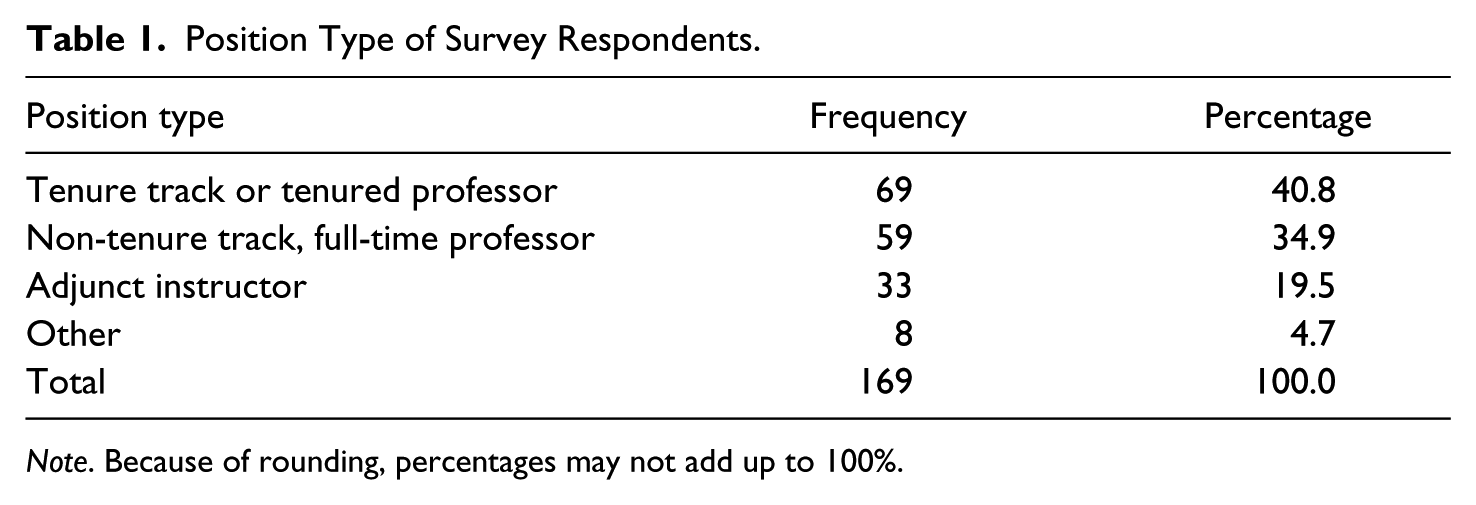
Note. Because of rounding, percentages may not add up to 100%.
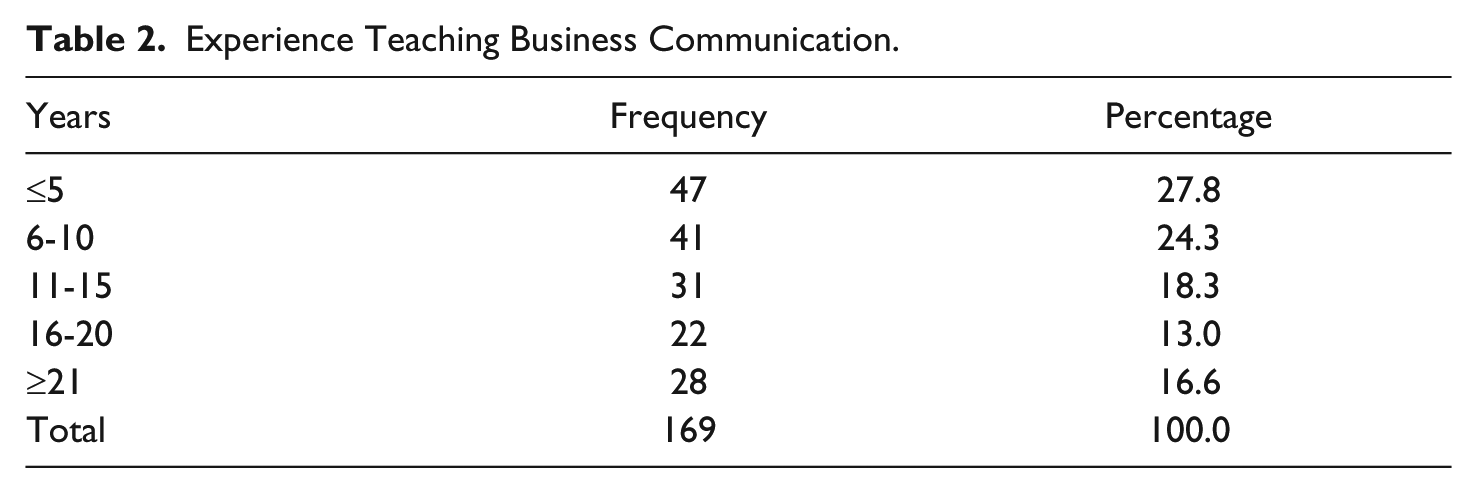
We found that our nationwide sample of business communication instructors is typically very experienced (seeTable 2). More than 72% of the instructors have been teaching more than 5 years. About a quarter of these instructors teach six or more business communication classes per year.
Experience Teaching Business Communication.
Class Size for Business Communication Courses
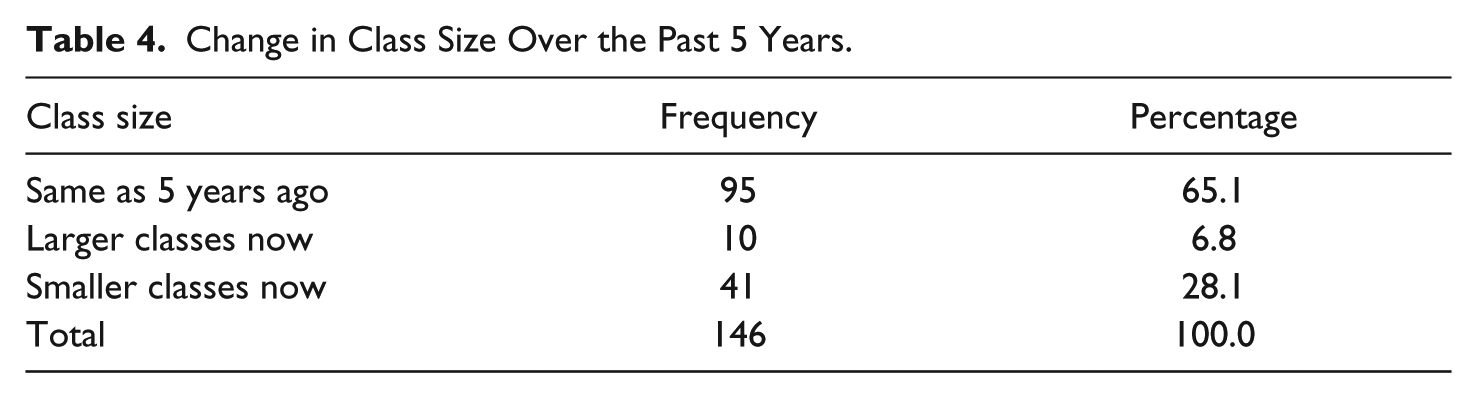
Almost all (98%) instructors believe that an ideal class should have fewer than 30 students (seeTable 3). Among instructors who have taught at least 5 years, respondents indicated that there has been little change in class sizes during the past 5 years. About 65.1% of business communication instructors say that their class sizes are the same as 5 years ago, about 28.1% say their class sizes are smaller, and 6.8% say their classes are larger. Approximately, 12.8% of business communication courses have 20 or fewer students, 36.5% have 20 to 24 students, 26.4% have 25 to 29 students, and 22.3% have 30 to 39 students. Approximately, 98% of universities have kept class sizes below 50, an identical percentage toRuss’s (2009)study 5 years ago.
Class Sizes Then and Now.
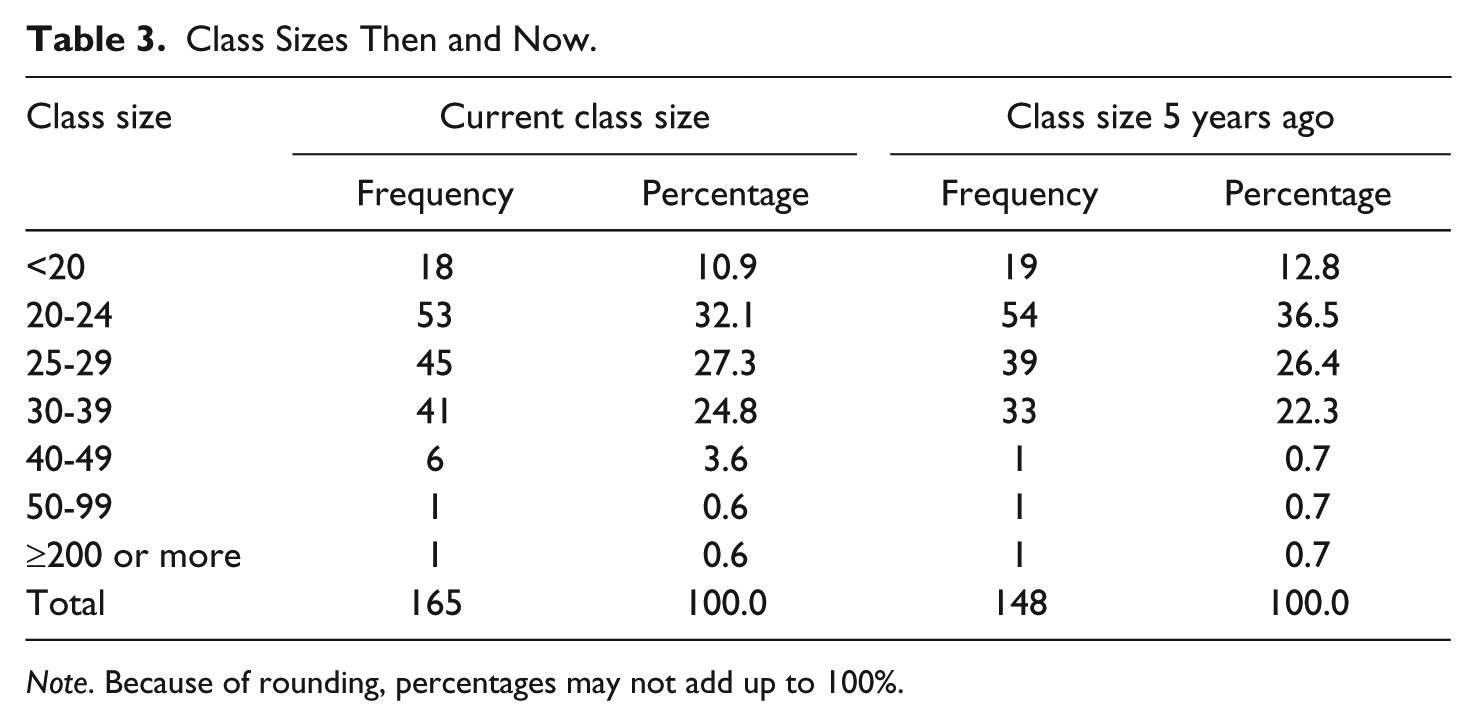
Note. Because of rounding, percentages may not add up to 100%.
So, while universities might have increased a few class size categories under 50 students by just a few percentage points, almost none have opted to go for more than 50 students. There are only 2 out of 170 respondents who have classes larger than 50 students. Finally, and this is indeed good news, almost three fourths of universities and colleges (about 74%) are offering the same number of business communication classes or are offering more business communication classes (seeTables 4and5).
Change in Class Size Over the Past 5 Years.
Recent Trends in the Number of Business Communication Courses Offered.

Content of Business Communication Courses
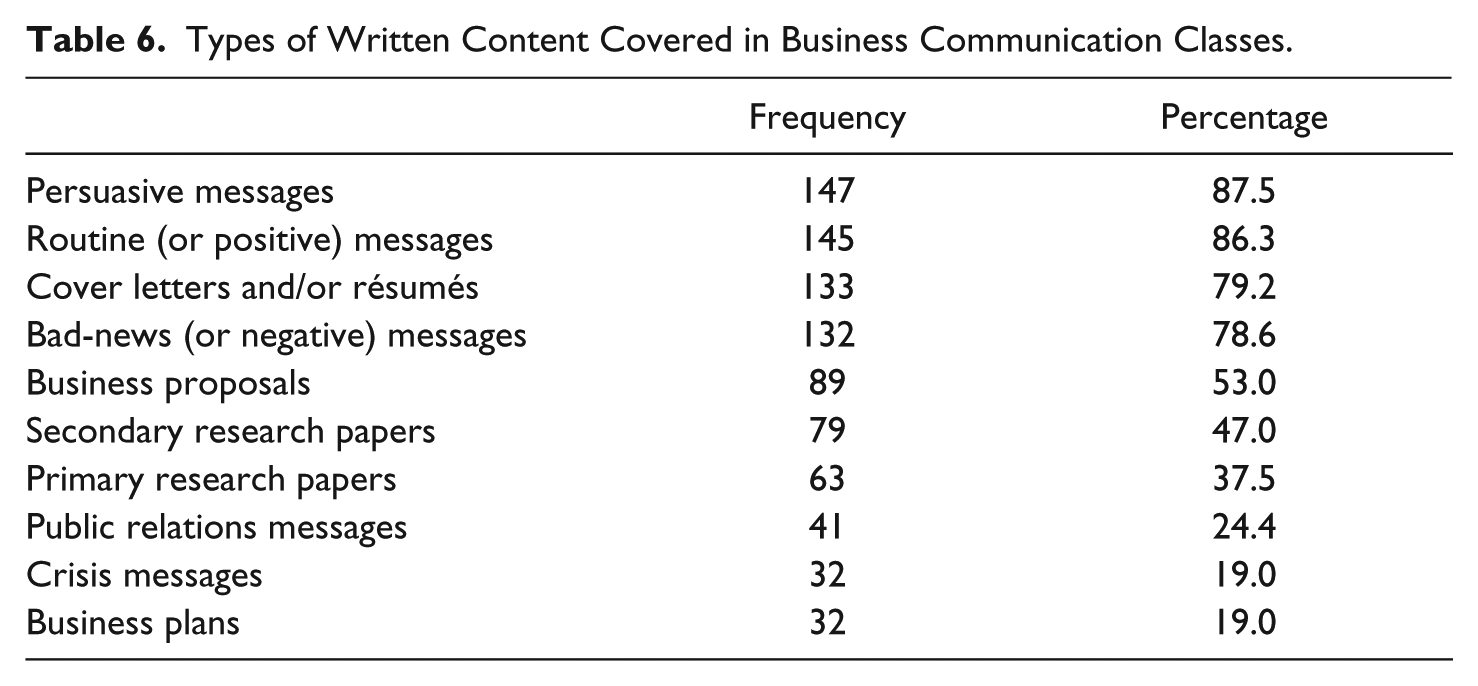
Among written assignments, the most common written assignments are the following: persuasive messages (87.5%), routine messages (86.3%), cover letters and/or résumés (79.2%), bad-news messages (78.6%), and business proposals (53.0%; seeTable 6).
Types of Written Content Covered in Business Communication Classes.
The most common formats for written assignments include the following: memos (91.1%), letters (85.7%), emails (83.9%), online discussions (38.1%), and blogs (14.9%; seeTable 7). A significant majority of instructors require their students (about 77%) to complete their written assignments in a combination of both individual and team assignments. Although fewer instructors require students to participate in team oral presentations, our data indicate that the majority of instructors (55%) do so.
Formats of Written Assignments in Business Communication Classes.

A majority of instructors (more than 55%) require eight or more written assignments and require the students to work on these assignments both individually and in teams (more than 80%).
About 40% of instructors include a research paper in their written assignments. More than 55% of instructors require one or two oral assignments as well, while a third (about 34%) requires three or more. Therefore, the picture that emerges of a typical business communication course allows the students to get extensive practice in writing and some practice in presenting materials orally.
Topics and Depth of Coverage in Business Communication Courses
The topic that received the most coverage (rated as “a lot of coverage” or “comprehensive coverage” in the survey) was business writing (92.7%). This is similar toRuss’s (2009)findings where he stated that “instructors give the most coverage to topics related to written communication” (p. 400). Similarly, business presentations, which was an important topic inRuss’s 2009study, continues to remain so with about 68% of respondents indicating that they either give a lot or comprehensive coverage to this topic. The next most common topics to receive substantial attention in business communication courses are the following: teamwork and/or team communication (63.5%), public speaking (48.7%), and interpersonal communication (46.5%; seeTable 8).
Coverage of Business Communication Topics.

Method of Delivery for Business Communication Courses
We gave the respondents the option to check any of the three available delivery methods, in class and in person, online, or hybrid. Our reasoning for this approach was that instructors could be teaching one class online and another in hybrid mode or onsite. About 60.7% of business communication instructors teach traditional, in-person classes only; about 36.3% of instructors teach traditional, in-person classes and online/hybrid classes; and about 3.0% teach only online classes (Table 9). So although our results may not be directly compared with the 2009 study, the hybrid percentage that we obtained (23.8%) is almost identical to the percentage that Russ reported (23.6%). Russ also indicated that a majority of the instructors (73.5%) delivered classes in person. We also found that to be true with more than 90% of respondents indicating that they are teaching business communication classes in a classroom setting. Although this might seem counterintuitive, our findings do not indicate a significant change in delivery methods in the past 5 years.
Method of Delivery for Business Communication Courses.

Conclusions
Our study reveals a number of significant trends that are shaping the teaching of business communication classes. The majority of these trends are positive for instructors of business communication. One negative and continuing fact is that a significant number of business communication instructors lack tenure despite their extensive, full-time experience teaching this important course (seeTable 1).
Based on the responses that we received from the instructors, our study shows that business communication class sizes have not increased and course offerings appear to be growing on the national stage. We had anticipated that the Great Recession would have caused business communication class sizes to increase. Anecdotally, we had heard that some business communication instructors felt the business communication course was slowly being removed and replaced from business curricula. To the contrary, the vast majority of class sizes have stayed the same or even gotten smaller. Furthermore, most business communication instructors report that they foresee this course retaining or even increasing enrollments in the future at their institutions.
Second, although there have been slight increases in number of students in smaller to medium classes (below 50), almost all the universities have not allowed their class sizes to pass the mark of 50 students. About 98% of classes have fewer than 50 students, which is the same as 2008. Therefore, even if the financial crisis of 2008 had initially resulted in larger class sizes, class sizes are currently back at 2008 levels.
Third, classroom teaching has not disappeared and indeed is alive and well. Despite the pressure of lobby groups who made 2011 “the year of virtual education reform” (Fang, 2011), more than 90% of instructors still teach in person, and the percentage of instructors using a hybrid method is virtually identical toRuss’s (2009)study.
Fourth, instructors have recognized the importance of teaching effective team-building tools and interpersonal communication to their students, and a majority of instructors now give considerable coverage to teams. WhereasRuss (2009)identified interpersonal communication as one of the “least covered topics” (p. 403) 5 years ago, our study shows that the majority of business communication instructors now say they provide “a lot” or “comprehensive” coverage of this area. In part, this may reflect suggestions by recent business communication scholars that this topic is needed more than ever (DeKay, 2012;Robles, 2012). The latter observation, taken together with the fact that more than 51% of instructors now either give a lot of coverage to teams, or cover teams comprehensively (seeTable 8) shows that business class instructors nationwide attempt to incorporate the team-based realities of the business world in their classes.
Based on the data, there is an increase in the number of assignments, which indicates that the demands on business communication instructors are growing and that they are trying to cover more content with more assignments. This is a significant issue moving forward and begs the question of whether the growing demands on business communication instructors are sustainable. We think that progressive and forward-looking administrators will find ways to reduce the burden placed on instructors to cover so much content and evaluate so much student work in what is arguably the most critical course for workplace success.
We were also somewhat surprised to see so few business courses with significant coverage of social media. Memos and letters continue to be the forms of written assignments more common than online discussion, blogs, wikis, and other social tools. Only 37.7% of business communication instructors said that they provided “a lot” or “comprehensive” coverage of social media or Internet communication. About 15 years ago, in response to the growth of Internet and email communication,Wardrope and Bayless (1999)were concerned that business communication curricula were not keeping pace with technology-mediated communication. They stated, “Writing is an important component of the business communication course, but effectively utilizing technology for communication may be even more critical to business success for students” (pp. 39-40). We are similarly concerned that business communication instructors are not including enough content about social media and online communication to keep up with the realities of the workplace. While these are common topics in ABC journals and conferences, our respondents seem to indicate that social media and online communication do not yet comprise a prominent role in the majority of business communication courses.
Examining the nature of the course over a 40-year period, we found that there have been substantial changes in some ways, yet the legacy of the course over many decades seems to have contributed to less change in other ways. The course has adopted more coverage of presentations, interpersonal communication, team communication, and intercultural communication in the past few decades. Furthermore, more technology-related topics have been introduced. However, the course continues to focus on the formats of letters and memos more so than various types of digital messages. The course also seems to focus on various genres of written messages that are primarily one-way in nature. Given the increasingly two-way, interactional nature of written communication afforded by email, social media, and other digital channels, perhaps the legacy of letters and memos as one-way communication has hindered business communication curricula in matching the nature of most contemporary written business communication.
In particular, we recommend further, more in-depth and more comprehensive examination of the role that social media and online communication should play in business communication courses. Currently, most articles in ABC journals about social media have focused on types of assignments that can be incorporated into the business communication curriculum (i.e.,Cardon & Okoro, 2010;Crews & Stitt-Gohdes, 2012;Dyrud, 2011,2012;Knight, 2012;Li, 2012;McEachern, 2011;Melton & Hicks, 2011;Meredith, 2012). As part of this more comprehensive inquiry, we encourage researchers to examine the following issues: (a) the compatibility and relevance of social media tools in business communication courses (we encourage a discussion about the criteria that instructors should use to determine what social media content should be included in courses), (b) the barriers—including lack of time, lack of instructor abilities, and lack of inclusion in textbooks—to incorporating social media topics into business communication courses, and (c) concrete ideas about how business communication instructors can gain competence in social media and recognize social media content that is most appropriate for business communication courses.
Summary
This study showed that business communication as a course is doing well on the national stage. The vast majority of class sizes have stayed the same or even gotten smaller. Furthermore, most business communication instructors report that they foresee this course retaining or even increasing enrollments in the future at their institutions. As in years past, written assignments and presentations are covered extensively in business communication courses. One significant change over the past 5 years has been the increased focus on interpersonal communication and teamwork. Whereas the most recent audit from 5 years ago identified interpersonal communication as one of the least covered topics in business communication courses, this study shows that the majority of business communication instructors now say they provide “a lot” or “comprehensive” coverage of this area. Surprisingly, most business communication courses do not contain a significant amount of coverage of social media. We strongly recommend further, comprehensive research about the role social media should play in business communication courses.
Footnotes
Appendix
Declaration of Conflicting Interests
The author(s) declared no potential conflicts of interest with respect to the research, authorship, and/or publication of this article.
Funding
The author(s) received no financial support for the research, authorship, and/or publication of this article.
Author Biographies