



Abstract
Students raised with pervasive technology are believed to have developed skills and ways of thinking that require new approaches to education. Often, social media is lauded as the answer, but a large gap remains in understanding student preferences regarding social media in courses. We uncover those preferences with data obtained from an anonymous survey of 368 students in large lecture classes. Our research focuses on social media preferences as well as differences in major, gender, and experience with social media for coursework. We discuss three lessons that can be applied immediately and suggestions for future research.
The wide use of social media may offer, or require, new approaches to teaching. Social media comes in a wide variety of forms, from text to images to video formats. As such, social media can be integrated into educational settings to achieve different outcomes, including interaction between students and instructors, collaboration between students, and convenient and timely access to information. Research suggests that using social media for those purposes can complement in-class experiences, but not without tradeoffs (Grover & Stewart, 2010;Luo & Gao, 2012).
Prior research suggests that social media can aid in the classroom experience by increasing participation, engagement, knowledge sharing, overall learning, or even student grades (Forkosh-Baruch & Hershkovitz, 2012;Junco, Heiberger, & Loken, 2011;Luo & Gao, 2012;Tyma, 2011). However, social media usage in the classroom setting is not without questions of its benefits, effectiveness, and adoption (Abe & Jordan, 2013;Dunlap & Lowenthal, 2009;Hemmi, Bayne, & Land, 2009;Thomas & Thomas, 2012). Based on these questions, we assess which social media platforms students prefer, which are seen as effective, and what makes students more likely to want social media integrated into their courses or to communicate with classmates, teaching assistants (TAs), and instructors.
Our research is structured as follows. We begin with a discussion of extant research and frame our study to address key open issues. Next, we detail our methods and present our results. Our research closes with a discussion of our findings and open issues for future research.
Background and Literature Review
Students raised with pervasive technology are believed to have developed skills and ways of thinking that require new approaches to education (Bourgonjon, Valcke, Soetaert, & Schellens, 2010;Oblinger & Oblinger, 2005). Often, social media is lauded as a way to answer that need (Thomas & Thomas, 2012). One benefit of integrating social media into courses is that it is adaptable to different learning styles. Since social media takes many forms—ranging from videos and images to short- or long-text formats—instructors and students can select a mix of tools that best fit the learning styles of students (Grover & Stewart, 2010).
Social media may bridge the time and distance boundaries of typical face-to-face-only classes. For example,Grover and Stewart (2010)found that social media extends learning opportunities beyond specified class times and helps increase participation.Luo and Gao (2012)also stated that students appreciated the ability to ask questions whenever and from wherever, especially since social media allows them to receive timely answers to those questions and feedback from instructors. By integrating social media into their courses, instructors can also help students communicate and collaborate with individuals outside of the typical classroom setting. For example,George and Dellasega (2011)found that social media platforms can be used to help students connect with industry experts. Similarly,Cochrane (2010)described how social media platforms (such as Twitter) can be used to provide students with the opportunity to collaborate internationally.
Increased participation and knowledge sharing have also been attributed to the use of social media in courses. For example, research suggests that Twitter and Facebook accounts used for higher education have helped promote knowledge sharing as well as informal learning (Forkosh-Baruch & Hershkovitz, 2012). Large lecture courses may also benefit from increased student engagement by creating a line of communication between instructors and students during the class; this is especially beneficial for students who are shy or are less likely to speak up during class (Luo & Gao, 2012;Tyma, 2011). Such interactions can lead to significant increases in student engagement (Junco et al., 2011), improvements in grade point averages (Junco, Elavsky, & Heiberger, 2013;Junco et al., 2011), and positive learning effects (Elavsky, Mislan, & Elavsky, 2011;George & Dellasega, 2011;Lowe & Laffey, 2011).
Finally, in addition to leveraging a skill and interest that students may already have, integrating social media into coursework can help prepare students for the business world they will enter after graduation. For example,Duffy and Bruns (2006)stated that educators have an obligation to help students develop skills related to communication and collaboration tools that will be required in their future careers. Thus, students who develop those skills may have an advantage over applicants who do not (Rodriguez, 2011).Crews and Stitt-Gohdes (2012)also described how Twitter can be integrated into a business and professional communication course as a communication tool that must be learned and applied by students to share business-related messages with a wider audience.
Despite those benefits, the use of social media for course communication is not unanimously heralded or adopted.Thomas and Thomas (2012)argued that college deans may be resistant to adopt new technology, whileHemmi et al. (2009)concluded that both faculty and students are approaching the subject with caution. In fact, one survey asked college faculty who were not using Twitter in the classroom how likely they would be to start using it. More than 37% of respondents indicated that it was “not likely” (Twitter, 2010). One reason some instructors are reluctant to integrate social media into their courses is that social media can cross the boundary between personal and professional interaction with students (Abe & Jordan, 2013). Additionally, some instructors are reluctant to adopt social media because it takes more time to set up and implement, may lead students to less valuable or trustworthy content, and may promote a narrow or shortsighted understanding of topics (Dunlap & Lowenthal, 2009). Other instructors may proceed cautiously to avoid pitfalls—such as replacing lectures with videos, which are not as interactive as other social media options and can be just as ineffective as a lecture (Moody, 2010).
Last, students are also apprehensive about privacy issues when it comes to using social media for educational discussions.Wang, Woo, Quek, Yang, and Liu (2012)found that students satisfied with the use of social media for course announcements and online discussions still expressed concern that their performance in the course may be discovered by their friends or, conversely, that their personal updates on a social media site may be accessed by instructors. Beyond those concerns, students have indicated that social media has limits. Even students who praise the use of social media admit that these tools may be problematic in large courses, such as classes with more than 50 students enrolled (Luo & Gao, 2012).
Overall, the studies above have begun to illuminate some benefits and detriments of social media in college courses, but a large gap remains in understanding student usage and preferences that might lead to more effective (and selective) application of social media in certain situations. In terms of business and professional communication courses, those unanswered questions include the following: What social media platforms do students prefer? Which are effective in students’ minds? What characteristics make students more likely to want social media integrated into their courses? Which students want to communicate with peers, TAs, and instructors? Answers to these questions can help instructors decide whether/how to integrate social media into their courses, which is the goal of our research.
Method
Our study’s objectives were to discover student usage of communication technology and their preferences regarding the integration of that technology in college classes. To ensure that we did not unintentionally narrow the students’ choice of preferences, we asked students about a wide range of media, including social media platforms as well as other communication technology (see theappendixfor the complete survey). For example, microblogging and social sites were included in the survey along with texting and email. Although the questions focused on broad categories, those categories included examples of specific social media services that may be more recognizable to students (e.g., the microblogging category included a parenthetical reference to Twitter, Tumblr, and Yammer). Specifically, the following categories were included in the survey:
Microblogs (e.g., Twitter, Tumblr, Yammer)
Social networks (e.g., Facebook, Google+ Circles)
Professional networks (e.g., LinkedIn)
Visual networks (e.g., Instagram, Pinterest)
Ephemeral media (e.g., Snapchat, OTR)
Video-sharing services (e.g., YouTube)
Videotelephony (e.g., Skype, FaceTime, Google Hangouts)
Collaboration tech (e.g., Google Docs, Quip, wikis)
Discussion services (e.g., blogs, discussion threads)
Texting/SMS
Our anonymous survey was distributed to 368 students in various large lecture classes during April and May 2014. Participation in the survey was completely voluntary, and no identifiable information was collected. The location of our study was a small Midwestern university. The approximate student population at the time of this study was 12,000 students (2012 estimate). Surveys were personally administered and were part of a larger study. Our respondents were approximately 47% male and 53% female undergraduate students from six colleges within the university (liberal arts, science and engineering, business, education, health, and public affairs). Respondents also represented all undergraduate levels (freshmen were 28%, sophomores 27%, juniors 31%, and seniors 14% of respondents). Finally, the respondents’ ages ranged from 18 years to 30 years and older; however, 87% of respondents were 18 to 23 years old at the time the survey was conducted.
We selected this group of young people because they are representative of typical business and professional communication students. In addition, they use social media to a great extent and use a wide variety of social media. Previous research (Correa, Hinsley, & de Zúñiga, 2010) has suggested that while tweens or younger adolescents use social media and do so with vigor, they typically focus their use of social media to a specific platform. Various social media companies (e.g., Facebook, Twitter, Instagram, YouTube, etc.) have also noted this usage pattern, but indicate that by the time users get to their early 20s, they are past the allegiance to a single social media company (Duggan & Smith, 2013). By this age, users of social media typically use several platforms for different purposes.
Approximately two thirds of the students surveyed were recruited in business communication large lecture courses. Those courses included research projects, out-of-class activities (such as attending networking events), and writing assignments (including job application materials as well as informal reports in letter, email, and memo form) related to business topics and general best practices of professional communication. The other one third were recruited in a general education psychology course that included students from a wide range of majors throughout the university. As a result, the study allowed researchers to focus on the preferences of business school and business and professional communication students, while comparing the results with students across the university to identify possible differences by major.
In addition, approximately one third of the students who were surveyed were enrolled in large lecture courses in which social media was being used for communication between students, TAs, and the instructor. Moreover, the survey asked students whether they had previously participated in a class that incorporated social media. The inclusion of those students and the question enabled researchers to identify any possible connection between preferences and previous experience with communication technology in a classroom setting.
We obtained respondents in a two-part data collection process. First, we collected a large random sample of subjects (N= 368) and assessed their level of social media usage and use in university coursework. Second, we focused on business student subjects (N= 228) and assessed their level of social media usage and use in university coursework. Demographic and classification data were measured using categorical question format, while usage patterns were measured using a 5-point Likert-type scale question format.
Results
Personal Use and Preferences
We found, in aggregate, that students generally would like social media resources included in courses. Specifically, 234 students (63%) answered “yes,” compared with 125 students (34%) who indicated they would not like to have social media incorporated into their courses.
In terms of specific media that students prefer, we focused on personal usage versus course usage. Our findings reveal trends that instructors can use to meet student preferences. For example, the medium that ranked the highest in personal and course preference was email, with 361 students (97%) indicating they use email for personal use and 308 students (83%) indicating they like email to be used for course communication (seeFigure 1). Video-sharing services such as YouTube also ranked high (i.e., were preferred by more than 200 students) in personal and course preference. Of the 368 students surveyed, 279 (75%) use video-sharing networks for personal use and 211 (57%) would like video sharing to be incorporated into their college courses (seeFigure 1).
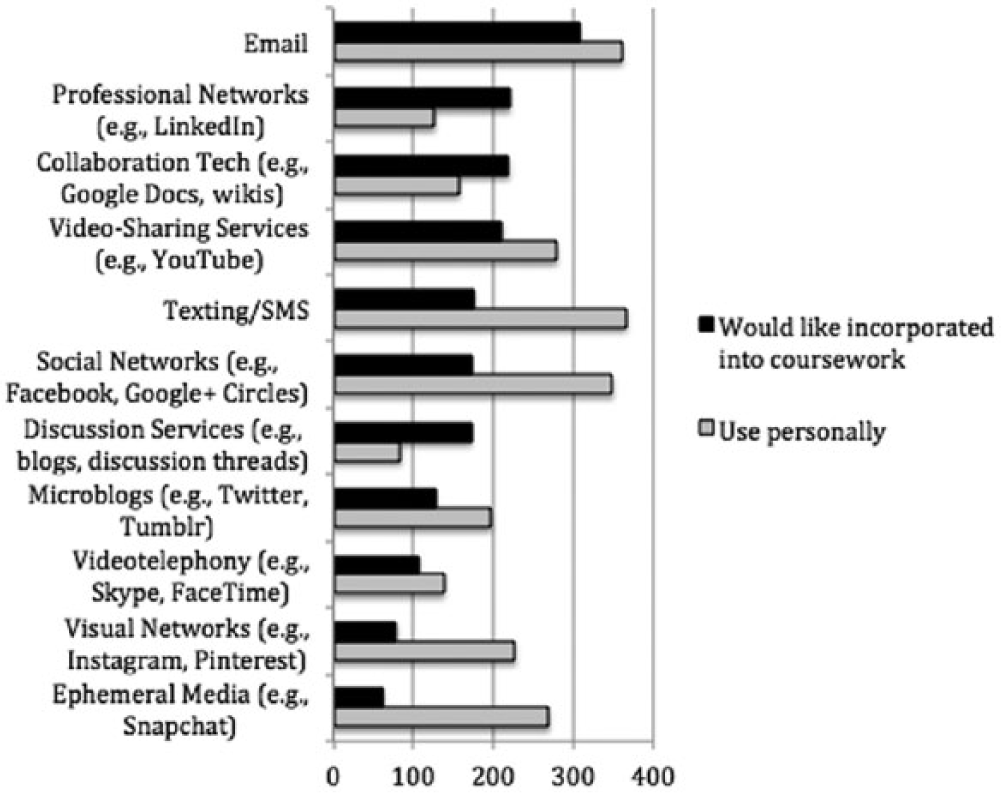
Comparison of personal usage and course preference (by medium).
Beyond email and video sharing, the majority of social media that ranked high in personal use were not preferred for course communication. For instance, text messaging, social networks (such as Facebook), visual networks (such as Instagram), and ephemeral media (such as Snapchat) were all ranked high in terms of personal use by students; however, approximately half of the students who used those media indicated they would not like them to be incorporated into their courses (seeFigure 1).
Conversely, two media—professional networks (such as LinkedIn) and collaboration technology (such as Google Docs and wikis)—ranked high in terms of being used as part of a course, even though students did not rank them high in terms of personal use (seeFigure 1).
Major
Our findings indicate that students majoring in business would like to have social media incorporated into their classes more than students in other majors (p= .001; seeFigure 2). Other than that, no differences were found between the majors in terms of the number of hours spent on social media or preferences related to communicating with friends, classmates, coworkers, TAs, or instructors via social media.

Social media (SM) preferences by major.
Gender
Our results indicate that females spend more hours on social media than males (p= .023; seeFigure 3). Females also prefer to use social media to connect with friends (p= .000) and coworkers (p= .037) more than males do (seeFigure 4). They are also more likely than males to regularly use social networks such as Facebook and Google+ Circles (p= .004; seeFigure 5). However, more males than females indicated they would be willing to use their personal social media accounts to connect with TAs (p= .013) and instructors (p= .002; seeFigure 5). No differences were seen between genders in terms of the desire to see social media incorporated into courses or to communicate with their classmates via social media.

Time spent on social media (SM) by gender.

Connecting with friends and coworkers (by gender).

Following and connecting preferences (by gender).
Social Media in a Previous Course
Another factor that influenced student desire to see social media incorporated into their coursework was a student’s prior experience with social media being used in a course (p= .001). We found that if a student had experience with social media in a previous class, that student was more likely to want it incorporated in courses going forward (p= .002; seeFigure 6). Similarly, students who had social media used in a previous class were more likely to want the ability to communicate with instructors via social media, compared with students who have not had social media incorporated into a previous class (p= .006; seeFigure 6). Other than that, no differences were found between the groups that had social media used in a previous class and those who did not have social media used in a previous class.
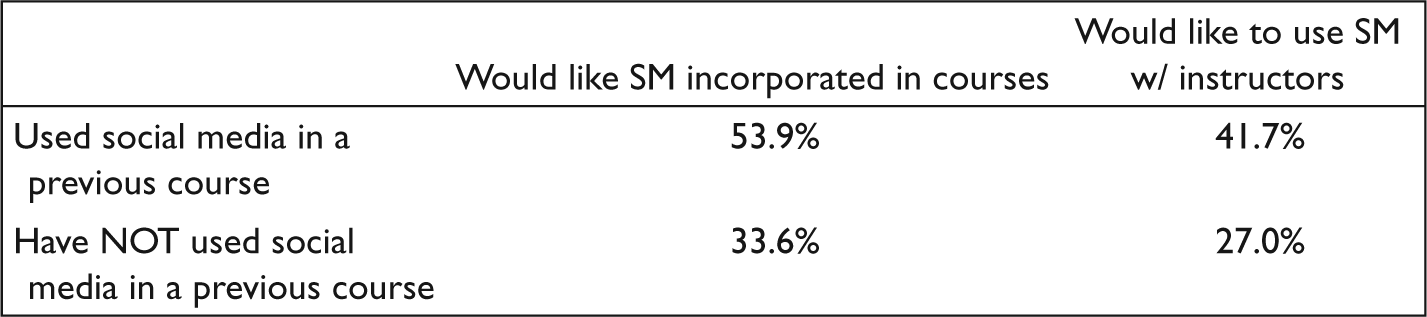
Social media (SM) preferences based on previous experience.
Prior experience with social media in a course also influenced business students’ desire to have social media incorporated into courses (p= .007). Again, if a business student had experience with social media being used in a previous class, that student was more likely to want it incorporated in courses going forward (seeFigure 7). Other than that, no differences were found between the groups that had social media used in a previous class and those who did not have social media used in a previous class.
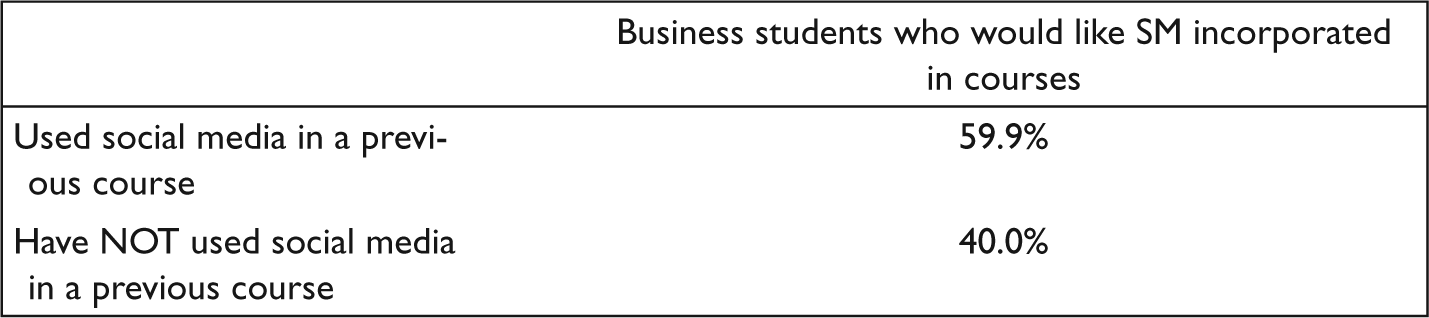
Business student social media (SM) preferences based on previous experience.
Discussion and Implications
Although many conclusions can be drawn from the survey responses, our research focuses on three major lessons that can be applied immediately by instructors: (a) email is not dead, (b) students prefer professional over personal services, and (c) resistance gives way to preference. The sections below explain each aspect in more detail.
Email Is Not Dead
It is a commonly repeated phrase: Email is dead—whether it be from a Pew Research study (Conger, 2011) or by the cofounder of Facebook (Wohlsen, 2014). However, general usage statistics and opinion pieces do not provide a nuanced understanding of email preferences. In our research, email received the highest ranking of all student communication—in both personal use (with 97% of students preferring it) and course use (with 83% of students preferring it). No other medium of communication ranked as high.
While texting and microblogs are effective for short snippets of information, they may not be appropriate channels for personal questions about an assignment, an absence, or even confusion that may leave a student feeling inadequate. The point is that different media are more effective at achieving different communication goals. To paraphraseElkafi Hassini (2006), a student may not feel comfortable communicating in a face-to-face meeting—or a social media post—after receiving a low score on an assignment. Email, however, opens communication between the student and instructor, while reducing the risk of confrontation and public humiliation, which makes it effective for student counseling (Poling, 1994), for helping struggling students (Smith, Whiteley, & Smith, 1999), and for creating a bond between instructors and students (Mowrer, 1996). Based on these prior studies and our own research, instructors should be careful not to integrate social media into a course at the expense of email or other forms of private messages. Instead, instructors should use various media, based on the content and the audience of the communication.
Professional Over Personal
Our study indicates that students would prefer that courses use a professional service such as LinkedIn for class discussions and projects, rather than more socially focused services such as Facebook and Twitter. For example, instructors may require students to participate in a closed LinkedIn group discussion, to “share” articles or news stories related to the course topics, or to engage with industry professionals by asking for advice or contributing to a professional group discussion on LinkedIn.
That said, it is important to understand when it is appropriate for instructors to choose a personal social site such as Facebook. Such a decision would be made if the social site is a more logical choice for the situation; however, even then, the reasons for choosing the social site must be communicated to students. For example, one of the authors of this article is using Facebook as part of a course project in which students in the United States collaborate with students in Japan. In that case, closed Facebook groups provide a channel of communication that students in both countries were already familiar with, while still providing an aspect of privacy (meaning that the members of the group are not able to see the personal posts and walls of other group members, unless they are explicitly added as friends in another step). Providing those reasons can help the instructor overcome business students’ preference to use professional sites like LinkedIn.
Resistance Gives Way to Preference
Regardless of the type of service used (social or professional), a large number of students may resist or hesitate to engage in the assignment. After all, based on the survey responses of students in this study, approximately one third of students (34%) indicated they would not like to have social media incorporated into their courses. Additionally, students majoring in business were more likely to want social media integrated into a course than students in other majors. The results showed that male students are more willing than female students to use their personal social media accounts to connect with TAs and instructors. Understanding those tendencies may help business and professional communication instructors identify which students may be more likely to participate in social media without hesitation and which students may need more assurance and prompting.
Although hesitancy may exist initially, survey responses indicate that students who have used social media in a previous course are more likely to want it incorporated in courses going forward and are more likely to want the ability to communicate with instructors via social media. One lesson that can be drawn from this finding is that students develop a preference for social media in their courses after they have experienced the benefits of it. That lesson mirrors the experience one of the authors of this article had. While teaching large lecture courses on business and professional communication, the instructor incorporated social media channels to help engage students and increase communication between students and TAs. During the first two thirds of the semester, TAs used Facebook and Twitter accounts to disseminate course information as well as ask open-ended questions to prompt discussions on the social media sites.
Despite those attempts, communication activity was minimal—and typically consisted of students viewing information on the sites but not commenting or contributing. Toward the end of the semester, students were given 1 week to earn extra credit for contributing to either of the social media sites (e.g., posting an article, asking a question, and answering another student’s or TA’s question). As a result, more than one third of the class contributed to social media sites during that week. In other words, students were less likely to participate in social media just for the benefit of communication, but were willing to do so if it was connected to their course grade. Moreover, once students participated in social media to earn the grade-related reward, they began to contribute more frequently on a wide variety of course-relevant topics. In fact, the number of posts doubled in the 2 weeks following the course credit offering—and almost all of the new posts were made by students who participated previously for extra credit. The new posts were unprompted and consisted of students asking questions about assignments, answering other students’ questions, and sharing information about course and university resources.
These results indicate that students may be likely to use and see the benefits of social media communication if they are first required to use it or are provided a grade-related reward that helps them overcome their initial hesitation.
Future Research
The survey data discussed in this article provide some insight into integrating social media into college courses, particularly business and professional communication courses. However, the survey results also indicate areas in which future research is needed to better understand student preferences and how to meet or address those preferences.
One area that deserves future research is student usage of email. For example, our study strongly indicated that email ranked high for both personal and course communication. Based on that finding, future studies and analysis might focus on which situations and content are best suited for email as compared with face-to-face interaction or social media posts.
Another area worthy of future research is how gender affects student preferences and usage of social media in the class. Broadly speaking, we found that females spend more hours on social media than males and are more likely than males to regularly use social networks such as Facebook and Google+ Circles. They are also more likely to communicate with personal acquaintances on social media. However, males are more likely than females to connect with people in positions of authority, such as TAs and instructors, via social media. Future studies (such as content analysis or focus groups) might shed light on the actual content of social media communication and the reasons behind the different preferences of males and females.
Conclusion
Instructors should acknowledge that social media does come with some concerns, such as the privacy of student information or the blending of personal accounts for work-related communication. On the one hand, that indicates that many students do understand the importance of limiting the amount of personal information they make publicly available on the Internet. On the other hand, it may make some students reluctant to engage in social media as part of their coursework. The results of this survey, however, indicate that social media can be integrated in such a way that students participate and benefit from the experience. The key is for instructors to make purposeful decisions about the goals they are trying to achieve and the social media platforms that would best fit those goals. For example, if the goal is to help students build a professional online persona, the use of LinkedIn profiles and networking would be appropriate. Conversely, if the goal is to better enable concise, timely interaction between students and instructors, microblogging accounts would be more fitting. In other situations, more private communication media (such as email or private Facebook groups) might be more appropriate. By selecting the appropriate platform and explaining its purpose to students, instructors can help ensure the success of social media assignments as part of their courses.
Finally, instructors can take comfort in this survey’s finding that indicates students tend to see the benefits of social media in their courses after they experience them firsthand. In the end, that firsthand experience will not only minimize student hesitation but can also help students develop the communication and technology skills that will be required in their future careers.
Footnotes
Appendix
Acknowledgements
We would like to thank the reviewers and editor for their insightful comments that helped strengthen this article.
Authors’ Note
An early version of the data was presented at the 79th annual meeting of the Association for Business Communication, Philadelphia, PA, USA, 2014. This study was approved by the Institutional Review Board of St. Cloud State University.
Declaration of Conflicting Interests
The author(s) declared no potential conflicts of interest with respect to the research, authorship, and/or publication of this article.
Funding
The author(s) disclosed receipt of the following financial support for the research, authorship, and/or publication of this article: This study received a grant from St. Cloud State University’s Center for Excellence in Teaching and Learning.
Author Biographies