



Abstract
This research establishes the role of communication education in employability by determining how employers of graduates view communication, identifying communication skills that employers view as relevant, and establishing whether these skills are included in communication courses. To achieve these aims, local businesses were surveyed, and the results were compared with communication course descriptors. The research shows, consistent with worldwide trends, that local employers value communication competencies highly when recruiting new graduates, and specific communication skills required in an industry reflect course content. However, some skills are still lacking, and the research questions where the responsibility lies in developing these skills.
The importance of communication and soft skills in helping new graduates find employment is well documented in research (Finch, Nadeau, & O’Reilly, 2013;Nickson, Warhurst, Commander, Hurrell, & Cullen, 2012;Remedios, 2012;Rynes, Orlitzky, & Bretz, 1997).Mason, Williams, and Cranmer (2009)have included communication in their list of skills affecting employability, while other international studies have shown that businesses require more from new graduates than technical skills; they have found that generic skills and communication are vital to employment success, as it is these skills employers look for when interviewing potential candidates for entry-level jobs (Robles, 2012).Lowden, Hall, Elliot, and Lewin (2011)at the University of Glasgow looked specifically at employer perceptions of employability skills of new graduates, reviewing previous studies as well as surveying businesses in Scotland, and they too noted the importance of core skills, transferable skills, and generic skills in employability.
This shift to assess soft skills with technical skills could be attributed to the changing structure of the contemporary workplace, with increasingly diverse workplaces and the use of project teams, cross-functional groups, and even virtual teams in business. As business networks develop across departments, cultures, and even time zones, so does the need for greater interpersonal awareness and clear communication within the team (Cheruvelil et al., 2014;Hinds & Mortensen, 2005;Kick, Contacos-Sawyer, & Thomas, 2015;Lappalainen, 2009).
The ability to share technical knowledge with nontechnical team members and to ask the right question of technical experts is vital to the success of any team.Waldeck, Durante, Helmuth, and Marcia (2012)have argued that this need suggests everyone needs to be a communicator, and to be able to contribute in a way that will increase the knowledge capital of the whole team. However, the value of communication goes even further than promoting understanding, as it affects the success of the business directly. Communication skills not only facilitate successful outcomes but also encourage employee engagement (Vorhauser-Smith, 2013), which then leads to increased productivity and business sustainability. Finally, the recent global recession has put greater pressure on new graduates, as employers have a wide pool of applicants from which to choose. The choices made in employment go much deeper than technical competence, and employers have emphasized the role of transferable and soft skills when recruiting (Chakraborty, 2009;Joseph, Ang, Chang, & Slaughter, 2010;Mitchell, Skinner, & White, 2010;Ramlall & Ramlall, 2014). Therefore, communication is not merely a nice quality to have for graduates looking for employment; it is an essential quality.
Literature Review
Soft Skills, Generic Skills, and Communication Competence
Jackson (2010)noted that while employers in Australia and the United Kingdom are generally satisfied with discipline-specific skills in graduates, the “other” elements of basic and soft skills are increasingly becoming the focus (p. 31). TheBoston Area Advanced Technological Education Connections (2007)reported that employers place more emphasis on employability skills than on technical skills.
The U.S. Department of Education Employability Skills Framework (http://cte.ed.gov/employabilityskills/) states that employability skills have a number of names, including career readiness skills, workforce readiness skills, and soft skills. However, terms likesoft skills, communication skills, andgeneric skillsare used somewhat interchangeably in both employment advertisements and in research articles on employability of graduates. Indeed, as identified by Financial Services Skills Council,The City of London (2006), each organization defines these skills differently: “[W]hat may be termed communication by one recruiter can be understood as teamwork by another” (p. 4). As another example, in their description of soft skills,Mitchell et al. (2010)included time management, teamwork, communication ethics, and an appreciation of diversity. In contrast,Andrews and Higson (2008)identified soft or transferable skills as self-management, self-confidence, and written and oral communication skills. It is obvious whyHager, Holland, and Beckett (2002)have noted that generic skills are a “very mixed bag of things” (p. 3).
According toHager et al. (2002), generic skills involve personal qualities and attitudes as opposed to knowledge or technical skills. These qualities include the ability to form relationships through oral communication and teamwork, to think independently and critically, to manage knowledge, and to be curious. The descriptions of the soft, generic, or transferable skills “bag” all include elements of intrapersonal and interpersonal communication, thereby suggesting an inseparable link between these skills and communication, and thus making employability and soft skills an issue relevant to the communication courses taught at tertiary institutions.
Because these employability skills rely on the ability to understand situations and use communication appropriately for their achievement, it suggests that more than basic communication skills are required. This aligns withPayne’s (2003)definition of organizational communication competence as “the judgement of successful communication where interactants’ goals are met using messages that are perceived as appropriate and effective within the organizational context” (p. 10).
Spitzberg and Cupach’s (1984)description of competence shows a link between generic skills and competence by including the attributes of appropriateness and effectiveness, andPayne (2005)has suggested that communication competence requires motivation and knowledge as well as skill. In her research,Jackson (2010)identified two levels of competence and argued that “threshold competencies” are key or basic competencies, the least that are required by employers, while “distinguishing competencies” would be seen as “ideal” (p. 32).Jablin and Sias (2001)also defined two levels of competencies but in a different way, distinguishing betweenprecompetence, a generic communication ability not yet acculturated into the specific business context, andthreshold competence, which is achieved through the addition of socialization. So, from this analysis we suggest that what employers are actually looking for is competence, not just skill. The communication competence levels mentioned above correlate withDwyer’s (2013)explanation of emotional competence, which involves both personal and social competence and explains the vital role communication plays in developing competence within an organizational context. By establishing this close link between communication competence and soft skills, we suggest that those graduates who show higher level communication competencies understand the business environment and are more likely to be employed.
Communication Competencies Required by Employers
Graduate skills surveys include various “top 10” lists for employability skills across disciplines, often featuring both soft and communication skills.Careers New Zealand’s (2015)list of “skills employers are looking for” included communication skills, teamwork, initiative, and problem solving. Similarly, a recent Employability Skills Survey conducted byVictoria University of Wellington (2015)included verbal communication skills, teamwork, interpersonal communication skills, and written communication skills all within the top 10 skills/attributes sought in university graduates. These findings are similar to research elsewhere, including a recent Australian Graduate Outlook Survey (Graduate Careers Australia, 2013), which listed interpersonal and communication skills first in a list of desired graduate skills, followed by passion, drive, commitment, attitude, and critical reasoning.
Broader research such as the content analysis of business-related professional journal and magazine articles byWaldeck et al. (2012)has shown that the value of communication and related soft skills is acknowledged in industry by the number of articles relating to the subject.Waldek et al. (2012)identified 347 articles published in 10 specialist journals and magazines for the period of January 2005 to June 2010. Analysis of the data revealed six communication competencies as being relevant within the contemporary business environment: relationship and interpersonal communication; mediated communication; intergroup communication; communication of enthusiasm, creativity, and entrepreneurial spirit; nonverbal communication; and speaking and listening.
The research noting the need for communication skills in entry-level jobs is found across a wide range of industries. The first impression a recruiter gets of new graduates is often from the job application and, according toGraham, Hampton, and Willett (2010), the written skills shown here and in other correspondence are an important part of the selection process. Thus, to help our graduates get jobs, tertiary education providers need to be aware of what employers are looking for.
According toPayne (2005)andPorterfield and Forde (2001), human resource managers deem communication, listening, and teamwork as very important for business graduates.Dacre Pool and Sewell (2007)have noted teamwork, creativity, planning, and communication as being necessary for Information Technology (IT) graduates, whileStevens (2005)included curiosity and contribution as also being desired by the IT industry.Smith (2005)described the need for communication skills such as listening, nonverbal, and interpersonal skills for accounting and auditing graduates, whileGray (2010)stated that 91% of accounting professionals identify oral communication skills as essential in their field. Taking this a step further,Rossetto and Murphy (2010)discussed the need to embed communication into courses for financial planning students to develop their interactive listening and questioning skills. It seems obvious that communication is essential for public relations (PR) graduates, andMcCleneghan (2006)showed this relevance in his research which identified written communication as the most important of 11 critical skills for PR practitioners, followed by critical thinking, listening, and speaking.
This brief review suggests that communication has been consistently identified as important to employability, both in research and specific employment skills lists. However, most importantly, other research shows that these skills are lacking in graduates. The U.K. Commission’s 2011 Employer Skills Survey identified communication, teamwork, and problem-solving skills among a list of desirable skills that employers found were lacking in graduates (Davies, Gore, Shury, Vivian, & Winterbotham, 2012). Concerns about the lack of soft skills among accounting, business, and IT students have been well documented in research (Albrecht & Sack, 2001;Barac, 2009;Gammie, Gammie, & Cargill, 2002;Howieson, 2003;Stainbank, 2009).Jackson’s (2010)international profile of industry-relevant competencies and skills gaps in modern graduates outlined gaps in several threshold and distinguishing competencies, including written communication, oral communication, teamwork, and interpersonal skills.
Communication Competence in Tertiary Education
The most recent CBI/Pearson Education and Skills Survey 2015 emphasized the need for collaborations between higher education institutions and employers (Confederation of British Industry, 2015), and, according toJackson (2010), the responsibility for teaching soft and transferable skills is increasingly being assigned to tertiary institutions. Thus, it is up to higher education institutions to decide whether or not to accept this challenge. Course content is generally designed and moderated by academics, and studies as early asTucker, Hart, and Muehsam (1993)have suggested that there is a lack of input from industry in terms of content.Jackson (2010)identified the need for employer opinion about employability and suggested that this comes through collaborative partnerships. This collaboration of education and industry currently takes place in New Zealand by the New Zealand Qualifications Authority through the Targeted Review of Qualifications, and in tertiary institutions through relationships with employers.
The Waikato Institute of Technology (Wintec, 2016) is a large provincial tertiary provider in the Waikato region of New Zealand which purports to develop work-ready graduates. The qualifications offered within the organization are vocational or applied, and many of the degrees and diplomas analyzed in this article are from national qualifications offered at several institutions. Additionally, the inclusion of a compulsory communication course in the first year of study is required by professional bodies in the areas of business, IT, and engineering. Given the vocational focus of our organization, the purpose of this research is to establish how employers of Wintec students perceive the role of communication courses in degree programs, and to identify whether current curricula align with the tertiary institution’s aims of producing graduates who are readily employable. To this end, this article uses New Zealand-based courses as a case study to identify correlations between employers’ views on the relative importance of specific communication skills for employability and the learning objectives in first-year communication courses.
Therefore, this article addresses the following research question: To what extent do first-year compulsory communication courses cover the soft skills and communication competencies required by employers?
Method
This research project built on the findings from the literature review by comparing and contrasting findings from the literature to those from primary research based in our own regional context, with a focus on employers of Wintec students and first-year compulsory communication courses taught at our institution. Overall, the aim was to investigate the sufficiency of first-year communication courses in covering the communication skills employers expect graduates to have. This necessitated the two phases of the project:
First, a survey was conducted to place local and national employers’ perspectives of the importance of communication skills in relation to broader findings and perspectives identified in the literature review.
Second, compulsory first-year communication courses were analyzed according to the survey findings to investigate whether the content sufficiently covers the required communication skills identified by employers.
We anticipated that the findings of this research project would be of value in adding to the growing body of literature on communication skills and employability skills, from the employers’ perspective, and in informing future course and content development—both at Wintec and beyond.
Phase 1: Survey
Participants
The target population for the survey was employers with a connection to Wintec, either by employing Wintec students or by being part of industry engagement initiatives. As one of the larger higher educational institutions in New Zealand with a focus on vocational learning, Wintec has established networks with employers in the Waikato region, nationally, and internationally. All schools and centers of study within the organization engage in discussion with industry and employers via Wintec Employer Partnership Groups or Wintec Industry Forums. Thus, for this study, we were able to use a purposive sampling method which identified, from Employer Partnership Groups and graduate surveys, several organizations in the Waikato region that have employed Wintec students in the past or have been part of a broader network of industry engagement within the institution. As the researchers are based in the Centre for Business, Information Technology, and Enterprise (CBITE) and the School of Media Arts, employers who were invited to participate in the survey specialized in diverse fields: media, finance, PR, local government, dairy and agriculture, IT, creative industries, event management, sports, health sector, retail, advertising, and communication. Respondents represented employers from large and small private and public enterprises.
Survey Method and Design
A link to an online survey was sent to senior managers from 40 organizations that have employed Wintec graduates, and 30 responses were received for analysis. Given the small sample of employers, and focus on graduate communication skills across—and despite—disciplines, results were not analyzed according to industry; also, generalizations from the results might be limited because of the number of responses.
The survey consisted of a mixture of open- and closed-ended questions, with a focus on what employers considered as desirable communication skills. Because of the lack of consistency in defining communication skills in the context of employability (Andrews & Higson, 2008;Financial Services Skills Council, The City of London, 2006;Mitchell et al., 2010), the survey included prompted questions asking respondents to rank specific communication skills, as well as some unprompted questions and an open-ended response option for all prompted questions.
Question 1: Communication and Employability
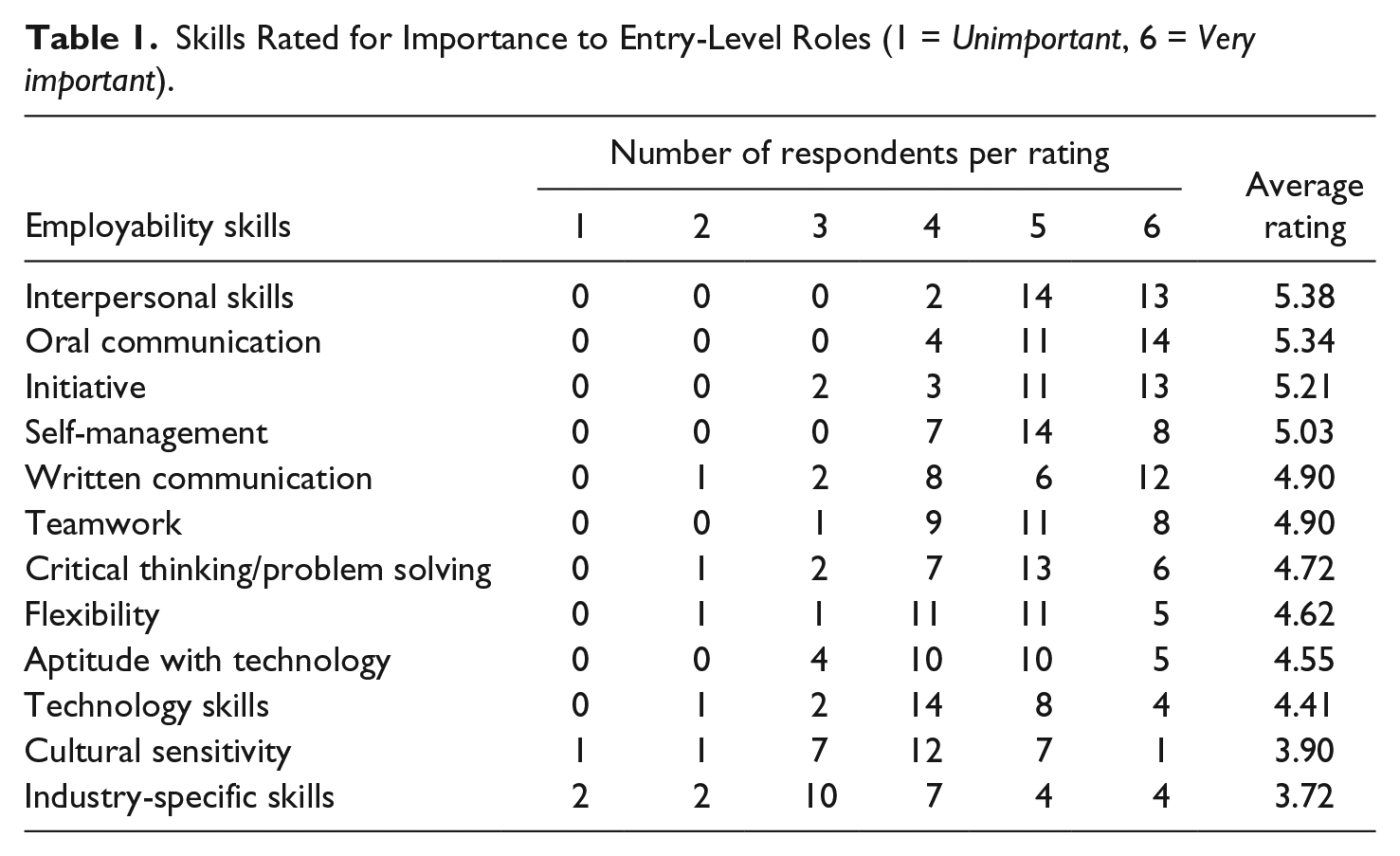
We first sought to investigate employers’ perceptions of the importance of communication skills in relation to other employability skills. In this instance, respondents were given a list of employability skills to rate (seeTable 1), compiled from recent graduate skills lists and employability skills lists (Bennett, 2002;Careers New Zealand, 2015;Fair, 2013;Graduate Careers Australia, 2013;Jackson, 2013;Robles, 2012;Victoria University of Wellington, 2015;Waldeck et al., 2012;Williams, 2015).
Skills Rated for Importance to Entry-Level Roles (1 =Unimportant, 6 =Very important).
As discussed in the literature review, the inclusion of communication skills in lists of desirable employability skills is not in question. However, what exactly is meant by communication skills, from employers’ perspectives, is not always readily discernible. In an attempt to investigate more fully what employers deem important regarding specific communication skills, the remaining survey questions (Questions 2-4) focused on three broader categories of communication—interpersonal communication, writing skills (mechanical/technical), and business communication (written/oral formats)—and specific skills within these categories.
Question 2: Interpersonal Communication Skills
In employability and transferable skills lists (e.g.,Bennett, 2002;Jackson, 2013;Williams, 2015), interpersonal skills often appear as separate from communication skills, but definitions provided of communication skills often include “communication with others,” while definitions of interpersonal skills include communication. Also, while skill sets and attributes around teamwork, leadership, and conflict management appear independently in some skills lists, definitions of interpersonal skills incorporate a variety of skills, as well as personal attributes around relating well to others, emotional intelligence, solving workplace problems, social ability, and taking initiative (Field, 2002;Goleman, 1995;Scott & Yates, 2002). In turn, if interpersonal communication incorporates broader aspects such as emotional intelligence, it also includes skills of self-awareness, self-management, and self-motivation (Rozell, Pettighon, & Parker, 2002).Jackson (2010)commented on the difficulty of drawing conclusions around definitions of interpersonal skills, given “the broadness of this skill set” (p. 44). Given the breadth of this skill, Question 2 asked employers to rate the importance of a list of interpersonal skills, derived from the literature reviewed for this research, rather than asking for unprompted responses.
Question 3: Business Communication Skills
For the purpose of this research, business communication skills incorporate oral and written communication in relation to professional contexts.Jackson (2010)noted that oral and written communication skills are multifaceted in their nature, but definitions of these skills identify some competencies such as giving effective presentations and writing memos, letters, and reports.Jackson’s (2013)employability skills framework (adapted fromJackson & Chapman, 2012) also includes meeting participation and a range of written formats in the description of the employability skills of communicating effectively. Taking this range of competencies into consideration, Question 3 asked employers to rate a list of business communication skills for relevance to entry-level roles.
Question 4: Writing Skills
These skills are readily identified as part of employability—either within definitions of communication skills (e.g.,Bennett, 2002;Robles, 2012;Williams, 2015) or separately in employability skills lists (Jackson, 2010). In this study, writing skills have been separated from specific business communication genres and contexts (e.g., a media release, or a business proposal), with Question 4 focusing rather on technical and mechanical skills, including tone and style. Although the focus on these skills is limited, an open-ended response option, together with Question 5, as explained below, allowed for additional skills to be identified, including more complex writing skills.
Question 5: Communication Skills Lacking in Entry-Level Role Applicants
Finally, as an inquiry into employers’ unprompted perceptions, Question 5 asked respondents about communication skills they found lacking in graduates. The intent was to compare these skills to those the respondents deemed most relevant and see whether these would be consistent, unlike the findings ofFair (2013), where lists of skills lacking were at times inconsistent with those skills cited as desirable in the first place.
Phase 2: Course Descriptors
The second phase of this research investigated the outcomes and content taught in compulsory first-year communication courses in diploma and degree programs in the Centre for Business, Information Technology, and Enterprise and the School of Media Arts at Wintec. As noted earlier, most of these courses form part of qualifications offered nationally by different institutions.
Disciplines of study linked to these courses included PR/Journalism, Fashion Design, Interior Design, Business Studies, IT, and Science. Nine courses were analyzed according to stated learning outcomes and content included in the course descriptors. For analysis, content was grouped into the same specific skills categories as used in the survey phase of the research, based on skill sets derived from the literature: interpersonal skills, business communication skills, and writing skills.
Results
Phase 1: Survey Responses
The results below identify findings from the survey questions, including perceptions of communication skills for employability, in the context of broader generic skills and personal attributes; relevance of specific interpersonal, business, and written communication skills; and communication skill deficiencies in new graduates.
Question 1: Communication and Employability
To investigate the importance placed on communication skills, employers were provided a list of skills and competencies and were asked to rate each for importance to entry-level roles.Table 1indicates the number of responses per rating and the average rating for each skill, with the highest possible rating of 6, and the lowest possible rating of 1.
As seen inTable 1, while all skills and attributes rated at an average of 3.7 and above, communication skills (interpersonal skills, oral communication, teamwork, written communication) were highly rated among the broader list, all with average ratings of 4.9 and above. Personal attributes of initiative and self-management were also rated highly, while cultural sensitivity and industry-specific skills scored the lowest average ratings.
Question 2: Interpersonal Skills
Employers were asked to rate specific interpersonal skills for relevance to entry-level roles, with a rating of 6 beingessentialand 1 beingirrelevant. They were also given the opportunity to provide an open-ended response regarding the relevance of specific interpersonal communication skills to entry-level roles.Table 2shows that motivation, listening, and teamwork were most commonly rated as essential by employers, with no ratings below 4. Intercultural communication is the only skill which achieved the lowest rating of 1 (irrelevant); it was unclear from the open-ended responses whether this seeming irrelevance was related only to entry-level roles or to communication skills in general.
Interpersonal Skills Rated for Relevance to Entry-Level Roles (1 =Irrelevant, 6 =Essential).

Some open-ended responses further highlight the emphasis on these skills in relation to entry-level roles; for example, a respondent in retail noted that “good listening and interpersonal skills are paramount” for trainees. Skills involving leadership, dealing with conflict, and intercultural communication were rated as less essential overall. A respondent in the events industry identified that some of these skills are not required for initial employment: People in entry-level roles are not expected to take the lead or be placed in areas where they are dealing with conflict; however, if a person does have these skills they will definitely be beneficial to their growth in the industry.
While overall ratings of interpersonal skills indicated some trends in employer preferences, open-ended responses indicated varied views on the importance of different skills. An accountancy respondent noted that the skills were all important and “hard to rank.” Another respondent in local government noted that they were all “critical.” Two respondents from local government and the events industry also noted that the importance of different skills would depend on the role, and on interaction with others: Each role will also be different if you are moving into a sole charge role or team environment. The type of communication skills required may also vary depending on what role they’re taking within the business.
It was clear from the open-ended responses that employers believed that interpersonal skills, in general, are very important to entry-level roles and to functioning within organizational contexts overall. A respondent from local government stated, In general employees at all levels need to be aware of the various personalities in their team and have the ability to adapt to working with them. Relationships are extremely important and will allow new staff to gain more knowledge of the industry or environment quickly and with support from colleagues.
Responses also alluded to the importance of interpersonal skills in considering graduates for employment. According to a respondent from advertising/media, “It [interpersonal communication skills] is likely to make the difference in our decision making.” However, some responses also suggest that broader skills, attributes, and competencies (not included in the provided list of interpersonal skills) are important for considering entry-level graduates. For example, two respondents from accounting and advertising/media commented: We are now putting more emphasis on hiring for personality and potential rather than on technical skills as in the past. Skills can be learned—attitude, not so much.
Question 3: Business Communication Skills
Employers were asked to rate specific business communication skills for relevance to entry-level roles, again with a rating of 6 beingessentialand a rating of 1 beingirrelevant. They were also given the opportunity to provide an open-ended response regarding the relevance of specific business communication skills to entry-level roles. In regard to the relevance of specific business communication skills,Table 3shows that, by far, emails were most relevant for the employers surveyed, followed by writing online and presentations, with meetings and proposals being rated less relevant overall.
Business Communication Skills Rated for Relevance to Entry-Level Roles (1 =Irrelevant, 6 =Essential).

Notably, while this question did not prompt responses regarding specific writing skills, several open-ended responses championed the need for “good writing skills.” For example, a respondent from local government noted that “good writing skills are an essential—sentence structure, grammar, writing style and spelling UK English is critical.”
In addition, two open-ended responses by respondents from accountancy and advertising/media suggested an expectation of courses to deliver graduates with good writing skills: We expect these people to already have good written skills—we are not really geared up to teach these. We maybe expect a lot from entry level and need them to hit the ground running. This means we have a higher expectation of the courses to deliver relevant learning.
While one respondent from agribusiness noted that “a lot of what they need to know will be learned on the job, so they need to be good listeners and fast learners,” some employers made mention of industry-specific business communication skills that they would expect from graduates. For example, other responses included writing for the web, writing media releases, and writing advertising/marketing copy. Two open-ended responses from local government suggested the importance of social media training in relation to communication skills: We need to beef up all social media training as part [of] general communication skills. Writing for social media is a specific skillset. Many graduates know how to “use” social media platforms, but lack the ability to create a strategy, plan, content management or ROI on the use of the platforms.
Question 4: Writing Skills
Given that, without prompting, employers identified writing skills as important, it is not surprising that they rated all specific categories of writing skills as essential to entry-level roles in their industry (seeTable 4below).
Specific Writing Skills Rated for Relevance to Entry-Level Roles (1 =Irrelevant, 6 =Essential).
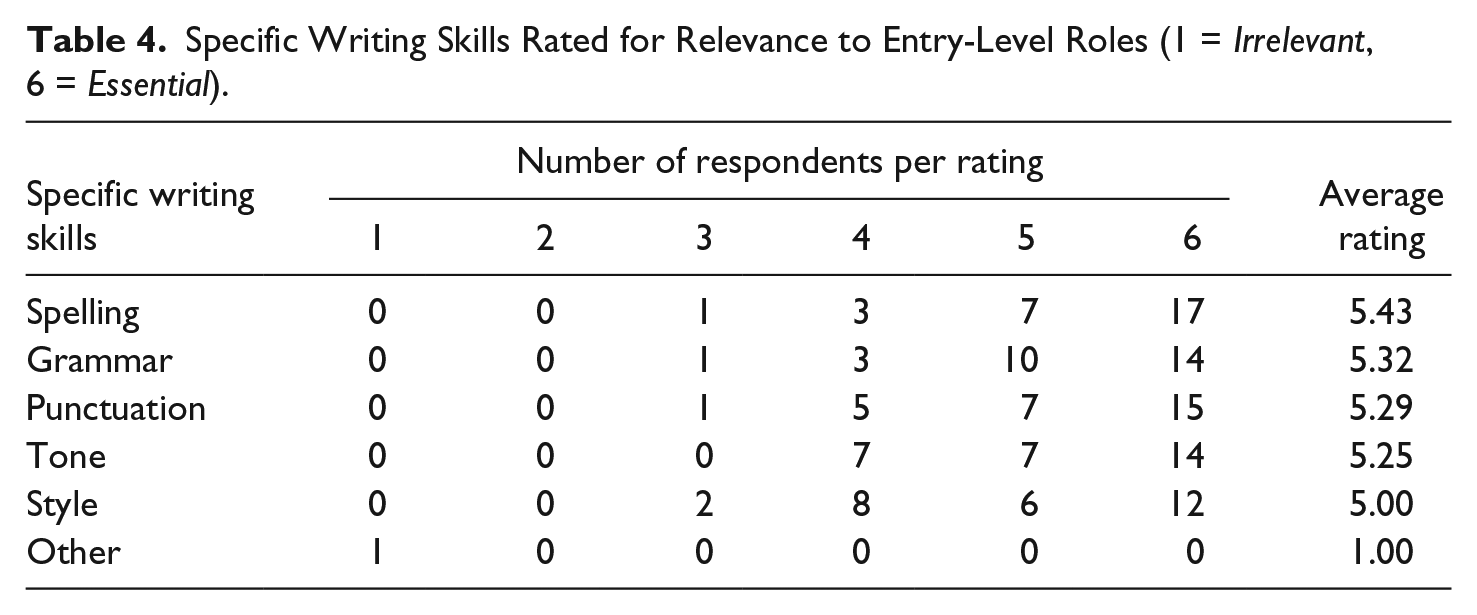
Open-ended responses echoed this notion, with an expectation of writing accuracy. For example, two respondents from agribusiness and local government noted: It can never be underestimated, and they all need to know that if they send an application in that is not 100% accurate, they won’t make it past first base in this organization. Spell check is not reliable. All employees write letters and emails to clients on a daily basis. We are not able to check emails before they are sent—hence the importance they are of a high standard.
Some open-ended responses highlighted the importance of tone in regard to specific business contexts, both in written and oral communication. However, two respondents from advertising/media suggested that style and tone are “dependent on the industry and brand you are working for,” and that these skills might be adapted or “molded.”
Question 5: Communication Skills Lacking in Entry-Level Role Applicants
To identify the skills employers felt were not displayed by graduates, we posed an open-ended question, unprompted by generic or specific skills lists, asking employers to identify communication skills they thought were lacking in entry-level graduates. While some responses to Question 1 indicated that employers may place written skills at a slightly lower level of importance than interpersonal skills, oral communication, initiative, and self-management (seeTable 1), in Question 5 writing skills were identified by half of the respondents as most commonly lacking in entry-level applicants. Aspects of writing that were noted as lacking included grammar, spelling, sentence structure, attention to detail, and formal or business tone.
More than one third of employers identified skills regarding functioning in an organizational context as lacking. These related to both industry-specific skills and general aspects of professionalism. For example, a business consultant, a respondent from local government, and another from advertising/media noted the following skills as lacking: Skills in working with related industry people. Understanding how organizations work in practice. Some [graduates] have a tendency to use email as their preferred method of contact when, in a deadline-driven environment such as media, an employer would much prefer they use the phone!
One third of the employers identified interpersonal skills as lacking in applicants, including a focus on communication with internal and external customers. Interestingly, this was found across the range of industries surveyed. For example, respondents from the events industry and from IT noted the following lacking interpersonal skills: Confidence in verbal communication with members of the public. Ability to think through what others care about. Ability to explain technical information to non-technical people.
Finally, some aspects regarding self-management were noted, including a lack of urgency to meet deadlines and either being overconfident or lacking confidence.
Phase 2: Course Descriptor Analysis
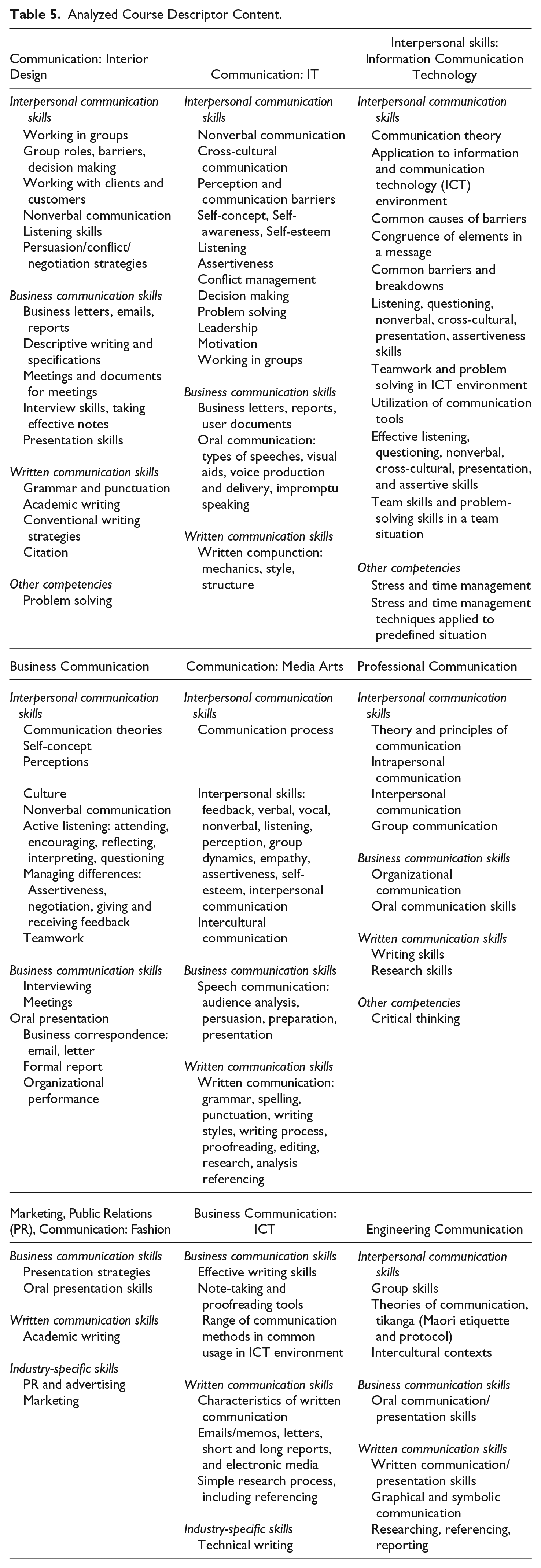
Table 5summarizes the content outlined in the nine course descriptors investigated for this research.
Analyzed Course Descriptor Content.
Interpersonal Communication Skills
Generally, all course descriptors analyzed for this research contained elements of interpersonal communication skills related to communication processes, including theories of communication, communication barriers, and intercultural communication. Communication strategies regarding groups/teamwork were common, together with skills such as problem solving. Interpersonal skills regarding listening, nonverbal communication, and basic conflict resolution were also common. Four course descriptors also included elements of intrapersonal communication, including self-concept and self-esteem, perception, assertiveness skills, and giving and receiving feedback. Motivation was only included in one course descriptor, in relation to group processes.
Business Communication Skills
The most common areas of business communication included in the eight course descriptors’ content were writing skills—specifically in reference to research, writing for professional/industry contexts, and also writing genres such as emails, letters (most common), and then reports and other industry-specific documents. All course descriptors include content related to oral presentation skills and visual presentation techniques. Other business communication skills included made reference to industry-specific aspects, including appropriate software, PR strategies, marketing plans, and other business documentation.
Writing Skills
All descriptors analyzed, apart from a course focused solely on interpersonal communication, included content on writing or written skills, and usually in relation to academic research or professional writing. However, only three mentioned spelling, grammar, and punctuation specifically, and two included proofreading. Only two course descriptors mentioned style and structure specifically, while only one course descriptor mentioned tone, purpose, and audience in the context of writing.
Discussion
This research set out to address the question of whether a first-year compulsory communication course sufficiently covers the soft skills and communication competency required by employers. We did this by questioning what employers of Wintec graduates expect in terms of soft skills and communication, specifically in relation to entry-level roles, and how this relates to broader literature. We also sought to establish whether content and outcomes of several first-year communication courses reflected these views.
The literature suggests that skills otherwise described as “soft” or “generic” all incorporate some elements of communication, in particular, interpersonal and intrapersonal communication. More than this though, in the vernacular of employability, employers are looking for attributes and skills such as listening, motivation, time management, commitment, and problem solving—along with, or as part of, communication skills.
Our survey of organizations in the Waikato region provided very similar results to surveys in international research on the same subject, showing that employers do look for soft skills and communication competence when recruiting new graduates (Bennett, 2002;Lowden et al., 2011). Specifically, the areas of speaking, writing, and interpersonal communication are all consistently shown as relevant to employability in desired skills lists (Careers New Zealand, 2015), with interpersonal communication emerging as most or very important from our research.
Our survey findings also highlight the fact that employers find new graduates are lacking certain skills, similar to findings outlined byDavies et al. (2012). However, as inFair’s (2013)research on employer perspectives of essential employability skills in Ontario, where employers cited “gaps” in employability skills not originally cited as essential, in our research, employers did not cite writing skills as the most important, but identified them most commonly as lacking in graduates.
When analyzing course content and descriptors, our findings broadly indicate that learning outcomes from current courses also correspond to skills that employers, both from our survey and in relation to broader literature, rate as important. For example, learning outcomes regarding interpersonal communication, business communication, and written communication are largely consistent with those skills indicated as important by employers (Graham et al., 2010). Current course content also emphasizes oral communication, again considered very relevant by employers (Gray, 2010).
So, essentially, the communication courses under research do contain content deemed relevant by employers. However, generally, the learning does not seem to always translate from the classroom to the workplace. This disconnect suggests three possible discrepancies between what is intended in learning outcomes and what skills students are expected to be able to use when in a workplace context.
First, written communication is included in all courses analyzed, but writing skills were consistently identified as lacking in graduates, both by our survey respondents and in broader literature. While our research focused mainly on the mechanics of writing, the ability to “write well” and to write in an appropriate tone were identified as wanting by research respondents. The inclusion of writing skills and processes in all course descriptors analyzed suggests that there is acknowledgment of the importance of written communication; however, few descriptors stipulated a focus on mechanics, structure, tone, and style. The lack of detail in the descriptors suggests that these mechanical processes might not be specifically taught in all communication courses, but this would require further investigation.
Second, although interpersonal skills are included in course content, both international and local employers noted the lack of these skills in new graduates (Jackson, 2010;Waldeck et al., 2012). This suggests that although the specific low-level skills are part of the course content, these are not translated into competence in the workplace. Here it is possible to applyJablin and Sias (2001), who argued that the students have precompetence, but their communication ability lacks acculturation into the specific business context.
Third, of the broader communication attributes deemed important by employers, problem solving, critical thinking, and time management were included in only three of the course descriptors analyzed. It is notable that motivation, which was rated most commonly asessentialby employers surveyed, was not included in the course content analyzed. Survey respondents and skills lists from literature also rated initiative and self-management to be as important as teamwork and written communication, but these competencies were again not included in content. This reinforces the notion that while lower level competencies are addressed in first-year communication courses, employers expect higher level competencies at the graduate level.
Conclusion
In the literature there is an overlap in the use of the termssoft skills, communication skills, andgeneric skills. There is also a tendency to include broader attributes in the description of communication skills, which suggests that what employers require are competencies. Our research attempts to add to the current literature a more detailed investigation of the connection between employer expectations of communication skills of new graduates and the sufficiency of the content included in the first-year compulsory communication courses across multiple disciplines.
Our survey of employers aligned with previous international research regarding the need for soft skills and communication ability in new graduates. At present, most of the required skills are being taught in basic communication courses at the first-year level; however, in line with broader literature, our survey respondents still identified several communication-related skills and competencies as lacking in graduates. This poses the question of whether it is enough to tweak these courses to fall into line with employers’ expectations or whether the problem is a broader one involving the structure of programs at the tertiary level and the need to embed communication beyond first-year communication courses.
Furthermore, employers do have clear opinions regarding important or essential communication attributes and soft skills for employability but, as international and local research have shown, these expectations are not uniform, specific, or consistent. This justifies a continued need for engagement between tertiary and industry. We would propose that educators need roles within this process too, as they are the ones who translate the requirements of employers into practical time-bound courses.
Our research findings suggest that a first-year compulsory communication course may not be enough to prepare students for the expectations of employment, where higher level competencies are required. This gap could be addressed in two ways: first, by ensuring the industry relevance of courses through modelling, examples, case studies, and work placements or internships; and second, by incorporating communication skills and competencies at all levels of learning, either through program or course design. This would place the onus on tertiary institutions, employers, and communication educators to collaborate further to develop the required competencies within degree and diploma programs.
Footnotes
Acknowledgements
The authors would like to acknowledge and thank the survey respondents in this research. We would also like to acknowledge the assistance of our colleagues, Adrian France and Gail Pittaway, in reviewing the manuscript.
Authors’ Note
This study was approved by the Research Office of Waikato Institute of Technology and by the Wintec Human Ethics in Research Committee. All information was gathered through anonymous surveying, and respondents’ comments are reproduced by permission.
Declaration of Conflicting Interests
The author(s) declared no potential conflicts of interest with respect to the research, authorship, and/or publication of this article.
Funding
The author(s) received no financial support for the research, authorship, and/or publication of this article.
Author Biographies