



Abstract
Many communication instructors make allowances for grammatical error in nonnative English speakers’ writing, but do businesspeople do the same? We asked 169 businesspeople to comment on three versions of an email with different types of errors. We found that businesspeople do make allowances for errors made by nonnative English speakers, perceiving these errors as less bothersome than those made by native speakers. We also found that businesspeople perceive pragmatic errors of politeness and tone as even more bothersome than grammatical error—a finding we share with our students to persuade them of the importance of polite and professional email correspondence.
Keywords
One long-standing tension in Writing Studies concerns the relative emphasis instructors should place on grammatical and mechanical errors in student writing. While there exists a range of positions on this issue, nearly all professional communication instructors would likely agree that students should strive to eliminate distracting or bothersome errors from their writing. Such errors, research tells us, are often judged harshly outside of English classrooms. Surveys of business professionals’ responses to error have shown that professionals consistently rate sentence errors (e.g., fragments and run-ons), verb tense and agreement errors, and spelling errors (especially homophones) as particularly bothersome (Beason, 2001;Brandenburg, 2015;Gilsdorf & Leonard, 2001;Hairston, 1981;Leonard & Gilsdorf, 1990). Furthermore, such errors can have major consequences for how the writer is perceived. For instance,Beason (2001)found that some professionals perceive errors not just as poor writing, but as evidence of poor thinking, sloppy or careless work ethic, or a lack of education.Brandenburg (2015)has offered support for Beason’s claims, finding that professionals rated the ethos of the writer of an error-laden memo as significantly lower than that of a writer of an error-free memo. Consequently, it makes sense for professional communication instructors to set standards that require students to eliminate noticeable errors from their writing.
Such standards, however, become problematic when we have nonnative English speakers (NNES) in our classrooms. NNES students often make usage errors that definitely qualify as distracting or bothersome, but are difficult to treat because they require sustained immersion in the English language to address. For instance, while most native English speakers [NES] intuitively know the phrase “I look forwardto hearfrom you” is incorrect, explaining why this is incorrect is challenging, especially when “I would liketo hearfrom you,” and “I hopeto hearfrom you soon” are both correct. Even if we tell students that “to” is being used as a preposition in this sentence, we still need to explainwhyit is used this way. In fact, dozens of discussion forums and blog posts have been dedicated to discussing why this sentence should read “I look forwardto hearingfrom you.” A single composition from an NNES writer may contain dozens of such distracting but difficult-to-treat errors, and eliminating all of these errors is a daunting task.
For these reasons, writing instructors typically do not hold NNES students up to the same standards for error elimination as NES.Rubin and Williams-James (1997)found that when English instructors were given (fabricated) information about student identities, they were more lenient with essays that were attributed to an NNES, versus NES, writer. Likewise,Song and Caruso (1996)found that English faculty gave less weight to error when rating compositions of NNES writers.Milnes and Cheng (2008)found that most (but not all) secondary school instructors found ways to reward the extra effort required of NNES writers, allowing them to make satisfactory grades despite having many infelicities of style and grammar.
Despite being well motivated, this double standard has always made instructors of professional communication uneasy, because we are unsure of how widely it is shared outside of our field.Nairn (2003)found such ambivalence when English instructors followed up lenient comments such as “I am prepared to tolerate some minor grammar errors and some incorrect idiomatic usage” with caveats: “but not in upper level business writing courses” (p. 3). Such vacillation may be warranted since many faculty without training in language or writing assessment place great importance on correctness. For instance,Cole (2014)encountered faculty in a writing-across-the-curriculum workshop who insisted on prioritizing grammar over other rhetorical concerns. As one faculty member put it, “I am of the opinion that without sound sentences, all the revisions in the world won’t lead to better writing” (p. 12). Other researchers have found that instructors in the sciences and engineering are harsher on NNES writing than instructors in the humanities or social sciences (Roberts & Cimasko, 2008;Santos, 1988;Vann, Meyer, & Lorenz, 1984), suggesting that different academic discourse communities hold different levels of tolerance.Wardrope (2002)similarly found department chairs in various business disciplines prioritized using correct grammar as the single most important skill for business students to possess, over the ability to effectively write reports, letters, and memos and the possession of interpersonal, listening, and teamwork skills. Data from business professionals can help us resolve this question of double standards: It is one thing for professional communication instructors to make allowances for students’ linguistic backgrounds, but if the workplaces that will hire our graduates do not make similar allowances, we may be setting our students up for failure.
When grammar errors seem untreatable, instructors of professional communication often focus on another more curable writing convention that NNES writers struggle to master: pragmatic competence. Pragmatics, as we define it here, is how intention is communicated and perceived in specific rhetorical contexts. Pragmatic competence in second language composition is notoriously difficult to master (Rose, 2005) and often conspicuous when lacking. For instance, in a study comparing NES and NNES business letters,Maier (1992)found that while the NNES letters did contain ungrammatical expressions, the most striking difference between NES and NNES was in terms of tone and style. She found that the NNES letters tended to be too casual or desperate and contained fewer phrases to soften their requests. Other researchers have similarly found that NNES writers have difficulty calibrating politeness in their correspondence.Chang and Hsu (1998), for instance, noticed that Chinese NNES would treat emails as either an informal phone conversation or a formal letter, two extremes that were often inappropriate for the situation.
Requesting information is a crucial and notoriously difficult speech act to execute successfully. While directness and clarity are essential for the recipient to understand what is being requested, the illocutionary force (Searle, 1969) must be tempered with downgraders and modifiers, such as query preparatory acts (e.g., “Is there any way you could . . . ?”) for the request to be pragmatically successful. Research has shown that NNES especially struggle with such expressions (Biesenbach-Lucas, 2006,2007;Economidou-Kogetsidis, 2011;Félix-Brasdefer, 2012;Hartford & Bardovi-Harlig, 1996). For instance, professors have complained that emails by NNES students appear demanding because they lack appropriate downgraders that signal the writer’s acknowledgment of the imposition their request places on the reader (Hartford & Bardovi-Harlig, 1996).
As is likely the case with many other writing instructors, we have found that impolite requests are hardly limited to NNES students. Both NES and NNES students have sent us inappropriate emails not only filled with errors but also with requests to respond “ASAP,” casual salutations such as “hey professor!” and a general lack of appreciation for our time and effort. Perhaps more disturbingly, we have heard reports from employers who hire recent graduates that students often treat professional communication—such as emails—as if they were sending texts to their friends. Clearly, negotiating email communication is key for students entering the workforce. Yet, when we want to critique students for their improperly worded communication, we feel inhibited by our status asEnglishteachers. We worry that students may perceive us as overly conservative or lacking credibility. However, having data from businesspeople, in their own words, about what kinds of pragmatic errors and infelicities of phrasing most bother them can provide useful data to persuade students to be more attentive in all of their communication and empower us to be more demanding in what we require.
To address these issues, we asked businesspeople who frequently hire our graduates to comment on three different versions of an email request from a potential applicant containing (a) grammatical errors typical of an NNES speaker, (b) grammatical errors typical of an NES speaker, and (c) pragmatic (politeness) errors. Specifically, we aimed to address the following research questions:
Method
Participants
Participants were contacted through our university’s career center, which maintains a mailing list of companies that frequently recruit our institution’s graduates. Surveys were collected from 169 of these human resource personnel. These professionals worked at companies in a range of fields, most heavily represented by technology/IT (n= 43, 25%), nonprofit (n= 17, 10%), and education (n= 15, 9%).
Of the participants, 58% were female and 42% were male. The overwhelming majority of participants (95%) were NES.
The Emails
Participants responded to three different versions of the same email request. This request asked the recipient, a potential employer, for information about what skills his or her company was looking for and advice on which classes the writer should take in his or her last semester of college to make him or her more marketable. An email to a potential employer was chosen as a relatively high-stakes situation, but not as high stakes as an actual job application. We opted not to use actual application materials, such as a cover letter, since it could be argued that these materials are so important that a single error might serve as grounds for dismissal.
Each email contained five errors that previous research has suggested range from highly bothersome to slightly bothersome. In all cases, we chose errors that, while noticeable, do not substantially interfere with comprehension.
The three emails are listed below along with the rationale for selecting the errors. These errors were not highlighted in the emails participants saw, although we have bolded them below to help readers identify them. The sender’s information and subject line were seen by the participant to offer hints about the sender’s linguistic background; however, the name was redacted from the politeness email to remove such judgment from their consideration. Thus, in addition to testing effects of linguistic background, we were able to explore our second and third research questions: how pragmatic errors compared overall with grammar errors.
The NNES Error Email (With Errors in Bold)
FROM: Xiu (Pat) Li SUBJECT: Dear Hiring Official: I am writing to request
The errors of Xiu were identified by an English-as-a-second-language specialist as characteristic errors of an NNES of an Asian linguistic background, and other researchers have suggested that errors such as incorrect articles, prepositions, and verb tenses are typical of Asian NNES (Bauman, 2006). We chose NNES errors typical of an Asian background because our university has a large proportion of students from this region. These errors represent a range in severity. Previous research has suggested that the incorrect verb tense (“I look forward to
In addition to the technical errors, this email is addressed to “Dear
The NES Error Email (With Errors in Bold)
FROM: Jamie Smith SUBJECT: Information Request Dear Hiring Manager, I am writing to request information about the job opening you posted on your
The five errors in this email also represent a range of severity. Previous research has suggested that most readers find the two homophone errors (your/you’re) highly to moderately bothersome (Beason, 2001;Kantz & Yates, 1994). Most businesspeople seem to find the omitted apostrophe in a possessive noun (“companies” instead of the correct “company’s”) and the comma splice (“
The Impolite Email (With Problems in Bold)
FROM: XXXXX XXXXXXXX SUBJECT: Job Information
Since we do not know of prior research that attempts to rank different categories of politeness, we used our judgment to select problems that range in severity. The imperative “please respond as soon as possible,” within the applicant’s given time frame, was perhaps the most severe instance of impoliteness. We anticipated that the assertion “I need to know” and the casual salutation “Hi” paired with the recruiter’s first name “Jim” would be a moderate instance of impoliteness. While not overtly disrespectful, these “errors” assume a level of informality and familiarity that is inappropriate for the situation and power differential. The two instances of the modal verb “can” are the least severe tone “errors” since they imply more of an obligation than the more tentative conditional “could.” Again, note that the sender’s name was redacted to avoid any judgment about his or her linguistic background and enable us to pursue a different research question: how pragmatic errors compared more broadly with grammar errors.
It may be argued that our emails are not precisely “equal” in terms of error severity. We readily acknowledge that error severity is very difficult to judge, and research, such as that ofBeason (2001), has shown that there is a very high range of variability in what different readers consider bothersome. We nonetheless believe that our results—particularly our participants’ comments—provide valuable data about how nonacademic readers respond to the types of pragmatic and mechanical errors that we often see in our students’ emails.
Procedures and Measurements
Participants were invited by our institution’s Career and Professional Development Center to complete a brief survey via the SurveyMonkey platform. The email invitation described the study as investigating “how business professionals perceive potential employees based on their email communication.”
Participants then responded to the three emails described above. Participants saw all three emails, but the order in which they saw them was randomized. Participants were instructed to read the emails “as if you were an employer reading an email from a potential employee responding to a job opening you posted” and were informed that their responses were meant to “evaluate the writer and are in no way a test or evaluation of your own skills.”
After reading each email, respondents were prompted to answer five 5-point Likert-type scale assessments: This person has acceptable writing skills. This person is an effective communicator. I was distracted by this person’s grammatical errors. I would consider this person as a potential employee if he or she had all necessary skills. I would respond to this person’s email.
These Likert-type scale questions allowed us to evaluate the participants’ perceptions of the writer as a communicator and a potential employee. After answering the Likert-type scale evaluations, participants were prompted to answer the open-ended question “What was most bothersome to you about this person’s email?”
After reading all three of the email conditions, participants were asked to rank, overall, which email was most bothersome and least bothersome, and they completed an open-ended response to explain their rankings. Finally, they were asked if they would like to pass along any advice to college students that might affect students’ emails to prospective employers. All policies and procedures mandated by our institutional review board were followed.
Results
The NNES email was ranked least bothersome and the impolite email most bothersome
Overall, our findings indicate that participants judged pragmatic problems more harshly than grammatical problems.Table 1shows that an overwhelming 74.5% of participants rated the impolite email as most bothersome, while 64.1% rated Xiu (Pat) Li (the NNES email) as least bothersome. These findings provide strong support for the contention that NNES writers should focus on learning pragmatic conventions of professional writing even more than they should focus on eliminating mechanical errors from their writing.
Proportion of Participants Who Ranked Each Email as Most and Least Bothersome.
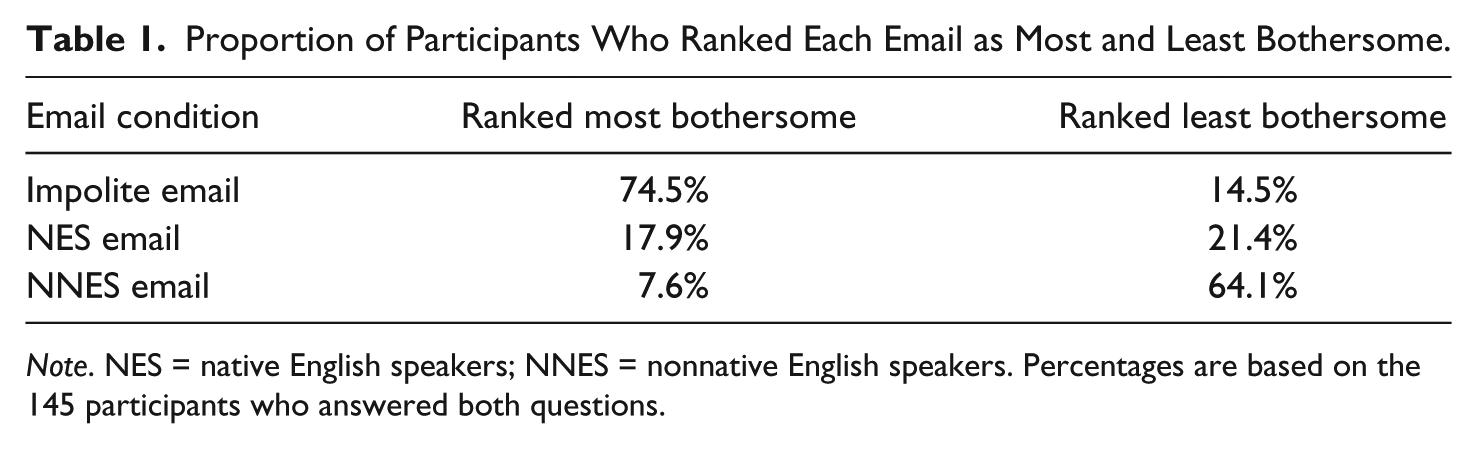
Note. NES = native English speakers; NNES = nonnative English speakers. Percentages are based on the 145 participants who answered both questions.
Table 2provides additional detail on how participants perceived the three emails. The first column ofTable 2indicates that participants were significantly more likely to consider Xiu as a potential employee than the other two writers,F(2, 476) = 15.05,p< .0001. Xiu was also the only writer considered to be an effective communicator,F(2, 474) = 6.71,p< .01, as demonstrated by the second column.
Perceptions of the Three Senders on a 5-Point Scale (1 =strongly disagree, 5 =strongly agree).

Note.NES = native English speakers; NNES = nonnative English speakers. If means in the same column have different superscripts, they are significant at thep< .05 level. If they have the same superscripts, there is no significant difference between them.
The third column ofTable 2indicates that participants were less inclined to respond to the impolite email than the other two,F(2, 477) = 11.02,p< .001. The final two columns indicate that the errors in Jamie Smith’s email (NES) were perceived as less acceptable and more distracting than those in Xiu’s or the impolite email. This finding may suggest (a) that despite our attempts to create equivalent errors between the NNES and NES conditions, the NES errors were more noticeable or (b) that participants found NNES errors less distracting because they were easier to forgive or understand.
One interesting finding, given that there were no grammatical errors in the impolite email, is that some participants nonetheless perceived it as grammatically flawed: 24 participants agreed (with three of thesestrongly agreeing) that they were bothered by grammatical errors in this email. One participant even noted grammatical errors as themostbothersome aspect of the impolite email. We suspect that many individuals without a background in language studies tend to characterize all writing problems as grammar issues.
It is also important to note that, even though there were differences among the three conditions,noneof the emails were perceived as very successful. This finding is not surprising given that all three emails contained major problems, as we discuss further below.
Participants explicitly made allowances for NNES writers
When we designed our study, we did not know if businesspeople would notice or care that the errors in one of the emails were typical of an NNES writer. However, one third of our participants mentioned in the open-ended comments that they recognized the NNES email was written by someone from another culture. Moreover, nearly one fourth explicitly stated they were more lenient with NNES writers, stating that they “cut some slack” or “give a pass” to writers who make prototypical NNES errors:
This email was almost certainly written by a non-native English speaker, and it’s easy to forgive mistakes like using incorrect plurals or adding in articles where they don’t belong because I know those things are tricky to learn. These mistakes didn’t impede Xiu Li’s ability to communicate and the overall tone of the email was still polite and respectful.
I presume that the person is a non-native English speaker, so the grammatical errors were acceptable to me. He/she still got their point across.
I can cut someone some slack for having English as a second language but I hold native speakers to a higher standard.
[The Jamie Smith] email bothers me because I assume they are a native English speaker and their grammar is terrible, as if they didn’t even try to write well or proofread. I would give [Xiu (Pat) Li] a pass because their errors made them sound like English is not their first language, and therefore I would be more understanding of their errors.
Some participants indicated that the name attached to the email suggested that the writer was an NNES, while others stated that, even without the name, they would have recognized the errors as typical of someone from a different culture:
Even without seeing a seemingly foreign name, it is clear to me that English is a second language of the speaker. Depending on the requirements of the position and where this applicant would be placed geographically, the grammar mistakes are something that I could overlook.
The grammar errors are obviously those of an English-as-a-second-language candidate, and while they are still bothersome and problematic . . . they do not necessarily indicate a lack of intelligence or attention to detail.
Like the participant above, 20% of our respondents stated that while the errors in Jamie Smith’s email signaled poor character—that the writer was either lazy, careless, or ignorant—these assumptions did not extend to Xiu Li due to the difficulty of mastering a foreign language:
Unlike the other two authors, Xiu’s email demonstrates neither disrespect or laziness and stupidity. Xiu is clearly still learning the finer points of English, but that by itself need not be a handicap in the professional world. While the other two authors manage to get across several negative personality and character traits, Xiu does not.
My initial assumption after seeing this email would be that the mistakes were due to English not being the applicant’s first language as opposed to a lack of attention to detail as was the case in Jamie Smith’s letter.
Moreover, the participants below indicated that the degree of emphasis they would put on the errors would depend on the exact nature of the position:
While it’s noticeable that this person’s first language may not be English, they are still able to effectively and intelligently communicate their points. Again, it depends on the amount of external interactions they have or if their role includes interactions with customers or clients.
While very good grammar is important in most of the jobs I oversee, errors due to simple language differences are surmountable. (I currently have two English as a second language speakers in my group, and we have mechanisms in place to check their important outside communications for any significant issues.) . . . The email did indicate that the person is apparently fluent in English and the meaning was very clear.
These comments indicate that many employers can recognize and are willing to make allowances for writers working in a second language. These employers, like many instructors, recognize how difficult it is for NNES to write error-free prose. Whereas errors made by NES writers suggest carelessness, those made by NNES writers appear much more forgivable.
However, this does not mean that all of our participants gave Xiu a pass. The participants below expressed concern that the writer would not be able to function in his or her work environment or that the writer did not have the professionalism to obtain help proofreading:
It’s clear what they mean but the mistakes would make me worried about their ability to write for professional use.
This formal letter should have been checked by the student’s support network. It obviously wasn’t so they, in my opinion, lack the social skills to work with people to hit a level of quality before formally communicating.
I’m not bothered by the grammar—it’s obviously second-language, etc., and I appreciate that Pat is being proactive. It doesn’t feel pushy. Most bothersome is that Pat didn’t ask a native speaker for a quick edit.
These findings indicate that while many employers recognize errors made by, and sympathize with, NNES writers, students contacting potential employers should ask for proofreading help, as they will likely be expected to do on the job.
The impolite email was bothersome due to the demanding language, casual tone, and lack of appreciation and context
As discussed above, the email with pragmatic errors was most bothersome for the overwhelming majority of participants, who characterized the email as “demanding,” “pushy,” “entitled,” or “aggressive.” Perhaps the most commonly cited reason for this perception was the “as soon as possible” at the end of the email, which was mentioned by one third of participants. The second most frequently cited reason for finding this email unacceptable was its informality, mentioned by another 30% of participants, many of whom cited the casual salutation. Such informality was seen as a serious lapse that, for many, indicated character flaws:
The casual nature of the message gave me the impression that the applicant would not take the job seriously.
This person’s youth shines through as he/she seems to be a millennial who believes it’s okay to address hiring managers familiarly by their first names and that their timeline (registration is next week) is what’s important here.
I reacted negatively to the statement “I also need to know what classes you took.” That came across as pushy and presumptive—it should be a question, not a demand.
Their rudeness trumps the grammatical errors of the others. Why would anyone ever want to work with a rude person? Even if they were brilliant at what they did, ultimately, a work environment requires cooperation between coworkers . . . I imagine this person would not be able to offer much in terms of good work just because they would most likely conflict with others constantly and in turn slow down the productivity of other workers.
Of the 40% of participants who found the email demanding, about 10 individuals specifically mentioned the writer’s choice of verbs as contributing to the message’s demanding tone:
It’s very demanding. I WANT this . . . I NEED to . . .
[Most bothersome was] the use of “want” instead of “would like” or “would appreciate.”
The use of “need to know” implies that I’ve already accepted an obligation to respond.
Such verb choice issues actually exemplify the demanding tone thatMaier (1992)andHartford and Bardovi-Harlig (1996)found in the correspondence of NNES students. A phrase such as “I want” is linguistically much simpler than the softer “I would like” or “I would appreciate” that one participant recommended. Although NNES students would have a much more difficult time formulating these softening phrases than their NES peers, it is unclear to what extent businesspeople might provide allowances for these problems from an NNES writer.
Twenty-five percent of participants also noted errors of omission in the impolite email. Several commented that the writer failed to express any appreciation for the audience or even acknowledge that he or she was placing demands on the reader:
If I’m being asked a favor I would like to get the impression the person asking is aware that it is, in fact, a favor.
If I’m going to be going out of my way to help someone, I would want them to seem more appreciative and grateful for my time.
Too casual and demanding, gave no introduction or context and did not show appreciation or even seem to understand they were asking a favor of the employer.
Such findings, while perhaps unsurprising, do provide compelling data for writing teachers who wish to insist that student emails be polite, appreciative, and appropriately formal.
Grammatical correctness was still very important for most businesspeople
Although the impolite candidate was overwhelmingly ranked as the most bothersome, grammatical errors were still a noteworthy problem for participants. Over one quarter of our participants found the grammatical errors in the NES and NNES email more bothersome than the impolite email—and even many of those who ranked the impolite email as most bothersome indicated that the grammatical errors in the other emails were still unacceptable.
Over 20% of our respondents explicitly stated that the grammatical errors in Jamie’s email suggested character flaws:
The grammatical errors in this email first and foremost demonstrate a lack of respect. Regardless of the author’s command of the English grammar, the email could have been edited using one of many readily available tools . . . That this was not done shows laziness, a lack of concern for the result of the communication, an indifference to the image projected by the email. My biggest pet peeve as a hiring manager is people like Jamie Smith that come looking for work with such gross grammatical errors in their emails and resumes.
Given the ubiquitous nature of tools with built in spell and grammar checking, there is no excuse other than sloppiness and laziness for these kinds of mistakes. Needless to say, these are not the qualities I look for in an employee.
Not worth my time as an employer . . . as they will likely be sloppy or not value things that our company values.
The grammar showed a lack of time and attention on the part of someone who is most likely a native English speaker. This is sloppy and unacceptable. If this person is trying to impress me and this is the best this person can do, I’d hate to see a bad day on the job.
These comments echoBeason’s (2001)andBrandenburg’s (2015)findings that businesspeople often perceive grammatical errors as indicative of much larger problems with an employee. The following advice provided by the recruiters attests to the fact that students should be aware of the ethos they necessarily construct with any written communication:
Every touchpoint with an employer gives a hiring manager a chance to assess you. Managers will be looking for signs of your intelligence, professionalism, and attention to detail.
Proofread your emails to employers, I wouldn’t give these emails any more than 2 seconds each and I probably would have stopped after the first error. If you’re going to be emailing someone and asking for a job you have to make the email professional.
Even short communications should have a second set of eyes looking at them. All it takes is one flaw that gets under the reader’s skin to turn them off to you (whether that’s fair or not!). Sometimes, these short informal communications have even more weight than a resume, especially in a competitive situation—it’s expected that resumes get a lot of review and proof reading, so non-standard letters and emails can tell you more about that person’s actual written communication skills.
Clearly, the amount of time and care necessary for professional correspondence should not be underestimated since employers use such communication to make deep character judgments about the applicant.
Participants were also bothered by the email’s unfocused purpose and broad request
We deliberately chose an email thatwas notapplying for a job position since we feared that such a high-stakes context would cause participants to insist that the communication be perfect, thus obscuring any allowances they might make for NNES errors. However, many participants expressed confusion over the purpose of the email, wondering whether the writer was, in fact, applying for a job. This seems to suggest that all three emails violatedGrice’s (1975)cooperative principle of relevance, as nearly 40% of participants commented on the purpose of the email. Many stated that they found all three of the emails bothersome because they did not have time to answer such broad requests for advice.
Many participants volunteered that the writer should have spent more time researching the company and crafting a more specific request. Such effort on the writer’s part would demonstrate respect for the recipient’s time:
This candidate is asking for a lot of time—way too much for what I have. . . . I don’t have time to outline all the skills I’m seeking in a candidate (they’re generally listed on our job descriptions). If this person is a self-starter (i.e., the type of person we need), he/she will figure it out themselves, and come back with either a concrete application, or really detailed questions that show they’ve taken the time to learn more about our company, our needs, and how they fit into that.
The “ask” is too broad. It would take me some time to respond to this email . . . Much better would be to offer me a few choices; e.g., “should I take class X, Y, or Z?”
The broad request for additional information was most bothersome. As a company receiving hundreds if not thousands of applications for entry level roles, it consumes a lot of time emailing back and forth with students who request more information. We always specify the role qualifications and responsibilities in our job descriptions by listing skills we require. . . . A generic “tell me more” approach from a student makes the applicant appear as though they didn’t thoroughly read the job description, or didn’t understand the role as well as their peers who applied without questions.
College recruiters drown in email. My first reaction to these requests is “I don’t know you. Please just read the job description and figure out the coursework from that.” My suggestion would be for students to attend the career fair.
Such comments about respecting readers’ time parallelHairston’s (1981)finding that, more than surface features, professionals were concerned about “lack of clarity” and economy (p. 798).Beason (2001)likewise notes that nearly all of his participants emphasized the importance of matters such as logic, organization, and conciseness—even though his questions focused on mechanics. Our participants likewise indicated that time is precious, and candidates who do not indicate respect for their readers’ time are unlikely to receive a response.
Discussion
As stated in our introduction, the primary purpose of this study is pedagogical: We want to validate our choices when we offer NNES students grammatical leniency, and we want to persuade students to adopt professional behaviors in all of their communication. Consequently, our discussion is organized around this study’s implications for teaching.
Our first finding suggests that our current practice of giving NNES students some leeway for grammatical errors is merited—at least as long as those errors do not interfere with comprehension. Respondents still found grammar errors distracting, but Xiu was the only individual who most businesspeople would consider as a potential employee. Nearly one fourth explicitly volunteered that they were more lenient with errors by NNES writers. For these employers, NNES errors are evidence of language learning rather than carelessness or laziness and thus are generally not judged as severely as errors made by native speakers.
Our findings can also be used to help persuade NNES students and disciplinary faculty that instruction in conventions, such as pragmatics, should be prioritized over instruction focused on eliminating grammatical errors. A large majority of our participants judged pragmatic errors as more bothersome than grammatical errors. Interestingly, many of these politeness errors are ones NNES students are inclined to make (Hartford & Bardovi-Harlig, 1996;Maier, 1992), but there was no indication from our participants that these errors could be due to cultural or linguistic differences. Although the impolite email may have been more tolerable if we had appended a foreign name to it, it is still likely that participants would find the tone problematic. Such findings suggest that we should prioritize teaching NNES students grammatical forms for softening requests—such as using the query preparatory acts “Would it be possible . . . ” or “I would greatly appreciate it if you could . . . ”—over eliminating minor grammatical errors such as incorrect pluralization or misuse of articles. Future research on this topic should examine whether businesspeople are able to recognize pragmatic errors as being characteristic of a second-language learner, and if they make allowances for such errors.
We also hope these findings will be useful to instructors who are considering a stronger focus on professional correspondence in their courses. We suspect that many students (unlike their instructors) may be surprised athowobjectionable potential employers find certain errors. Such was the case withCharney, Rayman, and Ferreira-Buckley (1992), who found that students underestimated the extent to which professionals would be bothered by typos on résumés.
Our participants’ extensive comments illustrate how important attention to detail can be in all communication with a potential employer. We have distilled the numerous suggestions into four main recommendations for students to remember in their job application process and future workplace communication:
Acknowledge the imposition the writer is placing on the reader. Writers should avoid the appearance of making demands, work on the reader’s timetable, and express gratitude.
Make it as easy as possible for the reader to respond. In some cases, this may mean finding the information oneself rather than sending an email. Participants made it clear that they questioned the work ethic and independence of writers who failed to find easily available information. In addition, writers should make requests as specific as possible, so the reader can respond with minimum effort.
Adopt a formal tone to show that the writer is serious and understands his or her position relative to the reader.
Proofread and ask friends or others to proofread before sending. Even in low-stakes communication, error causes readers to form negative impressions of the writer.
We have received a highly positive response to initial attempts at pragmatic instruction. One of the study authors began her most recent course by assigning students a video summarizing the parts of this study focused on employers’ reactions to impolite emails. She told students she would be evaluating all of their email correspondence for the semester as if she were their work supervisor. Students were told that any unprofessional emails would receive a request to revise before the instructor would respond. Since this short intervention, this instructor has seen dramatic changes in the emails her students have sent. In their emails, students have uniformly employed proper salutations, made clear requests that show concern for the instructor’s time, used polite phrasing, and proofread for errors—a satisfying and most welcome change from previous semesters. In addition, these results have been met with high interest—from undergraduate and graduate students—during campus workshops on professional communication.
When we embarked on this study, we initially worried that the emails we had composed were too extreme and that no one would send correspondence with so many problems to a potential employer. However, several participants emailed us privately to tell us that such egregious errors were not uncommon and to thank us for our research. These anecdotes suggest that some students need explicit warnings about sending careless or cavalier correspondence to employers.
There are, of course, many limitations to our study. When initially designing all three emails and selecting the errors, we did not consider errors of omission, such asnotthanking an employer for their time. These errors, however, were frequently noted as bothersome by participants, especially in the impolite email. Thus, it may be more flawed than the other two conditions, thereby exaggerating the extent to which participants are offended by impoliteness.
Future research might also try to disentangle the extent to which the names versus the types of errors influenced participants’ perceptions. When we first started, we were unsure if businesspeople would recognize that certain errors are typical of NNES; thus, to increase the likelihood that they would make this connection, we added a Chinese name to the NNES email. Since we now know that a sizeable number of businesspeople do make allowances for some grammatical errors when they believe the speaker is from an NNES background, future research might assess the extent to which businesspeople would recognize these errors and make these allowances if the writer had a typically Anglo name. Moreover, to avoid the possible risk of stereotyping Asian speakers of English, future research might use the same name across multiple emails or different names on the same email. Future research might also test whether readers would be similarly lenient of NNES errors typical of a native Spanish speaker or French African speaker. Such research might indicate how assumptions about a person’s socioeconomic status affect their ethos construction.
While this study could be dismissed on the grounds that we are simply reaffirming our existing beliefs, we would argue that it is important to put these beliefs to the test—and to collect data that can persuade skeptics to accept our pedagogical practices. Prior researchers have found that faculty in science and engineering tend to be less forgiving of error than those in the humanities (Roberts & Cimasko, 2008;Santos, 1988;Vann et al., 1984), and these are the instructors who will be most persuaded by data. We hope that our findings can help us persuade those outside of our discipline that good writing requires more than just good grammar.
Footnotes
Authors’ Note
This study was approved by the Institutional Review Board of Carnegie Mellon University. Participant comments are reproduced by permission.
Declaration of Conflicting Interests
The author(s) declared no potential conflicts of interest with respect to the research, authorship, and/or publication of this article.
Funding
The author(s) received no financial support for the research, authorship, and/or publication of this article.
Author Biographies