



Abstract
Despite the excellent work by scholars who invite us to consider disability, social justice, and business and professional communication pedagogy, little attention has been given to what a disability- and social-justice-centered business and professional communication course might look like in design and implementation. This case study offers an example of a simulation based within theHarry Potteruniverse that emphasizes the ways disability advocacy and civic engagement manifest themselves in foundational business writing theories and practices. This simulation enabled students to engage with social justice issues by understanding access as an essential part of business and professional communication.
Given the practical focus of business communication pedagogy, instructors of business and professional communication continue to push to find new ways for students to apply the foundational concepts of business and professional communication they learn in our classrooms. Scholars such asHaas (2012),Hunsinger (2006),Palmeri (2006), andGrabill and Simmons (1998)have insisted that students must have the chance to see their roles as business communicators within dominant power relations and corporate interests. In doing so, students will see the practical effects of business and professional communication theories and methods, which can lend themselves to conversations around access, usability, and social justice, among other issues. In response to these calls, I developed and delivered a business and professional communication simulation that specifically addressed these issues, based on my own investment in disability studies and social justice.
Simulation in the classroom has been defined in multiple ways.K. Jones (1995)defined simulation as an event that is sustained by roles taken on by each participant, who then responds to simulated problems with the appropriate information available to him or her.Hildebrand (1997)argued that a simulation is simply the inclusion of elements of one reality into another. In this way, simulations are ideal strategies for providing ways to begin difficult and sensitive conversations about situations or problems that would not be addressed in a more traditional learning model. In my own experience, social justice is not so easily integrated into traditional business and professional communication courses, given students’ insistence that business and professional communication is not, and cannot be, political. Thus, while several scholars (Crookall & Thorngate, 2009;Farrell, 2005;Kolb & Kolb, 2009;Russ, 2011a,2011b) have argued that simulations provide a more engaging teaching environment, I argue that the value of students’ engagement is that it gives rise to more accessible teaching environments—that is, because simulations rely on an experiential learning model characterized by participation, reflection, application, and inductive reasoning (Alon & Cannon, 2000;Drury-Grogan & Russ, 2013;Ismail & Sabapathy, 2016), simulation exercises provide more diverse educational opportunities for students.
Despite the excellent work by scholars who invite us to consider disability, social justice, and business and professional communication pedagogy (Colton & Walton, 2015;Meloncon, 2013a;Oswal & Hewett, 2013;Palmeri, 2006), little attention has been given to what a disability- and social-justice-centered business and professional communication course might look like in design and implementation. This case study offers an example of such a course: a simulation based within the universe ofHarry Potterthat emphasizes the ways disability advocacy and civic engagement manifest themselves in foundational business writing theories and practices. First, I begin with an overview of my course design and objectives. Then, I provide an analysis of the course, focusing on the core concepts and assignments, including the final project. Last, I explore the pedagogical benefits of social justice engagement, simulation, and theHarry Potterseries to demonstrate the need for our field to recognize the value of embodied knowledge and the degree to which the relationship between writing and disability is a global concern.
Course Design and Objectives
This introductory business communication course emphasizes that business and professional writing and speaking are culturally situated processes. To this end, students centralize accessibility for their intended audiences in their approaches to their assigned writing tasks. My class consisted of 16 students in their first and second years who were taking my course to fulfill their general education requirements. I had students in a variety of majors, none of whom were writing majors. The objectives and outcomes for the course were as follows:
Understand and apply basic business communication principles and strategies, including invention, drafting, critical thinking, problem-solving, technical proficiency, and presentation.
Identify the ethical, legal, cultural, and global impacts on and from business communication practices.
Demonstrate an awareness of audience and purpose, and select appropriate communication formats and channels.
Work collaboratively in groups with an emphasis on rhetorical listening, critical and reflective thinking, and responding.
Underlying these objectives was the challenge for students to understand how rhetorical appeals and document design function for various audiences across a variety of contexts. Accordingly, students were responsible for providing analyses of the rhetorical situations that arose throughout their planning and for providing support for their decisions about effective and accessible professional communication design. Students explored alternative ways to effectively connect with varying communities and to define communication and technology as they relate to varying differences and abilities. I identified three primary skills students need in order to design accessible communication: Students must be able to (a) evaluate the users’ communication needs in the specific rhetorical situation, (b) identify the essential function of any communication technology or tool, and (c) effectively use a communication technology or tool to respond to the communication needs. I saw this course as a way to prepare students to write across different settings and experiences by linking writing, cultural studies, and disability studies.
The Simulation
While only the final project proposal was set within theHarry Potteruniverse, students usedHarry Potteras a springboard to engage business and professional communication with citizenship, social justice, and disability advocacy in our discussions of core concepts. Several scholars (Harrell & Morton, 2002;Nexon & Neumann, 2006;Podemska-Mikluch, Deyo, & Mitchell, 2016) have argued that theHarry Potterseries provides readers with an opportunity to engage in citizenship and advocacy, since the series is an example of how to function as intelligent and responsible citizens. Furthermore, the series is set in a world where the evolution of technology has slowed in several areas—for example, the use of quills and parchment for writing, fireplaces for heating, and candles and gas lamps for lighting. Most important—and relevant to the design and goals of this course—is the reliance on and access to magic-based means of communication. While everyone has access to the Owl Postal Service (the magical equivalent to the postal service), the Floo Network (the magical equivalent of a telephone), and the radio and newspaper services of the wizarding world, the other forms of communication that author J. K. Rowling includes in the series are either difficult to perform (the Patronus Charm, Two-Way Mirror) or have limited usefulness (the Protean Charm, interdepartmental memos). Moreover, as students who are familiar with the series know, the lack of accessible and effective communication technologies and skills serves as a critical premise of several storylines.
Most important, I understand theHarry Potterseries to be a story about disability and eugenics, with a plot driven by the power of the business and professional communication documents and practices circulated by the wizard government. The documents and practices that condition a world of medicalizing and eliminating bodily difference—in particular, the Muggle-Born Registration files that delineate the genetic requirements of acceptable blood status of witches and wizards—mirror the practices of whatSnyder and Mitchell (2006)have called the eugenics era of disability in the United States. Scholarship on the eugenic undertones of the series (Agar & Terk, 2015;Chatterjee, 2013;Helgesen, 2010;Lyubansky, 2006) has typically focused on the racial dynamics of the series; thisHarry Pottersimulation, however, explored the relationship between eugenics and disability. Many scholars (Bérubé, 2016;Napolitano, 2016;Weaver, 2010) have observed the role and presence of disability in the series, generally agreeing that the series provides useful entry points into understanding disability within the social context (Weaver, 2010). Basing the simulation within a specific historical and cultural moment in a fictional setting enabled students to explore historical and cultural contexts in their own world that affect the access their favorite characters have in the fictional world. For example,Katz’s (1992)exploration of technical and business writing for eugenic purposes during the Holocaust resonated with students’ understandings of the documents produced and disseminated by the Ministry of Magic under Voldemort’s regime. Additionally, when reading excerpts fromCharlton’s (2000) Nothing About Us Without Us, students frequently invoked Hermione Granger’s establishment of the Society for the Promotion of Elfish Welfare and corresponding manifesto and mission statement as a way to ensure their writing made a space for the agency and subjectivity of marginalized peoples. In earlier versions of this course, students were not required to work collaboratively on final projects as they were in the course I describe here. In this course, they were more varied and reflective of their own interests and needs. For example, an architecture student created a model for a Quidditch stadium based on the concept of universal design, a writing major outlined an act regarding the rights of werewolves based on the Americans with Disabilities Act, and an education major designed a curriculum for magical students that included histories and perspectives of nonhuman magical beings and nonmagic peoples.
Given the success and ubiquity ofHarry Potter, even the students who did not identify as fans of the series recognized the brand and engaged with the in-class simulation, automatically placing them into whatJenkins (2006)called a “participatory culture.” A participatory culture is built on and sustained by informal peer-to-peer mentorship, wherein each member of a group acquires new knowledge by tapping into the expertise of his or her peers. In this way, students with only a cursory knowledge of the series could benefit from this learning opportunity. Indeed,Jenkins (2006)argued that because of participatory cultures’ likeness to whatGee (2004)called “affinity spaces”—that is, groups formed around shared interests, goals, or activities—they represent ideal learning environments that emphasize experimental, innovative, provisional, flexible, and localized learning opportunities. Participatory culture thus provides opportunities for young people to engage in civic debates and participate or even become leaders in their communities, even if those communities are limited to multiplayer games or online fan spaces (Jenkins, 2006). In this way, participatory culture provides access for students to engage in civic and social justice issues in their own world by seeing these same issues at play in a fictional world in which they are engaged.
Along these lines, the course objectives and design underscored the skills needed when facing real-life organizational and workplace conflicts. Assignments and final projects required students to demonstrate best practices learned in the classroom, including the implementation of feasible solutions to the problems the course assignments posed. Employing a simulation offered an ideal opportunity for students to apply their understanding of effective business communication practices across varying challenges and to understand the effects of their choices. In order to emphasize the practicality of the work they were producing, each unit was divided into two: The first half focused on the foundations of best practices in business communication, and the second half focused on the implementation of those practices. The value in keeping the theory and practice so close together was twofold: First, it served as a reminder of how interdependent theory and practice are—a critical recognition given the simulation’s emphasis on the effect that theory has on bodies within a eugenic context—and second, it reminded students that there are always new and effective ways to approach and implement foundational tools across business communication practices. In this way, the simulation allowed students to see how the foundational concepts and practices of business communication apply in all business and workplace-related situations, fictional or not.
Structure of the Course
The course described here was the third iteration of the business and professional communication course set in theHarry Potterworld. The course centered on the students’ semester-long project, which was to organize a sporting event (Quidditch World Cup) for the wizarding community with particular emphasis on universal design principles. Universal design is a set of ideas and concepts that underscore access to as wide a range of people (and abilities) as possible. The simulation followed a model based on sports management, specificallySolomon’s (2002) An Insider’s Guide to Managing Sporting Events. In this version of the course, students purchasedMarkel’s (2012) Technical Communication(10th edition), as well asSolomon’s (2002)text. I also required students to purchaseNexon and Neumann’s (2006) Harry Potter and International Relationsto help them understand and negotiate the tensions that arose in theHarry Potteruniverse in the wake of the Second Wizarding War. These tensions were addressed in the course description that appeared in the syllabus. Because sports are often a conduit for bringing people together, particularly in the aftermath of a national tragedy, organizing a global sporting event after a major war in theHarry Potterworld provided the opportunity for me to have conversations with students about coming to terms with the changing national and personal identities in the wake of major societal changes.
Primary documents (what I refer to ashistoricaldocuments) were also integrated into the course with an emphasis on documents around planning for the 2016 Olympics. I chose them for two reasons: First, the Olympics is a large-scale, international sporting event, and the writers and organizers often have to attend to the same kinds of issues I ask students to consider in their own planning. Second, most of these documents were released in the months before the course began, so they were easily accessible on the official website of the 2016 Olympics in Rio (www.Rio2016.com/transparencia). The website has since been taken down and rerouted to the official Olympics website, without access to the documents.
Course Schedule
The course schedule was organized by the core concepts, with each concept corresponding with the assignments for that unit (see theappendix). The course was divided into eight units, with 2 weeks per unit. The class met twice per week, on Tuesdays and Thursdays for 90 minutes. At the start of each unit, students were given copies of the deliverable requirements and the lesson plan for the unit so they could begin working immediately.
The first week of the unit focused on theory and discussion with an emphasis on core concepts of business and professional communication. Historical documents were used to contextualize the role of writing in policy creation and enforcement within the context of ethics in professional writing; four primary sources were assigned to each unit. Students chose one of these sources, and the homework on Tuesday night was to review the source and prepare a talking point to be brought up in the discussion for Thursday’s class. This talking point was an opportunity for students to articulate in their own words how each document did or did not follow best practices for business communication. The purpose for reading the primary sources was for students to develop a thorough understanding of the presence of disability and its relationship to access, safety, funding, and the agency of persons with disabilities. Engagement with these texts was characterized by the students’ ability to speak to the intersectionality present in each text and was demonstrated by the discussion, the talking points, and the unit reflections. After choosing one of the four documents, students teamed up with other students who had chosen the same source (these teams changed weekly, as different students chose the same document, and are not to be confused with the teams for the major project described below). Discussion always followed the same format: We began by reviewing the core concept discussed on Tuesday; each student would share a talking point on the primary source; and finally, the class discussed the talking points and the varying approaches to the core concept found in the primary sources.
Tuesday of the second week was spent working in class with their final project teams, which were decided the first week of the semester. Students divided themselves across four teams based on their interest: legal, financial, management, and marketing and sponsorship. To join their desired teams, students were required to give themselves a job title and provide a cover letter and résumé as if they were applying for the position. Team members were required to “interview” each other for their desired positions and provide written feedback to me. On these Tuesdays, teams worked on the deliverables for that unit. Thursday was presentation and reflection day. The presentations were of “works in progress,” as the final deliverables for the unit were not due until the following day, on Friday. Teams also scheduled additional meetings outside of class sessions. Although no units were dedicated specifically to the following concepts, they were emphasized in the weekly class discussions throughout the semester, and teams were responsible for considering them when creating their deliverables: ethical and legal considerations of business communication, the role of the business communicator, writing process (drafting, revising, editing, and proofreading), audience analysis, writing effective sentences, and oral presentations. Students (and teams) were held accountable for demonstrating an engagement with these concepts in their assignments.
The deliverables were directly related to theHarry Pottersimulation and were completed cooperatively among the four teams of four students each. Tuesday of the second week of the unit was spent working in class within and across teams. The value of this approach is the emphasis on students practicing collaboration strategies and situating their ideas about their own work and approaches to the deliverable within the larger assignment. While I suggested tasks for each of the four teams (legal, financial, management, and marketing and sponsorship), I did not assign specific tasks; it was up to the students to take the lead on certain tasks, which included working across teams, not just within them. Thus, students were forced to consult with other teams and members of their own team across varying assignments to make decisions and hold each other accountable for the work done. To ensure this accountability, accompanying each unit deliverable was a collaboratively written team report on the team’s strategies, operational decisions, and the results achieved (called a “participation report”). Each student’s contribution was summarized, and every student on the team signed this report. I was fortunate that no discrepancies among students’ accounts came up in this particular course. I attribute that to the fact that the class was advertised as aHarry Pottercourse, prompting students to feel like they were members of a participatory culture that encouraged them to feel that their contributions mattered to their peers (Jenkins, 2006).
Most important, the participation report had to demonstrate the ways in which their work for the unit was sensitive to varying communication needs and rhetorical situations, provide a rationale for the communication technology they chose for presenting the deliverable, and further acknowledge how they used this technology to respond to access needs. Students also had to include a self-evaluation and a peer evaluation that was seen only by me. In these evaluations, they assigned a grade to themselves and to their teammate and provided evidence for their decision. To determine the individual grades for each student, I considered the grade I had assigned to the entire project, the student’s self-assigned grade, and the average of all peer grades in the peer evaluations. Further descriptions and requirements of the deliverables can be found in theappendix.
Final Project Portfolio
All the assignments culminated in the construction of a project portfolio that consisted of all the deliverables, which had been revised based on my comments. Because the entire class produced each deliverable collaboratively, the contents of the final portfolios that the students turned in were largely the same; the task of each student was to edit, curate, and deliver the portfolio as he or she saw most appropriate. More than half of my students turned in hard copies of the portfolio, while the others created websites with all the information in one central location. In addition to including the required deliverables, students had to include an updated résumé and a cover letter that outlined their revisions, the reasons for their choices, and a reflection about the process of editing and curating a project portfolio. A central emphasis of this assignment and the overall course was on language and design, and the potential both have to promote accessibility or exclude certain audiences and stakeholders; along these lines, students were also required to demonstrate how the design of their documents considered the needs of the audience to which they were writing, but, more important, how that design might restrict persons with disabilities from gaining the kind of access the students had attempted to create.
Did It Work? Business Communication and Social Justice
N. N. Jones and Walton (2016)defined social justice research and pedagogy in terms of agency, collaboration, and engagement. With the space to collaborate, students felt a sense of agency and inclusion, demonstrated by the initiative many students took in order to ensure access of all kinds in their unit deliverables, including providing documents in multiple languages (including Braille) and multiple formats. Very quickly the class became less about how characters such as Mad Eye Moody (a disabled veteran with a magical glass eye) might navigate his way through this postwar sports spectacular and more about why and how sports venues, for instance, have the capacity to separate spectators based on class, ability, gender, and race. In this way, their desire to accommodate a fictional character transformed into a desire to interrogate accommodations and access—more specifically, the lack thereof—and encouraged them to understand how access and participation are conditioned by the contexts in which they arise.
More important, attention to accommodation gave students the drive to interrogate the implications of those sites and to treat them as representative of the values and cultures that built them. For example, in Unit 4 (Location/Venue), students were passionate about the venue choice—whether to build a new venue or use an existing one—often appealing to the access an existing venue offered, including parking for mobility-impaired guests. I urged them to consider the transportation technologies of theHarry Potteruniverse and asked them what the value of parking spaces would be to wizards who would likely arrive via magical means. Many students replied that transportation was not the point: Even witches and wizards have a right to choose whether they want to be magically transported to the venue or to arrive with other, perhaps nonmagical, guests. What ensued was a lively discussion of how the accessible parking should be designed; drawing on the design of accessible parking on campus, students brainstormed ways to improve this system. In fact, many students who were in this class went on to produce a report about access on campus, citing this particular unit as a motivating factor.
Indeed,N. N. Jones (2017)argued that once our pedagogical practices as teachers of business and professional communication are reconsidered in light of students’ agency, positionality, and inclusion, the business and professional communication class activities can become a grassroots way for thinking about diversity and social justice. In this way, an emphasis on agency is fundamental to a social justice approach to business and professional communication pedagogy: the agency of the communicator and the agency of the audience.Meloncon (2013b)argued that the body is what generates agency and that understanding it as a tool allows us to maintain an emphasis on agency at the forefront of all communicative efforts. Focusing on the bodies of the writers and audience, access becomes the central point around which ethical and effective business and professional communication practices can emerge.
Similar to a shift in the goals of the disability justice movement, this course serves as an appeal to shifting our structural beliefs about access.Shapiro (1993)described the disability justice movement as a “mosaic movement” that centralizes diversity and seeks to dismantle the systems of what leading disability activist blogger MiaMingus (2011)has called an “equality-based model of sameness” (para. 5). Where access and movement toward universal design and user-centered environments motivate most of the work at the intersections of disability studies and business and professional communication, disability justice asks us to move beyond access and “question a culture that makes inaccessibility even possible” (Mingus, 2011, para. 6). Thus, while the intersection of business and professional communication and disability studies provides a way to reimagine access, disability justice asks us to reimagine inclusionafteraccess. Disability justice looks more toward a social justice model that lends itself to and relies on intersectionality and interdependency so as to understand the varying experiences of being disabled. Emphasizing this approach in a business and professional communication classroom simulation provides students with a more nuanced framework for what it means to communicate effectively to specific audiences with specific access needs. When students are given agency in shifting their understanding of communication from a nondisabled center to a disabled one, the agency of people with disabilities is no longer enveloped in narratives of charity or care. When students learn the fundamentals of business and professional communication practices in a simulated workplace environment where access is expected, access and equality for people with disabilities is no longer something to be provided; rather, it iscreated, not as a retrofit but as a hallmark of effective and ethical business communication.
Conclusion
K. Jones (1995)noted that simulations provide an opportunity for students to make mistakes or even fail in a low-stakes environment. This is not to say that simulations set students up to fail but rather that simulations set students up to practice a form of communication that centralizes the voices and needs of as wide an audience as possible. This approach to simulations as something that engenders mistakes proved to be a crucial lesson for both my students and me. This course certainly had its unsuccessful moments: It was difficult at first for students who were not familiar with or fans of theHarry Potterseries to become comfortable with the simulation; many students wanted the class to be a class aboutHarry Potter; and as with most introductory writing courses, getting students to work collaboratively and offer constructive criticism to one another was difficult. However, on the whole, many problems I faced in earlier versions of this class were resolved by resituating my own role in the classroom. Unlike traditional pedagogy, teaching a simulation required that I step back and allow students to fail; stepping back allowed students to discover their own agency and value the agency of others. In other words, giving students the power to set their own course of action validates students’ experiences, knowledge, language, and culture, which, in turn, can help them develop their social and cultural identities and enable them to understand their history in meaningful ways. Students gain a sense of personal and social agency that extends to the world outside the classroom as well; they begin to feel as though they have the power to make a difference and to see themselves as makers of, as well as part of, history (Freire & Macedo, 1987). Therefore, what made this simulation successful—as opposed to the two earlier attempts—was its immersive nature.
I, too, had to situate myself within the simulation along with my students, and not just as the arbiter of it. I was their guide as we talked through the theories and practices of business and professional communication principles, and I drew on my own deep knowledge of the series to be their audience as they developed their own documents. By this, I mean that I took on the roles of the characters to whom they were writing. At the outset of each unit, I gave them the name of the character I would be and provided them with a quick reference guide for where they would find more information about these characters in the series and beyond. This became an exciting way to teach them audience awareness, as some of the characters I took on were former death eaters, war heroes, or even magical creatures. It was up to the students to decide how to pitch their documents to me based on my character’s place in the wizarding war.
More important, in choosing a simulation to facilitate difficult discussions, I had to balance the need to make the simulation realistic but not so real that it appropriated the experiences and stories of others. In an argument against using simulations to teach the Holocaust,Totten (2000)warned that simulations minimize, simplify, distort, and deny the complexity of oppression and the horror of genocide. With this in mind, I chose to useHarry Potteras a simulation because of the number of primary source materials associated with it: the Muggle-Born Registration Act, newspaper articles, Ministry of Magic documents, and even the characters’ own experiences and responses to the world around them. I was careful to draw only on these sources as a way for students to contextualize their project: The Quidditch event they were tasked with organizing was presented to them as the first after the conclusion of a brutal war chronicled in theHarry Potterseries.N. N. Jones (2017)has reminded us to recognize and embrace the concerns of students and ourselves within the political and politicized contexts in which we teach. In this way, students were not simulating the eugenicist practices against unwanted peoples in the series but rather responding to their situated and contextualized concerns so as to begin moving forward. Of course, this could only be done once the realities of the war’s horrors had been discussed and taken into consideration as they planned. It was during these moments when students drew on their own knowledge of the real world to try to understand the task they were taking on. For example, when discussing the design of the Quidditch stadium, a discussion ensued about the placement and accessibility of the top box; fans of the series know that the top box is accessible only by stairs, and that apparating—or teleporting—to it is illegal for security reasons. When the students wrote the official site proposal, they had to balance the security breach that had happened in the top box at the previous Quidditch World Cup with the need for access. To account for this need, students included a description of a network of transportation modes and guidelines that supported accessibility and connectivity without compromising security. Thus, what made this simulation successful—as opposed to my two earlier attempts—was my full commitment to both the simulation and taking on these uncomfortable conversations in a way that honored the real-life experiences and histories the students drew on in order to understand the simulation. AsGutstein (2003)argued, an essential part of social justice pedagogy is the students’ involvement in the solution to injustice. This involvement is possible only when students are given the opportunity to see their own experiences and knowledge as a valuable part of the learning process. Indeed, once students begin to consider questions that have meaning in their lives, they are more capable of grasping the systems, structures, and power relations that form their experiences. Simulation can create spaces for students in the business and professional communication classroom to consider the “unquestioned norms, habits, and symbols” that uphold marginalization, disenfranchisement, and disempowerment (Young, 1990, p. 41).
The value thatHarry Potterprovides to a simulation is the engagement with disability and embodied difference in direct ways—that is, in ways that help students see the impact their understanding of normality and difference has on their communication practices and productions. Rowling’s emphasis on Harry’s embodiment and sensations engenders a similar embodied identification between the text and the reader. Engaging in this kind of simulation, then, asks students to consider their relationship to their bodies, writing, and the cultural practices that shape their understanding of difference. With this understanding, students are able to engage with social justice issues by moving beyond seeing access as specific to people with disabilities to seeing access as an essential part of business and professional communication. In particular, because this is an introductory course, it establishes the field as always already considering access in social justice frameworks. Ultimately, the course described here addresses the growing need to expand our understanding of what business communication means, what it does, and the power of its practitioners.
Footnotes
Appendix
Course Schedule.
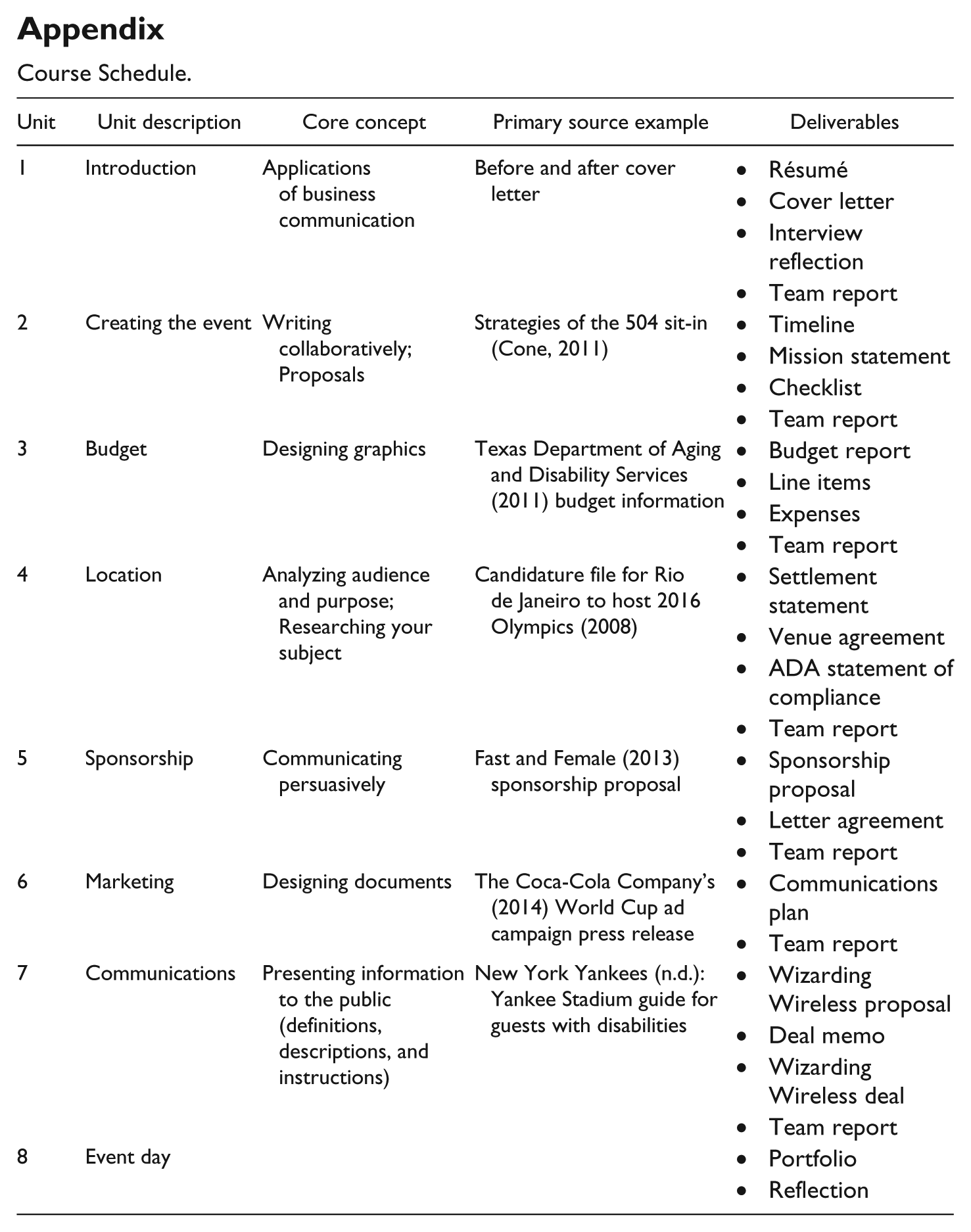
| Unit | Unit description | Core concept | Primary source example | Deliverables |
|---|---|---|---|---|
| 1 | Introduction | Applications of business communication | Before and after cover letter | • Résumé |
| • Cover letter | ||||
| • Interview reflection | ||||
| • Team report | ||||
| 2 | Creating the event | Writing collaboratively; Proposals | Strategies of the 504 sit-in (Cone, 2011) | • Timeline |
| • Mission statement | ||||
| • Checklist | ||||
| • Team report | ||||
| 3 | Budget | Designing graphics | Texas Department of Aging and Disability Services (2011)budget information | • Budget report |
| • Line items | ||||
| • Expenses | ||||
| • Team report | ||||
| 4 | Location | Analyzing audience and purpose; Researching your subject | Candidature file for Rio de Janeiro to host 2016 Olympics (2008) | • Settlement statement |
| • Venue agreement | ||||
| • ADA statement of compliance | ||||
| • Team report | ||||
| 5 | Sponsorship | Communicating persuasively | Fast and Female (2013)sponsorship proposal | • Sponsorship proposal |
| • Letter agreement | ||||
| • Team report | ||||
| 6 | Marketing | Designing documents | The Coca-Cola Company’s (2014)World Cup ad campaign press release | • Communications plan |
| • Team report | ||||
| 7 | Communications | Presenting information to the public (definitions, descriptions, and instructions) | New York Yankees (n.d.): Yankee Stadium guide for guests with disabilities | • Wizarding Wireless proposal |
| • Deal memo | ||||
| • Wizarding Wireless deal | ||||
| • Team report | ||||
| 8 | Event day | • Portfolio | ||
| • Reflection |
Acknowledgements
Special thanks to Sushil K. Oswal and to Casie C. Cobos for the inspiration.
Declaration of Conflicting Interests
The author(s) declared no potential conflicts of interest with respect to the research, authorship, and/or publication of this article.
Funding
The author(s) received no financial support for the research, authorship, and/or publication of this article.
Author Biography