




Abstract
Recent research demonstrates that operating effectively across boundaries is more complex than traditional essentialist models in cross-cultural studies suggest. The authors present a teaching model that leverages this research and moves away from static comparative models of intercultural interaction. Using self-reflexive and analytical processes, students learn to apprehend the multiple facets of their own and others’ identities as these become salient in different contexts. The article shows that through the experience of this course, students develop a mind-set which is essential to deal with the complexity facing today’s professionals. Students are quoted verbatim to illustrate the success of this model.
It is now universally accepted that today’s multicultural business environment is becoming pervasively complex in ways that involve more and more business professionals. As organizations are increasingly dispersed between head office and distant subsidiaries, employees are likely to be working in multicultural/multilingual settings, in teams that are geographically remote and linked mainly through online networks. This crossing of multiple boundaries has created new challenges which are pivotal to driving successful organizational strategy. This means, asGertsen, Søderberg, and Zølner (2012)pointed out, “thatan increasing number of individuals require some degree of sensitivity to different cultural perspectivesin order to do their jobs well and to successfully navigate within complex global organisations” (p. 3, italics added). When scholars study these different cultural perspectives in research on cross-cultural management, national culture tends to be their privileged point of entry. Although this facilitates the creation of interpretive frameworks and modelling, it obscures the complexity of the cultural and linguistic repertoires that lie within each individual. Understanding these multiple interlocking components is essential to successfully navigate across the multiple boundaries that exist in each and every interaction.
This complexity is not only a challenge within global organizations. It also poses a considerable challenge for business schools, universities, and training organizations whose mission is to prepare people for the work settings of today. For decades, programs addressing cross-cultural and/or language issues have relied on a standardized nation-based model designed to train the future expatriate to enter the foreigntargetcountry. This essentialist approach (Nathan, 2015) tends to reduce key dimensions to static items that can then be neatly categorized, creating an illusion of being efficiently dealt with.
Although we recognize that managing this complexity is indeed a priority both for organizations as well as the individuals within them, we contend that this will be better achieved if complexity is embraced and valued. This complexity is characterized by the wealth of actors and contexts reflecting diverse cultures and languages which are at play in each and every encounter. Recent research points to the value of this diversity as a hidden resource, for if properly managed, it provides a competitive edge for organizations operating on a global scale (Barner-Rasmussen, 2015;Brannen & Thomas, 2010;Hong & Doz, 2013).
In this article, we build on recent research to open the paradigm as to where linguistic and cultural diversity lie. We carry forward the idea ofexpandingthe concept of cultural identity introduced byJameson (2007)and the need to begin by a fuller understanding of one’s own cultural makeup. We show thatdiversityis indeed inherent in each and every person, as an individual is made up of a mosaic of multiple linguistic and cultural components. The challenge is to identify and activate these myriad hidden components. We demonstrate the value that this complexity represents for both individuals and organizations. We then propose a teaching model to transform this latent force into useable skills.
Theoretical Background: On Complexity and the Inadequacy of Simplistic Models
In their effort to contain the complexity of the global context of business and management education today, practitioners and students “look for ways to simplify and make sense of the world” (Osland & Bird, 2000, p. 67). The failure to acknowledge cultural paradoxes or the complexity surrounding cultural dimensions has led to “simplistic, rather than intelligently complex, explanations” (Osland & Bird, 2000, p. 69). “For understandable, systemic reasons,” these scholars claim, “business schools tend to teach culture in simple-minded terms, glossing over nuances and ignoring complexities” with organizational behavior and international business textbooks presenting mainly Hofstede’s cultural dimensions, and occasionally Hall’s theory of high- and low-context cultures (Osland & Bird, 2000, p. 67).
In international business studies and cross-cultural management, the concept of culture has traditionally been associated with national cultures conceptualized as static and bounded entities (Holden, Michailova, & Tietze, 2015). Such essentialist conceptions of culture do not account for the complexity of the dynamic and changing environments of today’s work settings characterized by “cultural diversity, change over time and space, shifting multiple intersecting identities and agency” (Nathan, 2015, p. 102).
In her analysis of intercultural encounters as socially constructed experiences,Prue Holmes (2015)maintained that the complexity of encounters in the workplace of today “puts into question formulaic, essentialist models of intercultural communication and competence that have characterized much cross-cultural business/management education” (p. 237). While acknowledging that these approaches may provide insights into the behavior and communication of people in a given national culture, she concluded that they most often result in stereotyping due to ethnocentric and prejudiced attitudes. Other scholars have underlined the limits of restrictive nation-based comparative frameworks and have called for the development of new theoretical perspectives and the need to “expose overgeneralised and oversimplified attributes of academic management” (Vaiman & Holden, 2015, p. 65).
The facility of adopting essentialist models has created a de facto dominance of the cross-national comparison stream in research and education as publications—textbooks or scientific journals—have too readily dismissed differing approaches (Primecz, Romani, & Sackmann, 2009). One such approach is themultiple culture perspective, which has led to the development of multilevel frameworks of analysis that include the different group affiliations (beyond the national) that influence the identity and behavior of individuals (Sackmann, 1997). Indeed, an individual’s cultural identity is not a monolithic block determined by one dimension. Depending on the context, one aspect or another of a person’s history or narrative will be foregrounded. This multiple culture perspective, also present in the concept ofintersectionality(discussed later in the article), points to the need to valorize complexity and shows the limits of oversimplification. This simplistic approach to culture often results in stereotyping, which tends to magnify the very factors that challenge communication.
As in the case of culture in cross-cultural management and international business studies, the complexity of language in cross-cultural communication and language learning has equally been disregarded. This can be explained by two factors. The first is grounded in the predominance of the essentialist perspective and the attraction of simplification as outlined above (i.e., one country/one culture/one language). The second is the assumption that the mere fact of sharing a working language, orlingua franca—often English—is the solution of choice. This, coupled with the commonly held notion that English is widely spoken and transparently understood, does not take into account the impact of microvariation in language use and the various layers of an individual’s language repertoire.
Indeed, in the field of second-language acquisition or language learning, essentialist notions have long prevailed in the adherence to standardized national models of language. However, with the emphasis on successful interaction between individuals working in multilingual/multicultural teams in international organizations, this essentialist nation-based paradigm is inadequate today.
In this world of cultural complexity and global cultural flows, language has come to be conceptualized in terms of dynamic and mobile resources that individuals draw on as they perform multiple roles.Blommaert (2010)wrote of the need for sociolinguistics in the age of globalization to “unthink its classic distinctions and biases and to rethink itself as a sociolinguistics of mobile resources, framed in terms of trans-contextual networks, flows and movements” (p. 1). In today’s business context, communication and intercultural competence can no longer be measured in terms of native speaker proficiency and conformity to national models (Cohen, Kassis-Henderson, & Lecomte, 2015;Kankaanranta & Louhiala-Salminen, 2013;Nickerson, 2005;Rogerson-Revell & Louhiala-Salminen, 2010;Seidlhofer, 2004;Virkkula-Räisänen, 2010).
As for the second assumption aforementioned, namely the use of a common language, or lingua franca, as a solution to problems that arise in a language-diverse environment, although this practice does facilitate some aspects of communication processes, it makes language differences apparently less salient—and potentially more problematic—as boundaries between languages are concealed. On the surface, the same language is being used by all, but the boundaries crossed by each individual, while translating into English or interpreting from it remain numerous (Kassis-Henderson, 2005).
Deconstructing and Valuing Complexity: Putting Complexity Back Into Culture
As aforementioned, the channeling of language- and culture-related issues through predefined dimensions veils perception and vitiates meaning if they are not understood in their complexity. People may become overconfident in their ability to interact with others when a strong identity marker, such as nationality, is shared (Jameson, 2007). And equally problematic, relying on essentialist identity markers often results in stereotyping and false assumptions, which also hinder the sense-making processes. If culture is the sharing of perceptions, values, and practice (Hofstede, 2015), in order to work successfully with individuals from other cultures—whether national, professional, organizational, educational—people need to discover what they share with others, which (perhaps counterintuitively) is facilitated by expanding the notion of cultural identity. AsJameson (2007)observed, “appreciating the complexities of cultural identity will help people discover areas of commonality with others instead of just the differences” (p. 206). Indeed, understanding and working with this cultural complexity will reveal where potential intersections to build bridges with others may lie. To paraphraseKimberlie Crenshaw (1991), the eminent scholar on intersectionality, recognizing that identity politics (to be understood here in the sense of negotiating cultural identity) takes place where categories intersect seems more fruitful than talking about the categories themselves. On the contrary, in the cultural dimension approach critiqued above, the categories alone drive the theoretical model. Categories as such are creators of boundaries, which are then viewed as sources of problems in organizations. We posit that if one uses the concept of intersectionality then boundaries are no longer synonymous with barriers. Boundaries are therefore not necessarily problematic. They may even function as an enabling factor if individuals are sufficiently aware of where they are and how they can be crossed.
The concept of intersectionality has been adopted by international business scholars to explore social phenomena in the workplace (Zander, Zander, Gaffney, & Olsson, 2010) and to demonstrate the importance of understanding the complexity of the multifaceted cultural identity of individuals as components of the group. AsCrenshaw (1991)explained, “Through an awareness of intersectionality we can better acknowledge and ground the differences among us and negotiate the means by which these differences will find expression” (p. 1299) in the construction of group identity. If properly managed—through self-awareness and group awareness, as discussed later in our training model—complexity may be a positive ingredient for the functioning of a group. In studies of interpersonal communication, scholars have theorized this complexity and demonstrated the value of taking multiple identities and multiple cultures into account (Frame, 2014,2016;Spencer-Oatey & Franklin, 2009).
As each individual is made up of amosaic of tiles—to use the imagery evoked byChao and Moon (2005)—different facets of self-identity become salient in different contexts and encounters. According to these scholars, a person’s identity is made up of a mosaic of tiles which fall into three main categories: demographic, geographic, and associative. Although this multifaceted model of apprehending identity may, on the surface, add additional layers of complexity, it in fact potentially simplifies understanding of the other by providing additional potential points of intersections. This finding of commonalities—and understanding the multiple aspects of self-identity—also demystifies difference, facilitating the establishment of common ground and rapport (Cohen & Kassis-Henderson, 2012).
If the various boundaries of a person’s tiles are allowed to become apparent, it is easier to identify who the “other” is. This act of identification can have positive, as well as negative, consequences for the organization (as well as for the individual or group), as boundaries are dividing lines that may either include or exclude, resulting in the formation of in-groups and out-groups, as analyzed in social identity theory. Studies on the resulting fault lines, however, show the counterintuitive idea that the more diversity within members of a team, the more cohesive the team becomes, enabling better teamwork (Lau & Murnighan, 2005).
We suggest it may be more constructive to make these tiles—or boundaries—visible in order to facilitate intersections—or boundary crossings—in order to better seek out compatibility and shared areas of interest on which to build working relations. AsCrenshaw (1991)aptly wrote, “Ignoring differencewithingroups contributes to tensionamonggroups” (p. 1242).
Deconstructing and Valuing Complexity: Putting Complexity Back Into Language
In a context of increased mobility, there is a need to learn “to move between languages and to understand and negotiate the multiple varieties of codes, modes, genres, registers, and discourses” that will be encountered in the real world (Kramsch, 2012, p. 107). It is how one is situated and/or identified, both from an individual perspective as well as how one is viewed by the other(s)—and the interspace of the rapport that is built between the different actors—that determines sense making in communication (Kramsch, 2007).
This coexistence of a plurality of languages within each person also evokes the image of a mosaic of tiles used above. Thus, one could talk of language tiles or personal repertoires or voices which will have more or less salience depending on the context of each encounter and on which voice a person chooses to use with whom.
Sociolinguists have drawn attention to the ways in which different aspects of personal background, beyond national culture, condition expectations and reactions within the context of specific encounters. From this perspective, voice echoes and reveals culture, as it is “the personal background that might account for variations in individual verbal behaviours, whether they be attributable to a national, racial, or ethnic culture or the culture of a particular social class, generation or gender” (Gumperz, 2003, p. 226).
This angle of approach through personal language repertoires is more subtle and nuanced than monolithic or essentialist approaches focused on country-specific language capability and cultural competence. It encourages careful deconstructions of behavior and language use, along the lines proposed byBlommaert (2005)with the notion ofmicrovariation(p. 2010) and byJanssens and Steyaert (2014)together withMakoni and Pennycook (2012)with themultilingual francaapproach. This microvariation is manifested in the use of styles, accents, and words within what appears on the surface to be the same language—often English. In a similar way, Business English as a lingua franca (BELF) research has pointed to this phenomenon by identifying “a hybrid of discourse practices originating from the speakers’ mother tongues” (Kankaanranta & Planken, 2010, p. 392). Therefore, in international contexts, words assume new meanings and connotations which are shared momentarily within specific exchanges as speakers tap into their own and others’ multilingual resources. This process is facilitated by recognizing where intersections lie, which in turn leads to the successful negotiation of meaning.
Introducing the concept oflinguaculture,Risager (2012)made the point that people carry their linguistic resources, like their culture, from one context to another. They thus draw on their personal repertoire, making their language choices correspond to the type of interaction required in each situation (Risager, 2012). Other sociolinguists have shown how multiple languages are used by workers in different professional or social contexts (Otsuji & Pennycook, 2011).Blommaert (2010)conveyed this notion strikingly in the following lines: Movement of people across space is therefore never a move across empty spaces. The spaces are always someone’s space, and they are filled with norms, expectations, conceptions of what counts as proper and normal (indexical) language use and what does not count as such. (p. 6)
A Multilingual Franca Approach to Linguistic Identity
Janssens and Steyaert (2014)have contributed the notion of “amultilingual francaapproach” to international business studies. For them, English as alingua francais a multilingual way of using English, which enables speakers to express voice by mobilizing multiple linguistic resources (p. 623). This lingua franca multilingualism results in languages being “so deeply intertwined and fused into each other that the level of fluidity renders it difficult to determine any boundaries that may indicate that there are different languages involved” (Makoni & Pennycook, 2012, p. 447).
Bakhtin, a literary theorist and philosopher, also emphasized the social and political dimensions of language by conceptualizing communication as successfully negotiated “chains of utterances.” He also introduced the concept ofheteroglossia, or the diversity of speech types within a given language, a concept which is useful to help understand what contributes to effective functioning of individuals in multi/transcultural settings. Building on this concept, the idea can be presented as follows: “Language, whether monolingual or multilingual, carries social meanings through phonological, lexical, grammatical and discourse level forms. These forms index various aspects of individuals’ and communities’ social histories, circumstances, and identities” (Bailey, 2012, p. 505).
This ability to summon these different sets of linguistic resources is also central to the concept of heteroglossia. From this perspective, to create social meaning a speaker may switch languages, alternate between a dialect and a national standard, shift register, or speak monolingually (Bailey, 2012). Indeed, effective communication and the ability to negotiate the social world stem from an individual’s use of these heteroglossic sets of linguistic resources (Bakhtin, 1981).
Demographic changes and increased mobility, together with the possibilities offered by information and communication technology, have given people access to partial language repertoires. These include bits of the different languages in which they have varying levels of literacy (Blommaert & Dong, 2010). This opens up an increased, yet often untapped, reservoir of language diversity within each individual. The individual, therefore, has both a linguistic and cultural repertoire (see discussion of intersectionality above) which, when viewed together, are whatClaire Kramsch (2012)referred to as a modern version of multilingualism. She defined this as “the ability to use several linguistic systems in everyday life and to draw on several cultural contexts of experience in order to put forth several identities, such as immigrant, employee, mother, woman, Spanish speaker or English speaker” (Kramsch, 2012, p. 116).
On Teaching Complexity: Responding to the Call for Effective Boundary Spanners
In order to deal with the complexities discussed above, recent studies have shown that exposure alone to multicultural contexts does not necessarily allow individuals to become competent or acquire transferable skills. As demonstrated above, cross-cultural training based on a comparative approach focusing on cultural differences between the country of origin of the learner and the target culture is no longer an adequate framework given the complexities in today’s world. This “culture-specific” approach (Brannen & Lee, 2014) aligns particular characteristics and skills to a specific country, with acculturation (within a specific national culture) becoming the goal of the learning process. This often goes hand in hand with thelanguage-specific approach, which posits native speaker competence in the corresponding language as an ideal. For reasons aforementioned, a stream of management scholars and some sociolinguists have pointed out the inadequacies of this traditional approach to cross-cultural and language training, stressing the need to move beyond the static and comparative models of cultural interaction on which it is based to develop the more relevant culture-general and language-general approaches (Cohen & Kassis-Henderson, 2017).
Certain competences falling under the category of culture-general and language-general are particularly effective for complex environments: an open mind-set, cross-cultural awareness, adaptability to new working contexts, flexibility, and an ability to contextualize issues (Hong & Doz, 2013). These cultural and language skills have also been identified in recent research as those common to “boundary spanners” in multinational corporations (Barner-Rasmussen, Ehrnrooth, Koveshnikov, & Mäkkelä, 2014). This skill set, recognized as providing a competitive edge to companies working globally, is most often found in biculturals (Brannen & Thomas, 2010) or professionals having a substantial experience abroad. These individuals, considered a “valuable resource” for organizations, are both “rare” and “difficult to imitate,” as acquiring the requisite level of the skills identified above calls for a “significant investment” (Barner-Rasmussen et al., 2014, p. 900). Although such useful modes of behavior may be indeed a reflex for the bicultural individual or experienced expatriates, we contend that if such behaviors are sufficiently analyzed and conceptualized, they can be transformed into transferable skills.
A range of such skills has been identified in BELF literature (Kankaanranta & Louhiala-Salminen, 2013;Kankaanranta & Lu, 2013;Kankaanranta & Planken, 2010;Louhiala-Salminen, Charles, & Kankaanranta, 2005;Nickerson, 2005;Seidlhofer, 2004). By shifting the focus from the nation-based native speaker model to context-based effective business communication, this BELF research cites a range of competencies to be mobilized—by both native and nonnative speakers—to adapt to the variety of ways the English language is used within a given business context.
BELF competencies focus on the communication know-how to get a given task done rather than sophisticated language mastery modelled on the native speaker. These communication competencies have been identified as integral to business know-how in general, necessary in any professional domain. BELF competencies cited include adapting to context and interlocutor, focusing on clarity of message above linguistic perfection or sophisticated phraseology, and checking for understanding to establish rapport and successfully negotiate meaning (Kankaanranta & Planken, 2010).
In a similar vein, other scholars working on language-general, as opposed to language-specific, skills emphasize these same pragmatic competencies common to communicative practices regardless of the language spoken. This better enables individuals to interact in an increasingly mobile and complex business environment. Whether they are under the heading of BELF or language-general, these pragmatic competencies are essential to any business interaction—for native and nonnative speakers alike—and hence the development of such competencies must be a major objective in business communication curricula.
A Call for Reflexivity in Education and Training
If, as the research suggests, rules, recipes, stereotypes, and essentialist banks of knowledge approaches are of limited value (Osland & Bird, 2000), and if individuals will need to find out for themselves what works and what does not in any given situation in increasingly complex contexts, the question must be raised: What mental processes must be set in motion and how can they be developed?
Martin and Nakayama (2015), scholars in the field of communication studies, have introduced the importance of adopting a dialectical approach to navigate effectively between “the self and larger contexts” by creating a “self-reflexive move” (p. 22). They conclude by emphasizing the importance of reflexivity as an intercultural competence, stressing that the individual must constantly resituate him or herself and draw on a personal cultural and linguistic repertoire in relation to a specific encounter.
Recent studies in the different fields of international business, management education, and intercultural communication stress the need for reflexivity and self-awareness in cross-cultural education and training (Cohen et al., 2015;Gertsen et al., 2012;Søderberg & Zølner, 2012). As a case in point, the “Practical Implications” section of an article byYagi and Kleinberg (2011)suggests the importance of this reflexivity in accompanying the opening of the cultural paradigm to develop the individual’s conscious awareness of, and reflection on, the multiple facets of identity. Doing this, they contend, can give individuals a heightened awareness of the range of cultural resources at their disposal. Be they monoculturals (with respect to national culture) or biculturals, this would enable a more informed response in boundary-spanning situations. This suggests that if given the adequate training, any individual can acquire the boundary-crossing skills which have tended to be exclusively associated with biculturals or experienced expatriates because of the random privilege of birth or professional opportunity.
In the following section, we present a teaching module incorporating reflexivity and building on the conceptual framework discussed above. The course objective is to allow participants (monoculturals and biculturals alike) to better apprehend the complexity of confronting cultural difference to more effectively interact in multicultural/multilingual settings.
The Teaching Module: Negotiation and Culture
The course, “Negotiation and Culture,” delivered in a master’s program in an international European business school, was initially based on a traditional national culture approach (i.e., culture-specific) designed to familiarize students with the practices associated with doing business in different European countries. As indicated above, and as demonstrated in recent research, this approach is insufficient today. The course has, therefore, been redesigned to introduce a critical, more culture-general approach to focus on apprehending complexity in order to develop a better understanding of the competences required in a real-world context of interpersonal exchanges in a multicultural/multilingual environment.
This course is delivered in five 3-hour sessions taught in English by professors of different nationalities. Two of the authors have taught the course over six semesters, and the verbatim presented below has been taken from the various cohorts. The groups have varied in size (24 to 43 students) and have always been of mixed nationality (minimum 12, maximum 18). Ages have ranged between 20 and 26 years.
The course alternates between theoretical input, case studies, and the students’ own critical incidents, thus allowing students to unravel the layers of cultural and linguistic variables and to come to an understanding of how to operate effectively in complex environments. The student verbatim presented below illustrates the learning outcomes achieved through this module.
Our teaching model seeks to develop students’ capacity for reflexive analysis, an important professional competence to acquire. For maximum impact, students experience complexity in the classroom before being introduced to theory. At the outset of the course, students are placed in culturally heterogeneous subgroups of four or five (mixing nationalities, languages, genders, ages, etc.), thus mirroring the complexity of teams in the workplace. They then are asked to analyze a critical incident set in a multicultural educational setting, first individually then collectively in their group. By sharing, confronting, and discussing their different analyses, they immediately see that a variety of individual analytical perspectives is at play and that not just one single meaning has been taken from it. When then discussed in a plenary session, this initial exercise makes students realize the importance of contextualizing an event, and of first taking into account the range of perspectives and interpretations possible, rather than jumping to conclusions or simply interpreting it through the lens of their own perspective. This provides students with an initial insight into the complexity of intercultural encounters, introducing the idea that intercultural encounters are not necessarily limited to those between different national cultures. At this point, students are asked to critically reflect on key terminology and concepts, and through this group reflection we introduce theory. As students have already started to unravel layers of cultural complexity, they can readily see the shortcomings of essentialist models.
We then present the sense-making model created byBird and Osland (2005)of framing and reframing encounters to enable students to better apprehend and make sense of a given situation. Through the initial case-study exercise, students have experienced the risks and limitations of relying solely on their own nonreflective, spontaneous framing of a situation. Confronted by the different responses of their peers, they can see that reframing may be called for. Students are thus more prone to apprehend and adopt this model and to reconsider and recalibrate initial interpretations before they act, and so bring about more effective outcomes for themselves and others in intercultural settings, which they now understand in more complex terms—beyond the static, essentialist dimension.
To further demonstrate the interest of introducing complexity to expand the notion of cultural identity, a more static model—at least in title—is presented for the German culture and the Arab world. But here as well, students are quickly confronted with their biases, stereotypes, and assumptions to reflexively comprehend the unexpected commonalities in their modes of interaction, ultimately facilitating communication (see section below). In these class sessions, which are designed to critically introduce specific cultural areas (in the sense of national cultures), students are sensitized to the fact that it is not enough to be able to recognize key cultural variables as presented in the essentialist cultural dimensions and values literature. Rather, these dimensions are just one entry point to the multiple components of individual identity that create the intersections (as determined by the people, place, and situation) that become salient in any one context.
In a later session, students are asked to bring to class a description and analysis of a personal critical incident. In this preparatory work, they are instructed to describe their initial understanding—orframing—of the incident and what made it problematic. They are then to reframe the incident in light of the theory and discussions in previous sessions in a way that would have either brought about a more successful result or a more enlightened interpretation. In small groups, they then orally present their critical incidents to each other and discuss the various interpretations possible. Through this discussion, students are confronted with the multiple meanings that can be derived from any given situation depending on the salient component at play in the interaction. This exercise helps demonstrate the interest of apprehending complexity and the risks of drawing hasty conclusions. In order to reinforce the learning outcomes, we ask the students to write a log reflecting on the impact of each session on their understanding of intercultural situations.
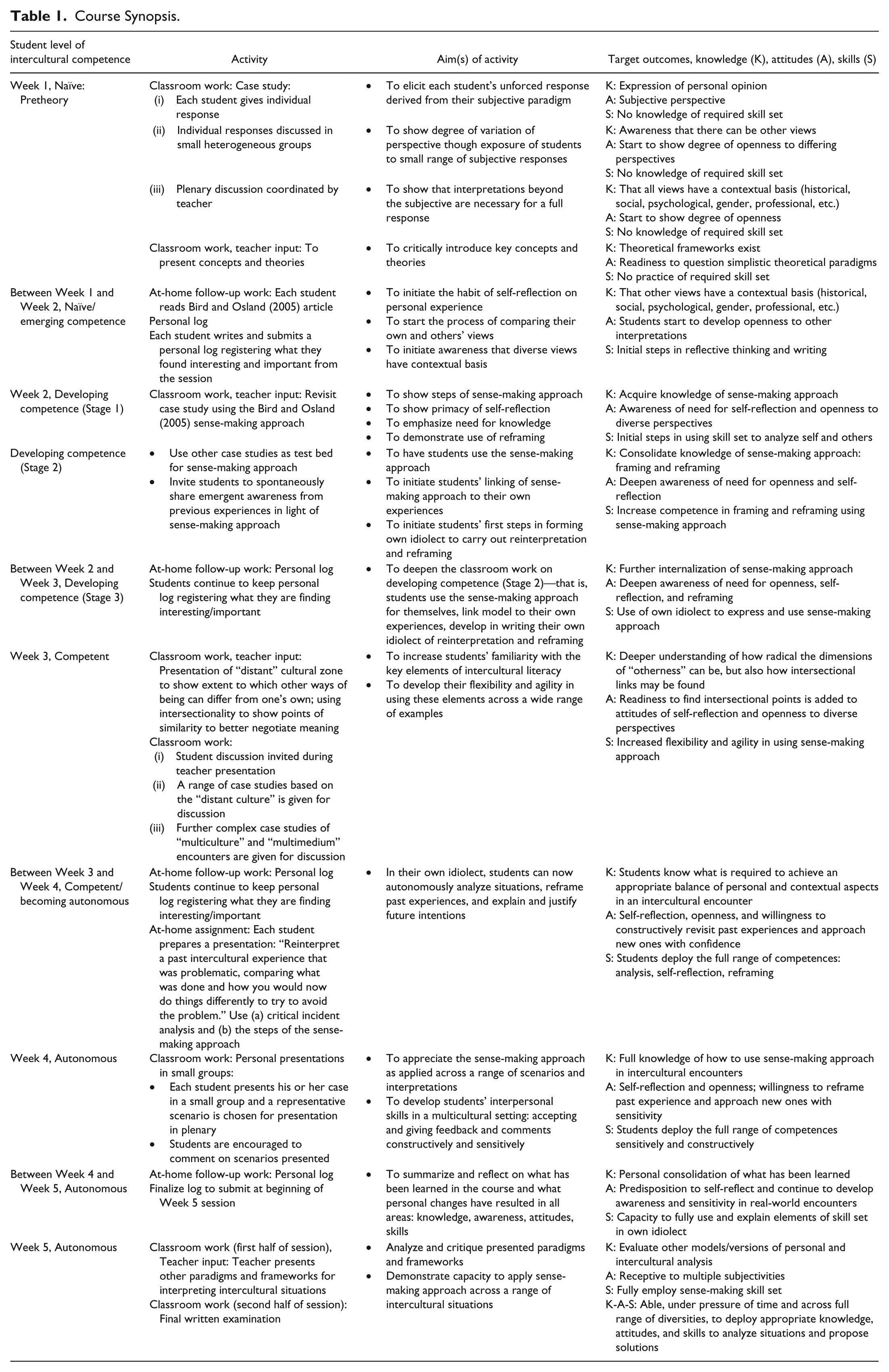
The course assessment requirements—critical incidents, course log, and final examination—demonstrate how successfully, as seen in the verbatim below, the students have internalized the content of the course and are able to reframe previous experiences, thereby acquiring essential professional competences. This changed mind-set is crucial to their future success in today’s business environments (see course synopsis inTable 1).
Course Synopsis.
Student Verbatim and Discussion
The verbatim below, selected from the course assessment requirements listed above, shows how 15 participants representative of the various cohorts came to reassess their own identities through reflective processes of self-evaluation and self-judgment in light of the theoretical input presented and discussed. Many of the students’ written observations show they have fully integrated the value of the reflexive notion ofexpectancy disconfirmation. This “refers to a state where individuals expect a certain behaviour or response from those they interact with but experience a different one” (Rosenblatt, Worthley, & MacNab, 2013, p. 358), crucial for establishing successful rapport in a multilingual/multicultural—and therefore complex—environment. The verbatim faithfully reproduces the students’ own words. However, the bold emphasis in the quotes is ours and refers back to theoretical points discussed earlier. Certain quotes speak for themselves. We have provided comments when necessary to clarify the context and to further our arguments.
Illustrative Empirical Data: Student Verbatim
Understanding Cultural and Linguistic Complexity
Student Reflection on the Concept of Cultural Mosaic or Tiles
Student Reflection on Language Tiles or Repertoires
The main learning outcome here is the realization that they are likely to encounter similar experiences of fluency asymmetry in professional contexts, and that it is important not to stigmatize others according to their language proficiency, as the least fluent may have the most interesting contribution to make to the group, a point that is also made below.
In addition, some observations show that native English speakers fail to perceive risks of miscommunication in international English-speaking contexts. Also, students tend to overestimate their similarities and downplay differences:
Dealing With Stereotypes: Confronting the Culture-Specific Model
It is noteworthy that these observations are in line with research findings regarding business communication between young Chinese professionals and Westerners. Studies byKankaanranta and Lu (2013)of the evolution of BELF have suggested there is a convergence with Western styles, as young Chinese professionals communicate in an increasingly direct way, diverging from expected stereotypical modes of communication (Kankaanranta & Lu, 2013, as cited inSaarinen & Piekkari, 2015, p. 428). These scholars have suggested that young managers who are comfortable using English in the workplace form a transnational elite “whose cultural traits may be less demarcated when they operate in English” (Kankaanranta & Lu, 2013, as cited inSaarinen & Piekkari, 2015, p. 428). However, overestimating these easily accessible similarities may hide the importance of other tiles hidden further below the surface, and therefore may silence these other voices.
Students recognized this risk, as seen in the following quote:
Starting With Self: Reflecting on Self and Understanding Others
Finding Commonalities or Intersections: Listening for Similarities
In becoming aware of so-called country-specific communication styles, students tended to compare certain traits with their own and other national cultures. This seeking for common ground (or intersections) enables students to identify what can bring people together rather than separate them.
Interestingly, by overlapping intersectionality with the presentation of country-specific dimensions, students identified unexpected similarities, thereby becoming aware that boundaries are not where you expect them to be and, if understood in this sense, can be inclusive rather than exclusive. This is illustrated by Chinese students who spot similarities between Arabs and Chinese:
And in a similar vein, an Italian student highlighted similarities between her own culture and the Arabic one. She was surprised by this realization as she confronted her own unconsciously applied biases.
Finding Commonalities or Intersections: Listening for Diversity
Significantly, these perceptions have often been as much about language as about culture, in the broad sense:
Conclusion
Trends in research in both language and culture have broken with the oversimplistic and essentializing approaches which consider national culture and language as necessarily the most salient variables influencing behavior in intercultural interactions. Continuing the conversation proposed byJameson (2007)to expand the concept of cultural identity, this article breaks new ground by viewing language as well as culture through a more complex lens, leading to the identification of professional competencies heretofore considered beyond the domain of transferable skills. Our study has demonstrated the need to go beyond the standardized, nation-based, language- and culture-specific model and to incorporate and utilize the pool of diverse cultural and linguistic repertoires within each individual in order to develop the capacities identified in boundary crossers, essential in today’s work settings.
Our study has shown how individuals in interaction tap into different identity facets—or traits—at different moments and in different contexts, enabling the forming of intersections—or bridges—which foster the building of rapport and successful communication. In today’s work settings, all employees cross cultural and linguistic boundaries on a regular basis when working with others, albeit often unknowingly when they do not work with foreign countries or need to speak in a foreign tongue. Therefore, gaining sensitivity to different cultural perspectives and linguistic profiles should be a requirement for all members of the workforce in order to perform their tasks effectively and to successfully navigate within complex global organizations.
As illustrated through our empirical data, our teaching model demonstrates (a) the limits of essentialist models based on cross-national comparisons and (b) the benefits of introducing reflexive learning processes to enable the appropriation of the concept of cultural and linguistic boundaries as a complex construct to be realigned to each context. We see boundary crossers as individuals who can analyze situations in ways that (a) contextualize their own sociocultural and linguistic constructions, (b) go beyond this to a valid interpretation and appreciation of difference, and (c) practice the skills necessary to negotiate an appropriate meaning outcome. To develop this, teaching should focus on experiential learning through critical incidents, or engagement with case studies that involve expectancy disconfirmation, confrontation with multiple interpretations of an event, and the requirement to negotiate meaning among a number of culturally and linguistically diverse participants.
The course as presented above was delivered in an international European business school where student diversity, from the point of view of nationality, is fundamental to the school’s identity. Therefore, different nationalities are necessarily represented in student groups. However, the teaching model we propose can be adapted to any student group. As our argument throughout this article has made clear, the multifaceted identity of each individual means that diversity is intrinsic to even the most seemingly homogeneous groups of individuals. In such outwardly homogeneous groups, preliminary exercises would be necessary to help reveal the cultural and linguistic tiles of each student’s identity as, for example,Jameson’s (2007)model of individual cultural identity proposed. Through this type of exercise revealing the variation and difference as well as points of commonality and potential intersections, students will begin to appreciate the latent diversity present in any group of individuals.
Beyond its implications for management education, our article has practical implications for human resource management, recruitment, and training in companies. Studies addressing the question of developing cultural sensitivity in a global company have shown that employees fail to reflect on and learn from their intercultural experiences if these are not supported by organizational initiatives (Søderberg & Zølner, 2012). We would also claim that individuals, once skilled in these ways, could feed back their knowledge and skills into their home organizations. Our article suggests a conceptual framework for dealing with the complexity facing today’s professionals.
Footnotes
Authors’ Note
An earlier version of this article was presented at the 10th International GEM&L Conference on Management and Language, Paris, France, 2016. This study was approved by ESCP EUROPE Business School. Student comments are reproduced by permission.
Declaration of Conflicting Interests
The author(s) declared no potential conflicts of interest with respect to the research, authorship, and/or publication of this article.
Funding
The author(s) received no financial support for the research, authorship, and/or publication of this article.
Author Biographies