




Abstract
The ability to copy in relevant stakeholders has rendered the business email a useful tool for managing interpersonal relations and operational matters. However, CCing in business email has remained vastly underresearched in workplace discourse literature, a gap this article seeks to address. We explore the functions of CCing in workplace emails and the way formality is negotiated by writers in one organization. We draw on the analysis of email chains and discourse-based interviews and show that employees strategically project professional achievements and assume and deny responsibility for company decisions as they shift between the sender/receiver positions in the chain.
Keywords
The rapid changes to the way economies and businesses have been run over the past few decades have had a clear impact on communicative activity in the workplace.Boden (1994)suggested long ago that employees at every level of hierarchy will be affected by a new accelerated work environment that will be both technologically and interpersonally complex and demanding. Corporate companies have taken steps to enhance competitiveness, and one can find a growing body of literature on these global strategies (Debrah & Smith, 2002), typically referring to flexibility in structures, cooperation, and collaboration of employees in dispersed workplaces (e.g.,Lorenz & Valeyre, 2003). Against this backdrop, information and communication technology and new media are increasingly being used to meet these companies’ needs (Turner & Reinsch, 2010;Warren, 2014,2016) as employees struggle to do more in less time more efficiently (Gimenez, 2014a).
Business email, in particular, is becoming more frequent, more complex, and more important for work-related communication (Cameron & Webster, 2011;Evans, 2012;Gimenez, 2012,2014a;Ho, 2010c,2011a;Louhiala-Salminen & Kankaanranta, 2005). Having already partially replaced other genres (e.g., business letters and memos) or mediums of communication (like face-to-face interaction) in certain companies, it has acquired a central place in business communication. It is seen to serve a variety of formal (e.g., for accountability) and informal purposes (e.g., an informal note or reminder), giving access to both front stage and even personal backstage negotiations. Although emails can be deleted and not responded to (Crystal, 2006), they are also used for record keeping and retrieval of transactions. Despite their centrality, however, emails, like any text, do not exist in isolation. Even a single email is interconnected to previous or subsequent emails, as well as reports, proposals, face-to-face meetings, and phone calls (Ho, 2011a). Under pressure, employees often write an email and at the same time have a conversation and send text messages (Gimenez, 2014a). As all these prior, current, and subsequent texts and types of discourse are often indexed in emails, the genre of emails acquires a pivotal role in the interactional flow. Hence, the analysis of business email provides important insights into the daily communication practices of modern organizations and a glimpse into how genres respond to the changing needs of the users.
Apart from its potential for multiple uses in carrying out administrative and other work-related tasks, email can play a part in maintaining interpersonal relations at work, and researchers have looked into the way social distance, socialization, and power are enacted in the linguistic choices of the interactants (e.g.,Bremner, 2012;Chen, 2006). For example, a great body of literature concentrates on the enactment of politeness (e.g.,Bremner, 2006;Graham, 2007;Ho, 2010b,2011b), some work has been done on formality (e.g.,Bjørge, 2007;Gimenez, 2000;Machili, 2014b,2015), and other studies have recently looked into the use of emoticons (Skovholt, Grønning, & Kankaanranta, 2014). Relations at work have become more complex to develop and maintain through the use of email CCing (i.e., sending carbon copies of the message to people the writer of the original message sees fit) as multiple parties geographically dispersed in different professional roles are called to engage in decision-making and problem-solving, their participation statuses varying from passiveoverhearersto actively involvedaddressees. However, despite the theoretical convenience and rapid interaction afforded by the CCing facility with its potential for multiple addressability, it seems likely that CCing will lead to dilemmas among the interactants; participants may find themselves in a predicament as to what is expected of them, who to include and exclude in their response when copied in, and how to frame their messages as they seek to maintain harmony between people at various hierarchical levels, in different departments, and in disparate fields of expertise. Despite the abundance of discourse studies on the way power is enacted in workplace interactions (Bremner, 2006;Ho, 2010b;Holmes, 2005;Locher & Hoffmann, 2006;Sarangi & Roberts, 1999), there is still a dearth of research into power struggles at work evidenced in the use of CCing.
Against this backdrop, this article focuses on the function of CCing in single and chain emails (threads involving more than two emails and a minimum of four for the purposes of this article) in one business organization. The study is based on real-life and interview data, and special attention is paid to employee perceptions regarding the impact of CCing and chain emails on discourse practices. We probe the concept of accountability, the relationship between function and formality, and the ways in which employees account for their choices.
The article is organized into four parts. First, we place the discussion in context by providing a succinct account of current email research (and we discuss whether email epistemologically constitutes a new genre or merely refers to a channel of communication widely used in corporate environments). We then turn to our own study on the functions of CCing and share our findings and conclusions. We close this article by summarizing the role of CCing in the organization we discuss here as well as the implications for teaching business writing.
Email Research
Since it became uniformly adopted in the business world around the 1990s (Ducheneaut & Watts, 2005), email has become and still remains the most dominant means of communication, even to the point of email overload (Kuslev & Dunn, 2015;Soucek & Moser, 2010;Thomas et al., 2006), and evidence suggests a still increasing trend both in terms of volume and ubiquitousness (Ducheneaut & Watts, 2005;Jerejian, Reid, & Rees, 2013;Reinke & Chamorro-Premuzic, 2014). Even despite the more recent emergence of newer electronic forms of communication (e.g., video conferencing, Facebook, instant messaging, Twitter, etc.), email still occupies a central place in the business environment (Colbert, Yee, & George, 2016;Guerin, 2017).
Attempting to explain this popularity of email, researchers have been preoccupied with its technical and social characteristics which are missing from other means of communication. Examples of the former are ease of use and multiple addressability to geographically dispersed teams. Its asynchronicity enables multiple users to respond at a time of their choice and facilitates their participation in the resolution of complex issues. At the same time, its CCing function enables storage and retrieval of messages in the email accounts of employees at different hierarchical levels, with varying expertise and agendas, establishing accountability in workplace interaction. Emails are used for multiple purposes in vertical and horizontal communication, both for carrying out everyday procedural tasks as well as for more complex matters and for different purposes when addressing mixed audiences (Markus, 1994;R. E. Rice & Shook, 1990).
The social characteristics of email have also spawned a debate on whether email constitutes a rich environment for social cues. Some have argued that email has the potential to foster an egalitarian workplace environment by filtering out social status cues (Daft & Lengel, 1984,1986;Lucas, 1998;Sproull & Kiesler, 1986). Its multiple addressability through the CCing function theoretically allows both the core and the periphery to equally access participation opportunities, and it even allows the periphery to check on the core (Ducheneaut & Watts, 2005). From this perspective, email can provide a medium for the exchange of views, resolution of conflicts, and smooth communication flow. Others, however, suggest that users compensate for email’s poorer social and emotional cues; indeed, several studies have shown how its linguistic features (e.g., formality, politeness) and structural elements (e.g., presence/absence of a written message or greetings, addition/omission of signature) are used differently by employees in different organizations, departments, and hierarchical levels (Machili, 2014b;Waldvogel, 2005) to build rapport or emphasize status differences, thus, reflecting and enacting both egalitarian and nonegalitarian relations within and across organizations (Machili, 2014a;Sherblom, 1988;Spencer-Oatey, 2000;Waldvogel, 2005).
Further to this, discourse analysts argue that interpersonal relationships are constructed and negotiated in the course of the interaction (e.g.,Graham, 2007;Ho, 2009,2010a,2010b;Holmes, 2005). Critical discourse analysts in particular have frequently shown that the workplace is fraught with power imbalances which are not confined to hierarchical differences. Rather, poweroverothers can be exercised by virtue of who one knows, one’s expertise, mastery of language skills, intercultural competence, years of experience in the company, and of being referred to and admired (e.g.,Angouri, Mara, & Holmes, 2017;Holmes, 2005;Spencer-Oatey, 1996;Spencer-Oatey & Xing, 2003;Virkkula-Räisänen, 2010;Warren, 2014). Even the identity of a leader has been variously associated with being an accountable, rational, authoritative, and considerate leader to one who achieves compliance to requests (Ho, 2010b;Spencer-Oatey, 2000). Evidently this process is reflected in a combination of different discourses and social practices (e.g., formal-informal, institutional-professional-personal register, etc.) as interactants struggle to achieve both transactional and interpersonal aims (Ho, 2011b). Power isdonein and through all modes of communication that interactants have access to—including email (Bremner, 2006;Ho, 2010b). So, both the egalitarian and the hierarchical affect of email is part of the way power asymmetries are negotiated and enacted in daily work practices.
The variety and context-bound nature of the form and functions of email have ultimately led to a discussion on whether it can be accorded genre status—for our purposes, whether business email can be seen as a workplace genre. Although a genre is often partly defined in terms of its stable characteristics, genres remain stable only so long as they adequately equip writers to respond to situations that the community interprets as recurrent (Miller, 1984), and they change in response to the changes in the socioeconomic environment (seeJørgensen, 2005;Kankaanranta, 2006;Skovholt et al., 2014;Trosborg & Jørgensen, 2005). In this context, the workplace email is seen as a variable genre subject to changes in the socioeconomic environment and identifiable and meaningful within the workplace communities where it is employed, according to how important (Winsor, 2000) and/or recurrent (Miller, 1984) its functions are perceived to be by its members (Orlikowski & Yates, 1994).
As recent work has pointed out, the volatility of the email genre is evidenced in its intertextual nature (Bremner, 2008;Gimenez, 2014a;Ho, 2011a;Kankaanranta, 2006;Warren, 2009,2016) and its concurrent use alongside other modes of communication (Cameron & Webster, 2011;Gimenez, 2014a). With regard to the former line of research, emails inherently consist of multiple links to other communication tasks and events that are carried out concurrently in business transactions. So repeatedly employees switch from one task to another (e.g., from writing a current email to reading a previous email to having a chat on the phone, and then to making notes on a notepad or a spreadsheet and going back to writing the current email, referring to both the phone chat and the previous email). The examination of the way these tasks are knit together and how this interconnectedness is achieved (Warren, 2016) provides insight into the complex nature of business communication. In relation to the latter line of enquiry, research into which modes of communication are mixed or better packaged together and why provides proof of the changed nature of business communication, where employees are required to develop new skills to manage multiple oral and written conversations at the same time. The CCing facility adds yet another layer of complexity as employees are called to juggle tasks, people, and media (Gimenez, 2014a) by having to address multiple and variable audiences in terms of level and area of expertise, who are allocated core and peripheral roles in the conversation, and to meet both transactional and interpersonal demands, requirements which are often seemingly impossible (Bremner, 2006). Hence, a far more complex picture of workplace communication in general and email communication in particular begins to emerge.
CCing and Its Communicative Functions
Employees often work in teams in remote locations, and CCing as a multiple addressability facility allows information sharing with variable parties simultaneously who play more or less direct roles in the chain. In some workplaces, CCing superiors into communications is often a requirement, particularly for novice writers, but the distinction between those directly addressed and copied in creates a common space for all parties to negotiate professional roles and responsibilities. Since strings or chains of emails also provide the context and the means for a permanent and retrievable record for all interactants, the negotiation of relationships can become a high-stakes activity (Paré, 2002).
The most prominent function of emails is information sharing, and it is directly related to both issues addressed in this section, namely accountability and decision-making. AsSkovholt and Svennevig (2006)commented, CCing serves to inform not merely the primary recipients but additionally a number of others. This has allowed users to engage in the construction of new knowledge as well as in negotiating practices and processes already in place at work. Users take the roles ofobserverorhearer(Skovholt & Svennevig, 2006) who, in principle, are not asked to become actively involved. However, these roles are not static, as observers may decide to become more actively involved in the chain and more active participants may decide to play less prominent roles as the discourse unfolds. All the parties addressed must decide whether to remain in their initially delegated role or to shift to a more passive or active role. In doing so, users help shape the organization’s power structures; they negotiate who has access to what information and who acts as gatekeepers to formal and informal communities.
Behind the guise of informing about organizational activities and employee roles (Skovholt & Svennevig, 2006), CCing can also serve as a tool for shifting the responsibility for addressing an issue at hand to all the recipients so that information sharing also implies responsibility sharing. And so, despite the power of email to reach a wide audience and to share responsibility, it carries the attendant risk of confusion on the part of some of the addressees about what is expected of them. Knowing how to use email appropriately encompasses acquiring workplace sector/company norms and cultures, while also doing so in a way that speaks to one’s personal motives and agendas.
In this context, the use of emails is directly related to issues of accountability and decision-making. The concept of accountability is central in any workplace and has been studied in a number of disciplines such as psychology, sociology, and management. The term as used here is related to “economic reporting and surveillance systems” (Kreiner, 1996, p. 86). Through the forwarding and CCing functions, employees seek approval and confirmation as they report about activities that have taken place. Employees at the same level are also called to witness the progress of activities they are associated with and subordinates to witness and learn from the way others handle business activities. Ultimately, being accountable to others also provides the opportunity to show off achievements, to project oneself, and, in this way, to establish and strengthen one’s own institutional identity (Skovholt & Svennevig, 2006). At the same time, the email allows a shift of responsibility from self to other and can lead to a wide cover-your-ass syndrome.
In principle, CCing multiple geographically dispersed participants makes transactions simpler and more transparent. However, the wide diversity of the copied in parties and the possibilities afforded by the CCing facility complicate things more than earlier studies on categories of email functions suggest (Gains, 1999;R. P. Rice, 1997;Yates & Orlikowski, 1992). The CCing facility has added uses, and the functions performed are all interconnected. For example, a report, which is primarily intended to inform, may also serve as an act of covering one’s back or an exhibition of one’s achievement but could additionally serve as an implicit request for a follow-up action, and this may in turn trigger a discussion with a series of responses. The intention of the sender is reported to be often difficult to interpret, resulting in frequent misunderstandings (Bellotti, Ducheneaut, Howard, Smith, & Grinter, 2005). The CCing facility also opens texts to multiple audiences, and hence positioning becomes less transparent. AsBremner (2006)has suggested, writers may feel frustrated and caught in a predicament between personal and institutional roles as they express themselves in email. As a result, the multiple parties participating in the making of a decision may have difficulty in following the thread of the argument, and therefore in reaching a consensus. In this respect, the multiple addressability through the CCing function appears to complicate rather than enhance an organization’s communication flow. Thus, the email message has evolved from simpler question-and-answer formats to chains and embedded formats—to discussions where recipients jump in without being directly involved in the matter at hand or explicitly invited to participate or are called on to observe as hearers rather than being active decision makers (Skovholt & Svennevig, 2006). These multiple and often tacitly understood roles mean a paradox is observed between the apparent transparency of email and the uncertainty of roles, responsibilities, and permitted interventions of what may be a large number of participants. This uncertainty and lack of clearly defined tasks and duties has been reported to provide fruitful ground for the negotiation of power relationships (seeAngouri, 2013for strategic ambiguity). Subordinates can be controlled at a distance, and employee relations and institutional positions can be challenged in public discussions. The way this is done is related to the way the participants negotiate the self and others’ professional identities in their workplace setting. On the other hand, power imbalance is seen to be inherent in organizational life and even necessary for organizational efficiency (Grant, 1996;Herring, 2003). Hence the analysis of CCing practices can provide insight into power struggles at work.
Ultimately, the versatility of functions emails serve is reflected in the linguistic choices of the interactants, and an examination of CCing would not be complete without taking into consideration the discursive practices adopted in emails. For example, a range of formal and informal linguistic features has been seen to reflect both more stable social characteristics of their writers (e.g., title, hierarchical level) as well as more negotiable characteristics (e.g., roles as decision maker, knowledge claimer). We therefore argue in this article that CCing creates the context in which employees manage professional relationships and responsibilities through their use of formality. In this light, an examination of the formal and informal linguistic features can shed light on the predicament writers are in when addressing multiple audiences in more or less direct participation roles or when these roles and readers alternate in the same chain interaction. Although various discourse analysts have looked into the enactment of politeness, formality in workplace email remains relatively underexplored. Hence, this article aims to examine the CCing functions email serves in the workplace and the way these functions provide the space to enable employees to negotiate their professional roles through their formal and informal linguistic choices.
Methodology
This article draws on a mixed methods research project (Machili, 2014b) focused on exploring the dynamic and highly variable nature of workplace practices in a number of multinational companies in Greece by investigating the documents participants wrote and the discourse they used in their emails. In this article, we report on qualitative data collected in one multinational company situated in Greece, Semeli (pseudonym). (The termmultinationalis defined as a company that has subsidiaries or branches in at least three countries and/or recruits a multinational workforce and/or undertakes business activities in at least two industry sectors; see alsoStarke-Meyerring, 2005). The data were collected from line managers (LMs) and postholders (PHs). The line managers were two general managers (Andreas and Peter), two senior managers (Maria and Gregory), two junior managers (George and Tasos), and a financial controller (Chris); and there were a number of postholders (e.g., Lin). All informants were nonnative speakers of English. We considered them to be competent users of the language, as they have worked in an English-speaking, white-collar environment and in relatively senior positions for at least 5 years. Indeed, one of the prerequisites for qualifying employees to participate in this research was that they had used the working language of the company for work-related purposes for at least 5 consecutive years. Furthermore, we considered this setting to be typical of modern workplaces, and especially multinational companies, that are, by nature, multilingual with certain languages being granted the status of working languages.
For the purposes of this article, we draw on an illustrative sample of email data. Based on principles of qualitative research, the intention behind the collection of emails was to analyze the dynamic, real-life written discourse of the interactants and to investigate the functions and uses email serves in the companies investigated. This allows us to gain in-depth insights into the micropicture of why the participants acted the way they did.
We adopted a participatory design and allocated control over the data collection to the employees who became coresearchers (for a discussion of this, seeStubbe, 2001). A convenience sampling approach was adopted, and a corpus of 100 email chains was collected by the participants themselves. The participants also contributed with their contextual knowledge by means of pre- and postanalysis discourse-based interviews (Odell, Goswami, & Herrington, 1983), providing all information that they considered relevant to the interpretation of their linguistic choices (Bargiela-Chiappini & Harris, 1997). Before the analysis, the interviewees were shown the emails they had written and asked for pertinent contextual information (e.g., information about the companies represented in the emails, who the participants were, previous and follow-up actions, etc.) and their intentions in their use of email (i.e., the functions the emails served and their use of CCing) and formal and informal linguistic features (i.e., they were asked to indicate and explain instances of formal and informal language in their emails and to comment on the appropriateness of the formality of these linguistic features and of the emails). During postanalysis, they were shown the emails and the results of the analysis. They reexamined the emails and confirmed that the interpretation of the results was convergent with our preliminary reports—and, at times, expanded upon our analysis further. Since accessing all participants involved in the email chains would have been impossible, we interviewed those who were directly involved as main writers or readers, these acting as main informants. Including the participants in the process allowed us to access contextual knowledge that would not have been apparent or available to an outsider. The interviews were recorded, transcribed, and analyzed using a combination of inductive and deductive thematic analysis to search for “repeated patterns of meaning” (Braun & Clark, 2006, p. 86) related to the use of CCing and the formal and informal linguistic features by the participants.
Provisional codes were generated from the transcripts and then grouped into initial potential themes. In the next phase of analysis, these were, in turn, grouped into larger categories reflecting the uses of CCing and the formal and informal linguistic features used (seeAppendix A). The groupings were based on the informants’ views on which use of CCing was intended by the writer and which linguistic features they considered formal and informal. The emergent themes reflecting the uses of CCing initially led to a provisional thematic map (seeAppendix B) and were then regrouped, leading to the final categorization of functions of CCing shown inAppendix C. Following a similar process of regrouping and renaming, the themes of the formal and informal linguistic features led to a table with a list of all these types of linguistic items informants used in their emails (see table inAppendix D). The intention was to allow for a comprehensive compilation of their choices rather than more limited points of convergence.
Findings and Discussion
In this section, we start by presenting the categories of CCing functions and discuss each one by looking at email chains and one email representative of the functions, the varied statuses of the interactants, and the formal and informal linguistic features discussed. In turn, we discuss the use of CCing as an act of accountability and as a tool for collective on-the-spot decision-making and problem-solving. We end with the use of CCing for self-projection.
Our analysis of the CCing functions led to the following categorizations of themes: CCing asaccountabilityin the presence and absence of superordinates, ascollective on-the-spot decision-makingin both public and private discussions, and asself-projectionto superordinates and to colleagues and subordinates (seeAppendix C).
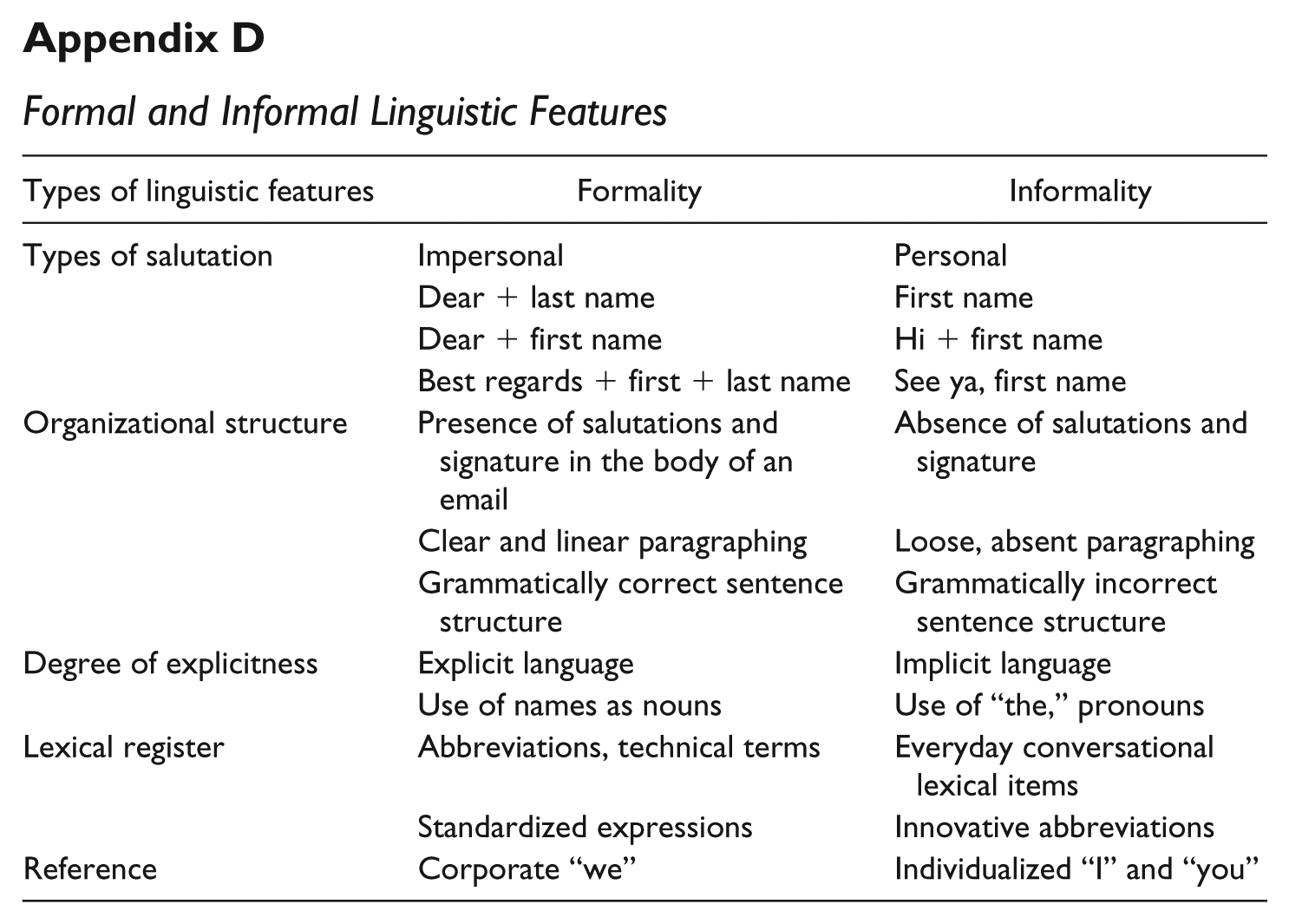
In our analysis of each email chain, attention is paid to the formal and informal linguistic choices the interactants made that are relevant to our discussion and are shown in the table inAppendix D. The first column of the table shows the main themes reflecting the linguistic features the participants used in relation to formality. The second and third columns show examples of the actual linguistic features used, which the participants perceived as formal or informal. The distinction betweenformalandinformalis of course crude, and we do not wish to claim speakers make simple choices between items at the two extreme ends of a continuum but ratheralongthis continuum; their choices aremoreorlessformal and highly subject to the immediate interpersonal context of the interaction and the wider organizational context within which it is placed. Given the inherent limitations of categorization, the table is therefore a visualization of the analysis of the data and represents a simplification of the complex reality of the written interactions. Salutations are opening and closing greetings in emails. Although pronoun reference can be seen under bothreferenceandexplicitness, in the former category it is restricted to the difference between the corporateweand the individualizedIandyou, and in the latter it concerns the use of deixis in place of nouns. Organizational structure refers to variety (rather than difficulty) in organizational patterns of the body of an email, paragraph, and sentence. FollowingHeylighen and Dewaele’s (1999)definition, explicitness is seen here as lack of ambiguity by eliminating expressions that are fuzzy and highly dependent on context and implicitness as context dependence, which entails clarity for the interactants who share a common understanding and fuzziness for those who do not. Because of space limitations, the chains we present here are relatively short and include a maximum of seven exchanges between the participants. We draw on these data in the analysis below and categorize the linguistic features that are used in the emails as those employed to enact formality and informality according to these criteria. The analysis of each chain is preceded by some contextual information and is supplemented with participants’ quotes representative of the CCing functions (seeAppendix Efor transcription conventions). We start from the first function of CCing, which is accountability.
CCing’s Role in Accountability
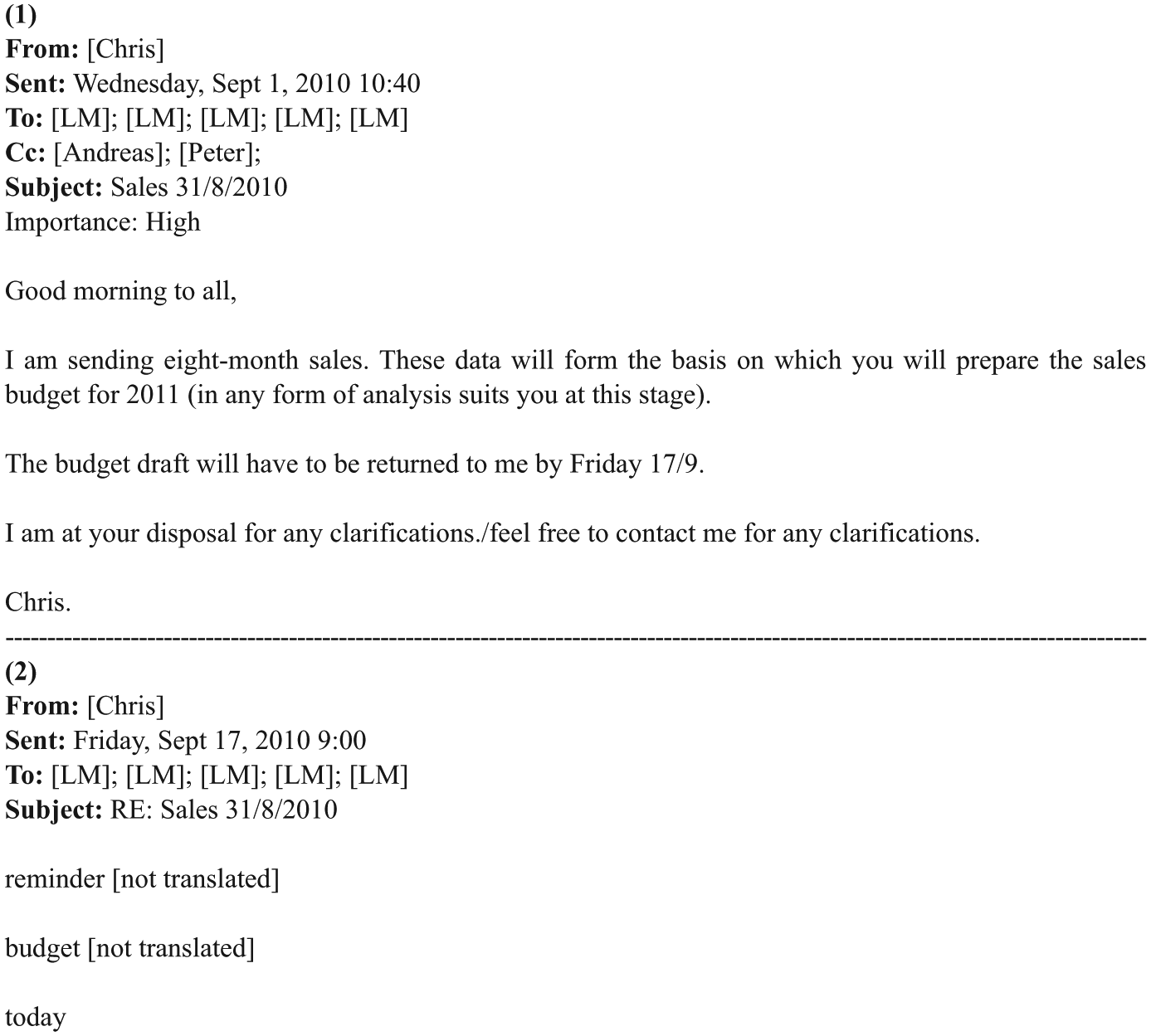
In his first email (seeFigure 1), Chris, Semeli’s financial controller, issued a directive to department managers and copied in the two senior managers, Andreas and Peter. His second email was a reminder of the first sent on the date of the deadline. The first email was in Greek and the second in English.
Email Data No. 1.
Budget preparation is standard practice in most companies, and Chris copied in his superiors in the formal directive for the preparation of the annual budget. By doing so, he acknowledges its importance and covers his back—possibly lessening the responsibility for a potential delay. Worth noting is that, although all employees should already be well aware of the procedure, Chris additionally highlighted it further in his indication “Importance: High.” The affordances of the medium were visible to the users. Chris noted,
I’m playing it safe here it may be pretty standard but [.] it may also have repercussions and I’ll be accountable for it so [.] I need to cover my back and everybody needs to know that everybody else knows.
As the quote suggests, our participants argued that CCing can serve as a safeguarding strategy against the possibility of something going wrong. It strengthens the transparency of the interaction, but it also allows Chris to put pressure on the rest of the team to perform with no delays (“The budget draft will have to be returned to me by Friday 17/9”). The accountability to the two managers is also evident in the formality of the email’s linguistic features in terms of the organizational structure of the message and use of salutations, explicitness, and lexical register. With regard to the first, Chris clearly structured his email with an opening and closing salutation and the main body of the message in clear paragraphs. “Good morning to all” is considered semiformal and the use of the first name only, in this case “Chris,” informal. As Chris explained,
Well good morning like good afternoon is [.] depends on where it is used really I consider it somewhat semiformal but in internal emails in our company between us is more formal than hm saying nothing [..] or hm hi there [..] I want to write in this way because the bosses are watching too.
Chris described how openings like “good morning” and “good afternoon” are used to add formality to an internal email exchange with the managers copied in and highlight that the formality of the linguistic features is subject to the organizational context of the interaction as well as the interpersonal dimension. He also explicitly directed his colleagues to prepare the budget, ensuring there was no ambiguity in his additional clarifications about the basis of the budget, the form of analysis required, and the deadline. In his interview, Chris pinpointed the need for absolute clarity in interdepartmental communication:
A serious problem in communication that we’re facing involves our interdepartmental communication. Each department names and understands things in its own way . . . so first you must think who am I writing to? [.] find a common code and then write. That’s how misunderstandings take place. You cannot afford to have something like you know “you didn’t tell me” or eh/hm “I didn’t realise it was so urgent.”
The quote reveals a problem commonly reported by the participants—the need for explicitness to avoid potential miscommunication even in the case of standard practices. In this context, CCing was seen as ensuring that the message conveyed was correctly understood by all and freed the sender from the responsibility of misunderstandings. If the message were in any way unclear to the recipients, the responsibility would then fall on them to point this out and ask for clarification.
In contrast, the second exchange was Chris’s informal reminder of the task and was very different. Instead of paragraphs, properly structured sentences, and clarifications, the second message was conveyed in three words, all of which were in English, for recipients who are all native speakers of Greek: “Reminder budget today.”
The three words indicate shared knowledge, including knowledge of the previous exchange and of the appropriate corporate jargon in English rather than the local language (Greek) in the particular organization. It is clearly a more implicit exchange. Added to this is the complete absence of salutations in contrast to the previous email. In this exchange, Chris retained his institutional role as financial officer and sent the reminder, but he now excluded his superiors.
The identification and analysis of primary and secondary recipients indicate the complexities in audience design (Bell, 2001) in embedded emails where addressees and addressers change or shift in the course of the interaction.Gimenez (2006)has suggested that the concepts of accountability and reliability of work-related interactions of geographically dispersed teams are directly related to the function of embedding emails, as it allows people who are spatially distant to be informed and to participate in the work-related task. CCing also plays a very important role in the carrying out of work-related tasks in general, and accountability in particular, even when teams are spatially close by. Importantly, however, the multiple audiences occupying varying participation statuses also influence decisions relating to the content and style of the users. For example, email writers have been seen to have difficulty adapting their levels of politeness and formality and the content of their messages to multiple audiences even within the same office building when their superiors are also copied in (Bremner, 2006;Ledwell-Brown, 2000;Machili, 2014b).
CCing’s Role in Collective, On-the-Spot Decision-Making
The exchange inFigure 2concerns the solution of a problem that has risen with the dispatch of a line of pharmaceutical products. The Athens headquarters of Semeli had not been notified that its Thessaloniki branch had been storing an excessive quantity of products that were going to expire soon and would have trouble distributing them. The exchange took place between the company branch, where George (branch manager), Tasos (junior manager), and Lin (secretary) are located, and the headquarters, where the senior managers, Andreas (general manager), Peter, Maria (the product’s line manager), and Gregory, are based. George and Tasos were the ones responsible for causing the problem to which a solution was sought in this exchange.

Email Data No. 2.
The chain is an example of the way CCing is employed to facilitate collective, on-the-spot decision-making and problem-solving among multiple relevant parties. Worth noting is that the participants differed in terms of their professional roles, expertise, hierarchical statuses, and years of experience in the company, and participants were invited into the discussion through direct and indirect requests for action. For example, Lin directly addressed Nick (warehouse postholder) in (1), and George directly asked for the list from all involved parties in (6). However, Tasos was indirectly addressed in (1) in Lin’s “MR MOUSIOS WILL BE AVAILABLE FOR ANY CLARIFICATIONS CONCERNING REASONS FOR RETURN OF PRODUCTS” and in (2) in Maria’s “Today I sent a question to Tasos and I’m expecting a reply.” In email interaction, participants are addressed directly when they are primary recipients and indirectly when they are copied in. The email genre allows for interaction to move between exchanges which are distributed to all employees and restricted to only a few in ways that no other written mode of communication can afford. In making decisions as to who to exclude/include, power and role issues are foregrounded, as is apparent, for example, in a quote from Maria, who was excluded from part of the chain:
Shouldn’t I have been copied in too? I’m responsible here and they resolved it among themselves [.] hadn’t I been right all along? but [.] the big boss would not admit that in the open [.] not with everybody else present [.] but eh/hm he’s the GM (General Manager) and all [.] you know [.] we also have a
Often the change from public to private is also evidenced in a subsequent shift in an email’s informal or formal features. For example, in this chain, the more private email (e.g., 2) and the less public emails where Maria is either excluded (4) or allocated a backseat (6) only included the body of the message. In contrast, the more public emails (1, 3, and 5) included opening and closing salutations.
Undoubtedly, the need for the cooperation of multiple employees in the writing of workplace documents such as annual reports, tender proposals, and progress reports is well documented (Angouri & Harwood, 2008). Email communication similarly demands the cooperation of employees, and the CCing function brings to the fore understandings and expectations of “who should be involved in what.” As participants with various professional roles, expertise, hierarchical statuses, and years of experience in the company are drawn together to analyze problems, negotiate solutions, and resolve pressing work-related issues, excluding/including someone in an email chain has serious repercussions in the management of work relationships as well as in the power balance between those who are given access to decision-making processes and those who are excluded. As Excerpt 4 indicates, not being in a chain can be perceived as undermining one’s authority or professional role and as an imposition of hierarchical power.
Underlying tensions and power struggles can also be uncovered in the shift in formality as we progress through the analysis of this chain. Tasos and George were the main accountable parties, and their messages were more informal than the rest of the emails in the chain. This can be seen in the use of greetings, organizational structure, explicitness, and lexical register. In contrast to Tasos’s and George’s messages, which used no salutations, all other emails, with the exception of the more private (2), started and ended with a salutation. “GOOD AFTERNOON TO ALL” in (1), “DEAR COLLEAGUES” in (3), “Good morning to all” in (5), and “Good morning” in (7) are semiformal openings showing the collective handling of the problem. Although a little more variable than the openings, the closures seem to follow a similar pattern. With the exception of (2), (4), and (6), all the other closures ended with the writers’ names, three of which also included last names.
The two emails authored by Tasos and George also differ from the rest in their organizational structure and explicitness. With regard to the first, Tasos’s email was written in one long run-on sentence of 52 words, and at the other extreme is George’s email with the four-word sentence “Send us the list.” In relation to the latter, the two parties were being more implicit than the other employees invited to participate in the chain. George issued his directive by referring to “us” and “the list.” Tasos, similarly, although more extensively, implicitly provided an explanation by talking about “the oversight,” “the list,” “the products,” and “the procedure.” There was also no specification as to the referent ofwein “we would talk,”themin “I had submitted them,” andtheyin “they left.” Style decisions are evidently not random, and interview data are useful in providing access to the users’ accounts:
I’m actually one of the oldest here and know better [.] I know what is appropriate [.] what’s important is how much you sell [.] to solve the problem by the end of the day [.] not we would like this and that [.] it’s similar with George we can’t worry with I would like to apologise of course he’s apologising. (Tasos)
Tasos perceives himself as an experienced employee by virtue of which he acquires the power and the right to express himself ashesees fit, even in the presence of his superiors. Although he seems to offer a mild apology in his “The oversight is mine,” he considers matters of appropriateness of writing style such as “we would like this and that” and “I would like to apologise” to be less important than ensuring the problem is solved. Stylistic convergence and divergence have been discussed repeatedly in sociolinguistic enquiry as a way for individuals to respectively reduce and accentuate interpersonal differences in age, ethnicity, social status, and hierarchical level (Auer, Hinskens, & Kerswill, 2005;Babel, 2010;Giles, Coupland, & Coupland, 1991), and accommodation theory (see,Gallois & Giles, 2015) has shown that this applies to formality decisions. Stylistic choices have been shown to contribute to positioning in an organization’s ecosystem; an email receiver is likely to adapt his formality to that of the sender’s (Gains, 1999) to show solidarity and collegiality. On the other hand, stylistic divergence signals differences in power, social distance, and experience among parties in an organization (Machili, 2014b). In this email interaction, the shift in formality, allocation, claim, and primary and secondary participant roles indicates the power struggles that take place as decisions are made to solve problems in the presence of superiors.
Our analysis also supports other studies that have described the spiral and “messy” nature of decision-making and problem-solving (Angouri & Bargiela-Chiappini, 2011;Boden, 1994;Huisman, 2001), where issues are repeatedly discussed over a period of time in various instances of communication in a cumulative way.Huisman (2001), for instance, made a convincing case for the difficulty in spotting the moment a decision has been made, as relevant discussions are spread over a series of meetings or emails and so on. In the case of the chain analyzed here, the issue was brought up and talked about in office chat as the various emails were exchanged, and the final interaction between Maria and all the other parties was followed by a number of phone calls and an informal meeting held the following day among the Athens team at headquarters. The spiral nature of problem-solving is also evident in the embedded and intertextual nature of email, reflected in the work of prominent researchers (e.g.,Gimenez, 2006;Ho, 2010b,2011a). Specifically, an email can be initiated by or as a response to another work-related event (e.g., a phone call or meeting). And although the chain may be terminated by an email, depending on the context, the issues discussed could either be recycled in follow-up chains or generate different events (e.g., a meeting). The same issue could be simultaneously discussed on the phone, face-to-face, and in an email chain (seeGimenez, 2014aon multitasking). This further illustrates the complex and technologically advanced character of modern workplaces where different modes of communication are dynamically intertwined and interdependent.
AsBoden (1994)suggested over 20 years ago, “In the local/global workplace of the future, current emphasis on ‘just in time’ production processes will be critically connected to ‘just here, just now’ interpretations of incoming information and understanding of unfolding events” (p. 211). Embedding emails seems to provide the means for “just here, just now” problem-solving and decision-making. This does not mean that the process of reaching a decision is less complex than in the past, but the email and the CCing function have provided an additional tool and vehicle for interaction. In the case of the exchanges inFigure 2, the interaction began on Tuesday and had been resolved by Friday. When the problem was being discussed, emails were exchanged over a very short period of time (see emails 2 through 7 inFigure 2). This arguably poses a new challenge for employees, as the repercussions of not responding may lead to the conversation moving on without them and them being left out of the decision-making process. In a recent study,Thomas et al. (2006)refer to how the pressure to respond is constructed in the interaction (see, e.g., in our chain the immediate requests for a response or action). These pressures become more acute by means of the CCing process itself, which at times has the immediacy of spoken conversation, and hence interactants may feel the need to jump in to make their voices heard.
We now turn to the final excerpt discussing the use of CCing in projecting one’s achievements.
CCing’s Role in Self-Projection
The business email provides a context for the negotiation of participants’ roles and is a tool for projecting a professional persona both to more senior and more junior coworkers. According toSkovholt and Svennevig (2006), employees use CCing to make their professional achievements visible to their superordinates, and our data show that visibility of achievements serves to show them off and thus boost one’s position.
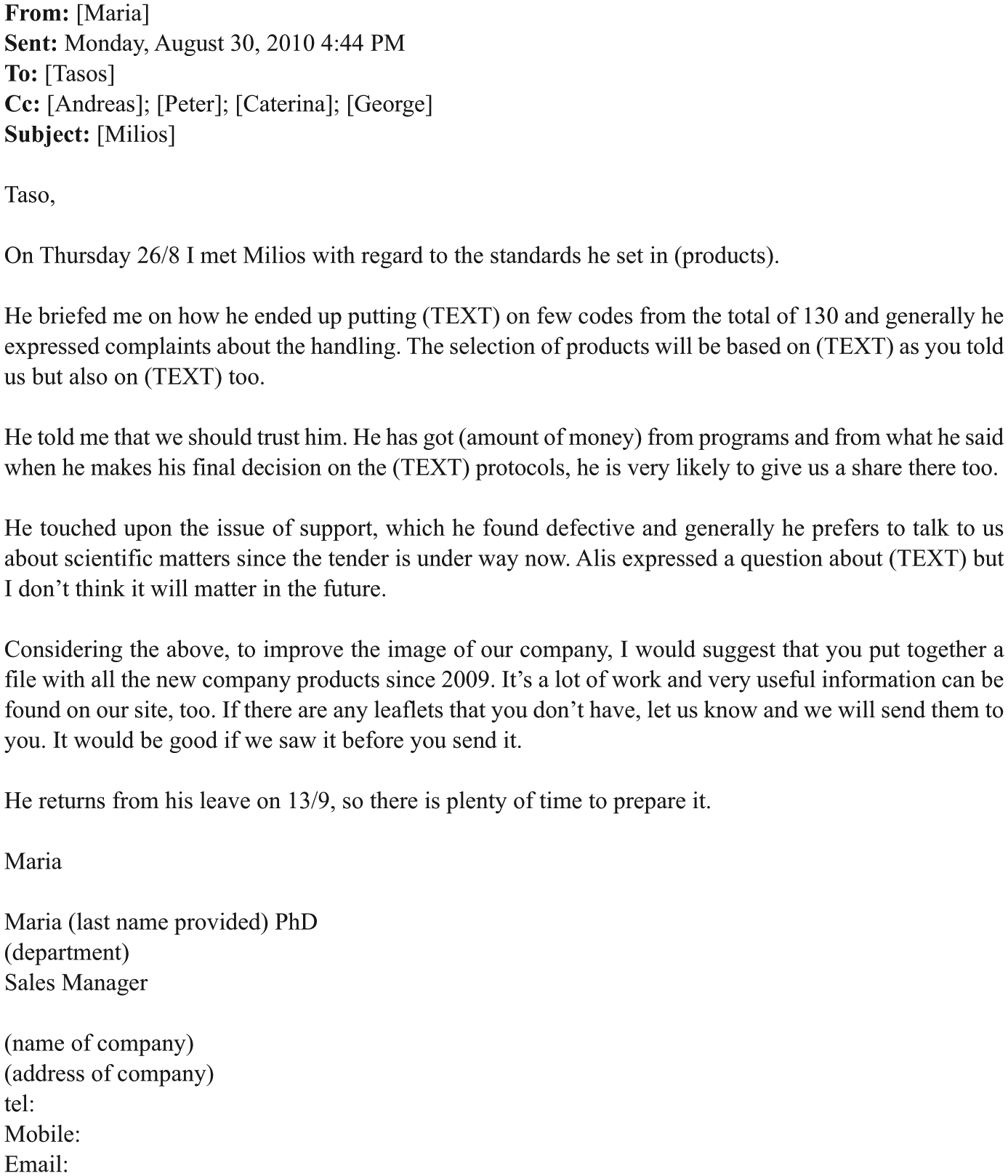
In the email inFigure 3, Maria (experienced sales manager of a particular line of diagnostic equipment, based in the Athens headquarters) sent a report to Tasos (new postholder, based in the company branch in Thessaloniki) about a meeting she had with Milios (an important customer of theirs) to address a complaint against the company and to instruct Tasos about what to do next. Milios had expressed dissatisfaction with the handling of certain matters, and Maria was requested to make a last-minute trip to Thessaloniki to resolve the issue. Although the complaint did not fall under her direct responsibilities as a sales manager, she perceived it as a personal matter, as the customer specifically asked for her and asked to be trusted, so she needed to ensure the problem was dealt with. Having already briefed the general manager about the meeting and agreed on future action over the phone, Maria now sent a report to Tasos about it, copying in her two superiors, Andreas and Peter, and her subordinates: Tasos’s superior at the branch, George, and contract secretary, Caterina. She argues,
Email Data No. 3.
It’s very simple really [.] your work needs to show when you do it well.
As the excerpt shows, Maria employed CCing to project herself in the way she handled the issue to both their superiors (Andreas and Peter) and her subordinates (George, Tasos, Caterina). She added,
[Tasos is] too slow and he’s new eh/hm the problem is he doesn’t listen (to what Maria and his superiors and more experienced employees tell him to do) [.] does the general manager need to be watching for him to listen? and it’s not just that [.] they (her subordinates) have to know they (her superiors) have to be
By copying in the general manager, Maria wanted to show Tasos that she had his consent and to project her credibility. However, our data show that projecting her achievement is not restricted to superiors and is not only aimed at showing off. George, the Thessaloniki branch manager and Tasos’s superior, and Caterina, the branch contract secretary, were also copied in. So, projection of one’s achievement is seen here as an act of setting an example for less experienced or efficient employees to follow. But addressing employees from different hierarchical levels and posts in the same email may not always be straightforward (Bremner, 2006). Maria’s predicament has its origins in wanting to project her good work to her superordinates and subordinates while maintaining good relations with them; it also shows in the mixture of formal and informal linguistic features. In terms of salutations, she started rather informally, addressing Tasos directly by his first name, and ended with her first name. Although this, in isolation, may seem informal, her added signature with her title and credentials in signing off adds a tone of formality and helps her project her achievements further. As she explained,
To me the added signatures in our internal communication is a symbol of status [.] a way of projecting who you are [.] your credentials and all [.] so I make it a point not to use it in my internal mail [.] unfortunately in this case (in this email) they have to be reminded (about my credentials and my status to listen) but at the same time I must be careful so as not to risk relations with them and I still want to keep my good relations with my colleagues.
The structuring of the message with the clear and focused paragraphs and correct sentence structure added to the formality, but the assumed shared knowledge in “the standards he set,” “the handling,” “the tender,” “the issue of technical support,” and the absence of standardized expressions and/or corporate jargon added a tone of informality.
The email is interesting in that it shows how copying in multiple parties and employing a mixture of formal and informal linguistic features enable Maria to project herself and develop good relations at work. On the one hand, backed up by the general manager’s consent and by adding her signature in her internal email, Maria strengthens her status, institutional position, and identity to her subordinates. Highlighting her achievement to superiors and subordinates allows her to maintain power at work and strengthens her authority over her subordinates; but, on the other hand, avoiding formal, standardized corporate jargon and explicitness enables her to do relational work.
The email functions in this particular company as an informal report. But our data reveal how it is difficult to define the genre of email in focus here according to the purpose it serves, even in one community, as it may serve different purposes for the primary and secondary recipients. Our data illustrate that this email is not only intended to report to (and, by extension, to inform) the primary recipient, but it also serves to seek backup, set an example, and define institutional duties to the secondary recipients. Private intentions (Askehave & Swales, 2001) are evident here and further support the view of genres as dynamic and evolving, yet highly dependent and recognizable within the community in which they are employed. The CCing facility adds to the multiple functions email serves (Bremner, 2006;Machili, 2014b;Waldvogel, 2007), even within the same email, and sets the material space in which formality is employed to do transactional and relational work.
Conclusion
The analysis of our data indicates that CCing has a number of functions that add to the complexity of the communicative and pragmatic purposes of the email; while it is used for information sharing, it is also employed for the establishment of accountability, collective on-the-spot decision-making, and self-projection. These functions may change in the course of an email chain and even within the same email as the participants work together in one chain to fulfill their work-related tasks and manage their interpersonal relationships.
In agreement with previous studies (e.g.,Bremner, 2006;Skovholt & Svennevig, 2006), we show that by bringing in multiple parties and ascribing them different roles (e.g., ofhearers, witnesses, coordinators, negotiators, etc.), the participants may be trying to enact a virtual conversation by importing practices and conventions from the more traditional and physically bound oral conversation or discussion—yet in a written genre. In this light, the CCing facility adds to the argument that email is a mixture of written and oral speech, yet not only in terms of linguistic features but also in terms of participation statuses, as some interactants are more or less actively involved and in control of the discussion than others (Angouri & Bargiela-Chiappini, 2011). Given the lack of research on CCing, this is an area that requires further research.
Our analysis highlights thestrategicrather than thecanonicaluse of email to strengthen one’s institutional authority by projecting achievements, to disseminate information about the progress of ongoing activities (and possibly proving the transparency of the process), to define or redefine rules and regulations, to cover one’s back, and to assume and deny responsibility for company decisions. In this light, email can be employed by participants todopower, whether to reinforce or challenge conventional hierarchical structures at work.
Our data also indicate that the CCing facility of a business email is similar to (and affected by) face-to-face interactions (e.g., meetings) in problem-solving and decision-making processes. It pinpoints the challenges employees face, such as the negotiation of linguistic and stylistic norms as well as the difficulty in determining or even controlling the possible audience of their emails. These constitute underresearched areas open to further investigation. George, for example, is known for his attempts to derail what he sees as unnecessary email chains; as Tasos suggested, he seems to have a preference for “face-to-face meetings whenever possible.” Hence, the importance of local practices is also relevant regarding the form, purpose, and frequency of the genre.
In closing this article, we briefly refer to the implications of this and other similar studies for the teaching of business writing. Our work has shown that business email, in common with all genres, is dynamic, fluid, and flexible in nature. We would thus argue that the findings of research like ours on workplace discourse may usefully inform pedagogy in general and teaching materials specifically, which we have pointed out in earlier work can misrepresent genres as static by adopting prescriptive-model-based approaches to teaching business communication (Angouri & Harwood, 2008). Rather than these conventional pedagogical approaches, then, students and employees would benefit from becoming familiar with the variation and variability in function and form of an increasingly important genre.
First and foremost, given the prominence and hybrid functions and styles of workplace email, email threads involving the CC facility should become an integral part of any Business English course. Learners should be made aware of the dynamic and interactional nature of emails by analyzing a range of real-life email chains from different organizations where participants in various professional roles engage in transactional and relational work using different features of formality and informality. Far from portraying emails as static, one-way messages, teachers should help learners understand that the linguistic features, length, structure, and purpose of emails vary according to the relationships of the parties involved in the interaction and the workplace community they are part of. Hence, they should also be trained to analyze the contextual cues of the email thread they are presented with (e.g., considering the type of organization the thread is from, the professional roles of the interactants, and previous emails and/or other related documents). Particularly relevant here is awareness of the organization’s email writing practices, including when, who, and why to CC, as appropriate.
Once learners’ critical language awareness is raised (Weninger & Kan, 2013), through scenarios and a simulation-based approach toward teaching email writing, learners can take on a more active role by being asked to write one or two email messages at different points in the chain (as suggested byEvans, 2012) and to decide who to CC and who to directly address based on the contextual information given. Admittedly, such simulations are no substitute for on-the-job experience, which will provide true socialization into the writing practices of each firm; however, simulations do, at least, highlight the need to consider substantial contextual information when reading and responding to emails in a way that a model-based approach does not (seeThill & Bovee, 2005for an example). In the same vein, the importance of appreciating the intertextuality of emails and reading them alongside other written and spoken texts (e.g., meetings, discussions, telephone calls) has been repeatedly highlighted by researchers (Bremner, 2008,2012;Evans, 2012;Gimenez, 2014a,2014b). By considering the stylistic choices and the CCing functions employed in previous emails, learners can practise adjusting their own messages to those of their interactants (Evans, 2012;Gains, 1999) and gradually learn to make their own decisions as to which linguistic features to use, depending on their simulated role and who they feel should be directly and indirectly addressed.
Alternatively, learners can be assigned to write a complete email thread in groups by using the CCing facility to make a collective decision (e.g., to prepare and formulate a plan and to resolve a problem), where each writer occupies a different professional role. The roles may vary in terms of hierarchical statuses, years of experience, and expertise, and Business English teachers can complicate matters further by supplying information about each student’s writing intentions, interpersonal relations with each other, and attitudes toward the handling of the particular situation. Each writer can make his or her own contribution to the chain, in turn, by deciding individually what to write, how to organize his or her message, how formal or informal to be, which linguistic features to use, and who to address directly and indirectly through CCing; the discussion will thereby evolve organically. Although a number of researchers have been in favor of giving learners the freedom to make their own decisions in these matters (e.g.,Evans, 2012), our argument here is to gradually initiate learners into the subtleties of email writing in general and of CCing in particular by raising and developing their critical language awareness prior to setting productive tasks.
Initiating the learners gradually into the complex and highly interactional and contextual nature of workplace emails should prove particularly helpful for novice writers and English as a Foreign Language learners who are still struggling with notions of grammatical correctness, stylistic finesse, and appropriateness (Kankaanranta & Louhiala-Salminen, 2010). Issues arising from intercultural differences (for intercultural differences in email communication styles, seeHoltbrügge, Weldon, & Rogers, 2013), such as use of directness, the presence of opening and closing salutations, and the appropriateness of brevity, can also be dealt with more effectively if learners are first given input in the form of previous emails and then asked to make their own decisions on who to address and how.
Hence, we emphasize the need for using real-life workplace data in teaching Business English. Discourse practices are, of course, context bound, as our findings demonstrate; and while our proposed simulations will feature contextual information, future employees will not be able to become members of workplace communities in any classroom. But, in addition to becoming more contextually aware via the use of simulations, students can usefully be exposed to published research on the complexities that writers face in the modern workplace, to teach students how to learn and how to be flexible and receptive to local practices (Angouri & Harwood, 2008). Authentic email chains which have been qualitatively analyzed like ours may not offer generalizable findings due to the specificity of their context for other Business English teacher-researchers, but they can serve as initial resources and inspiration for other practitioners to engage in further data collection and the authoring of teaching materials along the lines we have suggested. In the same vein, developing students’ critical language awareness (Weninger & Kan, 2013) and providing practice in thematic threading, addressing multiple audiences of different statuses through CCing (Machili, 2014b), media packaging, and audience profiling (Gimenez, 2014a) could become more prominent in curricula, when appropriate, in order to socialize students into the workplace and its practices. While the design of such activities may present a challenge for material developers and teachers, such a challenge is necessary, given the dynamic, complex nature of business email in general and CCing in particular and the gap between the reality of workplace communication and how it is represented pedagogically in teaching materials.
Footnotes
Appendix E
Appendix A
Appendix B
Appendix C
Appendix D
Formal and Informal Linguistic Features
| Types of linguistic features | Formality | Informality |
|---|---|---|
| Types of salutation | Impersonal | Personal |
| Dear + last name | First name | |
| Dear + first name | Hi + first name | |
| Best regards + first + last name | See ya, first name | |
| Organizational structure | Presence of salutations and signature in the body of an email | Absence of salutations and signature |
| Clear and linear paragraphing | Loose, absent paragraphing | |
| Grammatically correct sentence structure | Grammatically incorrect sentence structure | |
| Degree of explicitness | Explicit language | Implicit language |
| Use of names as nouns | Use of “the,” pronouns | |
| Lexical register | Abbreviations, technical terms | Everyday conversational lexical items |
| Standardized expressions | Innovative abbreviations | |
| Reference | Corporate “we” | Individualized “I” and “you” |
Authors’ Note
Ethical considerations relating to collecting real-time data were addressed by gaining the participants’ approval and establishing an ongoing dialogue between researcher and participants in all stages of the research project. The senior management and each of the participants were briefed on the nature and purpose of the project, the degree and manner of the organization’s contribution, and the analysis and use of the data in subsequent publications orally and in writing, and their informed consent was sought. To ensure confidentiality, at the firm’s request, anything that could identify the firm or the participants, as assessed by the human resource managers or the participants themselves, has either been replaced by pseudonyms, omitted, or blackened out. All participants were offered the option to sign a mutual confidentiality agreement form as an additional way to ensure confidentiality and anonymity in writing prior to their consent. The study also underwent ethics approval at the University of the West of England, Bristol. Email messages are reprinted by permission.
Declaration of Conflicting Interests
The author(s) declared no potential conflicts of interest with respect to the research, authorship, and/or publication of this article.
Funding
The author(s) received no financial support for the research, authorship, and/or publication of this article.
Author Biographies