




Abstract
Data from a survey of 864 executives and managers with hiring authority suggest that business communication has external legitimacy regardless of program sponsorship and that hiring managers favor courses that comprise the business communication curriculum, such as public speaking, leadership, business management, and interpersonal communication. Findings from the study can give students guidance when selecting coursework electives and writing résumés, guide faculty in making curricular and advertising decisions, and support the legitimacy of the business communication curriculum.
Ongoing national surveys of business communication faculty suggest that the business communication curriculum continues to evolve (Knight, 1999;Sharp & Brumberger, 2013;Wardrope & Bayless, 1999). Business communication may be a single-course requirement for a degree, as is the case for the organizational communication specialization, or it may be a destination of study (degree program) in a few departments (seeSharp & Brumberger, 2013). Curricular programs go by many different names, including organizational, business, management, or corporate communication (Shelby, 1993). As a discipline of study and topic of pedagogy, business communication sits under many university awnings, including English, communication studies, and management departments (Carmichael, 1996;Laster & Russ, 2010;Moshiri & Cardon, 2014;Russ, 2009), though business schools are the dominant sponsor (Russ, 2009).
What to call a discipline, what faculty should teach and research, and where to house a degree program are perennially important considerations for academics (Redding, 1985). But do these considerations concern external organizational stakeholders? Data from a survey of 864 respondents with hiring authority suggest that the degree may slightly influence hiring managers’ evaluation of graduate preparedness for generalist positions in sales, administrative, or customer relations roles. Rankings slightly favor degrees traditionally found in business schools, such as marketing, business administration, and human resources management. However, a ranking of selected courses shows favorability toward communication courses in the business communication curricula. Sponsorship of the business communication degree or courses could factor into the decision-making of some hiring managers; however, approximately 74% of respondents indicated department sponsorship of a business communication degree would not influence their opinion of the degree. Based on findings reported in this article, I provide modest recommendations about advising students and maintaining program support (legitimacy) for the business communication curriculum.
Purpose
In 1996, Krapels and Arnold suggested thatexternalacceptance of a degree’s legitimacy (e.g., approval by working professionals) is as important asinternalacceptance (e.g., approval by faculty or college deans). Krapels and Arnold’s article inspired a lively conversation about the utility of the business communication degree, which took place in a 1998 special issue of theJournal of Business Communication(seeCarmichael, 1998;Krapels & Arnold, 1998;Murphy, 1998;Rogers & White-Mills, 1998). Since this debate, a handful of scholarly studies have reported what knowledge and skills employers and executives desire from graduates of business communication programs (e.g.,Ortiz, Region-Sebest, & MacDermott, 2016;Robles, 2012;Stevens, 2005). However, no study to date, at least to my knowledge, asks managers with hiring authority to rank the business communication degree against other relatable degree options.
Findings in the above-referenced studies complement the frequently referencedJob Outlook Survey, published each year by the National Association of Colleges and Employers (NACE), on the key attributes that employers want to see on new college graduates’ résumés. According to its most recent survey, employers seek job applicants who can solve problems and work well on a team. Other desirable attributes include written and verbal communication as well as interpersonal, analytical, and strategic planning skills (NACE, 2017).
Surveys of courses taught within the discipline indicate that coursework emphasizes these competencies (Sharp & Brumberger, 2013). However, hiring managers are not likely to seek out course descriptions, outlines, or syllabi when inferring from the limited data provided on a résumé. Thus, they determine career readiness by using degree specialization and department of study as their evidence (Chen, Huang, & Lee, 2011;Thoms, McMasters, Roberts, & Dombkowski, 1999). If a résumé includes a list of coursework completed, hiring managers must believe that a course, based on its title, has transferred the knowledge, skills, and abilities needed to perform a job well. In short, readers of résumés are open to their interpretation of a degree specialization’s legitimacy and the usefulness of courses that comprise its curriculum.
Résumés, especially those of recent graduates (i.e., early careerists), tend to include a brief profile summary (or summary of qualifications), employment history, education, and cocurricular activities. In many cases, employment history may not be immediately relevant to a potential employer (e.g., employment as a server in a restaurant does not translate to copywriting positions). In some cases, applicants may use a hybrid résumé format to overcome this and other limitations. A hybrid résumé includes some work history details and lists competencies and skills in a separate section. Early careerists, as I have observed as a career coach and professional résumé writer of 15 years, lean heavily on their degree, major, and specialization as essential credentials and explainers of competencies. Early-career professionals believe a degree sufficiently indicates proficiency in areas of knowledge and skills. Even business communication students, as some business communication scholars have noted, ineffectively articulate their skills and expertise on résumés (Cole, Rubin, Field, & Giles, 2007;Conn, 2008;Smart, 2004) because they do not understand the rhetorical nature of self-presentation in employment documents (Ding & Ding, 2013).
Unfortunately, all the above issues leave fledgling careerists, especially those who may not receive impactful résumé coaching, at the whims of how hiring managers view an applicant’s degree and relevant coursework. Thus, it is useful to know hiring managers’ impressions of specific degree names or courses. Knowing which course titles impress managers with hiring authority would allow careerists to emphasize the appropriate courses on their résumés.
In summary, a college degree, and to some extent coursework, serves as an appropriate piece of evidence for many early-career professionals. The degree qualifies recent graduates for entry-level positions requesting a bachelor’s degree. For liberal arts, social sciences, communication, or business administration graduates, the degree indicates that the applicant should have some basic knowledge and skills, such as critical thinking and writing, needed to succeed in entry-level generalist positions (Chen et al., 2011). For both applicants and hiring managers, degrees and coursework serve as proxies for knowledge, skills, and abilities. Understanding hiring managers’ impression of degrees and courses provides some insight into whether they see courses as legitimate sources of knowledge and skills development. Therefore, a key question is the following: Which majors and courses do managers with hiring authority for generalist positions view favorably? In this study,generalist positionwas defined to respondents as positions like salesperson, administrative assistant, or customer relations representative.
Knowing how hiring managers perceive degree names and coursework can provide students some guidance when selecting coursework electives and writing résumé content, guide faculty and administrators in curricular decision-making, and improve the internal and external legitimacy of the business communication discipline.
Study
A paid survey-collection agency sent a questionnaire to 1,000 respondents throughout the United States. The agency sent a survey link only to people employed at the senior management, vice president, or executive levels. Focus on these higher level positions was necessary because a 50-response pilot showed that team leaders and midlevel managers were not very active in hiring, but those in senior management, vice president, and executive-level roles were actively involved in hiring.
Responses were collected over a 2-week period in early 2017. The instrument consisted of two parts. The first part requested demographic data and asked questions about industry, position, and rank. This part also asked whether respondents have hiring authority and are actively involved in hiring. The second part of the questionnaire asked respondents to give their impression of the business communication degree, compare the employability for graduates with the business communication degree to other disciplines, vote for courses they would recommend to students to increase employability, and indicate if program sponsorship influences their perception of degree quality. Responses were then tallied to identify which majors and courses managers with hiring authority would favor for entry-level applicants seeking a generalist position. At the end of the survey, respondents could optionally respond to a prompt for additional qualitative input.
This study did not directly ask respondents about their impressions of degree legitimacy or request explanations from respondents about why they see a sponsor, major, or course as more valuable than another. However, one can plausibly interpret that courses that receive more votes have greater external legitimacy. Of course, respondents may not recommend a course or may have an unfavorable impression of a major or degree for many reasons: misunderstanding of what a degree or course requires (rigor), an ideological bias, dislike of a discipline, or a poor experience in an actual class. However, institutional theorists indicate that motive for cognitive preference is not essential to legitimation (Meyer & Rowan, 1977). Aggregate ranking of courses by simple vote captures a collective attitude about courses’ utility for skills transference to the workplace, which increasingly is a criterion for institutional legitimacy of higher education (Alajoutsijärvi, Juusola, & Siltaoja, 2015). If a course or program is irrelevant to most hiring managers, it loses legitimacy.
Results
Of the 1,000 surveys delivered, 864 (86.4%) respondents indicated that they have hiring authority and are actively involved in hiring. All respondents completed the questionnaire in its entirety; however, responses from those with no active involvement in hiring were excluded from this analysis because active participation in recruitment likely alters decision-making about candidate qualifications. The following information concerns only those remaining respondents included in the data presented in this study. Demographically, 47% were female and 53% male. Five percent of respondents were 18 to 29 years old, 90% were 30 to 44 years old, and 5% were 45 to 59 years old. The average size of organizations was 58 employees. Respondents represented a broad range of industries; the top industries included retail, consulting, pharmaceuticals, health care, information technology, and banking services. Respondents were asked their primary position in the organization in an open text box. More than 85% of respondents typed supervisor, manager, leader, senior [position], or some variation (e.g., HR manager, project manager, project supervisor, team leader [manager], senior planner, or senior auditor).
Results from questions about respondents’ impressions of the business communication degree are organized into the following sections: degree name and legitimacy, recommended courses, and program sponsorship.
Degree Name and Legitimacy
To determine how respondents viewed a degree in business communication, they were asked the following question: “With a bachelor’s degree in Business Communication, a recent graduate will be gainfully employed within six months of graduation.” Respondents could choose from a 5-point Likert-type scale that ranged fromstrongly disagreetoneither agree nor disagreetostrongly agree. Gainful employmentwas described to respondents as consistent employment that provides adequate and regular compensation for a level of education. Six months was used as the benchmark since this marks the end of the federal loan grace period and is the date used by colleges to report postgraduation employment success rates. Responses tended to be skewed favorably toward the degree’s ability to lead to gainful employment (seeFigure 1). Sixty-seven and two tenths percent of respondents with hiring authority indicated theyagreeorstrongly agreewith the statement, suggesting the degree has external legitimacy among majority of managers with hiring authority.
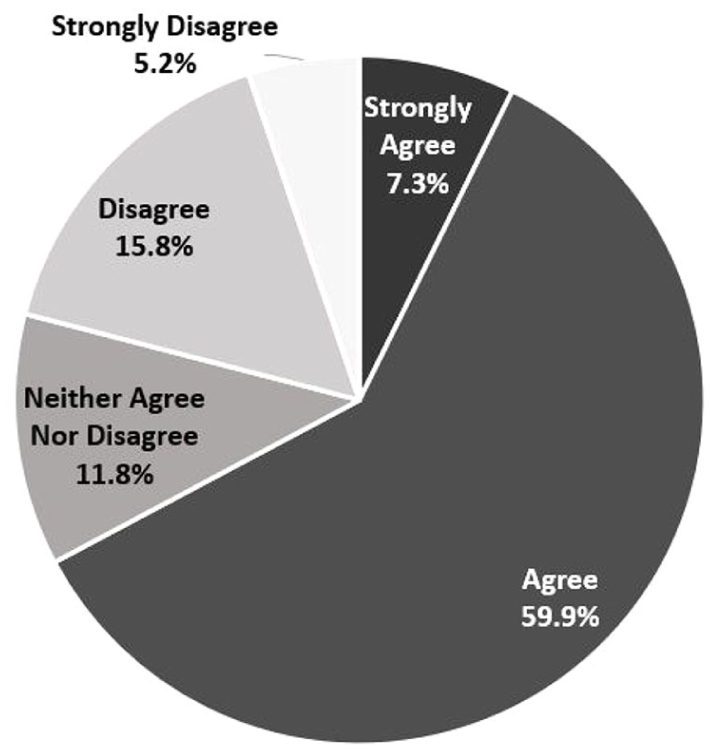
Business communication leads to gainful employment (hiring manager responses).
Respondents were then asked to compare the employability of those with a business communication degree to similarly named degrees (corporate communication, management communication, organizational communication) or alternative degrees from the social sciences (sociology, psychology) and business subdisciplines (marketing, human resource management, business administration/management): “Compared to a bachelor’s degree inbusiness communication . . .[degree] has greater employability.”Table 1illustrates the order in which options were provided to respondents.
Degree Comparisons.
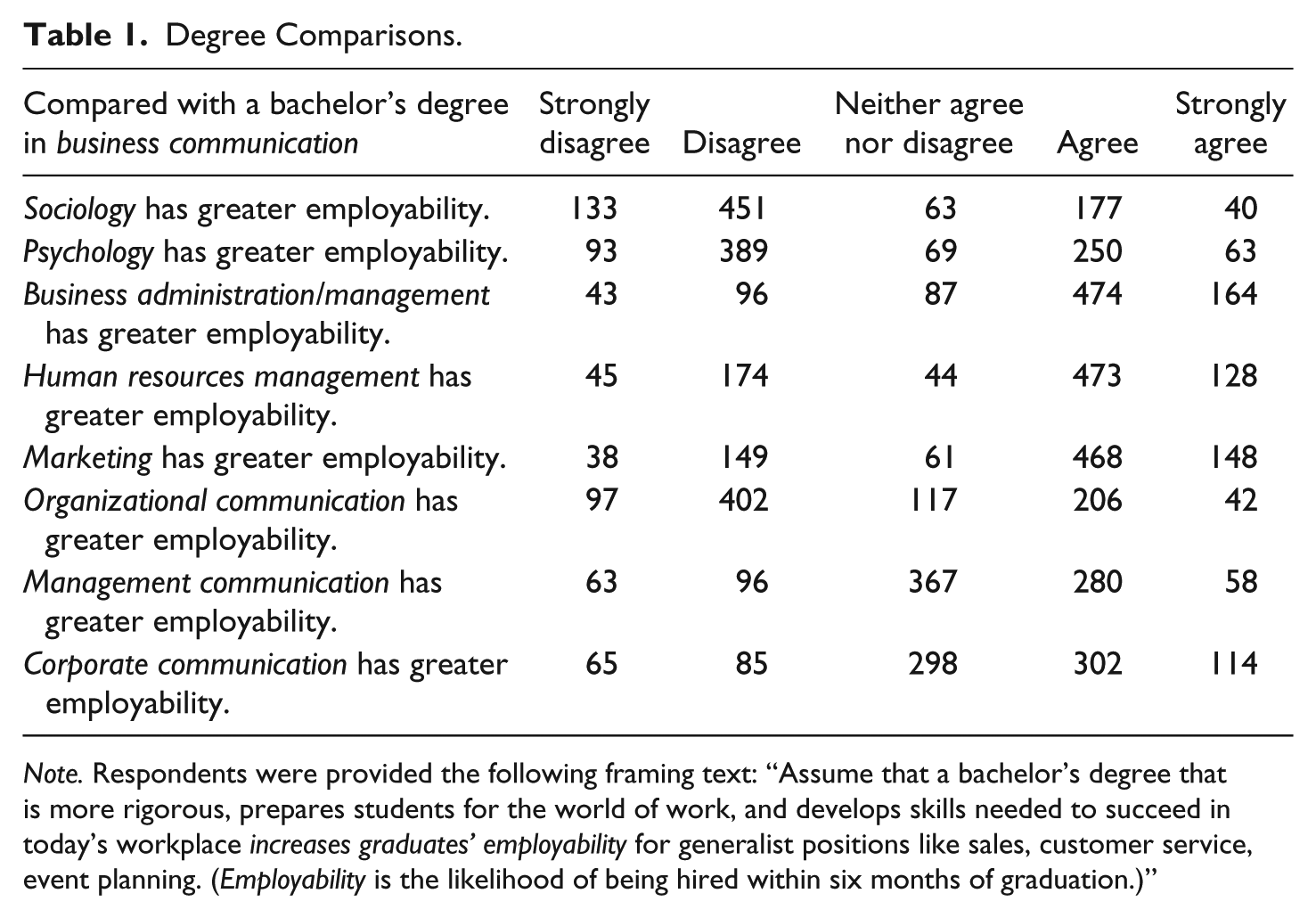
Note.Respondents were provided the following framing text: “Assume that a bachelor’s degree that is more rigorous, prepares students for the world of work, and develops skills needed to succeed in today’s workplaceincreases graduates’ employabilityfor generalist positions like sales, customer service, event planning. (Employabilityis the likelihood of being hired within six months of graduation.)”
The list of alternative degrees was limited to a few disciplines to minimize the number of inputs required from respondents. Corporate communication, management communication, and organizational communication were included because these are recognized as counterparts in business communication literature (Shelby, 1993;Taylor, Flanagin, Cheney, & Seibold, 2001). Marketing, human resources, and business administration/management were included in the list because these are the most frequently occurring dual majors or minors with a communication studies degree at my university. I also hypothesized that business degrees would be viewed more favorably by hiring managers. Psychology is one of the most popular majors in the United States (National Center for Education Statistics, n.d.) and includes the field of organizational psychology. I included sociology because the field of organizational communication, one of my secondary areas of research, draws heavily on sociological inquiry.
Figures 2and3represent data fromTable 1.Figure 2, a stacked column chart, represents responses exactly as presented inTable 1, though responses are reorganized fromleast likelyto increase employability (sociology) tomost likelyto improve employability (marketing). This chart makes it easier to visualize the sentiment of respondents.Figure 3excludes neutral responses and illustrates, as a percentage of the 864 responses, respondents’ favorable-to-unfavorable sentiment toward the employability of the business communication degree compared to an alternative degree. This cluster bar graph shows that marketing is considered favorably as much as sociology is viewed unfavorably. Corporate communication and management communication are rated favorably, though corporate communication is favored more.
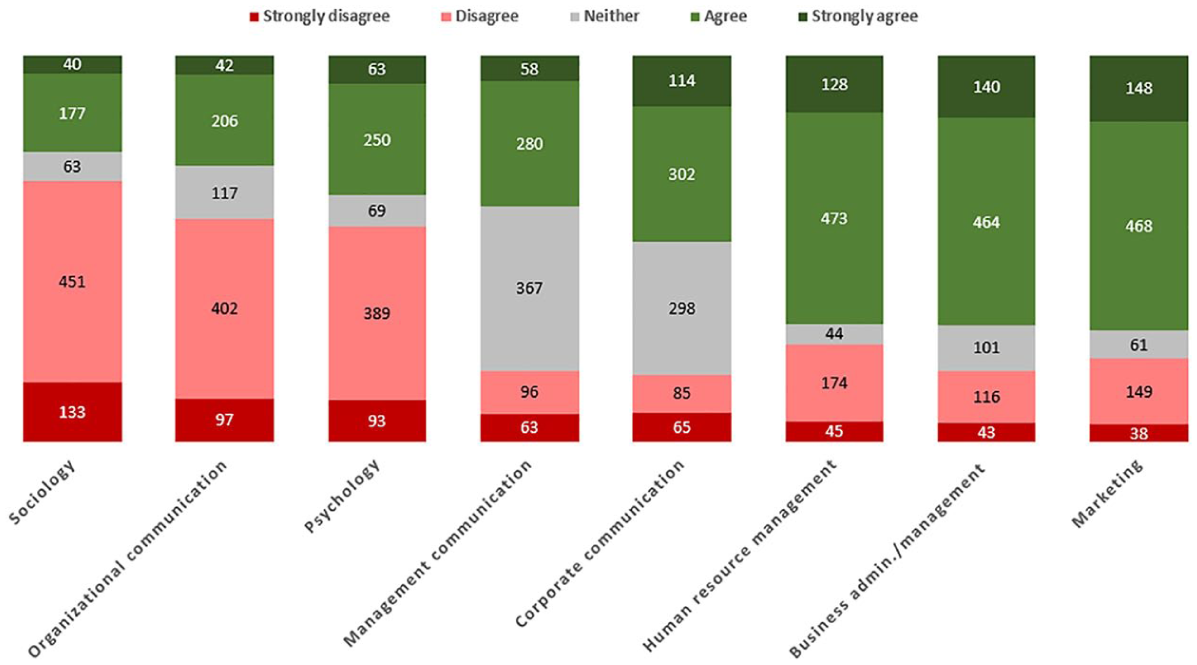
Comparison by degree.
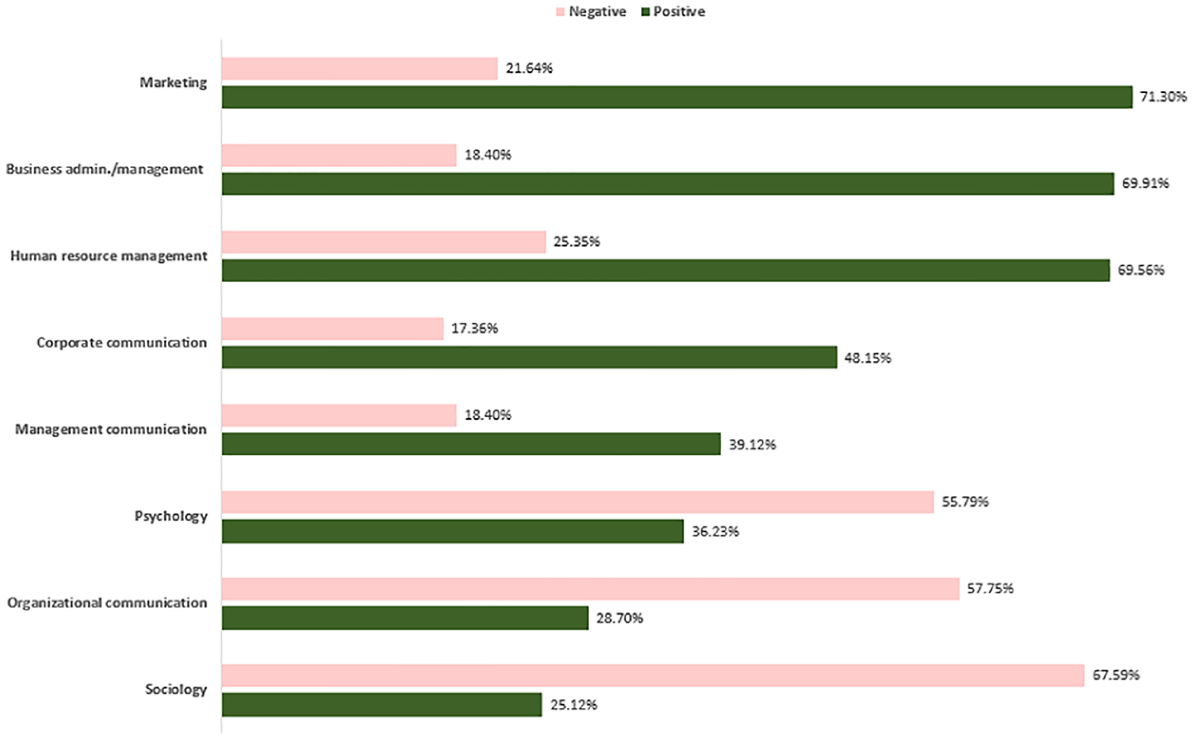
Favorable-to-unfavorable ranking.
Recommended Courses
Following the degree-related questions, respondents were asked to indicate by check mark any courses they thought college undergraduate students should take to increase their employability in generalist positions requiring a bachelor’s degree. The list included 30 courses commonly required in business or communication degree paths, including public speaking, business communication, advanced writing, leadership, business management, persuasion, sales, accounting, research methods, marketing, human resource management, and so on. All options were presented randomly to each respondent. Given the length of the list, respondents were asked to validate their responses on the next screen (e.g., “In the previous response, I selected public speaking; I selected public relations; I selected analytical philosophy”). The respondent had to answer his or her selections correctly. Of the hiring managers’ responses, which formed the initial data set (N= 864), 41 responses were excluded because respondents did not correctly select the options that paired with their initial selections. In other words, they triggered the invalidation criteria.Table 2lists the top-ranked courses.
Recommended Courses for Generalists.
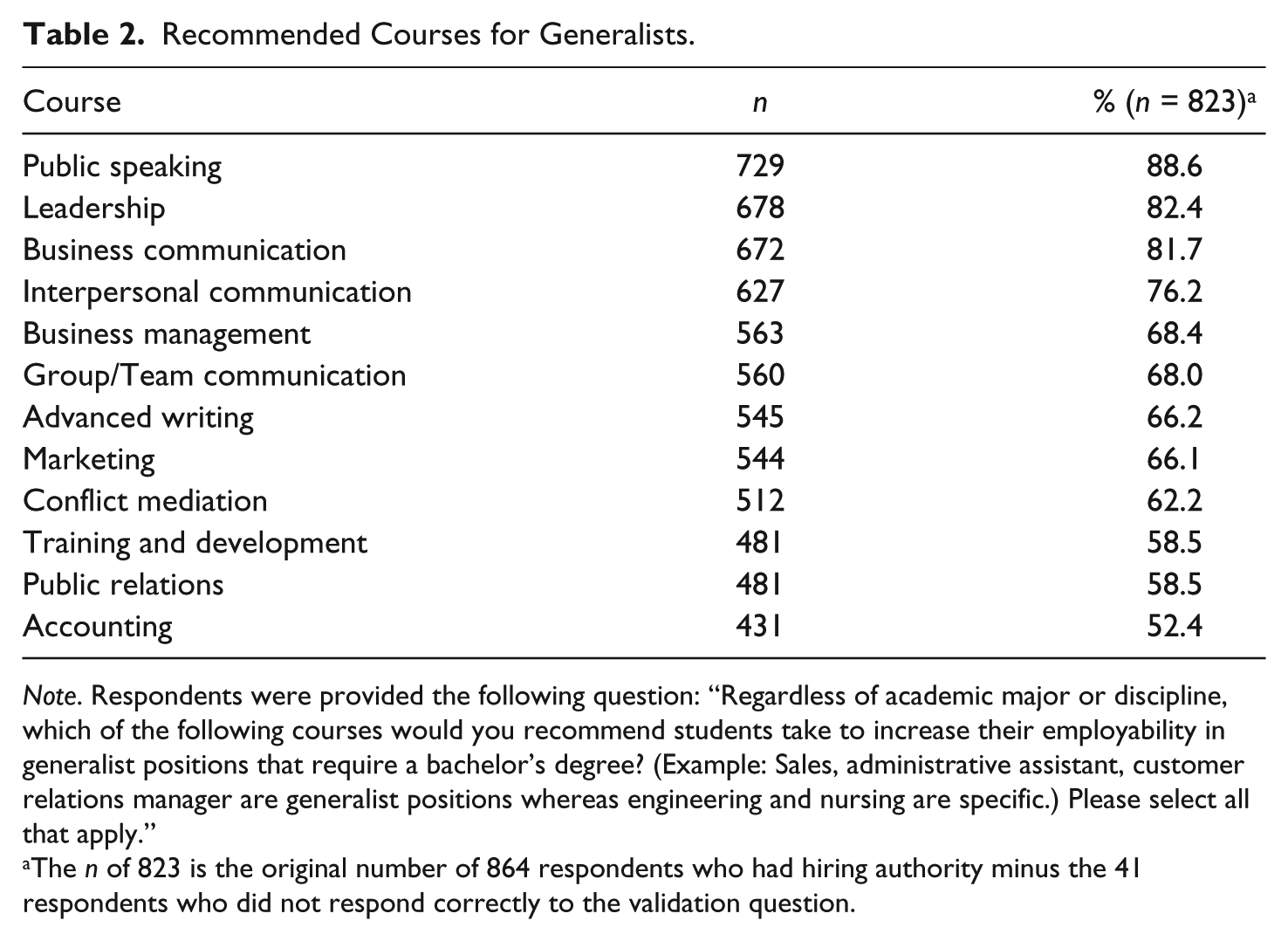
Note. Respondents were provided the following question: “Regardless of academic major or discipline, which of the following courses would you recommend students take to increase their employability in generalist positions that require a bachelor’s degree? (Example: Sales, administrative assistant, customer relations manager are generalist positions whereas engineering and nursing are specific.) Please select all that apply.”
Thenof 823 is the original number of 864 respondents who had hiring authority minus the 41 respondents who did not respond correctly to the validation question.
Program Sponsorship
Following the question related to specific courses, participants received a series of questions related to business communication. Conditional branching of questions, which is clarified question by question below, determined which degree a program hiring manager thought was of higher quality. By filtering respondents through the following questions, only respondents who indicated the degree is valuable and think sponsorship is important weighed in on which department provides the highest quality courses. Therefore, a slightly more accurate account of hiring managers’ impression of a sponsor’s legitimacy was obtained. All respondents were presented with Question 1:
Business Communication courses tend to teach technical skills related to document analysis and design, writing and editing, and public speaking. Do you think these courses are a useful investment for any student preparing for a career in a professional setting?
Of the 864 respondents from the modified original data set (i.e., the responses excluding nonhiring managers), 87% (752) of respondents selectedYes(favorable opinion), 5% (43) selectedNo(unfavorable opinion), and 8% (69) selectedUnsure. Respondents who selectedNoorUnsurewere taken to the end of the survey.
Only those who selectedYeswere presented with Question 2:
Business Communication courses are often part of the curriculum in either Departments of Communication Studies, English Departments, or Departments of Business/Management. Does the department that teaches Business Communication change the quality, rigor, or value of Business Communication?
Most respondents who indicated a favorable opinion of business communication (752) also indicated that sponsorship was unimportant: 72% (541) selectedNo, 24% (180) selectedYes, and 4% (31) selectedUnsure. Those who selectedNoorUnsurewere taken to the end of the survey.
Finally, respondents who selectedYes(180), indicating that they believe sponsorship affects the quality of business communication, were asked to choose which department they think should sponsor the program: “You indicated that departments impact the quality of a course or program. Which department do you think provides the highest quality Business Communication courses?” Respondents indicated business and communication might be the best sponsors of the program: 46% (83) selectedBusiness, 37% (67) selectedCommunication Studies, 14% (25) selectedEnglish, and 3% (5) selectedNone of the above.
Clarifications
Because there is significant subjectivity in respondent reasoning or interpretation of questions, the end of the survey included an option for respondents to explain their specific responses. One of three triggers determined the question presented to respondents:
Trigger 1: If respondents indicated they disagreed or strongly disagreed with a graduate’s ability to find gainful employment but had a favorable view of the business communication course, they were asked the following question: “During the survey, you indicated that a student earning a business communication degree might not be employed within six months of graduation; however, you indicated that you had a favorable opinion of business communication as a useful investment. Can you offer some insight into your responses?” Sixteen respondents received this question; five wrote responses.
Trigger 2: If respondents indicated that they agreed or strongly agreed that students with a degree in business communication would be gainfully employed in 6 months but then had an unfavorable view or opinion of business communication courses, they were asked the following question: “During the survey, you indicated that a student earning a business communication degree would be employed within six months of graduation; however, you indicated that you had an unfavorable opinion of the courses as a useful investment. Can you offer some insight into your responses?” Eight respondents received this question; three wrote responses.
Trigger 3: If respondents selected they had an unfavorable or unsure view of business communication as an investment, they were asked the following question: “During the survey, you indicated that you had an unfavorable opinion or were unsure that business communication is a useful investment. Can you offer some insight into your response?” One hundred and two respondents received this question; 34 wrote responses.
Respondents who did not meet any of the above criteria (n= 738; 85.4%) were asked to provide an answer to the following optional question: “Do you have any thoughts or advice for current college students about how to prepare for the job market?” Two hundred and twenty-six participants responded to this question. Few Trigger 1 and Trigger 2 questions were asked, which indicates that there was consistency in opinion about the employability of a degree and the required coursework. In other words, respondents who did not think a business communication degree would increase employability also did not believe the curriculum is a good investment. Select responses to qualitative questions are provided to support suggestions and recommendations presented in the discussion.
Discussion
This study does not provide definitive conclusions about the business communication degree, courses, or its overall legitimacy. It does, however, offer several useful insights. These insights, when coupled with other relevant articles within disciplinary journals, can be used to make informed decisions when teaching and advising undergraduate students, (re)designing the business communication curriculum, explaining program legitimacy to administrators, or considering sponsorship of the business communication degree. Subsequent sections provide recommendations and questions for additional consideration.
Advising Students and Early-Career Professionals
There are several takeaways from this study that can support advising efforts. Foremost, the business communication degree is considered to lead to gainful employment. As highlighted inFigure 1, 67.2% of hiring managers had a favorable or highly favorable opinion of the business communication degree leading to gainful employment. When asked about the degree after ranking specific courses, 87% of respondents thought the degree is a useful investment. Students seeking a degree that has strong favorability among managers with hiring authority can confidently choose the business communication degree, especially if they plan to pursue generalist jobs requiring a bachelor’s degree (e.g., salesperson, recruiter, administrative assistant, event planner, or customer service representative).
Of course, not all respondents had a favorable view of the business communication degree: 21% of hiring managers, which is not an insignificant number, indicated they did not think graduates would be employed within 6 months of graduation. However, respondents who had a negative view of business communication did not favor other degrees, as presented inTable 2(the correlation coefficient between a negative view of business communication and belief that another degree would provide greater employability ranged from .81 [marketing] to .92 [sociology] for each degree category). In other words, respondents with a less-than-favorable view of business communication possibly have an overall negative view of higher education or are biased toward degrees not presented in this study (e.g., information technology, engineering, or geology). Data inFigure 2also support human resources, business administration, and marketing as better alternatives. However, not all students will be interested in these specific areas of study.
What is more, there is a great deal of subjectivity in hiring decisions. For example, one respondent favored a liberal arts curriculum for a position that would seemingly favor business: I work in HR and I hire recruiters and specialists all the time. Truthfully, I tend to hire more liberal arts students than business students or even those with HR degrees because liberal arts students are better writers and more creative and just more interesting to work with. Anyone can learn HR quickly, but it takes time to cultivate these skills [presumably those related to the courses inTable 2]. If I understood the makeup of the courses listed as being part of the business communication courseowkr [sic], I’d be more likely to consider that recent grad for an interview and probably hiring. Probably should through [sic] in a sales or improv course and they’d probably make a great recruiter.
Business communication is not a fail-safe degree or necessarily the best degree, but it is a legitimate degree. The above quote supports the next takeaway as well.
Second, students who complete a curriculum in business communication should facilitate others’ understanding of the degree by listing select coursework on their résumés (likely in the education section, under degree) and LinkedIn profiles. Specifically, students could list courses inTable 2if they are applying for generalist positions, such as sales, administrative support, or customer relations: public speaking, leadership, business communication, interpersonal communication, group communication, and advanced writing. Listing courses would provide more context about the degree. Similarly, students in other disciplines, especially those in more technology-centric disciplines, would likely benefit from listing select business communication courses on their résumés. Thus, students in other disciplines should be advised to take business communication courses as electives. Since many of the courses cover so-calledsoft skills, the business communication curriculum is valuable to students in other disciplines, as noted by scholars in engineering (Fernández-Sanz, Villalba, Medina, & Misra, 2017), health care (Newcomb et al., 2017), and computer science (Verdugo et al., 2013). Moreover, findings in this study replicate findings from NACE’s (2017) study: Hiring managers, regardless of industry, want to see résumé content that demonstrates that a job candidate has leadership abilities, team management skills, written and oral communication skills, problem-solving skills, and creativity. Listing courses with titles that cover these topics can improve a résumé (Robles, 2012).
Third, points one and two suggest students could be encouraged to pursue dual majors, minors, or certificates in business communication. If the metric for return on investment is gainful employment within 6 months of graduation, the generally favorable responses to questions in this study support the additional financial and personal (time) investment required to complete additional coursework. Of course, readers of this journal will like the idea of students in other disciplines taking business communication courses. The argument is persuasive: Courses frequently taught within the business communication curriculum (Sharp & Brumberger, 2013), such as communication for leaders, business speaking or writing, interpersonal communication, and intercultural communication, can complement degrees in any program of study and are supported by this study and others cited above. These studies can be used to pitch collaborative partnerships with other units across campus.
Fourth, students should not worry about which department sponsors the business communication degree or related courses. They should take business communication anywhere it is offered on campus. The descriptive data in this study indicate that business communication, regardless of where the program is housed (sponsored), is viewed favorably. Students concerned about taking business communication courses at their university or college, perhaps because communication or English departments sponsor them, should be reassured that sponsorship of the business communication course or degree does not significantly alter the impression of legitimacy among hiring managers. In this study, 72% of the respondents with an overall favorable opinion of business communication indicated sponsorship in business, communication, or English does not change the rigor of the program. Of those who did think sponsorship matters, they generally favored business (46%); however, as a total of the overall population of respondents, this only represents the view of 83 respondents (9.6%). Nevertheless, it is unlikely hiring managers would know which department teaches a specific course. Colleagues in English departments may find solace in this anecdote provided by one respondent: This study made me recall an interesting experience: Back in the day, I took two business communication courses in one semester, thinking this would be a way to easily knock out two electives—what I did in one class, I would do in another. (Yes, I am aware of the questionable ethics.) One was taught by the English Department, the other by the Communications Department. Turns out, this was a bad idea. The English prof had some high standards. One of the hardest courses I ever took, but also one of the most useful.
Finally, I want to point out that courses rated higher by hiring managers enhance key skills thatBrynjolfsson and McAfee (2017), faculty of the MIT Initiative on Digital Economy and recognized experts on disruptive technology, suggest are needed in the future: high emotional intelligence, interpersonal communication skills, leadership skills, and conflict-management skills. Thus, business communication is likely to remain an excellent degree option for students seeking to develop technical and social skills needed to navigate workplaces rapidly changed by artificial intelligence (AI), machine learning, and the Internet of things (IoT). Future research should explore business communication students’ preparedness for these trends.
Legitimacy and Sponsorship
This study has useful takeaways for faculty and program administrators. First, much of the data and examples provided in previous sections highlight the external legitimacy of business communication. Specifically, based on the responses of the initial 864 respondents (n= 580; 67.1%), hiring managers agree or strongly agree that the business communication degree will lead to gainful employment. In addition, validated responses to the question regarding courses (n= 823) suggest that many respondents believe that business communication courses will increase employability (n= 672; 81.7%). Compared with sociology, organizational communication, and psychology degrees, respondents feel business communication is a better choice for employability. These data can be shared to enhance perceptions ofinternallegitimacy when defending the utility of programs and courses. Proving legitimacy may be increasingly important as universities reorganize to handle decreasing enrollments and reductions in state allocation of funding (Kenyon, 2014). Arguments in favor of business communication include its external legitimacy among managers with hiring authority and its development of knowledge and skills suitable to the changing jobs landscape. Of course, future studies should also explore why nearly a quarter of respondents did not think the degree would lead to gainful employment.
Second, this study could drive decisions that would further increase internal legitimacy. Courses thought to increase employability (Table 2) are those frequently taught within business communication, corporate communication, or management communication programs (Moshiri & Cardon, 2014;Shelby, 1993;Wardrope & Bayless, 1999). Because upper-level university administrators want proof that external audiences seek to hire students from degree programs when making decisions about resource allocation (Wardrope, 2002), data from this study can be used to argue for internal legitimacy and to procure additional resources for business communication programs.
Third, enrollment is often used as an internal metric of a course’s or program’s utility. Findings in this study can be used to improve enrollment numbers. First, data support advertising business communication as a viable college-to-career option, which will likely motivate some students to declare it as their major field of study. Second, the curriculum also continues to cover topics that generate knowledge and skills desired by employers (NACE, 2017;Ortiz et al., 2016;Stevens, 2005). Again, this is useful advertising. Finally, data drawn fromTable 2andFigures 2and3can be used to make minor changes to the curriculum that could lead to increased enrollment in specific courses. For example, the data show a positive bias toward business and leadership (seeFigure 2andTable 2). This bias is not likely held only by hiring managers. Therefore, course titles and objectives can be updated to make courses more attractive to students. For example, I modified and retitled a course “Introduction to Organizational Communication” to “Introduction to Organizational Communication & Leadership.” Despite overall declines in university enrollment, the enrollment in the course immediately doubled and maintained its enrollment numbers each term. Adding leadership to the title and covering more leadership-related themes in the curriculum increased enrollment by enticing students from other disciplines to take the course. Similarly, I retitled “Organizational Communication” to “Advanced Business and Professional Communication.” After changing the title, there was a 30% increase in enrollment, primarily by drawing in public relations students who had generally avoided courses in the organization communication specialization. Though purely anecdotal, these examples show how I am applying the study’s findings to improve enrollment numbers.
Finally, sponsorship is a topic of interest for business communication faculty (Laster & Russ, 2010;Moshiri & Cardon, 2014;Sharp & Brumberger, 2013). This study suggests that sponsorship of the business communication curriculum by a department of communication, English, or business is not likely to significantly affect hiring managers’ impression of the degree. Future studies might look at the potential value of an interdisciplinary degree since departments on college campuses often duplicate many of the top 12 ranked courses.
Limitations
Some limitations of this study lessen the assertiveness with which I make the above suggestions. First, the forced-choice aspect of this study assuredly affected how respondents voted on degree employability. For example, sociology or organizational communication would likely have scored better if compared with art history. Similarly, given the current enthusiasm for science, technology, engineering, and math (STEM;Zakaria, 2015), public speaking could have been rated lower than computer science courses had they been listed as options. However, in qualitative responses, only 12 respondents indicated that they thought the survey should have listed courses in the sciences. These respondents work in science-heavy fields (two noted they work in research labs, six in health care, three in pharmaceuticals, and one in science consulting).
Second, gainful employment is a subjective construct. Thus, it is not clear if business communication is a good return on investment, since the return on investment could be interpreted differently by each respondent (based on job satisfaction, salary, long-term career growth, etc.). Despite this limitation of the study, the following quote from one respondent suggests that business communication is meaningful if students are passionate about the subject: Students should not invest in degree, they should invest in themselves. The idea of earning a degree is somewhat dated, they should pursue courses that fit their passion and develop skills they need to do what they love. If that [means taking] one or fifty courses, so be it.
The business communication curriculum provides many courses that are interesting; therefore, the curriculum ought to suit diverse learners’ passions. The business communication curriculum has historically achieved skills development (Russ, 2009;Wardrope & Bayless, 1999).
Finally, this study only posed two questions: Does the degree name influence hiring managers? Which courses are considered a good investment? Based on responses, hiring managers do view business communication more favorably than sociology. The curriculum does cover courses considered to be a good investment. However, the questionnaire did not identify if respondents consider degrees an essential criterion for employment. In practice, it is unlikely that a hiring manager will put much emphasis on a degree itself. Instead, he or she will favor other qualifying information when advancing a candidate in the recruiting process. One study showed that a student’s alma mater may have more impact than the specific degree, particularly when readers are considering applicants’ general mental abilities (Chen et al., 2011). Moreover, the entire résumé, including leadership activities and prior work history, should be more influential to hiring managers than a specific degree.
Despite some of its limitations, this study obtained hiring managers’ basic impressions of the business communication degree. Many early careerists must rely on the degree as a selling point in their first few years of their job search; thus, knowing that hiring managers view business communication favorably is a good marketing point for program administrators trying to increase enrollment. Except for professionalized degrees (e.g., accounting, law), any university degree is going to be evaluated based on the perceived transference of coursework into career-relevant knowledge, skills, and abilities. While this study does not make a strong case that studentsshouldstudy business communication, it suggests it is a good option. A respondent’s somewhat aggressive note summarizes what students ultimately need to know: I really don’t care about the degree. I’ll take a student with a degree in Zoology or Gender Relations (or any other degree university’s [sic] cook up) to work on my sales team if they are personable, can communicate well, and take directions. I’ll train them to succeed.
A dozen or so other respondents’ similar comments supported this sentiment. The key point in this statement, at least in my reading, is based on the key wordspersonable, communicate well, take directions, andtrainable.Developing students’ emotional intelligence, which would make them personable, trainable, good communicators, and so on, is a learning objective of business communication.
Despite the above limitations of the study, parents or students evaluating the business communication degree may appreciate knowing that most respondents in this study had a favorable impression of the degree (67.2%)—81.1% if including all 1,000 responses. Thus, business communication has external legitimacy. What is more, whether it is called management communication or corporate communication (seeFigure 2), the sentiment holds.
Conclusion
This study does not provide definitive or comprehensive answers to questions about the legitimacy of business communication (Krapels & Arnold, 1996); however, it offers useful insights. I shared several examples and ideas to illustrate how students and careerists can use the data to improve their résumés. I also suggested ideas for faculty who hope to increase the internal legitimacy of the business communication degree. There are a few more key points and suggestions I want to highlight, which can guide future studies.
First, the survey needed to be very brief. Survey respondents of paid survey agencies, such as the one used in this study, expect to be able to complete questionnaires in fewer than 5 minutes. It was not possible, therefore, to include questions that might capture cognitive bias, respondents’ assumptions about courses and workplace preparedness, or data for inferential analysis. Doing more research on this topic will yield a better understanding of how hiring managers perceive the degree. Specifically, having hiring managers look at real résumés in a controlled experiment (where the degree name or listed coursework are treated as the independent variables) would provide useful results on impressions of the degree in an applied scenario. Such an experiment might also reveal which is the better name: business communication, management communication, or corporate communication. Professional communication was not included as an option in this study, but ought to be in future studies. Nevertheless, data in this study show support of the business communication degree and courses among managers with hiring authority.
Second, topics of degree name, recommended courses, gainful employment, and investment are very subjective. The brevity of the survey limited my ability to account for potential variances in respondents’ interpretation of these terms. Better background information on respondents or a more controlled pool of respondents, such as only including human resources recruiters, might produce more reliable results. In this study, I targeted high-level positions because these seemed to yield more respondents with hiring authority. Some upper-level hiring managers may not interact with early-career professionals or generalist positions. Nevertheless, people in top positions may set policy that guides the hiring decisions of lower level professionals. For example, an organization may adopt a policy of only hiring candidates from top universities or specific programs (Rivera, 2015). In short, future publications should better define constructs, survey targeted demographics, and obtain information about the respondents’ hiring policies.
Third, the questions posed about employability and courses assume that respondents see a link between courses and skills preparation. Future studies should ask respondents if they believe courses develop transferable skills, which would strengthen claims related to the legitimacy of the business communication curriculum. In actual practice, hiring managers are not privy to degree coursework and, therefore, likely make assumptions about the degree. Therefore, data from this study are valid. However, knowing the assumptions that hiring managers have about degrees and courses would improve our understanding of the business communication degree’s legitimacy.
Fourth, a key finding in this study is not only that 67.2% of hiring managers view the business communication degree as leading to gainful employment (it is a legitimate degree), but that 21% do not see it as leading to gainful employment. Future studies might explore why respondents do and do not think the degree is legitimate. Knowing this information would improve advertising campaigns aimed at correcting misperceptions of the degree. This information could also be used to modify the degree to better conform to audience expectations. Marketing and curriculum improvements would further increase the legitimacy of the degree among internal and external stakeholders. In the meantime, business communication faculty and researchers should advertise and explain to various stakeholders that the business communication curriculum is well positioned to be a worthwhile long-term investment, even in an AI world (Brynjolfsson & McAfee, 2017;Smith & Anderson, 2014). We should assure our students and administrators that we are continually adapting the business communication degree to ready students for the work demands of the future. Of course, looking at the nuances and uses of business communication in the age of machine learning is a fruitful area of research.
Finally, in an era increasingly marked by a college-to-career approach to higher education, we should ask the following question: What degree specializations or courses leave hiring managers with a positive impression? Data from the study presented in this article suggest that business communication gives a positive impression. Students should be encouraged to complete a business communication specialization if it exists on their campus. Based on data obtained bySharp and Brumberger (2013), it likely does not. Therefore, faculty in business, communication, and English should consider adding business communication as an area of specialization within a degree or as a minor.
Footnotes
Author’s Note
This study was approved by the Human Subjects Committee of Southern Illinois University Carbondale (Protocol No. 15301). Participant comments are reproduced by permission.
Declaration of Conflicting Interests
The author(s) declared no potential conflicts of interest with respect to the research, authorship, and/or publication of this article.
Funding
The author(s) received no financial support for the research, authorship, and/or publication of this article.
Author Biography