



Abstract
Mentoring of graduate students is essential to the professional development of business and professional communication (BPC) scholars; it also helps advance the field of BPC and its disciplinary identity. In this article, a professor and graduate student use a case-study approach incorporating historical/archival data collection and grounded in critical reflection to describe and characterize their own long-term, cross-institutional mentoring relationship. They analyze artifacts from their mentoring experience; discuss benefits and challenges to mentoring in BPC; offer implications for mentees, mentors, and academic programs in creating formal mentoring plans; and suggest topics for further research.
Those pursuing academic and scholarly careers in business and professional communication (BPC) face special challenges because of the nature of the field. There is considerable variation both in how BPC is thought of and recognized within institutions and academic departments and in how it is framed within pedagogy courses students take during graduate school.Locker’s (1998)observation that the degrees of faculty teaching business communication “are almost never in something called ‘business communication’” (p. 20) still rings true today. The kind of understanding that a graduate student gains of BPC—indeed, whether a graduate student develops an understanding of it much at all—varies widely. Additionally, pathways to BPC scholarship and pedagogy are not always well established within graduate programs. Because BPC inherently crosses disciplines, there are typically not well-established or stable career paths for BPC faculty within academic institutions (Cyphert, 2009;Wardrope, 2001). Individuals’ persistence and success in navigating these challenges through graduate school and beyond depend in part on the quality of mentoring relationships they are able to establish along the way (Rymer, 2002).
These challenges have resulted in part because the field of BPC has long struggled to build a clear identity for itself. For example,Reinsch (1991)asked very simply, “What is business communication?” and concluded by suggesting that the discipline focus on how communication “contributes to organizational success” (p. 309).Sullivan and Porter (1993)noted that trying to define the professional writing subdisciplines led to “mainly unsatisfactory results” (p. 391), and they reflected over a decade later that “the interests of professional writing are interdisciplinary—and departmental organization works against this” (Porter & Sullivan, 2007, p. 17).R. L. Bell and Muir (2014)provided a table summarizing several articles discussing the challenges that business communication’s interdisciplinary nature presents (pp. 101-103). Noting that business communication does not have a single institutional home—it can be found in many different academic departments, such as management, English, and communication—Graham and Thralls (1998)suggested that “perhaps we should give up the notion of business communication as a single discipline or even a unified interdiscipline and admit that our field is multidisciplinary” (p. 10). Following this line of thought,Knight (2014)commented on the “multi- trans- and interdisciplinary nature of the fields that now represent business and professional communication” (p. 5), noting that while the focus of BPC is on “communication in the workplace” (p. 5), that encompasses “many interdisciplinary, international, and organizational perspectives” (p. 5) and a variety of fields and topics. As the study, teaching, and practice of BPC advance, and while disciplinary characteristics retain their importance, the interdisciplinary nature of the field also presents key sensitivities that BPC scholars benefit from developing as early in their careers as possible.
Associated with the challenge of identity, then, is the need to inculcate a sense of that identity in emerging scholars of BPC—namely, graduate students and early-career faculty. Yet there has been little discussion in the BPC literature about how to develop graduate students for careers in teaching and practicing BPC. In this article, we reflect on and discuss a case study of our own mentorship experience that began in 2006, when we were both at a medium-sized university in the Midwest. At that time, Janel was a visiting assistant professor in the Department of English and a writing consultant for a department in the School of Business, and Jeremy was a master’s student in the program in which she taught. This mentorship started as part of a formally assigned teaching mentorship; since that time, our mentoring dynamic has become more informal, evolving to include research collaborations alongside continued discussions of pedagogy and practice in BPC. Through an analysis of relevant literature and a description of our own experiences in an ongoing mentoring dynamic, we offer mentorships as a way of developing graduate students in BPC.
Specifically, we seek to address the following research questions:
Literature Review: Mentoring Graduate Students
While this article focuses specifically on mentoring graduate students, it is worthwhile to begin by briefly examining the concept in general. The idea of mentoring traces back to Homer’sOdyssey, which includes a character named Mentor (actually the goddess Athena in disguise), who helps Odysseus’s son Telemachus find the strength (menos) and connections (napios) necessary to accomplish the challenges before him (O’Donnell, 2017). This concept has persisted over time, and much guidance can be found in popular self-help books about strategies for both being a mentor and being mentored. Examples includeOne-Minute Mentoring(Blanchard & Diaz-Ortiz, 2017),Mentoring 101(Maxwell, 2008),The Mentee’s Guide(Zachary & Fischler, 2009), andThe Elements of Mentoring: 75 Practices of Master Mentors(Johnson & Ridley, 2018).
As these books discuss, mentoring is applicable in many situations. In higher education, the term is often used in connection with guiding graduate students and tenure-track faculty through the early stages of their careers. It should be noted that for the purposes of our study, we are treating mentoring as a separate concept from advising, although there can be considerable overlap within these roles within higher education (McWilliams & Beam, 2013).
Mentoring is not a one-way street, where the mentee is the sole benefactor of the mentor’s wisdom; it involves shared responsibility.Gabarro and Kotter’s (1980) Harvard Business Reviewarticle “Managing Your Boss” discussed the idea ofmanaging up.Lee, McGee, Pfund, and Branchaw (2015), building on this idea, advised graduate student mentees to “mentor up” (pp. 135-136) and be proactive participants in relationships with their mentors.Cassuto (2015)emphasized the need for faculty to pay better attention to graduate student mentoring in several aspects, such as the job market and scholarly publishing.Espinoza-Herold and Gonzalez (2007)interviewed faculty to gather their perceptions of successful strategies for mentoring graduate students and new faculty and found that being role models, providing networking opportunities, and exhibiting empathy contribute to a mentor’s effectiveness.
It is important, too, to differentiate betweenformalandinformalmentoring. Formal mentoring (see, e.g.,A. Bell & Treleaven, 2011;Patel, 2017) involves a defined and at least partly systematized learning relationship between two or more people; oftentimes, the basic parameters of that relationship are defined in written documentation provided to those involved. Informal mentoring (see, e.g.,Liang & Gong, 2013;Rose, Rukstalis, & Schuckit, 2005;Torney Welsh, Bhave, & Yong Kim, 2012) implies that the dynamic is not official (i.e., it is not recognized programmatically or institutionally) and may not even be formally articulated between the parties involved, but rather is tacitly understood; importantly, though, a professional learning relationship between two or more people still exists, and its intended function is to provide near-term and/or long-term professional benefits to at least one (and, optimally, more than one) of the participants in the interaction. Also worth noting is that both types may have formal and informal aspects. For instance, two professionals in a formal mentorship may interact socially outside work settings. Similarly, a seasoned professional may provide casual advice and guidance to early-career colleagues within the same organization; the mentoring that takes place is informal, yet the organizational relationships are formal.
Strategies for mentoring graduate students have been discussed in the literature of a variety of fields.Finch and Fernández (2014)proposed a model called From Conception to Co-instructor to Completion (FCCIC) for mentoring graduate students in teaching, specifically in sociology, but also applicable to a variety of disciplines.Metzger, Petit, and Sieber (2015)described a mentoring model called Connection-Cultivation-Integration (CCI) that is designed to create a positive, supportive, and collaborative academic culture in the graduate program and beyond.Pardun, McKeever, Pressgrove, and McKeever (2015)surveyed over 200 senior faculty in journalism and mass communication to gather insights on doctoral education. The responses indicated that mentees use mentors as role models in terms of forming their opinions about career paths—for example, viewing holding a PhD as more important than having experience in the journalism field.
As revealed in interdisciplinary readings on the topic, race/ethnicity and gender considerations raise important implications for mentoring as institutions strive to improve diversity and inclusion among faculty and students (C. S. V. Turner & González, 2015). Additionally, over time, awareness of and sensitivity to issues of harassment and discrimination have increased, and some incidents involving mentees and mentors have become highly publicized (e.g.,Bartlett & Gluckman, 2018;Mangan, 2018). As a result, both mentees and mentors may hesitate to enter mentoring relationships. In both informal and formal mentoring, these dynamics, along with others such as age and socioeconomic background, are relevant considerations. When matching mentors with mentees and designing mentoring programs, how these dynamics come into play depends on the situation and the individuals involved.Blake-Beard, Bayne, Crosby, and Muller (2011)studied issues of gender and race in mentoring matches of over 1,000 undergraduate, graduate, and postdoctoral mentees and found that some individuals, particularly women and those of color, felt more comfortable with a mentor of their own race and gender. Dynamics such as including mentors from diverse backgrounds and assessing comfort levels of mentees should be examined and considered in designing mentoring programs and assigning mentors in formal arrangements. Given the potentially limited number of mentors in many programs, those charged with administering mentoring programs should be aware that if mentoring is left to informal means only, these dynamics could cause some students to have trouble finding any mentors at all (Shteir, 2015). In one example of an effort to address such issues, the math department at the University of Iowa adopted a formal mentoring program that has helped contribute to its success in attracting and retaining diverse students (Patel, 2017). Such programs, while they cannot remove the challenges entirely, at least acknowledge their presence and help students navigate them in finding strong formal and informal mentors both within and outside of the institution.
Within higher education, in order to be most effective, at least some elements of mentoring need to be field specific (Zellers, Howard, & Barcic, 2008). Though there has been little discussion of mentoring specifically in BPC, the issue of graduate student mentoring has been discussed in cognate fields such as technical communication. For example, in a recent issue ofJournal of Technical Writing and Communicationdedicated to the theme of training graduate students for research,Grant-Davie, Matheson, and Stephens (2017; a faculty member and two doctoral students at the time) discussed how mentorship is instrumental in the development of scholarly identity and “vocation” within technical communication (pp. 160-161). In a somewhat conversational style, they addressed the mentoring process from their own perspectives, focusing specifically on the need for graduate students to learn how to formulate and articulate a research agenda “to be able to explain both to themselves and to others what they do and why it matters” (Grant-Davie et al., 2017, p. 153)—not just in terms of research, but as it relates to all aspects of one’s work. This identification of purpose is especially critical for a field—like BPC—that continues to work toward a cohesive, consistent identity among scholars.
In another piece on mentoring in technical communication from the same issue, current and previous members of Michigan State University’s Writing, Information, and Digital Experience (WIDE) collaboratory described how their research incubator serves as a space in which graduate students learn to “practice and reflect on active listening, collaboration, transparency, and accessibility [in a way that] is grounded in feminist and intentionally inclusive approaches to teaching and learning” (H. N. Turner et al., 2017, p. 136). The WIDE approach to mentoring was then connected to specific practices, such asMcGuire and Reger’s (2003) comentoring modelemphasizing “cooperative, non-hierarchical relationships for learning and development” (p. 54) and exemplified in thevignettesof five current and previous members of the group.
Discussions of graduate student mentoring specifically related to BPC are even less common than those relating to technical communication. In an editorial inBusiness Communication Quarterlytitled “Generation Next,”Riley (2006b)asked, “What about the graduate students now coming up ‘through the ranks’ to join us as professionals whose teaching and scholarship concerns business communication?” (p. 125). She noted that the graduate students she worked with were interested in evolving topics that were new to senior faculty and also that work styles had become more collaborative—in contrast to the solo author tradition common to faculty with literature/English backgrounds (pp. 125-126). In another editorial,Riley (2006a)discussed the importance of good role modeling, pointing out that working with graduate students is a good way of generating the type of reflection that helps mentors ensure that they are enacting the same values they hope to help others develop.
The field of BPC has continued to change sinceRiley’s (2006a,2006b) articles, yet there has been little discussion in the BPC literature of mentoring graduate students.Stowers and Barker (2010)mentioned mentoring, but mainly to point out that faculty in organizational communication, specifically, should use their skills in listening and coaching to help students develop not only in the classroom but also into the workplace and beyond—similar to mentors in industry. They spoke of mentoring in general terms, yet without a specific focus on mentoring graduate students or new faculty.Janson and Howard (2004)discussed how management communication PhD students at one university formed a community of practice amongst themselves for emotional and academic support, comparing it to Odysseus’s journey, but focusing more on the support they collaboratively generated amongst themselves rather than on that provided by faculty mentors. Similarly,Rymer (2002)discussed how informal connections formed among faculty colleagues within a professional organization evolved into comentoring relationships.
Through this study of our long-term mentoring relationship, we hope to reinvigorate the conversation about developing graduate students and early-career scholars in BPC. Because a long-standing dilemma in the field is the lack of identity and clear career path, paying more deliberate attention to establishing and developing faculty-graduate student mentoring relationships helps the individuals involved and also helps strengthen the field’s overall identity and purpose.
Methodology
This research is framed as a case study incorporating historical/archival data collection and critical reflection.Gerring (2007)defined a case as a “spatially delimited phenomenon observed at a single point in time or over some period of time” (p. 19); a case study, he wrote, is “the intensive study of a single case where the purpose of that study is—at least in part—to shed light on a larger class of cases (a population)” (p. 20). This case study spans the time period beginning August 2006 and continuing to the present. Our interactions have been necessarily varied in geography; this was especially true after our initial mentoring relationship, but even that time regularly included communication and interaction via email and mobile phone. More recently, our interactions have been at conferences, restaurants, and other ad hoc meeting places. Though we do not suggest that our experiences are generalizable to every mentoring relationship in BPC, we do assert in this article that what we have learned from the long-term mentoring process offers worthwhile implications for mentoring relationships in pedagogy and scholarly pathways in the field.
Case-Study Approach and Data Collection
The case-study approach has precedent in BPC research. For example,Drury-Grogan and Russ (2013)framed their classroom-based research on students’ perceptions of participating in an executive business communication simulation as a case study. Case-study research byAinsworth (2013)used surveys and interviews of students in a university’s business school to determine the effectiveness of international business in the business curriculum at that school. In workplace research,Dulek (2015)used a case-study approach to study a cultural change program at a major international manufacturer’s corporate offices. In writing studies as a whole, the approach has often been used in situations where the research questions are primarily rhetorical or communicative (see, e.g.,Cushman, 2016;Walton, 2016). In our case, we are using the case-study methodology as a way of framing a long-term mentoring interaction with implications for pedagogy and professional development in BPC.
Our method of data collection is a combination of historical/archival collection (Kynell & Seely, 2002;Ramsey, Sharer, L’Eplattenier, & Mastrangelo, 2010) with primary artifacts in archived emails, programmatic documents from previous professional experiences, and assignment descriptions that one or both of us developed. We also recounted and recorded anecdotal recollections individually and in conversation (see, e.g.,Gaillet, 2010), which contributed to reflections that we wrote and later combined into a single reflection document.
As we collected data, we recognized the importance of critical reflection as part of this research. Describing critical reflection as a qualitative research method,Fook (2011)thought of it broadly as “an overall process of learning from experience, with the express aim of improving professional practice . . . . a way of learning from and reworking experience” (p. 56). Several frameworks and concepts of reflection inform her approach, including reflective practice, learning from experience, reflexivity, deconstruction, and critical reflection as a practice. We incorporate critical reflection as part of our methodology in large part because, asFook (2011)explained, “it incorporate[s] both personal and social elements of experiences, and [mimics] the primarily interactive process in making meaning of experience” (p. 59), and because the approach, by its very nature, calls for a dialogic (shared and dynamic), integrative (inclusive of various aspects of our complex experiences), and transformative (providing a basis for empowering change and action at the personal and social levels) process of meaning making that was valuable to us as we collected and analyzed data and conversed about our findings.
Artifacts
Our basis of data analysis consisted of a series of artifacts—emails, assignment descriptions, a guideline document, and other materials—that we collected and curated. Generally speaking, the audience for each of the artifacts we collected and analyzed included one or more people in a mentoring dynamic within BPC. For example, the graduate program where we started working together produced mentoring guidelines intended for use by the mentor and mentee as their primary audience; secondary audiences included administrators, professors who were not mentoring graduate students yet needed to be aware of the guidelines, and nonteaching staff. As another example, the emails we sent one another were usually intended for our own use and planning. Generally speaking, then, the primary audience for most of the artifacts analyzed were the people directly involved in the mentoring dynamic, which was primarily ourselves: Janel, the professor, and Jeremy, the graduate student. These artifacts—and key findings from our analysis of them—are discussed in more detail in a later section. First, it is essential to present background context for our mentoring case.
Background to the Mentoring Case
Janel’s background included experience in business, accounting, and professional communication before going back for her PhD in the late 1990s; in 2006, she was a visiting assistant professor in the English department at an R2 university. Jeremy’s background was in technical writing, a field in which he had worked for nearly 5 years before enrolling in a master’s program at the same institution. Our mentoring relationship began when we were assigned to work together in an undergraduate business writing course in August 2006. This arrangement, which included an additional graduate student from another program in the department, was predetermined by the master’s degree program in which Jeremy was enrolled. There were some detailed guidelines for how mentors should work with faculty, but these guidelines allowed for a great deal of flexibility. (Of note, the guidelines themselves were somewhat similar toFinch and Fernández’s [2014]FCCIC model in which students observed for a full semester before teaching their own class.) The graduate students would observe the instructor’s class, assist with grading, and occasionally teach or lead class sessions before becoming the instructors of record the following semester in their own classes.
After the fall semester, the mentoring relationship continued, as Jeremy and the other graduate student often came to Janel with questions about their classes and how to handle various issues. This mentoring was in addition to a separate pedagogy course taught by the program director, which all of the graduate students teaching technical or business writing attended. These seminars, which lasted through Jeremy’s first year in the master’s program, were discussion based; readings focused on pedagogy, and much of the seminar time focused on classroom management, grading, assignment determination, and weekly observations based on the participants’ own experiences. The benefit of the additional mentoring relationship with Janel was its informality and casual discussion context, along with the shared experience of the class the previous semester.
In 2008, Janel became a tenure-track faculty member in an English department at another institution; at nearly the same time, Jeremy transitioned from his master’s coursework back into industry. With Janel in academia and Jeremy in industry, the mentoring dynamic evolved into a practically grounded discussion over the next several years. Mostly through email, we found ourselves reflecting on the relationship between our pedagogies and practical work in business communication.
In 2015, while still in industry, Jeremy began teaching technical writing as an adjunct. It was at this time that Janel and Jeremy began communicating specifically about pedagogy once again, either in person or by phone or email. By this time, Janel was a tenured associate professor at the same institution she went to in 2008. In 2016, Jeremy entered a PhD program in writing studies. In the two subsequent years, we collaborated on multiple presentations—one of which led to our writing this article.
Analysis of Artifacts
In our analysis, we found that the study artifacts themselves can be characterized on the basis of two different but important categories: type and purpose. We identified five types: email, programmatic document, course material, scholarly document (including conference presentations and sources documenting our research), and reflection. The lattermost type was a combined series of reflections that we wrote based on recollections and analyses of periods of time within our mentoring experience. We decided to include this as an artifact because it provided valuable data for our analysis. We further categorized each artifact by its primary purpose: reflective (serving to describe some aspect of the mentoring dynamic), informative (serving to provide BPC academics or professionals with information on a BPC-related theme, whether pedagogical or practical), pedagogical (intended to provide information, or to be used as a basis for providing information, to students in a BPC course context), advisory (serving to provide situated guidance in the mentoring dynamic), or conversational (involving mostly a discussion of miscellaneous topics, such as confirmation of a return trip from a conference). Although these categories are not mutually exclusive, our analysis focused on what we considered the primary purpose. For example, teaching guidelines from the master’s program were considered “informative” because they provided general guidelines on teaching a business writing class. On the other hand, an email from Janel to Jeremy where she provided him with guidance on how to handle an attendance issue was considered “advisory” because her advice in that email was situation specific.
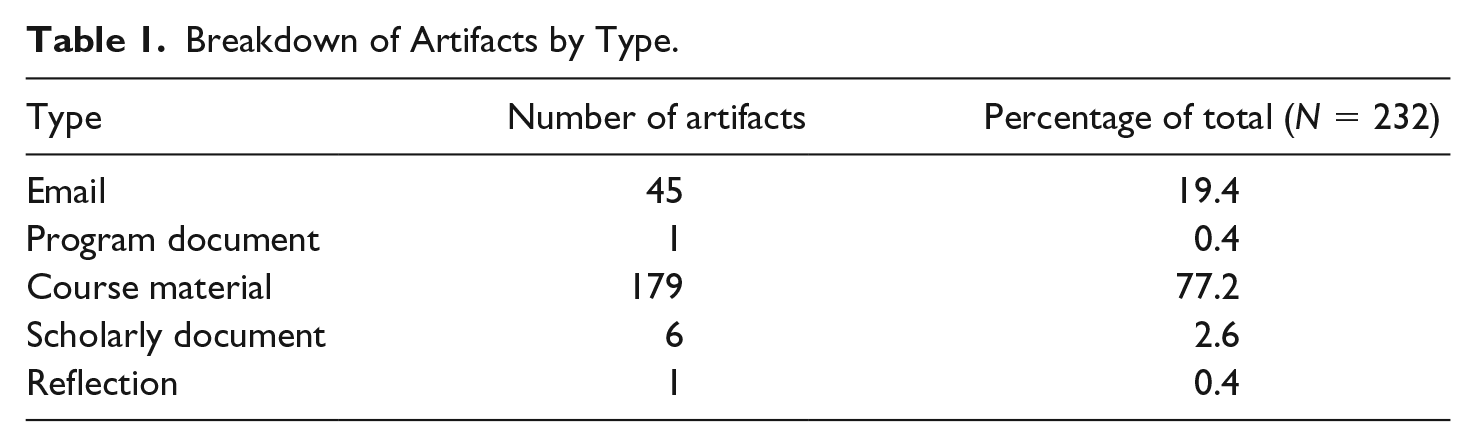
We identified a total of 232 artifacts through searches of available materials in electronic media, email, and paper files.Table 1shows the breakdown of artifact types.Table 2shows the breakdown of primary purpose categories identified across them.
Breakdown of Artifacts by Type.
Breakdown of Artifacts by Category.
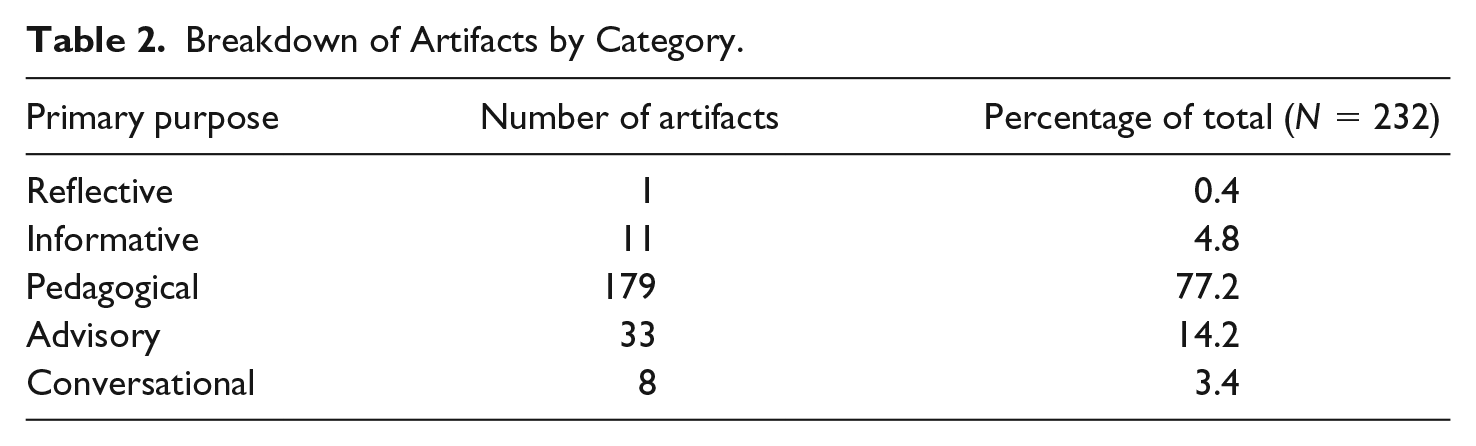
As the tables indicate, most of the artifact types were course materials (77.2% of the artifacts we analyzed), followed by emails between us (19.4%), and then smaller numbers of scholarly documents (2.6%), a program document (0.4%), and our own reflections (0.4%). The primary purposes of the artifacts were pedagogical in a majority of cases (77.2%), then advisory (14.2%), informative (4.8%), conversational (3.4%), and reflective (0.4%). It is not surprising that a majority of the artifacts relate in some way to the teaching of BPC. Pedagogy is what our mentoring relationship was founded on, and it remained the predominant topic of our communication until 2016, when Jeremy entered his PhD program. Though our pedagogical conversations have continued, our direct collaborations have been research focused.
These primary purposes provide a basis for analyzing the artifacts, helping contextualize our mentoring interactions over the long term. However, the categorization does not address specific nuances or instances of our interactions that exemplify our long-term mentoring dynamic and serve as a basis for identifying benefits, challenges, and implications for mentoring relationships more generally. In the following subsections, we provide more specific reflections and examples of each of the categories, which are organized in order of most to least prevalent in the study corpus.
Pedagogical Materials
Pedagogical materials, which we define as those materials that provide information (or that are meant to be used as a basis for providing information) to students in a BPC course context, made up the greatest percentage (77.2%) of the artifacts analyzed in this study. This is likely because our mentoring relationship was rooted in pedagogy when we first started working together and has remained an element of our interaction since that time. Both of us are interested in teaching, and both of us will continue to teach and to work toward enhancing our teaching strategies throughout our careers.
A vast majority of the pedagogical materials in the study corpus are teaching materials that were either developed by us or provided to us as examples or models in the program where we both taught. Such materials included prewritten lecture notes, assignment handouts, syllabus templates, grading sheets, quiz examples, and day-by-day course materials (e.g., PowerPoint presentations on topics like résumé creation as well as supplementary handouts—see, e.g.,Figure 1). One of the materials was an email which Janel sent to her students (and which Jeremy received as one of her formal mentees) in a class in 2007 about an upcoming assignment and in-class activity; this email was something of an outlier because it was the only email in the pedagogical category.
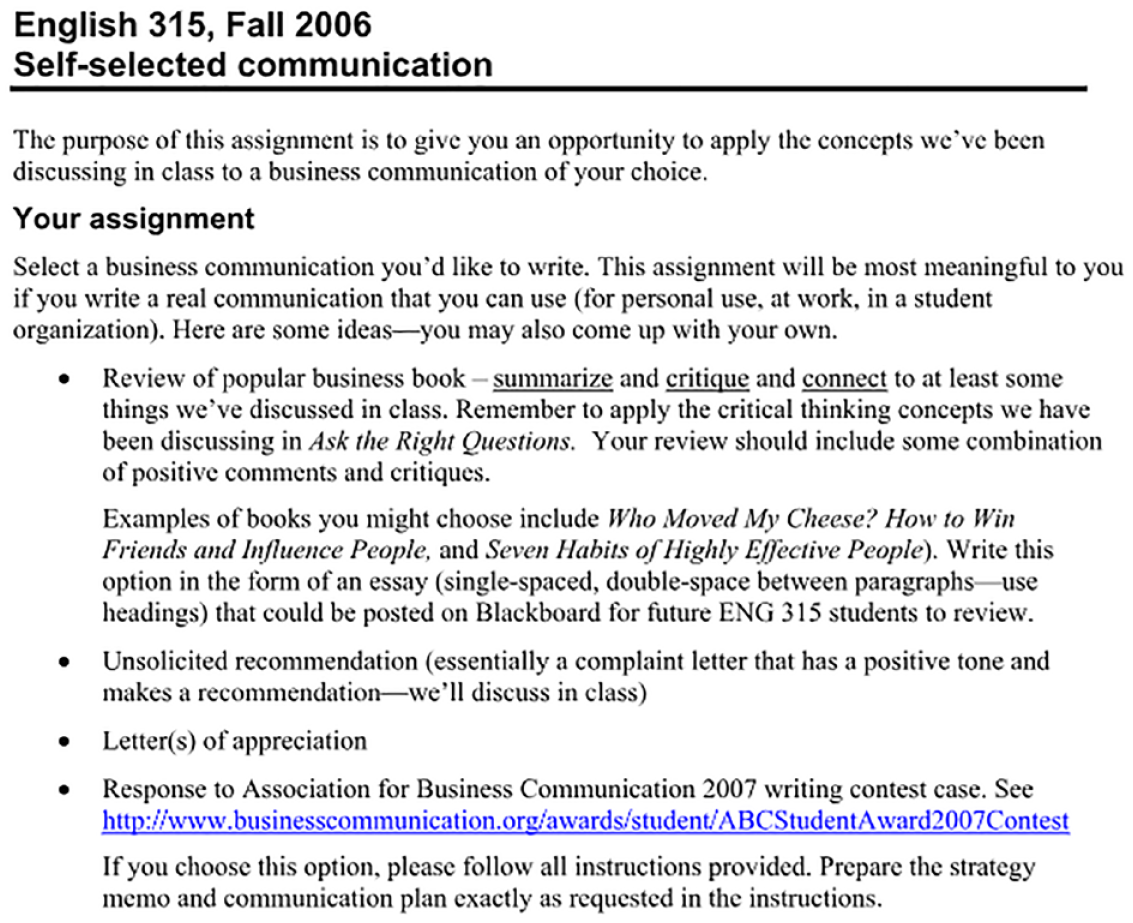
An introduction to an assignment from the course in which the coauthors first worked together.
This predominance of teaching materials demonstrates how mentoring relationships can be centered on a specific aspect of the mentee’s role. When our mentoring relationship began, Jeremy was new to teaching, so that was the focus of our communication. As the relationship has progressed and Jeremy has become much more comfortable with teaching, it has expanded to other aspects.
Advisory Materials
Advisory materials, those that reflect situated guidance in the mentoring dynamic, made up 14.2% of the study corpus. All 33 of these artifacts were emails between Janel and Jeremy; typical of these communications were situations where Janel was advising Jeremy on a class-related, conference-related, or research issue, or when Jeremy was asking for guidance on such an issue. Class-related issues were common in both the formal phase of their mentoring (such as an August 2007 email in which Janel was advising Jeremy on how to communicate textbook options to his students) and in the informal phase (such as a series of emails in September and October 2016 in which Jeremy asked for suggestions and examples of materials to use for a job materials assignment and a rhetorical problem-solving case).
Guidance on teaching matters has therefore been common throughout the mentoring dynamic. Since 2016, when Jeremy entered his PhD program, many of the advisory topics have noticeably shifted to conference work (see, e.g.,Figure 2) and research. We project that this trend will continue for the foreseeable future. If, however, Jeremy were to teach a course that was previously unfamiliar to him (such as an editing course or a graduate seminar once he became a faculty member), the likelihood is that our advisory conversations would once again turn to teaching matters. In that sense, then, our advisory conversations are likely to include future discussions on both teaching and research.

Email regarding collaboration on a conference topic.
While teaching dominated our conversations, these materials show that advising on a variety of topics is an important aspect of mentoring. Mentors should be prepared to address a variety of topics, but part of their role is to be able to refer mentees to other resources with which they may not yet be familiar.
Informative Materials
Informative materials were those artifacts designed to provide BPC academics or professionals with information on a theme related to BPC; these themes may be pedagogical or practical. Of the 11 artifacts in this category (4.8% of the study corpus), 3 were presentations that Janel and Jeremy had created for conference purposes, 2 were conference proposals, 2 were emails with information from conference organizers regarding a conference proposal, 1 was a list of potential BPC panelists that Janel had created, 1 was a list of conference topic ideas (seeFigure 3), 1 was a letter of support that Jeremy had written on Janel’s behalf informing others of her contributions to his professional growth, and 1 was a guidelines document for formal mentoring in the program where Janel and Jeremy first worked together. These materials were thus variable in scope and medium; what they had in common is that they shared information on BPC themes, conditions, or situations. They were not pedagogical per se, and they did not involve sharing guidance between the mentor and mentee in this case study. In addition, the primary audiences for most of the artifacts in this category were sometimes, but not always, inclusive of Janel and Jeremy; though, generally speaking, if they were a part of the intended audience, they were not the only part.
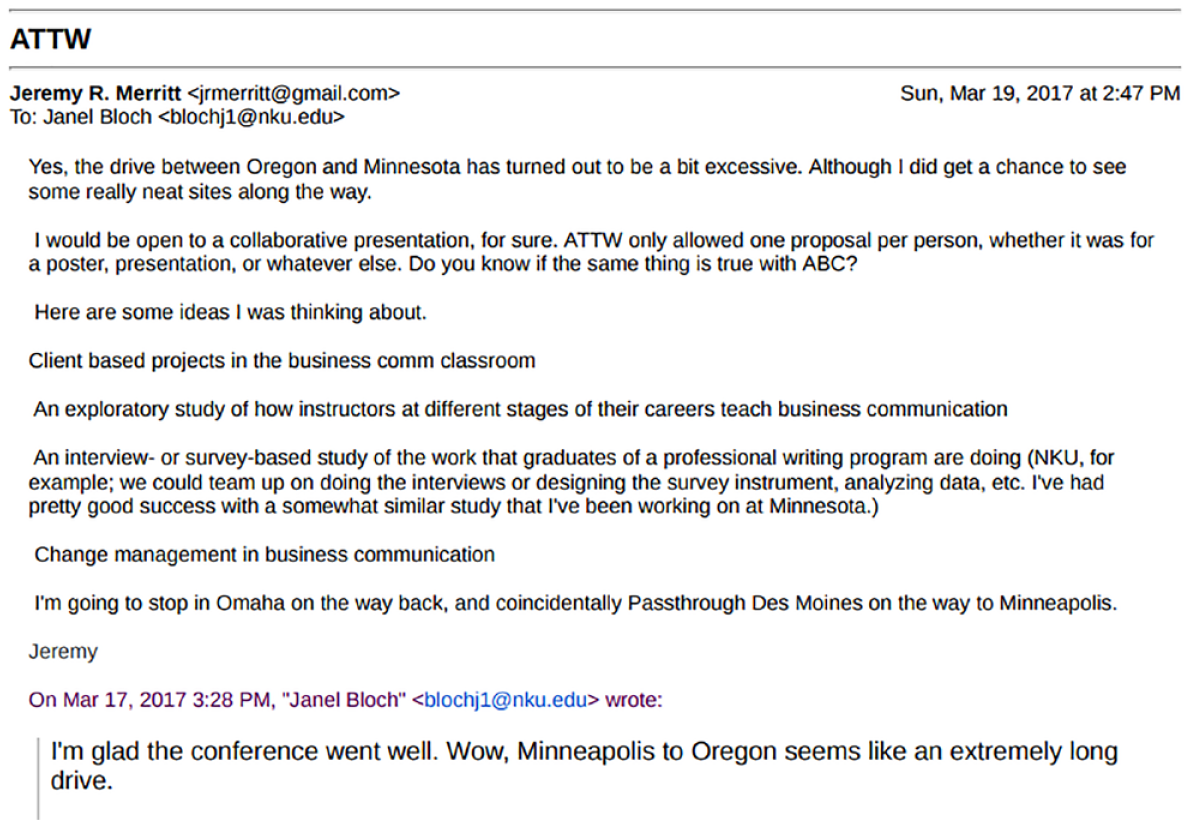
Conference ideas.
These informative materials illustrate how a mentoring relationship is affected by others (e.g., the guidelines document) and affects others (e.g., conference presentations). They also illustrate how, while a mentoring relationship can be established through a formal program, it can evolve in various ways, depending on the participants’ situations, needs, and goals.
Conversational Materials
Conversational materials on miscellaneous topics made up 3.4% of the study corpus. While these materials did not necessarily advance our teaching or research goals specifically, we included them because they exemplified noteworthy elements of our mentoring dynamic—and, we felt, in other potential mentorships as well. The example inFigure 4is a conversational artifact. In it, Janel and Jeremy are discussing his return from a regional conference during a period of inclement weather—a discussion interspersed with relatively brief comments dealing with conference and publication matters. To put it somewhat frankly, the informal conversation was not arequiredpart of our research collaboration. However, we see it as important because it exemplified a human aspect of our mentoring dynamic, a level of professional consideration that strengthened the overall mentoring dynamic.
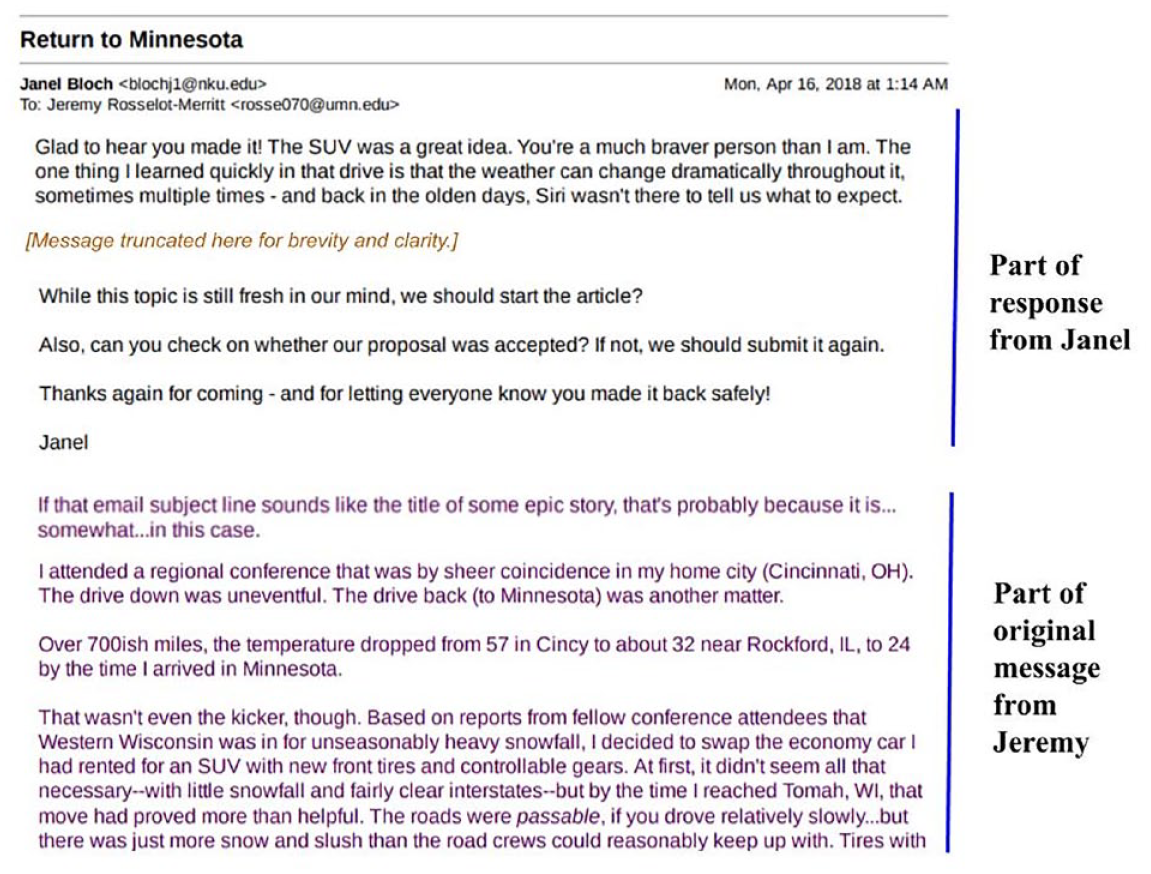
Conversational email.
This subset of artifacts displays the rapport we have developed throughout the mentoring dynamic in both its formal and informal iterations. Another element is the fact that very few, if any, mentoring dynamics will be exclusively instrumental; we assert that some element of situational human conversation (e.g., “small talk” ) will be observable in most mentoring relationships, whether formal or informal. These observations relate to collaboration and affective benefits of mentoring in BPC, as well as to the implication that those involved in a mentoring dynamic must be willing to “check in” periodically (all of these are described in more detail later in this article).
Reflective Materials
The reflective category included one artifact—a document of our individual reflections—the only item created specifically for the purpose of this case study. As we reflected on how our mentoring dynamic had evolved over time, we made notes on our individual observations, thoughts, and feelings. These notes eventually became the basis for two narratives that we wrote about our mentoring experiences; the narratives, in turn, formed the basis for the larger reflection document. The reflection document, in effect, allowed us to expatiate on our observations of previous happenings in the present tense; to fill in certain analytical gaps (some mentoring-related materials, particularly printed ones, were likely lost or misplaced over the years); and, in the spirit of critical reflection, to “rework [our] understanding” (Fook, 2011, p. 56) of experiences from our mentoring dynamic as well as reflect on those experiences affectively and as they connect to our own evolving value systems.
We thus added the reflective category to accommodate an artifact unique in nature yet quite essential in our reflective process. In sum, the document consisted of 1,870 words of reflection by both of us. Janel’s reflection focused on some of the positives and challenges of the mentoring dynamic—particularly during its initial, formal stage—and how that initial dynamic evolved. For example, she wrote, It’s interesting how Jeremy is still using some of the same assignments that we used during that semester. But if I think back, having gone through that same mentoring program [years before], I still use elements of some assignments that my initial mentor used, although I have put my own spins on them over the years, as has Jeremy.
Jeremy reflected on the same mentoring aspect in part of his reflection. Discussing an introductory memo assignment that he continues to adapt in his classes, he wrote, [The assignment and] grading sheet model that [Janel] developed for [her] courses is one that I still use, albeit with some variation. I think that our teaching styles are pretty different from what I can remember; then again, everyone’s pedagogical style is different, and neither of us has seen the other teach in quite a few years. But when I think about the structure of the classes that I teach—sort of the thought process and reasoning that I use when designing them—there’s no doubt that much of that comes from [Janel’s] influence as a professional writing instructor.
This piece of reflection illustrates the potentially lasting influence of a mentor even over a period of many years—the “echoes” of mentoring, if you will, that persist well after the formal piece of it has concluded.
Both Janel and Jeremy found space to reflect on an affective dimension of their dynamic in an interesting way. This dimension came in the form of interacting with Janel’s dog at the time, a pug named Hermonie, whom she brought to a program picnic the first time that Janel and her mentees met. At one point, Janel needed to leave for a moment, and Jeremy offered to hold Hermonie’s leash. As Janel wrote, [I] noticed how panicked he was when the dog started crying. The crying was not crying because he was holding the leash but because she wanted the food that I was getting. I guess this shows how perceptions of small details are a matter of perspective. Mentees may start off trying to do everything “right.” Part of the process of realizing that what is “right” is a matter of perspective and there really aren’t such things as “mistakes”—it’s all just part of the learning process.
Jeremy reflected on the same instance: Yes, I remember taking Hermonie’s leash while [Janel] left to go get food. . . . I was about 27 at the time, and my primary goal was to establish a good rapport [with Janel] as soon as I could. . . . I’m sure I was worrying too much about it.
These reflections on a single instance demonstrate the importance of individual perceptions and feelings in a mentoring dynamic, even when that instance is not a part of the “official” mentoring experience. In retrospect, Jeremy can say that his rapport with Janel was generally fine in the early days of their mentoring experience; he can even find humor in some instances, like Hermonie’s getting upset because she wanted food. At the time, however, the early minutiae of their interpersonal interactions were of great concern to him. In a longer term context, it was in some sense up to Janel to help him navigate those minutiae and help him to learn how to contextualize the broader professional dynamic taking place—skills that would benefit him in his professional future.
Another piece that merits mention here was Jeremy’s reflection on the importance of mentoring as a complement to graduate coursework and other program-based offerings: It is simply a matter of course that any academic program cannot possibly meet the complete scope of needs of every graduate student. In that respect, our mentoring dynamic has helped address critical needs in developing my teaching in BPC; navigating conferences; establishing that essential scholarly identity; and learning from [Janel’s] experiences in teaching, research, and administration. While each of these is something that I could learn from future experience, I would strongly assert that having a mentor (formal or informal) with whom to work on—or discuss—such matters facilitates insights that may be difficult to gain independently. Certainly not as soon in one’s development, and certainly not as smoothly, in many cases.
While this last piece of reflection is in many ways specific to Jeremy’s experience, it speaks to the significant, long-term benefits that a well-supported mentoring dynamic offers.
Benefits and Challenges of Mentoring in Business and Professional Communication
Part of a successful mentoring relationship is maintaining awareness of benefits and challenges alike. Despite the many potential benefits of mentorship in BPC, challenges will inevitably surface. This section identifies the benefits and challenges of mentoring that we observed within our case.
Benefits
Because our mentoring relationship has continued in some form for 13 years, both the nature of that relationship and its benefits have changed over time. In general, our reflections have led us to observe several types of benefits, including collaboration and coauthorship, scholarly dialogue, formation of scholarly identity, BPC pedagogy, and affective benefits. While by no means is our observation of benefits an all-encompassing list nor is it generalizable to every situation, we believe that these are representative of benefits that can extend to other mentoring relationships between senior scholars and graduate students.
Collaboration and Coauthorship
The benefit of collaboration and coauthorship is one of the first that came to mind as we reflected on our mentoring relationship. Simply put, much of the work we have been doing in BPC would not have been possible without our past and current collaborations. (This fact rings true pedagogically as well, as discussed later in this section.) Most of our scholarly collaborations have been within the past 2 years, during which time we have worked together on topics ranging from the transdisciplinarity of BPC, to mentorships, to diversity and inclusion in BPC. These collaborations have not only allowed us to bring our own scholarly perspectives to the work but also provided an opportunity to develop and enact an iterative workflow management strategy.
Scholarly Dialogue
Although it does not always find explicit expression in our presentations and writing, the importance of scholarly dialogue in mentoring cannot be ignored. In Jeremy’s case, he started his doctoral program as one of the few graduate students with a pronounced interest in BPC; conversations with Janel have directly informed his research trajectory in BPC. For Janel, she has found that Jeremy’s recent experience in his program’s methods courses has allowed her to conceptualize methodological approaches in evolving ways. Along with these learnings, there are the disciplinary discussions. Where does BPC fit into institutional and departmental contexts? What of its transdisciplinary nature strengthens its value in writing studies? How can writing studies scholars with a subspecialty in BPC position themselves in academic job searches (a question of particular interest to Jeremy right now)? When we talk at conferences, do research, and write, these, among others, are questions that we consider and can discuss openly, with our mentoring dynamic as the discursive foundation.
Formation of Scholarly Identity
Closely tied to our scholarly dialogue is an opportunity to develop our scholarly identities. With Janel having established herself in the field, this element of the mentorship is particularly important to Jeremy—a theme strongly reflected byGrant-Davie et al. (2017)in their accounts of mentoring dynamics in technical communication. We find, too, that elements of scholarly identity are coconstructed and mutually influential in observable ways. For example, our work on transdisciplinarity—a key element of both our scholarly identities—was a direct result of Janel’s experiences as a faculty and administrative committee member at her institution—experiences which led Jeremy to explore analogous themes at his institution and to reenvision his evolving role as a BPC scholar. Indeed, as a graduate student, Jeremy’s identity as a workplace communication scholar traces back to the original formal mentorship in 2006 and continues to be shaped by the informal mentorship today.
BPC Pedagogy
The effects of mentorship on our teaching have been wide-ranging and pronounced over a long period of time. In the BPC course he teaches now, Jeremy still uses variations of assignments that Janel introduced to him. One example is the introductory memo, an early-semester assignment in which students contextualize their backgrounds and professional goals in an undergraduate BPC course. Another example is the problem-solving communication assignment, which calls for students to address a negative communication situation. Given the importance of social justice goals in writing pedagogy (seeHaas, 2012;Jones, 2016,2017), we have recently collaborated on pedagogical practices promoting inclusion and diversity in the BPC classroom. The basis for much of this ongoing collaboration grew from coursework Jeremy has taken in writing pedagogy that emphasizes critical pedagogy (Giroux, 2001) and a “politics of difference” (Young, 2011) challenging normative models of justice.
Affective Benefits
The other benefit we wish to discuss is perhaps more abstract than the others but, on many levels, equally compelling: the affective benefits of academic mentorship in BPC. Academic work requires a considerable investment of emotional labor—a fact that researchers in a number of disciplines have noted (Bellas, 1999;Lawless, 2018;Schueths, Gladney, Crawford, Bass, & Moore, 2013;Tunguz, 2014). Furthermore, much of this research has shown a stratification of emotional labor along lines of gender, ethnicity, and tenure status, with women, members of minority groups, and untenured faculty expending greater emotional labor in their teaching and scholarly work. Research has found benefits toinfrastructural mentoringin technical communication courses, which calls for pedagogical adjustments that help undergraduate women who intend to enter engineering fields assert themselves in future workplace settings (Sullivan & Moore, 2013). In our experience with mentoring, we have found clear affective benefits—enjoyment; a feeling of collegiality; and the shared feeling of accomplishment associated with positive, productive collaboration. In addition, research indicates that the affective benefits will be of particular importance to early-career scholars and persons in underrepresented gender, ethnic, cultural, socioeconomic, disability, medical, and other groups.
Challenges
As we have reflected on the mentoring experience, we recognize that the mentoring dynamic comes with challenges, some of which are probably inevitable and some of which could lead to mentoring relationships that are not viable (or that are viable for a period of months or years but, because of various factors, become difficult to maintain). The challenges we have identified range from conflict to effort expenditure, distance, transition from formal to informal mentoring status, and changes in teaching or research paths.
Conflict
Conflict in mentoring happens (see, e.g.,Burgman, 2016;Powell, 2006;Wilson-Ahlstrom, Ravindranath, Yohalem, & Tseng, 2017). Some conflicts may truly be conflicts of interest in which the goals of one person in the mentoring relationship are inherently out of sync with the goals of the other, or when there is an ethical consideration that requires a more critical look at the mentoring relationship itself. Conflicts of interest must be dealt with and rooted out in both formal and informal mentorships, up to and including the conclusion of the mentoring relationship if it is found that a conflict of interest is not reconcilable.
Interpersonal conflict—which differs from a conflict of interest in that it involves a clash in personalities, individual styles, or individual priorities—is another potential challenge in mentoring. Particularly in formal mentorships, the persons involved often have little control over whom they are grouped with. The variety of people in mentoring relationships, combined with the pressures of academic work, can lead to unanticipated (and generally unwanted) relational conflicts which bear out in wide-ranging ways: Besides pronounced vocal expression of conflict, other effects may include passive-aggressive remarks between one another or in meetings, persons in the mentorship deciding not to respond to emails, a senior scholar repeatedly criticizing to the point of affecting a graduate student’s self-esteem, or a graduate student simply refusing to take guidance from the senior scholar at all. While some level of interpersonal conflict is unavoidable in a mentorship, it can be reduced and managed through openness; regular, honest communication; and consistent discussion of individual and collective goals from the outset.
Effort Expenditure
Effort expenditure, the use of one’s mental and physical resources, becomes highly significant in a mentoring relationship for the very fact that mentoring is an effort-intensive activity in itself. The emotional labor of academic work can be high; taking part in a mentoring relationship adds another dimension to that labor. We use the worddimensionhere because that effort expenditure can lead to net-positive results for all involved in the mentoring relationship. Yet senior scholars and faculty members should feel at liberty to express when they do not have the professional bandwidth needed to “take on” a mentee. For example, Janel was a nontenure-track faculty member with a heavy teaching load when assigned to mentor Jeremy and other students. Not having sufficient time or resources to devote to mentoring can also result in conflict, as discussed in the previous section, resulting from mentees feeling they are not being given the time they deserve, while mentors may be struggling to find the time to give. While mentoring can provide great intrinsic rewards to mentors, to do it effectively requires significant time and effort. Therefore, academic institutions and departments should strive as much as possible to offer course releases or additional support to faculty members who provide formal mentoring to graduate students.
Distance
Distance has affected our mentoring relationship significantly at times. Here, we refer to distance as both a professional and geographic construct, and our own experience may shed light on how the two can play a significant role in a mentoring relationship. At the beginning of our mentoring dynamic, we were in close professional and geographic proximity; that is to say, we worked at the same institution in the same program, and our professional goals (particularly in pedagogy) were well aligned.
As previously discussed, however, our work context changed significantly in 2008 when Janel became a tenure-line faculty at another institution and Jeremy transitioned back into industry. At that point, we continued to live in the same metropolitan area; however, the focus of our work had changed. While we continued to stay in touch, our topics of interest did not always correspond in a one-to-one fashion: Janel was focused on teaching and research, while Jeremy (for the time) was driven to meet the organizational goals of his company. In that way, the geographic distance was small, but the professional distance had grown. When Jeremy became an adjunct instructor, and later a graduate student, the professional distance lessened, and we found ourselves collaborating perhaps more frequently than we had after our original formal mentorship had concluded many years before. This notably happened in spite of significantly greater geographic distance.
Transition From Formal to Informal Mentoring
Many people involved in a formal academic mentorship may not know, or see the importance of, practices to maintain a mentoring relationship when the formal requirement no longer applies. Persistence and dedication are needed to help ensure a successful transition from a formal mentorship to an informal one. In the absence of a formal mentoring structure, mentors and mentees must make deliberate efforts to remain in contact, schedule meetings (face-to-face or remote), and collaborate. To do so is to perpetuate the potential for continued benefits of mentoring.
Change in Research or Teaching Paths
Finally, another factor that can significantly impact a mentoring relationship is a change in one’s teaching, research, or both. This factor is particularly important in BPC, a field whose disciplinary definition and identification can vary considerably among scholars. For example, a graduate student may be asked to teach business writing yet decide, over the longer term, to pursue certain subdisciplines more commonly associated with technical communication—rhetoric of science or rhetoric of health and medicine, for example. Even within BPC, pedagogical and research interests may vary. Some scholars, for example, are primarily interested in intercultural business communication; others focus largely on visual design. While those areas do not mutually exclude a potential for collaboration, long-term mentoring becomes easier when scholarly interests overlap. In our own experience, though, and as a positive aspect to this challenge, we have found that one of the most compelling bases of continued conversation is pedagogical. In our case, the formal mentorship began for pedagogical reasons; and while our long-term collaborations expanded to include additional research in conferences and writing for publication, the informal mentorship flowed from our pedagogical conversations.
Implications for Mentoring and Pedagogy
There are several implications for both individuals and programs that can be drawn from our analyses relating to mentoring and pedagogy in BPC.
Meaning Is Coconstructed
The development of a mentoring relationship depends on the perceptions and activities of both the mentor and mentee. If one or the other does not choose to actively engage, then the relationship will likely not be as effective. In long-term mentoring relationships such as the one described here, the meanings and goals develop over time. The guidelines provided by an academic program can be a starting point for establishing the relationship, but they can only go so far. Our mentoring relationship was formally assigned; however, that assignment lasted only about a year. Assigned mentoring relationships can work as well as those that develop organically, but it is the responsibility of the parties involved to determine how they proceed. It is easy for such relationships to stagnate or to become a superficial way of simply meeting a requirement if both the mentor and mentee do not contribute to building the relationship and determining its real meaning and purpose.
Promoting Equity Among Participants is Essential
In educational environments, mentoring relationships often begin with power differentials, which can have the potential of being intimidating to the mentee. According to the established guidelines of our relationship, which were a required part of Jeremy’s graduate assistantship, Jeremy was supposed to “assist” Janel. This relationship could easily have ended after that one-semester period of required assistance was over and Jeremy began teaching his own class. Instead, part of what led to the success of the relationship was the give-and-take over time. Therefore, in terms of maintaining relationships over time, it is important to be open to the power differentials changing and eventually disappearing.
Successful Mentoring Requires Openness to Imperfection
Mentoring participants should realize that mentoring is a learning process for all involved. Mistakes will inevitably be made. However, it is important to learn from mistakes. In formal mentoring relationships, one way that mistakes can be prevented from recurring is to modify and develop guidelines for future mentors/mentees to use. For example, in our situation, we sometimes found it difficult to formally meet. If the basic guidelines set up minimal expectations for doing so, that can motivate those involved in the mentorship to strive for a positive initial dynamic, at the very least. In informal mentoring relationships, participants must also be open to trial and error. As our mentoring relationship moved beyond the formal bounds of the graduate program, we continued to develop strategies and tacit guidelines for effectively maintaining it.
Mentoring Need Not Always Be Formal
A formal mandate to start a mentoring relationship can be a good impetus to do so. However, such relationships may or may not ultimately turn out to be good matches. Informal relationships can perhaps be stronger, as they tend to be self-selected. Our mentoring relationship was at first formally established and, over time, has persisted. Janel had one or more mentees assigned each semester during her 6 years as a faculty member in the graduate program where Jeremy was enrolled, and most did not persist much past the single semester. Quite possibly, those mentees found other informal mentors that better suited their needs. Considering the characteristics of a long-term mentoring relationship, though, will help in terms of enabling relationships to persist.
Maintaining a Long-Term Mentoring Relationship Requires a Willingness to “Check in” Periodically
As with any relationship, mentoring relationships can be easy to neglect if time and distance are involved. Coming up with a way of mutually being responsible for maintaining the relationship can help it persist. For example, when we were on campus, we scheduled a time to meet each week. After we left campus, it became much less frequent until one or the other took the initiative to reestablish regular contact. As mentioned in the next paragraph, we found that both of us becoming involved with the same professional organization, the Association for Business Communication (ABC), greatly helped in terms of reestablishing regular contact.
Academic Programs and Professional Organizations Can Enhance and Encourage Both Formal and Informal Mentoring
It is common for academic programs to have mentors. Some vetting of the “matches” and “mentoring on mentoring” provided to all participants early in the program may be helpful in terms of enabling all involved to understand their roles and expectations. Professional organizations such as ABC can also institute voluntary programs to help individuals find mentors, thus creating a more formal version of the informal comentoring described byRymer (2002). Such external support can become valuable, as BPC faculty at some institutions may find themselves as the lone specialist in BPC in their academic department (e.g., English, communication, or management). While not all of these mentoring relationships may end up being long-lasting matches, they would still give participants the tools for establishing connections and building networks (Rymer, 2002). Holding periodic, required parlors and meetings for participants in mentoring programs in academic programs and at annual conferences could help facilitate this process. After Jeremy returned to graduate school, he joined ABC at Janel’s suggestion; we organically found this association to provide a stronger basis for our own conversations, pedagogy, and research, as the conferences and publications tend to provide a venue for working on projects together.
Mentors, Academic Programs, and Professional Organizations Can Work Together to Help Mentees Seek Vocational Growth for the Mentee
Helping mentees find a place within a professional organization such as ABC also helps fulfill another important aspect of mentoring: assisting mentees in establishing their professional identity. AsGrant-Davie et al. (2017)discussed, it is important for doctoral students to determine how they want to begin fitting in as teachers and scholars. Providing this assistance can be particularly important in BPC as the field continues to evolve. Mentors should be willing to serve as sounding boards, matchmakers, and even detectives for mentees in helping them find promising opportunities that match strengths.
Reciprocal and Collaborative Communication Can Help Relationships Develop and Adapt Over Time
“Mentoring up” (Lee et al., 2015, pp. 135-136) involves mentors and mentees engaging in two-way communication to make mentoring relationships work. In order for mentoring up to be effective, mentees must be confident enough to manage the relationship and communicate openly with the mentor so that the relationship can be mutually beneficial. This can take shape in different ways over time, and it might involve things like communicating clearly about schedules, time commitments, and other responsibilities. If mentors encourage mentees to feel comfortable communicating with them, especially at the beginning of a mentoring relationship, this can set a positive tone for future communication.
Intellectual Openness Is an Important Element in Mentoring Relationships
Mentors should encourage mentees to feel free to express new ideas. For mentors, mentoring can offer a fresh perspective, new avenues of knowledge to pursue, or different approaches to try. Over time, Janel has continually encouraged Jeremy and other mentees to offer suggestions for new ways of doing things or new pedagogical or research strategies to pursue. In turn, Jeremy has offered perspectives from his own coursework and experience that the two of us have discussed in the context of our collaborative and individual work.
An Initial Plan/Agreement Provides an Important Foundation for Mentoring Relationships
The formal mentoring program that we participated in had guidelines that were mainly focused on helping prepare the mentee to teach independently for two semesters. While we did not have a plan beyond that time period,Patel (2018)recommends having anadvising statementthat lays out the responsibilities and expectations of both parties. For formal mentoring situations, this statement could include a common element throughout the program that specifies procedures for handling ethical concerns, such as power issues and harassment, which might arise. It could also include an element that the individuals tailor to their own needs and periodically revisit and update.
Consider Inclusion, Diversity, and Equity When Designing Mentoring Program Guidelines
As discussed earlier in this article, diversity and equity are critical considerations when designing formal mentoring programs. Programs should identify ways for those who feel marginalized or underrepresented to have a voice and express their concerns. This could be within the department or at the larger university level. Students should be made aware of and encouraged to use resources such as their student conflict resolution resources, diversity offices, ethics helpline, or human resources. As mentioned, articulating these avenues in an advising statement would support their use by both mentees and mentors.
Conclusion
In this article, we have described a case study of our own mentoring relationship as it has evolved over several years and across institutional contexts. We have described benefits and challenges to academic mentorships in BPC, particularly between faculty and graduate students, and have suggested implications for individuals and academic programs.
Since a case study focuses on particularities rather than generalities, we realize that our experience represents one example of a mentoring dynamic in BPC. There is certainly value in continuing the conversation about mentoring in this field, collecting additional vignettes (echoing H. N. Turner et al.’s [2017] use of the term) of a range of experiences in the field, and conducting quantitative and qualitative research to gain additional data leading to more generalizable findings. With these findings, we may gain additional insights into such questions as the following:
What are best mentoring practices for mentors and mentees?
What short- and long-term impacts on senior scholars and graduate students does mentoring have? How do these effects differ in formal and informal mentoring?
What programmatic approaches help ensure positive mentoring experiences for those involved?
How can challenges related to diversity, inclusion, and social justice, such as those related to power differences, a lack of available mentors, or negative perceptions and inaccurate assumptions that others may have of various mentoring dynamics (e.g., mentor/mentee pairs having different genders, races/ethnicities, and ages), best be addressed in formal mentoring programs?
How can professional organizations in BPC encourage mentoring relationships to form and be sustained?
Our experience with mentoring started as a formal, programmatically required mentorship that evolved into an informal dynamic through which Janel refined and expanded her role as an experienced scholar in BPC and Jeremy started to find his place in a field where graduate students often need direction beyond their day-to-day experiences in research, teaching, and programmatic goings-on. Our experience not only reinforces the value of mentoring in BPC but also invites further discussion and research on professional development in this evolving and ever-growing discipline.
Footnotes
Acknowledgements
The authors also thank the anonymous reviewers for their feedback, as well as Lee-Ann Kastman Breuch for her valuable suggestions on refining and focusing the article.
Authors’ Note
Preliminary research related to this article was presented at the Midwestern/Southeastern U.S. Regional Conference of the Association for Business Communication, Cincinnati, OH, 2018. The authors thank attendees for their input, which was used in creating this article.
Declaration of Conflicting Interests
The author(s) declared no potential conflicts of interest with respect to the research, authorship, and/or publication of this article.
Funding
The author(s) received no financial support for the research, authorship, and/or publication of this article.

Author Biographies