




Abstract
This article reports on the representation and operationalization of interpersonal attention in complaint management by comparing business textbooks, service recovery research, and situated practice. While textbooks commonly recommend the use of interpersonal strategies when writing complaint refusals, service recovery research points toward contextual differences in this regard. We use an authentic sample of complaint refusals from an intercultural business-to-business setting to show that the decontextualized recommendations in textbooks are not always applied in actual practice and that this lack of interpersonal attention need not be problematic.
Keywords
Many companies have often managed complaints ineffectively, resulting in large numbers of customers who are dissatisfied with the way in which their complaints are handled (Homburg & Fürst, 2007;Lewis & McCann, 2004;Van Vaerenbergh et al., 2019). The ensuing customer dissatisfaction has considerable negative consequences in both the short and the long run: It leads to customers producing negative word of mouth (Blodgett et al., 1997) and switching to competitor firms (Homburg & Fürst, 2005), which in turn result in lost revenues and higher costs (Hart et al., 1990). Against this background of ineffective complaint handling, the business literature underscores the importance of customer relationship management (CRM;Håkansson & Ford, 2002;Ojasalo, 2004), and business communication textbooks, in particular, often give advice on how to communicate with complaining customers. However, scholars have criticized advice given in textbooks on business communication (e.g.,Bremner, 2010;Clifton, 2012;Creelman, 2012;Salerno, 1988) for its decontextualized nature with passe-partout recommendations that are not based on observations of what actually goes on and what works best in a situated, genuine interaction. For this reason, scholars feared that these materials may turn into fetishized school examples that hinder, rather than help, communicators in their work.
In this study, we explore whether this fear is justified by assessing and comparing the advice given in a sample of business communication textbooks and service literature with situated communication practices in the context of business complaint management. As such, we examine to what extent decontextualized notions of good practice are present in the literature, if and how they are implemented in practice, and what the effect of their presence or absence is. We do so by focusing on complaint refusals, which constitute a highly delicate, sensitive genre in the context of business complaint negotiations. Employees are asked to deliver bad news to the customer (i.e., the news that their complaint has been refused by the company; seeAppendix Ain theonline Supplementary Materialfor an example). At the same time, however, it is the employees’ job to protect the company’s reputation and customer relations. We will discuss the issue of complaint refusals in three subsequent steps. First, research findings from the fields of linguistic pragmatics, professional communication, and service recovery studies are presented. We discuss research findings within these disciplines on how different kinds of refusals (including complaint refusals) are phrased in real-life settings, on the effectiveness of bad-news letters, and on how to handle complaints effectively. Second, common textbook recommendations on how to address (complaining) customers are presented. We compare these recommendations with the research findings on complaint refusals in a real-life setting. This comparison allows us to examine if these recommendations find their way into actual practice. We conclude that textbook advice is indeed not always in tune with how complaint refusals are dealt with in authentic situations. For a more complete picture on how to interpret this discrepancy, we also compare business textbook recommendations on responding to complaints with the advice offered in service recovery studies. Third, a sample of authentic complaint refusals originating from an intercultural business-to-business (B2B) setting is used as a starting point for an experimental study in which we probe into the effect of textbook advice in comparison with actual practice on a selection of customer outcomes. This experiment allows us to test the effectiveness of textbook recommendations and that of actual practice in this particular setting.
While previous research has already problematized the generalizations inherent in business textbook recommendations, our study goes one step further by actually verifying this claim in a genre that has received little scholarly attention from a discourse perspective: the genre of complaint refusals. Moreover, our study goes beyond merely revealing discrepancies between textbook advice and situated practice: We also present an experimental study that allows us to find out which communicative strategy—the recommended one or the one rooted in actual practice—actually works best in a specific context. Our study adds an additional layer of knowledge to research on professional (complaint) communication and bad-news letters by transcending disciplinary boundaries and also incorporating findings from service recovery studies as a marketing-related discipline. Finally, the article also partially provides counterweight to the strong focus on the English language in the complaint-refusal literature by singling out German as the object of study. Following studies such asJansen and Janssen (2010,2013) on Dutch data, we hope this will accelerate the inclusion of other languages on the complaint management research agenda.
The article proceeds as follows: We start by discussing research findings in linguistic pragmatics and professional communication on how different types of refusals are effectively phrased. We continue with a short overview of research findings in service recovery studies. The next section presents a selection of guidelines on business communication in general and written complaint refusals harvested from a sample of German business textbooks. These textbook guidelines are then compared with actual practice as described in previous studies and to recommendations made in service recovery studies. We then present the findings of our experiment. Last, we discuss the implications of our study and outline limitations and directions for future research.
Literature Review
In what follows, we present relevant research findings from different disciplines. In the first section, we discuss findings in linguistic pragmatics and professional communication on how different types of refusals are effectively phrased. We then discuss findings from service recovery studies on what constitutes effective complaint handling.
Linguistic Pragmatics and Professional Communication
Refusalshave generally been defined in linguistic pragmatics as speech acts by which a speaker expresses his or her will not “to engage in an action proposed by the interlocutor” (Chen et al., 1995, p. 121). Scholars have described them as face-threatening acts (Brown & Levinson, 1987) or dispreferred responses (Pomerantz, 1984), and have generally assumed that interactants will tend to formulate refusals in linguistically softened, face-saving ways (e.g., using hedging devices, apologies, compliments) in order to keep the risk of face threat as low as possible and to maintain social harmony (Davidson, 1984;Drew, 1984;Félix-Brasdefer, 2006;Sacks, 1987;Tanck, 2002). In many cases, they are also accompanied by an explanation for the refusal in which the speaker shows the listener that he or she is unable, rather than unwilling, to comply (e.g.,Kitzinger & Frith, 1999).
Influenced by these findings, researchers in pragmatics have tried to establish open classifications of refusal strategies (Beebe et al., 1990;Campillo, 2009;Félix-Brasdefer, 2006). Existing refusal taxonomies have in common that they distinguish direct from indirect refusal strategies, complemented by a list of adjuncts, which are perceived as elements preparing for a refusal to mitigate the face-threatening potential of the refusal itself. Scholars studying the pragmatics of refusals have tended to assume that indirect refusal strategies are politer and less face threatening, and that refusals require long sequences of negotiation and therefore tend to occur as speech act sets (Tanck, 2002), as combinations of speech acts that together make up the full refusal.
AsCreelman (2012)described in a literature review dedicated to the genre, several scholars have studied authentic, written bad-news messages in professional contexts, mainly focusing on how these messages are organized and phrased and on the effectiveness of specific discursive strategies. Motivated by a shared distrust in textbook advice, researchers have tried to verify empirically which type of message organization is most commonly applied: Do messages start off with a buffer and an explanation before delivering bad news, as is recommended in textbooks (option 1), or do they immediately begin with bad news, followed by an explanation (option 2)? These enquiries resulted in contradicting findings. WhileMascolini (1994)found that the complaint refusals in her sample tended to follow the first option,David and Baker (1994)attested a preference for the second option in their sample of internal memos.Salerno (1988)found no clear patterns in favor of buffer writing in his sample of job refusal letters. Interestingly, two more recent studies have analyzed refusal emails instead of letters.Schnurr and Zayts (2013)studied refusals in multilingual workplaces in Hong Kong. They compared spoken refusals with email refusals and concluded that the email refusals, although they “all include some kind of mitigation strategy” (p. 605), are “much more explicit and potentially face-threatening” (p. 605), and also “appear less complex—for example because they typically unfold over less turns” (p. 609) than the spoken ones. Finally,Decock (2015)conducted a rhetorical-pragmatic analysis of an authentic sample of German-language complaint-refusal emails from an intercultural B2B setting. She found that these emails are built as traditional bad-news letters in that they contain a salutation, a neutral buffer (acknowledgment of receipt of complaint, often accompanied by a repetition of the reason for the complaint and a reference to the fact that the complaint has been investigated), an explanation, a decision or conclusion (i.e., the refusal), and a closing. Similar to the complaint-refusal lettersMascolini (1994)studied, the preferred option is to provide an explanation first before arriving at the conclusion. In most cases, the decision to refuse the complaint is communicated in an explicit way, using direct refusal strategies. As far as the linguistic realization of the refusal emails is concerned, two characteristics stand out. First, the emails contain recurrent orthographic and grammatical mistakes as well as less idiomatic expressions. It should be noted that, unlike the alternative spellings often included in online “new vernaculars,” used to emulate spoken discourse (Androutsopoulos, 2011), the attested deviations in this sample do not belong to the latter category. None of the attestations mimic spoken discourse features or aspects of netspeak; they seem to be the result of nonedited writing or proficiency issues. Second, the emails display a tendency toward an impersonal approach; the customers’ names are often not mentioned in the salutation, the corporateweperspective is dominant while theIperspective is used only sporadically, and the closings tend to be phrased in a highly formulaic, standardized way, through sentences such as “Für eventuelle Rückfragen stehen wir gerne zu Ihrer Verfügung” (“We are at your disposal for any further questions”). At the same time, however, the e-complaint refusals do occasionally contain some linguistic strategies aiming at rapport between the interactants. Direct refusals tend to be softened by stating inability, rather than unwillingness to accept, and occasional delicate messages of accusing and blaming are generally mitigated by obfuscating customer agency.
What refusal emails inSchnurr and Zayts’s (2013)andDecock’s (2015)data sets have in common is an inclination toward explicitness and directness. This tendency can partly be explained by the transactional goal of this type of business communication. Against this background, it is useful to take into accountCharles’s (1996)reconceptualization of the notion of face in business interactions. According to Charles, different and even more direct strategies need not necessarily be detrimental in buyer-seller business interactions. She argued that in these types of interactions, where behavioral expectations are more centered around standards of professional conduct linked to specific roles (e.g., as an employee or customer), a different type of face is at play that is distinct from personal face (the desire to be viewed positively as an individual) and social face (the desire to be respected and valued in our social roles;Spencer-Oatey, 2008). Charles introduced the concept of professional face, which she related to tactical aspects of buyer-seller interactions. Certain types of otherwise offensive behavior are tolerated in the context of business negotiations, and face-threatening acts to professional face only occur when someone “behaves in a manner contrary to status and/or role expectations” (Charles, 1996, p. 25). An additional explanation for the tendency toward explicitness and directness in this professional context is the fact that we are dealing with the genre of emails. For professional emails, a different and diminished use of politeness strategies has been attested (e.g.,Murphy & Levi, 2006). This seems to be caused by the particular features of email communication—that is, its hybrid identity through a combination of oral (e.g., more informal) and written (e.g., phraseological elements of traditional business letters) discourses (e.g.,Baron, 2003;Gains, 1999;Gimenez, 2000;Jensen, 2009;Roshid et al., 2018), its swiftness, and the fact that interlocutors are not copresent, which may have a negative impact on interpersonal relationships (Economidou-Kogetsidis, 2011).
Apart from studying discourse patterns, several studies on written refusals in a professional context have examined the effectiveness of these patterns, often by adopting an experimental approach. First of all, the effect of message organization (first explanation, then bad news as the first option vs. first bad news, then explanation as the second option) has been tested, withJansen and Janssen’s (2013)study confirming earlier findings that the first option is indeed valued more highly by receivers. As far as buffers are concerned,Locker (1999)found that they have no effect on reader responses. Contrary to buffers, however, the inclusion of explanations does seem to be of significant importance.Jansen and Janssen (2010), for instance, tested the effects of adding and combining positive politeness strategies (give reasons, compliment, show understanding) in Dutch-language letters denying claims to policyholders. They found that onlygive reasons(explanation) has a positive effect on the evaluation of the letter, while the two other strategies have no effect. Finally,Schryer (2000), who combined textual analysis of English-language negative letters in an insurance company with writers’ accounts of producing these letters, identified some more subtle strategies that characterize effective negative messages (at least as they are evaluated by their writers in this organization). Effective letters seem to contain less judgmental comments that shift blame on the readers, and they seem to attribute more agency to the readers.
From this overview, it becomes clear that studies in linguistic pragmatics and professional communication offer detailed analyses of organizational bad-news letters as well as first insights into the effectiveness of specific discursive strategies in these refusal messages. However, as we show in the next section, marketing studies on service recovery offer an interesting additional perspective, mainly because they investigate the impact of organizational responses to complaints on customer outcomes such as satisfaction.
Service Recovery Studies
We briefly summarize the most important findings in service recovery studies based on two meta-analyses (Gelbrich & Roschk, 2010;Orsingher et al., 2010) and a recent literature review (Van Vaerenbergh et al., 2019). In their meta-analysis,Gelbrich and Roschk (2010)drew onEstelami (2000)to distil a three-partite classification of organizational replies to customer complaints: (a) compensation, comprising a tangible benefit in the form of a monetary or cash-equivalent remuneration as well as an intangible, psychological compensation in the shape of an apology; (b) organizational procedures, referring to policies, procedures, and structures a company has in place to provide a smooth and timely complaint-handling process; and (c) favorable employee behavior, covering the interpersonal aspect of complaint handling between the employee and the complainant, which can be described as empathic, friendly, courteous, and informative behavior of the service person (see alsoDavidow, 2003).
Justice theory has emerged as the most frequently used theoretical framework to capture the driving forces behind satisfaction with complaint handling (Smith et al., 1999). Justice perceptions, as the individual subjective assessments of organizational responses, are said to mediate the relationship between organizational responses and postcomplaint satisfaction and have been subdivided into three different categories (Orsingher et al., 2010): (a) distributive justice, which is strongly linked to the domain of compensation and encompasses the customer’s perception of righteousness regarding the actual decisions that are taken and the monetary or psychological compensations that are offered; (b) procedural justice, which is related to organizational procedures and is defined as the perceived fairness of the decision-making process (cf. accessibility, swiftness, flexibility, and transparency of procedures); and (c) interactional justice, which ties in with favorable employee behavior and reflects whether complainants perceive that employees treat them with politeness, friendliness, empathy, honesty, and respect.
This short overview shows that marketing research integrates the transactional and interpersonal dimensions as important aspects of complaint management. Service recovery research has also revealed that the impact of distributive justice, interactional justice, and procedural justice depends on the context. First, studies have suggested that interactional justice has a different status or works differently in business-to-consumer (B2C) compared with B2B settings. In B2C settings, customer satisfaction with complaint handling appears to be affected most by distributive justice, followed by interactional justice, and only weakly by procedural justice (Orsingher et al., 2010). In B2B settings, however, customer satisfaction with complaint handling has been found to be affected by distributive and procedural justice, but not by interactional justice (Brock et al., 2013). In a similar vein, the study ofChang et al. (2012)found that customers with high transaction frequency—who are also typically B2B customers (Brock et al., 2013)—focus less on favorable employee behavior and more on timeliness. However,Henneberg et al. (2015), who adopted a more qualitative approach, nuanced these findings by demonstrating that interactional aspects, such as showing empathy and transparency, are equally expected by customers in effective B2B complaint management.
Second, studies have shown that the importance of interpersonal attention differs across cultures (Henneberg et al., 2015;Mattila & Patterson, 2004;McFarlin & Sweeney, 2001). For instance, fromHenneberg et al.’s (2015)study, it appears that in the British business culture, softer relationship aspects are highlighted by placing greater importance on attributes such as empathy, openness, and honesty, compared with a German business culture.
For a long time, service recovery studies have not paid attention to language- and discourse-related aspects when studying the impact of organizational responses to complaints. However, the importance of these aspects when aiming at positive customer outcomes in service interactions is increasingly acknowledged (Holmqvist et al., 2017), which points toward a growing awareness of how research in marketing and linguistics can complement each other (Carnevale et al., 2017). In the context of digital service recovery communication, it has been shown, for instance, that consumers often have a preference for language conveying a personalized approach. Standardized responses are not well received (Mattila et al., 2013), it is better to use the personal pronounIinstead ofweto convey customer-agent agency and empathy (Packard et al., 2018), and consumers prefer organizations to use names and personal pronouns instead of no names and impersonal formulations when responding to negative feedback (Crijns et al., 2017). It should be mentioned, however, that language- and discourse-related aspects have, until now, only been studied in B2C, not in B2B, contexts.
Some important customer outcomes that are known to be positively affected when customers feel that they are being given the appropriate type of interpersonal attention through language in B2C service interactions are perceived interactional justice, word of mouth, repurchase intentions, customer satisfaction, and brand trust as “the consumer’s confidence that the brand will act as expected” (Gretry et al., 2017, p. 78; e.g.,Jakic et al., 2017;Orsingher et al., 2010).
Note that the importance of context demonstrated in service recovery settings resonates with role theory as a well-established theory in sociology (Sarbin & Allen, 1968;Schewe, 1973;Solomon et al., 1985). Role theory stresses the importance of role-specific appropriate behaviour for successful social interaction. Interactions are positively evaluated when people have the impression that their interactional partners behave appropriately according to their role in the relationship.Shelby (1998), who made the case for a strong link between the appropriateness of rhetorical options and assessments of communication quality,Charles (1996), andCreelman (2012), in her literature review on bad-news messages, theorized in a similar way with regard to business communication.
After having presented research findings relevant to the topic of this article in linguistic pragmatics, professional communication, and service recovery studies, the next section elaborates on communication guidelines with regard to complaint refusals in German business textbooks. This allows us to examine how these guidelines relate to actual practice as described in previous studies and to recommendations made in service recovery studies.
Complaint Refusals in German Textbooks on Written Business Communication
To take a closer look at models of best practice regarding complaint-refusal management as specified in German-language business textbooks, we consulted a selection of German textbooks on written business communication published between 2001 and 2015 (Baumgartner, 2013;Behrens-Schneider & Schmitt, 2002;Briefe und e-mails,2013;Briese-Neumann, 2001;Falkenberg, 2003;Herweg, 2008;Jäggi & Portmann, 2012;Kettl-Römer, 2015;Neumayer, 2006;Neumayer & Rudolph, 2000;Sauer, 2005;Wergen & Wörner, 2009;Wurm, 2002). These textbooks are useful for both native and nonnative speakers of German who want to improve their written professional communication skills. In the selection process, we first consulted the textbooks available in our university library. These reference works have been carefully selected by lecturers in German-language and business communication classes, and course material in professional communication in German within our university setting is based on them. We therefore believe their spread and coverage to be relevant enough to confirm their status as best practice models in the educational contexts in which they are used. This selection of course books was further complemented with an online search in Google (query term:Reklamationen beantworten[respond to complaints]). We consulted the textbooks that were ranked first in the Google search list and that offered relevant content (Baumgartner, 2013;Briefe und e-mails,2013;Jäggi & Portmann, 2012;Kettl-Römer, 2015). All these textbooks were second, third, or fourth editions, underscoring their popularity in the context of pedagogic approaches explaining how to respond to complaints. A textbook published by Duden, the most renowned publisher in the German-speaking world in the area of language-related norms and advice, was part of this selection (Briefe und e-mails,2013). We carefully screened these 13 textbooks and found out that they were all highly similar in their recommendations. Because of this repetitiveness, we concluded that data saturation had been reached (Mason, 2010), and we deemed it not necessary to further expand this selection.
Table 1summarizes recurrent, general goal-oriented as well as person-oriented guidelines for business communication in these consulted textbooks. These models of best practice are considered to be hallmarks of regular as well as electronic professional mail, especially if the communication is directed at a person or people outside the company.
Textbook Guidelines for Written Business Communication.
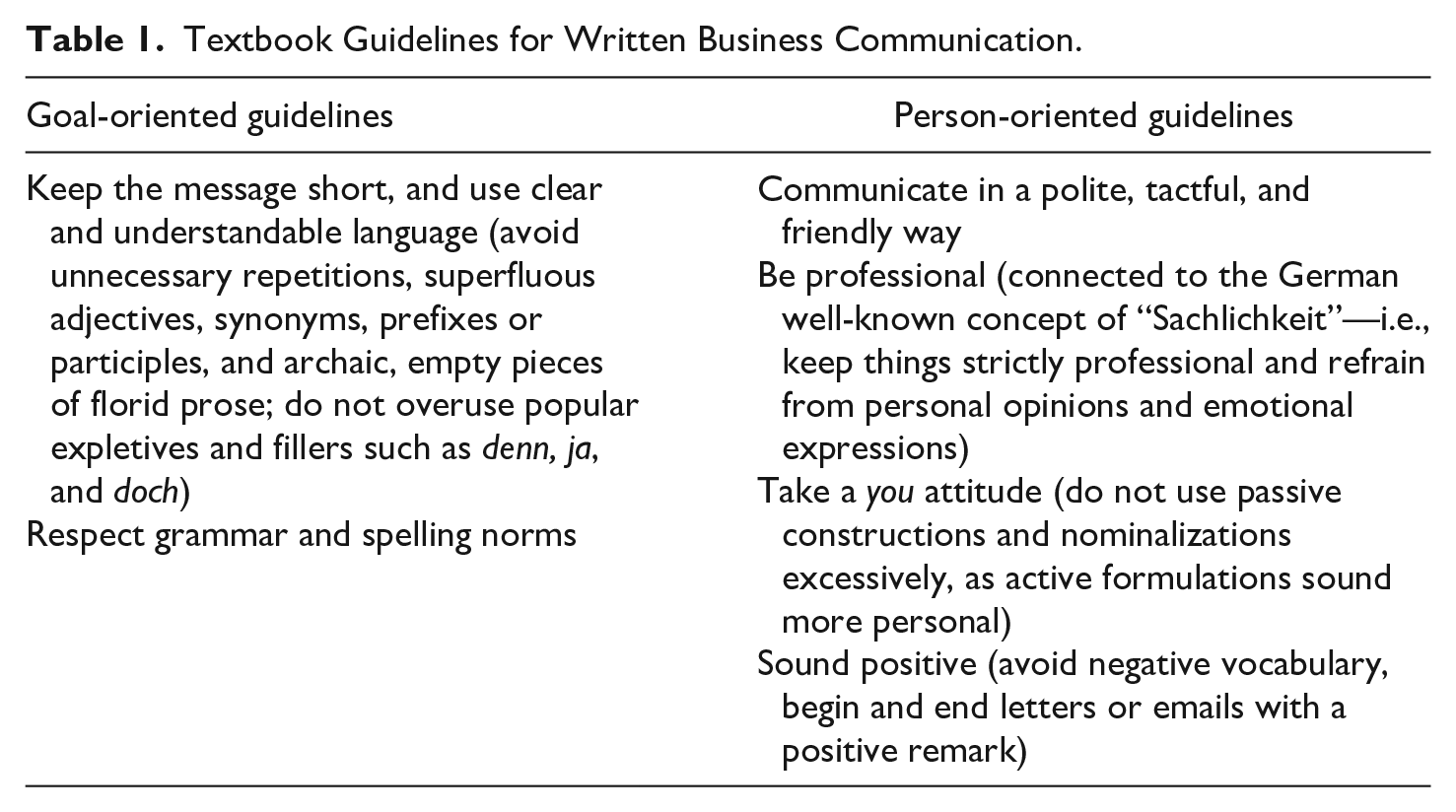
In the more recent textbooks that specifically mention computer-mediated communication, concern is raised about current practices in email communication, as it seems to lure the writer into nonchalance, less adherence to spelling and grammar norms, and more informal formulations. Therefore, these textbooks call for caution and advise the writer to uphold principles of politeness, accuracy, and standards of professionalism in email correspondence. Studies indeed have suggested that orthographic and grammatical mistakes may harm perceptions. Experimental research into the effect of language mistakes in news stories (Appelman & Bolls, 2011), company promotions through direct mail (Jansen, 2010), advertisements (Mozafari et al., 2017), and online reviews (Maesschalck, 2015) has shown that errors negatively affect customer outcomes such as credibility and repurchase intentions. However, being a nonnative speaker might serve as an extenuating circumstance. Studies on business English as a lingua franca (BELF)—such asJenkins et al. (2011);Kankaanranta et al. (2018); andSeidlhofer (2011)—suggest that in intercultural interactions with English-as-a-lingua-franca speakers, lower proficiency levels resulting in a lack of formal correctness and ritualistic politeness (as recommended in textbooks) need not necessarily be problematic, as speakers in these contexts seem to be far more concerned with getting the message across.
When addressing complaint-refusal letters, the consulted textbooks formulate specific advice on how to draft these negative messages.Table 2presents an overview of the different textual components that were identified in these textbooks. Although the textbooks themselves do not refer to genre theory as such, we can—based on genre research—also refer to these textual components asmoves(cf.Upton & Cohen, 2009). Every textual component, or move, serves a particular communicative function. The terminology, as well as, in some cases, the order of the components (e.g., components 6 and 7 may have a reversed order), differs across sources, but for reasons of clarity, we did not include these variations in our overview.
Textbook Guidelines on Textual Components in Complaint-Refusal Letters.
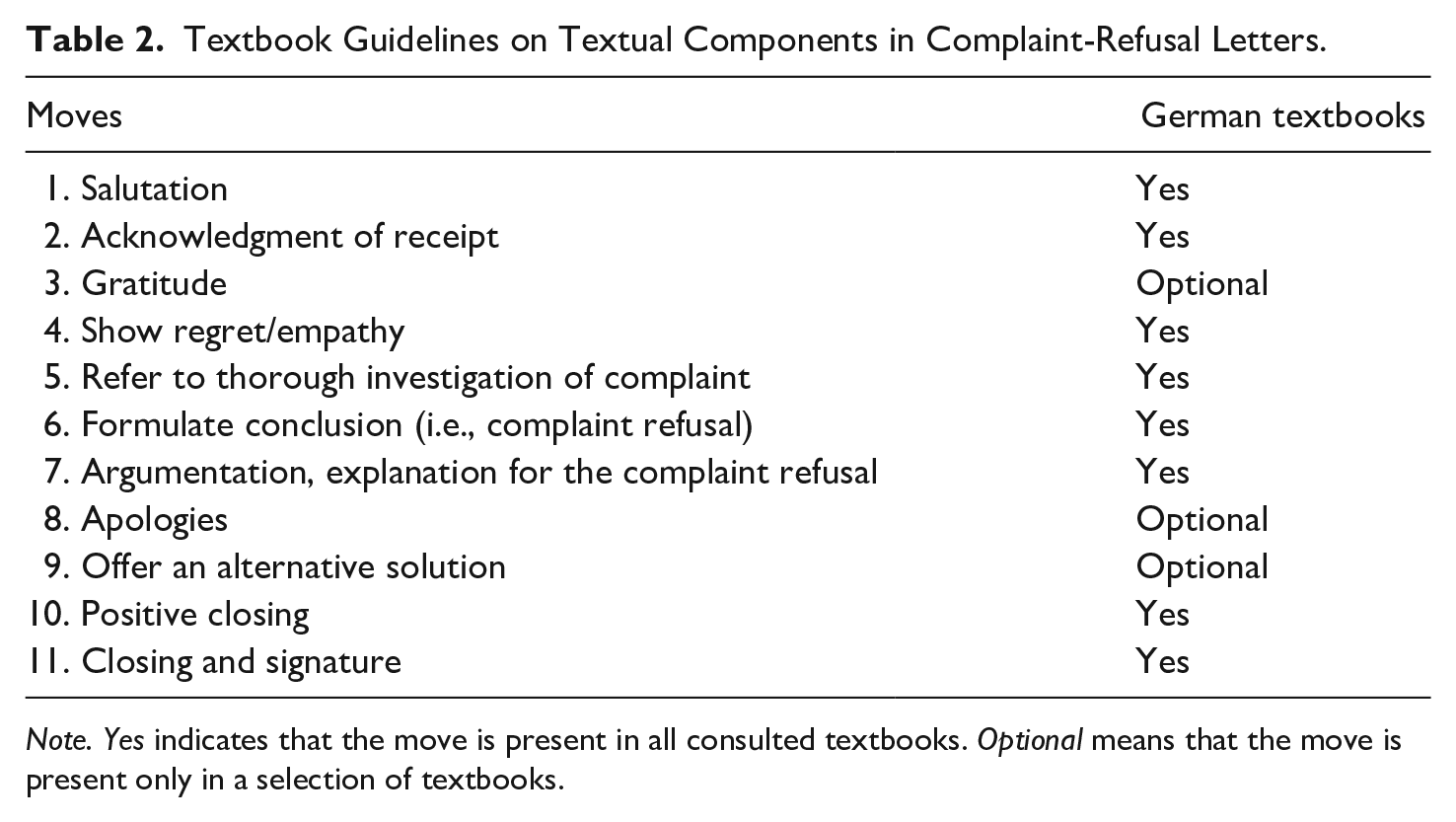
Note. Yesindicates that the move is present in all consulted textbooks.Optionalmeans that the move is present only in a selection of textbooks.
While the presence of some of these components (e.g., acknowledgment of receipt, gratitude) seems to be rather specific to the genre of written business complaint refusals, other moves seem to be typical refusal strategies as evidenced in pragmatic research, such as mitigating the actual refusal through expressions of empathy or apology, offering explanations for the refusal, and coming up with an alternative solution (cf.Félix-Brasdefer, 2006).
Decock’s (2015)study on rhetorical and pragmatic characteristics of German-language complaint-refusal emails in an intercultural B2B context allows us to compare the German-language business textbook guidelines with an example from actual practice. This comparison reveals that while the authentic complaint-refusal emails follow some of the stylistic guidelines of using clear, concise, and tactful language, the data also show a remarkably low investment in customer-oriented language. Put differently, the focus seems to be on the problem, not the people. The authentic complaint-refusal emails do not contain moves that are explicitly aimed at interpersonal aspects via expressions of gratitude, empathy, and apology, resulting in an underrepresentation of interpersonally relevant rhetorical moves. In addition, the emails contain language errors and fewer idiomatic expressions—possibly suggesting sloppiness and carelessness—and customers tend to be treated in an impersonal way (e.g., salutations without names, formulaic politeness,weperspective). All in all, we can conclude that transactional stance clearly outweighs interpersonal stance, which is at odds with recommendations made in the business communication textbooks we consulted.
It is still unclear, however, to what extent this mismatch presents an actual problem. While these interpersonal moves are virtually absent from the data inDecock’s (2015)study, this need not mean that complaint management in the particular company setting is very poor. At the same time, nor does it mean that the recommendations are useless and that the implementation of interpersonal strategies would have a negative effect, for that matter. While discourse scholars tend to frown upon training and textbook materials because of their promotion of rather decontextualized norms of interaction, potentially resulting in inadequate advice (e.g.,Bremner, 2010;Clifton, 2012;Creelman, 2012), at this stage we cannot assess whether the advice given is wrong; we can just attest that it is not always implemented in actual practice. Of course, the scope of this mismatch is unclear. We do not know how systematic this mismatch between theory and practice is. The examples of situated practice fromDecock’s (2015)study are obviously not representative of complaint management as a whole. An observation that can be made, however, is that the recommendations made in our sample of business communication textbooks do not seem to reflect the context-sensitive advice as advocated in service recovery studies. The marketing literature thus strongly indicates that business textbooks on complaint communication need to take contextual differences into account more when formulating recommendations on written business complaint refusals.
While textbook recommendations stress the importance of interpersonal stance, the authentic complaint-refusal emails rooted in the intercultural B2B context thatDecock (2015)examined are characterized by the absence of interpersonal moves and a low degree of investment in customer-oriented language. To find out which communicative strategy is most effective in this specific context, we decided to conduct an experimental study assessing the impact of actual practice (less interpersonal attention) versus recommended practice (more interpersonal attention) regarding complaint-refusal messages on customer outcomes.
Experiment: Effectiveness of Textbook Advice Versus Actual Practice
Before elaborating on the hypothesis, the design, and the stimuli of the experiment, we feel it is necessary to briefly contextualize the authentic data that we draw on as an example of actual practice. These data, consisting of email complaint negotiations between a company and its customers, including organizational complaint refusals, were retrieved from the sales department of a Belgian worldwide supplier of spare parts for material handling and industrial equipment between November 2013 and March 2014. For confidentiality reasons, company, customers, and employees were made anonymous. The sales department was divided into several language teams, consisting of a team leader, office staff, and sales representatives in the field. It was the company’s policy to address customers in their mother tongue. The team involved in relaying to customers from Germany, Austria, and Switzerland (henceforth, the German team) belonged to the most important sales teams in the entire company, both in staff number (20 employees) and in trade volume. The employees were native, or L1 (first language), speakers of Dutch, and nonnative, or L2 (second language), speakers of German with a C1 (effective operational proficiency) or C2 (mastery) level (proficient users, according to the Common European Framework of Reference). The complaint negotiations thus took place between Dutch-speaking Belgian sales employees, who were L2 speakers of German, and customers, who were L1 speakers of German from Germany, Austria, and Switzerland.
Customers could file a complaint through phone, fax, email, or the online CRM system. To avoid “he said/she said” disputes, they were encouraged to do so through the CRM or at least in written form. These business-related complaints are mostly calledReklamationenin German, thus referring to a situation in which a customer is dissatisfied with a certain product and therefore desires compensation in the form of a new product, a repair, or a credit note. It was the task of the sales employees to notify customers of the acceptance or refusal of their complaint (i.e.,Reklamation) via email.Decock (2015)described and analyzed such complaint-refusal emails in a previous study. We summarized the results of this study earlier in this article, and we showed that these authentic German-language complaint-refusal emails differ from recommendations made in our sample of German business textbooks. This discrepancy ignited the need for an experiment, which we will describe in the following sections.
Hypothesis
Formulating a hypothesis on expected effects proved to be somewhat complicated. Based on the literature review, one could expect an email with more interpersonal attention to positively affect perceived interactional justice, perceived appropriateness, repurchase intentions, positive word-of-mouth intentions, credibility, and brand trust. Indeed, several studies have underlined the relative importance of favorable employee behavior (Gelbrich & Roschk, 2010;Henneberg et al., 2015;Orsingher et al., 2010;Packard et al., 2018;Van Vaerenbergh et al., 2019). In addition, research into the effect of language mistakes (as markers of sloppiness and carelessness, and thus less interpersonal attention) in a variety of professional communication genres has shown that errors negatively affect customer outcomes such as credibility and repurchase intentions (Appelman & Bolls, 2011;Jansen, 2010;Maesschalck, 2015;Mozafari et al., 2017). It is therefore likely that this is also the case for emails communicating corporate complaint refusals.
At the same time, though, we also expected that the effect of additional interpersonal strategies might not be very strong because communicative exchanges take place between a Belgian company and high-transaction customers from German-speaking countries in a B2B setting. As mentioned before, there are indications that for high-transaction customers in B2B settings, distributive justice and procedural justice outweigh the importance of interactional justice (Brock et al., 2013;Chang et al., 2012). In addition,Henneberg et al. (2015)found that German customers, compared with U.K. customers, place less value on personal relationships. Moreover, in studies byJenkins et al. (2011),Kankaanranta et al. (2018), andSeidlhofer (2011), a more tolerant, functional approach to language in BELF has been observed, with no central concern with correctness and formulaic politeness, as recommended in textbooks. Our intercultural business context, in which L1 and L2 speakers of German communicated with each other, obviously differed from BELF encounters in which English is often nobody’s first language. This also means that regardless of differences in proficiency, many BELF encounters do not display power asymmetry based on mother tongue privilege. Still, while we did have an L1/L2 context in our data, this need not automatically imply asymmetrical power relationships. As L2 proficiency in German is less common and therefore more remarkable than L2 proficiency in English, we expected the German-language customers to demonstrate a certain degree of tolerance and benevolence toward incorrect or less idiomatic language use by sales employees who are L2 speakers of German.
Design, Stimuli, and Procedure
In collaboration with the company whose email data we analyzed, we set up a between-subjects experiment with two different German-language complaint-refusal emails. In the first (control) condition, respondents were confronted with a default email (i.e., a German complaint-refusal email that reflects the company’s actual practice). This default email was based on a template that was adapted and completed by the employees. We did this to ensure scenario realism and to be able to assess the impact of the company’s current communicative practices in complaint refusals on customer outcomes. The default email was marked by the absence of clear interpersonal moves—more specifically, the expression of gratitude (for signaling the problem) and the expression of regret (for having to refuse the complaint). Apart from the signature of the company employee at the end of the email, it was also written from the corporateweperspective. Moreover, the default email contained grammatical and lexical errors and less idiomatic language, thus accurately reflecting the intercultural setting in which company employees are L2 speakers of German and write German-language emails that regularly contain mistakes and less idiomatic expressions.
In the second condition, the interpersonal speech acts of gratitude and of regret were added at the beginning and the end of the email. The manipulated refusal email also alternated between the corporateweperspective and the personalIperspective. By showing a level of personal investment, the employee decreased the distance between herself and the customer (Packard et al., 2018), albeit in a very subtle way. Moreover, the manipulated email did not contain language errors or less idiomatic expressions, thus evoking linguistic closeness and avoiding the impression of sloppiness and carelessness. In short, the second condition incorporated textbook advice on e-complaint refusals by demonstrating more interpersonal attention through language (seeAppendix Ain theSupplementary Material).
The refusal email in both conditions was directed at a male customer and written by a female employee, based on the largely male customers in the company portfolio and the largely female composition of the German sales team. Both customer and employee names were fictionalized or made anonymous.
The target population of the questionnaire consisted of genuine customers from German-speaking countries (Germany, Austria, or Switzerland) who were selected from the company’s client database. Clients were asked to complete an online questionnaire as part of the company’s quality management procedures in which they had to envisage a familiar complaint situation about a refused warranty claim concerning a malfunctioning starter, which was backed up by a technical report that reveals wrong usage. The experiment was available online for a duration of 2 weeks in September 2017, and respondents were randomly allocated to the two experimental conditions. In total, 72 usable responses were retrieved, split into 35 for the default condition and 37 for the manipulated condition. We cannot estimate the response rate, as we could not gain knowledge on the total size of the company’s German-speaking customer base. The majority of participants were male (81.9%), which was in line with the gender distribution of the company’s customers. Most participants were employed either as laborers (28%) or as customer service/sales/purchasing employees (33%), and a minority identified themselves as managers of their own company (18%). A majority of participants (75%) worked in a company with a maximum of 10 service technicians, and 14% worked in a company with more than 10 service technicians. With the exception of one participant, all of them had German as their native language.
Measures
After reading the default or manipulated email, respondents were asked to fill out a questionnaire. We wanted to know if the manipulations would affect certain customer outcomes. They were asked to evaluate a number of statements regarding their perceptions, attitudes, and behavioral intentions on a Likert-type scale of 1 to 7 (Van Vaerenbergh & Thomas, 2013), which in most cases representedstrongly disagreetostrongly agree(seeAppendix Bin theSupplementary Material). All measures were based on previous work in service research and communication studies (seeAppendix B). We also added manipulation checks with binary response options to the questionnaire to see if the respondents were aware of our manipulations (i.e., differences regarding interpersonal moves, language competence, and theI/weperspective). Finally, we asked respondents to give basic information about themselves and their company (e.g., gender, age, position within their company, amount of service technicians in company, language).
Results
We analyzed our data using SPSS 25. Manipulation checks for presence of errors, apology, and gratitude proved viable (p= .00,p= .00, andp= .01, respectively). The manipulation check that tested the contrast in first-person pronouns (weorI/we) was not successful (p= .6). This could mean that either this manipulation was too subtle or that the phrasing of this manipulation check was unclear; we did not literally ask whether respondents thought that the email was written from theweor from a combinedI/weperspective, but whether they thought that the employee wrote the email in the name of the company or in her own name. Results regarding the impact of the manipulated condition on customer outcomes indicate quite surprisingly that the addition of rhetorical moves (gratitude and apology), the absence of language errors and less idiomatic language, and the alternation between theIand theweperspective in email complaint refusals in our specific intercultural B2B context did not have a significant effect on the perceptions, attitudes, and behavioral intentions of the participants in this study (seeTable 3). The manipulated email did not have a more positive effect on the customer outcomes compared with the control (default) email. These results do not support our hypothesis.
Results From thet-Test Analysis.

In addition, if we look at the mean scores of the constructs and the email features, we notice that relatively high scores are obtained in both conditions. The scores for all the constructs and email features fluctuate between 5 and 6 (agreeandstrongly agree), which means that both emails were positively assessed by the respondents.
Discussion
The results from our experimental study show that the respondents, who are German-speaking customers from the company we collaborated with, evaluate both complaint-refusal emails in the experiment as positive, on average. They gave relatively high ratings to customer outcomes such as brand trust, word-of-mouth intentions, and interactional justice, which indicates that they seemed to be quite satisfied with the way in which the company communicated the complaint refusal. More important, the results indicate that there was no significant difference between the two emails in the experiment. The default complaint-refusal email (i.e., the email reflecting actual practice)—with language errors and fewer idiomatic expressions and without interpersonal moves of gratitude and apology and an alternation of perspective (I/we)—was not rated lower than the email that adopted textbook advice by including more interpersonal attention. These results contradict our expected results, as our hypothesis was that the manipulated email would positively influence customer outcomes.
We did predict that the effect of additional interpersonal strategies would be weaker because we were dealing with high-transaction customers from German-speaking countries in a B2B context (Brock et al., 2013;Chang et al., 2012;Henneberg et al., 2015) and because the German-Belgian setting was likely to induce intercultural tolerance with regard to language use (e.g.,Kankaanranta et al., 2018). It now seems that these contextual factors are even more influential than what we expected.
First, being a high-transaction customer in this B2B case implies frequent customer-company interactions (on a daily to monthly basis) on various topics—mainly inquiries and orders, but sometimes complaints—using not only email but also telephone. To further increase familiarity, most customers are assigned to a specific sales employee (i.e., preferred agent) with whom they handle most of their transactions. This implies that the respondents in the study were probably already quite familiar with the company and at least one of its employees; they were beyond the stage of building their first impressions. The reputation of the company was already quite solid, and it was unlikely that a complaint-refusal email with or without more interpersonal attention would make a difference. Increased interpersonal attention would probably be more effective in a business relationship with substantially lower transaction frequency, which therefore relies much more on first impressions (cf.Gretry et al., 2017). This should not mean, however, that interpersonal attention is irrelevant in high-transaction B2B contexts. AsHenneberg et al. (2015)showed, B2B customers do expect favorable employee behavior during complaint handling. It is possible that this favorable employee behavior in high-transaction B2B contexts manifests itself more prominently during other (perhaps oral) communicative encounters with the same customers and/or that it is realized in more implicit and informal ways (e.g., through small talk and/or emphatic talk on the phone, nonverbal cues, swift actions, flexibility, and extra efforts) compared with low-transaction relationships, in which one of the only opportunities to show interpersonal attention is by mentioning it explicitly in formal communication. More implicit manifestations of interpersonal employee behavior might turn it into a less salient and tangible factor, but this does not decrease its importance when it comes to building trust. Second, the respondents in our experiment were customers from a German-speaking country. In view ofHenneberg et al.’s (2015)finding that a German business culture places less importance on relationship atmosphere-related attributes than a British business culture, this might also help explain our results. Third, results indicate that language competence of L2 speakers in business settings is understood less in terms of grammatical correctness and more in terms of “getting the message across” and “getting the job done.” Indeed, although the manipulation check for language errors was successful, the presence of errors did not have an impact on respondents’ assessment of the sales employee’s language proficiency (p= .26). This intercultural tolerance might be further enhanced by German-speaking customers’ overall appreciative attitude toward the fact that they are able to speak German with sales employees of a Belgian company, an attitude that was frequently referred to in our interviews with Belgian sales employees. In cases where the employee’s German might be deemed better than the client’s self-assessment of any L2 they speak, it is not surprising then to see a more gracious attitude toward the employee’s use of German.
The results we obtained can be better understood in light of role theory (Sarbin & Allen, 1968;Schewe, 1973;Solomon et al., 1985), which stresses the importance of role-specific appropriate behavior for successful social interaction. Interactions are positively evaluated when people have the impression that their interactional partners behave appropriately according to their role in the relationship. A crucial element in assessing appropriate behavior is the degree of familiarity. As our study shows, customers in our high-transaction and intercultural Belgian-German setting did not perceive the email with more interpersonal attention as more or less appropriate than the default email, which indicates that more interpersonal strategies are not expected in this particular communicative situation, but neither do they backfire. In support of these claims regarding communicative attitudes and expectations in B2B and intercultural contexts, it should be noted that the analysis of the email sequences (Decock, 2015) did not reveal metapragmatic comments from customers showing discontent with the way in which the refusal was formulated.
Implications, Limitations, and Future Research
The results of our study complement previous criticism raised against training and textbook materials on business communication, as they indicate once more that the models of best practice presented in some of these course books may be hypercorrect exaggerations of simplified, isolated communicative procedures that fail to take into account the embedded communicative context of such critical moments. In a recent English-language academic business textbook, discourse scholarsDarics and Koller (2018)acknowledged the importance of taking contextual differences into account when formulating recommendations. The authors stated that “communicators who are likely to succeed are the ones who use the right tone of voice and the level of politeness deemed appropriate in a specific situation” (Darics & Koller, 2018, p. 92). In a chapter on talking with customers, they further specified that it is also important to remember that to become effective communicators, we always have to take into consideration the context, the audience and the specific situation at hand, and not use the verbal strategies as a mere shopping list of items. (Darics & Koller, 2018, p. 100)
We highly welcome these statements and hope for similar observations to be made in future business textbooks.
At the same time, however, when it comes to the managerial implications of our results, they do not necessarily imply that companies that are involved with high-transaction customers in an intercultural Belgian-German setting should stick to the type of communication expressed in our default email. Showing gratitude and regret, avoiding language mistakes and less idiomatic language, and shifting between theIand theweperspective as measures to increase interpersonal attention did not have a negative effect on customer outcomes either. With the ongoing growth of the service sector, transforming companies from product- to service-based enterprises in which communication and language skills have become crucial foundational skills for today’s workers (Heller, 2010), such measures can be considered good practice. Against this background, it should be mentioned that the respondents in our study primarily worked at small enterprises in the manufacturing industry. While it seems that this type of customer is representative of our company’s customer base, it is possible that a similar experimental study with respondents working in larger and/or more service-oriented organizations would have generated different results. Such employees are likely to have been trained more extensively in the field of customer care, or they might have higher expectations in terms of language proficiency (especially when their own level of L2 is higher as well), possibly resulting in higher standards for business communication.
This demonstrates that it is necessary to conduct a similar study in different settings (e.g., B2B but another type of industry, B2C, intercultural but other languages, monocultural) to find out in which context more interpersonal attention is the most effective. Moreover, it would also be interesting to conduct a similar experiment with different or stronger manipulations to examine, for instance, how many and what type of linguistic imperfections are acceptable in intercultural contexts.
Supplemental Material
BPCQ-18-075.R3-Decock-Appendices-Queries_FInal_Editors_Corrections – Supplemental material for Interpersonal Strategies in E-Complaint Refusals: Textbook Advice Versus Actual Situated Practice
Supplemental material, BPCQ-18-075.R3-Decock-Appendices-Queries_FInal_Editors_Corrections for Interpersonal Strategies in E-Complaint Refusals: Textbook Advice Versus Actual Situated Practice by Sofie Decock, Bernard De Clerck and Rebecca Van Herck in Business and Professional Communication Quarterly
Footnotes
Acknowledgements
The authors thank the anonymous reviewers whose comments and suggestions helped improve and clarify this manuscript.
Authors’ Note
We are very grateful to the company for having granted access and thus making it possible for us to conduct our study and to help them improve their complaint-handling communication. This study, a work in progress at the time, was presented at the 15th International Pragmatics Conference, Belfast, Northern Ireland, 2017.
Declaration of Conflicting Interests
The authors declared no potential conflicts of interest with respect to the research, authorship, and/or publication of this article.
Funding
The author(s) disclosed receipt of the following financial support for the research, authorship, and/or publication of this article: The authors received a starting grant for this research from Ghent University.

Supplemental Material
Supplemental material for this article is available online.
Author Biographies
References
Supplementary Material
Please find the following supplemental material available below.
For Open Access articles published under a Creative Commons License, all supplemental material carries the same license as the article it is associated with.
For non-Open Access articles published, all supplemental material carries a non-exclusive license, and permission requests for re-use of supplemental material or any part of supplemental material shall be sent directly to the copyright owner as specified in the copyright notice associated with the article.
