



Abstract
This study examined student perceptions of an online case study development experience where students wrote their own case studies about workplace communication processes and created accompanying pedagogical materials. Students then shared their cases in small groups and engaged in dialogue. Students from organizational communication classes at four universities completed preevaluations (n= 77) and postevaluations (n= 67), providing quantitative and qualitative data. Analyses suggested that students perceived that the experience enhanced their understanding of course materials, aided them in connecting course materials to the real world, and enabled them to reflect on their own and their classmates’ organizational experiences.
Case studies have been used as valuable learning tools in classrooms from business and communication to law and medicine since the early 20th century (Lang, 2011). Indeed, many textbooks already feature short cases or vignettes that illustrate complex concepts covered in course materials, and there is a range of books for business and professional communication on the market that explicitly feature case studies (Fyke et al., 2016;Keyton & Shockley-Zalabak, 2010;May, 2013). Typically, case studies are short stories that describe real or reconstructed events and present readers with a dilemma for which there is not a clear solution (May, 2017). This pedagogical tool actively engages students in learning, advances critical thinking skills, and encourages students to make connections between course materials and complex, real-life situations (Alvarez et al., 2015;May, 2017). In addition, evidence suggests that utilizing case studies in the classroom can result in enhanced learning experiences and enable students to develop more realistic outlooks on work life (Banning, 2003). Despite these many benefits, instructors still sometimes struggle to find contemporary case studies that are most relevant for students or to persuade students that case studies really do reflect real-world experiences (Meluch & Gettings, 2019). One way to address these issues is to encourage students to create their own cases based on their own personal organizational experiences or those of close others.
As professors and scholars of business and professional communication, we describe a learning experience that capitalizes on the value of using case studies in the classroom in an enhanced way: (a) by asking students to write their own cases and develop materials to help others integrate their case with course materials, and (b) facilitating online reading and discussion of student-developed case studies and materials among students. In this article, we report on our formal evaluation of a multisemester, multiinstitution initiative during which students wrote case studies and developed accompanying pedagogical materials, shared their cases with other students, and then engaged in online discussion with the case authors (graduate, undergraduate) and undergraduate classmates.
Case Study Pedagogy
There is a great deal of scholarly support for the value of using case studies in the classroom both in general (Lang, 2011) and in specific disciplines such as business (Laditka & Houck, 2006;Lee et al., 2009) and organizational communication (Alvarez et al., 2015;May, 2017). Research suggests that students who utilize case studies experience higher levels of learning and develop better understanding of organizational life (Canary, 2007;Mesny, 2013). Case study pedagogy provides students with the opportunity to apply course theories and concepts to real-world examples that illustrate complex processes.May (2017)explained that case studies effectively “hone students’ analytical and problem-solving skills” and allow students to connect “theory and practice” (p. 216). Specifically, case studies provide a concrete context in which students can see how abstract concepts from business and organizational communication courses actually occur in the workplace, which is one of the key reasons for their utility in the classroom. Given the importance of connecting pedagogy to contexts beyond the classroom, case studies continue to be one of the most useful tools by which instructors can make clear connections between theory and practice.
Beyond their function as examples of concepts in practice, case studies are a pedagogical best practice because they facilitate student critical thinking (Meluch & Gettings, 2019) and enable students to develop deeper understandings of workplace dynamics that may still be quite new to them. For instance,Alvarez et al. (2015)described how the classroom is “an instructive institutional space of socialization for individuals as thinkers and workers” and thus instructors “should place difference at its forefront” to prepare students to succeed in increasingly complex and diverse workplaces (p. 302). Because the challenges presented by workplace diversity may be somewhat new considerations to some students, the authors offer case studies as one way to aid students in anticipating how they might address related organizational dilemmas. Similarly,Laditka and Houck (2006)pointed to teaching ethics as a particularly challenging task—even alluding to the fact that some scholars believe that ethics cannot be taught. Again, case study pedagogy is offered as one way instructors can assist students in learning about and preparing to traverse this potentially unfamiliar workplace territory. Teaching ethics in this way helps to increase students’ awareness of their own moral values and attitudes toward ethical dilemmas and facilitates thinking about how they might respond when placed in ethically dilemmatic situations. Case study pedagogy is also useful in crafting community in the classroom (May, 2017). That is, through analysis and discussion of case studies examining business and professional communication processes and practices, students are encouraged to engage in appropriate questioning, discussion, and active listening, which are all critical ingredients to developing a (virtual) classroom community that fosters productive dialogue.
Despite the many benefits of using case studies as a pedagogical tool, students still find some case studies to feel contrived, difficult to connect to, or outdated (Forman, 2006;Meluch & Gettings, 2019). As such, it can be a challenge for instructors to consistently identify or create realistic, relevant, and/or current case studies that students find effective when presented with them in the classroom. In response, some instructional scholars have described the benefit of incorporating student-written case studies into a course as an effective practice that asks students to make connections to course materials and use creativity to highlight these connections (Bailey et al., 2005;Forman, 2006;Laditka & Houck, 2006).
Student-Developed Case Studies
Student-developed, or student-written, case studies essentially require students to take on the role of author of a case to illustrate theories or concepts from the course materials in an example from their work/professional experiences, the work/professional experiences of others that they know well, or those they have come into contact with through media reports and/or research. Ideally, students fully understand the theories or concepts they hope to portray and how they intersect with workplace experiences to write their case study (but even students without a firm grasp of course materials can develop a case, albeit often a shallow one). Furthermore, through writing a case study, students may find that they become better able to reflect on concepts and theories, which helps them more deeply understand how course materials can be applied to real-world settings even when they are still learning about these ideas. Case study writing allows students to be creative and, therefore, engages problem solving and innovation skills (Lang, 2011). Both skillsets are important in organizational contexts beyond the classroom.
To date, some instructor-scholars have noted the value of student-written case studies in face-to-face business courses, such as management and marketing (Bailey et al., 2005;Forman, 2006;Laditka & Houck, 2006). For example,Laditka and Houck (2006)required students enrolled in management courses to develop individual case studies focusing on ethical issues in the workplace using their own work experiences. Similarly,Bailey et al. (2005)asked students to work in teams to write case studies that incorporated group members’ experiences in the workplace into case learning. Finally,Forman (2006)assigned students to research companies and write their own case studies based on their findings.Forman (2006)further noted that case study writing helped improve students’ written communication. Given the importance of teaching writing in business communication courses and the need for transferability of this skill to the workplace (Mascle, 2013), assignments that provide students with a unique and creative opportunity to cultivate their writing skills are useful pedagogical tools. The experiential student-developed workplace case study experience described here builds on and extends this previous scholarship.
Student-Developed Workplace Case Study Activity
When selecting case studies to share with students it is important to find cases that students will find engaging and, if possible, relatable. However, it can be a challenge for instructors to identify cases that will captivate students. Indeed, the impetus for incorporating student case study writing into our classes was a set of limitations we observed in traditional case study pedagogy and the desire to further engage students through the use of a creative outlet that integrated course concepts and personal experiences. After using traditional case study pedagogy for years in our business and professional communication and organizational communication courses, we noticed that sometimes students did not connect to the cases in the ways we anticipated (or sometimes they did not connect at all). Students occasionally were unfamiliar with organizations highlighted in case studies, did not find narratives to be relevant to their personal experiences, and/or believed cases felt artificial. Expecting students to gain a deeper understanding of course materials via exposure to these kinds of cases was difficult because it required, for instance, a great deal of education about the case itself before any connections could be made. As specific examples, many students were not at all familiar with the Enron scandal or could not relate to a case focused on a middle-class soon-to-be father trying to decide whether he should take paternity leave from his company for the birth of triplets. To be clear, we are not suggesting instructors abandon examples simply because students are unfamiliar with them; rather that a mix of familiar and unfamiliar may be beneficial. To address this shortfall, we designed this assignment to provide students with the opportunity to write their own case studies and, importantly, to share these case studies with their classmates. This collaborative component is crucial to the learning experience. Prior research on student-generated case studies has examined the efficacy of student-case study writing and in-class discussion for the topic of ethics (Laditka & Houck, 2006) but has not addressed how this type of assignment can be used to cover a broader range of concepts in business environments and, importantly, students’ perceptions of the value of this assignment to their understanding of course concepts. Moreover, the efficacy of the assignment in a virtual environment is unknown. As such, analyzing pre- and posttest data from students who have engaged in this experience via multiple modes of delivery is necessary to provide further insight into the value of this pedagogical technique and the steps instructors need to take to ensure its efficacy.
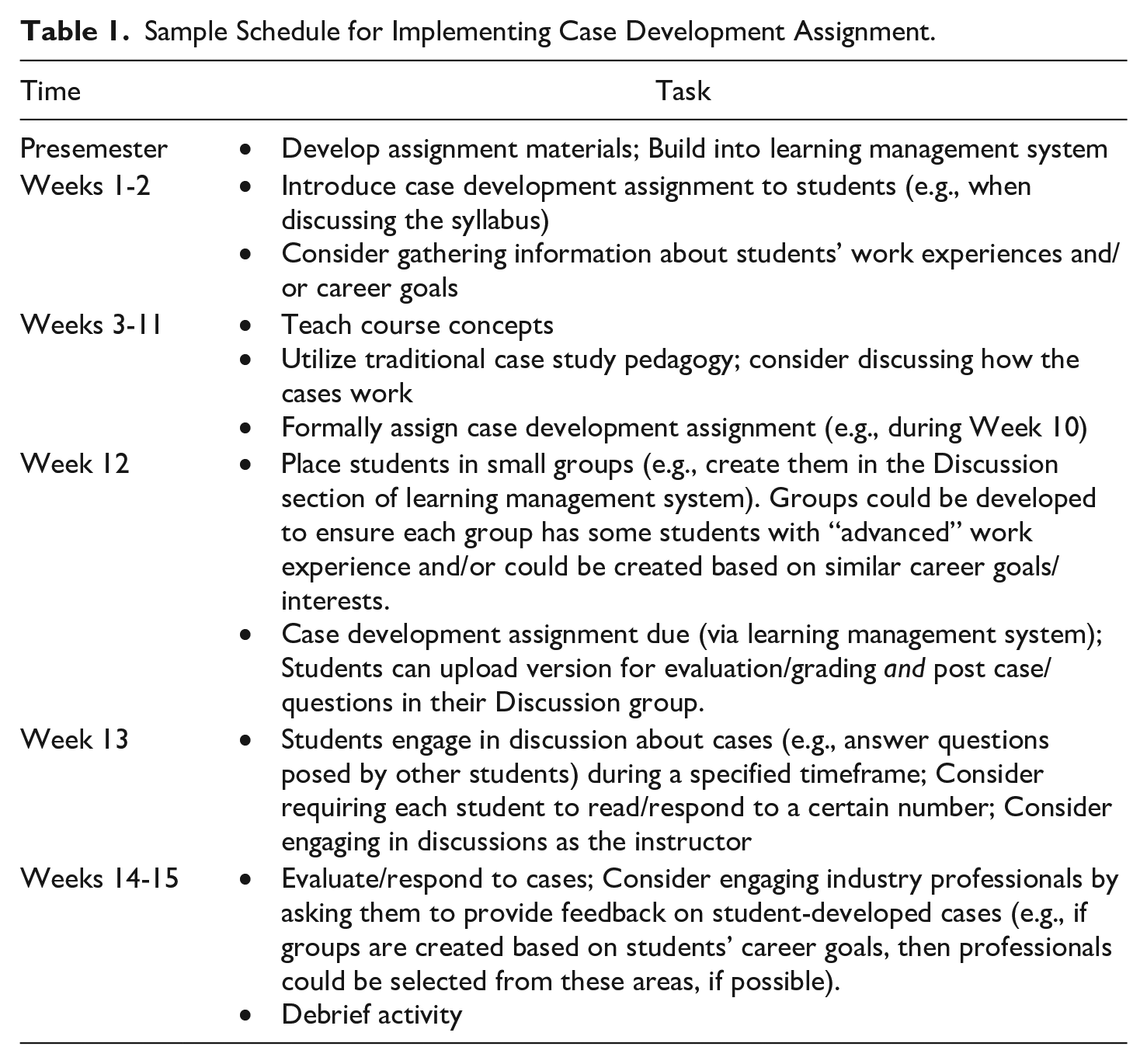
The activity itself requires students to write their own case studies illustrating a concept from the course materials (seeTable 1and theappendix). Specifically, students are given the freedom to choose a course concept that they have some experience with (e.g., socialization processes, leadership) or have seen discussed in media coverage of organizational challenges (e.g., crises, mergers) and develop their own case study around this topic. To ensure that students understand the nature of case studies and their format, the instructors have students read and respond to case studies prior to engaging in their own case study writing (e.g., a written case analysis assignment, informal discussion of cases shared in class). Once students are familiar with the format of case studies, instructors invite them to write their own to emphasize a challenge with no clear answer faced by a person who is a member of and/or who is interacting with a business or other professional organization. Students are encouraged to use pseudonyms in their case study so as not to directly implicate any given business or organization (e.g., students discussing experiences working at a local ice cream shop may change the name of the ice cream shop and the names of the main actors in the case study). After students have completed the case study, they are instructed to write a short overview of the course topics/concepts they emphasized and develop discussion questions to share with their classmates (either in person during class or small group discussions or by posting the case study and accompanying questions to an online discussion board). Discussion questions should be open-ended and ideally spur conversation around the central dilemmas and course concepts addressed in the case study.
Sample Schedule for Implementing Case Development Assignment.
The Present Study
Case studies are a useful pedagogical tool in a range of classroom contexts. One limitation of some traditional case study implementations is that the cases themselves are inaccessible for students. Here, we propose and assess an activity where students develop their own case studies about workplace communication processes and share their cases in small groups as a way to facilitate dialogue around course concepts. Given the literature reviewed and the nature of the activity implemented in our classes, our analysis is guided by the research question: How do students perceive the experience of engaging in case study (a) development and (b) collaboration? To address this question, we collected both qualitative and quantitative data before and after students completed the case development activity. Data are analyzed using descriptive statistics and thematic analysis (Braun & Clarke, 2006).
Method
We engaged in two rounds of data collection involving four classes across four institutions. Semester 1 involved two undergraduate classes at two institutions. Semester 2 involved one undergraduate and one graduate class at two institutions. All institutional review board policies were followed throughout the design and administration of the study.
Semester 1: Undergraduate Only Case Development
Participants
Participants were undergraduate students enrolled in upper-level organizational communication classes at either a public research university in the Midwestern or Northeastern United States. One class was fully online and the other was initially in-person but then shifted to fully online mid-term due to the COVID-19 pandemic. All students wrote cases and integrative questions as part of the course assignments but could choose to participate in the research component or an alternative activity. Across both classes, a total of 44 students completed the pretest and 38 completed the posttest. In terms of demographic makeup, the Midwestern institution—which will be called Sample A—included 49.4% female and 75.6 % White students. Demographics of the students at the Northeastern institution—which will be called Sample B—included 48% female and 57% White students. Research participants were recruited via a convenience sample as they were already enrolled in the classes of interest (Wrench et al., 2013) and closely resembled the demographic make-up of the broader institution. Notably, though, this sample is appropriate given study aims, and participation in the study was voluntary as students were given alternative learning opportunities if they opted to not participate in the study.
Procedures
We engaged in four steps to structure and implement the case study experience over the course of one semester (seeTable 1).
Prework
First, we obtained necessary institutional review board approvals. Students were placed in small groups (approximately eight) via the learning management system (Blackboard). Students were invited to complete the pretest anonymously online.
Instruction and case development
Students received instruction on a range of theories, topics, and processes of organizational communication throughout the 15-week semester. The nature of instruction likely varies based on the course, but examples of theories includedTaylor’s (1911)scientific management,Maslow’s (1943)hierarchy of needs,Blake and Mouton’s (1964)managerial grid andMcPhee and Zaug’s (2008)communicative constitution of organization four flows, and other topics such as organizational assimilation, conflict management, technology and organizing, and work-life integration. Students participated in online discussions about course topics. In addition, they completed informal in-class case analyses and a formal written case analysis. Completing these assignments and receiving instructor feedback prepared students for writing and responding to case studies. Students then completed the case development assignment (see theappendix). In one class, students also created short video teasers to share with classmates as a way to attract readers to their particular case.
Implementation
All students were reminded of the timing for the case study discussion, which was consistent with timing used throughout the semester. Over the course of 1 week, students posted their cases (and a teaser, if required) and responded to one another’s cases and the discussion questions posed. During implementation, instructors were engaged in the online discussion only as necessary. In terms of course topics, case studies most commonly focused on organizational conflict, classical management approaches, organizational socialization/assimilation processes, and burnout/emotional labor. Given the timing of this assignment, some students incorporated the COVID-19 pandemic’s impact on organizational processes into their case.
Reflection and evaluation
Students voluntarily completed an online postassessment where they anonymously responded to open- and close-ended questions. Instructors evaluated each student’s case study using a rubric designed to assess the case’s connections to course concepts and clarity of writing. Instructors also evaluated each student’s effort and posts in the online discussion based on a 10-point scale using a rubric.
Instruments
In line with course learning objectives, the pretest measure included questions that evaluated the extent to which students understood how course concepts were relevant to the real world. Students responded to three items on a scale from 1 =strongly disagreeto 5 =strongly agree, such as “It is easy for me to see how organizational communication theories are relevant in the ‘real’ world.” The posttest measure included the same items, plus five additional items. Students also responded to two open-ended prompts (e.g., “In what ways was this activity useful to you in your life outside of the classroom? Please provide examples to explain what you mean.”).
Semester 2: Undergraduate-Graduate Case Collaboration
Participants
Participants were undergraduate and graduate students from two regional campuses of a state university system in the Midwestern United States. Undergraduate student participants were enrolled in a hybrid organizational communication course, which involved approximately 50% in-person and 50% online instruction during the semester. The demographic makeup of the student body at this institution—which will be called Sample C—included 61% female and 82% White students. Graduate student participants were enrolled in a fully online master’s-level organizational communication course. Students in this course were either completing coursework to earn a master’s in communication or seeking credits as part of the state’s dual-enrollment program (i.e., where high school instructors need continuing education credits to teach courses in which students earn college credits). Thus, some of the graduate students were instructors themselves. The demographic makeup of the student body at this institution—which will be called Sample D—included 65% female and 73% White students.
Ultimately, the Semester 2 sample included 25 undergraduates who completed pre- and postmeasures (all students in class), eight graduate students who completed premeasures, and four graduate students who completed postmeasures (total graduate class size was nine students).
Procedures
For Semester 2, we engaged in the same four steps described for Semester 1. 1 Once students consented to engaging in the experience, they were entered into the combined online site. Each graduate student facilitated their own discussion group, which was populated with 3 to 4 undergraduate students. In addition to undergraduate students (as above), graduate students also focused on course content for approximately 10 weeks of the semester then were asked to write their own organizational communication case study. Graduate students first submitted their cases and accompanying materials to their instructor. The instructor provided extensive feedback on revisions the student might consider to improve the case. Students made revisions and uploaded final materials to the shared course site. The graduate instructor evaluated cases based on students’ ability to (a) present a well-developed and clear narrative that connected to one, or more, organizational communication concepts or theories, (b) create instructional materials (i.e., learning objectives, discussion questions) that are clear and assess observable learning objectives, and (c) present materials that are free of grammatical, spelling, and style errors.
Over the course of 1 week, undergraduates posted responses to the discussion questions posed by the graduate student facilitator, graduate students replied, and undergraduates responded once more. After a week’s time, graduate students posted a wrap-up discussion summary to the group. During implementation, instructors were engaged in the online discussion (e.g., prompting students who may be late in posting) but perhaps less active then in other online discussions so as to enable the graduate students to be the primary facilitators.
Instruments
Semester 2 used the same instruments as Semester 1 for undergraduate students. The following graduate student assessment was used. A pretest and posttest measure included questions that evaluated the extent to which graduate students perceived case studies as useful tools for helping students understand how course concepts were relevant to the real world as well as their abilities as discussion facilitators (e.g., “I believe case studies are a useful tool to illustrate organizational communication concepts/theories.”). Students responded to items on a scale from 1 =strongly disagreeto 5 =strongly agree. In addition, students answered two open-ended questions (e.g., “In the future, would you recommend this activity to other graduate students? Why or why not?”).
Analysis
Descriptive analyses of quantitative data were conducted in SPSS 26.0. We utilizedBraun and Clarke’s (2006)six-phase process to conduct thematic analysis of qualitative data because it is a flexible approach that can usefully summarize a body of data and can be used to identify similarities and differences across a data set. Thus, we started by familiarizing ourselves with all student responses to open-ended prompts by reading through all responses multiple times, individually taking notes on our initial impressions, and then discussing these impressions. Next, we engaged in open coding of all responses to generate a list of all initial codes. Practically, this involved creating tables where column one listed each participant number, the next included their responses to the open-ended questions, and the third is where we typed emerging codes. For example, initial codes included short phrases like “had heard about the case in the news,” “enjoyed the experience,” and “grad student didn’t respond.” Codes are “the most basic segment, or element, of the raw data or information that can be assessed in a meaningful way regarding the phenomenon” (Boyatzis, 1998, p. 63). Next, both alone and via discussion, we grouped the initial codes together into meaningful themes (i.e., broader concept that captured multiple initial codes) and refined them (e.g., by making sure we had excerpts that supported each and that these excerpts cohered). For each theme, we created a name, definition, and examples of how we knew whether a theme was present (with extracts;Boyatzis, 1998). Themes were inductive (i.e., data driven) and were not mutually exclusive. Then, we developed our thematic map based on the overarching benefits and drawbacks framework that was present in the data, including multiple subthemes (seeFigure 1). Finally, we wrote a draft of the results of our analysis and revised it via discussion. A version of this article was presented at a conference as a teaching idea and so we honed aspects of our analysis based on the questions asked by individuals who attended our panel at the conference.
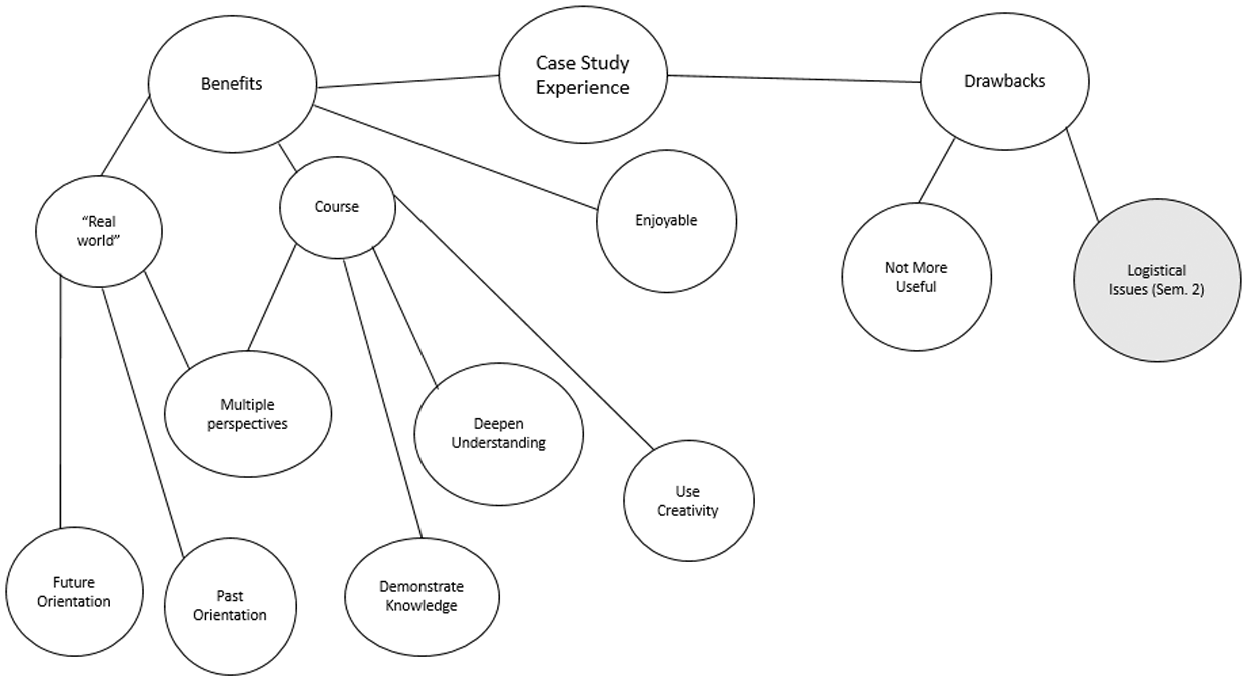
Themes from undergraduate qualitative responses.
Results
To address our research question, we present results based on analysis of undergraduate quantitative and qualitative responses, followed by results from graduate student participants.
Undergraduate Responses
Overall, the pattern of means indicated a slight increase in the extent to which students felt they could integrate course materials with the real world for Samples A and C (seeTable 2).
Undergraduate Responses to Real-World Preassessments and Postassessments.
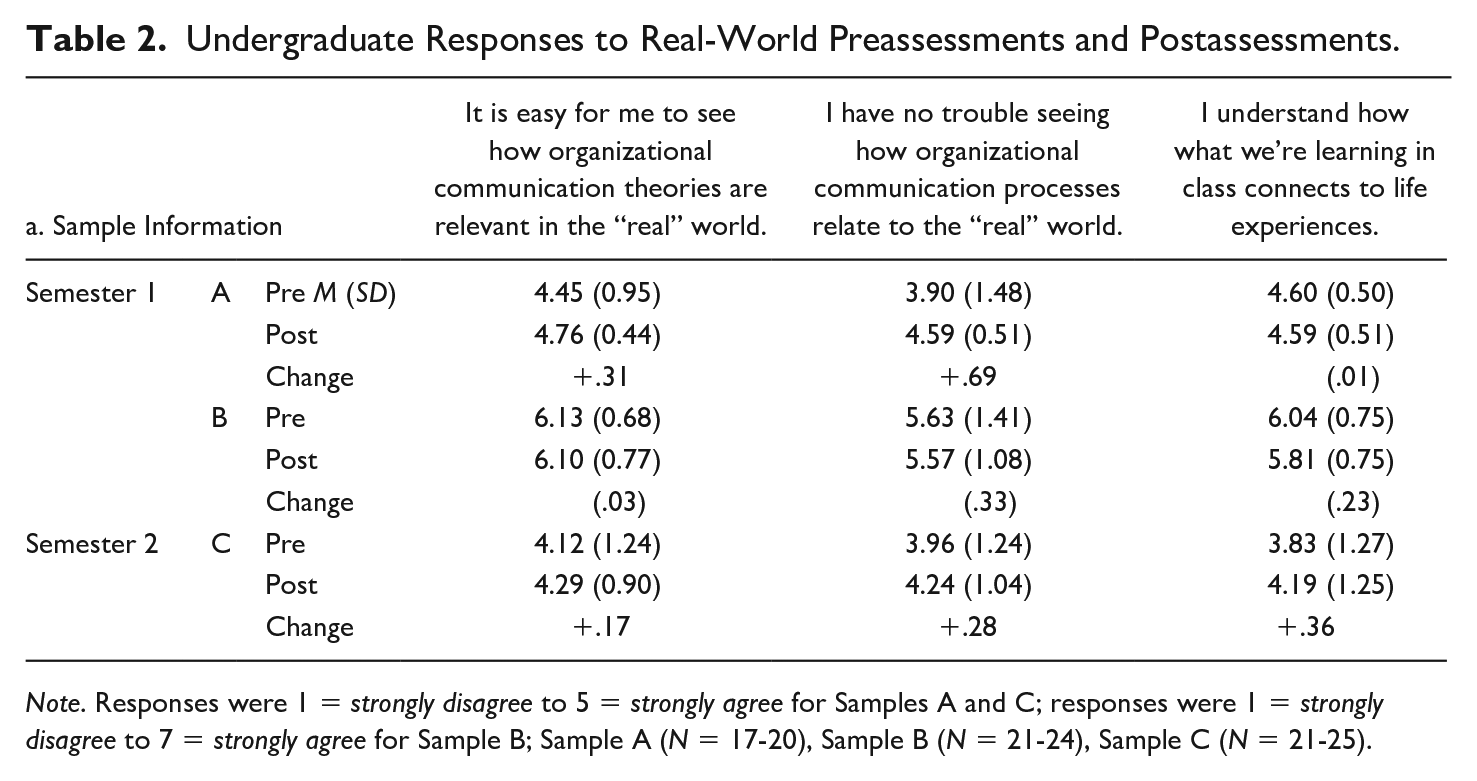
Note. Responses were 1 =strongly disagreeto 5 =strongly agreefor Samples A and C; responses were 1 =strongly disagreeto 7 =strongly agreefor Sample B; Sample A (N= 17-20), Sample B (N= 21-24), Sample C (N= 21-25).
The postassessment responses to five additional items, in general, suggested that students found the activity to be beneficial to their course learning (Research Question 1a) and that they felt interacting with classmates to be a positive experience (Research Question 1b; seeTable 3). For instance, in response to the item “This activity helped me to see things from a new perspective,” 94% of Sample A, 86% of Sample B, and 50% of Sample C students somewhat agreed/agreed/strongly agreed.
Percentage of Students Agreeing With Postassessment Items.
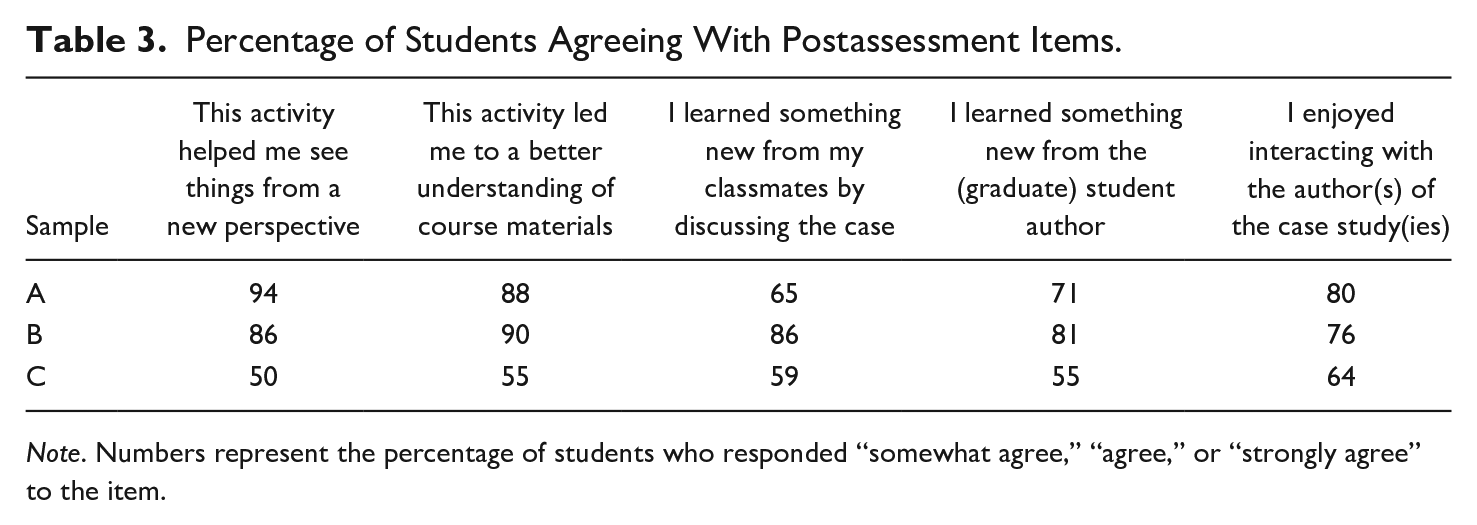
Note. Numbers represent the percentage of students who responded “somewhat agree,” “agree,” or “strongly agree” to the item.
Based on analysis of open-ended responses, undergraduate participants’ perceptions of the case study experience can broadly be grouped into those that reflectedbenefitsordrawbacks. Please seeFigure 1. Below, quotations are provided to support themes and, for each, the sample the student was in is indicated (i.e., A, B, C, D).
Benefits
One general benefit of the case study experience was that participants found itenjoyable(Research Question 1a). For example, one participant (A) wrote “I really enjoyed this activity,” another (A) stated “I enjoyed writing the original case study,” and a third (C) reported “I think it was a neat experience!” The rest of the benefits described by participants could be grouped into those related to thereal worldor thecourse, although the benefit ofseeing things from multiple perspectivesrelated to both of these. That is, responding to both Research Questions 1a and 1b, this theme included not only getting to know classmates better (and their organizational experiences) but also being able to see course concepts through their eyes. For instance, one participant (A) explained: “The original case study was a great way to learn about our classmates and what experiences they have had in their various organizations.” Another (C) commented that the experience was useful outside the classroom because [it] allowed be [sic] [to] discuss real-world issues with people that [have] different and unique perspectives . . . to consider real-world problems an[d] apply concepts I have learned in the classroom to . . . real-world issues like racism and imbalances in society.
Finally, one student (B) indicated that they found it helpful interacting with the writers of each case . . . it allowed for another perspective on the material than your own which was incredibly useful because these theories and concepts can take form in many ways.
Real world
Addressing Research Question 1a, participants felt the activity was of benefit to them in terms of making sense of their past organizational experiences (i.e.,past orientation) and would be useful in their future real-world experiences (i.e.,future orientation). In terms ofpast orientation, one student (B) commented This activity is useful for my life outside of the classroom because . . . I am easily able to dissect the do’s and don’ts of a [sic] organization. For example, in my real life, I am now able to identify that my first job wasn’t run fairly . . . I am only aware of this because of what I was taught in class.
In a similar vein, another (A) wrote: This activity helped me to identify flaws and benefits of organizations I have previously worked for. I’ve been fortunate enough to work at organizations that have fair and equal pay structures. Structures based on experience and skills, not one’s sex.
In terms offuture orientation, students felt the knowledge gained would be beneficial in terms of acquiring employment and better understanding future work experiences. For example, one student (B) said, “Looking forward, I can use the knowledge about organizational communication for future job searches, interviews, and to analyze my organizational experiences.” Another (C) stated: “it was beneficial to look at an organizational experience and offer a critique that I could utilize later on in my own life if I experience something similar.” A third (A) remarked This activity allowed the students to really apply the ideas learned in this class to their own real life [sic] experiences . . . and moving forward in professional life. If I were to encounter a company or boss, or even co worker [sic] who exemplifies poor skills in the areas learned in this class (communication, conflict management), I would be able to recognize and properly be able to handle any situation thrown at me because of this . . . class.
Course
Participants also felt the activity benefited them in relation to the course itself. Three themes emerged that respond to Research Question 1a:deepen understanding, demonstrate knowledge, anduse creativity.
First, students reported that the case development experience facilitated better understanding of course concepts. Simply put, one (A) said, “This assignment helped me to better understand theories and concepts within the course that were covered,” and another (C) wrote “This activity is useful to my success in class . . . it is a good way to practice case analysis and it helps me understand the course more.” A third participant (A) provided a specific example of a course concept: the topic of organizational conflict is so broad that I had difficulty truly grasping what would be defined as organizational conflict. But, connecting the concept to something I’ve actually experienced has helped me better understand the concept as a whole.
Second, participants reported that the experience provided them with the opportunity to demonstrate what they had learned in the course. One (B) claimed the experience “shows our understanding of the course material.” Because this assignment occurred at the end of the semester (seeTable 1), students also felt it allowed them to bring together what they had learned in a coherent way (A): “I think that this activity tied in all of the information we have learned throughout the semester.”
Finally, students reported that the experience encouraged creativity. One (B) stated that the activity “taught us to implement what we learned into our writing more creatively” and another (B) said “I think writing our own case study allowed us all to think outside the box and apply the theories we have learned throughout the semester into ur [sic] own stories.”
Drawbacks
Although the majority of responses highlighted benefits of the experience, participants pointed out two drawbacks as well. One of these was that they felt the case experience activity wasno more usefulthan the other ways cases had been incorporated into the class (Research Question 1b). For example, one (B) commented that “interacting with the writers of the case to me felt no different than only reading cases from the book/other printed materials.” Another participant (A) stated, “I don’t think interacting with the author made it better.” That is, because we had scaffolded this case development experience by engaging cases in other ways throughout the semester, some students felt that aspects of this new assignment (e.g., interacting with the authors of the cases themselves) did not add much value. To help address this drawback, instructors might consider asking students to discuss as a class what benefits they experienced through writing their own cases, in addition to reading cases written by their classmates, to focus collective attention on the unique contributions of the cases developed for/by the class.
The second drawback oflogistical issueswas specific to Semester 2 in which undergraduate and graduate students were grouped together (Research Question 1b). These issues included delays in posting or responding. For instance, one student (C) felt “a little frustrated when my case was posted late on Sunday night” and another (C) wished the graduate student “could have responded faster so we could have had a longer discussion.” A third student (C) remarked that the graduate student “facilitated our discussion well, albeit a little slowly.” It is noteworthy that these kinds of comments were not present in Semester 1 responses (all undergraduate students), which perhaps reflects that undergraduate students have heightened expectations of graduate students. To help address this second drawback, instructors (rather than graduate students) might post cases to discussion boards and/or provide a clear schedule for when students should post their comments (e.g., all students must post their initial comment by Wednesday and their response posts by Friday).
Graduate Student Responses
Graduate student perceptions of the case development experience (Semester 2 only) were generally positive. For example, in the postassessment prompts, responses addressed Research Questions 1a and 1b by suggesting that engaging with undergraduate students in this type of activity enhanced their own understanding of the organizational communication course materials (on a 1 to 5 scale, mean [M] = 4.50, standard deviation [SD] = 0.58) and enabled them to develop their own their pedagogy (M= 4.25,SD= 0.96). To this end, one student (D) commented that the activity “helped [them] better understand the concepts and ideas” and, another noted that it was “challenging to make sure that the materials (e.g., discussion questions and terminology) were developed for a [sic] undergraduate understanding. I think this helped my pedagogy as I had to keep the audience in mind throughout the entire process.” Related to developing pedagogy, one participant remarked that engaging with undergraduates in the discussion board was useful because it gave them an “idea of what it’s like to be a professor, if that is the route anyone wants to go.” In addition, graduate students found interacting with the undergraduates to be enjoyable (M= 4.00,SD= 1.41). One graduate student (D) commented: “It was a nice change from the discussion with other graduates, and it also allowed me to get a glimpse of teaching and facilitating a discussion. Overall, quite fun!”
Discussion
An ongoing dilemma for business and professional communication instructors is to find ways to connect concepts, theories, and skills covered in our courses to the practices that students will inevitably encounter in the workplace. Case studies are one of the most valuable tools to overcome the theory versus practice challenge in our classrooms (May, 2017). As our evaluation of this learning experience illustrates, student-developed case studies are an opportunity for students to form the connections between the abstract concepts covered in class and, to an extent, the lived experiences of employees in the workforce. Specifically, the results of our analysis illustrate that students see the real-world application of course concepts through their own and their classmates’ cases (i.e., lived experiences). This finding supports prior research that highlights the unique benefits of student-developed case studies in providing students with the opportunity to make connections between theory and practice (Laditka & Houck, 2006) and extends it by executing the experience in an online learning environment.
The results, as illustrated inFigure 1, further demonstrate that writing and responding to case studies enables students to reflect on past experiences in organizational settings and consider how the concepts covered in class may be critical for them to apply in future work. This finding is particularly significant since students’ experiences in the business and organizational classroom are critically related to workplace expectations (Hastings et al., 2020). In terms of the past/present, a particularly interesting outcome related to students’ abilities to make sense of their ongoing work experiences through case study writing occurred in Semester 1 because the timing of the assignment coincided with the global outbreak of the COVID-19 pandemic. For example, one student wrote about their experiences working in a grocery store at the onset of the COVID-19 pandemic and how this crisis related to issues of (essential) worker well-being and burnout. This example, and other student-developed case studies like it, are directly informed by the challenges (student) workers are experiencing in real time in ways that published case studies and even current news stories are unable to fully capture. As such, students are able to grapple with their experiences and the experiences of their classmates through this assignment and further make sense of how business and organizational communication theories and concepts occur in the workplace.
In terms of future scholarship, there may be important ties to make to scholarship on self-efficacy, which can help support why even the perception that information will be valuable may be significant. Self-efficacy refers to one’s judgment about their own ability to effectively accomplish tasks or actions in particular contexts. According toBandura (1986), self-efficacy mediates the path between knowledge and behavior, thus influencing how we interact with our environment. In the present study, there is no absolute way of knowing how or if undergraduates were able to make accurate determinations of what information will be valuable to them in their future careers. However, it is arguably useful simply that studentsbelievethis information will be useful to them in the future in the sense that believing they will be able to manage conflict, thrive in diverse environments, and so on could be linked to positive future performance, as evidenced by research such asStajkovic and Luthans’ (1998)meta-analysis, albeit in different contexts, of 114 studies that produced a significant correlation between self-efficacy and work-related performance.
Limitations and Future Research Directions
Like all research, findings from this study should be considered in light of limitations. The small graduate class size and low posttest response rate led us to limit claims about the graduate student experience and, instead, focus on findings from the relatively robust undergraduate student sample. In addition, expecting pretest to posttest changes over the course of a few weeks was ambitious especially since we emphasized case-based learning throughout the semester. Thus, even the overall modest gains in two out of three samples (A and C) are noteworthy. Although students’ open-ended answers were positive (i.e., no different than those from the other samples) and means were relatively high (seeTables 2and3), Sample B showed slightdecreasesfrom pre to post (Table 2). One possible explanation for this is that Semester 1 for this class started out in person but then shifted to online learning due to COVID-19 and Sample B, in particular, came from a geographic region that experienced significant infection at the time of the course. Finally, the current study does not directly address the extent to which the cases reflect real-world experiences nor can it speak to whether student learning from the case development activityactuallyenhance students’ future work lives.
Based in part on these limitations, we propose three future research directions to further explore the efficacy of student-developed case studies in business and professional or organizational communication courses. First, we believe that this activity would greatly benefit from being adopted in graduate classes alone (and with larger samples). Although Semester 2 did involve undergraduate-graduate student collaboration, we believe this general assignment and format could be successfully adopted as a graduate assignment with the goal of professional publication of the case studies in addition to the collaborative nature of in-class seminar discussion.
Second, students enrolled in the semesters we deployed the case studies were placed in small groups and limited/required to only reading and responding to one or two student-developed case studies. Expanding that format to have students exchange a larger number of case studies (potentially over a longer period of time) and evaluating various group sizes in future research would be useful. Indeed, the number of students in a small group likely influences their interaction. For instance, students were placed in groups of approximately eight members in Semester 1 (all undergraduates) and students did not have to read and respond to cases of all other students in the group. Semester 2 students were in groups of 4 to 5 members (one graduate student, three to four undergraduate students) and all undergraduates read/responded to the one case written by the graduate student. In Semester 1, we observed that a group of eight may be too large as it became unwieldy to keep up with responses, particularly in the online setting. In Semester 2, though, we noticed that attrition in smaller groups became problematic. Continued focus on the ideal group size matched with modality for completing this activity will be important as groups that are too small can limit the variety of ideas, but groups that are too large can inhibit contributions from some members (Hennessy & Evans, 2006).
Finally, future research should aim to assess how real students’ cases are and the extent to which engaging in this case development activity benefits students in their future career experiences. For example, although the majority of students in this study had some type of work experience and were easily able to connect course materials with their experiences, it would be useful for future instructors to gather more detailed information about the nature of these experiences (e.g., length, industry, and responsibilities) and/or future career goals perhaps via a preactivity survey. One way this information could be used would be to create small groups in ways that ensured each group had a student with extensive work experience and/or groups based on similar career interests. Then, instructors might consider engaging industry professionals in a range of ways such as offering ideas about the likely types of dilemmas/challenges that emerge in particular career areas, providing feedback on case drafts, and/or evaluating students’ cases to determine the extent to which they reflect the real world. In addition, future researchers might consider other study designs—such as longitudinal data collection—that could shed light on how (or if) the case development activity actually influences workplace experiences (i.e., assess the extent to which the future orientation theme plays out).
Conclusion
Our study explored student perceptions of the use of student-developed case studies and online, collaborative classroom discussion related to workplace communication processes. The main findings indicated that students appreciate the opportunity to develop their own creative case studies, share these case studies with classmates, and learn more about the lived experiences of workplace communication processes and procedures. Although there is some support for student-developed case studies in the business literature (Bailey et al., 2005;Forman, 2006;Laditka & Houck, 2006), instructor-scholars have performed limited follow-up research on the efficacy and value of this pedagogical tool. Our analysis not only addresses that current gap in the literature but extends understandings of the pedagogical benefits of this type of activity in multiple modes of delivery that are becoming more and more common across higher education. For instructors interested in incorporating case study pedagogy into their classes, we suggest that they add student-developed case study experiences to their pedagogical toolboxes.
Footnotes
Appendix
Authors’ Note
This study was approved by the Institutional Review Boards of the University at Albany, SUNY (Approval No. 20E030), University of Akron (Approval No. 20191209), and Indiana University (Approval No. 1806974903). A version of this article was presented at the 2019 National Communication Association Annual Convention in Baltimore, MD.
Declaration of Conflicting Interests
The author(s) declared no potential conflicts of interest with respect to the research, authorship, and/or publication of this article.
Funding
The author(s) disclosed receipt of the following financial support for the research, authorship, and/or publication of this article: The teaching and learning experiences reported in this article were supported, in part, by the Indiana University Teaching and Learning Prototype Grant program.

Notes
Author Biographies