



Abstract
This article argues for using discourse analysis in business and management curricula to increase language awareness. To that end, an ecolinguistic discourse analysis approach (Stibbe, 2015a) for teaching sustainability is proposed. The article first explores sustainability discourse in two chief executive officer letters to shareholders followed by a classroom implementation enabling students to practise discourse analytical skills. Students examined vocabulary, hedging, modals, abstract and concrete representation, and social actors. Linguistic features were interpreted to reveal communicators’ underlying ideologies. This systematic analytical approach allows students to reflect on communication processes and how these processes can be used strategically when communicating in organizational contexts.
Keywords
The collapse of the economy in 2008 was blamed on the banking industry’s immoral investing practices and a bureaucratic leadership that failed to consult or value the opinions of others. This led to discourse studies of banking and business narratives explaining the financial crisis and attempts to shirk responsibility (Ainsworth, 2020;Hearit, 2018;Johansson & Nord, 2018;Liu et al., 2017;Riaz et al., 2016;Tourish & Hargie, 2012). These studies pointed to the linguistic choices used in these narratives that, instead of mitigating the crisis, led to a further crisis of confidence in corporate leaders (Craig & Amernic, 2018;Patelli & Pedrini, 2014). In the years following the Great Recession, public trust in business and government was at an all-time low (de Bettignies, 2014). Furthermore, public distrust in the private sector, a growing sense of inequity, and institutions viewed as incompetent and unethical have continued to this day (Edelman, 2020).
For organizations to regain public trust, they must shift away from the prevailing business model of consumerism, economic growth, and increased shareholder value and communicate a new business model centered on responsible leadership, sustainability, global responsibility, and stakeholder involvement (Brueckner et al., 2018). In fact,Scherer and Voegtlin (2020)found that for corporations to enjoy long-term success, involving stakeholders, not shareholders, facilitates inclusion, increases trust, and cultivates cocreation and knowledge contribution through a broader range of perspectives of sociocultural and environmental conditions. Therefore, to meet sustainability and social consciousness imperatives, business schools must implement transformative curricula aimed at educating responsible, credible business leaders of the future (Fisher & Bonn, 2017).
Teaching sustainability, however, is particularly challenging because it requires critical pedagogical methods that help students question and critique dominant practices and beliefs, identify current ideologies that undermine social justice and environmental sustainability (Kahn, 2010;Stibbe, 2015a), and provide students with the freedom to explore their future roles in transforming their world (Giroux, 2014). In response to this challenge, this article proposes a pedagogical method based on an ecolinguistics approach to discourse analysis (Stibbe, 2014) to increase awareness of strategic language use and to arm students with appropriate strategies to choose from when communicating in organizational settings.
Discourse Analytical Skills to Teach Sustainability in Business Communication
To meet the challenges of increasing socioecological problems facing the world, business schools are called on to integrate sustainability values at the institutional, curricular, and instrumental or methodological levels (Garlick & Matthews, 2014;Setó-Pamies & Papaoikonomou, 2016;Sidiropoulos, 2014;Springett, 2005) in order to equip students to effectively navigate the complex challenges of an increasingly resource-constrained world (Cortese, 2003;Stibbe, 2009). The current capitalist paradigm of production and consumption commonly found in business schools is widely seen to be ill-suited to dealing with noneconomic worldviews.Stibbe (2015c)wrote, “Given the current trajectory of increasing inequality, over-consumption and waste, profound changes are needed to hold back or reverse the tide of ecological destruction” (para. 1).Garlick and Matthews (2014)articulated the concept ofecoversityas an institutional approach whereby teaching, scholarship, and research share knowledge, identify local or global problems and solutions, stimulate ethical debates, and challenge unsustainable development. To start the process of influencing and implementing these profound changes, business schools must build curricula around these principles and imperatives, thus contributing to the emergence and development of ethical, responsible leaders (Adams et al., 2011;Halkias et al., 2021).Brueckner et al. (2018)maintained that it is a “moral imperative” and a “question of social relevance” that business schools wishing to remain places of learning should do so with a conscience and a purpose (p. 1). Business schools must educate and equip students with the knowledge and tools for tackling global sustainability, or, asMartin and Jucker (2005)stated, to help students become earth-literate future leaders.
Nevertheless, despite two decades of calls for changes to business and management education to include sustainability education (Cortese, 2003;Galea, 2004;Springett, 2005;Thomas, 2004), these calls have only partially been heeded (Dameron & Durand, 2017;Fisher & Bonn, 2017;Setó-Pamies & Papaoikonomou, 2016), often with standalone courses in various curricula (Brueckner et al., 2017;Doh & Tashman, 2014) or weak sustainability orientation (Landrum & Ohsowski, 2017). As a result, business school curricula are failing to develop responsible leaders and to influence managerial and professional attitudes and practices that drive positive social change (Dameron & Durand, 2017;Fagan, 2009;Green et al., 2017;Rezaee et al., 2016) as well as the critical thinking and decision-making skills required for modern management (Kaltenecker & Kahle-Piasecki, 2018;Sidiropoulos, 2014).
This is in part due to the prescriptive turn of higher education teaching in the United States, United Kingdom, and Australia where prepackaged materials and imposed curricula undervalue and supersede critical thinking (Brueckner et al., 2018).Mautner (2016)examined the discourse of marketing textbooks and contends that the “studyof marketing in academic settings and thepracticeof marketing have become conflated” (p. 154). She exposed four persuasive devices. First, criticism of marketing practices employs acts of distancing through linguistic forms whereby marketing practices are reported rather than stated in the author’s own voice. This distancing effect is also created by the use of nominalizations and passive voice. Second, corporate misdemeanour is referred to via euphemisms. Third, criticisms of marketing are reported inyes-butpatterns that defend and ensure that mainstream marketing has the last word. Fourth, criticism is deflected by using deductive fallacy and claiming that others are guilty of the same transgressions.
To counter criticisms of the dominant business school curricula, several practitioners suggest alternative pedagogies to critically teach sustainability, such as implementing the United Nations Principles for Responsible Management Education (Young & Nagpal, 2013), “expectation of failure” in Critical Management Studies (CMS [Alcaraz & Fotaki, 2018]), a holistic/experiential approach to problem definition and problem solving (Mabry, 2011), and critical leadership studies (Collinson & Tourish, 2015). Critical leadership studies encourages students to question and rethink leadership taken-for-granted assumptions, the importance of power in leadership practices, and to investigate the damaging effects of overconformity of destructive behavior. CMS aims to offer a pedagogy of resistance, social justice, and social transformation that explores alternative economic activities that support dignity, justice, well-being, and the environment (Cunliffe & Linstead, 2009).
However, these methods overlook increasing calls to emphasize the need to develop discourse analytical skills that take a close look at the linguistic choices of corporate leaders when communicating with stakeholders. The understanding of language and discourse has largely been neglected in management curricula and teaching (Ashcraft & Allen, 2009;Cohen et al., 2005;Musson & Cohen, 1999;Stubbs & Cocklin, 2008).Mautner (2016)noted the dialectical link between management practice and discourse so that neither can be changed without the other. Discourse analytical skills can address a wide range of practical concerns including how to meet the needs of learners from the many fields of business studies and how to develop sustainable skills that business and management students can apply to a rapidly changing communication environment. Thus, critical discourse analysis and CMS should be natural allies given their shared roots in critical theory and partly overlapping goals (Mautner, 2016).Ashcraft and Allen (2009)also proposed an alliance of critical management education and communication studies to enhance interdisciplinary alliances with CMS, thus enriching critical organizational communication scholarship.
From a critical language perspective, business and management communication academics can encourage students to look at language as social practice and raise awareness of linguistic choices as socially constructed underlying ideologies that influence stakeholders’ perceptions. Linguistic choices and the framing of these choices reveal important aspects of a leader’s ideological stance when relating events linked to environmental and human sustainability (Alexander, 2009). Additionally, discourse analysis provides a method of moving away from prescriptive linguistic regulation and formulae in business communication education and directs student attention to language in action. In this way, current and future professionals observe and reflect on language in action, thus enabling them to internalize linguistic and discursive practices and to identify how these strategies function and how they might be interpreted and perceived (Darics & Koller, 2019). Raising awareness of previously ignored linguistic and discourse analytical insights can empower students to choose and implement a wide range of strategic business communication aims (Levin & Behrens, 2003) in a variety of contexts.
This article, therefore, argues the need for business and management students to develop critical language awareness in their business communication education by offering an analytical model that enables students and practitioners to discover the importance of language choices when communicating with stakeholders. Specifically, an ecolinguistic discourse analysis is proposed as a means of raising awareness of leadership sustainability discourse in corporate texts. Ecolinguistic discourse analysis enables students to question and expose the stories that underpin mainstream discourses leading to unsustainable practices, ecological destruction, and social injustice and find new stories that are useful in dealing with the ecological issues we face (Stibbe, 2014). Awareness of strategic language use coupled with analytical skills enables students to become discourse analysts and empowered communicators (Darics & Koller, 2019) who can apply their understanding of communication strategies in future organizational settings and professional contexts.
The next section presents the concept of ecolinguistics and ecolinguistic discourse analysis. Using this framework andDarics and Koller’s (2019)model for analyzing the role linguistic choices play in constructing reality in communication, the following section presents the author’s analysis of sustainability discourse. The final section presents a classroom application in an undergraduate business communication course, including steps to implement a multimodal assignment and examples of student analyses. The texts selected for the author’s analysis and for the student assignment are the 2017 and 2018 annual report letters to PepsiCo shareholders (PepsiCo, 2017,2018). Outcomes in terms of raising student awareness of sustainability discourse in organizational communication are discussed.
Ecolinguistics and Ecolinguistic Discourse Analysis
Ecolinguistics is about ecology and about language.Ecologyis how humans treat each other and the natural world.Languageis how our thoughts, concepts, ideas, ideologies, and worldviews influence how we treat others and nature. Ecology and language are linked because the former is shaped through language. Since language influences how we think about the world and how we think influences how we act, language can inspire us to either destroy or protect the ecosystems on which life depends (Stibbe, 2015a). Consider, for example,Alexander’s (2018)investigation of the discourse of the Coca-Cola and WWF partnership on water conservation and climate protection. The analysis revealed how damage to the environment is concealed by the use of positive sounding or euphemistic words, abstract nouns and nominalizations, unidentified actors and future-oriented intentions rather than descriptions of present activities. These language devices create an impression of Coca-Cola’s philanthropy and service to humankind, whereas, in reality, they serve a “massive campaign to control the agenda and to crowd out critical voices” (Alexander, 2018, p. 206).
Ecolinguistics, therefore, is “about critiquing forms of language that contribute to ecological destruction and aiding in the search for new forms of language that inspire people to protect the natural world” (Stibbe, 2015a, p. 1). Ecolinguistics explores the patterns of language that influence how people think about and treat the world (Alexander, 2009) by investigating the stories we live by (Stibbe, 2015a). The stories we live by are structures in the minds of individuals or across the minds of multiple individuals that influence behavior and how people face the world’s ecological challenges. The stories that underlie discourse are referred to as ideologies. Ideologies are defined as “belief systems about how the world was, is, will be or should be which are shared by members of particular groups in society” (Stibbe, 2015a, p. 23). Groups may also wish to share their stories to larger audiences so that they become the normal way that people think.
An example of a particular ideology is the discourse of the commodification and instrumentalization of society on which management education is anchored: Profitability and short-term financial performance are the first and most important business priority or the only social responsibility (Stubbs & Cocklin, 2008); organizations must maximise shareholder wealth rather than stakeholder welfare (Adams et al., 2011); natural resource depletion should not concern strategic organizational issues unless it affects profitability (Stubbs & Cocklin, 2008); resources are unlimited, free, and plentiful; and environmental and social negative impacts are treated as externalities that technological advances will solve in the future (Alcaraz & Fotaki, 2018). These stories are communicated through lexical items, grammatical constructs, and other linguistic devices commonly used by a particular group and can be illustrated by examining these features of corporate texts.
It must be noted, however, that ecolinguistic analysis of an ideology does not question whether the ideology is true but whether it encourages people to preserve or destroy the ecosystems that support life. Ecolinguists must assess whether the ideology conforms to theirecosophy. Ecosophy is an ecological philosophy, for example, a “normative set of principles and assumptions about the relationship among humans, other forms of life and the physical environment” (Stibbe, 2015a, p. 202). The ecosophy of this article calls for a global reduction in consumption, increased quality of life, and social equity. The ecolinguistic assessment is therefore premised on the need to question and resist the neoclassical business model that underlies much of business and management education (Brueckner, 2018).
Destructive, Ambivalent, and Beneficial Discourses
Ecolinguistics examines and classifies discourses into destructive, ambivalent, or beneficial (Stibbe, 2015a). The discourse of neoliberal management education is an example of destructive discourse because, according to the ecosophy of this article, it encourages unnecessary growth and consumption resulting in environmental damage while quashing other paths to well-being that do not involve consumption (Hill & Kumar, 2009). In PepsiCo’s 2018 report to shareholders, the chairman relates the company’s mission to “create more smiles with every sip and bite” and starts the next five sentences with “We bring smiles to.” This suggests that consuming a PepsiCo product is a substitute for simply enjoying life, that one cannot achieve more smiles without purchasing a product that is unlikely to provide deep, long-lasting enjoyment. For employees, it is difficult to see how the story, “We bring smiles to ourassociates and communitiesby creating meaningful opportunities to work, gain new skills and build successful careers” (para. 5), can provide genuine satisfaction through consuming a PepsiCo product. The purpose of analyzing discourses that play a role in ecological destruction is to resist these stories by raising the awareness of key stakeholders to put pressure on those responsible for destructive discourses.
Ambivalent discourses contain some aspects aligned with the analyst’s ecosophy and some that are not. These discourses may aim to reduce ecological problems, but in reality, they emanate from the same organization as destructive discourses and may be influenced by political or commercial interests. Similar to destructive discourses, they may represent nature and resources as objects to be exploited. They may represent superficial solutions to avoid environmental destruction while praising these solutions as being beneficial to social, ecological, and economic concerns (Brueckner et al., 2018), or they may hide agency to disguise blame for ecological destruction (Alexander, 2018). An example from the 2018 letter states, “Winning with Purpose . . . conveys our belief that sustainability can be an even greater contributor to our success in the marketplace” (PepsicoCo, 2018, para. 13). In other words, the sustainability agenda is beneficial as long as it contributes to company and shareholder wealth. Ecolinguistic analysis attempts to preserve the positive aspects of ambivalent discourses while addressing any problematic aspects.
Beneficial discourses are discourses that convey ideologies that actively encourage people to protect ecological systems. Shedding light on beneficial discourses allows the analyst to promote them as alternative ways of telling stories about the world and to help spread those stories. The analysis provides evidence of whether the ideologies correspond to the analyst’s ecosophy. Accordingly, “Advance our goal of designing 100% of our packaging to be recyclable, compostable or biodegradable by 2025” (PepsiCo, 2017, p. 7) is treated as beneficial discourse. Beneficial discourses must be promoted as “a way of writing or speaking that tells a useful story” (Stibbe, 2015a, p. 33).
I next illustrate this framework with a more detailed linguistic analysis of these texts followed by a description of a classroom application to teach corporate sustainability.
Analyzing Sustainability Through an Ecolinguistic Lens
In this section, I provide an example of an ecolinguistic discourse analysis of two annual report letters to shareholders (PepsiCo, 2017, 2018). The letters were chosen for analysis because they constitute prototypical leadership discourse affecting all stakeholders (Amernic & Craig, 2006). Leaders use language strategically to impose their perception of organizational activities. Thus, the language used in routine corporate narrative reporting may be regarded as ideological (Merkl-Davies & Koller, 2012) since information stated in certain ways conveys a particular system of values that influence how others interpret that system (Rentz & Debs, 1987). Moreover, leadership discourse is considered relevant either in forging and perpetuating the ecologically destructive stories we live by or in challenging those stories and providing new stories we could live by (Stibbe, 2015a).
The letters are from the same multinational, PepsiCo, a firm operating in the consumer packaged goods industry. The consumer packaged goods industry is often criticized for depleting natural resources and for the environmental impact of packaging materials. The 2017 letter was written by the chairman, Indra Nooyi. The 2018 letter was written by the new chairman, Ramon Laguarta. It is interesting to note thatGlass et al. (2016)examined the environmental record of all Fortune 500 chief executive officers (CEOs) over a 10-year period and found no evidence that women CEOs are more likely than men CEOs to strengthen environmental initiatives. Therefore, gender is treated as an insignificant variable in this analysis.
Related toFairclough’s (2003)model of the dialectic relationship between text and social practice, the analysis focuses on the way texts represent and evaluate social actors, entities, and social events. The lexical items and grammatical constructs examined are (a) vocabulary, hedging, and modals; (b) concrete or abstract representation of events; and (c) how participants are represented—that is, pronoun use. The final stages of analysis expose the underlying ideologies conveyed by these features, compare ideologies with the article’s ecosophy, and consider whether the discourses on the whole are destructive, ambivalent, or beneficial.
Vocabulary, Hedging, and Modals
One example of meaning differences can be found in the referents of the termfootprintused to communicate the relationship between the text and reality. In the 2017 letter, Chairman Nooyi uses this term to signify protecting the environment: “We are accelerating our efforts to minimize PepsiCo’senvironmental footprint, enabling us to curb costs and mitigate our operational impact on the communities we serve” [emphasis added in all quotations from chairman letters unless otherwise noted] (p. 9). In comparison, in the 2018 letter, Chairman Laguarta usesfootprintto indicate the strength of PepsiCo’s global business operations: “We have aglobal footprintwith strong positions in our largest markets” (p. 3). Stakeholders might interpret this language as referring to the environment when in reality the term refers to global market visibility and increased profit for shareholders. He deflects the usual meaning of this term and the logic of the environmental impact of increased production capacity.
Another difference between the two letters concerns the frequent use of hedging devicessee,looked for,asked, and the modalcan. In the 2018 letter, these forward-looking statements are central to the discursive management of the company’s responsibility toward its shareholders. They frame Laguarta’s projections and absolve him of responsibility: “weseea very good organization thatcanbe great” (p. 4); “looked forplaces to improve” (p. 4); “askedhow wecanbe better organized” (p. 4); “explored how wecanelevate our sense of purpose” (p. 4). The consistent use of these devices to foreground PepsiCo’s expertise and the company’s future actions can thus be seen as “functional to the construction of the basis of perceived authority that is necessary to advance credible, and thus effective, legitimating predictions” (Fuoli, 2012, p. 74). In this way, these claims about the future are grounded in the authority of the person or institution making the predictions and can be used to justify, legitimate, or persuade for future courses of action. There are no instances of hedging in Nooyi’s letter (2017). Three uses of the modalcanare accompanied by explanations of how the company keeps its promises to stakeholders: “using Big Data to help make sure consumerscanfind their favorite snacks” (p. 9); “enhancing our Education Assistance Program so frontline associatescanbuild their skills” (p. 10); “advancing both short- and long-term priorities, hand in hand, so wecandeliver strong returns” (p. 10).
The use of comparatives and modified comparatives reinforcesLaguarta’s (2018)emphasis on competition and performance compared with the previous chairman’s emphasis on sustainability. While the comparatives positively evaluate performance, they also implicitly suggest the possibility of improvement: “even greater heights” (p. 4); “better organized” (p. 4); “more effective” (p. 4); “even greater source of inspiration” (p. 4). In this way, the evaluative items in the comparative form function as hedges (Fuoli, 2012) mitigating responsibility: “fostering amoresustainableplanetfor our children and grandchildren” (p. 4); “focusing our sustainability agenda forgreaterimpact” (p. 5).
Laguarta (2018)also uses the predictive modalwillto make futurological predictions that go beyond the company’s sphere of action (Fuoli, 2012) to include suppositions about the future of supply chain, technological developments, and sustainability: “committing to Winning with Purpose, whichwillelevate our sustainability agenda” (p. 5); “creating a circular economy for plastics thatwillfundamentally change the way the world interacts with our products” (p. 5). Although written in a generalised and abstract way, futurological predictions are powerful (Fairclough, 2003) contributors to the establishment of the chairman’s expert authority when addressing powerful interest groups such as shareholders and may have implications for society as a whole. Similarly,Laguarta (2018)usesbelieveto frame the company’s viewpoint on issues that affect its interests, but the scope and implications, as in the case of predictions, release the organization from responsibility: “webelievewecan. . . accelerate our topline growth in a sustainable way” (p. 4). In contrast,Nooyi’s (2017)use of the predictive modalwillrelates to the impact of her decisions on achieving company goals: “I am absolutely confident that PepsiCowillbe one of those companies, emerging from this period stronger than before” (p. 4).
Having investigated examples of vocabulary, modals, and hedging, the next section examines in more detail the linguistic means of representing events concretely or abstractly.
Concrete or Abstract Representation of Events
The CEO or top management team members can have a profound impact on a company’s decision to move to a more sustainable business model if they undergo a change of perspective, a crisis, or a personal epiphany based on new knowledge or insight (Doh & Quigley, 2014), which drives them to appeal to shareholders to support that shift. AlthoughLaguarta (2018)demonstrates a shift in the company’s business model, this shift is a move away from environmental impact concerns. In 2017, Nooyi described sustainability in concrete terms related to clear socioeconomic principles and concrete facts and figures to illustrate the actions the company took to meet sustainability goals. Consider, for example, the following: In 2017, we teamed up with leading universities, governments and innovators on projects such as developing biodegradable film resins that meet the sustainable flexible packaging needs of our global business—helping advance our goal of designing 100% of our packaging to be recyclable, compostable or biodegradable by 2025. (Nooyi, 2017, p. 9)
In contrast,Laguarta (2018)resorts to vague language or abstract descriptions that are problematic because he avoids identifying any concrete sustainability actions taken the previous year or goals for the coming year. This omission reveals that he has returned to the business view of sustainability that is more often connected with profit and corporate prestige (Stubbs & Cocklin, 2008). In fact, the discourse of sustainability is usually accompanied by references to ensuring growth and increasing profit: “Replenishing more waterthat we use in water-stressed areas, so we canassure business continuity” (p. 5); “Advancing farming practices tooptimize crop yields, protect human rights, improve farmer livelihoods, andsecure supply” (p. 5).
Additionally,Nooyi (2017)describes accomplishments aligned with her third sustainability pillar—talent sustainability—by praising employees and stating PepsiCo’s commitment to supporting employees, as in, On-site and near-site childcare opened in Purchase and Plano—joining the childcare options already available at or near PepsiCo locations around the world—and we are launching our Ready to Return initiative, a 10-week “boot camp” for professionals seeking to refresh their skills after taking time off to care for a loved one. (Nooyi 2017, p. 10)
In this part,Nooyi (2017)focuses on initiatives to create a work environment that responds to employee and societal needs. Previously, we noted thatLaguarta (2018)uses vague language to show his commitment to employees: “bring smiles to ourassociates and communitiesby creatingmeaningful opportunitiesto work, gain new skills and build successful careers” (p. 4).
The next section turns to social actor representation in the chairmen’s letters.
How Participants Are Represented (Individuals or Aggregated)
In this section, the analysis examines “whether actions are represented in ways which specify or conversely elide the agency of actors, and what the social and political significance of this textual ‘choice’ may be” (Fairclough, 2003, p. 135). Social actors are foregrounded when someone wants to emphasise the actors’ role in positive events or backgrounded when it will serve the writer’s purpose better to obscure actors, to refer to a group collectively, or not mention them at all. Such foregrounding or backgrounding points to the function of social actor analysis in helping infer ideologies and intentions (Darics & Koller, 2019). The analysis looks at who is represented or not represented and by what linguistic means. It examines transitivity and identifies whether the participants are in grammatically active or passive positions and what degree of semantic agency they have (Halliday & Matthiessen, 2004), whether participants are referred to in personal or impersonal ways, and how they can be excluded or (implicitly or explicitly) included (Merkl-Davies & Koller, 2012). Thus, the analysis connects content and linguistic forms at the text level.
The social actors included inLaguarta’s (2018)letter aremy leadership team and I, afterwards referred to asweandour associatesand the company.Weandourstanding formy leadership team and Iand the company are clearly predominant throughout. For example, they are used on the last page of the letter where the only instances (4) of the termsustainabilityare found:
Weare . . . focusingoursustainability agenda for greater impact . . . . With this in mind,weare committing to Winning with Purpose, which will elevateoursustainability agenda. Winning with Purpose acknowledgesPepsiCo’s leadership in integrating sustainability with strategy for more than a decade, and conveysourbelief that sustainability can be an even greater contributor tooursuccess in the marketplace. (Laguarta, 2018, p. 5).
Interestingly, Laguarta uses the wordcompanyonce as a social actor in the concluding paragraph (“yourcompany. . . is fully committed,” p. 5) and twice in prepositional phrases, whilePepsiCois used as a direct object four times and once in a prepositional phrase. The chairman and his team are the main social actors and sources of power in this letter.
Nooyi (2017)also aggregates company actors using the pronounsweandour. However, the nouns these pronouns refer to,companyandPepsiCo, represent social actors, indicating less focus on the company’s power hierarchy—“Ourcompanyhas come a long way” (p. 10); “PepsiCohas launched” (p. 8); “PepsiCo Greater Chinacelebrated” (p. 6) —or the possessive form: “PepsiCo’s premium bottled water brand” (p. 6). Furthermore, Nooyi recognises the importance of associates and human sustainability. The social actorassociatesis employed four times in actor-subject positions—“associatesdevelop” (p. 10); “associatescan build” (p. 10); “associatescompleted” (p. 10); “associatesattended” (p. 10) —as is the social actorteam—“PepsiCo’secommerce teamdeveloped” (p. 8); “ourdesign teamhelped drive” (p. 7) —thus including these people as integral contributors to the company’s success: “PepsiCo’s success has always rested on our single greatest asset: ourpeople” (p. 10).Associatesis used twice more in direct object complement position—“supporting ourassociates” (p. 10); “upskilling ourassociates” (p. 4) —and once in a prepositional phrase: “dedication of ourassociates” (p. 7).
InLaguarta’s 2018letter, the social actorassociatesis found four times in total: once in a finite verb phrase— “Ourassociatesare passionate about our business” (p. 3)—but represented three times in prepositional phrases rather than as actors: (“to our associates” (twice on p. 4), “interests of our consumers, customers, associates” (p. 4). In a vague reference to employees,peopleis used once as social actor: “workplace wherepeopleare committed to ethically delivering top-tier performance” (p. 4).
Another form of impersonalization is objectivation, where social actors are turned into objects often by having an aspect of them stand for them. In the 2018 letter,talent baseandfrontlinestand for the people who work for the company, thereby reducing them to abstract concepts rather than human beings: “Building a differentiated organization,talent base, and culture” (p. 4); “your company, from the Board of Directors to thefrontline, is fully committed” (p. 5). In 2017, Nooyi usedfrontlineonce accompanied byassociates: “frontline associates” (p. 10).
We now turn to the final step of the ecolinguistic discourse analysis, which is to determine how these linguistic choices reveal important aspects of a leader’s ideological stance regarding environmental and human sustainability and whether they align with or contradict the researcher’s ecosophy.
Underlying Ideologies Compared With Ecosophy
From an ecolinguistic perspective, the key issue for the discourse analyst is whether the ideologies embedded in the discourses are aligned with or contradict the ecosophy. Thus, the final step of the discourse analysis is to compare the results with the analyst’s ecosophy that calls for a global reduction in consumption, increased quality of life, and social equity.
The analysis reveals thatNooyi (2017)leans toward an ecological modernization model for the organization by integrating sustainability issues into the enterprise strategy with her global social responsibility agenda focusing on human, environmental, and talent sustainability. Her discourse focuses on not only reducing the use of natural resources but also seeks to renew them. By using concrete language, she treats nature as a primary stakeholder. She recognizes that earth’s resources are limited and takes measures to replenish water in communities where PepsiCo operates. Nooyi provides concrete examples of the company’s significant investments in technology, processes, and joint research and development to design low-impact products that reduce its ecological footprint related to waste, energy, and water. Her agenda for waste reduction goes further with the goal of eliminating waste by 2025. She also illustrates commitment to supporting employees and pursues increased quality of life and equity by improving workplace culture, helping associates develop new skills, and supporting associates with child care facilities. The company’s goals are aligned with stakeholder welfare rather than shareholder wealth. Shareholder value is thus balanced against the interest of other stakeholders, including nature. These efforts enable the company to operate “in a way that not only generates sustained financial growth and consistently strong returns, but also does so while being responsive to the needs of the world around us” (Nooyi, 2017, p. 10). On the whole,Nooyi (2017)pursues sustainability because of ethical motives—that it is the right thing to do (“a good neighbor in the markets we serve,” “prioritizing the short term at the expense of the long term is simply not sustainable,” “embedding sustainability into everything we do and powering a virtuous cycle that allows us to continue doing well by doing good”). Consequently, this discourse is classified as beneficial discourse aligned with the analyst’s ecosophy.
Laguarta’s (2018)discourse seems to stem from the neoclassical business model. This model rarely questions the logic of continually producing new products for unlimited consumption without linking this production to environmental degradation (Brueckner, 2018). Concerns about depleting resources are strategic organizational issues if they affect profitability: “Replenishing more water than we use in water-stressed areas,so we can assure business continuity” (p. 5). This business model aligns with short-term financial performance (Stubbs & Cocklin, 2008). Shareholders are the dominant stakeholders, and their returns are prioritised above other stakeholder needs. The organization seeks to maximise profits and shareholder value by increasing efficiency, reducing costs, and expanding market share. Because pursuing a sustainability agenda is associated with increased operational costs, such as technological innovation to reduce waste and emissions,Laguarta (2018)pursues environmental sustainability when it results in a positive return on investment. The ideology of this business model is represented through patterns of pronoun use and objectivation of participants, representing events abstractly, and using forward-looking lexical terms and modals to hedge responsibility when relating events linked to environmental and human sustainability. The use of these devices, along with vaguely suggested programs, limits his responsibility for ecological protection and human equity. The chairman is faced with the efficiency-legitimacy dichotomy of reconciling wealth creation with company stakeholder expectations of business conduct. Sustainability is an optimization problem (Brueckner et al., 2018). It is noted, however, that his sustainability discourse is premised in part on the previous chairman’s vision and principles of sustainability since he mentions her legacy to the company. Aligned with the analyst’s ecosophy, this discourse is classified as ambivalent.
Applying Ecolinguistic Discourse Analysis to Teaching Organizational Sustainability
As mentioned in the introduction, teaching sustainability is challenging because it requires developing and using critical pedagogy (Kahn, 2010). To that end,Stibbe (2015b)has developed an online course in ecolinguistics that is free for both instructors and students to explore and apply ecolinguistic discourse analysis to sustainability discourses. An example of a multimodal application of this online course in an undergraduate business communication course follows. Students registered in this course were business students who had little training in linguistics with the exception of international students who had learned English as a second or foreign language.
The assignment required students working in teams of five to examine critically the language patterns and discourse of sustainability in the 2017 and 2018 letters to PepsiCo shareholders, complete a written text analysis, record a news podcast, upload the podcast and text analysis to the learning management system discussion, and comment on two team podcasts. The instructor provided students with instructions and examples of stories and discourses to look for based onStibbe’s (2015a)online course in ecolinguistics (seeTable 1).
Ideologies, Discourses, and Examples.
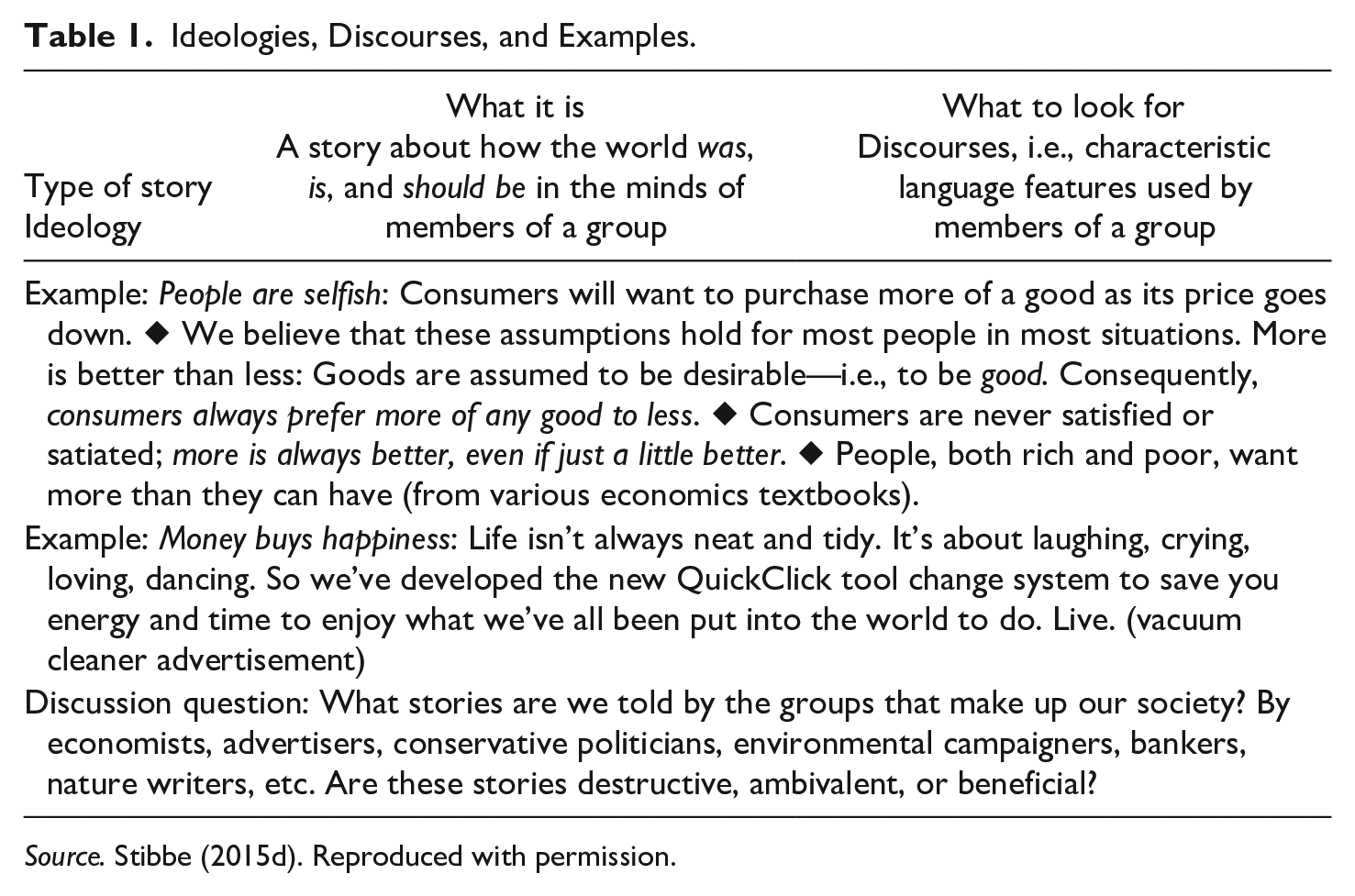
Source. Stibbe (2015d). Reproduced with permission.
Students received the following list of ecolinguistic features fromStibbe (2015a, p. 34) to look for, many of which had been studied earlier in the course:
Vocabulary (e.g., connotations of words, pronoun use, modals, e.g.,mightormust)
Relationships between words (e.g., synonymy, antonymy, or hyponymy)
Grammatical structures (e.g., active vs. passive, nominalization)
Transitivity (the arrangement of processes and participants in a clause)
Assumptions and presuppositions embedded in clauses
Relationships between clauses (e.g., reason, consequence, purpose)
How events are represented (e.g., abstractly or concretely)
How participants are represented (e.g., as individuals or an aggregated mass)
Intertextuality (patterns of borrowing from other texts)
Genres (conventional formats of texts that serve a social function)
Figures of speech (e.g., irony, metaphor, metonymy)
The instructor then explained how to interpret the analyses in relation to destructive, ambivalent, and beneficial discourses (Stibbe, 2015a).
In-class workshops were held so that students could work on their analyses with the instructor present to answer questions, facilitate discussion, and ask questions to encourage critical thinking. The instructor provided an analysis of examples selected from another section of the letters so that the students would have a model to work from when studying the discourse of the sustainability section. The instructor discussed the use of the actorwein the 2017 letter and the omission of any actor in the same part of the 2018 letter. We asked whether the absent actor could still be implicitly present in the text, and if so, who or what might it be? By analyzing these language choices and others, the instructor encouraged students to interpret the communicator’s possible intentions and ideologies that may have informed the text. For example, the inclusivewecould be interpreted as includingemployeesin the company’s success; the absence of any actor might mean that an implicit actor, the company, is responsible for these achievements and not the hardworking employees.
The second planning step consisted of showing students Audacity, a free, open-source digital audio editor and recording application software (https://www.audacityteam.org/). Using screenshots, the instructor explained the recording and editing tools, as well as how to cut and paste into another Audacity file to work on draft versions. Students then downloaded the software and practised recording a few sentences in class. However, students could choose a different software to record the podcasts, and since we were meeting on Zoom by that time, some teams organized a recording session on Zoom. The podcasts were framed as newscasts or investigative reporting with a panel of experts. In this way, students could assign roles to team members, such as business or economics expert, discourse analyst, socioeconomic context researcher, the program host, or audio editor.
The final step was a one- to two-page document consisting of team analyses with examples, outside socioeconomic research and the podcast introductory paragraph. Teams were quite creative when introducing their podcast, as in, Interested in becoming a successful CEO? This podcast is for you! The “Investigating The CEO” Podcast analyzes a CEO’s letter to their stockholders and their approach towards sustainability and corporate responsibility. We provide feedback, tips, and in-depth analysis for CEO’s. This episode we will be comparing two different PepsiCo CEOs in their letter to their stockholders. Listen to find out which letter was successful or unsuccessful in their deliveries.
Team analyses indicated that carrying out an ecolinguistic discourse analysis raised student awareness of corporate leaders’ linguistic choices when describing sustainability efforts. Furthermore, students demonstrated critical thinking skills by arguing that these choices reflected underlying ideologies that influence stakeholder perceptions of the organization’s commitment to sustainability. Verbatim examples are reproduced inTable 2.
Team Analyses of Sustainability Discourse.

Students also carried out more in-depth background research and included their sources in their written analyses. Using this research, they were able to discuss the wider socioeconomic context in which texts are embedded (Fairclough, 2003) and apply this knowledge to analyzing ideologies revealed by certain discursive features, for example, Laguarta has had multiple laid off employees come out and speak on how they were alerted to layoffs, and then kept for the extra month to train their own replacement in the coming weeks (Taylor, 2019). [citation from students] Laguarta also comes from a very intense business background and high hopes for this role as the new CEO (Cavale, 2018). [citation from students] He came from one of the most complex business divisions of Pepsi, which could explain why his language may have been more direct and concise. Indra had been in the position for a while with a lot more experiences and notes to highlight which is why hers may be more lengthy with deeper explanations.
After teams uploaded their podcast and text analysis to the discussion, each student was required to comment on two podcasts. The comments indicated that they were able to learn from other teams’ interpretations of conflicting values and ideologies conveyed by certain linguistic devices, as these excerpts illustrate: Furthermore, I liked your analysis of Laguarta’s use of gerunds throughout his letter compared to Nooyi’s use of more direct collaborative pronouns in her letter. I enjoyed the analysis of each CEO’s values, comparing Nooyi’s intrinsic values to Laguarta’s extrinsic values. I agree with you that Ramon is looking to help PepsiCo’s bottom line while Indra looks to further PepsiCo’s image by helping the public. It was very interesting how that in the 2018 article the CEO was only mentioning the word sustainability but was never giving actual proof on how the company is helping communities. He really thought that just having Pepsi in the world meant the world was a better place. I really enjoyed how you did not take his words at face value. Great job.
To sum up, this assignment benefits students in many ways. First, they learn how to examine the language used in two examples of leadership texts from an ecolinguistic discourse analytic perspective. They analyze language to reveal underlying beliefs and values and are able to compare the social agenda discourse of the two texts to provide a deeper understanding of language as social practice. Student learning was reinforced and scaffolded through research, discussions, and reconstructing information. Students built new digital skills using computer-based tools to tell stories and deliver content. And finally, students were very engaged in this project even though we were all meeting virtually!
Concluding Thoughts
This article sought to apply the online course in ecolinguistics proposed byStibbe (2015b)and the discourse analysis model proposed byDarics and Koller (2019)to a classroom activity to raise awareness of the discourse of sustainability in corporate texts. The first step is descriptive and allows researchers, students, and practitioners to gain a better understanding of modality and hedging, and abstract and concrete language, in addition to social actor representation in organizational texts. The next step is interpretative and enables the analyst, students, and practitioners to infer underlying ideologies, values, and beliefs, as well as the writer’s possible intentions. The final step analyses whether the underlying ideologies, values, and beliefs correspond to the analyst’s ecosophy.
In the two examples above, the communicators express somewhat different values. In the 2017 example, the communicator emphasizes a company as environmentally conscious with moral principles and values. The text achieves this goal by combining actions related to the food and beverage industry with actions to protect the planet. The analysis infers the wider belief system that sees companies concerned with the greater social good rather than simply as organizations producing goods and services and seeking profit. The analysis of the 2018 example, on the other hand, revealed that the communicator was less concerned about the environment, or at least less concerned about demonstrating the company’s responsibility to minimise ecological destruction. The text communicates that the company is a for-profit organization producing goods for consumers to purchase, thus increasing shareholder wealth.
Closer examination of the 2018 communicator’s possible intentions reveals that the discourse of sustainability is represented through vague language, hedging, and predictive modality that absolve the chairman of responsibility to stakeholders. The communicator’s responsibility is to shareholders and the language of sustainability is couched in terms of environmental programs that ensure the continued financial performance of the company. The efficiency-legitimacy dichotomy is revealed through the discursive juxtaposition of these two values. The linguistic representation of employees through objectivation, as well as using the collective pronoun to represent the chairman and his team as the main social actors, would seem to indicate exclusivity and concentrated power and authority at the top. Such a representation of employees as excluded may be unintended. Students could avoid such representations and interpretations with increased language awareness and better analytical skills to apply to future writing and speaking in professional contexts. In the text analysis presented here, students gained insights into the intended and unintended outcomes of certain linguistic choices. Using ecolinguistic discourse analysis, students were able to discover the underlying ideologies, values, and beliefs that influence a text, reflect on communication practices, and recognise how language features affect the communicator’s aims or the aims of the communication.
Since the discourse of sustainability addresses an organization’s social, environmental, and economic activities in response to all stakeholders, including nature and the natural environment, a discourse analytic approach can benefit teaching and learning about several aspects of sustainability embedded in organizational discourse. First, studying language and discourse in business and management courses is an effective way to focus on aspects of organizational communication that might not be noticed otherwise. Second, students can gain insights into organizational and economic processes using an approach that has practical outcomes. Third, a discourse analytic approach enables business and management students and professionals to become more aware of language, how it affects communication, and how these strategies can be used when communicating in organizational contexts. Finally, employing language and discourse analysis enables practitioners to raise student awareness of organizational communication practices and the role of language use as social practice. Students are then equipped to analyze texts more systematically, reflect on communication processes, improve their practice, and produce more impactful texts.
Footnotes
Declaration of Conflicting Interests
The author declared no potential conflicts of interest with respect to the research, authorship, and/or publication of this article.
Funding
The author disclosed receipt of the following financial support for the research, authorship, and/or publication of this article: This study was approved by the Institutional Review Board of Temple University (Approval No. 26136). Student comments are reproduced by permission.

Author Biography