



Abstract
Critical thinking and problem-solving are essential skills in management education. ChatGPT and other AI-assisted writing tools might disrupt conventional tools like essay writing and case-study analysis. The project incorporates bibliotherapy-inspired usage of ChatGPT and critical thinking and problem-solving frameworks to make students identify and solve real-life problems like social media addiction or time-management skills. ChatGPT is used as an assistant, coach, and/or motivator in the project. Students’ experiences are shared as blog posts. The impact of the project on developing critical thinking and problem-solving skills is measured by a post-and-then-pre survey questionnaire.
Introduction
Critical thinking skills have been considered as the essential core competencies to navigate personal and professional life (Skrzek-Lubasińska & Malik, 2023). Critical thinking skills create a basis for learning other crucial skills like languages (Abbasi & Izadpanah, 2018), problem-solving, creativity, and reflective ability (Liu et al., 2014). Management education focuses on developing critical thinking skills to equip managers to face the highly volatile and fast-moving business world (Gupta & Bamel, 2023). The pandemic affected consumer demands and broken supply chains (De Vito & Gómez, 2020). The effects of this crisis are more long-lasting than previous critical events like the Spanish Flu (1918), as the COVID-19 pandemic occurred in a truly global and interconnected world (Ozili & Arun, 2020). The overnight changes in life in general and standard business practices in particular resulted in COVID-19-related uncertainty (Szczygielski et al., 2022). Even in a world without any pandemic, business managers and leaders are required to solve complex business problems in an uncertain world, keep pace with the changes by fueling innovation, and manage shifting goalposts (Rast & Hogg, 2016). Ever since the 2008 global crisis, uncertainty has been on the rise due to political fragmentation or pandemic (Bloom et al., 2023). Apart from these incidental and crisis or situation-based uncertainty, other economic and social aspects like rural-to-urban migration (Mak et al., 2021), aging population (Schneider & Langen, 2021), and income disparity and radicalization in politics (Engler & Weisstanner, 2021) also necessitate a change in business strategies. To navigate through the rise in uncertainty in the postpandemic business world, managers need to learn to identify issues, gather relevant and credible information, explore workable options, and apply them with the help of critical thinking skills (Calma & Davies, 2020). To sustain businesses in a socially and economically changing world, critical thinking is one of the vital skills required in future managers and leaders (Skrzek-Lubasinka & Malik, 2023; WEF, 2020).
Management educators either include a dedicated course on critical thinking skills or teach critical thinking through other courses like business writing, strategic management, etc. (Samaras et al., 2022; D. Sharma, 2021). In various management courses and assessment components, critical thinking skills become an integral part of managerial problem-solving and decision-making processes. Pedagogical tools like in-class discussions or debates, or assessment components like group projects, open-book and open-ended examinations, worksheets, exercises, etc. aim to develop critical thinking skills (Bandyopadhyay & Szostek, 2019). Essay writing is another tool to test students’ critical thinking skills (Hammer & Griffiths, 2015). Writing essays becomes a form of expressing critical thinking abilities and processes (Dixon et al., 2005; Goatly, 2000). Several empirical studies like Afshar et al. (2017) and Sharadgah et al. (2018) suggest a statistically significant correlation between critical thinking skills and essay writing abilities. Another prominent tool for developing critical thinking skills in management education is case studies. Case studies provide management students with opportunities to become active learners and reflect upon complex situations. It allows students to be skeptical, and flexible, and debate the most useful alternative (Herreid, 2011). Case-based teaching fosters problem-solving and decision-making skills that lead to improved critical thinking skills (Crespy et al., 1999; Klebba & Hamilton, 2007). However, students do not learn the actual implementation of the alternatives they ideate in a case study, nor do they face the consequences of their decisions (McCarthy & McCarthy, 2006). Hence, computer-based simulations as experiential learning activities are used to foster critical thinking skills as well as managerial domain knowledge (Poisson de Haro & Turgut, 2012). Unlike case studies, in these simulations, the students can implement their decisions and critically analyze the consequences of each action.
Through various pedagogical and assessment tools, faculty facilitate the process of developing critical thinking skills wherein students gather and validate information, formulate arguments and alternatives, synthesize, and form conclusions, and present them orally or in writing. However, artificial intelligence tools like ChatGPT can potentially disrupt this process. Based on natural language processing and artificial intelligence, ChatGPT takes users’ inputs in natural language and gives highly human-like text responses in a matter of seconds (Caldarini et al., 2022; Wang et al., 2023). This ability to produce human-like text responses is advantageous as it can be used to create first drafts of business texts (Davenport & Nitin, 2023) as well as disadvantageous as it has the potential to propagate academic dishonesty and cheating in assignments where written submission is required like case studies and essay writing (Dehouche, 2021; Tlili et al., 2023). In a recent study about the impact of AI tools on writing skills, about 75% of business communication instructors stated that these AI tools might hamper the development of critical and creative thinking skills in the context of writing skills (Cardon et al., 2023). Fundamentally, these two tools are primarily used to make students think critically about a topic (essay) or a business problem/situation (case study). However, ChatGPT can write a standard essay on any given topic within seconds, and it can analyze any case with proper answers and recommendations (Cotton et al., 2023; Rudolph et al., 2023). An increasing number of students are relying on ChatGPT to write their essays, case-study analysis, and other such hand-in projects (Anderson et al., 2023; Arif et al., 2023). ChatGPT does all the background research on a given topic and forms coherent and elegant sentences and paragraphs in the form of essays. Many institutions have or are in the process of banning ChatGPT and other such AI tools as they deprive students of developing prominent critical thinking skills like researching, analyzing, and expressing (Cotton et al., 2023; Nolan, 2023). Plagiarism-checking software also offers AI-assisted writing detection. These efforts stem from research studies that report that the dishonest usage of ChatGPT may hamper the process of developing critical thinking skills in students (Sun & Hoelscher, 2023; Zhu et al., 2023). Another potential risk related to the unmindful use of generative AI and ChatGPT by the students is not understanding the hallucination tendency of these AI tools. Bang et al. (2023) term ChatGPT “a lazy reasoner” that might hallucinate and hastily give false arguments to prove its point. Experiments found that generative AI can make up 3% to 27% of facts to support its arguments (Metz, 2023). Since a major source of information for generative AI is the Internet and webpages, and false information is also available on the Internet, sometimes, these generative AI tools can use this false information to prove their points (Metz, 2023). Even OpenAI, the firm that introduced ChatGPT, is mindful of AI-based plagiarism or “AIgiarism” (Hern, 2022) and is looking forward to making it difficult to submit AI-generated text as human-generated text (Aaronson, 2022) by creating tools like AI classifiers (Kirchner et al., 2023).
However, despite all these efforts, the students are still finding ways and means to use ChatGPT to write essays and analyze case studies (Lim et al., 2023). In this context, the present article discusses a project that fosters critical thinking and problem-solving skills in a manner that purposefully uses ChatGPT, yet successfully develops students’ critical thinking and problem-solving skills. The project incorporates bibliotherapy-inspired usage of ChatGPT and critical thinking and problem-solving frameworks to make students identify and solve a real-life problem (e.g., social media addiction or time management skills). The students follow critical thinking steps given in the framework by Paul and Elder (2019) and resolve a real-life problem. They share their experiences in the form of blog posts. The impact of the project on developing critical thinking and problem-solving skills is measured by a post-and-then-pre survey questionnaire. The rest of the article discusses the literature on critical thinking skills in the context of ChatGPT. Further, methodology, results, and discussions are presented. The article ends with implications for faculty members, future research scope, and conclusion.
Literature Review
Critical Thinking and ChatGPT
Critical thinking is one of the most essential human skills that allows us to process, analyze, and evaluate situations and resolve problems. Critically analyzing a situation or a problem requires concentrated, controlled, and logical thinking that leads to actionable and implementable comprehension and solutions (Calma & Cotronei-Baird, 2021; Smith 2003). Critical thinking has been defined in several ways in extant literature (Davies & Barnett 2015). It is defined as a tool to assess statements (Ennis, 1962) and as a skill to be reflectively skeptical (McPeck, 1981). Thinking critically also means developing an acumen to think logically and systematically to solve problems (Mayer & Goodchild, 1990), or to confirm or refute a line of thought or arguments (Moore, 2011). One of the most used definitions of critical thinking has been given by Ennis (1996) where it is defined as “reasonable reflective thinking focused on deciding what to believe or do (p. xvii).” Here being reasonable refers to the fact that one must follow a logical sequence of thinking instead of being random or absurdist. Being reflective refers to pondering over one’s thinking process and being metacognitive instead of being purely instinctual. Finally, the decision or result of critical thinking must lead to some action or opinion formation. Thinking critically must end with an actionable or implementable conclusion.
In several industry-led studies, critical thinking and problem-solving are the most often cited skills that need to be focused on in the present times (McKinsey, 2021, 2022; Melnichuk, 2022). For tackling challenges of the 21st century like environmental degradation, critical thinking has been considered as a key skill by bodies like UNESCO to achieve SDGs (Straková & Cimermanova, 2018). In b-schools and management education, teaching critical thinking is essential as it helps future managers in processing and evaluating information and making managerial decisions (Smith, 2003). Since managers grapple with highly volatile and complex real-world problems, critical thinking skills enable them to navigate the business world with logical and systematic thinking (Mingers, 2015). Critical thinking also helps future managers to make decisions when they face environmental and/or ethical conflicts, for example, profitability vs sustainability (Hummel et al. 2018). Overall, incorporating critical thinking skills in management education equips students with better managerial decision-making skills, which can lead to easy absorption of students by the industry (Bloch & Spataro, 2014; Carr et al., 2018).
Peer discussions, debates, and case study analyses are some pedagogical tools that can foster critical thinking skills. Future managers can be assisted in thinking critically about business problems through group projects, simulations, and open-book examinations. At the managerial skills and management courses level, critical thinking has been associated with strategic management (Casey & Goldman, 2010), business negotiations and arbitration Page and Mukherjee (2007), team management and business leadership (Garcia, 2009), managerial problem solving (Quigley, 2013), selling and marketing skills Clabaugh et al. (1995), and business transformation (E. Sharma & Sharma, 2018). Various pedagogical and assessment techniques are used to impart and hone critical thinking skills (Snyder & Snyder, 2008). Simulations and case studies are used prominently to make students comprehend and resolve real-life business scenarios with the help of critical thinking skills (Kennedy, 2007; Roy & Macchiette, 2005; Samaras et al., 2021). Consulting projects and real-life business scenarios are also used to foster critical thinking skills (Cloete, 2018). In terms of assessing critical thinking skills, several instruments like the California Critical Thinking Skills Test (Facione, 1990) and the Halpern Critical Thinking Assessment (Butler et al., 2012) have been developed. Researchers have experimented with Bloom’s Taxonomy and pedagogical tools like business case studies to assess critical thinking skills (Dwyer et al., 2014; Nkhoma et al., 2017). Capturing perceptions through a survey is another tool used to assess critical thinking (Wilkin, 2017).
Specifically in business education, critical thinking has been considered an integral part of the business communication domain among other domains. Formulating strong arguments based on the analysis of the provided information or the given situation is a vital aspect of oral and written communication (Dyrud & Worley, 1998; Hill et al., 2011; Sharma & Pankaj, 2022). Gathering relevant information, analyzing the information, situation, and/or the audience, and formulating strategies to communicate one’s ideas effectively are key components of communication as well as critical thinking (Bean, 1996; Bloch & Spataro, 2014). Morrison (2017) explores the usage of genre theory in a business communication (writing) course to develop critical thinking skills in the form of transferring classroom learning to business contexts. Various innovative practices like incorporating a client-based consulting project (Muir, 1996), a merger and acquisition exercise (Paulson, 2011), a memo-writing assignment for finance majors (Carrithers & Bean, 2008), or reading and analyzing business journals (Roever, 1998) are devised in the context of critical thinking in business communication. The most recent survey by Moshiri and Cardon (2020) reported that critical thinking is highly prioritized by communication faculty in their teaching and assessment of business communication skills. Given the importance of critical thinking in the business communication domain, a special issue was published in 2014 focusing on teaching and assessing critical thinking skills in the context of business communication (Knight, 2014).
Despite these efforts to teach and assess critical thinking skills, researchers acknowledge that teaching and assessing critical thinking skills is a complex and daunting task (Calma & Cotronei-Baird, 2021; Peach et al., 2007). The most recent literature review by Calma and Davies (2020) also asks for further research in teaching and assessing critical thinking in the business context and links it with real-life problem-solving. In this regard, the present research discusses a project that fosters critical thinking and problem-solving skills with the help of critical thinking frameworks and bibliotherapy-inspired use of ChatGPT.
Bibliotherapy-Inspired Use of ChatGPT
Bibliotherapy refers to therapeutically using books (biblio) with or without professional psychological counseling and assistance. Bibliotherapy can foster creativity, positivity, and improved mental health (Mazza, 1987). It can improve oral and written communication (Branco, 2001). Bibliotherapy assists the process of mental, emotional, and/or physical change in youngsters (Lucas et al., 2019). In the academic context also, bibliotherapy-based interventions are conducted at school and college levels (Prater et al., 2006). Bibliotherapy can improve emotional well-being (Forgan, 2002), develop self-regulating habits like time management (D. Sharma, 2022d), and initiate career orientation (Eliasa & Iswanti, 2014).
However, bibliotherapy does not consist of only reading books. It is also a well-structured mechanism of initiating and conducting meaningful conversations about self-improvement with self and others. The text of the book facilitates the process of the conversation with self and others in a reflective manner. Here, instead of a book, ChatGPT has been used as the text that initiates the conversation on self-improvement and acts as the platform for reflection and feedback. ChatGPT is a text-generative artificial intelligence tool that can analyze, synthesize, and compress millions of books, research articles, websites, and other forms of text/data to provide summarized information. It acts as a conversation or “chat” where users can converse with it and get answers to their questions and cross-questions. As an assistant, it can be used to write emails, essays, promotional content (brochures, leaflets, etc.), and business reports that are highly indistinguishable from texts generated by humans (Abdullah et al., 2022). As a coach or mentor, it can be used to provide an outline or ideas for writing a text, or suggestions or recommendations to complete a complex task (Zhu et al., 2023).
For example, in our case, instead of reading one book on time management skills like Eat That Frog, one can ask for the summary of the three best books on time management skills from ChatGPT. Further, one can keep on asking questions in the same conversation thread about some specific aspects or techniques of time management skills provided in the summary by ChatGPT. One can ask further related questions like why do people generally fail to adhere to their to-do lists, or what are some precautions one must take when they are planning to manage their time better. Additionally, ChatGPT can also aid the students in implementing the critical thinking frameworks. Using ChatGPT, students can explore numerous books, research articles, websites, and other sources in a detailed manner and comprehensively understand the topic. Similarly, one can use ChatGPT to visualize, question, and observe the problem, its causes, and probable solutions. By continuously conversing with ChatGPT, one can analyze and synthesize the information to form an action plan. At the evaluation stage of the critical thinking framework also, ChatGPT can act as a feedback mechanism wherein one can adjust their action plan according to their implementation experience. In this way, the present research explores how ChatGPT can be used as a substitute for books and as an assistant to think critically in self-improvement projects.
Methodology
Action Research
Aiming to foster critical thinking skills, the instructor conceptualized an innovative self-improvement project based on bibliotherapy-inspired usage of ChatGPT using action research methodology. Previously, action research has been conducted to improve professional business communication skills offline (D. Sharma, 2022b, 2023) as well as in online contexts (D. Sharma, 2022a, 2022c). Here we focus on fostering critical thinking skills with the help of bibliotherapy-based ChatGPT usage. The impact of the intervention was measured by actual changes in the habits and behaviors of the students that they shared in the form of a blog post for the class’s blog and orally in the form of class discussions. Additionally, statements were created based on the critical thinking framework by Paul and Elder (2019). The participants rated their critical thinking skills on a scale of 1-5, where 1 denotes strongly disagree and 5 denotes strongly agree. Additionally, the confidence and skillfulness in using ChatGPT as a coach and assistant were also measured with statements based on previous research (Getchell et al., 2022). A post-and-then-pre design was used to capture the effectiveness of the intervention as this design mitigates the bias and sensitivity of pretest designs (Howard, 1980; Russ & Drury-Grogan, 2013). At the end of the intervention, first, the participants reflected upon their present status of critical thinking skills and the confidence and dexterity in using ChatGPT as a coach and assistant. Then we recorded their perception of the same statements assuming they had not participated in this intervention. The two scores of the post-and-then-pre design were measured with a paired-sample t test. The survey data were collected after the completion of the course and the project in the final session of the course. The blog posts were submitted as a part of the course assignment before the final session of the course. The final session was also used as an oral reflective session where students reflected upon their experiences and learnings from the project.
Participants and the Context
The intervention was run in a trimester I Post Graduate Diploma in Management program as a part of the business and professional communication course “Critical Reading and Writing.” It was a 30-hour on-campus course in an AACSB-affiliated b-school in India. Overall, the course aimed at fostering critical reading and writing skills in the students. The self-improvement project that fostered critical thinking skills was one of the assessment projects carrying 30% marks. The participants (n = 122) had completed the undergraduation from various streams (science = 27, commerce = 64, arts = 10, technology = 14, others = 7), aged between 20 and 24 years, and almost equally distributed in terms of gender (48% females, 52% males). The research board approved the project. Due consent of the students was taken to include their data in the research study.
Project
A project was developed to foster critical thinking and problem-solving skills in the management students. At the initial stage, the students participated in a brainstorming session wherein they identified a problem in their personal life that they wanted to solve with the help of critical thinking skills (Table 1). The most common problems identified by the students in their personal lives were social media addiction (n = 54), time management (n = 38), and the lack of public speaking skills (n = 31). We discussed the importance of critical thinking and various aspects of problem-solving skills with the help of pre-reads and discussions in the classroom in session 2 of the course. The students were divided into groups of 6 and were assigned a pre-read. The students were to give a short presentation of 3-4 minutes on the relevance and importance of critical thinking and problem-solving skills in personal and professional lives based on the preread and general research on the Internet. The prereads were taken from sources like Harward Business Review and Forbes.
Use of Bibliotherapy-Inspired ChatGPT at Various Steps of Critical Thinking Framework.

Note. All workshops and the reflective session were conducted in consecutive weeks for 5 weeks. The course was run for 10 weeks and had 20 sessions of 90 minutes each. The overall assessment scheme of the course was this project with ChatGPT (40% marks of the total course), a business magazine cover story analysis (40% marks), and an analysis of a business letter to shareholders by the CEO (20% marks). The rubrics of the assessment are given in Annexure 1.
Further, the students were introduced to Paul and Elder’s (2019) framework in the classroom. The students were asked to apply the six steps of the critical thinking framework to solving their problem. For various steps of the framework, the students were encouraged to take the help of text-generating AI, ChatGPT. However, before the students could start using ChatGPT, as a prerequisite, the students were asked to complete a MOOC course on the use of ChatGPT ethically and professionally on LinkedIn Learning. LinkedIn Learning access was provided to all the students. Once all students completed the course, a discussion session was conducted to clarify doubts and discuss concerns of the students regarding ChatGPT and its usage.
The first step of the framework is “Knowledge,” focused on building a knowledge base about the main problem. In a conventional bibliotherapy intervention, participants are asked to read a book or some literature on the topic. For this project, the students were encouraged to use ChatGPT. However, before the students could start using ChatGPT from a bibliotherapy perspective, they were introduced to bibliotherapy as a tool to resolve personal and professional problems. The students were given seminal research papers to read. By reading these papers, the students got a sense of how bibliotherapy is used in various contexts to understand the problems one faces in life and resolve them. With this conceptual knowledge of the bibliotherapy processes the students conversed meaningfully with ChatGPT by asking questions like which the most useful books are to manage time or what existing research and literature say about social media addiction. From this starting point, the students inquired further about the problem they wanted to resolve. Using ChatGPT, the students read summaries of books like 7 Habits of Highly Effective People (Covey, 2015), Eat That Frog (Tracy, 2017), and Why Social Media Is Ruining Your Life (Ormerod, 2018). The second step of the critical thinking framework is “Comprehension.” An in-depth understanding of all aspects of the problem is required to critically analyze it. Here the students were introduced to different strategies to converse with ChatGPT, which they used according to their needs. Using ChatGPT, the students summarized the latest research in psychology and social sciences about their problems. The students inquired about different perspectives on how to resolve the problem. They comprehended the problem and its possible solutions from various perspectives as how a sportsperson would resolve a time management problem. They asked ChatGPT to give a perspective of their ideal persons (e.g., a Hollywood celebrity or a sportsperson) on the problem they are facing. The next two steps of the critical thinking framework are “Application” and “Analysis.” Using various creative and innovative prompts the students analyzed the problem they were facing. Empowered with the analysis they have done on the problem and its various aspects; they listed all possible solutions to resolve the problem. The next step was “Synthesis,” where an actionable plan from the list of all possible solutions. These 5 steps were covered in a 3-hour workshop as a part of their business communication course.
The final step of the critical thinking framework is “Evaluate,” where one tests the solutions to the problem one has chosen after careful thinking and analysis. The students get 1 week to implement the action plan they devised in the workshop by conversing with ChatGPT. Some aspects of the action plan were to make “To-do lists,” “Lock the phone in a drawer for the entire evening and night,” or “read a text for 15 minutes in front of a mirror.” They were asked to share their experiences with ChatGPT. If the students were able to achieve their daily goal, they would share it with ChatGPT and ask for further motivation. If the students completely or partially failed to achieve their daily target, they were to share this with ChatGPT and ask for strategies to improve their performance. At this stage, the students were also advised to use their critical thinking skills and analyze the information/response provided by ChatGPT. They had options to discuss their issues with the course instructor or the campus counselor. The students recorded their progress and experience in a daily log and shared it with the course instructor.
The experiences of the students were shared in another workshop after the implementation week. The students were asked to write their experiences in the form of a blog post. The broad outline of the blog post was the narrating of the critical thinking framework experienced by the students to resolve a problem, the assistance they got from ChatGPT, the challenges of implementing the plan, and any suggestions or advice they would want to give to people who are trying to resolve the same problem (i.e., time management, social media addiction, etc.). The outcomes of the project are discussed in the next section.
Outcomes of the Project
In another workshop after the implementation week, the students shared their experiences. Most of the students (83%) were able to achieve their daily goals throughout the week. Eleven percent of the students could complete the daily tasks for 3-4 days only, and 6% of the students followed the implementation plan for the first day only. Just 8% of the students contacted either the instructor or the campus counselor to discuss the challenges they faced in following the implementation plan. The students shared their experiences orally in the workshop. As a part of the project, the students were required to write a 1000-1500-word blog post for the class’s blog. A general format of the blog post was the 5W and 1H: why, where, when, what, who, and how did you go through this experience?
Orally and through blog posts, the students shared how they used the critical thinking framework and ChatGPT to resolve life problems. Commonly, ChatGPT summarized popular books and the latest psychological studies on the problem. ChatGPT asks the students to acknowledge the problem, share it with the people closer to them like friends or parents, make a to-do list with achievable daily goals, practice mindfulness, etc. Specifically, for social media addiction, the students were asked to unfollow unproductive pages, limit notifications on their smartphones, and do creative and physical activities like taking a walk, etc. For public speaking, ChatGPT suggests students record their speeches and listen, do short courses on online platforms, and listen to public speaking presentations like TED videos. For time management, some of the steps suggested are prioritizing, setting time limits for certain tasks, and using productivity techniques. Students explored and probed further about the steps and techniques suggested by asking further questions from ChatGPT. For example, when ChatGPT suggested productivity techniques to social media addicts or students with time management issues, the students asked ChatGPT to give more details about productivity techniques. The students further inquired about specific productivity techniques like the Pomodoro Technique, time-blocking, or the Eisenhower Matrix and how to utilize them in their specific context.
Additionally, at the implementation stage, the students used ChatGPT to help them follow the action plan daily. Initially, when the students faced a challenge in following the action plan, they shared their experiences and feelings with ChatGPT and asked for help. Sometimes, the students lacked clarity of the concepts, techniques, and strategies. The students then asked for further examples of the concepts to achieve clarity and understanding. Sometimes, the students felt that they had made very ambitious action plans and they requested ChatGPT to reset and readjust the action plan in their context. In some cases, even when the students were able to complete their daily tasks, they turned to ChatGPT to increase their goals and looked for further motivation. Overall, the students used ChatGPT as an assistant and a coach to help them at every stage of the application of a critical thinking framework to overcome their issues.
Additionally, the analysis of the blog post and the classroom discussions revealed the project focused on several aspects of critical thinking and problem-solving skills. Some prominent skills focused on by the project are given in Figure 1. Mainly, the students get to visualize their future and observe their present selves to identify a learning gap or a personal problem that can hamper their future accomplishments. They practiced research and knowledge-building skills to first personalize and contextualize the goals and then to identify the steps to achieve their goal. They learn how to experiment and reflect on their daily tasks and achievements. Finally, as students share their experiences in the form of blogs, they learn how to engage the audience by telling a personal story. As the students share the link of their blog posts on their own social media accounts (LinkedIn, Instagram, etc.), the intended audience is primarily their connections on these platforms, which can include their professional connections as well as their peers. In sum, the project created several opportunities for the students to practice and learn various aspects of critical thinking and problem-solving skills.
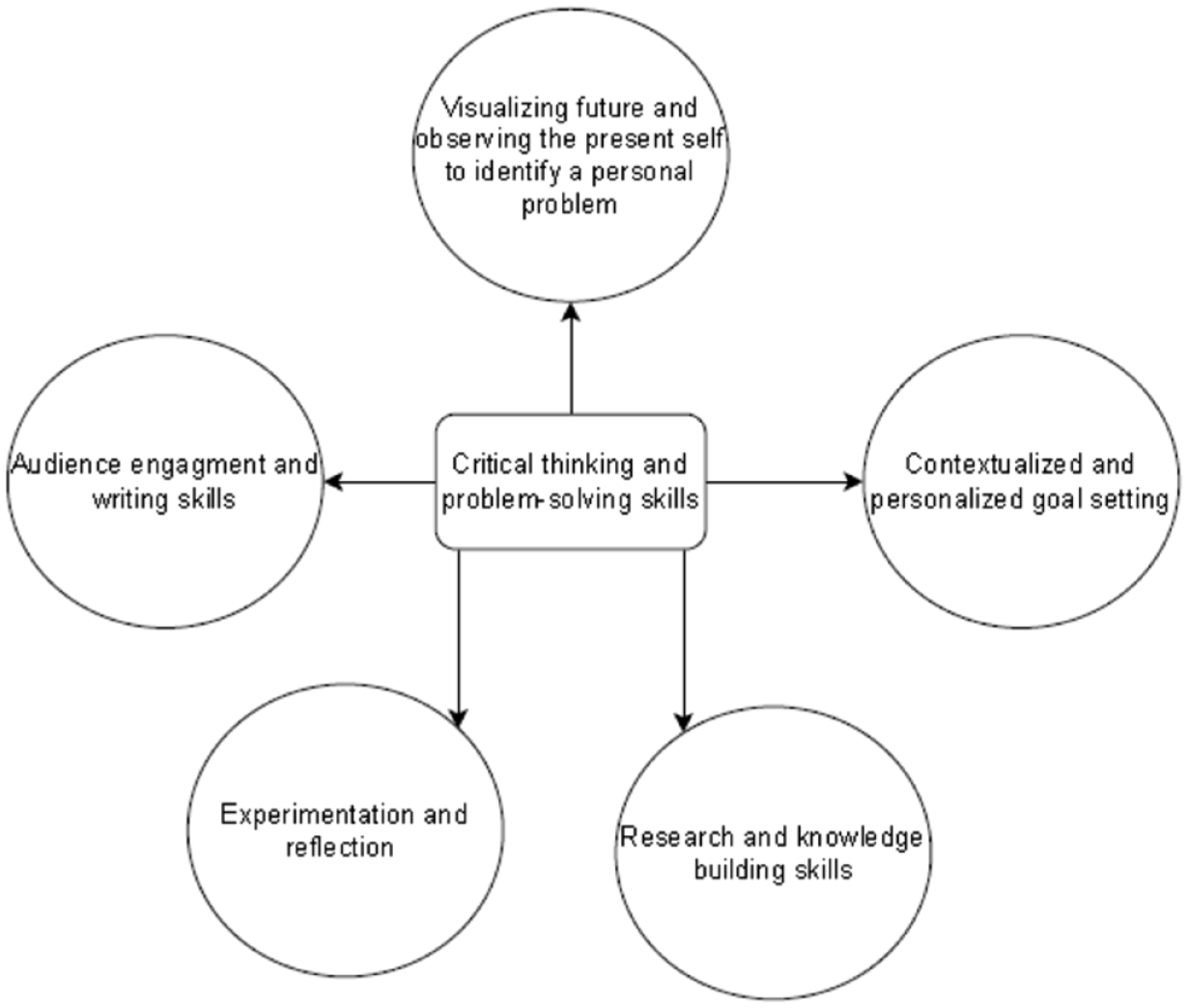
Various critical thinking and problem-solving skills targeted in the project.
Post-and-Then-Pre Survey Results and Overall Impact of the Intervention
The difference in students’ perception of competency and understanding of applying critical thinking skills and using ChatGPT as a coach and assistant is shown in Table 2. The critical value of t = 2.3576 is lower than the t value for all statements at the 0.01 significance level.
Posttest and Pretest Scores of Students’ Perceptions of Understanding and Competency of Using Critical Thinking Skills/Framework and ChatGPT as an Assistant and a Coach.

After using ChatGPT and critical thinking frameworks, the students realized the importance of critical thinking skills and felt competent in applying critical thinking frameworks to solve problems in their professional and personal lives. By thinking critically and using ChatGPT as an assistant and a coach, in 1 week, the students made considerable progress in their respective issues. With the help of ChatGPT, the students set daily goals and developed a personalized mechanism to track their progress daily. About 80% of the students were able to do the predecided activities with better time management skills. The social media addiction group was able to reduce their screen time by 60% to 70%, bringing it from an average of 4-5 hours to 1.5-2.5 hours. Similarly, students facing problems with public speaking shared that they gave a speech of 3-5 minutes in formal settings like classrooms or campus club activities or informal settings like campus café or playgrounds. About 80% of students said that they will continue to follow the critical thinking framework and ChatGPT to improve their performance in their respective areas.
The experience also made the students competent in using ChatGPT as an idea generator and as a feedback tool. The students comprehended the process of conversing meaningfully with ChatGPT for a specific purpose. Some students shared in the classroom discussion that they started using ChatGPT to generate ideas and build a knowledge base for other projects and subjects. The students appreciated ChatGPT’s capacity to analyze the information from different perspectives and summarize the information in a useful manner. One specific use of ChatGPT that the students mentioned to continue to use was to get feedback on their work.
Implications for Faculty Members
The faculty members who would try to foster critical thinking by implementing the project discussed in this article can keep the following implications in mind for better understanding.
Self-directed and self-governed process of learning critical thinking skills: The project conceptualizes critical thinking skills as highly individualized skills that can be learned in a self-directed and self-governed process. The literature discussed in the article highlights that critical thinking is a complex skill and teaching and assessing is difficult and different from teaching and assessing hard skills like finance or Microsoft Excel. As the project asks students to focus on self-development and personal problem solving, the students must navigate through the critical thinking and problem-solving skills on their own. Although the project provides a standard process, stages, and rubrics for the students to follow, their self-development journey can have individual struggles and paces. In comparison to other tools for improving critical thinking and problem-solving skills like simulations and case studies, this project provides an opportunity to solve real-life and personal problems of the students. The faculty must consider this aspect of the project. The students must be provided with choice and flexibility to truly grasp the various facets of critical thinking and problem-solving skills. The students can choose an aspect (a skill or a habit) of their personal life that they want to improve or modify. The students can make a combination of two skills or habits like time management and less use of social media, or time management and improvement of public speaking skills. The faculty needs to consider this flexibility and choice and work more as a facilitator than a process owner in this project. By doing this, the faculty can also increase the engagement level and build ownership of the process among the students.
ChatGPT and ethics: In the times when there are mixed views about text-generative tools like ChatGPT in the academic world and where some academic institutions are banning ChatGPT, asking students to use ChatGPT in the class itself might surprise the students. In this project, when students are asked to use ChatGPT to build knowledge and comprehend the problem from various perspectives to create a to-do list, some students ask for a to-do list in the first ChatGPT prompt itself. The student asked that when the conversation with ChatGPT aims to make a to-do list, why should one build a knowledge base first? Here, students were tempted to use ChatGPT as a quick fix instead of an assistant in the process of comprehending the problem. The faculty must consider this aspect of the use of ChatGPT and prepare accordingly. While discussing the critical thinking framework itself, the faculty must highlight the importance of building knowledge and understanding of the problem and its linkage with the synthesis and evaluation stage. A to-do list created by ChatGPT would be very difficult to follow if it is not contextualized and personalized by the students at the synthesis stage. It can be done only when they build a strong knowledge base about the problem. Instead of using ChatGPT as a shortcut, the students can be encouraged to visualize themselves in a library where a dedicated assistant is reading and summarizing books and research papers for them. When guided in this manner, the students start using ChatGPT more comprehensively and ethically instead of using it as a tool to cut corners. Additionally, when students understood the importance of knowledge building, they explored webpages, YouTube, and even physical books suggested by ChatGPT.
Bibliotherapy—creating a circle of assistance and counseling: The project uses bibliotherapy as a theoretical framework to make the students learn and experience critical thinking and problem-solving skills. In this project, the text of the bibliotherapy process comes from ChatGPT in the form of summaries and cross-questions based on books, research studies, and experts. Furthermore, the students also used ChatGPT as a feedback tool where students shared their successes or challenges in following the implementation plan with ChatGPT and asked for change/modification in their implementation or further motivation. It also counseled the students and suggested techniques and steps like “being kind to self,” “focusing on the purpose of doing this project,” and “setting realistic expectations,” etc. In this aspect, although ChatGPT functioned as a coach and mentor, the faculty must create other communication channels for the students as a support system. First, the faculty can create a student peer group and encourage students to talk to their classmates in informal settings about the challenges they face in implementing the plan. Second, the faculty can discuss students’ problems during the faculty’s consultation hours. The faculty can also remain available via email or short-message services like WhatsApp according to the context. A message group can be created on WhatsApp, Google Chats, Telegram, etc. to share the challenges and success stories. Finally, if a psychological counselor is available on campus, the faculty must share the details of the project with them. The faculty can inform the students that they can take the help of the counselor in extreme cases.
ChatGPT’s hallucinations and Critical thinking skills: Another aspect of ChatGPT that can be used as an opportunity to foster critical thinking skills is the hallucination of ChatGPT. Sometimes, ChatGPT can give very wrong and incorrect answers in a very professional and formal language (Farrokhnia et al., 2023). In this context, the students are asked to be conscious of the limitations of ChatGPT and use their analytical skills to decide whether they need to cross-verify the information provided by ChatGPT with other sources like books, Google, etc.
Limitations and Future Research Scope
ChatGPT is a recent technology, and its impact is still being studied in various contexts. Although the post-and-then-pre survey reveals the positive impact of the project, the study has been conducted in a limited context. Educators from various streams like management, science, etc. can design and reflect upon similar learning activities and projects that use critical thinking and problem-solving skills to solve business problems with the help of generative AI assistants. Courses and domains like entrepreneurship and design thinking can also benefit by making students use generative AI assistants to conceptualize and resolve real-life business problems. Further, using qualitative research methods like focus-group discussions, interviews, and case study in-depth understanding of the process of developing critical thinking skills through such projects can be developed. Additionally, comparative studies with controlled and experimental groups can be conducted to validate the findings of the present study.
Conclusion
Critical thinking and problem solving are essential skills in the 21st century. Business education experts advocate teaching these skills in various forms and contexts. Essay writing, case studies, simulations, etc. are prominent pedagogical tools to develop these skills. However, with the introduction of AI-assisted writing tools like ChatGPT, these conventional tools might become less effective. In this context, the present article uses bibliotherapy-inspired ChatGPT and the critical thinking framework by Paul and Elder (2019) to foster these skills. The students identify a learning gap in their personal-professional life like social media addiction, time management skills, etc. They use ChatGPT as an assistant, coach, and/or motivator at various stages. The analyses of the post-and-then-pre survey questionnaire reveal that the students gained confidence in applying critical thinking framework and skills in solving a real-life problem. The students also understood an ethical and productive way of using ChatGPT as an assistant and a coach. Management educators need to be inclusive and invent ways and means to include real-world technologies in their teaching-learning process. These initiatives will equip future managers with the desired skills and attitude required to excel in the highly complex and volatile business world.
Rubrics Used to Assess the Project.

Footnotes
Declaration of Conflicting Interests
The author declared no potential conflicts of interest with respect to the research, authorship, and/or publication of this article.
Funding
The author received no financial support for the research, authorship, and/or publication of this article.
