



Abstract
This study employs a quantitative content analysis to investigate how reputation-restoring crisis responses (i.e., denial, diminishment, and apology) from organizations and public figures are verbalized. In addition, this study examines if distinct crisis response strategies are systematically associated with particular language categories (i.e., language abstraction, uncertain language, passive voice, and emotional language). By analyzing 179 audiovisual crisis messages (e.g., press conference broadcasts, television interviews, social media videos), this study shows that denials are generally expressed in the most concrete way (i.e., precise numbers), diminish strategies in the most uncertain way (i.e., hedges), and apologies are the most emotionally charged, primarily referring to the emotions of sadness and shame. These findings highlight the significant role of language in crisis communication and help practitioners in the field to become aware of key linguistic features that could influence the effectiveness of a crisis message.
Crises are unpredictable events that can seriously impact organizations as well as public figures and can have detrimental effects on human safety, reputations, and financial stability (Coombs, 2015). Crises disrupt the relationship between the party involved in the crisis and its stakeholders, demanding effective crisis communication efforts to restore this harm (Bundy et al., 2017; Coombs, 2007). There is an extensive body of research in the fields of management, organizational communication, and public relations on how organizations and public figures should respond to crises in order to protect or repair their reputation (Avery et al., 2010; Bundy & Pfarrer, 2015). Established theories, such as image repair theory (IRT; Benoit, 1997) and situational crisis communication theory (SCCT; Coombs, 2002, 2007), have categorized the response strategies that individuals or organizations in crisis can adopt (e.g., denial and apology) and developed frameworks to understand their impact on reputational outcomes. Several experimental studies have tested these theoretical assumptions and provided an empirical foundation regarding the potential effects of distinct crisis response strategies (e.g., Claeys et al., 2010; Kiambi & Shafer, 2016).
Each single crisis response strategy, however, can be formulated in multiple ways (Bentley, 2017; Zhou et al., 2022). Distinct strategies can entail a variety of elements, for instance, apologies can consist of elements such as responsibility acceptance, remorse expression, promising forbearance, or offering reparations (Bentley, 2015; Bisel & Messersmith, 2012). By including or excluding certain elements, the same strategy can bring about different effects (Bentley & Ma, 2020). Experimental research in crisis communication has manipulated the same crisis response strategies in various ways (Zhou et al., 2022), potentially resulting in different outcomes. For example, an apology is perceived as more remorseful when intensified with an adverb (e.g., “We are very sorry”) compared to a simple apology without an intensifying adverb (e.g., “We are sorry”; Georgiadou, 2023). The importance of looking beyond the overall strategy, and considering the formulation as well, is therefore becoming increasingly evident. When we consider the formulation of crisis response strategies, however, we should also consider the role of language (Clementson & Page, 2021; Zhang & Borden, 2023). Recent studies have established that emotional language (emotional vs. rational language; Schoofs & Claeys, 2021), language abstraction (concrete vs. abstract language; Zhang & Borden, 2023), and verb voice (active vs. passive voice; Fannes & Claeys, 2023) are some of the linguistic constructs that can influence how a crisis message is perceived by the public. We do not know, however, to what degree actual crisis communication messages are characterized by these and other linguistic categories, and if distinct crisis response strategies may draw more heavily on particular language features than others.
If language indeed determines the effectiveness of crisis communication, we should comprehend the manners in which it is applied, deliberately or not, in crisis communication messages. For example, does a crisis communication message generally contain more uncertain hedges (e.g., “We probably could not have avoided this incident”) than certain pledges (e.g., “We certainly could not have avoided this incident”)? Second, with this study, we want to understand if, and how, certain linguistic features are connected to distinct crisis response strategies in practice. Apologies phrased in the passive voice, for example, have been considered a tactic to restore reputational damage and avoid legal liability at the same time (Cohen, 1999; Patel & Reinsch, 2003). Does that imply that in actual crisis communication messages, apologies are constructed in the passive voice (e.g., “I’m sorry you were hurt”) rather than in the active voice (e.g., “I’m sorry I hurt you”)? Therefore, the aim of this study is to provide a comprehensive overview of the extent to which certain language categories are used in crisis communication, in general, and for the formulation of distinct crisis response strategies, in particular.
The quantitative content analysis focuses on audiovisual crisis communication as the research data unit for a number of reasons. First, crisis communication increasingly reaches us via audiovisual media. While audiovisual crisis communication used to only reach us via television news reports about press conferences or interviews, we now also watch crisis responses directly from organizations or public figures through social media (G. Y. Choi & Mitchell, 2022; De Waele & Claeys, 2017; Sandlin & Gracyalny, 2018). Second, videos of crisis responses allow to analyze the crisis message as it was sent by the messenger. Written statements like press releases reach the public in revised form through news media. Traditional media outlets operate independently and follow journalistic ethics and editorial guidelines, which can alter the original crisis message from the organization (Coombs, 2015). And while written social media posts like tweets do offer the message directly from the company-controlled social media account, they are oftentimes very brief. Third, a focus on audiovisual crisis communication provides the opportunity to examine both contexts in which the messenger can fully control the crisis response (e.g., corporate videos or “YouTube apologies”) and contexts in which there is less control over the message (e.g., interview). Finally, some language cues are not present in writing (e.g., hesitations) or are more pronounced in spoken language (e.g., emotional words).
The findings obtained from this research have distinct value for the theory and practice of crisis communication. The burgeoning research interest into language and crisis communication has led to a recent growth in experimental studies demonstrating the significant influence of how crisis messages are phrased (e.g., Clementson & Page, 2021; Zhang & Borden, 2023). Our study complements this causal research by examining (a) which of those and other linguistic features are most prevalent in practice and (b) how they relate to specific crisis response strategies. In order to fully grasp the role of language in crisis communication, it is essential to complement the insights from controlled lab experiments with naturally occurring data (Josef & Helena, 2022). In addition, the findings can reveal the prevalence of linguistic cues (e.g., hedges and hesitations) that despite their theoretical relevance have not been causally examined yet in a crisis communication context. Such insights provide avenues for further research. The findings also provide a valuable addition to Situational Crisis Communication Theory (Coombs, 2007), which offers guidelines about which crisis response strategies are most effective under what circumstances. Our results show that some language cues are prevalent in the formulation of certain crisis response strategies, which may influence their impact. As such, crisis communication theory should not only provide guidance regarding the selection of an overall strategy, but also consider how the linguistic formulation determines its impact. The findings are relevant to practitioners and educators as well. By revealing how distinct crisis response strategies are formulated, and connecting those insights to causal findings regarding the implications of certain linguistic cues, we can raise their awareness of the potential outcomes of current practices.
Literature Review
Crisis Response Strategies Available to Avoid or Repair Reputational Damage
Crisis communication research has mainly focused on the content of crisis responses (Avery et al., 2010). Several typologies have been established that outline what organizations or individuals can communicate during a crisis to protect or repair their reputation. The most important theory in that regard is situational crisis communication theory (SCCT; Coombs, 2007). SCCT’s basic premise is that organizations in crisis should accept as much responsibility as the public attributes to them in order to effectively protect their reputation (Coombs, 1995, 2007). The theory differentiates between three crisis type clusters (victim, accidental, and preventable crisis), based on the level of responsibility they generate, and connects each of them to an appropriate crisis response strategy. The response strategies differ in the degree to which they acknowledge that there is a crisis and that the organization is responsible for it (Coombs, 2007). Deny strategies (i.e., attack the accuser, deny that a crisis exists, scapegoat) are an attempt to remove any connection between the organization and the crisis. Diminish strategies (i.e., excuse, justification) are the most ambiguous crisis response strategies, in which an organization attempts to minimize its own responsibility or the severity of the crisis. Rebuild strategies (i.e., compensations, apology) allow for an organization to accommodate stakeholders and take full responsibility.
Several experimental studies have examined the reputation-restoring potential of SCCT’s crisis response strategies and the conditions under which they are most effective (e.g., Claeys et al., 2010; Kiambi & Shafer, 2016). However, selecting the most optimal crisis response in a given situation is only the first step in the crisis communication process. The following step is to put the chosen strategy into words and trying to craft a convincing crisis message. The persuasive power of crisis communication, as with any strategic message (Dillard, 2014), is determined by the content as well as its formulation (Fediuk et al., 2022). Studies have therefore recently been launched to explore the role of language in crisis communication, in particular, and to try to uncover how the precise wording of crisis messages affects audience perceptions.
How Can Crisis Response Strategies Be Formulated?
There are many ways to articulate a crisis response strategy, each resulting in a unique crisis communication message. Based on insights from experimental studies in crisis communication (e.g., Schoofs & Claeys, 2021), as well as related fields like persuasion (e.g., Areni & Sparks, 2005), several linguistic categories can be identified. Of all linguistic constructs in the literature, four are especially relevant with regard to the formulation of a crisis communication message: language abstraction, language expressing uncertainty, verb voice, and emotional language (Borden & Zhang, 2019; Fannes & Claeys, 2023; Liu et al, 2016; Ndone, 2024). Empirical evidence supports the significance of these four language styles in the context of crisis communication, which will therefore constitute the focus of this study. Their unique relevance and conceptualization will be discussed below.
Concrete or abstract
The degree to which a message contains concrete versus abstract language is called language abstraction (Miller et al., 2007). On the one hand, messages stated in concrete terms tend to display detailed and specific information (e.g., precise numbers and timestamps), which results in highly contextualized representations that might restrict interpretation. On the other hand, abstract messages are characterized by fewer details and representing ideas that cannot be directly observed (L. Huang et al., 2021). These qualities allow for describing complex ideas or explanations, which might also be useful in crisis communication. However, abstract language tends to be less specific and precise, leaving less evidence for the assertions made and more room for multiple interpretations (Schwanenflugel et al., 1988). In general, most research findings show that concrete messages have more beneficial outcomes than abstract messages, because the former are cognitively easier to process and more persuasive than the latter (e.g., Larrimore et al., 2011; Schwanenflugel et al., 1988).
The studies that have empirically examined the role of language abstraction in the context of crisis communication underscore the beneficial effects of concrete language (Borden & Zhang, 2019; Fannes & Claeys, 2022). They demonstrate that crisis messages written in a concrete manner (e.g., specific numbers and precise timestamps) increase message comprehension, trustworthiness of the message source, and organizational reputation, and reduce responsibility attributions compared to abstract crisis messages. We therefore want to explore to what degree organizations and public figures in fact formulate their crisis response messages in a concrete or abstract manner:
Research Question 1: How concretely are audiovisual crisis response messages formulated?
Certain or uncertain
Crises are, by their very nature, uncertain events where information is often lacking and much ambiguity exists about the situation, as well as the cause of the crisis (Liu et al., 2016). On the one hand, best practices advise organizations in crisis to accept and publicly acknowledge uncertainty (Seeger, 2006). Particularly in the initial stage of a crisis, complete or verified information is usually not available and one has to issue an announcement based on insufficient data. On the other hand, the general public experiences uncertainty during a crisis as well, which can arouse stress and fear (Coombs, 2007). Organizations in crisis are, therefore, recommended to provide certain information in order to restore stakeholders’ sense of control (Claeys & Cauberghe, 2014; Liu et al., 2016). Herein clearly lies a contradiction: the public wants a competent organization that communicates certain information to put them at their ease, while the organization often does not possess such unequivocal information and is instructed to reveal its uncertainty.
Messages can express uncertainty through several linguistic cues, such as hedges (e.g., “maybe”), hesitations (e.g., “uhm”), and tag questions (e.g., “isn’t it?”). In contrast, the absence of these features and the presence of pledges (e.g., “definitely”) signal certainty (Areni & Sparks, 2005; Blankenship & Holtgraves, 2005). Research has shown that uncertain language generally has a negative effect on impression formation (Blankenship & Craig, 2011). In various strategic communication contexts, there is evidence that linguistic indicators of uncertainty decrease the perceived competence and trustworthiness of the sender and negatively affect the persuasiveness of the message (e.g., Adkins & Brashers, 1995; Areni & Sparks, 2005; Blankenship & Holtgraves, 2005). However, despite the theoretical relevance of uncertainty in crisis communication (Liu et al, 2016) and experimental studies in related fields, there is no existing research that has examined the role of uncertain language in crisis communication. Therefore, we will explore the degree to which crisis messages from organizations and public figures exhibit linguistic cues of uncertainty in their messages:
Research Question 2: How certain are audiovisual crisis response messages formulated?
Active or passive
In many languages, a sentence can be constructed in the active or passive voice, which is referred to as verb voice (Siewierska, 2013). In the active voice, the agent (i.e., the performer of the action) operates as the grammatical subject in the sentence (e.g., “I hurt you”), while in the passive voice, the agent is downgraded to the grammatical object via a by-phrase (e.g., “you were hurt by me”) or is removed from the sentence altogether (e.g., “you were hurt”). Psycholinguistic research shows that the passive voice can act as a linguistic device to mask responsibility in the case of a negative act because it deemphasizes the party accused of wrongdoing (Cloud, 2005; Henley et al., 1995; Knobloch-Westerwick & Taylor, 2008). For that reason, a crisis communication recommendation from a legal perspective has been to passively apologize in order to avoid possible liability (Cohen, 1999; Patel & Reinsch, 2003). From a reputational perspective, however, an apology phrased in the passive voice can come across as strategically fabricated and insincere (Bentley, 2015; Wang & McGlone, 2020).
Experimental research regarding the impact of verb voice in organizational crisis communication found that a passively formulated crisis message indeed lowers responsibility perceptions toward an organization in crisis, resulting in less reputational damage (Fannes & Claeys, 2023). However, this effect occurred only in the case of a denial strategy, not for apologies, and only in passive formulations that omitted the agent completely. This study will examine to what degree these passive formulations are used in real-life situations, when organizations and individuals respond to actual crises:
Research Question 3: How prevalent is the passive voice in audiovisual crisis response messages?
Emotional or rational
While crises often have an emotional impact on members of the public (Choi & Lin, 2009), they can trigger emotional responses in organizational representatives as well (Van der Meer & Verhoeven, 2014). Prior research has examined the causal effects of verbal expressions of emotions in crisis communication, characterized by emotionally loaded words and subjective descriptions of the crisis (Huang & DiStaso, 2020; Xu & Wu, 2020). These studies have found evidence that a verbal display of emotions leads to a more positive reputation than a rational crisis response (Claeys et al., 2013; Ndone, 2024). Especially an expression of sadness has been linked to more beneficial perceptions among the public, although some boundary conditions have been identified that nuance these positive effects (e.g., Claeys et al., 2013; Schoofs & Claeys, 2021). The prevalence of emotion, overall, and discrete emotions (e.g., sadness, hope, shame, and anger), in particular, in crisis communication language, however, remains unknown:
Research Question 4: How emotionally are audiovisual crisis response messages formulated (a) and which discrete emotion is most prevalent (b)?
Does the Formulation Depend on the Crisis Response Strategy?
Each crisis response strategy (i.e., deny, diminish, and rebuild) consists of some fundamental components and pursues a specific objective (Coombs, 2007). As both the content and presentation of that content are essential features of a persuasive message, they are presumably aligned to achieve their goal (Dillard, 2014). To that end, it is reasonable to assume that some of the above-mentioned linguistic categories may systematically vary according to the crisis response strategy used. For example, a denial strategy aims to disconnect the organization from the events or actions leading up to the crisis (Coombs, 2007). As such, more so than in the case of an apology, an accused party denying responsibility might adopt the passive voice (Fannes & Claeys, 2023). Furthermore, diminish strategies can be considered the most equivocal responses as they are neither completely defensive nor fully accommodative (Marcus & Goodman, 1991). As such, a diminish crisis response may contain more uncertain language in comparison to a denial and an apology. Therefore, we aim to investigate not only how prevalent distinct language cues are in overall crisis communication messages but also if distinct crisis response strategies draw more heavily on particular language features than others:
Research Question 5: How are distinct reputation-restoring crisis response strategies (i.e., denial, diminishment, and apology) formulated linguistically in audiovisual crisis messages?
Method
By means of a quantitative content analysis, this study examined the prevalence of four linguistic constructs in existing audiovisual crisis response messages from organizations and public figures alike. In addition, we examined the relationship between each of those categories and the distinct crisis response strategy adopted in each video. Large-scale financial crises (e.g., financial crisis of 2008) and global health crises (e.g., the COVID-19 pandemic) were not included in the study. The data set consisted of English spoken crisis communication videos since 2002. Finally, the focus of this study lies on the phrasing of reputation-repairing crisis response strategies, which means that only crisis messages that contain a deny, diminish or rebuild strategy were included in the sample. Guided by SCCT’s definition of crisis response strategies (cf. Coombs, 2007), a crisis message should clearly reject, minimize, or accept responsibility to be categorized by the researchers as a reputation-repairing response. When the crisis message merely provided information about the crisis, it was not included in the sample.
Data Collection and Sample
The data collection procedure consisted of three search strategies that resulted in a sample of 179 audiovisual crisis communication messages. 1 First, a systematic search was conducted on Web of Science with the search term “crisis communication” to identify specific crisis communication cases that were mentioned in prior research. For example, the brand crisis of Barilla in 2013 was the subject of a case study (Pace et al., 2017), and the data breach of Target in 2014 served as stimulus material in an experimental study (Jahng & Hong, 2017). Then, the videos of these cases were downloaded after an online search (e.g., YouTube, news websites, and public figures’ social media account), which generated an initial sample of 64 audiovisual crisis communication messages. Second, Flemish (the Dutch-speaking community of Belgium) newspapers were systematically examined via the digital press database, Belgapress, with the search string “crisis OR scandal OR reputation OR image NOT (financial OR economic OR euro OR corona OR covid).” The generated results were sorted by relevance, and the first 300 articles were manually scanned. This search produced 21 additional crisis communication cases (e.g., sexual misconduct of Oxfam staff in Haiti and the Facebook–Cambridge Analytica data scandal) from which the corresponding videos were downloaded. Third, a convenience sample of 94 audiovisual crisis communication messages of well-known crises (e.g., Boeing 737 plane crash) was included in the final sample (N = 179).
The crisis communication videos were broadcast in a time span of 22 years, between 2002 (Jeffrey Skilling, CEO of Enron, responding to a fraud scandal) and 2024 (social media influencer, Andrew Tate, denying allegations of sexual misconduct). The majority of the sample consisted of organizational crisis communication (62%), in which the response was given by a member of the organization’s management or a spokesperson. The remaining videos concerned individual crises (38%) of politicians, athletes, celebrities, and other types of public figures. The audiovisual format, used to communicate the crisis message, included interviews (31%), press conferences (41%), and corporate/personal videos (28%). Most speakers in the sample were male (85%) and American (65%). The videos had an average length of 5.06 minutes (SD = 5.32; range: .35 to 32.1 minutes) and the average speaking time of the communicator was 3.74 minutes (SD = 3.63). The videos were manually and verbatim transcribed. The resulting transcriptions showed that a speaker’s message contained on average 593 words (SD = 630) with a range between 35 words (i.e., British Petroleum’s CEO Tony Hayward on the Deepwater Horizon oil spill: “I’m sorry. We’re sorry for the massive disruption it’s caused their lives and, you know, we’re, there’s no one who wants this thing over more than I do. You know, I’d like my life back.”) and 4,869 words (i.e., Target’s CEO Gregg Steinhafel on costumer data breach). See the Appendix in the Online Supplemental Material for an overview of the sample.
Coding Procedure and Measurements
The variables of interest were measured at the level of the crisis communication video. A codebook was developed based on previous efforts to operationalize and code crisis communication and language variables (e.g., Coombs, 2007; Areni & Sparks, 2005). Intensive training sessions, in which crisis communication transcripts that were not part of the main study were used, preceded the actual coding in order to finetune the coding instrument and to reduce coder subjectivity to a minimum. The training consisted of extensive group-coding, individual coding, and in-depth discussions to resolve possible difficulties with the coding instructions (Neuendorf, 2017). The first author and a graduate student conducted the final coding, dividing the sample between them. In order to assess intercoder reliability, the two coders independently coded 15% (n = 27) of the final sample that was randomly selected (Lombard et al., 2002). Krippendorff’s alpha was calculated for each variable (see variable descriptions below).
The crisis response strategy was coded based on the SCCT distinction between (a) deny strategies in which crisis responsibility is rejected (i.e., scapegoating, simple denial, and attacking the accuser); (b) diminish strategies in which crisis responsibility is minimized (i.e., excuse and justification); and (c) rebuild strategies in which crisis responsibility is accepted (i.e., apology and compensation; Coombs, 2007). When more than one crisis response strategy was identified in the video, the most predominant strategy was coded (Krippendorff’s α = .94).
Language abstraction was coded by means of two linguistic cues that have been shown to be related to perceptions of abstraction (Pan et al., 2018), namely, specific numbers (α = .91) and precise timestamps (α = .79). The average amount per 100 words was calculated for both numbers and timestamps to make standardized comparisons possible as the text length of the video transcripts differed considerably.
(Un)certain language was coded by means of four linguistic cues: hedges (α = .76), pledges (α = .71), hesitations (e.g., “uhm”; α = .97), and tag questions (“right?”; α = .94). These cues are indicators of how certain or uncertain a speaker appears (e.g., Areni & Sparks, 2005; Blankenship & Holtgraves, 2005). Hedges and pledges could appear in various linguistic forms, such as verbs (e.g., “may,” “seem,” “assure,” “guarantee”), adjectives (e.g., “possible,” “absolute”), adverbs (e.g., “probably,” “definitely”), nouns (e.g., “expectation,” “evidence”), pragmatic markers (e.g., “sort of,” “of course”), and other expressions (e.g., “to my knowledge,” “without a doubt”). The coded values were the number of hedges, pledges, hesitations, and tag questions per 100 words.
The passive voice was coded by reviewing each verb or verbal group and determine if it was constructed in the passive voice (Henley et al., 1995). A distinction was made between an agentive passive voice, in which the agent was present as the object of the sentence via a by-phrase (α = .91), and an agentless passive, in which the agent is not included in the sentence (α = .84). The average number of agentive and agentless passive verbs was calculated per 10 sentences. The number of active voice constructions was not calculated because of coding difficulties during the training sessions and because the passive voice constituted the theoretical focus of the study.
Emotional language was operationalized as the presence (1) or absence (0) of emotionally loaded words, for example, nouns (e.g., “tragedy,” “aspiration,” “outrage”), verbs (e.g., “mourn,” “rage,” “yearn”), and adjectives (e.g., “sad,” “upset,” “ashamed”; α = .72; Stafford & Day, 1995). If emotional language was in fact present in the crisis communication message, in a second step the coder identified the discrete emotion(s), namely, sadness (α = .83), anger (α = .10), hope (α = .52), or shame (α = .78). The discrete emotions were selected based on prior crisis communication research (e.g., Claeys et al., 2013; Van der Meer & Verhoeven, 2014). Because the coding of the emotions anger and hope were below 0.70, and, therefore, not sufficiently reliable (Lacy et al., 2015), they will not be included in the further analyses.
Results
Descriptive statistics were used to map the occurrence of the language cues of interest, thereby providing an answer to Research Questions 1-4. The results of this descriptive analysis are presented in Tables 1 and 2. In addition, a series of analyses of covariance (ANCOVAs) and chi-square tests were conducted to answer Research Question 5 in which we examined if the application of certain linguistic features was associated with distinct crisis response strategies. To control for the diversity of the data and reduce confounding effects, the type of messenger (i.e., individual vs. organizational) and the video format (i.e., press conference vs. interview vs. corporate/personal video) were included as covariates. As video format is multicategorial, dummy variables were created. Based on theoretical considerations, corporate/personal videos served as the baseline group. Press conferences and interviews allow less control over the message compared with corporate/personal videos (De Waele & Claeys, 2017). See the Appendix in the Online Supplemental Material for the covariates results.
Descriptive Overview Languages Cues in Audiovisual Crisis Communication Overall.
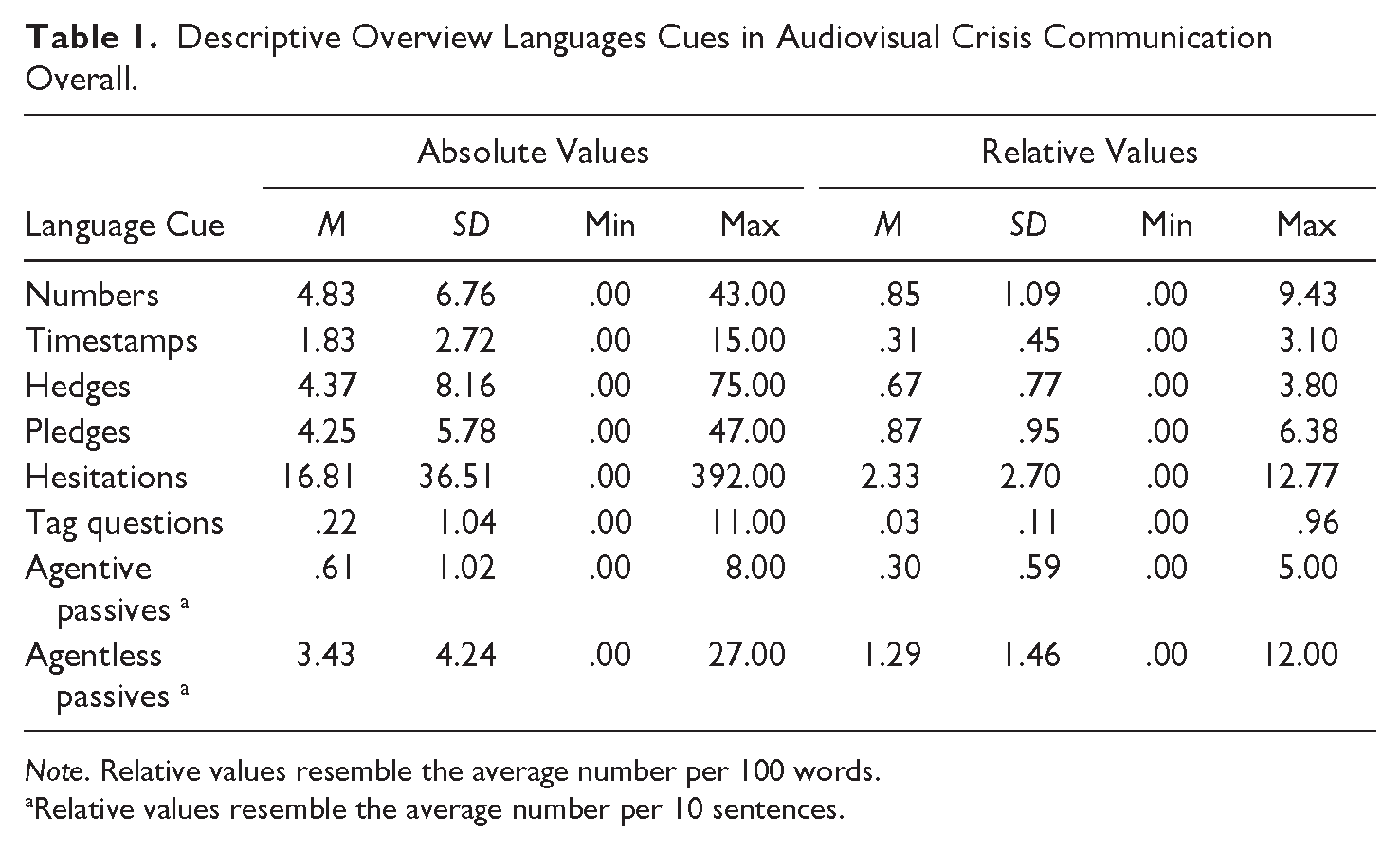
Note. Relative values resemble the average number per 100 words.
Relative values resemble the average number per 10 sentences.
Descriptive Overview Emotional Language in Audiovisual Crisis Communication Overall.

Note. N = 179 audiovisual crisis communication videos.
Language Abstraction
The amount of specific numbers and precise timestamps were calculated in order to examine how concrete audiovisual crisis communication messages are formulated (Research Question 1). First, the results showed that overall, most crisis messages contained numbers (77%) and timestamps (62%), and that, on average per 100 words, numbers (M = .85, SD = 1.09) occurred more frequently than timestamps (M = .31, SD = .45) as an indicator of concreteness. In addition, there was a large range concerning the average amount of numbers. For example, when the CEO of Mylan responded to the EpiPen price increase during a hearing, she referred to almost 10 specific numbers per 100 words (e.g., “Since 2014 the wholesale acquisition cost for 2 EpiPens increased from 401 to 608 or 51 percent but the net revenue to Mylan after rebates and fees what we actually received increased from 235 to 274”), while other speakers did not mention numbers once.
Second, two one-way ANCOVAs were conducted to examine the impact of crisis response strategy on the occurrence of numbers and timestamps (Research Question 5). The results are illustrated in figure 1. There was no statistically significant effect of crisis response strategy on the number of precise timestamps, F(2, 173) = .61, p = .53, η2 = .007. There was a small but statistically significant effect of crisis response strategy on the amount of specific numbers, F(2, 173) = 3.01, p = .05, η2 = .03. A Bonferroni post hoc test revealed that a deny crisis message (M = 1.18, SE = .16) contained significantly more numbers than a rebuild crisis message (M = .69, SE = .12; p = .04). There was no significant difference between a diminish crisis message (M = .83, SE = .15) and a deny (p = .40) or rebuild crisis message (p = 1.00). As such, the findings suggest that the use of concrete language may be more prevalent in deny crisis response strategies than in rebuild crisis response strategies, as for example, television host Bill O’Reilly proved when he was denying an allegation of sexual harassment: “I’ve been 42 years in this business. I’ve worked for 12 companies. Not 1 time did I have any interaction with HR or any complaints filed against me.”
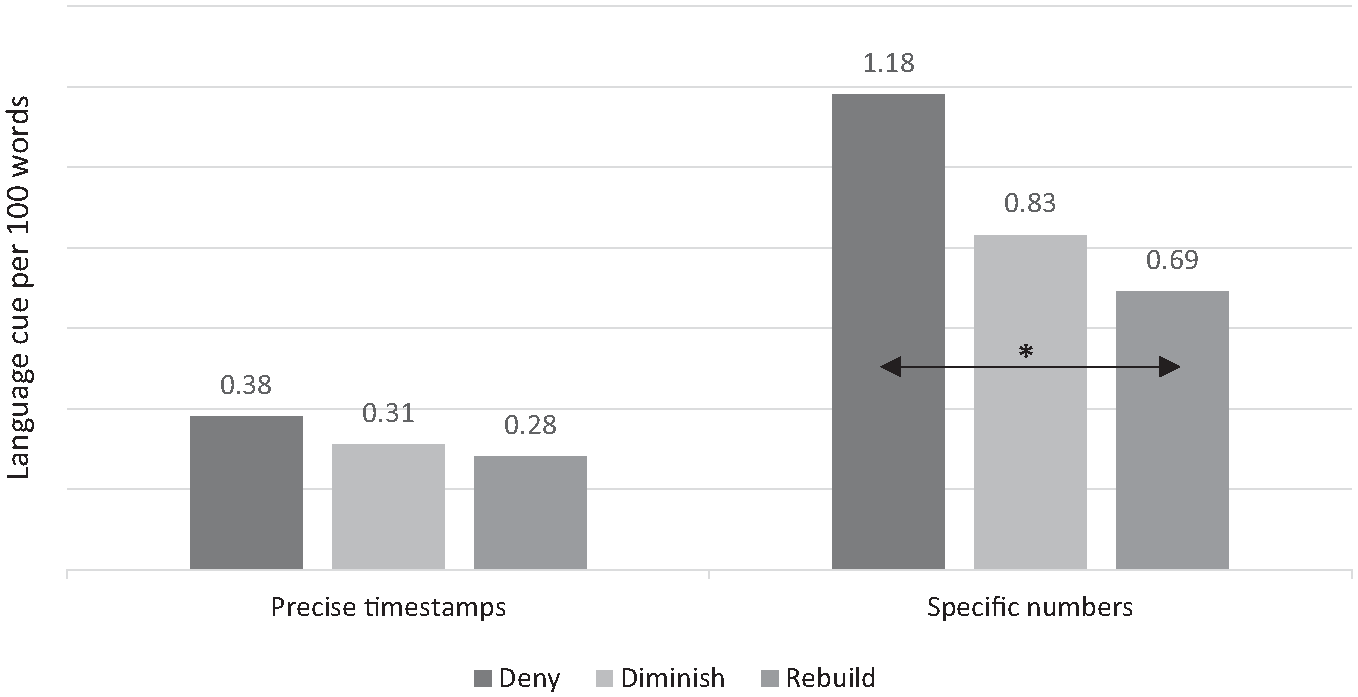
Crisis response strategy and language abstraction.
Uncertain Language
The number of hedges, pledges, hesitations, and tag questions were calculated in order to examine how (un)certain audiovisual crisis communication messages are formulated (Research Question 2). First, the results showed that overall, most crisis messages contained hedges (70%), pledges (83%), and hesitations (73%), but only a few included tag questions (9%), for instance, the CEO of Hampton Creek delivering a diminish crisis message during a CNBC interview (e.g., “If it had a sales impact, we would see it in the data, right?”). On average per 100 words, hesitations (M = 2.33, SD = 2.70) were most prevalent, followed by pledges (M = .87, SD = .95), hedges (M = .67, SD = .77), and tag questions (M = .03, SD = .11).
Second, four one-way ANCOVAs were conducted to examine the impact of crisis response strategy on hedges, pledges, hesitations, and tag questions (Research Question 5). The results are illustrated in Figure 2. There was no statistically significant effect of crisis response strategy on the number of pledges, F(2, 173) = 2.35, p = .10, η2 = .03; hesitations, F(2, 173) = .19, p = .83, η2 = .002; and tag questions, F(2, 173) = 1.87, p = .16, η2 = .02. However, there was a statistically significant effect of crisis response strategy on the number of hedges, F(2, 173) = 4.34, p = .02, η2 = .05. A Bonferroni post hoc test revealed that a diminish crisis message (M = .91, SE = .10) contained significantly more hedges than a rebuild crisis message (M = .52, SE = .08; p = .01). There was no significant difference between a deny crisis message (M = .67, SE = .11) and a diminish (p = .37) or rebuild crisis message (p = .80). As such, the findings from this study indicate that diminish strategies generally apply more uncertain language cues than rebuild messages. For example, Tony Hayward, CEO of British Petroleum, tentatively minimizing the damage of the Deepwater Horizon oil spill: “I think the environmental impact of this disaster is likely to have been very modest.”
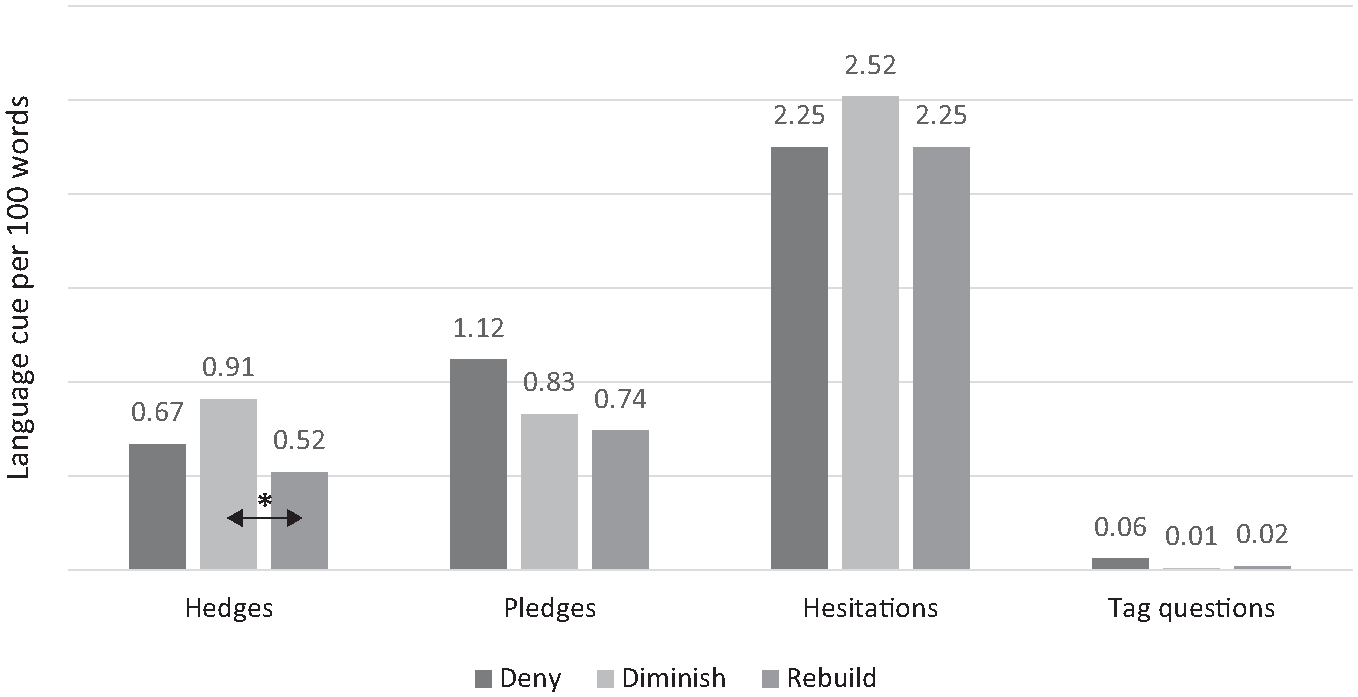
Crisis response strategy and uncertain language.
Passive Voice
With regard to the use of the passive voice in audiovisual crisis communication messages (Research Question 3), the results first showed that most crisis messages contained at least one passive verb construction (83%). The agentless passive voice (M = 1.29, SD = 1.46) was, on average per 10 sentences, more prevalent than the agentive passive voice (M = .30, SD = .59). A remarkable example was the response of general Angus Campbell on the alleged war crimes of the Australian army in Afghanistan, which contained the most agentless passive voice constructions in the sample. It was the only crisis message that, on average, included more than one passive voice per sentence, in which the performer of the action was left out (e.g., “those have been killed,” “patrol members were coerced,” and “weapons were planted”).
Second, two one-way ANCOVAs were conducted to examine the impact of crisis response strategy on the two passive voice types (Research Question 5). The results are illustrated in Figure 3. There was no statistically significant effect of crisis response strategy on the frequency of the agentive passive voice, F(2, 173) = 1.84, p = .16, η2 = .02, and the agentless passive voice, F(2, 173) = 1.04, p = .35, η2 = .01. As such, there are no indications that organizations or individuals in crisis draw more heavily on the passive voice when formulating either a deny, diminish, or rebuild crisis message.
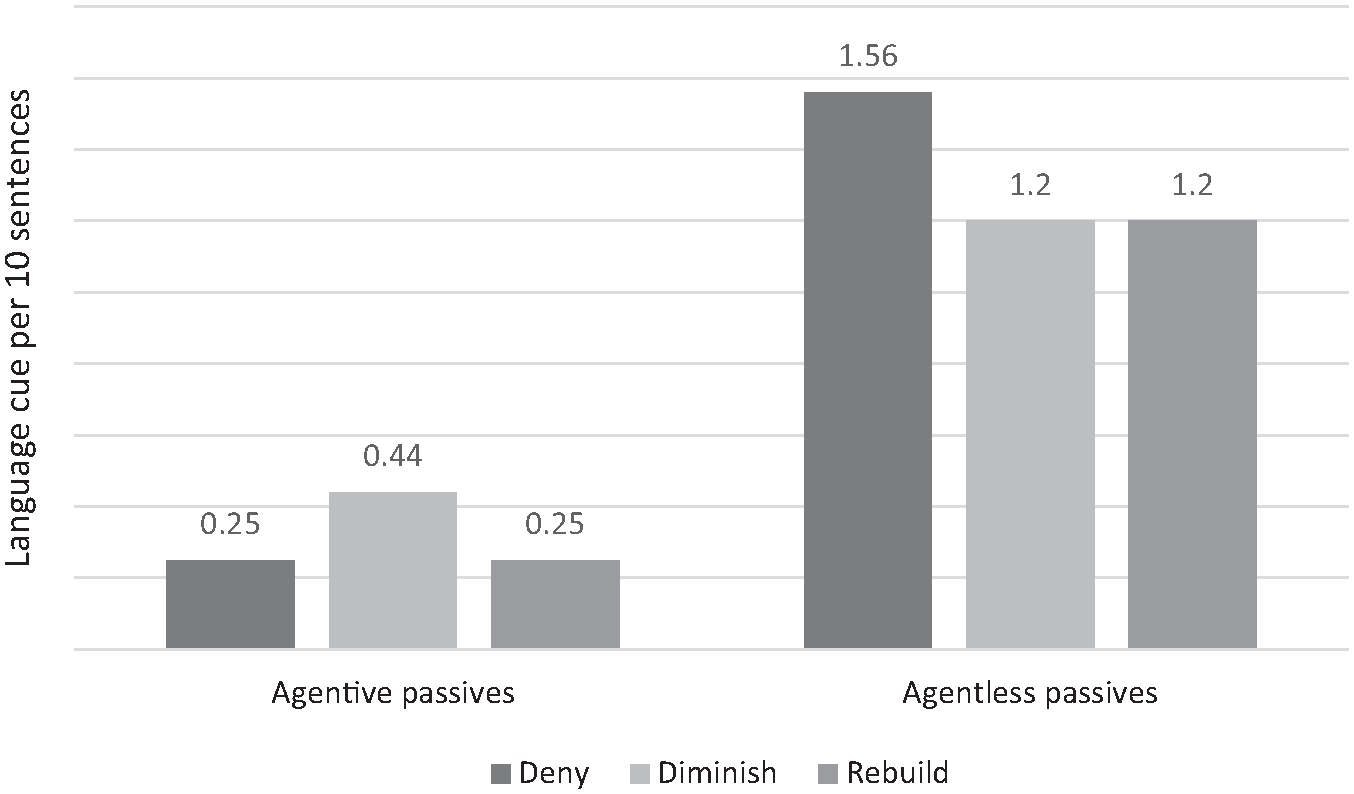
Crisis response strategy and passive voice.
Emotional Language
Emotionally loaded words were coded in order to examine how often audiovisual crisis communication messages are emotionally formulated and, if so, which emotion is most prevalent (Research Question 4). First, the results showed that half of the crisis messages included emotional language (52%). When such emotional language was present, this predominantly referred to the discrete emotion sadness (56%; e.g., CEO of Boeing responding after plane crash: “I’m heartbroken by your losses”), and to a lesser extent to shame (17%; e.g., Football player Kareem Hunt responding to his violent behavior in a leaked video: “I’m extremely embarrassed because of that video”).
Second, three chi-square tests were conducted to determine the association between the crisis response strategy and the occurrence of emotional language in general, as well as the association with sadness and shame in particular (Research Question 5). The results are illustrated in Figure 4. A first chi-square test showed that there was a significant association between the crisis response strategy and whether or not emotional language was present, χ2(2) = 12.51, p = .002. A post hoc test revealed that emotional language was significantly more prevalent in a rebuild crisis message (65%) than in a deny crisis message (33%). For example, our sample included the emotional apology of singer Chris Brown after committing domestic violence: “I want to publicly express my deepest regret and accept full responsibility. . . . What I did was inexcusable and I am very sad and very ashamed of what I’ve done.” The prevalence of emotional language did not significantly differ between a diminish crisis message (47%) and a deny or rebuild crisis message.
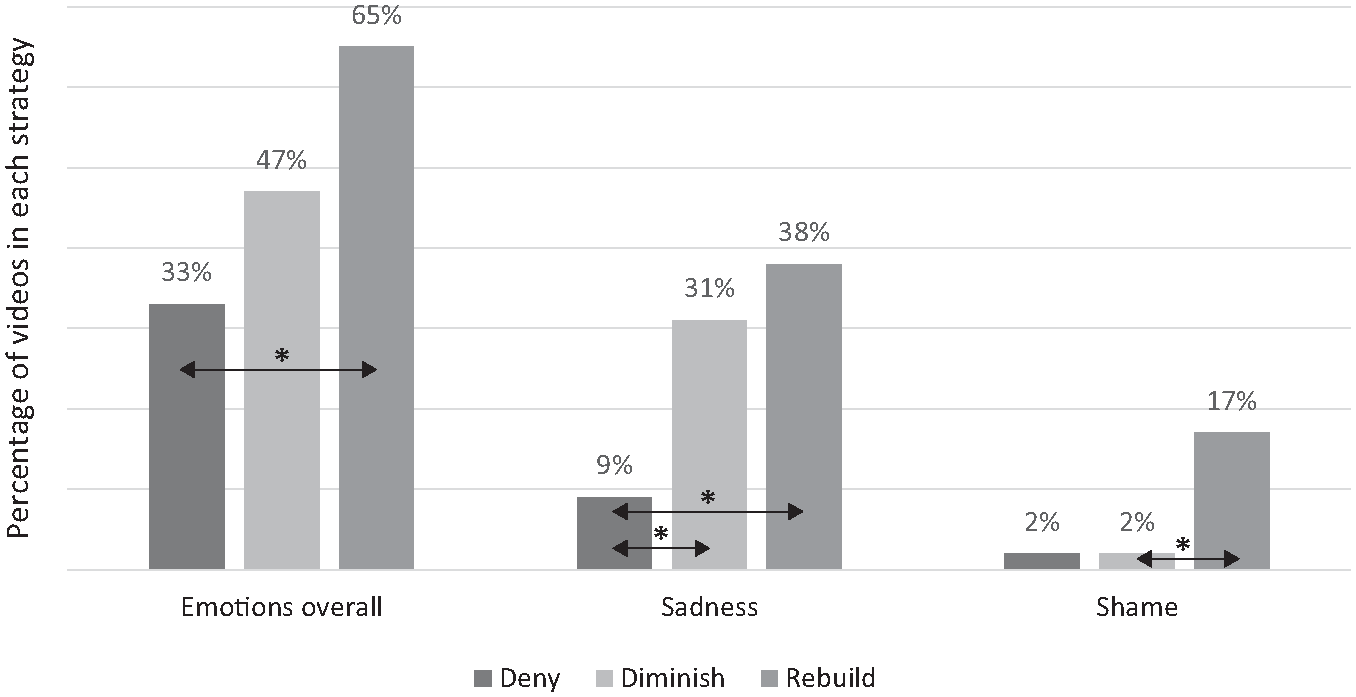
Crisis response strategy and emotional language.
A second chi-square test showed that there was also a significant association between the crisis response strategy and whether the discrete emotion sadness was present, χ2(2) = 11.32, p = .003. A post hoc test revealed that sadness was significantly more verbalized in a rebuild crisis message (38%) and a diminish crisis message (31%) than in a deny crisis message (9%). The prevalence of sadness did not significantly differ between a diminish crisis message and a rebuild crisis message. A third chi-square test showed that there was also a significant association between the crisis response strategy and the expression of shame, χ2(2) = 11.29, p = .004. A post hoc test revealed that shame was significantly more verbalized in a rebuild crisis message (17%) than in a diminish crisis message (2%). The prevalence of shame did not significantly differ between a deny crisis message (2%) and a diminish crisis message or a rebuild crisis message. The findings, therefore, show that emotional language is most frequently expressed in rebuild crisis response strategies, and sadness and shame in particular.
Discussion
This study examined how, whether intentionally or not, reputation-restoring crisis response strategies are verbalized. This was examined by means of a content analysis of audiovisual crisis messages from organizations and public figures, through the focus on four linguistic constructs that might influence crisis communication outcomes. In addition, we examined whether certain crisis response strategies draw more heavily on particular language features. When one considers the linguistic verbalization of the crisis message overall, there are two observations that stand out. First, it appears that the passive voice is not avoided in crisis communication, despite the (contested) guideline in many style manuals to use the active voice as much as possible (Ferreira, 2021). Moreover, the results show that the agentless form of the passive voice clearly prevails over the agentive passive voice type. This is a relevant finding as research shows that the adoption of the passive voice in crisis communication lowers responsibility attributions, but only in the case of the agentless passive form (Fannes & Claeys, 2023). As such, irrespective of the distinct crisis response strategy used, crisis communication messages in practice have a tendency to employ verb voice in a manner that reduces responsibility attributions. Future research should examine to what degree the use of the (agentless) passive voice in crisis communication is deliberate.
Second, organizational representatives and public figures do not appear to shy away from verbally showing emotions in crisis communication. A little more than half of the crisis messages contained emotional language. In particular, the discrete emotion sadness is frequently expressed, which we know from prior causal research can have reputational benefits (e.g., Claeys et al., 2013; Y. Huang & DiStaso, 2020). Whereas prior research had already showed that sadness is often expressed nonverbally in crisis communication (Sandlin & Gracyalny, 2018), we add that these emotions are reflected in verbal messages as well.
The second and most important aim of this study was to examine whether distinct crisis response strategies are systematically formulated through distinct linguistic cues, irrespective of the sender’s intent (see Table 3 for an overview of the key findings and the potential implications). The results show there is no difference among a deny, diminish, and rebuild crisis message in terms of verb voice. The theoretical recommendation to passively apologize in order to avoid legal liability (Cohen, 1999; Patel & Reinsch, 2003) or to actively apologize to increase sincerity (Bentley, 2015; Wang & McGlone, 2020) did not result in significantly more, or fewer, passive voice constructions in an apology than in any other response strategy, as far as we could ascertain with our sample.
Overview of Key Findings and Potential Implications.

However, language abstraction, uncertain language, and emotional language did systematically vary with the content strategy of the crisis message. Each of these three language categories was characteristic of one of the three crisis response strategy clusters from situational crisis communication theory (cf. Coombs, 2007). First, denial crisis response strategies contain the most precise numbers, which may suggest that concrete information is more prevalent in this response type. Denial strategies attempt to disconnect the organization from the crisis (Coombs, 2007) and can be quite effective, but only when people believe them (Coombs, 2007; Fuoli et al., 2017). As such, organizations and public figures issuing a denial may have a tendency to provide credible and verifiable evidence to prove their innocence (Hansen & Wänke, 2010). Findings from experimental studies demonstrate that concrete crisis communication enhances the trustworthiness of the message source and lowers perceptions of crisis responsibility (Borden & Zhang, 2019; Fannes & Claeys, 2022). As such, the inclusion of concrete language might indeed increase a denial’s effectiveness. Future experimental research might examine if concrete language is more impactful for the outcome of denial strategies as compared to apologies.
Second, diminish crisis response strategies include the most hedges, which might indicate that these strategies are expressed in the most uncertainty way. A possible explanation for this result is that diminishing can be considered the most indecisive response strategy compared to a denial and an apology. Crisis responsibility is not completely accepted or rejected in diminish strategies (Coombs, 2007). As such, the organization or public figure in crisis applying this type of strategy might use tentative language to keep their options open in case more information becomes available and a more definite response can be communicated with confidence. However, research in related fields primarily suggests a negative effect of hedges on impression formation (Blankenship & Craig, 2011). The question then arises how the public perceives such cautious word use during crises and if it affects the outcomes of diminish strategies.
Third, the findings reveal that rebuild crisis response strategies seem to include the most emotional language overall. When we look at distinct emotions, the findings reveal that rebuild strategies express sadness more than denial strategies and communicate shame more often than diminish strategies. Offering an apology is typically an emotional experience for the person who committed the offense (Fineman & Gabriel, 2010). This is the reason why the recipients expect an emotional display, as that is the only way they believe the apology is authentic (Ten Brinke & Adams, 2015). Research on emotional crisis communication supports this assumption and confirms that a sincere display of emotions can have a positive effect on postcrisis reputation (Claeys et al., 2013), especially in the case of an apology (Stephens et al., 2019). The evidence-based recommendation that one does not have to be afraid to show heartfelt emotions in crisis communication thus appears to be put into practice by public figures as well as organizational spokespersons. Future research should examine if the display of distinct emotions influences the outcomes of each crisis response strategy.
Limitations and Directions for Future Research
This study has some limitations that provide interesting suggestions for further research. First, the sample only included audiovisual crisis communication messages in English. Therefore, no inferences can be made about written crisis communication, as the linguistic style of spoken language in general deviates from written language (Biber, 1988). The same applies to crisis responses in other languages, because the prevalence of the coded language features can differ between languages and other cultural meanings might be attached to them (House & Kádár, 2021; Kim & Lee, 2021). For example in Japanese, the passive voice is used as a language device to communicate in a respectful and polite manner (Ishizuka, 2012).
Second, future research could look beyond reputational crisis messages and examine language patterns in informational crisis responses too. The priority of crisis communication is to inform stakeholders and minimize harm (Coombs, 2007; Sturges, 1994), and strategic language use can be a fruitful way to increase the impact of messages designed to guarantee the physical and mental safety of stakeholders during crises (Fannes & Claeys, 2022).
Third, this study only investigated the language level of audiovisual crisis messages, although their interpretation is affected by linguistic as well as nonverbal aspects. There already exist some content analytical studies that have looked at the prevalence of nonverbal cues in crisis communication (e.g., Choi & Mitchell, 2022; De Waele & Claeys, 2017; Stephens et al., 2019). However, the verbal and nonverbal components of audiovisual crisis communication do not operate independently. They interact and collectively influence audience perceptions (De Waele et al., 2019; Schoofs & Claeys, 2021). Future research could, therefore, adopt an integrative approach and examine the extent to which language and nonverbal cues coincide and interrelate within audiovisual crisis messages.
Fourth, the chosen operationalizations do not fully capture the four language categories that are the focus in this study. The measurements of language abstraction in particular is rather limited. Although specific numbers and precise timestamps are indeed indicators of language abstraction (Pan et al., 2018), there are other linguistic features that are related to the concrete-abstract construct as well, such as prepositions, nouns, and verbs (Larrimore et al., 2011; Semin & Fiedler, 1988). The finding that a denial crisis message is formulated most concretely because it contains the most precise numbers should thus be interpreted with caution.
Finally, only the occurrence of language features was examined, not their impact on public perceptions or the extent to which organizational representatives and public figures deliberately adopt them. There have already emerged quite some experimental studies that have investigated the influence of language cues on how a crisis message is perceived (e.g., Borden & Zhang, 2019; Clementson & Page, 2021), but more causal research is needed to unravel its effect, boundary conditions, and underlying mechanisms. Furthermore, in-depth interviews with crisis communication professionals could be conducted to obtain their perspective on the role of language in crisis communication, to determine how consciously they reflect on its strategic use (e.g., use of the passive voice), and to detect possible new interesting language features that are used in practice and have not been identified by research yet.
Conclusion and Implications
The findings of this study provide theoretical and practical implications. Along with findings from prior experimental research, this study provides an overview of linguistic tools that are at the disposal of public relations professionals to increase the effectiveness of their crisis message. We discovered that some linguistic categories, such as emotional language and expressions of sadness, in particular, are frequently adopted in practice and rightfully so (Schoofs & Claeys, 2021). Other language features, however, seem to be applied too often, or rather not frequently enough, in practice. Hesitations, for example, occur in audiovisual crisis communication messages more than the literature would recommend (Blankenship & Holtgraves, 2005). Yet, the use of concrete language is something that crisis communication practice should consider more whenever possible (Fannes & Claeys, 2022). PR practitioners are advised to become better aware of the language toolbox they can employ to successfully verbalize their crisis communication strategy and to recognize which formulations could strengthen or weaken their messages.
This is something that can already be trained in business communication programs. Most public relations practitioners are familiar with crisis communication theories, such as SCCT (Coombs, 2007), but they indicate that these theoretical guidelines are difficult to put into practice (Claeys & Opgenhaffen, 2016). Teaching business communication students about crisis communication should mean they learn how to select the most appropriate communication strategy in a given crisis situation as well as how to put that strategy effectively into words. A focus on the combination of the strategic and linguistic aspects of a crisis message would be a valuable asset to business communication pedagogy (Aertsen et al., 2013) and would make the theoretical principles more practice-oriented. Our research shows that it is important to be aware of the different phrasing options of crisis communication, and this awareness could already be developed in the classroom.
Finally, this study emphasizes the theoretical relevance of language in crisis communication and, as such, complements situational crisis communication theory (cf. Coombs, 2007). SCCT explains when to adopt which reputational crisis response strategy, but it does not inform us about how to design a crisis message that effectively executes the chosen strategy. We found that in reality both organizations and public figures formulate distinct crisis response strategies in distinct ways. Linguistic message variation helps explain why prior research has found inconsistent results regarding the impact of SCCT’s matching strategies (Ma & Zhan, 2016) and, as such, sets important boundary conditions on the theory’s proposed relationships. Future research should continue to examine the causal impact of formulating crisis strategies in specific ways, such as the ones that appeared most frequently in our data sets.
Supplemental Material
sj-docx-1-bcq-10.1177_23294906241286141 – Supplemental material for Phrasing Crisis Communication: How are Distinct Crisis Response Strategies Put Into Words?
Supplemental material, sj-docx-1-bcq-10.1177_23294906241286141 for Phrasing Crisis Communication: How are Distinct Crisis Response Strategies Put Into Words? by Gijs Fannes, An-Sofie Claeys and Baldwin Van Gorp in Business and Professional Communication Quarterly
Footnotes
Acknowledgements
The authors would like to thank Mayte Destino for her involvement in the coding process and Kristien Temperville for proof reading the article.
Declaration of Conflicting Interests
The author(s) declared no potential conflicts of interest with respect to the research, authorship, and/or publication of this article.
Funding
The author(s) received no financial support for the research, authorship, and/or publication of this article.

Supplemental material
Supplemental material for this article is available online.
Notes
Author Biographies
References
Supplementary Material
Please find the following supplemental material available below.
For Open Access articles published under a Creative Commons License, all supplemental material carries the same license as the article it is associated with.
For non-Open Access articles published, all supplemental material carries a non-exclusive license, and permission requests for re-use of supplemental material or any part of supplemental material shall be sent directly to the copyright owner as specified in the copyright notice associated with the article.
