




Abstract
Research revealing associations between Conservative Protestantism and lower socioeconomic status is bedeviled by questions of causal inference. Religious switching offers another way to understand the causal ordering of religious participation and demographic markers of class position. In this article, we look at adolescents who change their religious affiliation across four waves of data from the National Longitudinal Study of Adolescent Health (Add Health) and then observe their transition to adulthood using four crucial markers—completed educational attainment, age at first marriage, age at first birth, and income at the final wave. Results show that switching out of a Conservative Protestant denomination in adolescence can alter some, but not all, of the negative consequences associated with growing up in a Conservative Protestant household. Specifically, family formation is delayed among switchers, but early cessation of education is not.
Research confirms that white youth raised in Conservative Protestant households experience consistent disadvantage in the transition to adulthood, especially young women who are at risk for lower educational attainment and earlier ages at first marriage and first birth (Darnell and Sherkat 1997; Eggebeen and Dew 2009; Glass and Jacobs 2005; Keysar and Kosmin 1995; Lehrer 2004). This “accelerated transition to adulthood” is robust with respect to cohort and data source and has been important in understanding ideational influences on the intergenerational transmission of social class (Fitzgerald and Glass 2012; Xu, Hudspeth, and Bartkowski 2005). But research revealing associations between religion and social class is bedeviled by questions of causal inference: Are Conservative Protestants motivated by religious participation to order their lives in certain ways, or are those who order their lives by the early assumption of adult roles simply more attracted to the message and resources of Conservative Protestant organizations?
Religious switching offers another way to understand the causal ordering of religious participation and demographic behavior. In this article, we look at adolescents who change their religious affiliation across four waves of data from the National Longitudinal Study of Adolescent Health (Add Health) and then observe their transition to adulthood using four crucial markers—completed educational attainment, age at first marriage, age at first birth, and current income. By observing youth in Conservative Protestant households who do and do not persist in their religious affiliation over time, we can ascertain whether those who disaffiliate subsequently diminish their disadvantage relative to those who continue their childhood religion. We describe and control for any observable differences that distinguish those who did and did not disaffiliate. We distinguish between two groups of religious switchers—those who move to a mainline denomination and those who disaffiliate from religion altogether. There are substantial reasons to expect that those who continue to participate in organized religion will be advantaged compared with those who disaffiliate because religious participation has been shown to increase social integration, social capital, and ties to conventional institutions (Glanville, Sikkink, and Hernandez 2008).
Background
Most of the extant literature on religious switching seeks to understand the antecedents of switching or changes in patterns of switching over time. For example, scholars have shown that approximately one-third of Americans change their religious affiliation at least once in their life (Loveland 2003; Newport 1979; Roof 1989) but are most likely to shift within closely related denominations rather than broad religious categories or faiths (Hadaway and Marler 1993; Smith and Sikkink 2003). Religious switching seems to be lower in strong or distinctive religious traditions, such as Conservative Protestantism, compared with mainline denominations (Loveland 2003; Sherkat 2001). Some switches appear to realign the social class or educational attainment of switchers and their destination denomination (Newport 1979; Sherkat 2001). Of particular relevance for this investigation, there is a history of individuals leaving evangelical or Pentecostal denominations for mainline Protestant denominations as their social class increases in adulthood (Stark and Glock 1968). But the dominance of this category has been fading over time as more heterogeneous switches occur (Roof and Hadaway 1979; Uecker, Regnerus, and Vaaler 2007) and as switching becomes more motivated by political ideology (Hout and Fisher 2002; Scheitle and Smith 2012; Sherkat and Wilson 1995). Finally, religious disaffiliation or “apostasy” has been both growing over time (Hout and Fischer 2002; Kluegel 1980) and is predicted by different factors than denominational switches (Brinkerhoff and Mackie 1993; Lim, MacGregor, and Putnam 2010; Sandomirsky and Wilson 1990).
Moving specifically to religious switching among adolescents and young adults, previous studies have found a recurring link between parental divorce, geographic mobility, and changes in religious participation that precipitate religious switching and disaffiliation (Hoge, Johnson, and Luidens 1995; Petts 2009) particularly for Conservative Protestant youth who, overall, come from a more stable religious category (Lawton and Bures 2001). Disaffiliation from religion, in particular, is characterized by changes in family structure and functioning, such as parental divorce and decreased religious participation, as well as lower involvement in church youth programs (Hoge and O’Connor 2004). These demographic precursors of switching are important because they suggest that youth who switch religious denomination are more likely than stayers to have experienced what might be characterized as challenges to a successful transition to adulthood.
What almost all observers agree on, however, is that religious switching is related to changes in social ties and opportunities, which often precede the actual switch (Brinkerhoff and Mackie 1993; Hoge et al. 1995; Loveland 2003; Smith and Sikkink 2003). For example, youth may move away from their family of origin after high school graduation and may feel freer to switch to an affiliation more in line with their own preferences, decrease their religious participation, or disaffiliate altogether. Switching, as Brinkerhoff and Mackie (1993) posit, requires a change in both belief and community. Participating in a new religious network with different ideological emphases and commitments, or moving to a social network devoid of religious commitments, is crucial to our theoretical rationale for expecting changes in behavior following changes in religious identification among youth raised in Conservative Protestant households. The consequences of religious switching for behavior during the young adult years are much less well understood than the antecedents of switching.
In this article, we test for the existence of behavioral changes during the transition to adulthood motivated by religious switching out of a Conservative Protestant denomination. We cannot completely disentangle social selection and social causation in any difference we observe between youth who do and do not switch out of a Conservative Protestant denomination. That is, the youth who switch denominations may have switched precisely because the pathway to adulthood they preferred was not supported by their conservative denomination. But we can determine whether those who switched subsequently experienced different family formation and attainment patterns compared to those who did not switch. This becomes prima facie evidence that the social ties created through the process of switching facilitate a different behavioral pathway relative to the behavior observed among youth who maintain a Conservative Protestant affiliation. 1
First, we describe the distinct pathways observed among youth raised in Conservative Protestant households and the religious motivations that undergird them. Briefly, religious affiliation in one’s family of origin provides cultural resources that influence the timing of life course transitions—especially marriage, childbearing, and labor force entry. These life course events affect educational attainment, in particular, which in turn influences labor market outcomes (e.g., occupation, income). In addition to the direct effects of one’s family of origin on these outcomes, there are also indirect effects through network formation. Youth embedded in Conservative Protestant traditions develop interpersonal networks of friends and associates that influence their behaviors related to family formation and educational pursuits—which then ultimately lead to labor market outcomes.
The restriction of sexuality to heterosexual marriage is a key component of much Conservative Protestant teaching (Regnerus 2009; Smith 2002) and informs a tightly knit schema integrating sexuality, marriage, reproduction, and childrearing. Conservative Protestants tend to view sexual activity as something that should be circumscribed or avoided until marriage. The intent is clearly to create a seamless behavioral pattern in which premarital pregnancies, abortions, nonmarital births, and sexually transmitted diseases are rare because of volitional behavioral restraint. However, this reliance on behavioral restraint also tacitly encourages earlier marriage and childbearing among youth raised in Conservative Protestant households because this shortens the portion of the life span in which sexual restraint is necessary.
By emphasizing distinct gender differences in personality, interests, and needs, as well as the efficiency of the breadwinner/homemaker model of marriage, Conservative Protestants also hope to cement the dependency of each sex on the other, reducing the probability of divorce. Moreover, when women’s domestic labor can be assured within the household in exchange for the financial support of their husbands, contraception and abortion are less necessary because family size limitation is less important. This supports a tighter linkage between sexual activity and reproduction, and the welcome acceptance of all pregnancies in accordance with religious beliefs. This pattern of earlier marriage and childbearing and larger completed family sizes among women raised in Conservative Protestant households compared with those raised in mainline denominations has been documented in longitudinal data from the National Survey of Families and Households (Fitzgerald and Glass 2008; Glass and Jacobs 2005) and the Add Health Survey (Fitzgerald and Glass 2012).
However, the timing of life course transitions has different effects for men and women. For example, early family formation is negatively associated with later adult educational and occupational attainment for women (Chandler, Kamo, and Werbel 1994; Fitzgerald and Glass 2008; Marini, Shin, and Raymond 1989) but does not negatively affect men. Moreover, the pattern of early family formation among Conservative Protestants is racialized, affecting white and Hispanic youth more strongly than African American youth (Glass and Jacobs 2005). For these reasons, we restrict our analyses to nonblack youth and run separate models for young women and men.
In addition to family formation, foundational beliefs within Conservative Protestant traditions shape attitudes toward a wide range of topics, including science, the benefits of schooling, and the importance of higher education. Biblical literalism, and its connection to orthodox theological tenets, may produce an aversion to advanced science course-taking in high school. Negative views toward science might encourage adolescent Conservative Protestants to avoid the college preparatory work that could increase their chances of being admitted to and completing college (Darnell and Sherkat 1997; Sherkat 2011).
Conservative Protestants may also eschew higher education, particularly public secular colleges and universities, because of a deep distrust of the motivations and teachings of institutions of higher learning. This sentiment is echoed by highly visible religiously conservative theologians and politicians, including this statement by Newt Gingrich: “I for one am tired of the long trend towards a secular, atheist system of thought dominating our colleges, dominating our media” (Gentile and Rosenfeld 2012). Evangelist James Dobson, founder of the Focus on the Family ministry, claims, “Secular universities are blatantly hostile to Christian precepts” (Dobson 2011). Sikkink (1999) found that seven out of ten Pentecostals and Charismatics view public schools as being hostile toward moral and spiritual values, followed by approximately one out of two Fundamentalists and Evangelicals.
This antipathy toward public and/or secular schooling has led to a variety of alternative educational choices among Conservative Protestant parents. The rise of homeschooling, nonaccredited Christian schools, and biblically based educational curricula all reflect attempts to create educational institutions consistent with their religious beliefs that satisfy public demands for compulsory schooling of all children. The effects of these alternatives on children’s future occupational success have not often been the subject of empirical scrutiny. We suspect they correspond to lower earnings in adulthood for young men and women but particularly young women who may already have limited their labor force investments in favor of homemaking.
Our primary hypothesis is as follows:
By switching social networks and social ties away from the reinforcement of Conservative Protestant beliefs regarding sexuality and reproduction, youth are better able to delay family formation and invest in greater human capital prior to market entry.
Our second hypothesis is as follows:
Finally,
We begin by describing the transition markers of the Conservative Protestant youth population in the Add Health data as well as differences at time 1 between switchers and nonswitchers. We then model family formation behaviors, educational attainment, and earnings among those youth who do and do not switch religious affiliation from their time 1 anchor point.
Data and Method
We use nationally representative data from The National Longitudinal Study of Adolescent Health (Add Health), a school-based survey of adolescents in grades 7 to 12 during the 1994–1995 school year. Adolescents attended 132 schools across 80 communities, with almost all students within each school completing in-school surveys in 1994. A nationally representative subsample of these adolescents was given more in-depth, in-home surveys in 1994 and was surveyed again in 1996 (wave 2), 2001–2002 (wave 3), and 2007–2008 (wave 4). At the time of the final wave, respondents were between ages 24 and 32. Add Health provides a longitudinal perspective on individuals’ peer, family, and romantic relationships as well as their social well-being, health status, and health-related behaviors. This data set is well-suited for the purposes of this study because it offers data on respondents’ religious affiliations from adolescence through their transitions to adulthood—when they sought higher education, began families, and entered the workforce.
We restrict our sample to those respondents who completed both wave 1 and wave 4 surveys, had valid values for the religious identification question, and reported belonging to a Conservative Protestant denomination at wave 1 (N = 4,510). This allows us to compare the early adulthood transitions and outcomes of those adolescents who remained Conservative Protestant into young adulthood to those who switched to a different denomination or disaffiliated from religion altogether. Because research suggests fundamental differences in the “denominational culture” (Steensland et al. 2000) of the Black Church, as well as differences in the role of Conservative Protestant religion in the lives of African Americans and its effects on their early adulthood outcomes (Glass and Jacobs 2005), we further restrict our analysis to non-Hispanic white and Hispanic Conservative Protestants (54 percent of the sample of wave 1 Conservative Protestants), and exclude respondents who are African American, Asian Americans/Pacific Islanders, American Indians, and those respondents reporting another race/ethnicity or who are missing on the race/ethnicity measure. We also exclude Conservative Protestant adolescents who switched to a non-Christian religion because of their extremely small number, and those few without valid sample weights, leaving 2,220 cases for analysis, or about 49.5 percent of the sample of Conservative Protestants who participated in both waves 1 and 4. Because we examine four different outcomes, our sample size varies across our four sets of analyses.
We use the survey command (“svy”) in Stata to incorporate our sample weight and better account for clustering within schools. We use multiple imputation to handle missing data on the independent variables in our models.
Dependent Variables
To examine the different dimensions of the transition to adulthood, we examine four dependent variables: age at first birth, age at first marriage, adult educational attainment, and annual income. The first two variables are continuous and measure the age at which respondents experienced their first family formation event. Adult educational attainment is a categorical variable measuring highest degree earned (0 = no college, 1 = some college, 2 = college degree or higher). The category “some college” consists of respondents reporting “some vocational/technical training,” “completed vocational/technical training,” and “some college.” Those respondents reporting “some college” constitute 80 percent of the category that we refer to as “some college.” Unfortunately, we cannot determine whether individuals in this category completed some college at a two-year or a four-year college. Our final dependent variable is measured as the natural log of respondents’ reported personal income in 2006, 2007, or 2008, depending on the time the wave 4 survey was completed.
Independent Variables
Our independent variable of interest captures the religious switching of adolescents who reported belonging to a Conservative Protestant denomination at wave 1. We draw from the work of Steensland et al. (2000) and Roof and McKinney (1987) in the construction of our religious affiliation categories. We define those respondents who identified their religion at wave 1 as Adventist, Assemblies of God, Baptist, Holiness, or Pentecostal as Conservative Protestant. Because Add Health does not ask Baptist respondents what type of Baptist Church they attend, one cannot distinguish between non-Conservative Protestant Baptist denominations and Conservative Protestant Baptist denominations. As a result, we follow the convention of other work on Conservative Protestants that used Add Health and define Baptist adolescents as Conservative Protestant (Erickson and Phillips 2012; Regnerus 2005). Respondents reported a greater diversity of denominations at waves 3 and 4 compared with the first two waves. We categorized those who identified at wave 4 as Anabaptist, Evangelical Covenant Church, Church of Christ, Wesleyan, and Reformed as Conservative Protestant as well, rather than as religious switchers. 2 Given the importance of nondenominational churches in Conservative Protestantism in the United States, we also coded respondents who reported “other Protestant,” “just Christian,” “Christian,” “non-denominational,” or “interdenominational” as Conservative Protestant if they met certain criteria. At wave 1, we relied on reports of a belief in biblical inerrancy and identification as a “Born-Again Christian.” Respondents were not asked these questions in waves 4. In this case, we categorized these respondents as Conservative Protestant if they identified as either “Evangelical” or “Pentecostal” or “Fundamentalist” (vs. “Mainline,” “Liberal,” or “None of these”). The inclusion (or exclusion) of these respondents in the Conservative Protestant category does not alter the substantive conclusions that can be drawn from the findings.
In our first set of analyses, we estimate the association between switching out of Conservative Protestantism and our transition to adulthood measures, regardless of the presence or absence of a destination religion. In our second set of analyses, we examine whether the association between Conservative Protestant switching and the transition to adulthood varies by the destination type (whether the individual switched to a mainline Protestant denomination or disaffiliated from religion altogether). We refer to Conservative Protestant adolescents who switched to a mainline Protestant denomination 3 as “Switched to Mainline.” We include Conservative Protestants who switched to Catholicism in the “Switched to Mainline” group because different categorizations of this small group of Catholics do not affect our results. We refer to respondents who were Conservative Protestant at wave 1 but reported their religion was “none/atheist/agnostic” at wave 4 as “Switched to Secular.” 4 Conservative Protestant adolescents who also reported Conservative Protestant affiliation at wave 4 (“Stayed Conservative Protestant”) serve as our reference category.
We control on a host of variables that may confound the relationship between Conservative Protestant switching and our outcomes. In all analyses, we control on respondent’s reported ethnicity (white = 0, Hispanic = 1), whether the respondent was raised by both biological parents, highest parental education, parental income, rural residence, residence in the South, church attendance (1 = at least 1 time per week), respondents’ wave 1 self-reported GPA during the academic school year, 5 belief in biblical inerrancy, whether the respondent had taken a “virginity pledge,” and whether the respondent believed there was a high chance (more than 50percent) they would be married by age 25. Each of these variables was measured at wave 1. We control for residential mobility between wave 1 and wave 4 by measuring the largest distance moved between observations. We measured distance in quintiles with 0 indicating no move or short first quintile moves, and scores of 1 to 4 corresponding to the remaining distance quintiles (but including only moves that occurred prior to any religious switch). 6 As residential moves may alter peer networks and school culture, moving could motivate religious switching as well. We use this variable to avoid confounding the relationship between religious switching, residential moves, and early adult outcomes.
In our model predicting annual income, we also include several variables measured at wave 4. These include respondents’ highest degree earned, relationship status (single = omitted category, cohabiting, married), number of children (none = omitted category, one, at least two), whether the respondent was enrolled in school, the number of hours the respondent reported working per week, the number of jobs at which the respondent was working, and whether the respondent recently began a new job.
Descriptive statistics for our dependent and independent variables by gender and switching status are presented in Online Appendix A (available at scu.sagepub.com/supplemental).
Analytic Plan
Our analytic models vary across our outcome variables. We use Tobit regression analyses to predict respondents’ age at first birth and age at first marriage because about half of the respondents had not experienced a live birth and about a third of respondents had not married by wave 4 (ages 24−32). In an attempt to better estimate a causal relationship between Conservative Protestant switching and timing of family formation, we include a separate dummy variable for those Conservative Protestant switchers who switched to a different religion after they experienced a family formation event. Thus, our measures of Conservative Protestant switching in the family formation analyses include three mutually exclusive dummy variables indicating whether the respondent stayed Conservative Protestant (omitted), switched to a non-Conservative Protestant affiliation, or switched to a non-Conservative Protestant affiliation after the family formation event. We also include a missing flag for respondents for whom we could not determine the timing of their switch. 7
We estimate respondents’ adult education with a multinomial logistic regression and restrict this analysis to respondents who earned at least a high school degree. 8 In sensitivity analyses, we control on the probability of having earned a high school degree in the model predicting postsecondary education. These analyses yielded estimates that are very consistent with those reported.
We estimate respondents’ adult earnings with an Ordinary Least Squares (OLS) regression and restrict this analysis to civilian respondents who reported more than zero dollars in earnings and who had ever worked for at least 10 hours per week. This selection filter may bias our estimates of the relationship between Conservative Protestant switching and adult earnings, particularly if the probability of being excluded from this subsample significantly varies by Conservative Protestant switching status. We use a strategy rooted in the Heckman two-step selection correction logic in an attempt to address this problem (Berk 1983). We first used a probit model to estimate the likelihood of being included in the sample with a host of covariates listed in the descriptive statistics table. From this, we predicted each respondent’s propensity to be included in the sample and then computed the inverse Mills ratio (IMR; see Berk 1983, for more detailed information). We included the calculated IMR, or the hazard rate of not being included in the sample, 9 as a regressor in the model predicting adult annual income. This adjustment does not significantly alter our results.
Our analyses of each outcome are stratified by gender. In each analysis, we report estimates of the baseline relationship with Conservative Protestant switching and then estimates after adjusting for important observable covariates.
Results
Table 1 shows the means and proportions for our outcome variables for women and men by switching status. Both women and men who switch are less likely to have married or had a child by wave 4 than those youth who stay in a Conservative Protestant denomination. Among those who formed a family, the age at first marriage and first birth were significantly higher for the women who switched, but only the age at first marriage was higher among the men who switched. The actual year differences ranged from 1 to 1.5 years.
Weighted Means and Proportions by Switching Status.

Table 2 displays the Tobit results for age at first marriage and age at first birth. Both show large and robust delays in both age at first marriage and age at first birth among those who switch out of a Conservative Protestant denomination. Significantly, these delays in family formation occur for both young men and young women and are insensitive to the inclusion of a wide array of controls for social class in the family of origin, other attitudes and aspirations at wave 1, and family structure. Effect sizes are large, ranging from about 4.5 to 6.5 years, representing both the observed delays among those respondents experiencing family formation events and lower probabilities of experiencing the events by wave 4 among Conservative Protestant switchers.
Tobit Regression Coefficients Estimating Impact of Conservative Protestant Switching on Early Life Course Transitions.
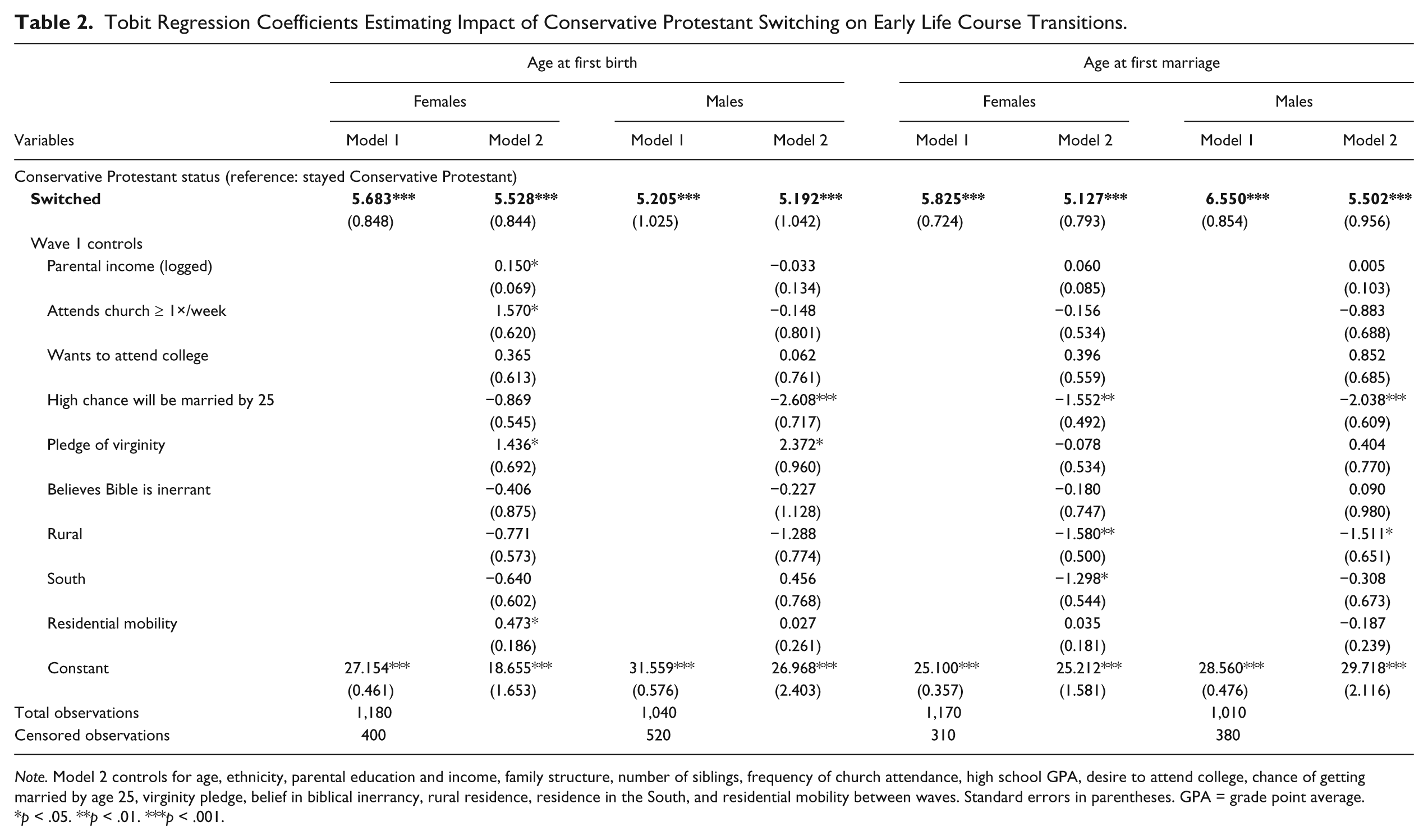
Note. Model 2 controls for age, ethnicity, parental education and income, family structure, number of siblings, frequency of church attendance, high school GPA, desire to attend college, chance of getting married by age 25, virginity pledge, belief in biblical inerrancy, rural residence, residence in the South, and residential mobility between waves. Standard errors in parentheses. GPA = grade point average.
p < .05. **p < .01. ***p < .001.
Table 3 shows the odds ratios for educational attainment and regression results for logged annual earnings at the final wave. Unlike the results for family formation, these models show no advantage of religious switching for those raised in Conservative Protestant households. Neither young women nor young men seem to benefit from switching in either human capital formation or socioeconomic attainment in young adulthood. 10
Relative Risk Ratios from Multinomial Logistic Regression Estimating Type of Degree Earned and OLS Regression Coefficients Estimating Adult Earnings.
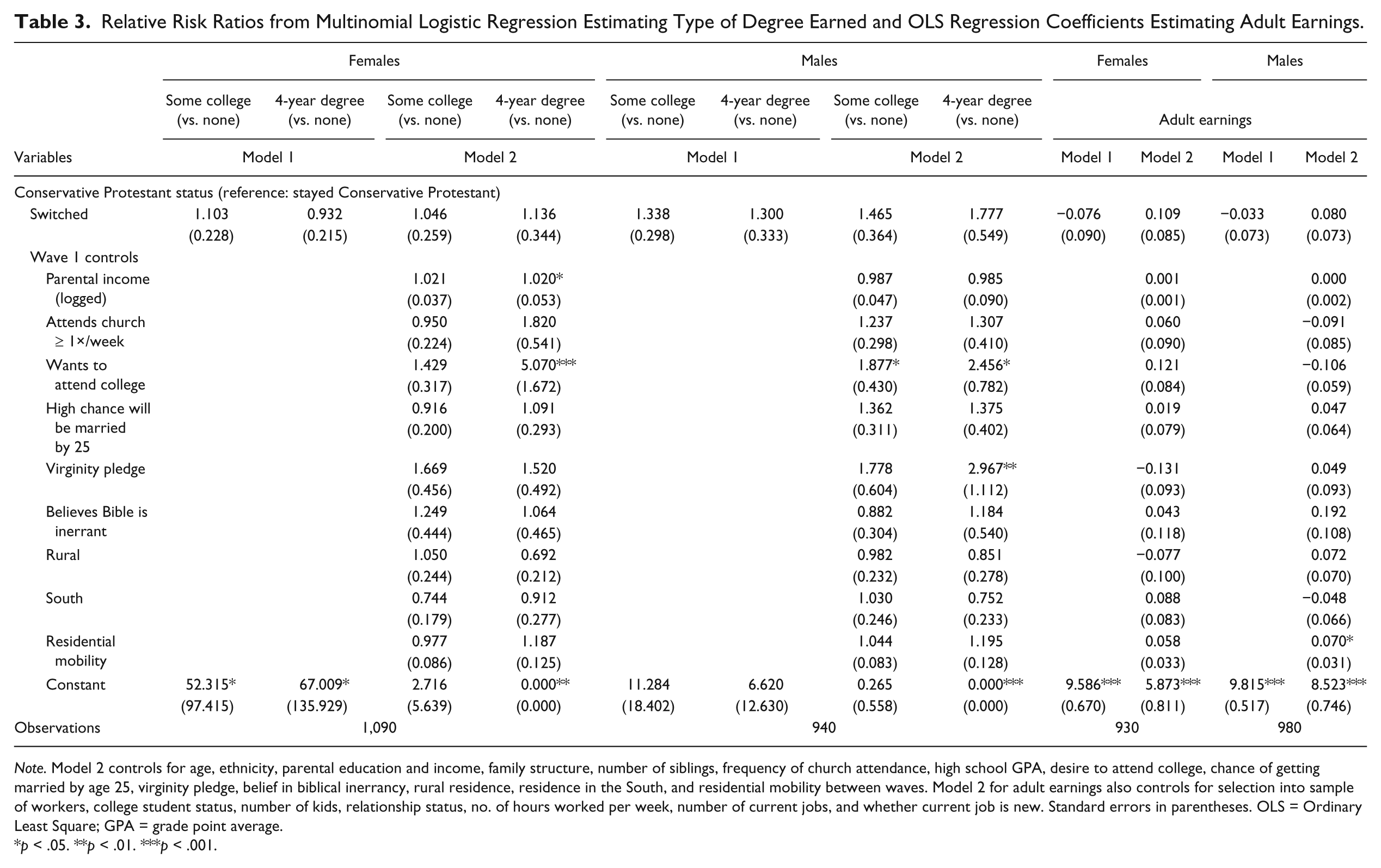
Note. Model 2 controls for age, ethnicity, parental education and income, family structure, number of siblings, frequency of church attendance, high school GPA, desire to attend college, chance of getting married by age 25, virginity pledge, belief in biblical inerrancy, rural residence, residence in the South, and residential mobility between waves. Model 2 for adult earnings also controls for selection into sample of workers, college student status, number of kids, relationship status, no. of hours worked per week, number of current jobs, and whether current job is new. Standard errors in parentheses. OLS = Ordinary Least Square; GPA = grade point average.
p < .05. **p < .01. ***p < .001.
In Table 4, we discriminate between the destination status of Conservative Protestant switchers in our analysis of family formation behavior, contrasting those who affiliate with a mainline denomination to those who disaffiliate from religion altogether. The Tobit regressions show little difference between the two groups of switchers among women—both show significant delays in the age at first birth and age at first marriage. However, results indicate that men who disaffiliated from religion altogether are significantly more likely to delay both family formation events compared to their counterparts who switched to a mainline Protestant denomination.
Tobit Regression Coefficients Estimating Impact of Type of Conservative Protestant Switching on Early Life Course Transitions.

Note. Model 2 controls for age, ethnicity, parental education and income, family structure, number of siblings, frequency of church attendance, high school GPA, desire to attend college, chance of getting married by age 25, virginity pledge, belief in biblical inerrancy, rural residence, residence in the South, and residential mobility between waves. Standard errors in parentheses. GPA = grade point average.
p < .05. **p < .01. ***p < .001.
Table 5 displays the disaggregated results for educational attainment and earnings. No association between the type of religious switch and subsequent educational attainment or earnings for women could be detected. Results suggest that men who switched from a Conservative Protestant denomination into a mainline Protestant denomination have significantly higher earnings than men who remain in a Conservative Protestant denomination. With this one exception, however, destination status in either a mainline denomination or religious disaffiliation appears surprisingly irrelevant for educational attainment and young adult earnings.
The Impact of Conservative Protestant Switching on Educational Attainment and Adult Earnings.
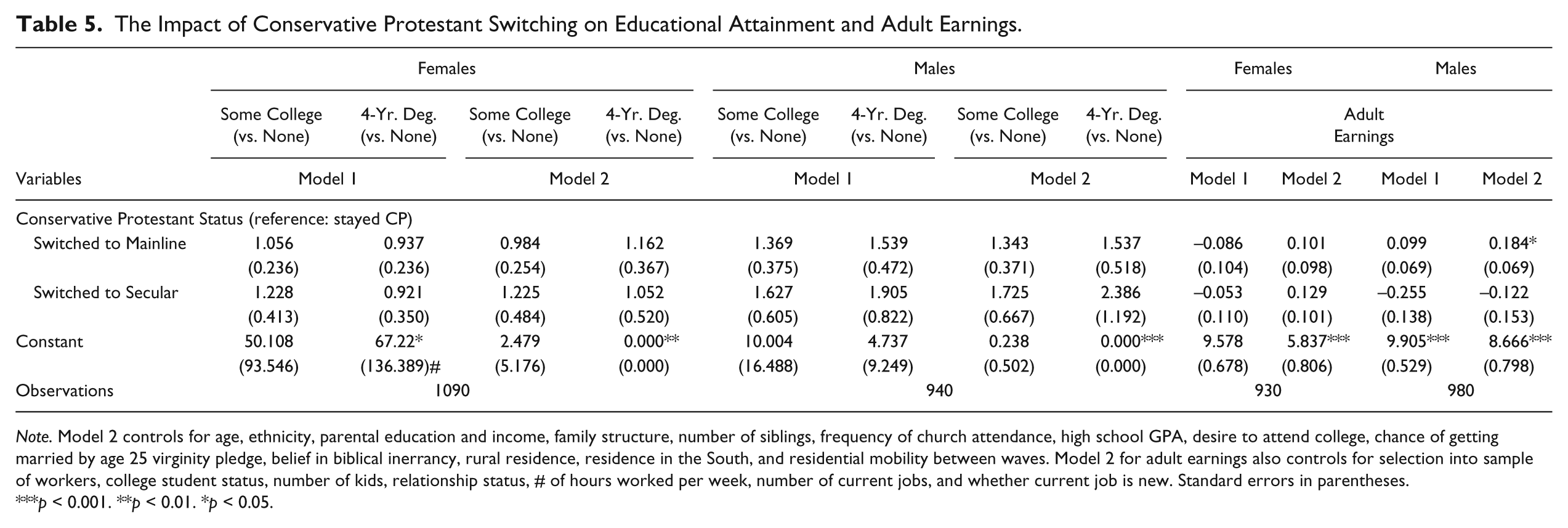
Note. Model 2 controls for age, ethnicity, parental education and income, family structure, number of siblings, frequency of church attendance, high school GPA, desire to attend college, chance of getting married by age 25 virginity pledge, belief in biblical inerrancy, rural residence, residence in the South, and residential mobility between waves. Model 2 for adult earnings also controls for selection into sample of workers, college student status, number of kids, relationship status, # of hours worked per week, number of current jobs, and whether current job is new. Standard errors in parentheses.
p < 0.001. **p < 0.01. *p < 0.05.
Concerned that ecological limitations on education and earnings might explain the lack of impact from switching on measures of human capital, we estimated interaction models in Table 6 with region (South–non-South) and location (rural–urban) at time 1. 11 Although occasional interaction terms could be found suggesting that location does limit human capital development even after youth switch out of Conservative Protestant networks, the pattern was not uniform across outcome or type of switch. Out of 24 total interaction terms, only two were statistically significant. We found a statistically significant negative interaction between residence in the South and disaffiliating from religion on women’s earnings, and its presence in the equation produced a positive (previously suppressed) main effect of disaffiliation of approximately equal magnitude on women’s earnings. Thus, it appears that women’s earnings do benefit from religious disaffiliation, but only for those raised outside the South. We also found a statistically significant positive interaction between rural residence and disaffiliating from religion on men’s earnings. Although we found a positive main effect of switching to mainline on men’s earnings, disaffiliating from religion completely only increased earnings among men originating from rural areas.
Type of Degree Earned and Adult Earnings by Type of Switching and Residence.
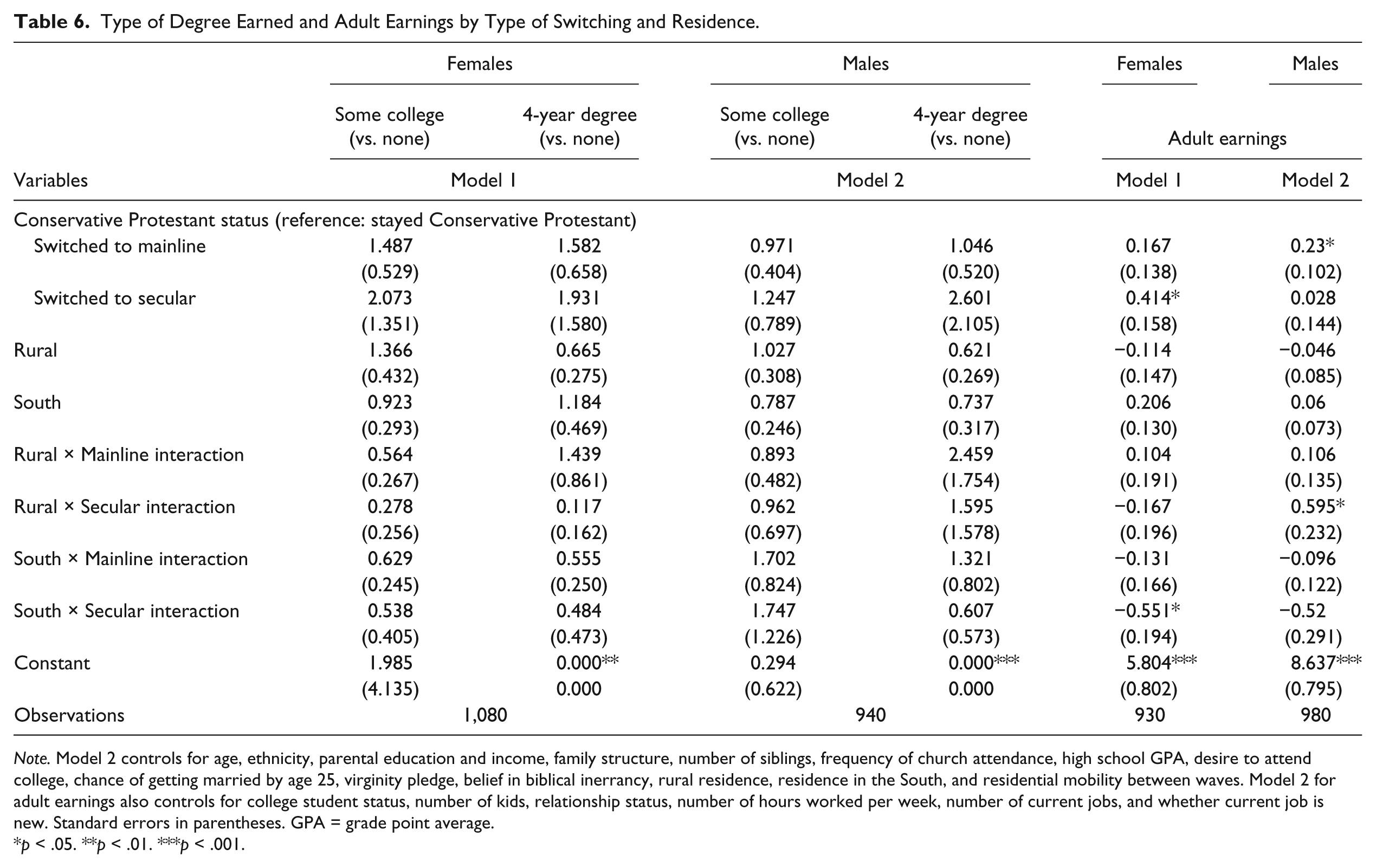
Note. Model 2 controls for age, ethnicity, parental education and income, family structure, number of siblings, frequency of church attendance, high school GPA, desire to attend college, chance of getting married by age 25, virginity pledge, belief in biblical inerrancy, rural residence, residence in the South, and residential mobility between waves. Model 2 for adult earnings also controls for college student status, number of kids, relationship status, number of hours worked per week, number of current jobs, and whether current job is new. Standard errors in parentheses. GPA = grade point average.
p < .05. **p < .01. ***p < .001.
In sum, our hypotheses were partially supported. Switching did reduce early family formation among both women and men but did not affect educational attainment and only affected earnings in very limited ways. Contrary to our expectations, results did not seem stronger for women than for men, nor were the benefits of switching generally greater for those who continued a religious affiliation than those who disaffiliated from religion. Overall, the results paint a picture of religious switchers who avoid early family commitments but are not able to increase their education during this period of postponement and show only limited increases in earnings. This pattern generally holds whether individuals continue to affiliate with an organized religion following their switch or not.
Discussion
Why the difference between those outcomes measuring family formation and those outcomes measuring socioeconomic attainment? We believe these differences emerge because youth have less personal control over their eventual educational attainment (and subsequent income attainment) than their age at first marriage and first birth. Because schooling advantages and disadvantages accumulate over time (Kerckhoff 1993), the opportunities a student has for academic upward mobility narrow over the high school career (Schneider, Swanson, and Riegle-Crumb 1997; Stevenson, Schiller, and Schneider 1994). Educational attainment may be set by early adolescence because of the immutable trajectories students face in secondary schools. Moreover, college attendance for this cohort was strongly overdetermined by parents’ willingness to pay for postsecondary education (Steelman and Powell 1991). Although youth may disaffiliate from their childhood religious affiliation, their parents most probably have not. Sherkat and Darnell (1999) show that youth who reject their parents’ religious fundamentalism exhibit markedly lower educational attainment while young men who shared their parents’ fundamentalist beliefs went further in school, suggesting that Conservative Protestant parents are more likely to help pay for schooling for those (male) children who conform to their religious views. More recently, Bengtson, Putney, and Harris (2013) describe Evangelical parents who report close relationships that include practical help and assistance when their children share their religious beliefs but more distant and uninvolved relationships when children reject this religious heritage.
In contrast, age at first marriage and first birth are strongly tied to young adults’ own sexual behavior and desire to establish their own families. Although still requiring some parental investment, these choices are often more immune to parental disapproval. When youth alter their religious social network by switching, they come into contact with other youth more likely to postpone family formation and norms supporting delay until income and maturational goals are achieved.
Certain disadvantages of the data may have also prevented the detection of greater impact from switching among respondents. First, this cohort was still relatively young at the last wave, 26 to 32 years of age. For some, educational attainment was not yet complete, while earnings trajectories among those with greater education had not yet had time to differentiate them from peers with less education in a tight labor market. Even though the amount of education received did not distinguish Conservative Protestant stayers versus switchers in this analysis, the type of education received by switchers might still be different, with switchers obtaining degrees from more selective institutions. Second, our ability to determine the precise time of the switch was limited. We did not have enough cases to differentiate between earlier switches in the data and later switches across survey waves, nor were we able to detect which switches were shared by parents and which were switches of youth alone. Most of our switches occurred at later ages (late teens and early 20s), when financial limitations may have prevented switchers from engaging in higher education without parental support. Finally, our limited sample size made techniques to overcome sample selection in the switching groups impractical. Propensity score matching techniques with future data might yet yield better estimates of the impact of Conservative Protestant switching on family formation and adult attainment among youth.
Nevertheless, these longitudinal data display strong and consistent effects of leaving a Conservative Protestant denomination on delays in family formation. Because delayed family formation has positive consequences for the stability and well-being of families and children, as well as the accumulation of family wealth over time (Keister 2008), religious switching may provide benefits to Conservative Protestant youth later in life. These results confirm that religious switching from a Conservative Protestant affiliation slows the accelerated transition to adulthood experienced by Conservative Protestant youth.
Much remains to be explored. The mechanisms through which religious switching alters developmental trajectories require explication and empirical support. We believe that changes in social networks and decreases in normative pressures to postpone premarital sex affect the timing and type of union formation among switchers. Information on school type (religious, public, secular private) and degree of network religious homogamy may help pinpoint when religious switching is most likely to delay family formation. These delays may improve the economic well-being and savings rate of switchers relative to those who remain Conservative Protestant, despite the failure of switching to improve earnings in young adulthood. The lack of impact of changes in religious networks on educational attainment and income also require further explication. School context information, including math and science course-taking, college attendance rates, and school average SES may help elucidate why switching does not affect educational trajectories in high school and beyond.
Finally, the results reported here do not address whether other forms of religious switching produce similar delays in the assumption of adult roles or whether the results for Conservative Protestant switching are unique. Our preliminary analyses of mainline denominational switching suggest this is the case, but future work will more carefully delineate how mainline religious switching and disaffiliation affect adult well-being.
Footnotes
Authors’ Note
An earlier version of this article was presented at the Population Association of America Annual Meeting 2013.
Declaration of Conflicting Interests
The author(s) declared no potential conflicts of interest with respect to the research, authorship, and/or publication of this article.
Funding
The author(s) disclosed receipt of the following financial support for the research, authorship, and/or publication of this article: This research was supported by Grant 5R24HD042849, awarded to the Population Research Center at The University of Texas at Austin by the Eunice Kennedy Shriver National Institute of Child Health and Human Development.
Notes
References
Supplementary Material
Please find the following supplemental material available below.
For Open Access articles published under a Creative Commons License, all supplemental material carries the same license as the article it is associated with.
For non-Open Access articles published, all supplemental material carries a non-exclusive license, and permission requests for re-use of supplemental material or any part of supplemental material shall be sent directly to the copyright owner as specified in the copyright notice associated with the article.
