



Abstract
Among the many crimes that go unreported to the police, intimate partner violence (IPV) is one of the least reported by victims. While some research has addressed various factors that influence police reporting for crimes in general, less is known about what shapes comfort with disclosing same-sex IPV within the lesbian, gay, and bisexual (LGB) community. The present study utilized secondary data gathered by a local nonprofit in the southeastern United States (N = 277) to explore the influences of race, gender, previous IPV victimization, and previous police intervention on the comfort participants reported in disclosing same-sex IPV to the police. The findings illustrate that those LGB who are nonwhite, male, and had experienced a previous police intervention in their own case of same-sex IPV reported significantly less comfort in disclosing same-sex IPV to the police. These results have implications for police training, LGB outreach, and future research.
Recent estimates have shown that intimate partner violence (IPV) continues to be a serious public health concern with 3 in 10 women and 1 in 10 men having been victimized (Black et al. 2011). In general, most studies conclude that rates of same-sex IPV are at least comparable with those of heterosexual rates, between 20 and 30 percent (McCarry, Hester, and Donnovan 2008; Renzetti 1992; West 2002). For victims of IPV, reporting to the police is often one of the least utilized resources and one that is perceived to be the least helpful (Coulter et al. 1999; Gracia, García, and Lilia 2011; Hutchison, Hirschel, and Pesackis 1994; Johnson 1990). Why victims of IPV, or crime victims in general, underreport to the police has been the subject of social scientific debate for decades. Many studies have examined the influence of a variety of sociodemographic predictors on how the police are perceived and how that may or may not influence a victim’s decision to report (Brown and Benedict 2002; Cheurprakobkit 2006; Frank, Smith, and Novak 2005; Gabbidon and Higgins 2009; Wu and Triplett 2009). The perception of law enforcement within communities has been a prominent area of research in policing (Brandl et al. 1994; Cao, Frank, and Cullen 1996; Henderson et al. 1997; Reisig and Parks 2000; Sampson and Bartusch 1998). How individuals perceive the effectiveness and potential biases within the police ultimately may influence whether or not the victim(s) of a crime report it. While there is an extensive literature on factors generally related to reporting crime, the literature on lesbians, gays, and bisexuals (LGB) within this area is significantly smaller.
When considering the LGB community, there is a long-standing history of homophobic police abuse (Chauncey 1994; Feinberg 1993; Wolff and Cokely 2007). The criminalization and historical oppression of LGB Americans by law enforcement is well documented and continues to be a prominent issue in policing (Bernstein and Kostelac 2002). Recent studies have continued to show that many law enforcement officials continue to hold homophobic and heterosexist attitudes (Bernstein and Swartwout 2012; Lyons, DeValve, and Garner 2008; Younglove, Kerr, and Vitello 2002). Others have linked police homophobia to over-policing and underreporting of crime by LGB (Dwyer 2011).
While many researchers have examined police perceptions by race, gender, and sexual orientation on the influence of crime reporting in general (Lai and Zhao 2010; Miles-Johnson 2013; Ren, Cao, Lovrich, and Gaffney 2005), fewer have examined how IPV victims perceive the police and how these perceptions influenced their comfort in disclosing IPV. Furthermore, the available studies have focused almost entirely on heterosexual female victims of IPV documenting the impact of other women’s negative stories of the police and how the criminal justice system marginalizes victim voices (Bennett, Goodman, and Dutton 1999; Epstein, Bell, and Goodman 2003; Liang et al. 2005; Wolf et al. 2003). However, within this area, there has been little focus on how LGB individuals report comfort with disclosing same-sex IPV to law enforcement. The current study expands our understanding of comfort in disclosing IPV to police by including the LGB community and exploring potential influences of a variety of sociodemographic indicators. These findings are of significant importance to law enforcement, victim advocates, and antiviolence projects. In addition, this discussion contributes to the development of an inclusive body of literature that examines the needs and perceptions of the LGB community and their ability to report IPV victimization with consideration to the diversity within this marginalized population.
Literature Review
Perceptions of Police
Within the area of perceptions of police research, most of the focus has been on historically marginalized and oppressed racial or ethnic groups and their general crime reporting (Garcia and Cao 2005; Schuck, Rosenbaum, and Hawkins 2008; Sims, Hooper, and Peterson 2002; Weitzer and Tuch 2005). A multitude of studies show that both African Americans and Latinos have much stronger negative perceptions of the police and are significantly less likely than whites to report crimes (Frank et al. 2005; Gabbidon and Higgins 2009; Lai and Zhao 2010; Wu and Triplett 2009). In addition to race, other studies have examined the influence of gender on police perceptions that have yielded mixed results with some showing that women have more favorable views of the police while in others having less (Brown and Benedict 2002; Cao et al. 1996; Cheurprakobkit 2000; Correia, Reisig, and Lovrich 1996; Reisig and Correia 1997; Reisig and Giacomazzi 1998). In addition, many studies have illustrated that gender may have no influence at all on how the police are viewed or the probability of reporting crimes (Frank et al. 1996; Jesilow, Meyer, and Namazzi 1995; Parker, Onyekwuluje, and Murty 1995; Ren, Cao, Lovrich, and Gaffney 2005).
Some studies have shown that gender effects may disappear when considering previous victimization—with those who have previously been victimized being more likely to have less favorable views of the police (Cao, Frank, and Cullen 1996; Frank et al. 1996; O’Connor 2008; Payne and Gainey 2007). These findings may illustrate that victims often feel that they have the police to blame for “allowing” their victimization to occur. IPV victims in particular may feel reluctant to report to the police because of fear of partner retaliation, the perceived “uselessness” of police involvement, or overall community perceptions of the police (Coulter, Kuehnle, Byers, and Alfonso 1999; Hutchinson, Hirschel, and Pesackis 1994).
Victims and Comfort in Disclosing to Police
Police intervention in IPV has shown to provide mixed results for victims. Several studies using shelter or social services samples have regularly found strong negative perceptions of the police regarding involvement in IPV (Coulter et al. 1999; Wolf et al. 2003; Yegidis and Renzy 1994). In interviews with 41 women in social service agencies, Wolf et al. (2003) found negative perceptions of police involvement that included stories in which the police trivialized victims’ experiences, perpetrators bonding with the police officer, and cultural norms in avoiding police reporting. Similar negative perceptions of the police have been echoed in studies by Erez and Belknap (1998), whereas others such as Martin’s (1999) and Fleury’s (2002) studies yielded positive or neutral views toward the police, respectively.
Some more recent studies have examined the role of race and/or ethnicity on IPV victims’ perceptions of law enforcement. Lipsky et al. (2006) claimed that “racial and ethnic disparities in help-seeking from IPV-related community resources have been explored to a greater extent” (p. 83). Several studies have found that while minority female IPV victims are less likely than their white counterparts to seek help, police assistance is an exception (McFarlane et al. 1997; Kaukinen 2004; Krishnan, Hilbert, and VanLeeuwen 2001; West, Kantor, and Jasinski 1998). In addition, it has been found that black women may be most likely to use police intervention as their primary form of help-seeking (O’Campo et al. 2002; Pearlman et al. 2003). This may be partially due to the fact that these women have routine police presence in their neighborhoods or have the police called for them by others (Lipsky et al. 2006).
While there is support for the proposition that racial and ethnic minority women are most likely to call the police, this is not necessarily an indication of favorable views. In a majority African American sample, Fugate et. al (2005) found that in general, police reporting was uncommon and not perceived as helpful for IPV. In the Wolf et al. (2003) sample, white women reported that police were “prompt and courteous” in their response to the calls for help while racial and ethnic minority women expressed fears of racial biases and discrimination (p. 125). A significant factor influencing IPV victims seeking help from the police may be attributed to the experiences of other battered women or at least hearsay of negative police experiences. As Liang et al. (2005) stated,
many abused women have heard about or experienced negative police responses, including failure to arrest the batterer; mistaken identification of victim as batterer; the victim not listened to or the situation trivialized; and race, socioeconomic status, and homophobic stereotyping (Bennett, Goodman, and Dutton 1999; Wolf et al. 2003). (P. 77)
Concerns over how victims will be perceived by the police or how actual experiences with police have varied based on perceptions of the victim illustrate the power of stereotypical constructs of IPV victims. Those who feel they may not be believed, helped, or supported by the police tend to be nonwhite, male, or LGB (Seelau and Seelau 2005).
Of particular importance to the present study is Liang et al.’s (2005) mention of homophobic stereotyping by police and the reluctance to report same-sex IPV by LGB victims. As the research on IPV victims’ perceptions of the police has been primarily dominated by female experiences within the context of heterosexual relationships, a largely unexplored area exists in examining IPV victims’ perceptions of the police within the context of same-sex relationships. While it has been estimated that LGB individuals face comparable rates of IPV victimization with that of heterosexual women, less is known about their interactions with or perceptions of police.
In a key study by Merrill and Wolfe (2000) that explored the help-seeking behaviors of gay male IPV victims, they reported that “battered gay and bisexual men, like their lesbian counterparts, have difficulty enlisting appropriate response from the police” (p. 7). Previous pioneering studies have found that LGB victims of IPV consistently had negative experiences with the police or negative perceptions of the police that influenced reporting (McClennan 2005; Renzetti 1992). Gender-role stereotyping and narrow assumptions of who “real” victims are also discourage reporting among LGB individuals. Those who are perceived as “butch” or male may be seen by police as less believable victims and may result in misarrests (Seelau and Seelau 2005). Merrill and Wolfe (2000) mentioned that, in particular, for gay men, there exists a “long history of harassing” (p. 7). While these studies have been crucial in opening exploration, they have been limited by very small sample sizes; in the Merrill and Wolfe example, only 52 responses were left in the final analyses which found the police to be the least somewhat helpful by a majority of respondents. Finally, previous studies and theoretical works have demonstrated support for an intensified lack of trust in the police among gay and lesbian victims of color and/or of lower socioeconomic statuses (Butler 1999; Kanuha 1990; Mendez 1996; Wolf et al. 2003).
Overall, it has been well supported that narratives constructing believable or ideal victims have marginalized those survivors who are not white, heterosexual women. Many of the studies focusing on LGB have been limited by a small sample size, empirical validation to theoretical propositions, and lack an exploration into various factors that may influence comfort in disclosing same-sex IPV to the police. Furthermore, there is no research to date that compares those LGB who have previously had police intervene in their own personal case of IPV within the context of a same-sex relationship with those who have not and whether this influences perceptions of the police.
The broadness of the available findings indicates that race is an important factor in the comfort with disclosing IPV to the police. While more mixed findings point to the influence of gender, it continues to be a factor of interest in this area of research. Finally, given the lack of investigation into LGB comfort with disclosing IPV to police and potential influential factors such as race, gender, previous IPV victimization, and previous police intervention, the following research questions were proposed: among LGB,
Method
The present study utilized an existing data set collected by community agencies in collaboration with a university research partner seeking to gather information on IPV within the local LGB community. The survey was constructed through a community participatory action model in which researchers, activists, and members of the community shared input on what aspects of same-sex IPV were essential to gauge within the LGB community. Inspired largely by the Virginia Anti-Violence Project (VAVP) community violence survey, the members assembled a survey that consisted of four separate sections. Part I assessed basic sociodemographics, Part II gauged participants’ perceptions of domestic violence, and Parts III and IV assessed participants’ experiences with IPV and/or the perpetration of IPV.
Sample and Participant Selection
The survey was made available online, was voluntary and confidential, and took approximately 10 to 15 minutes to complete. The sample was sought through avenues frequented by LGB-identified individuals (e.g., bars, Pride events, community centers, etc.). This targeted sampling allowed for the distribution and marketing of the survey in areas, organizations, and businesses that had a large LGB clientele base. In addition, participating LGB organizations marketed the online survey link through existing e-mail listservs. The use of a convenience sampling technique allowed for the opportunity to reach a marginalized community efficiently and is a common strategy in lesbian, gay, bisexual, transgender, and queer (LGBTQ) studies. However, as a result, any findings that result from convenience samples are not considered generalizable—an issue that continues to plague studies on LGBTQ communities (Owen and Burke 2004). Eligibility for the survey was determined with the following question:
1. Do you identify yourself as having a nonheterosexual sexual orientation or gender identity or expression not traditionally associated with your birth sex? (Or, do you identify somewhere along the Lesbian, Gay, Bisexual, Transgender or Queer spectrum?)
Only respondents that selected “yes” to this question were included in the data for analysis. The final sample size used for analyses was 277; this sample only includes participants who responded to each of the items involved in the analyses.
Measures
Originally, to measure comfort with disclosing same-sex IPV to the police, an index was constructed from five survey items that assessed respondent’s comfort level with police in various ways. These questions assessed whether a respondent felt that law enforcement officers were sensitive to LGB issues; law enforcement officers were homophobic; LGB avoid reporting same-sex IPV to the police because of fear of sexual orientation disclosure; transgender individuals avoid reporting same-sex IPV to the police because of fear of gender identity disclosure; and that the respondent would feel comfortable reporting their own incidence of IPV to the police. Response options were initially constructed in Likert-type format ranging from 1 = strongly agree to 5 = strongly disagree. The values ranged from 1 to 5 with higher values illustrating more comfort with disclosing same-sex IPV to police. Three items were reverse-coded in value to reflect that disagreeing with those statements indicated less comfort with disclosing same-sex IPV to police. For those items, strongly disagree was given a value of 5, whereas strongly agree was given a value of 1.
Combined values were divided by 5 to reflect a theoretical range of the index from 1 to 5; the actual range was 1 to 4. Overall, higher scores on the scale indicated more comfort with disclosing same-sex IPV to police. Exploratory factor analyses illustrated that these items all loaded together on one construct and the scale yielded a Cronbach’s alpha reliability coefficient of .68 indicating an acceptable reliability. The mean of this variable was 1.89 indicating that the overall sample felt less comfort in reporting same-sex IPV to the police. The overall distribution of this variable was negatively skewed yielding a kurtosis of 3.07. While log, square, square root, z-score, and cubic transformations were all performed to help normalize the distribution, none did so adequately. The variable was therefore best suit for a nonparametric analysis in which the dependent variable was recoded into a binary variable through a median split in which 0 indicated less comfort in disclosing same-sex IPV to the police and 1 indicated more comfort in disclosing same-sex IPV to the police. The median, 1.80, of the dependent variable was on the scale ranging from 1 to 4. Approximately 53 percent of the sample fell into the (0) category of less comfort in reporting same-sex IPV to the police, whereas 47 percent reported (1) more comfort in reporting same-sex IPV to the police.
Two of the explanatory variables, race and gender, were dichotomized. Due to the size of the sample, race was recoded into white (0) and nonwhite (1) (Asian, black, Hispanic, and other races). The largest minority group, Hispanic/Latino, had only 49 respondents. There were 23 African American/black, 7 multi- or biracial, 5 Asian/Pacific Islander, and 1 Native American/American Indian respondents. The original gender survey item included male, female, and transgender. Gender was dichotomized to only male (0) and female (1) as there were only eight transgender responses in this sample; transgender respondents were not included in the final analyses. The majority, 69 percent (n = 192), of the sample is white and 53 percent (n = 147) female. Respondents were also asked if they had previously called police to intervene in their own case of same-sex IPV in which they were the victims and this was also coded (1) yes and (0) no. Finally, respondents were asked if at any point in their lifetime they had been in an abuse same-sex romantic relationship; those response options were coded (1) yes and (0) no.
Control variables included income and years of education. These were held as controls to ensure any relationships between race, gender, IPV victimization, or previous police intervention in a participant’s own case of same-sex IPV had little or nothing to do with the participant’s income or educational background. The income variable was originally coded in categories of income ranges that ranged from (1) I have no source of income, (2) US$0–$11,999, (3) $12,000–$24,999, (4) $25,000–$39,999, (5) $40,000–$74,999, (6) $75,000–$1,00,000, and (7) $1,00,000 and above. This variable was recoded to midpoints of income categories transforming it from a categorical variable to a continuous one. The mean income for this sample was $43,030 with a standard deviation of $31,937. The education variable was transformed from a categorical variable to one that was continuous in years of education. The mean years of education for this sample were 15 years with a standard deviation of 2.24 years indicating that the average participant had 3 years of postsecondary education.
Results
Table 1 describes the final sample utilized. A fairly high percentage, 44 percent, of the sample had reported experiencing IPV within the context of a same-sex relationship but only 9 percent reported having had prior police intervention in their own case of same-sex IPV in which they were the victims. Binary logistic regression was employed to predict participant comfort in disclosing same-sex IPV to the police utilizing the main explanatory variables of race, gender, previous police intervention, and IPV victimization (see Table 2). This method was most appropriate as the comfort in disclosing same-sex IPV to police variable needed to be split by the median into a binary variable. All assumptions were verified and held.
Means and Standard Deviations for the Overall Sample.

Note. IPV = intimate partner violence.
Logistic Regression Standardized Coefficients Predicting Comfort in Disclosing Same-Sex IPV to the Police.
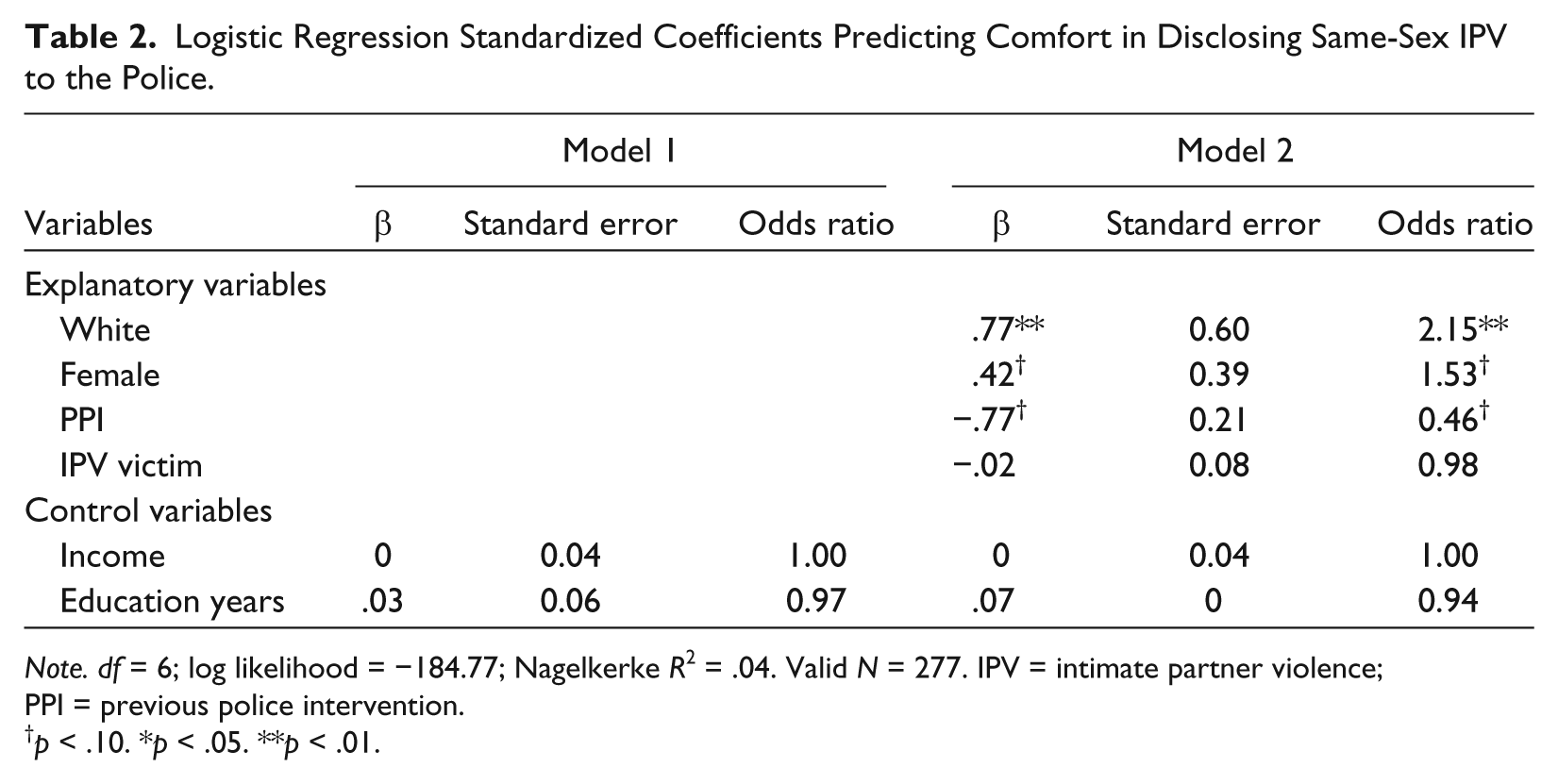
Note. df = 6; log likelihood = −184.77; Nagelkerke R2 = .04. Valid N = 277. IPV = intimate partner violence; PPI = previous police intervention.
p < .10. *p < .05. **p < .01.
Two logistic regression models were conducted; one in which only control variables were included and one that added the four explanatory variables. The first model which only included the control variables of income and education years did not yield any significant findings. The second model added the explanatory variables of race, gender, previous police intervention, and IPV victimization. This model was statistically significant (χ2 = 14.37, df = 6, p = .02), though pseudo-estimates of explained variance were low (e.g., Nagelkerke R2 = .04). This low effect size is discussed in more detail in the proceeding “Discussion” section.
Regarding Research Question 1, race and gender revealed significant influences on the perception of police homophobia related to same-sex IPV. White respondents were approximately twice as likely to report feeling more comfortable with disclosing same-sex IPV to the police than their nonwhite counterparts (odds ratio [OR] = 2.15, p < .006). While only marginally significant (p < .10), female respondents were 1.5 times more likely to report feeling more comfortable with disclosing same-sex IPV to the police than male respondents (OR = 1.53, p = .09). The second research question asked whether a relationship would exist between comfort in disclosing same-sex IPV to the police and having reported a previous police intervention in one’s own case of same-sex IPV. The model illustrated a marginally significant (p < .10) relationship indicating that those respondents who had reported having had a previous police intervention were 0.46 times less likely to feel comfortable disclosing same-sex IPV to the police than those who had not experienced a police intervention in the past (OR = 0.46, p = .08). Finally, the third research question asked whether a relationship would exist between having had experienced same-sex IPV in the past and comfort in disclosing same-sex IPV to the police. The model did not yield any significant finding for this relationship.
Discussion
The purpose of this study was to explore various influences on comfort with disclosing same-sex IPV among LGB. Specifically, it measured this perception of the police within the context of same-sex IPV response. This provided an investigation into how LGB individuals perceive the police in terms of how they would respond to same-sex IPV. Unlike previous studies that have documented homophobic experiences with the police or described a sense of perceived police homophobia within this community, this study explored various influences on these perceptions. By comparing participants by race, gender, previous IPV victimization, and previous police intervention experiences, this investigation expands what we know about what shapes comfort in reporting same-sex IPV to the police. While the final model only explained 4 percent of the variance in comfort in disclosing IPV, it is important to note that it should not undermine its explanatory contribution. Given that this specific area is largely unexplored, the model’s findings tell us that these factors (race, gender, and previous police intervention) are important but are only a small part of what influences comfort in disclosing IPV to the police. Previous literature on IPV victim’s perception of the police and their decision to report victimization argue that factors like gender and race matter significantly (Liang et al. 2005; Lipsky et al. 2006). What the small effect size of the model in this current study may show is that these factors (race and gender) may not be as influential in LGB samples. Importantly, the small sample size also weakens the model’s explanatory power and may not actually indicate that these factors only explain a small amount of variance in comfort in disclosing IPV to the police. These findings push the area of inquiry into what influences disclosure beyond race and gender focused explanations to other potential factors. These factors may include previous police interactions of other types not related to IPV, the context of geographic location, or perhaps how different types of IPV may make an LGB victim more or less likely to report.
The findings from this study support previous findings that those who are nonwhite report less comfort with disclosing to the police (Gabbidon and Higgins 2009; Lai and Zhao 2010; Wu and Triplett 2009). In this present application, the significant lack of comfort in disclosing same-sex IPV may be an indication of negative police perception. Considering the diversity within the LGB community, the influences of race on police perceptions have remained relatively unexplored before this study. In addition, these findings support other studies that men within the LGB community have distinctly more negative perceptions of the police when compared with women (McClennan 2005; Merrill and Wolfe 2000; Renzetti 1992). One explanation for why gay men may report less comfort in disclosing same-sex IPV to the police could be attributed to the long-standing hostility between police and gay or effeminate men (Merrill and Wolfe 2000). Gay men may perceive the police as hypermasculine and hostile toward their community and have heightened negative attitudes toward how police would respond to same-sex IPV. Studies on heterosexual male victims illustrate that men may be more likely to experience ridicule by police or be mistaken as the aggressor (Douglas and Hines 2011). The question remains whether heterosexual and gay or bisexual men experience problematic interactions with the police in similar ways.
What prior research has left primarily unexplored within the LGB community is how previous same-sex IPV victims and those who have had previous police intervention perceive police homophobia related to same-sex IPV. In this study, those who had reported previous police intervention in their own case of same-sex IPV reported marginally significant less comfort in disclosing same-sex IPV to the police. This is a particularly key finding as it indicates that those LGB who have previously relied on the police for their victimization may have had a undesirable outcome or experience. LGB victims of same-sex IPV are likely experiencing discrimination by police, negative encounters, or their victimization may not be taken as seriously. The potential perceptions of police homophobia may be a significant barrier to police reporting of same-sex IPV within the LGB community.
This study has several limitations that should be noted. First, the survey was constructed through a participatory action model that allowed for collaboration between researchers and activists in the LGB community. As a result, the survey items may not necessarily have had thorough psychometric properties and tests that ensured question validity. The measure for IPV victimization does not take into account severity, injuries experienced, or frequency, thus lacking some important detail. In addition, the method in which the sample was recruited may also introduce a bias in the sample in that these respondents were “out.” While the present discussion was limited to LGB, it is important to note that transgender members of the community may face not only similar but also many unique challenges with police and the criminal justice system that could not be explored utilizing these data.
While the nature of online surveys allows a platform for victims to respond to sensitive questions with more privacy, this method is not able to adequately capture the broader context of what influences comfort in disclosing IPV to police. For example, we are left without knowing the nature of the prior police involvement. Lacking this information, it is difficult to understand what specific concerns individuals had with their police interactions. Future research could explore these questions more effectively through in-depth interviews. Through detailed conversations, researchers may have the opportunity to explore the role of types of IPV (i.e., emotional, sexual, and physical) experienced and comfort in disclosing or whether previous police interventions resulted in the diminishment or increase of future violence in the relationship. Stages of relationships may also play a role in how comfortable LGB victims are with disclosing IPV to police; might victims feel more comfortable disclosing to police after the relationship has ended? In addition, interview-based research could capture the potential ramifications for police interventions such as loss of children or the abusive partner’s employment.
While the comparison of victims and nonvictims yielded no significant difference, future research should address the possibility that those who are victimized may feel like disclosing to the police is not an option. Those who reported being victims of IPV perhaps may have more negative perceptions of the police because they felt no one was there to help in the past or that they had no access to the criminal justice system. A lack of comfort in disclosing same-sex IPV to the police may be an indication that the LGB community does not feel able to pursue legal recourse for their victimization. These implications should be a priority addressed in diversity police training with particular attention to the perceived homophobia evident in the LGB community that may be a barrier to the reporting of same-sex IPV. In a fairly recent example, the Atlanta Police Department trained almost 2,000 of both their uniformed police officers and civilian employees in issues related to sexual orientation and gender identity (Bagby 2011). Their lesson plan included a brief history of the LGB community in America and explored various reasons why LGB may often not trust the police. An expansion of this application may include racial and gender identity diversity issues with the LGB community.
Future research in this area should explore differences in police perception between racial and ethnic minorities within the LGB community with larger samples. Furthermore, researchers should examine the experiences and perceptions of the transgender community with IPV victimization and police reporting. As evidenced by the lack of transgender responses in this study, the transgender population may be a difficult community to reach, but further knowledge is needed to address their unique perceptions of the police. Finally, as more police trainings and workshops include LGB-specific topics, evaluations of the success of these programs become important. Evaluations should seek to explore which aspects of these trainings are most influential in shaping more positive relationships with the LGB community and explore the effect on comfort with disclosing crimes to the police among the LGB population.
Footnotes
Declaration of Conflicting Interests
The author(s) declared no potential conflicts of interest with respect to the research, authorship, and/or publication of this article.
Funding
The author(s) received no financial support for the research, authorship, and/or publication of this article.