




Abstract
Research on the science, technology, engineering, and mathematics (STEM) “pipeline” has charted the loss of potential STEM talent throughout students’ secondary and postsecondary trajectories. One source of STEM talent loss that has been commonly suggested throughout the literature is the lack of family friendly flexibility in STEM careers. This explanation has been offered as a reason why women are underrepresented in the STEM fields. We test this thesis using original survey data collected from 3,229 college students at each of the 16 North Carolina public universities. Our results indicate that a concern for the potential inflexibility of one’s future career is associated with a decreased likelihood of majoring in the “hard” STEM fields (physical sciences, engineering, and mathematics). However, we did not find gender differences in this effect, suggesting that men and women who are concerned with the family flexibility of their future career are equally likely to be deterred from STEM.
Keywords
Introduction
The uneven pursuit of science, technology, engineering, and mathematics (STEM) fields has long been a topic of interest for social scientists, policymakers, and STEM practitioners (see Ong et al. 2011 for a review). Researchers have commonly discussed pathways to STEM careers by employing the analogy of a pipeline (Blickenstaff 2005), in which several stages must be successfully passed for an individual to arrive at a career in science, technology, engineering, or mathematics. These stages include elementary, middle (Rivoli and Ralston 2009), and high school (Subotnik et al. 2009; Tyson et al. 2007), college major declaration and graduation (Daempfle 2003; Seymour 1992), and transition into the STEM workforce, as well as retention in these career fields (C. Hill, Corbett, and St. Rose 2010). 1
Accompanying the pipeline image is the idea that “leaks” occur at each phase in the STEM pathway. Overall, research has indicated that despite an initially large pool of young people who are interested and/or capable in STEM (National Science Foundation [NSF] 2007), there is a high rate of attrition along the pipeline (NSF 2012). One emerging potential explanation for these leaks is a perceived lack of family flexibility of STEM careers. Several researchers have suggested that workplaces—for instance, engineering firms—that do not facilitate work-life balance cause women in particular to leave STEM fields (Gill et al. 2008; McIlwee and Robinson 1992). Yet, researchers have not established whether desires for family flexibility are associated with leaks earlier in the pipeline. The purpose of this study is to explore the role of perceptions of family flexibility of STEM careers as this relates to choice of majors among college seniors. 2
We test hypotheses regarding the link between perceptions of family flexibility and choice of college major using primary survey data gathered from a sample of North Carolina college students at all of the 16 public universities that comprise the state system. Our analyses reveal, first, that students who are concerned with future family flexibility of their careers are significantly less likely to pursue physical sciences, engineering, and mathematics majors, and are more likely to leave STEM majors for non-STEM majors. Such perceptions have no significant association with their probability of choosing a major in the biological sciences, however. Second, once prior academic experiences and other demographic factors are controlled for, men and women are equally likely to be deterred from a STEM field if they consider family flexibility. Moreover, this effect holds even when current family situations (age, partnership status, and parenthood status) are controlled for, suggesting an anticipatory consideration of work/family conflict in choice of majors. Third, these findings suggest that mere perceptions of a field’s norms or demands regarding work/family balance can impact individuals’ entry into that area through their choice of college major. Finally, our results indicate that consideration of family flexibility does not account for the extant gender differences in pursuit of STEM majors in college.
Family Flexibility in the STEM Workplace
The notion of family flexibility is a relatively recent one in the American workplace. E. J. Hill et al. (2008:151) defined workplace flexibility as “the degree to which workers are able to make choices to arrange core aspects of their professional lives, particularly regarding where, when, and for how long work is performed.” An increasing awareness of augmented work hours (Jacobs and Gerson 2004; Schor 1992), shifting workplace temporalities (Rubin 2007), and the burden of childrearing and other domestic responsibilities (Hochschild and Machung 1989) has pointed to the role of the workplace in mitigating the competing time demands of family and work.
Indeed, both the family and the workplace are greedy institutions, meaning that they compete to maximize individuals’ time commitments (Coser 1974). Workplaces, for example, place subtle pressures on workers to ensure time commitment; these include risks of unemployment or underemployment and continuous connectivity through cell phones and e-mail (Sullivan 2014). One of the greatest pressures to commit time to the workplace is cultural, notably the work ethic (or work devotion schema), which assumes that individuals are expected to fully commit to workplace demands and pervades American society. Yet, the need for flexibility in work time to support family is often stigmatized because it conflicts with the traditionally understood work ethic (Blair-Loy 2003; Williams, Blair-Loy, and Berdahl 2013).
Therefore, flexible working schedules and other family friendly work policies are not sufficient to create an environment that workers perceive as family friendly (Berg, Kalleberg, and Appelbaum 2003; Keene and Quadagno 2004). Instead, workplaces also require cultures that are supportive of a work/family balance (Blair-Loy and Wharton 2002; Cech and Blair-Loy 2014; Thompson, Beauvais, and Lyness 1999). These two components of workplaces—both the actual policies and the expectations surrounding their usage—serve to influence people’s perceptions of a career’s associated lifestyle in terms of family friendliness. As Powell and Greenhaus (2010) conceptualized them, the work/family balance/conflict and perceptions thereof will influence individuals’ work-related decisions regarding role entry, participation, and exit.
We combine these two insights by specifically investigating role entry as a function of perceptions of a career. We conceptualize students’ decisions to major or not major in a particular field in college as part and parcel of this role entry into a career—in this case, a career in one of the STEM fields. Prior work has indicated that, for most STEM fields especially, it is reasonable to assume a fairly tight major-career correspondence (Carnevale, Cheah, and Strohl 2012; see also Caren 2013). Furthermore, we expect that one element of the college major decision-making process involves perceived future lifestyle of the career. In other words, if a student values a certain lifestyle—such as one in which work and family time commitments can be balanced—he or she may make a college major decision founded on perceptions of the future career lifestyle associated with that major.
We anticipate that college students may perceive that STEM fields in physical sciences, engineering, technology, and mathematics fields (PSE) are less conducive to a work/life balance. This perception may also be reflected in the workload that the different majors require during college. As Arum and Roksa (2011) showed, students who major in engineering spend significantly more time on their academic coursework during college than students who major in non-STEM fields.
Indeed, this differential workload and lack of flexibility in college may seem to foreshadow a difference in workplace. Cech and Blair-Loy (2014) found that academic scientists and engineers who are parents report the presence of flexibility stigma in the workplace. In addition to academic work environments, studies on private employers have found that many STEM fields are characterized by workplace cultures that do not facilitate a family flexible professional life. Many of these studies have focused specifically on the technology sector. In the information technology (IT) industry in Ireland, Cross and Linehan (2006) and James (2011) concluded in separate case studies that although the Irish government has instituted family friendly policies such as paid parental leave, taking advantage of such policies was viewed negatively by employers. Bal (2010) conducted a survey of employees in the software industry in India, finding that these employees consider organizations’ policies regarding work-family balance to be important, although they may not necessarily be aware of their company’s policies or believe that they have been well implemented; Kanwar, Singh, and Kodwani (2009) reported similar findings for their surveyed sample in southern India. Also, in the software field, Scholarios and Marks (2004) concluded that the American technology sector is marked by a norm that the separation of work and home life is more “blurred” for employees in this sector than in traditional occupations. Within science and engineering, Xie and Shauman (2003) found that married women with children are disadvantaged in the American labor force because they are more likely to be unemployed, less likely to be promoted, and less likely to pursue a science or engineering field once they have completed the relevant major. Given these findings about the nature of work/life balance in the STEM workplace and its potential influence on STEM role entry, we hypothesize that students’ concerns about family flexibility will be an important predictor of whether or not students pursue studies in the STEM areas.
In contrast, careers in the biological sciences may be perceived as having greater family flexibility than the PSE STEM fields due to the fact that women have a more visible presence in the biological science fields (Ceci, Williams, and Barnett 2009). Gender proportions in a major or an organization may influence perceptions of and experiences with family flexibility. In fact, several studies (A. E. Davis and Kalleberg 2006; Goodstein 1994; Seyler, Monroe, and Garand 1995) have found that a higher proportion of women at a firm increases the amount of family friendly workplace benefits.
Yet perceptions of flexibility do not necessarily reflect the reality of flexibility. In fact, Golden (2001) found that natural scientists have the second-highest flexibility in their scheduling compared with all other occupations, with 60.2 percent reporting having flexible schedules. Mathematical scientists came in fifth, with 55.9 percent having flexible schedules. Engineers are tenth, at 47.9 percent who have flexible schedules. Health-diagnosing occupations, many of which fall within the realm of the biological sciences, figured lower, with 42.6 percent reporting having flexible schedules. Nonetheless, college students frequently make major decisions on the basis of very limited and often stereotypic information about the future careers associated with major fields of study. The increase in female incumbents in biological, science-based occupations such as medicine, dentistry, veterinary medicine, and pharmacy may contribute to an expectation that such professions offer family flexibility. Thus, we expect that, compared with the PSE STEM fields (i.e., the physical sciences, engineering, technology, and mathematics), the biological sciences are seen as more conducive to a work/life balance.
Gender and Work/Family Conflict
In contrast to the numbers mentioned above regarding flexible scheduling, some researchers have concluded that work-family conflict is more salient for women in the PSE STEM industries. Ahuja’s (2002) review of the literature cites work-family conflict as one of the reasons women are underrepresented in IT fields. In their mixed-methods study of female scientists, Etzkowitz, Kemelgor, and Uzzi (2000) characterized women’s professional lives as demanding, noting that they often conflict with equally demanding personal lives as well. These studies suggest the occupations in the PSE STEM fields of physics, engineering, technology, and mathematics may be marked by family unfriendly policies or workplace cultures that do not value work/life balance.
These cultures may affect men and women differently, both in academe and in the workplace. Some studies find environmental and cultural differences that lead to higher dissatisfaction for female STEM workers for a range of reasons. For example, Xu (2008) found that female STEM faculty are more likely than male faculty to want to change faculty positions, but attributes this dissatisfaction to perceptions of academic culture, rather than concerns about family responsibilities. More generally, Callister (2006) argued that perceptions of work climate, including concerns about institutional policies regarding work/family balance, mediate the relationship between faculty gender and intent to change jobs or leave academics altogether. Moreover, Settles et al. (2006) noted a similar level of dissatisfaction among female faculty in STEM departments, who find heightened levels of sexual harassment and other types of gender discrimination, results that are also echoed in Gardner’s (2012) study of “toxic” academic workplaces that lead to dissatisfaction among female faculty. 3
These workplace realities are particularly problematic for women in these careers because they are often compounded with women’s disproportionate amount of family responsibilities, and their responsibilities tend to be more time intensive (Coltrane 2000; Hochschild and Machung 1989). Prior research indicates that, in heterosexual relationships, women, particularly women with children, spend significantly more time on household labor than their male partners do (Bianchi et al. 2000; Bianchi et al. 2012). 4 Thus, concerns about family flexibility are likely to be a greater obstacle to STEM role entry for women than for men.
However, our third hypothesis is tempered by more recent research that has opened a wide debate over the validity of the “gendered time bind” argument. Indeed, some scholars have argued that progress toward gender equity in society has stalled because men’s roles have remained stable even in the presence of changing roles of women (Hochschild and Machung 1989). In essence, in the public sphere, women entered the labor force and even “men’s jobs,” but in the private sphere, men did not similarly challenge the gendered division of domestic labor, which has remained highly unequal. Consequently, the movement toward gender equality in both the public and private spheres has stalled (England 2010; Friedman 2015).
Nevertheless, some scholars disagree with this perspective and argue that although the move toward gender equity is uneven and slow, it is progressing in all spheres (Reskin and Maroto 2011). Importantly, although scholars disagree over the extent to which time spent on domestic labor has converged between men and women (Bianchi et al. 2000; Gershuny 2000; Milkie, Raley, and Bianchi 2009), many scholars agree that men’s responsibilities in the home and time commitment to these tasks have increased as women have entered the labor force (Bianchi, Robinson, and Milkie 2006; Bittman and Wajcman 2000). Furthermore, recent research has suggested that men and women are either equally likely to experience work-to-family interference and family-to-work interference (Byron 2005), or that men are more likely than women to experience work-family conflict (Galinsky, Aumann, and Bond 2009). This is due, in part, to the changing gender norms regarding what it means to be a “good” man. Men are more likely to believe today that they should be both a financial provider and an involved father/spouse (Aumann, Galinsky, and Matos 2011). At the same time, even among those employed in the academy, fathers are as likely as mothers to sense a stigma associated with needed flexibility for work-life balance (Cech and Blair-Loy 2014). Overall, the few studies of job values and life aspirations over the years have generally suggested gender convergence in job attributes sought by men and women (Konrad et al. 2000; Shu and Marini 1998) and in the relative importance of marriage and children to both genders (Marini et al. 1996; Morgan, Gelbgiser, and Weeden 2013; Xie and Shauman 2003). Faced with shifting cultural mores regarding men’s involvement in home and family life, young men as well as young women increasingly expect to juggle home/family and work responsibilities. We may therefore expect to find that contemporary college men and women may similarly consider family flexibility associated with their future occupations when choosing their majors.
Our study permits us to tap into contemporary college students’ cultural expectations regarding work/family balance. If, as previous research suggests, undergraduate men today anticipate their family roles to be as involved as do undergraduate women, then we would not expect gender to moderate the relationship between consideration of future career family flexibility and probability of majoring in a STEM field. By this reasoning, it is possible that we will not find support for H3 because there may no longer be gender differences between men and women in the degree to which consideration of family flexibility of future career is associated with majoring in a STEM field.
Finally, we formally test the propensity to leave a STEM major for a non-STEM major on the basis of perceptions of impending work/life conflicts associated with pursuing a career in a STEM area. We expect that, among those students who are equally capable of pursing a STEM field on the basis of their prior math and science achievement, those who express a consideration of family flexibility are more likely to exit the STEM pipeline than students who are not concerned.
Method
To test these hypotheses, we analyze primary survey data collected in 2013 from college students with senior standing at all 16 member institutions of the University of North Carolina (UNC) system. Students who had accrued more than 90 hours of academic credit by January 2013 were recruited via e-mail to take an online survey as part of a larger research effort for the Roots of STEM project (Stearns et al. 2013). Students who responded to the survey were entered into drawings for gift cards as incentives to participate.
Among the approximately 16,000 students in the sampling frame (90 or more hours of academic credit), 4,848 students responded to the online recruitment survey soliciting those interested in being interviewed about their choice of college major. The online recruitment survey yielded a response rate of approximately 30 percent. 5 After eliminating duplicate respondents and cases with missing data, the final analytic dataset used in this study contains 3,229 respondents. The final sample is 68 percent white, which is slightly higher than the population of students in the UNC system in 2013 (61 percent white), and 72 percent female, which is again higher than the UNC system (at 56 percent). 6
Students were surveyed about demographic, institutional, and background information, such as which college they were attending, whether they had transferred from another institution, what major they were pursuing, when they intended to graduate, and several questions specific to their interest and ability in the STEM fields, including their views on work/life balance.
The primary outcome of interest in this article is a three-level categorical variable capturing whether the student: (1) majored in a non-STEM field throughout college (the reference category), (2) majored in a biological science field, or (3) majored in a PSE STEM. To identify STEM fields, we employ categories according to NSF’s National Center for Science and Engineering Statistics’ classification (http://www.nsf.gov/statistics/nsf11316/pdf/nsf11316.pdf). Social sciences were excluded from the definition of STEM due to their relative parity in terms of gender, race, and socioeconomic status (SES) representation (see the online appendix for the categorization of majors into the three major categories). Approximately one-fourth of the sample falls under the STEM major umbrella, with notable variation evident among specific institutions (several UNC campuses are STEM-focused institutions). As Table 1 shows, when categorized into these groups, 77.73 percent of the sample are comprised of non-STEM majors, 11.46 percent are majoring in a biological science, and 10.81 percent are majoring in a PSE STEM.
Descriptive Statistics.
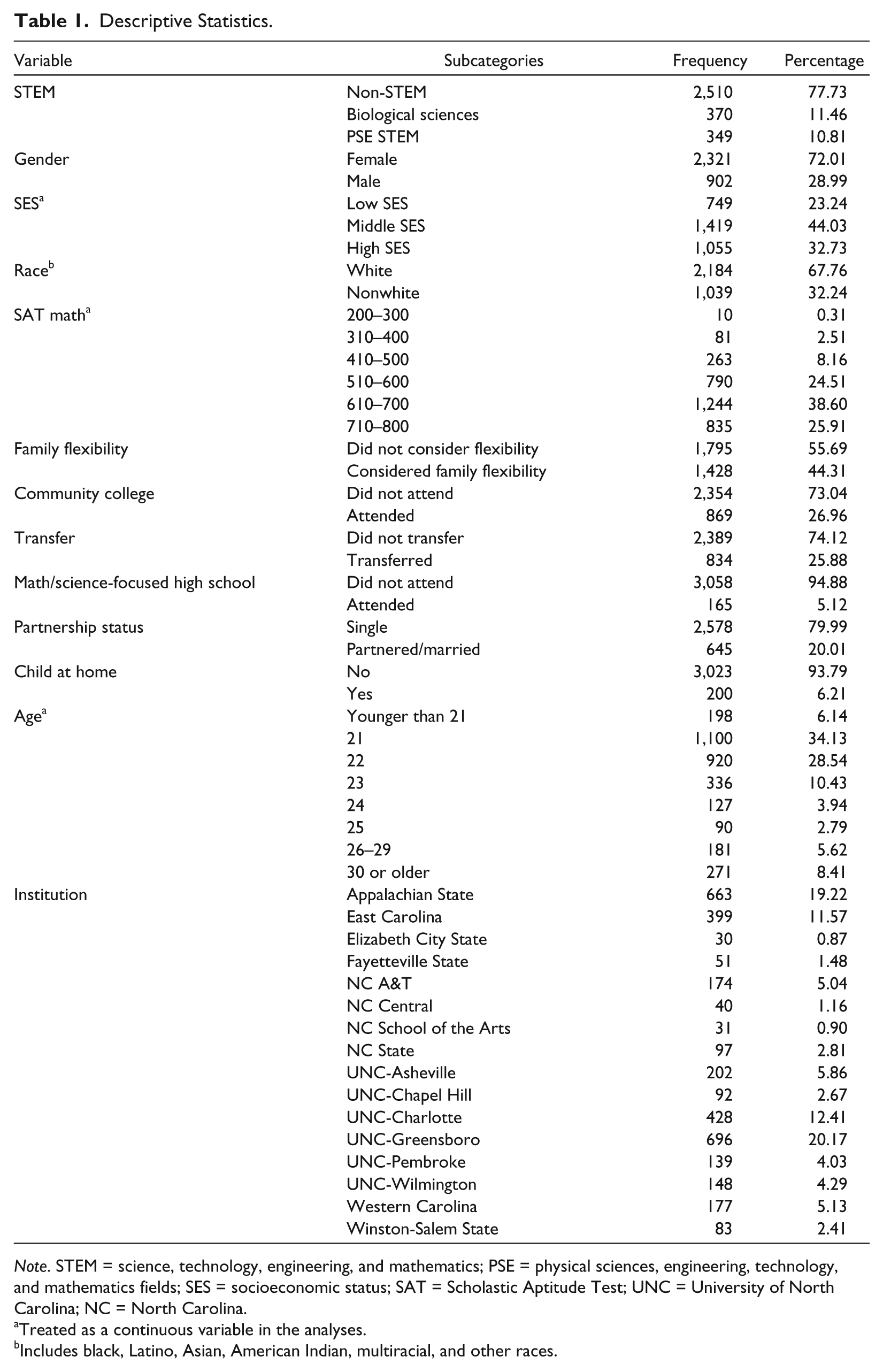
Note. STEM = science, technology, engineering, and mathematics; PSE = physical sciences, engineering, technology, and mathematics fields; SES = socioeconomic status; SAT = Scholastic Aptitude Test; UNC = University of North Carolina; NC = North Carolina.
Treated as a continuous variable in the analyses.
Includes black, Latino, Asian, American Indian, multiracial, and other races.
The key independent variables are gender and consideration of future career family flexibility. Gender is treated as a binary variable in this study. Consideration of future family flexibility is a dummy variable capturing concern based on the students’ yes/no response to the following survey question: “Did you consider the degree of family friendly flexibility in your future career when deciding what major to choose?” Established measures of perceptions of work/family balance (e.g., Berg et al. 2003; Keene and Quadagno 2004) have successfully used similarly worded questions to inquire about respondents’ views on their current workplaces’ family friendly flexibility. To our knowledge, no study has examined students’ perceptions of family friendly flexibility prior to role entry; thus, the current study is the first to inquire about these perceptions prior to role entry.
Demographic controls include SES, which is a composite measure of whether or not the student had a parent who graduated from college and whether or not the student is receiving financial aid; race is measured as a white dummy variable, with all other races as the reference category; and age. 7 We also control for two variables reflecting current family situation. These variables include student’s parenthood status (whether or not he or she has a child at home), and marital/long-term partnership status (coded as “partnered” if the respondent reported being either married or in a long-term and/or cohabiting partnership, so as to include same-sex couples whose partnership resembles marriage in all senses but a legal one). These controls are necessary to determine whether a consideration of future family friendly flexibility of career is an anticipatory effect, rather than simply a reflection of current family experience.
To eliminate the potentially spurious effect of prior academic experiences and achievement, we control for pre- and during-college factors that may influence choice of STEM major. In terms of precollege factors, we include students’ self-reported Scholastic Aptitude Test (SAT) math score as a proxy for math and science ability, 8 and whether or not the student attended a math and science-focused high school. The during-college factors include whether or not the student attended a community college before enrolling at the current university, and whether or not the student transferred from a non-community college institution. 9
We employ multinomial logistic regression with fixed college effects to model students’ likelihood of pursuing a STEM major. Due to the potential institutional-level factors that may influence certain colleges’ STEM environments, we estimate a model with both fixed effects for each university and robust standard errors that account for the clustering of students within universities. In fact, several institutions in the UNC system have traditionally specialized in STEM-related fields (e.g., North Carolina State University, North Carolina Agricultural & Technical University), suggesting that this is an appropriate strategy. Table 1 contains descriptive information regarding the sample.
We conducted a series of exploratory analyses to investigate the factors that aid in determining whether a student reports having considered family flexibility when choosing a major. Employing inductive regression techniques (stepwise regression and multivariable fractional polynomial models), five key features were revealed as important determinants of reporting a consideration of family flexibility: gender, current marital status, current parenthood status, age, and the university attended. These effects are shown in the results of the binary logistic regression in Table 2, which demonstrates that women, those who are currently married, those who currently have a child, younger students, and students attending certain universities are more likely to have expressed considering future career family flexibility when selecting their major field of study.
Results from Logistic Regression Predicting Consideration of Future Career Family Flexibility (N = 3,229).
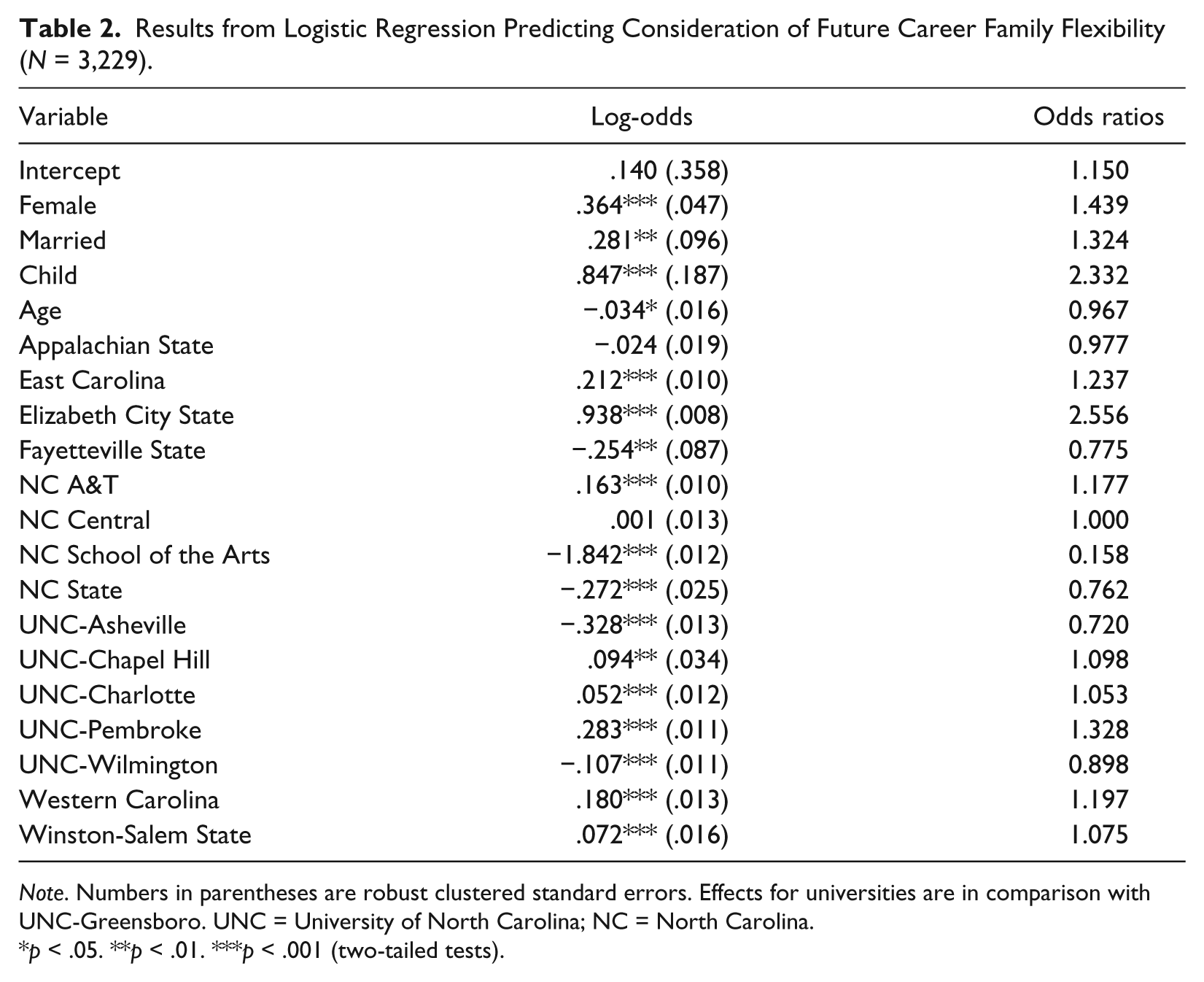
Note. Numbers in parentheses are robust clustered standard errors. Effects for universities are in comparison with UNC-Greensboro. UNC = University of North Carolina; NC = North Carolina.
p < .05. **p < .01. ***p < .001 (two-tailed tests).
Findings
We begin testing our hypotheses about the relationship between major category, consideration of family flexibility, and gender by examining a contingency table. As Table 3 shows, in every major category, the majority of respondents report not having considered future career family flexibility when making their major decision. Yet, it is also clear that, in each major category, more women than men considered family flexibility. Among non-STEM majors, 39.2 percent of men and 47.9 percent of women considered family flexibility in choice of major; among biological STEM, respective percentages are 43.2 and 46.2; among PSE STEM, the percentages are 28.9 and 36.2. A chi-square test of independence between gender and consideration of family flexibility suggests that the difference between men and women is significant for non-STEM majors, but not for biological and PSE STEM majors. If we look at the table another way, reading across majors, 45.9 and 45.4 percent of all non-STEM and biological science majors respectively considered family flexibility in their choice of majors. Yet, only 31.8 percent of PSE STEM majors considered family flexibility when choosing their majors. This low percentage of PSE STEM majors who considered family flexibility is striking compared with the much higher prevalence of consideration among non-STEM and biological sciences majors.
Percent of Students Who Considered Family Flexibility by Gender and Major Category.

Note. STEM = science, technology, engineering, and mathematics; PSE = physical sciences, engineering, technology, and mathematics fields.
p < .01.
Multivariate analyses are needed to control for other variables that may influence the relationship between consideration of family flexibility, major choice, and gender. We next turn to this set of analyses. The results of the multinomial logistic regression analyses predicting college major (with non-STEM major as the excluded category) are presented in Table 4. In Model 1, we look at the key independent variables as a function of the multinomial dependent variable to test H1 and H2, whether consideration of family flexibility is an important predictor of college majors. In Model 2, we test H3, whether there are gender differences in the importance of family flexibility by adding an interaction term between gender and family flexibility. This interaction term provides information about the magnitude and significance of the effect of consideration of family flexibility on major choice separately for men and women.
Results from Multinomial Logistic Regression Predicting College Major (N = 3,229).
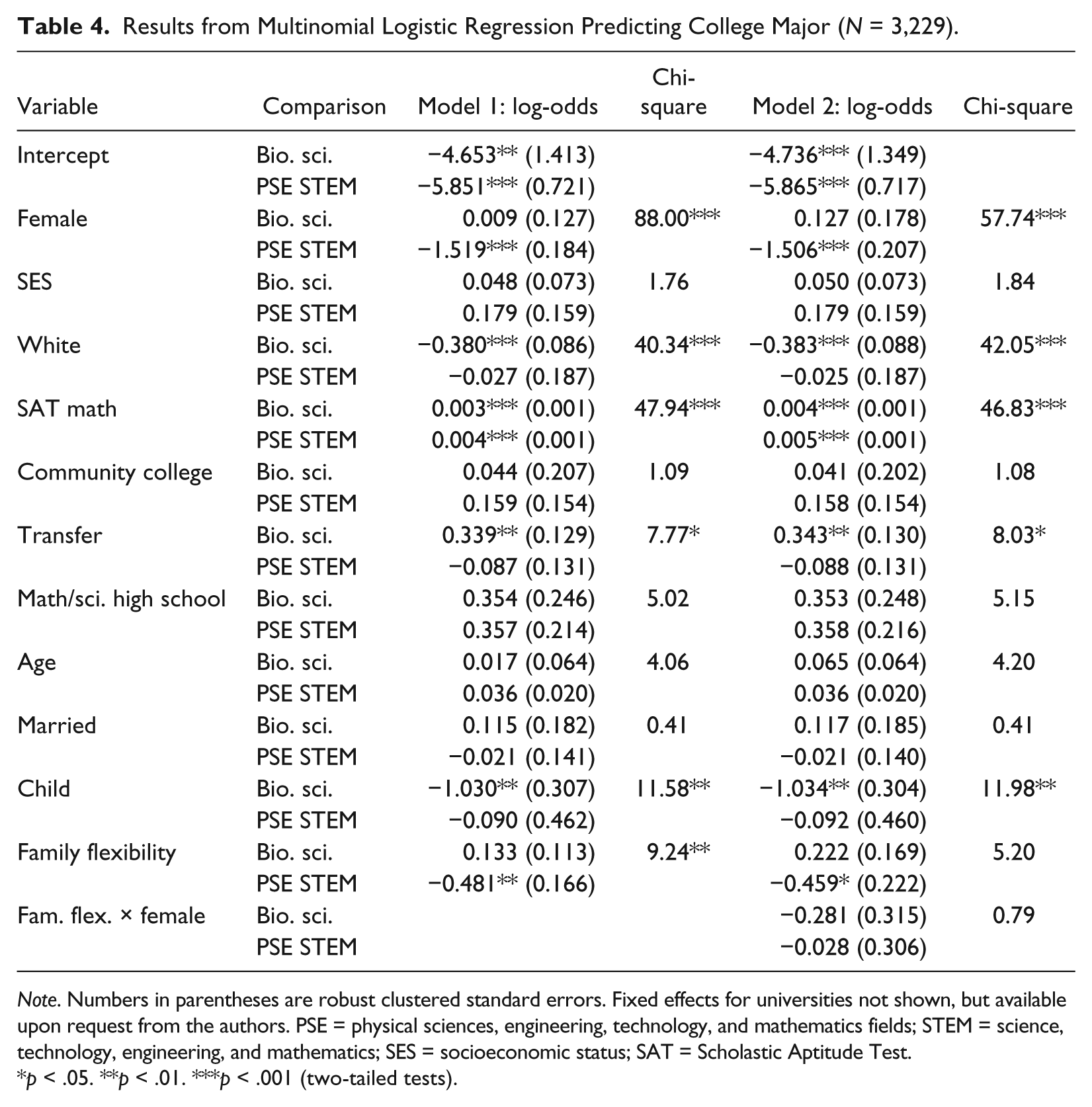
Note. Numbers in parentheses are robust clustered standard errors. Fixed effects for universities not shown, but available upon request from the authors. PSE = physical sciences, engineering, technology, and mathematics fields; STEM = science, technology, engineering, and mathematics; SES = socioeconomic status; SAT = Scholastic Aptitude Test.
p < .05. **p < .01. ***p < .001 (two-tailed tests).
Results from Model 1 offer support for H1 and H2. Consideration of future career family flexibility is a significant predictor of majoring in the PSE STEM fields as compared with non-STEM fields. It is not, however, significantly related to whether or not a student will pursue a biological science as opposed to a non-STEM field. Calculating relative risk ratios (by exponentiating the beta coefficients, which are given in log-odds), we can see that a consideration of family flexibility is associated with odds .618 times those of majoring in PSE STEM compared with majoring in a non-STEM major. Moreover, the relationship between consideration of future career family flexibility and majoring in a PSE STEM field is significant net of demographic characteristics and prior academic experiences and ability, as well as current family situation. These factors indicate that women are less likely to pursue a PSE STEM field than a non-STEM one; that whites are less likely than nonwhites to pursue a biological STEM field than a non-STEM one; that students with higher SAT scores are more likely to pursue a biological or PSE STEM field than to go into a non-STEM discipline; that students who transferred institutions are more likely to enter a biological STEM field than a non-STEM one; and that students who have any children are less likely to pursue a biological STEM major than a non-STEM major.
Model 2 displays the results of the gender interaction. As the nonsignificant chi-square statistic of .79 indicates (p = .673), there is no significant gender difference in terms of the effect of consideration of family flexibility on likelihood of majoring in a biological science STEM or a PSE STEM field. Thus, men and women are not differentially affected by consideration of family flexibility in terms of whether they choose a biological science as a major, or a PSE STEM field. This finding suggests that H3 is not supported, thereby replicating prior recent findings (e.g., Aumann et al. 2011; Byron 2005; Cech and Blair-Loy 2014; Galinsky et al. 2009; Reskin and Maroto 2011), which report that shifts in men’s understandings—distinct from behaviors—of their involved role in both the home and workplace have converged with those of women.
We next employ predicted probabilities, holding all other variables at their means or modes, to visualize the effect of family flexibility on major choice, and how it differs by gender. As can be seen in Figure 1, students who considered family flexibility of future career when choosing a major are slightly more likely to pursue non-STEM fields (.765 for those who do not consider versus .794 for those who do). As predicted, students who consider family flexibility of future career are less likely to major in a PSE STEM field than those who do consider it (.087 for those who consider family flexibility versus .123 for those who do not). In other words, if a student remained otherwise the same in terms of gender, SAT math score, et cetera, but switched from expressing a consideration of family flexibility of career to not expressing this consideration, we would expect this individual’s chances of majoring in a PSE STEM field to increase by 3.6 percentage points. The probabilities of being a non-STEM major and being a biological science major are relatively unaffected by a consideration of family flexibility.
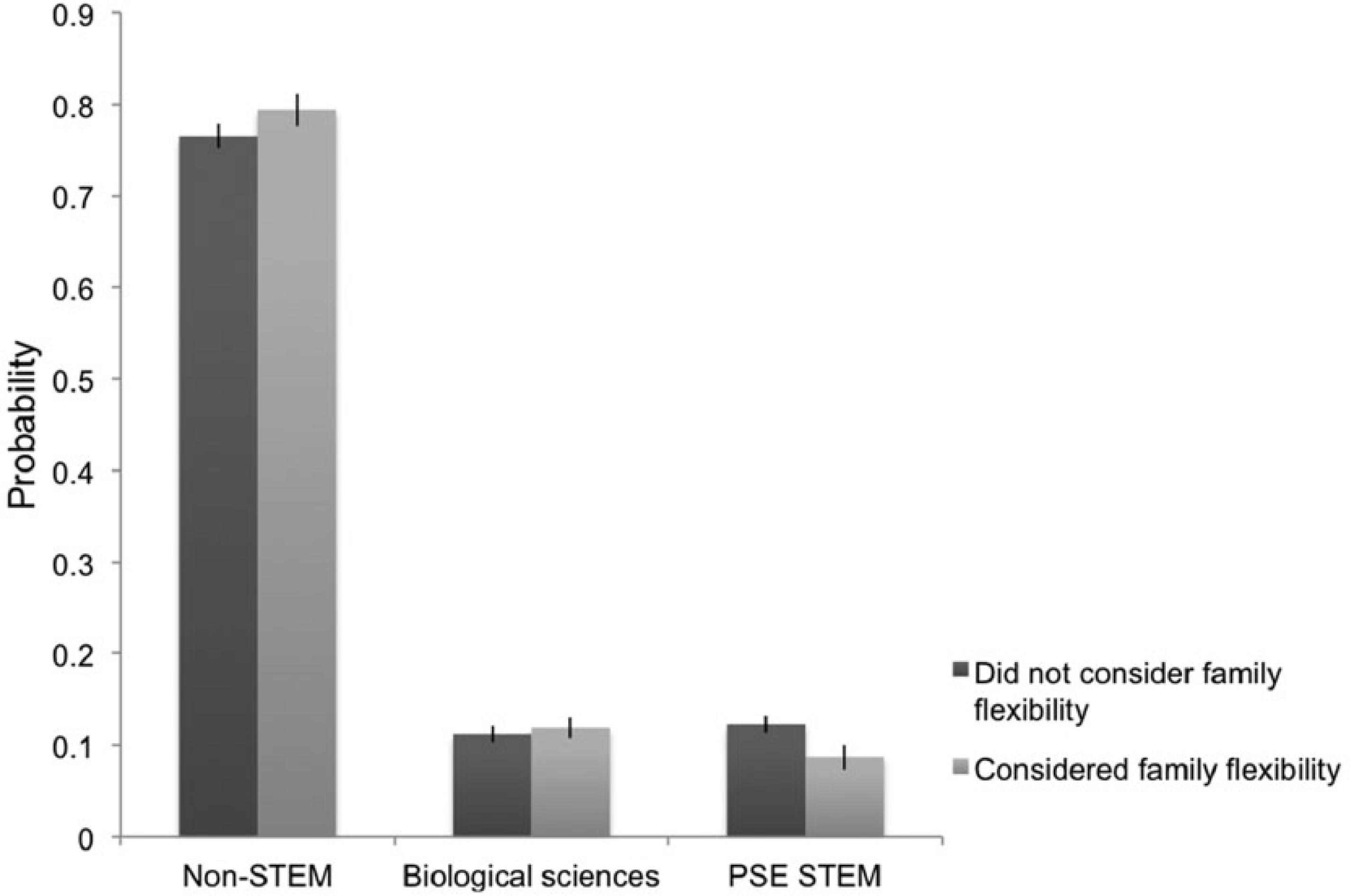
Predicted probability of major by consideration of family flexibility.
When we calculate predicted probabilities separately by gender (see Figure 2), it is evident that a consideration of family flexibility of future career has similar dampening effects on the choice to pursue a PSE STEM major for both men and women (.186 for men who considered family flexibility versus .261 for men who did not, .048 for women who considered versus .069 for women who did not). Consideration of family flexibility does not appear to greatly change the probability of majoring in a non-STEM field or a biological science for either men or women.

Predicted probability of major by consideration of family flexibility by gender.
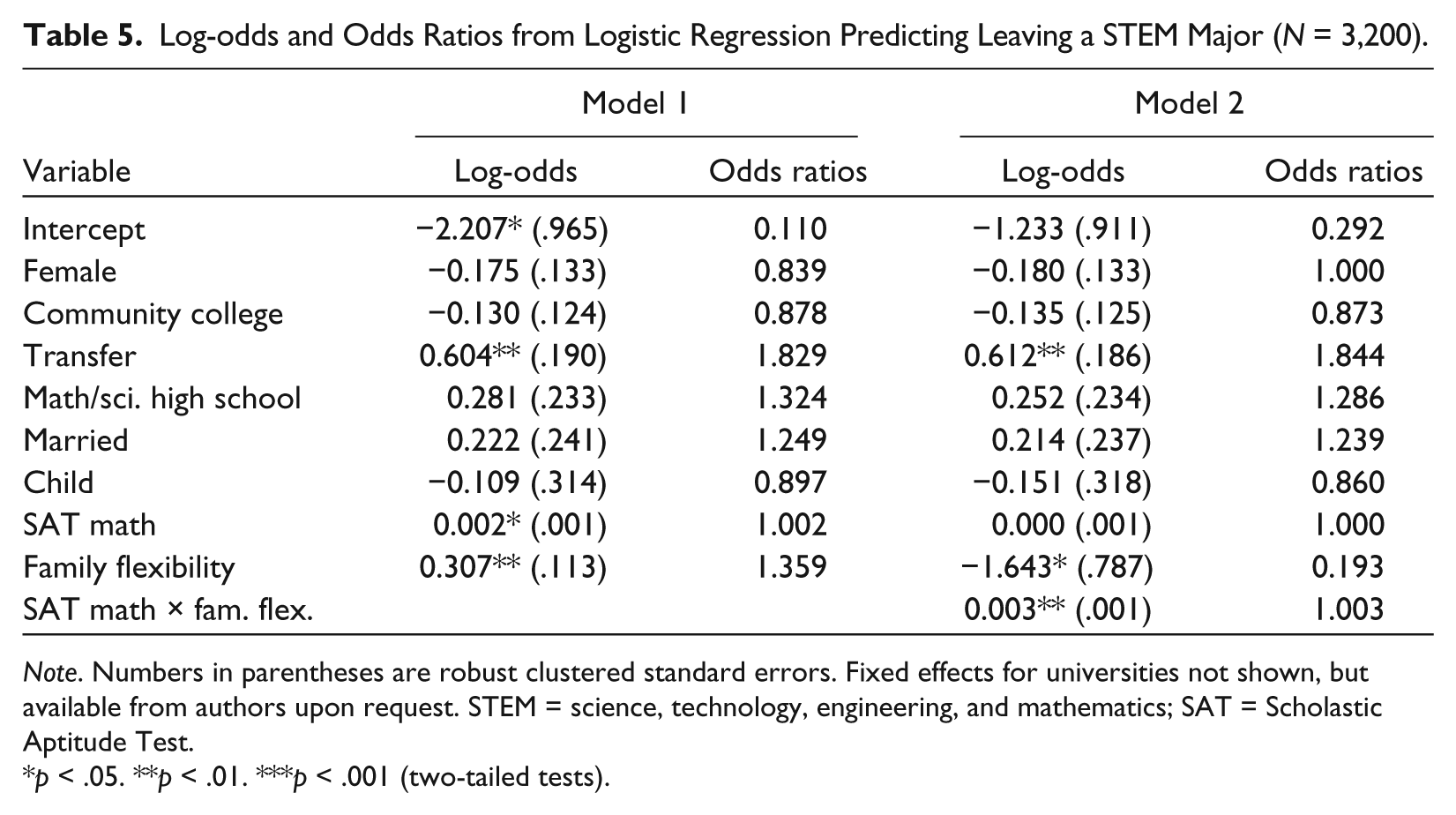
Last, we test H4 by modeling whether family flexibility influences the likelihood that a student declares a STEM major but then leaves that major for a non-STEM one. To do so, we employ binary logistic regression and account for university-level clustering by using fixed effects and robust standard errors. The results are displayed in Table 5 below.
Log-odds and Odds Ratios from Logistic Regression Predicting Leaving a STEM Major (N = 3,200).
Note. Numbers in parentheses are robust clustered standard errors. Fixed effects for universities not shown, but available from authors upon request. STEM = science, technology, engineering, and mathematics; SAT = Scholastic Aptitude Test.
p < .05. **p < .01. ***p < .001 (two-tailed tests).
The results from Model 1 indicate that students who express a consideration of future career family flexibility are significantly more likely to have declared a STEM major but then switched to a non-STEM one. In fact, students who considered family flexibility have odds of leaving their STEM major that are 1.359 greater than those who did not consider family flexibility. This effect holds net of indicators of math and science aptitude, such as SAT math score and having attended a math- and science-focused high school. But as a robustness check, we tested an alternate specification of the model. It is possible that students who are less prepared in math and science are more likely to be deterred from STEM by their consideration of family flexibility. We therefore introduce an interaction term between SAT math score and family flexibility in Model 2 to test whether this is the case. As Figure 3 illustrates, we find the very opposite effect: it appears that if a student reported considering family flexibility, a higher SAT math score actually increases the likelihood of leaving a STEM major. We therefore conclude that considerations of family flexibility are related to a higher propensity of leaving a STEM field, and, alarmingly, that a higher math SAT score does not insulate high STEM ability students but further increases the likelihood of leaving STEM.
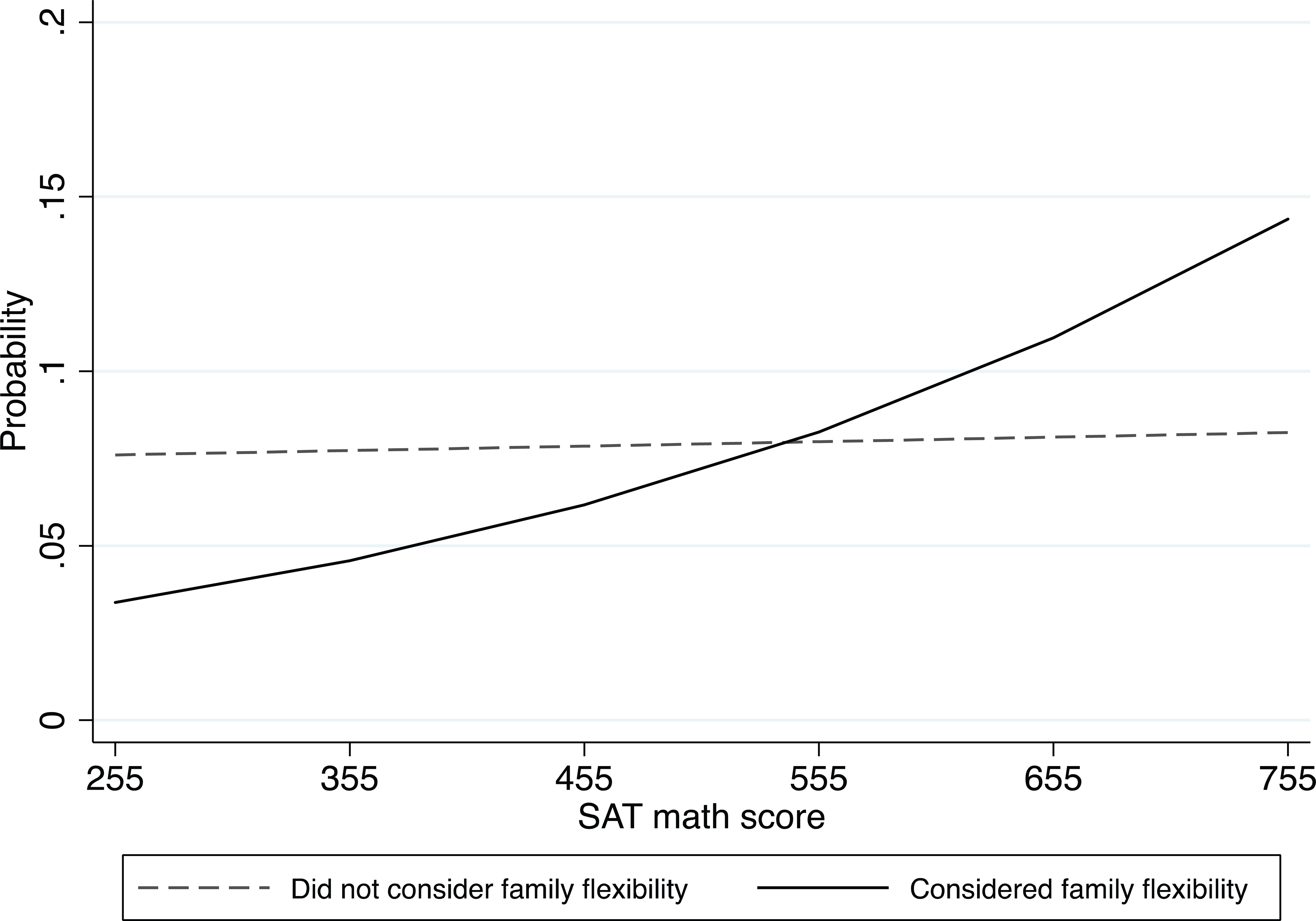
SAT math score moderates relationship between consideration of family flexibility and probability of leaving a STEM field.
Conclusion
Using primary survey data, we have been able to test a long-hypothesized link between consideration of future career family flexibility and pursuit of STEM degrees. We found that students who report taking into account the family flexibility of their future career when choosing college majors were significantly less likely to choose PSE STEM majors and were more likely to have left STEM fields for non-STEM fields. These findings support previous research that demonstrates that people take into account work/family conflict when making role-entry decisions into careers. Moreover, the simple perception of a lack of family flexibility in these fields seems to be driving away potential entrants from choosing college majors that may lead them into employment in these fields. Employing Powell and Greenhaus’ (2010) concept of role entry into a workplace, our findings suggest that this process may begin as early as the college and precollege years, when students form perceptions about the cultural norms associated with certain sectors, and choose their area of study accordingly. Importantly, these findings also suggest a shift has occurred in young men’s perceptions of cultural norms concerning their future families. In addition, it is not merely anticipated workplace culture regarding this flexibility, but also anticipated family life, as our results suggest that students’ current family situations are not the driving mechanism of this reported effect.
Our study also differs from prior research suggesting that issues of workplace family flexibility are deterring women, in particular, from the STEM fields. Instead, our results indicate that contemporary college men and women are equally likely to be deterred from the PSE STEM fields by a consideration of future career family flexibility. Because our primary survey data are drawn from students who were college seniors in 2013, these results suggest further support for recent research showing that there has been a cultural shift in people’s understandings of men’s role in the home and workplace. These results may seem to be at odds with findings that indicate a greater concern with a gendered conflict between family formation and pursuit of an academic career in STEM fields (De Welde and Laursen 2011; Mason and Goulden 2002; van Anders 2004). This research instead suggests that within this cohort of students, men and women equally consider family flexibility in their choice of a STEM or non-STEM major.
This last finding has important implications for gender research. There is a current heated debate regarding the gender revolution. Some scholars argue that it has stalled because men are not pursuing women’s roles, such as domestic labor (England 2010). Yet, this research suggests that men are considering domestic roles in their choice of majors, offering support for the notion that the gender revolution has not stalled (Reskin and Maroto 2011). Clearly, the gender revolution is incomplete as women remain underrepresented among STEM majors and earn less than men in comparable positions. But our findings provide suggestive evidence that a factor widely considered as central to gender inequity, gendered inequality in home life, is equally salient for men and women in their choice of a STEM major. According to Charles and Bradley (2009:966), “Sex segregation by field of study will not erode with economic or cultural modernization, but will persist as long as persons continue to understand themselves, their competencies, and their educational and occupational opportunities in fundamentally gender terms.” Our research provides preliminary evidence that family flexibility, a consideration that theoretically and historically has been associated with women’s choice of major, currently resonates with both men and women, moving us closer toward—albeit still far from—gender equity in the private and public spheres.
It is important to note, however, that it is possible that the gendered obstacle that concern with family flexibility presents is manifest at a later point in the academic career than we found among the undergraduates in this study. In fact, the respondents interviewed in De Welde and Laursen (2011) seemed to report generally supportive environments in their undergraduate years, and a dearth of concern regarding potential conflicts between STEM careers and family formation. At the same time, we find that the men in this sample are still much more likely, overall, to choose majors in physical sciences, engineering, and mathematics than women are.
We acknowledge that the current study is limited by three key features of the data. First, our sample is not perfectly representative of the UNC system or the general college population in the United States. This self-selection has the potential to bias our results only if we believe that willingness to take part in the survey also influences the relationship between perceived future career family flexibility and majoring in PSE STEM fields (J. A. Davis 1985). For this bias to occur, students who are especially likely to take the survey must also be especially sensitive to the relationship between family flexibility and their willingness to major in PSE STEM. Like all research employing self-selecting samples, we are not able to adjudicate this possibility. Future research should examine whether the relationships we observe here hold more generally across all ethnoracial groups, geographic regions, and so on. The second primary limitation of the current study involves the cross-sectional nature of the data. Although asking students about their perceptions of future career family friendly flexibility before choosing their major would have been ideal, research suggests that gender attitudes are relatively stable across the life course, and, if anything, become more liberal with increased levels of education (Brewster and Padavic 2000; Fan and Mooney Marini 2000). Thus, although we acknowledge that one potential interpretation of our results is that students who left PSE STEM fields may have post hoc justified their decision to leave by saying they considered future career family flexibility when in truth they did not, we find this alternate explanation at odds with most attitudinal research that sees attitudes as a function of behavior and not the other way around (Glasman and Albarracin 2006; see also Vaisey 2009). Finally, the limited nature of the survey question about influences on major selection means that we are not able to understand the precise strength of the effect of perceived future career family flexibility, as the question only permitted students to respond as having considered this matter or not. Nor can we adjudicate the relative importance of this perception compared with other considerations that may have affected choice of college major, such as future earnings or their perceived aptitude. Overall, future studies that follow a nationally representative cohort of students over time, assessing their perceptions regarding fields of study, gender attitudes, family flexibility, and future careers would prove eminently useful in further exploring the relationships uncovered here.
This study suggests that the fields of PSE STEM especially are losing out on potential talent among men and women due to the perception that these fields are less conducive to work/family balance. Future research could test these perceptions directly, and should also investigate whether or not these sectors are actually marked by a lack of family friendly flexibility. Last, our results lead us to conclude that a consideration of family flexibility of future career is likely not driving the extant gender discrepancies in STEM outcomes, as many other researchers have hypothesized. The PSE STEM pipeline experiences leakage from both men and women who consider family flexibility when choosing a major.
Footnotes
Authors’ Note
All errors and interpretations are those of the authors.
Declaration of Conflicting Interests
The author(s) declared no potential conflicts of interest with respect to the research, authorship, and/or publication of this article.
Funding
The author(s) disclosed receipt of the following financial support for the research, authorship, and/or publication of this article: This work was supported by the NSF Science, Technology, Engineering, and Mathematics Talent Expansion Program (STEP) (Grant Number DUE-0969286).

Notes
References
Supplementary Material
Please find the following supplemental material available below.
For Open Access articles published under a Creative Commons License, all supplemental material carries the same license as the article it is associated with.
For non-Open Access articles published, all supplemental material carries a non-exclusive license, and permission requests for re-use of supplemental material or any part of supplemental material shall be sent directly to the copyright owner as specified in the copyright notice associated with the article.
