




Abstract
Over the last few decades, youth have been delaying leaving the parental home and increasingly returning to it, often making these transitions for reasons other than marrying, such as to pursue education or employment. Concurrently, parental financial support to their young adult children has risen, partly redefining the meaning of residential independence, a major marker of the transition to adulthood. Using data from the National Longitudinal Study of Adolescent to Adult Health and Markov models, I examine transitions into and out of the parental home and their association with intergenerational financial transfers. Results show high prevalence of partial independence—that is, not living with parents but receiving financial assistance from them—with significant differences depending on college attendance and socioeconomic status (SES). Attending a four-year college increases the likelihood that youth subsequently live independently without parental financial support, although monetary transfers throughout college weaken the effect. Youth from high SES are more likely to leave the parental home, but typically with financial assistance from their parents; their higher likelihood of continued financial dependence raises concerns of prolonged dependence. Results also suggest that full or partial independence may lead youth from lower socioeconomic backgrounds into renewed dependence on their parents, later.
Keywords
Introduction
Leaving the parental home is considered one of the first major markers in defining the transition to adulthood (Billari and Tabellini 2010). It has been seen as “the key indicator of leaving childhood behind” (Goldscheider 1996:3) and is perceived as an integral part of establishing independence from parents (Holdsworth 2000). The achievement of residential independence is a crucial step in personal development, which denotes autonomy from the family of origin (Gaiser 1999). Powerful meanings and expectations are associated with it: it signifies freedom and privacy (Rusconi 2006), and it is the focal point for several developmental transitions, such as gaining full personal autonomy, developing an independent lifestyle, or forming relationships (Bendit 1999).
Within the context of the destandardization of the life course and the changing transition to adulthood (Brückner and Mayer 2005; Elzinga and Liefbroer 2007; Fussell and Gauthier 2005), a great deal of research has investigated the timing and patterns of leaving the parental home. Scholars have looked at the age at which youth leave, documenting a delay in home leaving (Buck and Scott 1993; Cherlin, Scabini, and Rossi 1997), as well as whether they leave temporarily or permanently, showing increasing returns to the parental home (DaVanzo and Goldscheider 1990); furthermore, accounts of exit destination have reported a decline in leaving to marry (Goldscheider and Goldscheider 1999). Less attention has been paid to what leaving the parental home actually means in terms of young adults’ independence from their parents. Yet, this appears particularly relevant in studying youth transition to adulthood, as recent research has shown that young people in the United States rely heavily on others, especially their parents, for support (Waters et al. 2011). Parents may provide support in different and nonalternative ways: besides (indirect) help through housing, they may offer financial gifts, which may influence and (re)define the meaning of residential arrangements. Moving away from one’s parents may not coincide with economic independence, and youths’ living conditions may be affected by their financial connections to their parents, which could highly alter the meaning of the transition itself. I ask, “How are youth living arrangements and parental financial transfers related?”
By analyzing living arrangements and parental financial assistance in relation to one another, this article makes an important contribution to the study of parental support and the transition to adulthood, for it fills a gap in previous literature, which has placed little emphasis on intergenerational financial transfers and their interplay with young people’s living arrangements. I argue that differences in socioeconomic status (SES) and college attendance, including type of college, may condition this relationship. By investigating differences across socioeconomic background and type of college attendance, I integrate not only literature in family sociology, young adulthood, and the transition to adulthood but also ideas from stratification and inequality. Furthermore, this article embraces a longitudinal perspective, by analyzing transitions into and out of the parental home and their association with financial support.
Literature Review
In the last few decades, both the public discourse and scholarly research have been increasingly concerned with the timing and patterns of leaving the parental home. The widespread perception seems to be that those coming of age during the last few decades are uniquely slow in establishing independence from their parents (Littwin 1986; White and Lacy 1997). Some scholars have argued that there has been a delay in home leaving (Buck and Scott 1993; Cherlin et al. 1997) and an increase in “boomerang” kids, who return home after leaving and may repeatedly leave home (DaVanzo and Goldscheider 1990). Others have focused on exit destinations and the changing reasons for moving out of the parental home, reporting a decline in leaving to marry (Goldscheider and Goldscheider 1999). Rosenfeld (2010) showed that the percentage of unmarried young adults who live with their parents reached an all-time low in 2000, which is in line with young adults’ increasing preference to live on their own (Klinenberg 2012). Researchers have advanced alternative explanations to account for young adults’ living arrangements: some have focused on the role of culture and preferences for privacy (Giuliano 2007; Manacorda and Moretti 2006; Reher 2005); others have stressed the role of economic and institutional factors, among which are the prolongation of education and the consequent postponement of the achievement of economic independence, as well as changes in marriage and family formation behavior (Aassve, Billari, and Ongaro 2001; Blossfeld et al. 2005).
Research has also shown that parents provide considerable support to their children, which has become more prevalent in the last three decades (Wightman, Schoeni, and Schulenberg 2013) and differs by SES (Cobb-Clark and Gørgens 2014). Schoeni and Ross (2005) examined material support youth received from their parents in terms of time and money and reported large disparities by parental income, with higher-income families more likely to provide assistance to their young adult children. Wightman, Schoeni, and Robinson (2012) found that (1) most young adults receive some form of support, (2) the amounts being transferred are substantial, and (3) family SES and college attendance are the biggest predictors of parental assistance.
We know less about the link between parental financial support and home leaving. However, monetary transfers likely create different circumstances of home leaving, and looking at parental financial support may, therefore, help us better understand the transition out of the parental home and factors associated with it. Research has shown that individuals have been postponing role transitions and have been experiencing them in diverse order, if at all (Berlin, Furstenberg, and Waters 2010); furthermore, while their relevance to being considered an adult has been questioned, transitions to independent living and financial independence from one’s parents have been shown to be among the top criteria for adulthood (Arnett 1997; Settersten 2011). However, virtually no attention has been paid to the way they work together and affect each other. Qualitative studies on European countries have shown that family support is a key factor in facilitating home leaving (Holdsworth 2004); however, quantitative evidence for the United States is scarce. As living arrangements as well as parental assistance have changed dramatically over the last few decades, examining them in relation to one another will provide a more accurate picture of youth transition to adulthood.
This study focuses on college attendance and family SES as important factors that could affect the circumstances of home leaving. Research has highlighted differentiation in how youth transition to adulthood (Brückner and Mayer 2005; Elzinga and Liefbroer 2007; Fussell and Gauthier 2005), focusing on the timing of home leaving and exit destinations. Here, I argue that differentiation likely applies also to whether young people are financially supported by their parents or not. This is particularly relevant, as young adults have become less likely to leave the parental home to marry but more likely to do so to attend college (U.S. Census Bureau 2000). The prolongation of education has led to changes in the relationship between residential arrangements and financial dependency relative to historical standards: being in college has been shown to be one of the most important factors in predicting both young adults’ economic dependence on their parents and their moving away from the parental home (Hamilton 2013; Wightman et al. 2012). College attendance may be a reason for living separately from one’s parents; at the same time, it is likely to increase the need and the likelihood of receiving economic support, as assistance with college tuition costs is one of the most common reasons for financial transfers from parents to their adolescent or young adult children (Wightman et al. 2012). Furthermore, college attendance is likely to affect youth’s future living conditions. An increasing share of jobs require a postsecondary degree (Haveman and Smeeding 2006), and the returns to a college degree in terms of earnings, although highly stratified by major and type of institution, have increased dramatically over the last quarter century (Autor, Katz, and Kearney 2008; Torche 2011). However, college graduates are often underemployed, with around a third holding jobs not requiring college degrees (Jones and Schmitt 2014).
Parental provision of financial support differs by SES, with higher SES being associated with higher probability of intergenerational transfers (Cobb-Clark and Gørgens 2014; Schoeni and Ross 2005; Wightman et al. 2012). Research looking at how home leaving behavior differs by family economic background, however, has reported mixed findings. Garasky, Haurin, and Haurin (2001) did not find an effect of family socioeconomic status on exit destinations, and Mitchell, Wister, and Burch (1989) did not report an effect on the timing at which youth move out of the parental home. However, Aquilino (1991) showed an effect of family SES on the timing of children’s home leaving, and Avery, Goldscheider, and Speare (1992) found that youth from higher-income families are less likely to leave to marry. Goldscheider and Goldscheider (1999) reported that young adult children of higher-educated parents are more likely to leave home, and Tang (1997) found that family public assistance increases repeated home leaving. More recently, De Marco and Berzin (2008) showed that poor youth are less likely to leave, but those who left did so at a younger age; the poor are more likely to leave repeatedly and for marriage than for school or other arrangements. Thus, differentiating residential states depending on whether parents provide monetary transfers or not may shed light on the link between SES and home leaving. Whittington and Peters (1996) found that children are less likely to become jointly residentially and economically independent when parental income is high, although such relationship weakens as the child’s age increases. Yet, we do not know whether the effect of parental income on residential independence is conditioned by financial assistance. This article fills this gap by looking at differences in the association between living arrangements and parental financial support among youths from different socioeconomic backgrounds.
The Interplay of Living Arrangements and Parental Monetary Transfers: Theoretical Considerations and Hypotheses
As leaving the parental home may highly differ depending on whether it is accompanied by parental monetary support or not, the increasing reliance of young adults on parental support suggests a shift in the characteristics of the typical transition out of the parental home. Residential arrangement decisions involve both the child and the parents (McElroy 1985; Whittington and Peters 1996). Youths may decide to move out of their parents’ home for diverse reasons: because they want to establish their own independent household, due to a desire for independence or to marry; to go to college or to take a job in a different area; or due to family conflicts. Alternatively, youth may decide to remain at home or move back in with their parent(s). They may do so for economic reasons, such as an inability to afford their own independent household or a desire to build up some savings. Moreover, preferences for togetherness or caregiving may also keep young adults in the same household with their parents. Parents may affect their young adult children’s living arrangements in several ways. Depending on their demand for privacy and on their resources, parents may affect the attractiveness as well as the feasibility of alternative living arrangements. Status attainment and human capital theory maintain that parents use their resources to protect their children: for example, they may want to help them meet the costs of higher education or provide assistance if they experience labor market difficulties. Parents may view co-residence as a less expensive way of transferring resources, as residence sharing is cheaper than providing equivalent living apart, due to economies of scale (Rosenzweig and Wolpin 1993). Alternatively, they may view it as entailing additional costs and lack of privacy and independence (Ermisch 2003; Ermisch and Di Salvo 1997; Laferrere 2005; Le Blanc and Wolff 2006; McElroy 1985), and they may prefer to support them via financial gifts. Parents may provide housing and financial support jointly or alternatively, which may affect their young adult children’s decisions to live with them or not as well as the actual context of residential arrangements.
Alternative residential and financial combinations may emerge. As it seems likely that all those who co-reside are realizing some cost savings compared with living independently, co-residence entails that young adult children receive some financial support from their parents. 1 For this reason, all those who are living with their parents jointly populate a first state, which I label “co-residence.” Alternatively, young adult children may be living independently from their parents, who may support them or not. I label the former state, characterized by support but no direct supervision, “partial independence,” and the latter state, characterized by no financial support and no direct supervision, “independence.” Differentiating youth depending on whether or not they receive support is particularly interesting among those who live independently; while co-residence may facilitate parental control and supervision, financial transfers may facilitate independent living, therefore allowing for lower supervision, and may redefine the context of residential arrangements. Living outside of the parental home yet remaining financially dependent defines a state that existing research based exclusively on living arrangement measures usually overlooks. A hallmark example would be college students living away from home whose parents continue to support them by subsidizing their housing costs and/or tuition. In contrast, without financial support, residential independence may be harder to establish but likely signifies higher independence.
The focus of this article is threefold. First, I investigate the prevalence of co-residence versus independent living in combination with and without financial support. Based on the findings from previous literature on parental support (Schoeni and Ross 2005; Wightman et al. 2013) and young adults’ preference for independence (Klinenberg 2012; Rosenfeld 2010), I expect partial independence to be the most prevalent state (Hypothesis 1 [H1]).
Second, I examine factors associated with the distribution of youth across such states. Given the high cost of tuition (Torche 2011) and college being one of the main reasons why youth move out of their parents’ homes, I expect college attendance to be positively associated with partial independence (Hypothesis 2A [H2A]). Furthermore, I expect differences in the effect of college depending on the type of institution attended; therefore, I differentiate between community colleges and four-year institutions.
As parents with higher SES have more resources to support their children, I expect them to provide more financial support also when youths live independently; consequently, I expect high SES background to be positively associated with partial independence (Hypothesis 2B [H2B]).
Third, I explore transitions across states—that is, transitions into and out of the parental home receiving and not receiving financial support—and factors associated with those transitions. The analysis of transitions has the potential to illustrate the extent to which residential and financial arrangements are transient or, instead, permanent in the lives of youths, which could highlight differential situations and vulnerable groups. If youth experience a state temporarily, as a stepping stone to another state, its significance in their lives may differ compared with the case in which youth remain in a state for an extended period or return to a state. For example, the fact that youths move out of the parental home but remain a financial liability to their parents may be seen as beneficial if that facilitates youths gaining financial—besides residential—independence in the future; however, indefinitely prolonged persistence in such state may reveal an inability to gain economic self-sufficiency. As youths are expected to progress from dependence to independence over the life course, I hypothesize that they are more likely to move out of the parental home than to remain in the parental home over their life course (Hypothesis 3A [H3A]). Furthermore, I hypothesize that youth transition through partial independence as a stepping stone to combined residential and financial independence (Hypothesis 3B [H3B]); this would be reflected in higher transitions out of partial independence and into independence rather than permanence in partial independence or return to co-residence. I also expect youth to be more likely to remain independent rather than to move back in with their parents or remain residentially independent but financially supported (Hypothesis 3C [H3C]).
Besides an overall picture of the likelihood of remaining in a state or transitioning to a different state, another interesting question refers to how specific individual and family-related characteristics are associated with such likelihood. Living arrangements and financial support may follow different dynamics across subgroups, based on diverse needs, resource availability, and cultural preferences, among other factors. For example, young adults’ education and work may generate differential needs, race and ethnic groups may have different preferences, and parents from different social classes may have different resources available to support their children. As outlined previously, this article focuses on effects conditional on college attendance and family socioeconomic background. Seeing college as an investment, and considering the high returns of a college degree, I expect that while youth attending college may be more likely to be partially independent at the time they are in college, they are more likely to be independent later in their life course compared with those who did not attend college; therefore, I hypothesize that those who were in college when first observed are more likely to move to full financial and residential independence later compared with those who were not attending college (Hypothesis 4A [H4A]). Accordingly, I expect that partial independence would serve as a stepping stone to independence, especially for youths attending college.
Parents with higher SES may have higher expectations for their children, as well as more resources to support them till they realize their aspirations. Accordingly, I hypothesize that youths from high socioeconomic backgrounds are more likely than youths from low socioeconomic backgrounds to remain in partial independence, as well as to move to partial independence (Hypothesis 4B [H4B]). In this sense, I expect that, independent of their education, youths from high socioeconomic backgrounds remain partially independent longer compared with youths from low SES families.
Method
Data
This article draws on data from Waves 1, 3, and 4 of the National Longitudinal Study of Adolescent to Adult Health (Add Health), 2 a nationally representative study of youths in the United States. Wave 1 started in 1994, from a sample of 20,745 students in Grades 7 to 12 (Harris 2009), who were followed with a series of in-home interviews at Waves 2 to 4. In 2001 to 2002, Wave 3 collected information for a sample of 15,197 respondents, while in 2008 to 2009, Wave 4 followed 15,701 original respondents. I exclude respondents who were 25 or older at Wave 3, to avoid age overlaps between the two waves and to focus on those who were younger at the time of the first observation. This results in respondents being between 18 and 24 at Wave 3 and between 25 and 32 at Wave 4. For this study, I select nondisabled 3 respondents participating in both Waves 3 and 4 and who were assigned a sampling weight. I also exclude cases in which respondents were living away from their parents before age 18 and those in the military at either Wave 3 or 4. This results in an analytic sample of 6,471 respondents. I use listwise deletion to deal with missing values on the dependent variable. 4 Missing information on the independent variables was trivial, but to avoid losing any additional cases in the multivariate analyses, I add dummies indicating respondents with missing information.
Measures
Add Health gathers information on both residential arrangements and intergenerational financial transfers. At each wave, a household roster indicates who lived in the respondent’s home, and at both Waves 3 and 4, respondents are explicitly asked whether they live in their parents’ home 5 ; at Waves 3 and 4, questions about monetary transfers between parents and children indicate whether parents are economically supporting their young adult children. Wave 3 includes a set of questions asking whether respondents received any financial support from any of the six parents about whom they were asked (current and former residential mothers and fathers as well as nonresidential biological mothers and fathers) in the previous 12 months. At Wave 4, respondents were asked whether a parental figure paid their living expenses or gave $50 or more to pay living expenses during the previous 12 months, as well as whether they received any financial gifts or loans from their parents or relatives to help with a home. 6 Based on the information about residential arrangements and financial transfers, I create a categorical variable that jointly captures the combination of residential and financial status, distinguishing between three states, including whether respondents (1) live with their parents (“co-residence”), (2) live independently while receiving support (“partial independence”), or (3) live independently and do not receive financial transfers from their parents (“independence”).
As outlined earlier, previous literature draws attention to two variables that play a major role in determining a youth’s residential and financial situation: type of college attendance and family socioeconomic background. I capture type of college attendance with a variable indicating whether a respondent is attending a two-year college or a four-year institution, or is not attending college at Wave 3. To capture socioeconomic background, I include parental education, 7 operationalized as a dummy indicating that at least one parent had a college degree. A more detailed categorical variable for parental education led to the same substantive conclusions, confirming findings by Wightman et al. (2013); thus, I chose a simpler operationalization.
In the following analyses, I also control for several factors that may affect the attractiveness and the feasibility of alternative choices about living arrangements as well as the likelihood of intergenerational transfers. Controls for sociodemographic individual characteristics include, besides a continuous variable for age and one for age squared, a dummy for sex, and a categorical variable for race/ethnicity. Gender has been found to affect home leaving: females tend to leave earlier than males (Aquilino 1991; Garasky et al. 2001; Mitchell et al. 1989). Race affects exit destination, as well as timing and reoccurrence of home leaving: whites leave earlier, are more likely to leave repeatedly, and are less likely to exit to marriage (Garasky et al. 2001; Tang 1997). Time-varying individual characteristics include a dummy distinguishing young adults in a marital or cohabitating union from singles; a categorical variable distinguishing between those working full-time (defined as working 30 or more hours a week), those working part-time, and those not working; and a categorical indicator for level of education (less than high school [HS], HS, BA/Associate, MA or higher). As family structure has been shown to be significantly associated with the timing of moving out of the parental home, with youths growing up in two-parent families less likely to leave earlier and more likely to leave for school, I include a dummy indicating whether the respondent lived with two biological parents at the first interview; I also account for parenting styles with a dummy indicator for involvement in any extracurricular activities at Wave 1 (Cheadle and Amato 2011). 8
Analytic Strategy
After describing the distribution of respondents across the three states (Table 1), I use multinomial logistic regression to estimate the probability of belonging to a state at Wave 3, accounting for sociodemographic and family-related factors that may affect living arrangements and financial support (Table 3). 9 Next, I investigate transitions across states. To do this, I estimate manifest Markov models in which the influence of past outcomes on the present outcome is explicitly expressed by modeling the conditional expectation of the response variable as a function of past outcomes (Markov process), as well as explanatory variables (Molenberghs and Verbeke 2005; Yu et al. 2003). Residential arrangements and financial transfers, which define the dependent variable as different states, are observed for each respondent at two points in time (Waves 3 and 4). To answer the question of how young adults transition across states, I estimate the transition probabilities from the state at time t − 1 to the state at time t. The outcome at t is assumed to depend on the state at t − 1 (first-order Markov process). I denote the outcome at time t by yt. The probabilities to be estimated are the transition probabilities P(yt = r | yt–1 = s), where s and r refer to a particular state. Note that this is a manifest Markov model in which the classification error probabilities are assumed to be equal to 0 and do not need to be estimated. I perform these analyses using Latent GOLD software (Vermunt and Magidson 2008), in which the model probabilities are parameterized using logistic equations (see equation A1 in the appendix) and the logit parameters can be interpreted as the log odds of making a transition from state s to state r rather than staying in state s (see equation A2 in the appendix). Note that in the transition probabilities equation, the “no transition” category serves as the reference category and the reference category changes with the origin state (for more details, see Magidson, Vermunt, and Tran 2007). For example, in the case of a respondent first observed in the partial independence state, two sets of probabilities are estimated: the probability of (a) moving to independence and of (b) moving to co-residence, rather than remaining in partial independence.
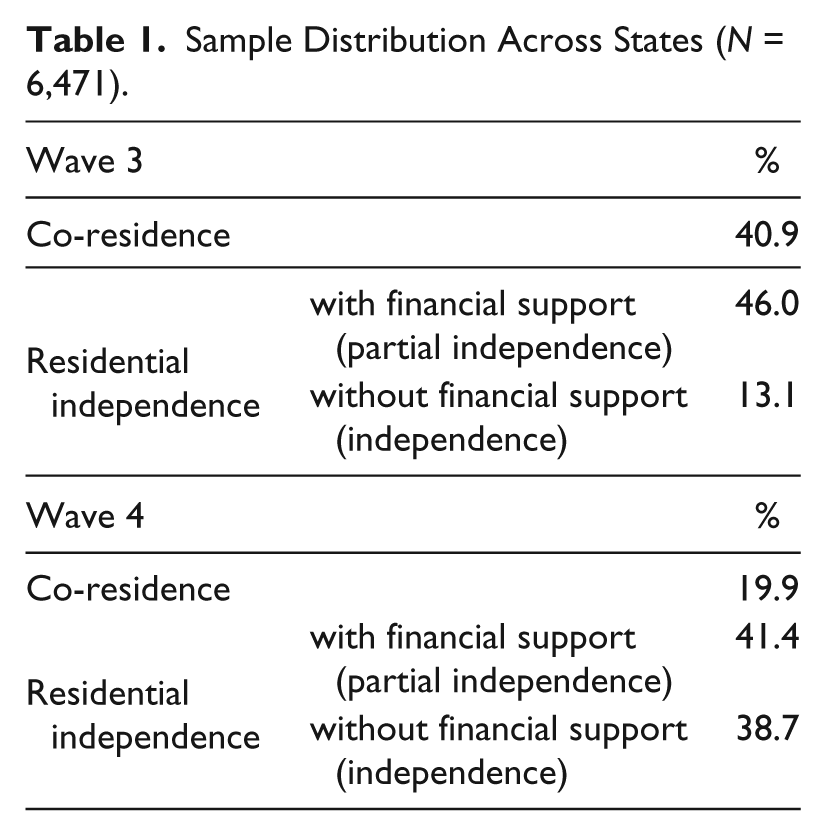
Sample Distribution Across States (N = 6,471).
In addition, I include the effects of covariates on the transition probabilities across states. To account for the effect of college attendance, including type of college, I estimate a model allowing transitions to depend on type of college attended: the effect of type of college attended is assumed to depend on the previous state, and parameters can be interpreted as the log odds of making a transition from one state to another rather than staying in the same state (Manzoni et al. 2010). In a similar fashion, to investigate the effect of family SES, I estimate a model assuming an effect of socioeconomic background on the transition probabilities. All the following analyses adjust for the complex sample design (Chen and Chantala 2014).
Results
Residential Arrangements and Financial Support: Descriptive Results
Table 1 illustrates the distribution of respondents across the three states. Results clearly show that living outside of the parental home does not always overlap with financial independence from one’s parents. About 46 percent of the respondents at Wave 3 and 41 percent of them at Wave 4 live independently but receive monetary transfers from their parents. At Wave 3, about 41 percent of the respondents still live with their parents and the majority of those who have moved out receive financial support from them. At Wave 4, fewer youths live with their parents (20 percent) and those who live independently are divided almost equally between those who receive economic assistance from their parents and those who do not. This suggests that with increasing age, more youths are living outside the parental home and more are doing so without financial assistance. However, living independently remains, in most cases, paired with intergenerational monetary transfers, which lends support to H1.
The Effect of Type of College Attended and Socioeconomic Background: Multivariate Analyses
Table 2 shows the distribution of respondents across states at Wave 3, depending on whether or not they attended college, and what type of college they attended, and by their socioeconomic background. Youths attending a four-year institution and those from high SES are more likely to be partially independent.
Sample Distribution Across States by College Attendance and Socioeconomic Background (N = 6,471).
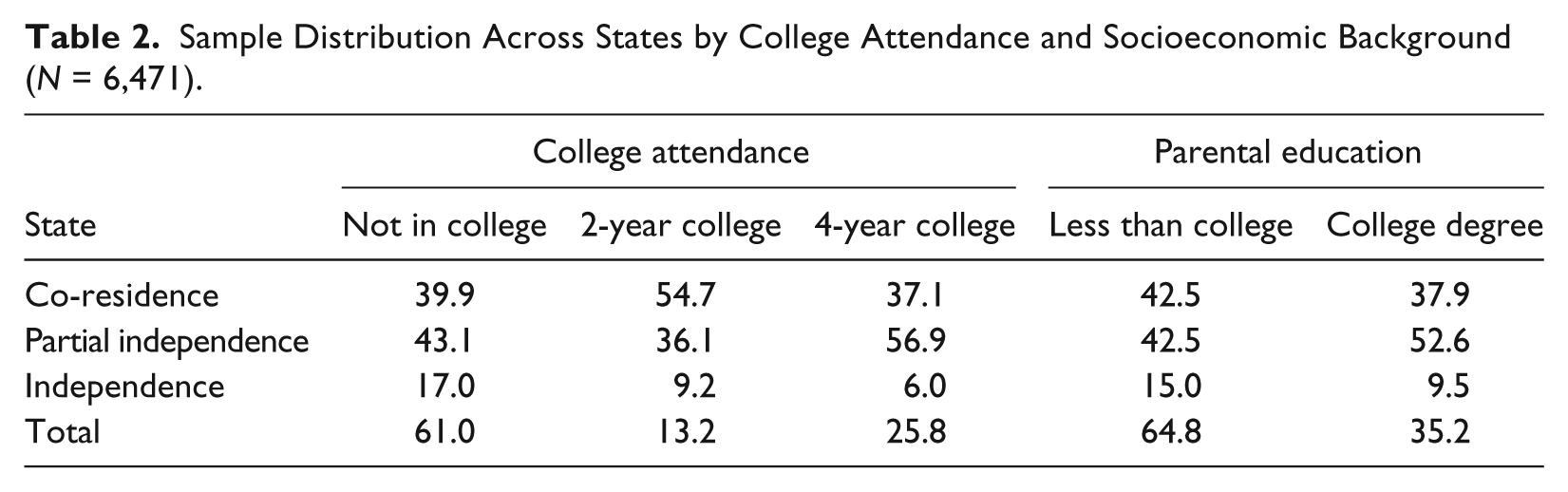
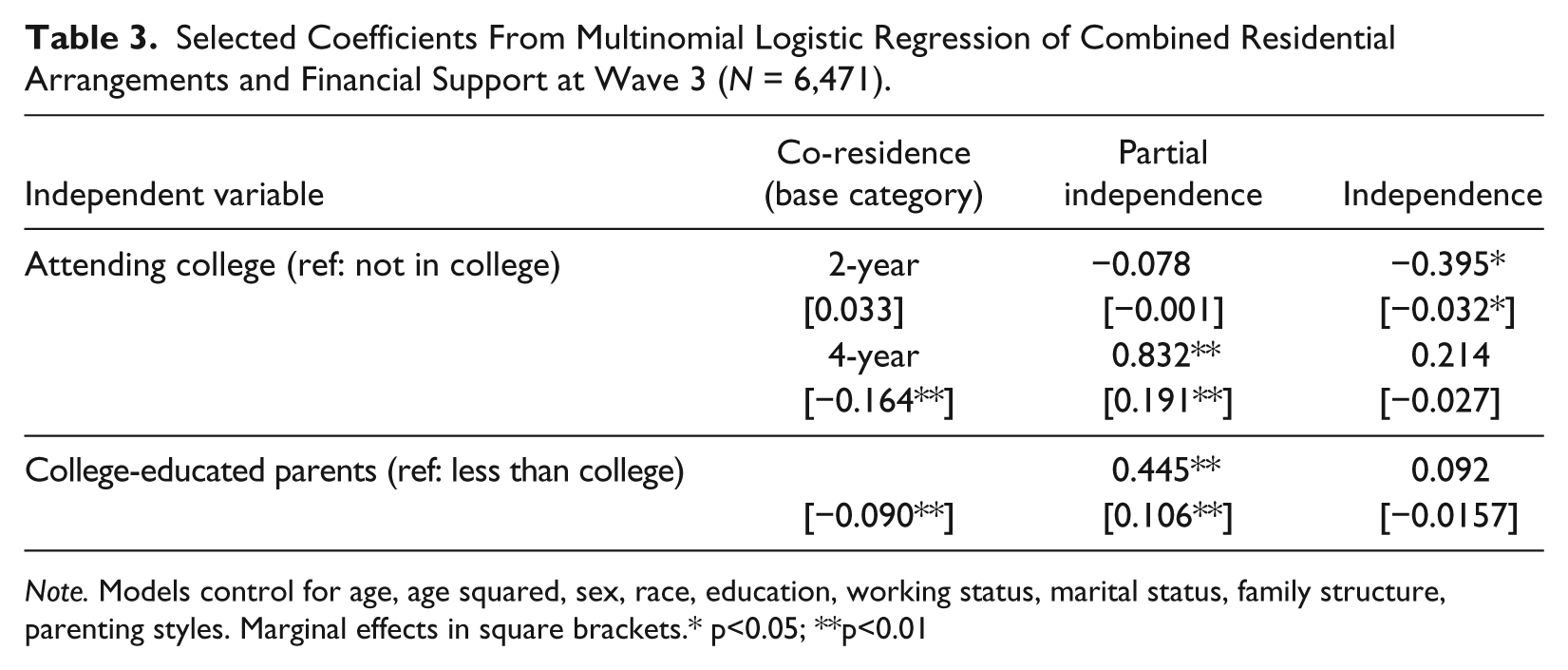
Table 3 shows selected results from multinomial logistic regression models estimating the likelihood of a state at Wave 3, controlling for sociodemographic and family-related factors. 10 I present coefficient estimates and also interpret results using marginal effects (at the means), which provide a good approximation of the amount of change in the dependent variable produced by a change in an independent variable (Williams 2012). Although I control for a number of sociodemographic and family-related characteristics, the interpretation will focus on the effect of type of college attended and family SES. Descriptive statistics for all the control variables and full results for the regression model are provided as an online supplement.
Selected Coefficients From Multinomial Logistic Regression of Combined Residential Arrangements and Financial Support at Wave 3 (N = 6,471).
Note. Models control for age, age squared, sex, race, education, working status, marital status, family structure, parenting styles. Marginal effects in square brackets.* p<0.05; **p<0.01
Attending a two-year college is associated with lower odds of independence compared with the odds of co-residence. In contrast, attending a four-year college or university is associated with higher odds of partial independence compared with co-residence. The marginal effects indicate that those attending a two-year college at Wave 3 have 3.2 percent lower probability of being independent compared with those not in college. Those attending a four-year institution have 16 percent lower probability of co-residence and 19 percent higher probability of partial independence compared with those not attending college. These findings corroborate H2A.
Having college-educated parents increases the odds of being in the state of partial independence rather than in the co-residence category, controlling for other factors. The marginal effects indicate that the probability of being partially independent is 11 percent higher for youths with college-educated parents compared with youths whose parents do not hold college degrees, which supports H2B. The probability of co-residence is 9 percent lower for those with college-educated parents. Coefficients do not show a significant effect of high SES background on independence.
Youths’ Transitions Across States: Markov Models
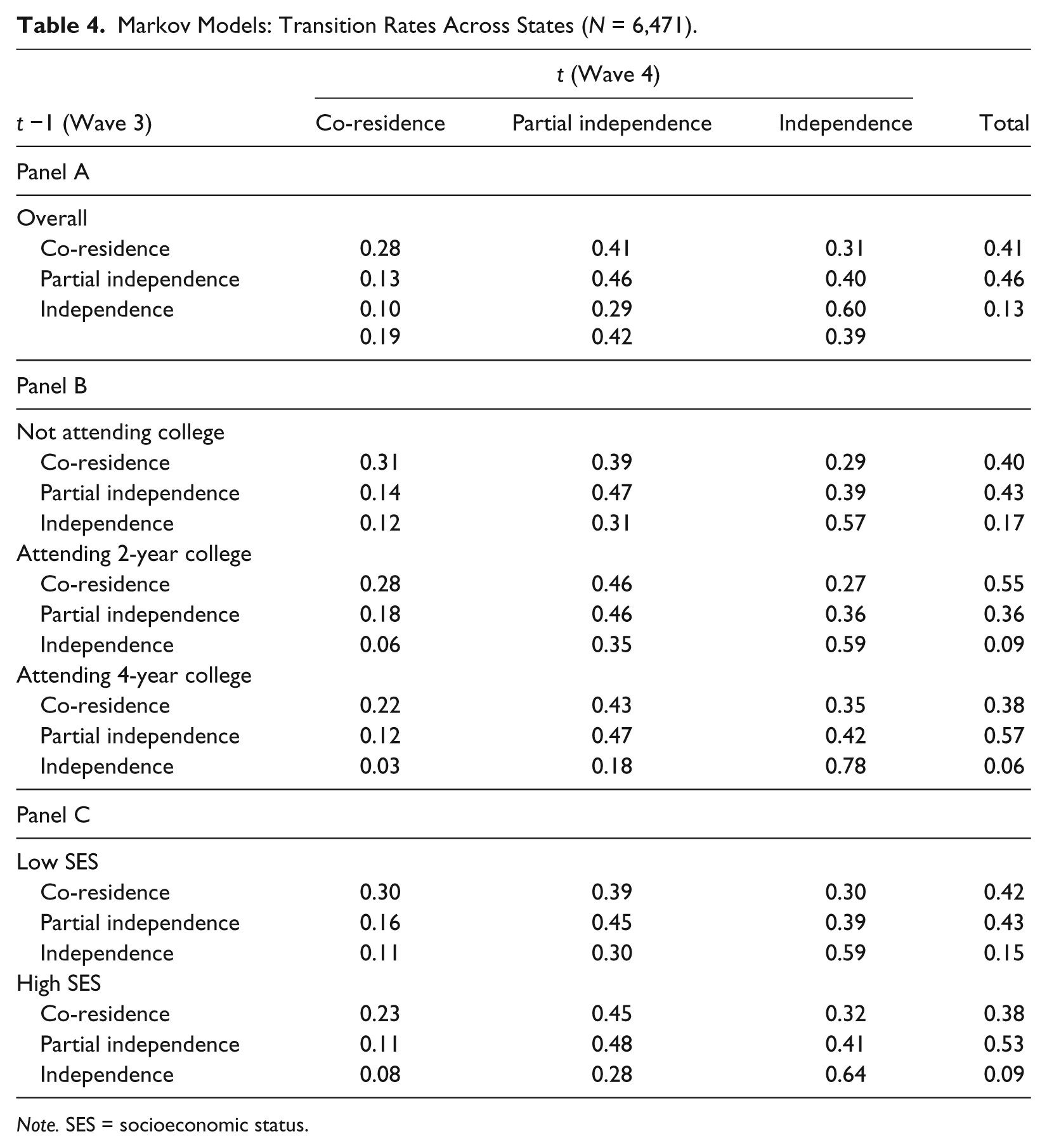
Table 4 (Panel A) illustrates the transition probabilities across the three states between the first and the second wave, as estimated in a baseline transition model without covariates. Respondents may be in the same state or move to a different state across the two time points. As the off-diagonal percentages show, almost 60 percent 11 of the respondents in the sample experience a transition between the two interviews. More than 70 percent of the respondents initially observed living with their parents move out of the parental home by the following interview, which supports H3A; however, only about 30 percent move to the independence category (i.e., independent living without financial support), while the remaining 41 percent move out but continue to receive support from their parents in the form of financial transfers. Among those first observed to be out of the parental home although not financially independent, about 13 percent move back to their parents’ houses, whereas about 40 percent transition to independence by the following interview. The remainder (46 percent) stay in the state of partial independence. These results contradict H3B and suggest that partial independence may be acting more as a stumbling block than a stepping stone to independence. Among those initially observed in the independence category, the majority (more than 60 percent) stay in this state, which corroborates H3C. Only about 10 percent move back in with their parents; however, almost 30 percent remain out of the parental home but receive monetary support from their parents. As 13 percent of those who were partially independent (6 percent of the total) and 10 percent of those who were independent (1 percent of the total) go back with their parents, these results suggest that receiving financial support exposes youth to higher risk of losing residential independence, while the lack of monetary transfers provides stronger protection from subsequent co-residence. However, partial independence is more likely to lead to independence than to co-residence, indicating that support without direct supervision could in some cases serve as a stepping stone from co-residence to independence.
Markov Models: Transition Rates Across States (N = 6,471).
Note. SES = socioeconomic status.
To investigate whether patterns differ depending on whether respondents attended college and which type, Panel B in Table 4 shows the transition rates for those who were attending a two-year college, those who were attending a four-year college, and those who were not attending college at t −1. These transition rates are derived from a Markov transition model assuming an effect of (type of) college attendance on the transitions across states. Results show that those not attending college at the first wave are the least likely to move out of their parents’ home by the second wave, which, in line with H4A, suggests that college facilitates moving out of the parental home. However, differences exist among college attendees: among youths living with their parents at the first wave, only 22 percent of those attending a four-year institution are still in the parental home by the second wave, compared with 28 percent of youth attending a two-year college and 31 percent of youths not attending college. The share of youths who move from co-residence to independence is the highest for those attending a four-year institution (35 percent) and the lowest for those attending a two-year college (27 percent). Transitions from partial independence to independence are the highest among youth attending a four-year college (42 percent) and the lowest among those attending a two-year institution (36 percent), who also have the most transitions back to co-residence (18 percent). However, among youths initially observed in partial independence, the majority remain in this state, with no significant differences between the three groups.
These findings indicate that although college may facilitate moves out of the parental home, it may not facilitate moving to independence when youths attend away from home and are benefiting from parental financial support. Among those initially observed living independently and without financial support, all youths are most likely to remain independent, although the effect is much stronger for those who were initially attending a four-year institution (78 percent) compared with those who were attending a two-year college (59 percent) or were not attending college (57 percent). Significant differences between those attending a four-year institution and those not attending college indicate that attendance of a four-year institution may offer a further protection from a loss of independence. The difference in the transitions back to co-residence out of partial independence versus out of independence suggests that when residential independence during college is attained with parental financial support, the effect of college attendance discouraging a subsequent return to the parental home fades away.
Table 4 (Panel C) shows the transition rates for youth from high and low socioeconomic backgrounds, which result from a Markov transition model assuming an effect of family SES on the transitions across states. In line with H4B, findings show that youths with college-educated parents are less likely than those whose parents do not hold college degrees to remain living with them (23 percent for those from high SES vs. 30 percent for those from low SES families) and have instead higher probabilities of moving from co-residence to partial independence (45 percent vs. 39 percent). Youth with college-educated parents are also more likely to remain living independently while receiving financial support from their parents, which further corroborates H4B. However, youth from high SES backgrounds are significantly more likely to remain independent and less likely to move from independence to co-residence or partial independence.
Discussion and Conclusion
Demographic trends associated with the second demographic transition (Lesthaeghe 2010; van de Kaa 2001), including educational expansion, changes in family formation, and career patterns, have raised awareness of the blurring boundaries between different stages in young people’s lives (Cordon 1997). This has spurred interest in exploring how they transition to adulthood. This article investigated the transition out of the parental home as one of the first and main markers of the transition to adulthood.
Whereas demographic changes, hard economic times, worsening employment prospects, and declining wages have been recognized as some of the factors determining breaking away from the parental nest, assumptions about parents’ support to their young adult children have also been changing significantly (Dey and Morris 1999). Parenthood is increasingly defined as a lifelong relationship that gives rise to unconditional parental obligations, and young adult children have relatively high expectations of parental support (Goldscheider, Thornton, and Yang 2001). Parents are regarded as having continued obligations toward their children, and young adults are nowadays receiving substantial financial assistance from their parents. Yet, to date, attention to intergenerational transfers in the context of the transition to adulthood has been scarce. This study addressed this gap by examining moves in and out of the parental home conditional on parental financial support. This is particularly relevant in the current context, characterized by high parental support, for parents’ monetary transfers to their young adult children may not only facilitate establishing residential independence but also affect the extent to which youth depend on their parents.
Distinguishing independent living situations based on whether youth receive financial support from their parents contributes to providing a more accurate picture of youths’ transition to adulthood. However, moving beyond a static view and investigating youths’ transitions across states may provide additional insight into the permanent or transient character of such arrangements. Exploiting the longitudinal nature of Add Health data, which provide information about inter-individual differences in intra-individual change (Miller 1998), this article also investigated the extent to which youth move across different states, further contributing to our understanding of young adults’ lives.
Findings from regression analysis revealed that partial independence—that is, not living with parents but receiving financial assistance from them—is a highly prevalent state among young people. The likelihood of youth being in such state was also found to be positively associated with (four-year) college attendance and higher socioeconomic background. Results from transition models revealed that while the majority of youth experienced transitions across states over the observation period, about a quarter of those transitions indicate partial or full loss of independence. Furthermore, findings showed high persistence in partial independence. Although this holds for all youths, other differences emerge when looking at patterns by (type of) college attended and socioeconomic background, leading to mixed evidence for the role of partial independence as a stepping stone or a stumbling block to achieving full independence traditionally associated with adulthood. College attendance was found to be positively associated with transitions out of the parental home, especially in cases of attendance of a four-year institution, although youths in college were not found to be significantly more likely than youths not in college to transition out of the parental home without financial support. Among youths initially observed living independently but receiving financial support from their parents, those attending a four-year college or university were found more likely to move to independent living without financial support when compared with youth not attending college; however, youth attending a two-year college did not have this advantage compared with youth not attending college. Four-year college attendees were found more likely to remain independent after achieving such status compared with those not attending college, while that was not the case for those who attended a two-year college.
Overall, results suggest difficulty in achieving full independence and caution us regarding problematic transitions and prolonged permanence in partial independence. Findings also point to inequities across youths and suggest that while college attendance encourages independence, parents financially supporting their young adult children’s independent living during college may generate situations not leading to a progression to financial independence. Furthermore, advantageous effects in terms of achievement of independence only seem to hold for those attending four-year institutions.
Looking at transitions by socioeconomic background, I showed that youth from high SES families are less likely to stay in the parental home compared with youth from low SES backgrounds, although those who moved out were more likely to do so with financial support from their parents. Youth with college-educated parents were also more likely to remain out of the parental home once they moved out. This suggests that going it alone may lead to greater dependence in the future for youth from lower socioeconomic backgrounds; however, youth from higher SES backgrounds who moved to partial independence were more likely to remain in such state, which may point to their prolonged dependence. It is important to note that findings about differences by SES are not simply the outcome of the intergenerational transmission of education (Black and Devereux 2011) and of the different likelihood of youth from different socioeconomic backgrounds to go to college; instead, results suggest that class background differences hold independent of educational achievement.
We should interpret these results with caution. Because between five and eight years passed between the two observations (at Waves 3 and 4), drawing causal conclusions might be unwarranted. Furthermore, youths may differ in ways that are not observed. Therefore, results should be viewed descriptively. Another data limitation relates to the indicator for financial transfers, which does not distinguish among different types of financial assistance and does not specify its amount. Parents may provide support to different extents and to cover different sorts of expenses, which may include rent or mortgage, vehicle, college tuition, bills, personal loans, and/or daily expenses. It may be that the association between financial support and living arrangements differs depending on the type of assistance provided; for example, money provided to cover college tuition may be differently associated with living arrangements and transitions across states compared with money provided to cover daily expenses, or to pay for housing. While analyses by type of college attended may indirectly reflect the specific effect of financial support provided to assist with tuition costs, I am unable to directly capture such differences. As a consequence, results mainly reflect the effects of the predominant type of transfer. If parents provide transfers for several purposes and the effects of these transfers vary, results may mask differences and be biased. In addition, parents may provide a wealth of other forms of assistance, such as information, networking, and emotional support.
Implications and Future Research
Investigating patterns of young adults’ living arrangements in association with parental financial assistance also has policy implications, given the link with housing, employment, and education, among other institutions. This research should warn against focusing exclusively on residential arrangements in designing policy supporting young people and invites us to also consider youths’ financial links to their families. As one of the mechanisms through which families pass on advantages to their children is the transfer of resources, this study also informs the discussion about the reproduction of social inequality. The growing dependence of young adult children on their parents’ ability to subsidize their college, housing, low-paying jobs, and so on, and the inability of some parents to provide this kind of support may reproduce and even exacerbate social inequality. However, although the availability of parental resources may afford youth from different backgrounds different experiences during their transition to adulthood, programs supporting youth may harmonize their experiences. The recent proposal by President Obama in his January 20, 2015 State of the Union address to make community college free, as part of the American Graduation Initiative (White House 2009), could be a first step in addressing the enormous degree of economic stratification in higher education. Reducing economic segregation in college may fulfill the promise of higher education as the engine of social mobility. Less financial stress may reduce the need for students to work when in college, decrease time to degree, and enhance success in and post-college, which also has the potential to alter the findings about a differential effect of attending a two-year rather than a four-year institution.
This research has contributed to the literature on the transition to adulthood and parental support, highlighting the interplay between intergenerational support and living arrangements. Findings stimulate additional questions that go beyond the scope of this article but suggest avenues for future research. For example, do different forms of parental support to their young adult children hinder or facilitate their transition to adulthood? On one hand, parental support, through co-residence or financial transfers, may relax liquidity constraints and encourage the accumulation of more human capital; on the other hand, financial support may negatively impact young adults’ assumption of responsibilities, and leaving the parental home “too early” has negative impacts on later income (Billari and Tabellini 2010). Additional concerns relate to the effect of co-residence on fertility patterns as well as to the possible damage to a country’s economic performance, as countries with a smaller fraction of young men living with their parents grow faster (Billari and Tabellini 2010). The unavailability of parental support may instead unduly constrain young people’s choices and consequently limit their successful completion of life-course transitions; as the unavailability of parental support may be more of a concern for some groups than for others, this may also aggravate inequality. Last, financial assistance is a two-way street. Youth may, for example, support their aging parents. Although this goes beyond the scope of this article, I encourage future research investigating intergenerational transfers from young adults to their parents and the extent to which parents may benefit from co-residence.
Footnotes
Appendix
Given 1 < yt < K, the multinomial logistic equation for model probabilities reads:
Under the identifying restrictions γ11=γ22=γ33=γ44=0 (see Magidson, Vermunt, and Tran 2007), the logit parameters can be written as:
Declaration of Conflicting Interests
The author(s) declared no potential conflicts of interest with respect to the research, authorship, and/or publication of this article.
Funding
The author(s) received no financial support for the research, authorship, and/or publication of this article.
